


Un ingeniero está revisando el historial de mantenimiento de un transformador elevador de 50 MVA que ha estado en operación durante 14 años. El transformador no ha enfrentado ninguna falla importante hasta ahora, pero el último análisis de aceite muestra un aumento en los niveles de hidrógeno y se deben tomar algunas muestras de aceite de OLTC. Los ingenieros han fijado el presupuesto anual para el mantenimiento del transformador y el transformador está a punto de ser utilizado en la próxima parada, que es de suma importancia para el proceso. En realidad, está claro que las tareas deben ser priorizadas en función de la eficiencia de cada tarea de acuerdo con el momento en que la tarea debe ser realizada y cómo cada tarea debe ser analizada por su efectividad.
Este artículo destaca los aspectos más importantes del proceso de mantenimiento de transformadores de potencia que están ocultos en manuales extensos, a saber, qué tareas deben realizarse realmente para garantizar la fiabilidad del equipo, qué significan los resultados de la inspección para el mantenimiento del transformador y qué tareas se pueden o no se pueden realizar.
Respuesta Rápida: El mantenimiento del transformador de potencia puede salvaguardar el equipo mediante: gestión de aceite, pruebas eléctricas, mantenimiento de accesorios y documentación. Los parámetros en el núcleo de la gestión incluyen: la temperatura del aceite de 75 – 85°C mientras trabaja bajo la carga nominal, humedad del aceite por debajo de 20 – 30 ppm, voltaje de ruptura superior a 30 – 40 kV, y el TDCG menor de 720 ppm de acuerdo con IEEE C57.104. Los costos anuales de mantenimiento alcanzan $1,500–$5,000 por sitio.
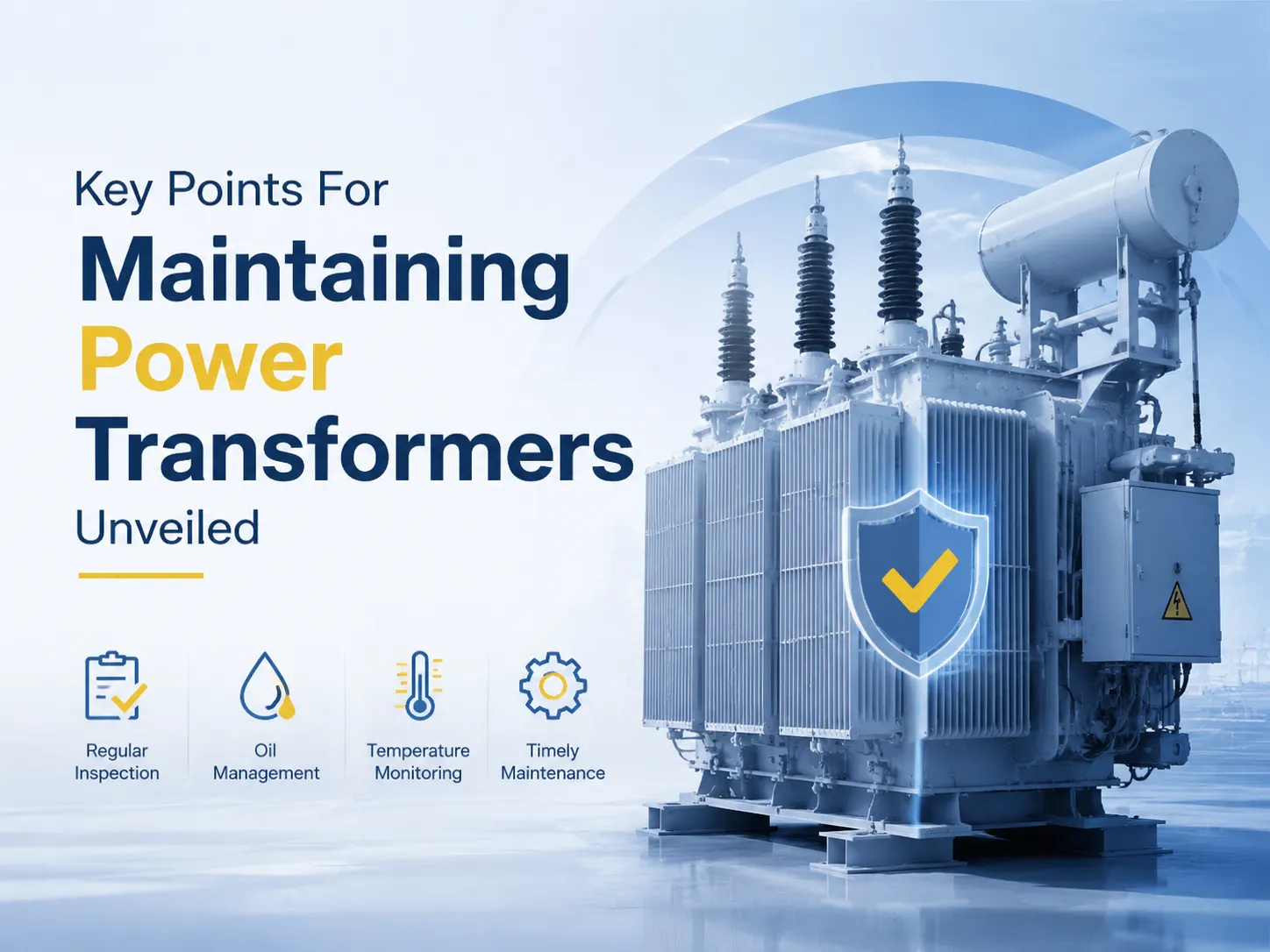
Por qué el Mantenimiento del Transformador de Potencia es No Negociable
El transformador de potencia es, a la vez, el equipo más costoso, de mayor duración y menos redundante que se encuentra en muchas estaciones de energía eléctrica. Si surge un problema con un transformador, la producción se detendrá, la planta se desconectará y tomará algunos meses obtener un reemplazo de manera urgente. Según los datos de fiabilidad proporcionados por los grupos de trabajo de IEEE y CIGRÉ, los fallos de aislamiento, los cambiadores de tomas y las roturas de bujes son las principales fuentes de mal funcionamiento de los transformadores; estos componentes pueden ser identificados durante procedimientos de mantenimiento adecuadamente designados que previenen que la falla real ocurra.
La justificación económica es bastante simple. Por ejemplo, un transformador de potencia de 50MVA cuesta $250,000 y puede costar hasta $1.2 millones; al mismo tiempo, su costo de mantenimiento anual es de $1,500 a $5,000, lo que representa solo un pequeño porcentaje del costo del equipo. Además, se sabe que las paradas no planificadas cuestan al menos $50,000 y pueden alcanzar $2 millones, dependiendo de la carga perdida y su duración. Por lo tanto, es seguro decir que es prudente asumir el costo del mantenimiento, ya que es el más rentable en términos de la magnitud de las posibles pérdidas.
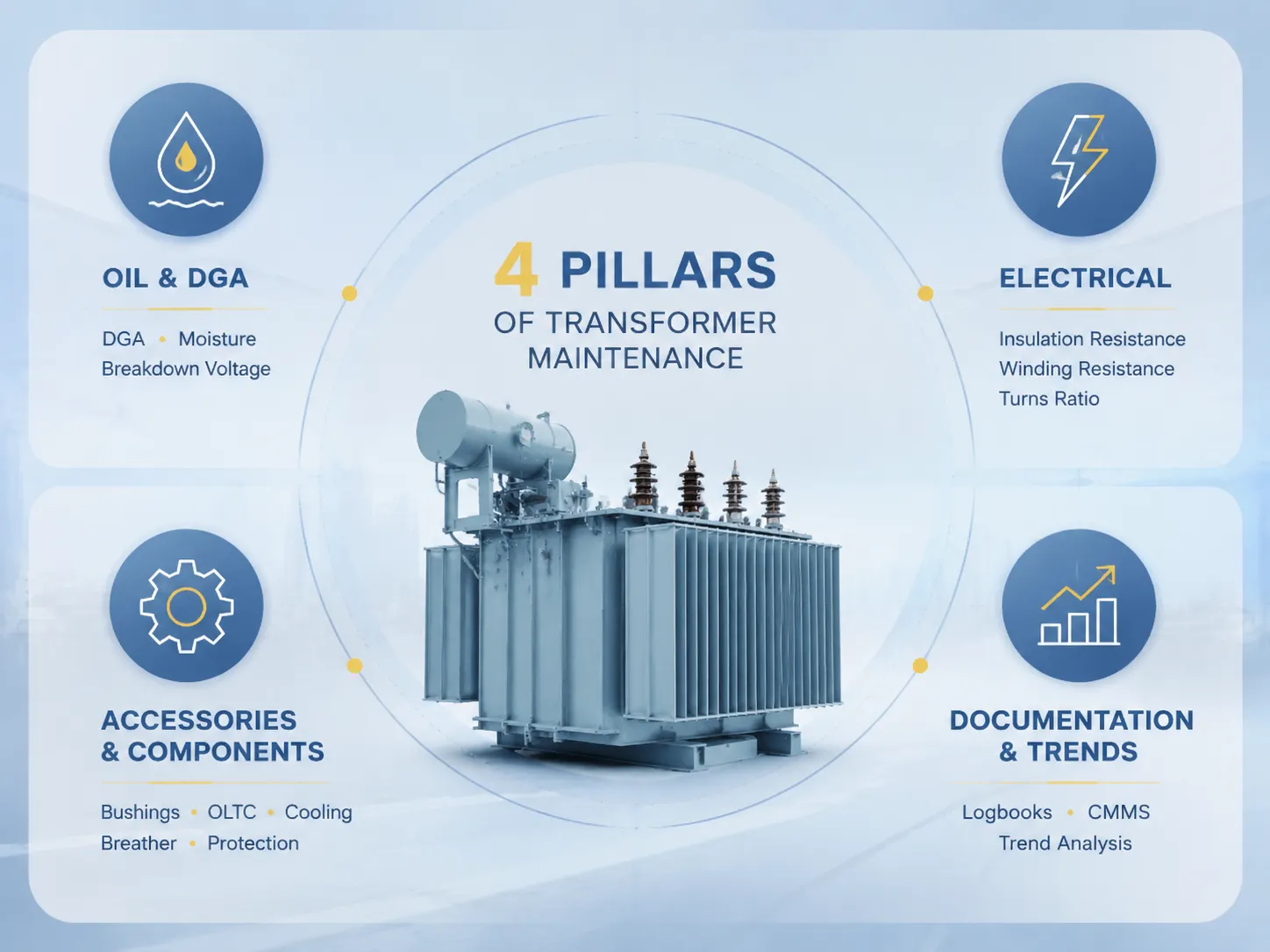
Los Cuatro Pilares del Mantenimiento del Transformador de Potencia
En lo que respecta al mantenimiento de transformadores enfriados por aceite, se encuentra bajo una de las cuatro áreas, que asegura que nada quede sin atender y que nada se haga en exceso.
| Pilar | Lo que Cubre | Prueba / Tarea Principal | Capturas |
|---|---|---|---|
| Gestión de aceite y DGA | Condición del aceite aislante y gases disueltos | DGA, humedad, voltaje de ruptura, acidez | Fallos térmicos, arco, entrada de humedad, contaminación |
| Pruebas eléctricas | Integridad de bobinas y aislamiento | Resistencia de aislamiento, relación, resistencia de bobinado, corriente de magnetización | Daño en el bobinado, degradación del aislamiento |
| Cuidado de accesorios y componentes | Aisladores, respiraderos, cambiadores de toma, refrigeración, protección | Inspección visual, prueba de aceite OLTC, verificación de respiraderos, prueba de ventilador | Desgaste mecánico, humedad, fallo de refrigeración |
| Documentación y tendencias | Historia, puntuación de condición, clasificación de riesgo | Libros de registro, CMMS, análisis de tendencias | Fallos de desarrollo lento que se pierden en lecturas únicas |
Pilar 1: Gestión de Aceite y DGA
El aceite actúa como el aislamiento y refrigerante en el transformador y como una herramienta de diagnóstico para identificar los fallos dentro del equipo. El análisis de gases disueltos representa la prueba más completa que revela toda la información requerida. Los fallos descomponen el aislamiento de papel y aceite en gases específicos disueltos en el aceite, como hidrógeno, metano, etano, etileno, acetileno, CO y CO2. La interpretación de los gases utilizando IEEE C57.104 e IEC 60599 indica el tipo y nivel del fallo.
Valores importantes de gestión de aceite en transformadores de potencia:
| Parámetro | Normal | Advertencia | Acción |
|---|---|---|---|
| Voltaje de ruptura del aceite | > 40–60 kV | 30–40 kV | < 30 kV: filtrar o reemplazar aceite |
| Humedad del aceite | < 15–20 ppm | 20–30 ppm | > 30–40 ppm: secar y encontrar fuente de entrada |
| Gas combustible total disuelto | < 720 ppm | 720–1,920 ppm | > 1,920 ppm: investigar; > 4,630 ppm: retirar de servicio |
| Acidez | Baja (número de neutralización < 0.1–0.15 mg KOH/g) | Tendencia en aumento | Alta: reacondicionar aceite |
| Contenido de furanos | Bajo | Aumento | Alto: envejecimiento del papel confirmado, plan de fin de vida |
El mantenimiento programado práctico para transformadores de potencia incluye un DGA anual y uno semestral para unidades críticas o después de un evento de falla. Dado que el aceite del compartimento OLTC envejece más rápido, su aceite se prueba cada 6-12 meses. Siempre recoja la muestra de la misma válvula a una carga definida y anote la temperatura del aceite.
Pilar 2: Pruebas eléctricas
Las pruebas eléctricas asisten a las pruebas de aceite en la inspección de los devanados y el aislamiento directamente:
- Resistencia de aislamiento (megger): se evalúa entre el devanado y tierra y entre los devanados. La resistencia de aislamiento del devanado de alta tensión normal debe mostrar entre 1000 y 5000 MΩ o incluso más; la comparación a lo largo de los años es de mayor importancia que los números en absoluto. Si los números comienzan a bajar, hay presencia de humedad o contaminación.
- Resistencia de devanado: se mide fase por fase y se compara; cualquier variación por encima del 2-3 por ciento indica una falla ya sea en una conexión o en un devanado.
- Relación de transformación: es una prueba de relación de devanado que confirma los resultados con la placa de identificación; una desviación por encima del 0.5-1 por ciento indica cortocircuitos en los devanados.
- Corriente de magnetización: un aumento en esta corriente puede indicar un cortocircuito o daño en el núcleo.
Estas pruebas normalmente cuestan entre $300 y $1,500 por unidad por inspección y se realizan una vez al año o después de algún incidente grave, como un cortocircuito o un rayo. Cuando se combinan con DGA, pueden ayudar a determinar el problema: DGA nos informa que hay una falla, mientras que las pruebas indican la ubicación.
Pilar 3: Cuidado de accesorios y componentes
Se sabe que los accesorios fallan más que el transformador principal y las fallas se pueden evitar porque son predecibles. La siguiente tabla muestra las tareas necesarias que deben realizarse y los costos asociados con la reparación:
| Accesorio | Inspección | Intervalo | Costo típico |
|---|---|---|---|
| Aisladores | Grietas, rastreo, filtración de aceite; PD/tan-delta para unidades críticas | Visual diario; PD cada 3-6 años | $3,000–$30,000 por fase para reemplazar |
| Deshidratador | Color del gel de sílice; regenerar cuando esté rosa | Verificación diaria | $50–$300 |
| OLTC | Muestra de aceite, motor de accionamiento, contactos | Aceite 6-12 meses; revisión 3-6 años | $5,000–$40,000 por revisión |
| Ventiladores / bombas de refrigeración | Operación, flujo de aire, aletas del radiador | Prueba mensual | $300–$5,000 por componente |
| Dispositivos de protección | Circuitos de disparo de Buchholz y válvula de alivio | Durante cortes programados | $200–$1,000 |
- Aisladores: verificar daños, grietas y fugas de aceite y asegurar que las unidades dañadas sean reemplazadas rápidamente. La falla de un aislador puede destruir transformadores y los costos de reemplazo varían de $3,000 a $30,000. Las pruebas de PD y tan-delta se pueden realizar cada 3-6 años para aisladores importantes.
- Deshidratador y conservador: el gel de sílice siempre debe ser azul; si es rosa, debe ser regenerado o reemplazado. Cuando un deshidratador está saturado, permite que el aire húmedo penetre en el aceite, lo que causa una degradación lenta del aislamiento.
- Cambiador de tomas: para unidades OLTC, el aceite OLTC debe ser muestreado regularmente; la operación de cambio de toma debe ser verificada y la corriente del motor comprobada cada 3-6 años. Los costos de mantenimiento de OLTC oscilan entre $5,000 y $40,000 por un ciclo de reparación, pero evitan fallas mayores.
- Sistema de refrigeración: los ventiladores, bombas y termostatos deben ser probados; las aletas del radiador limpiadas y el flujo de aceite monitoreado para detectar fallas.
- Dispositivos de protección: el relé Buchholz, dispositivos de protección de presión y circuitos de disparo deben ser probados durante reparaciones regulares.
Pilar 4: Documentación y Seguimiento de Tendencias
Los datos relacionados con el mantenimiento son increíblemente valiosos, mientras que la documentación proporciona apoyo a otros componentes esenciales del sistema. Un concepto clave aquí es la práctica de mantener un historial para cada unidad del sistema, que contenga resultados de pruebas de puesta en marcha, rendimiento y análisis de DGA, pruebas eléctricas, incidentes de sobrecarga, reparaciones y alarmas. Este historial permite tres cosas: descubrir patrones (por ejemplo, una concentración de gas aumentó de 40 a 120 ppm en 24 meses), establecer las condiciones (ordenar las unidades por prioridades presupuestarias) y probar la existencia de acuerdos de garantía y seguros.
La mayoría de los procedimientos de mantenimiento hoy en día están automatizados por sistemas modernos de gestión de activos. Lo mínimo que se debe hacer es mantener un libro de registro de todas las métricas útiles: todas las lecturas, fechas de eventos y acciones del personal de mantenimiento. Aquellas empresas que mantienen los datos obtienen ventajas a partir de ello al conseguir dinero para justificar sus presupuestos, ayudar a las autoridades de regulación de auditoría y acelerar la investigación de la causa raíz de cualquier problema.
El Programa de Mantenimiento: Tareas y Frecuencias
El programa a continuación contiene un punto de referencia útil para transformadores de potencia. Puede ser modificado según la urgencia, edad y estado del transformador.
| Frecuencia | Tarea | Costo típico |
|---|---|---|
| Diario | Ronda visual: nivel de aceite, sonido, temperatura, bushings, fugas | $300–$1,500/año mano de obra |
| Trimestral | Resistencia de aislamiento, verificación visual/funcional de OLTC, prueba de ventilador | $200–$800 |
| Semestral | DGA para unidades críticas, muestra de aceite OLTC | $200–$500 por muestra |
| Anual | DGA completo, paquete de calidad de aceite, resistencia de devanado, relación, megger | $800–$2,500 |
| Cada 3–6 años | Revisión de OLTC, PD/tan-delta de bushings, prueba de protección, inspección exhaustiva | $5,000–$40,000 |
| Cada 10–15 años | Revisión mayor, filtración/reemplazo de aceite, renovación de juntas | $10,000–$60,000 |
Como regla general, se debe realizar un DGA en cualquier momento y después de cualquier incidente inusual. En caso de que ocurra tal evento, el DGA debe hacerse de inmediato.
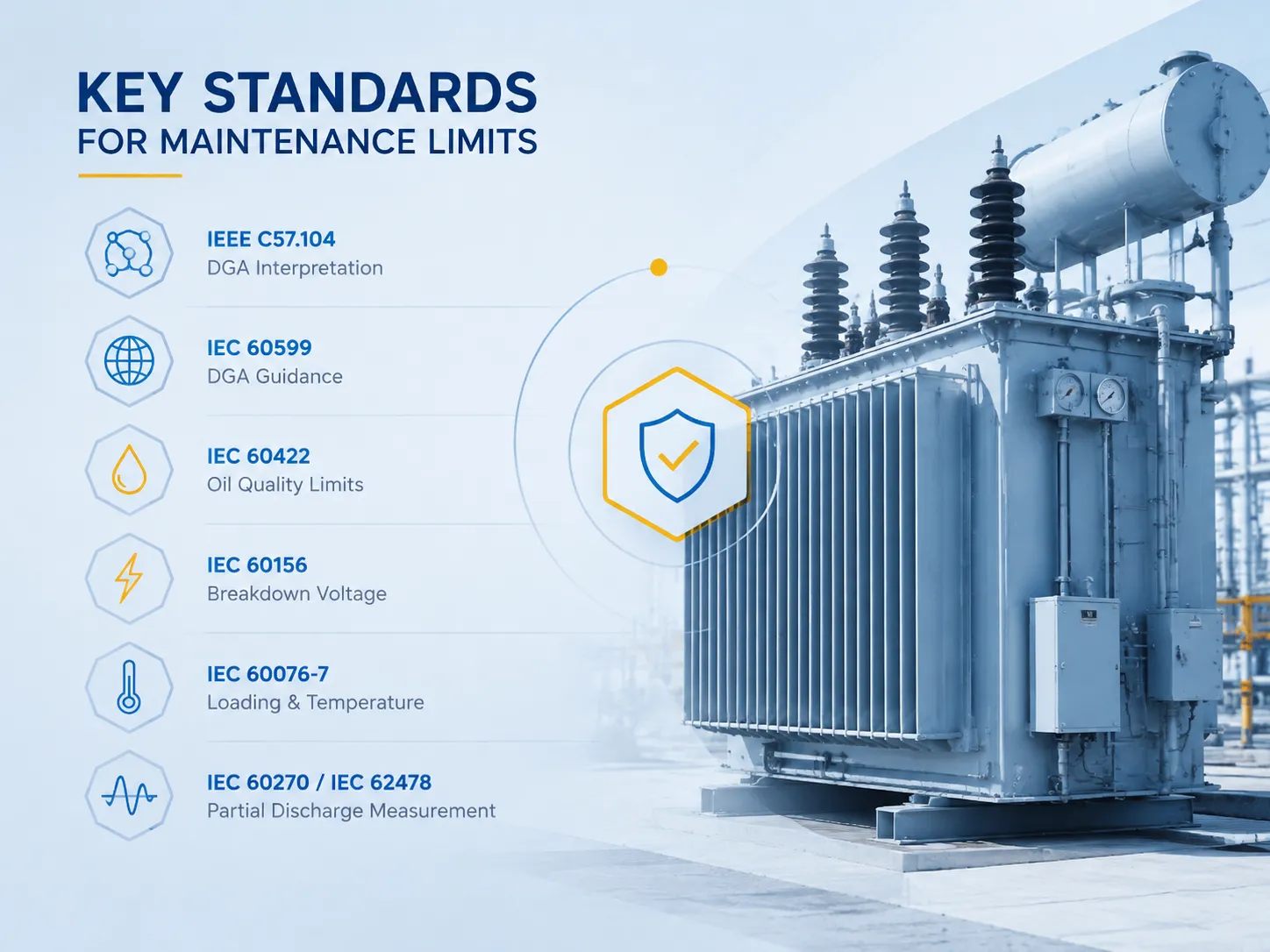
Normas clave para los límites de mantenimiento
Las decisiones sobre trabajos de mantenimiento deben basarse en las normas vigentes y no en rumores. A continuación se presenta la lista de referencias obligatorias en este campo:
- IEEE C57.104 – la interpretación de la descarga parcial y su evaluación para diagnósticos basados en aceite.
- IEC 60599 – una guía internacional para el análisis de DGA de equipos antiguos.
- IEC 60422 – control y servicio de aceites aislantes minerales con indicadores de calidad.
- IEC 60156 – método de prueba para fallos dieléctricos.
- IEC 60076-7 – recomendación sobre límites de carga y temperatura de transformadores.
- IEC 60270 / IEC 62478 – métodos de medición de descarga parcial en diagnósticos modernos.
Si las instrucciones del fabricante de un equipo específico proponen límites más estrictos o específicos, se deben cumplir.
Presupuestación del mantenimiento: Costo vs. Riesgo de falla
Los presupuestos de mantenimiento deben asignarse según el riesgo y no basarse en la experiencia o hábitos. Algunos principios son:
| Artículo | Valor Típico |
|---|---|
| Programa de mantenimiento anual (por transformador de potencia) | $1,500–$5,000 |
| Muestra de DGA | $200–$500 |
| Paquete de calidad de aceite | $150–$400 |
| Suite de monitoreo en línea (unidades críticas) | $25,000–$120,000 capital |
| Reemplazo de transformador (20–60 MVA) | $250,000–$1.2 millones |
| Costo de interrupción no planificada | $50,000–$2 millones por evento |
| Vida útil esperada con mantenimiento adecuado | 30–40 años |
Todo se reduce a matemáticas: una muestra de DGA de $400 por año de un activo de $500,000 del cual estás obteniendo más de 30 años de servicio es la inversión menos costosa que haces. El mismo razonamiento se aplica a extender las inspecciones para unidades en buen estado y a aumentar la frecuencia de inspección para unidades más riesgosas.
Herramientas de mantenimiento modernas: Monitoreo y análisis
El monitoreo y el análisis están revolucionando la disciplina del mantenimiento. Con monitores de DGA en línea, sensores de descarga parcial y rastreadores de temperatura/carga en su lugar, se dispone de datos continuos para unidades críticas, gracias a plataformas de análisis que transforman los datos en alarmas serias. La economía exige una combinación de métodos: monitores en línea para las pocas unidades críticas que causarían una falla catastrófica si ocurriera una, y el habitual DGA de laboratorio anual para la mayor parte. El umbral basado en normas no cambia, la única diferencia es que los sistemas de monitoreo en línea detectan la falla que ocurre entre las lecturas de muestreo.
Sin embargo, la interpretación experta sigue siendo esencial. Los datos pueden llevar a la fatiga de alarmas o a fallas pasadas por alto.
Preguntas Frecuentes
¿Con qué frecuencia debe mantenerse un transformador de potencia?
Los principios básicos detrás del mantenimiento de transformadores de potencia incluyen vigilancia visual recurrente en dos niveles, verificaciones eléctricas que ocurren trimestralmente y DGA más pruebas de calidad del aceite anualmente. Las pruebas de DGA semestrales pueden realizarse para los dispositivos más críticos, mientras que el monitoreo en línea también es aplicable; el aceite del OLTC se prueba casi una vez al año; las reparaciones mayores se realizan una vez cada cinco a diez años. En caso de cualquier anormalidad, se debe realizar primero una prueba inmediata.
¿Cuáles son las pruebas de mantenimiento más importantes para un transformador de potencia?
El análisis de gases disueltos se considera la prueba única más útil, porque permite detectar problemas térmicos y eléctricos antes de la catástrofe. Generalmente se utiliza junto con pruebas de humedad y voltaje de ruptura, pruebas de resistencia de devanados y pruebas de aislamiento, lo que hace un total de cinco pruebas que cubren la mayoría de los indicadores de deterioro.
¿Cuánto cuesta el mantenimiento de un transformador de potencia por año?
Cuesta alrededor de 1.500-5.000 dólares cada año implementar el programa totalmente basado en condiciones para transformadores de potencia, incluyendo vigilancia diaria, DGA realizada anualmente (costo de 200-500 dólares), calidad del aceite (150-400 dólares) y pruebas eléctricas (300-1.500). También se deben considerar los costos de reparaciones mayores, que requieren de 5.000-60.000 dólares una vez cada cinco o diez años.
¿Cuál es la vida útil normal de un transformador de potencia mantenido?
Con una gestión disciplinada del aceite, un monitoreo DGA adecuado y pruebas eléctricas regulares, los transformadores de potencia comúnmente sirven de 30 a 40 años, algunos incluso alcanzan los 50. El envejecimiento del aislamiento sigue una relación exponencial con la temperatura: cada 6-8 K de temperatura estable por encima del diseño duplica el envejecimiento del aislamiento, lo que convierte la carga disciplinada en una herramienta de mantenimiento.
¿Puede el mantenimiento predictivo prevenir todas las fallas de transformadores?
No, el mantenimiento predictivo ayuda a detectar y prevenir fallas graduales (debido a aislamiento, humedad, fracturas, contaminación del aceite) que representan derrotas continuas. Sin embargo, la explosión de bujes, descargas y cortocircuitos externos no pueden preverse.
Referencias
- IEEE C57.104: Guía para la Interpretación de Gases Generados en Transformadores Sumergidos en Aceite — La referencia para los umbrales de DGA y los niveles de respuesta de mantenimiento.
- IEC 60422: Supervisión y Guía de Mantenimiento para Aceites Aislantes Minerales — Límites de calidad del aceite y práctica de mantenimiento para transformadores en servicio.
- IEC 60599: Guía para la Interpretación de DGA en Equipos Impregnados con Aceite Mineral — Marco internacional para la interpretación de gases en equipos envejecidos.
- IEC 60156: Líquidos Aislantes — Determinación de la Tensión de Ruptura — Norma de prueba para la resistencia dieléctrica del aceite.
- IEC 60076-7: Guía de Carga para Transformadores de Potencia Sumergidos en Aceite — Límites de temperatura y guía de carga para unidades sumergidas en aceite.
- CIGRÉ — Folletos técnicos sobre mantenimiento de transformadores, confiabilidad y evaluación de condiciones.
- Jiangsu Subian Electric Power — Fabricante de transformadores conforme a IEC 60076 que proporciona documentación de mantenimiento y soporte técnico.
Conclusión
El mantenimiento de transformadores de potencia debe concentrarse en un servicio de calidad en lugar de producción en masa en el sentido tradicional de la palabra. El proceso de mantenimiento del equipo gira en torno a cuatro pilares: gestión del aceite y DGA, inspecciones eléctricas, mantenimiento de soporte y documentación. La implementación del proceso debe asegurar el uso del activo en la máxima medida, siendo el mantenimiento económico.
- Realice pruebas de DGA una vez al año y después de cada situación problemática.
- Realizar pruebas de DGA simultáneamente con pruebas de aceite y eléctricas.
- Mantener la disciplina del cuidado de accesorios: buje aislante, respiradero, OLTC y sistema de refrigeración.
- Documentar y mantener registros.