


Imaginez une installation de traitement industriel située à Zhengzhou qui utilise trois transformateurs de 1 600 kVA fonctionnant à un facteur de charge moyen de 92 pour cent pendant douze heures consécutives. Une perturbation de l'alimentation électrique un mardi après-midi entraîne une baisse de tension dans l'installation pendant 400 millisecondes, avec trois systèmes d'emballage à commande servo s'arrêtant simultanément. La production cesse pendant 47 minutes pendant que les opérateurs d'équipement réactivent les entraînements et les PLC, entraînant une perte de revenus d'environ $18 000, ainsi que la destruction de deux séries de production. L'enquête menée par le superviseur de maintenance confirme les soupçons soulevés autour des transformateurs de puissance qui étaient usés après six ans depuis l'installation.
Associés à l'automatisation industrielle, les transformateurs ne sont pas des pièces d'équipement statiques ; ils remplissent plutôt la fonction de médiateur entre l'alimentation haute tension et l'équipement sensible aux fluctuations de tension. Dans cet article, nous discutons de l'importance majeure des transformateurs dans l'automatisation industrielle — méthodes de dimensionnement et de spécification des transformateurs, contrôle de la qualité de la tension, rentabilité de l'efficacité et façons de choisir des fournisseurs sans trop payer. Notre article contient des exemples, des références à la norme IEC 60076 et IEC 60204, des plages de coûts réels et des conseils d'optimisation.
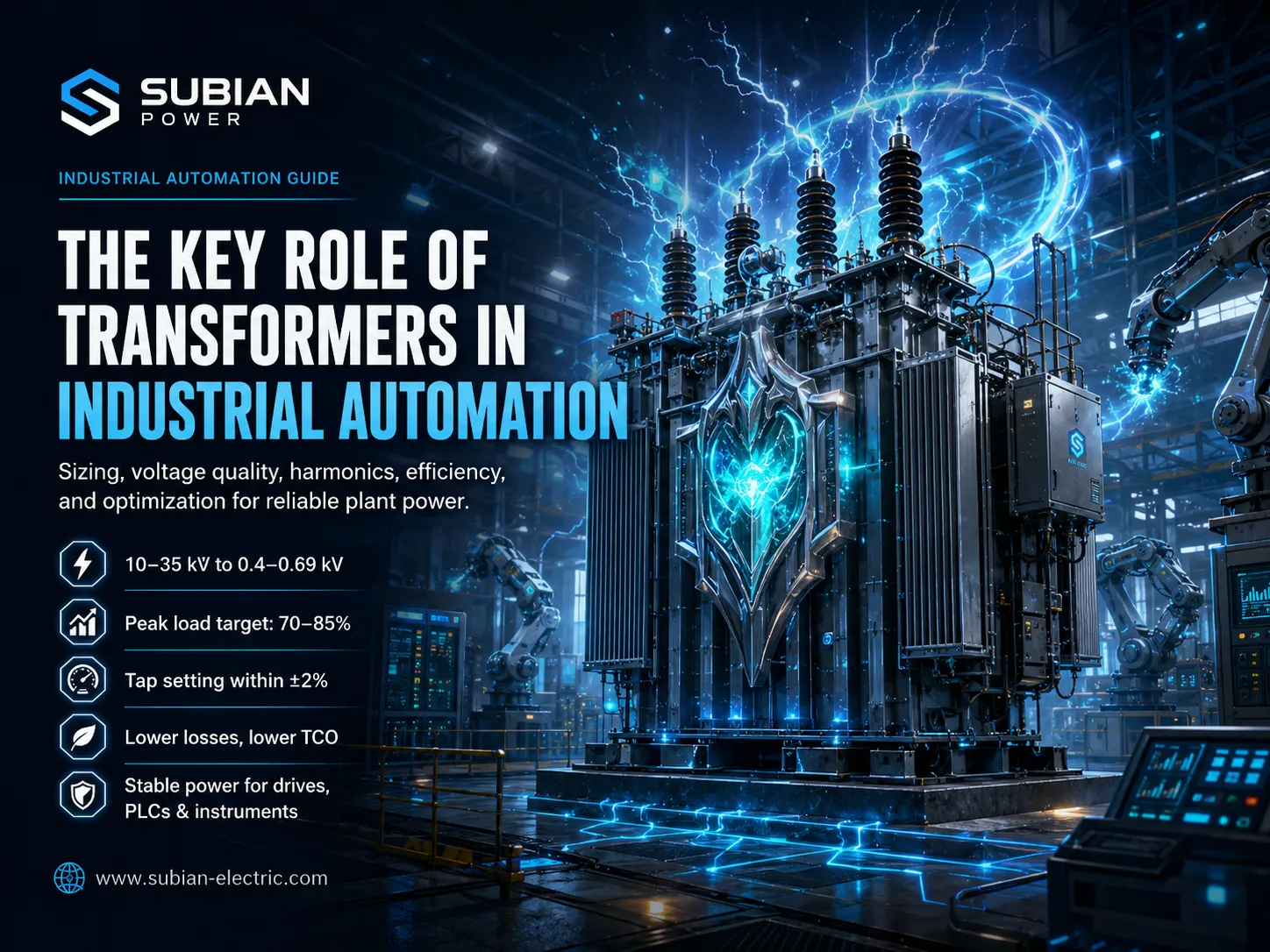
Importance des transformateurs dans l'automatisation industrielle
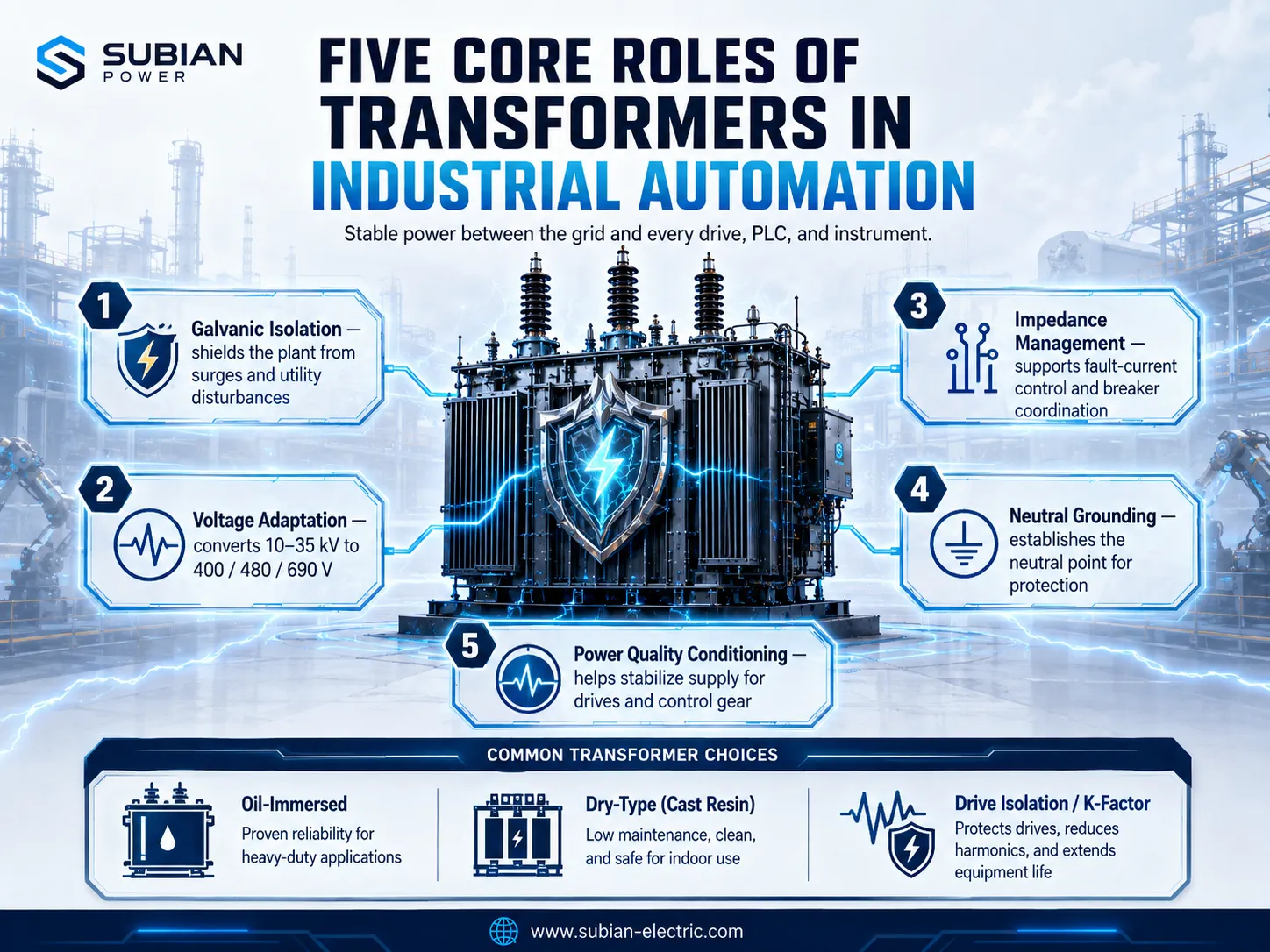
Tout système d'automatisation industrielle contient trois parties : la couche de terrain (capteurs, actionneurs, entraînements), la couche de contrôle (PLC, DCS, HMI) et la couche de puissance, où se trouve le transformateur. Le transformateur accomplit plutôt que de simplement changer les valeurs de tension. Il remplit cinq fonctions différentes :
Séparation galvanique : Elle sépare les sections de processus des perturbations de la ligne électrique telles que les surtensions, les baisses de tension et les transitoires.
Adaptation de la tension : Elle transforme la haute tension (10–35 kV) en basse tension (400 V, 480 V ou 690 V).
Gestion de l'impédance : L'impédance de court-circuit (environ 4–8%) limite le courant de défaut provenant de l'alimentation haute tension, rendant possible la coordination des disjoncteurs.
Mise à la terre neutre : L'enroulement secondaire agit comme neutre et assure le fonctionnement du système de protection.
Contrôle de la qualité de l'énergie : Le transformateur avec sa configuration peut aider à réduire les perturbations harmoniques et à stabiliser la source de tension.
Interruptions de processus liées à la qualité de l'énergie dans les usines automatisées. Un transformateur bien sélectionné avec le bon réglage de prise réduit l'impact des baisses de tension et prévient les déclenchements intempestifs sur les circuits PLC et d'entraînement.
Types de transformateurs utilisés dans les installations industrielles
Toutes les usines n'ont pas besoin du même transformateur. Le tableau ci-dessous résume les types courants et leurs caractéristiques pertinentes pour l'automatisation.
| Taper | Plage de classification | Tension typique | Forces dans l'automatisation | Prix typique (USD) |
|---|---|---|---|---|
| Transformateur de distribution immergé dans l'huile | 50–2 500 kVA | 10–35 kV / 0,4–0,69 kV | Coût le plus bas, robuste, bien compris | $6 000–$38 000 |
| Transformateur de type sec (résine coulée) | 100–4 000 kVA | Jusqu'à 36 kV / 0,4–0,69 kV | Installation intérieure résistante au feu, faible décharge partielle | $12 000–$75 000 |
| Transformateur d'isolement de moteur | 100–2 000 kVA | 4–0.69 kV | Protège les variateurs de fréquence des courants de mode commun et harmoniques | $4 000–$22 000 |
| Transformateur à décalage de phase / zig-zag | 500–5 000 kVA | 6–35 kV | Annulation harmonique pour de grandes banques de convertisseurs | $18 000–$70 000 |
| Transformateur sec à facteur K | 150–1 500 kVA | 48–0.69 kV | Évalué pour des charges non linéaires (moteur) | $10 000–$40 000 |
| Transformateur de puissance (classe sous-station) | 5–60 MVA | 35–110 kV | Grandes usines, cogénération, lignes de liaison | $80 000–$400 000 |
Pour un sol d'usine automatisé typique, le choix pratique se situe entre les unités immergées dans l'huile et les unités sèches. Les transformateurs secs (résine coulée) dominent les installations intérieures car ils sont résistants au feu, ne nécessitent pas de confinement d'huile et peuvent être placés à l'intérieur du bâtiment de production — à un coût supplémentaire d'environ 60–90% par rapport aux unités immergées dans l'huile équivalentes.
Comment dimensionner un transformateur pour une usine d'automatisation
Les erreurs les plus fréquentes lors de l'optimisation des transformateurs sont des erreurs de dimensionnement. Si le transformateur est sous-dimensionné, cela entraîne une surchauffe et une usure prématurée. Les transformateurs surdimensionnés peuvent provoquer des pertes dues à l'absence de charge, ce qui signifie de l'argent gaspillé.
Procédure de dimensionnement du transformateur :
Mesure de la demande. Assurez-vous d'enregistrer la demande maximale sur une période de 1 mois à l'aide du système de mesure de l'usine. Ne dimensionnez pas en fonction des informations de la plaque signalétique ; la majorité des usines n'utilisent que 40–70% de la capacité de la plaque signalétique.
Critères de diversité de charge. Multipliez les capacités de l'entraînement, du PLC et de l'utilitaire par un certain facteur de demande (environ 0,65-0,85, plutôt que 1,0).
Règle de marge. Sélectionnez la capacité nominale la plus grande suivante afin que la demande de pointe du système soit de 70%-85% de la capacité du transformateur.
Plans futurs. Si une deuxième ligne de production est prévue dans les 3 ans, la capacité actuelle du transformateur doit être dimensionnée à 120-130%.
De plus, il convient de prêter attention aux courants de démarrage. Les gros moteurs consomment entre 6 et 8 fois plus que leur valeur nominale au démarrage, et le transformateur doit être capable de réduire la chute de tension.
Qualité de la tension : prises, régulation et facteur de puissance
L'un des aspects les plus vitaux est la qualité de la tension d'entrée aux bornes des entraînements. Bien que les circuits d'entrée des entraînements et des PLC soient classés pour des variations de niveau de tension de ±10%, en pratique, des déclenchements se produisent même pour des variations de niveau inférieures, car la chute de tension entraîne une distorsion de la forme d'onde. Les trois mesures importantes dans ce contexte peuvent être définies comme suit :
| Mesure | Configuration typique | Effet | Coût |
|---|---|---|---|
| Réglage de prise hors circuit | ±2.5%, ±5% prises sur l'enroulement MV | Optimise la tension en régime permanent pour l'alimentation réelle de l'usine | $0 (inclus) |
| Changeur de prise sous charge (OLTC) | ±8% en 8–16 étapes | Maintient la sortie dans ±1.5% malgré les variations d'alimentation | $6,000–$18,000 ajoutés |
| Correction du facteur de puissance (PFC) | Banques de condensateurs fixes + automatiques | Augmente le FP de 0,80 à 0,95, réduit la pénalité de l'utilitaire | $4,000–$30,000 |
Régler la prise hors circuit sur la tension d'entrée moyenne de l'usine est gratuit et améliore généralement la tension d'entrée de l'entraînement de 2 à 4%. Pour les usines avec une alimentation volatile ou de grandes charges de démarrage de moteurs, un OLTC se rentabilise en 2 à 3 ans en éliminant les pannes d'entraînement et les temps d'arrêt de redémarrage.
Harmoniques et charges non linéaires
Bien que les variateurs de fréquence (VFD) constituent une partie importante de l'automatisation industrielle, ils nécessitent un courant non sinusoïdal entraînant une distorsion harmonique. La norme principale régissant ce domaine est l'IEEE 519 qui recommande une limite de distorsion harmonique de 5% au point de couplage commun. L'optimisation des transformateurs dans ce contexte a trois aspects.
Déclassement de charge. Un transformateur fournissant plus de 30% de charge VFD doit être déclassé ou indiqué comme une unité de transformateur K-factor (K-4 à K-20). Cela est dû à l'effet du courant harmonique sur l'augmentation du chauffage par courants de Foucault.
Sélection d'impédance. Une impédance inférieure de 4-5% réduit la distorsion de tension due aux courants harmoniques mais augmente le courant de court-circuit. Par conséquent, le choix de l'impédance doit être coordonné avec les classifications des disjoncteurs.
Décalage de phase. Pour une installation de convertisseur très grande, par exemple un redresseur à 12 impulsions utilisé pour l'électrolyse ou de gros entraînements, les transformateurs à décalage de phase élimineront les effets des 5ème et 7ème harmoniques à la source.
Dans une usine automatisée commune avec une charge VFD de 30%, les valeurs THD de tension étaient comprises entre 6-12% avant la mitigation, et 2-4% après l'installation d'un réacteur passif ou d'un filtre par groupe d'entraînement 5% d'impédance d'entrée à un prix de $500 à $2000.
Efficacité, Pertes et Optimisation de l'Énergie
Les pertes du transformateur se divisent en pertes à vide (noyau), qui fonctionnent 24 heures sur 24, et pertes de charge, qui augmentent avec le carré du courant. Le tableau montre l'économie pour une unité typique de 1 000 kVA.
| Composant de perte | Valeur Typique (IEC 60076) | Énergie Annuelle (7 200 h de fonctionnement) | Coût Annuel @ $0.09/kWh |
|---|---|---|---|
| Pertes à vide | 6–2.2 kW | 11 500–15 800 kWh | $1 040–$1 420 |
| Pertes de charge (charge pleine) | 9–12 kW | 21,600–28,800 kWh à 50% de charge | $1 940–$2 590 |
| Perte annuelle totale | — | 33 000–44 000 kWh | $2 980–$3 960 |
Les informations ci-dessus conduisent à trois possibilités pour tirer pleinement parti de l'optimisation :
Premièrement, les propriétés du noyau amorphe entraînent une diminution significative des pertes pendant le fonctionnement à vide : 60-75% de baisse, par exemple, de 2.0 kW à entre 0.6 et 0.8 kW pour une unité de 1000 kVA.
Le deuxième point concerne le fait de rendre le transformateur entièrement adapté à un fonctionnement autour de 60-80% du facteur de charge : les pertes à vide sont 4 fois plus importantes que pour le transformateur fonctionnant à 50% de charge, passant de 98.7% à pleine charge à 97.8%.
La troisième suggestion importante est d'utiliser des transformateurs en parallèle en cas de grandes fluctuations de charge et de les éteindre à faibles charges — de cette manière, 15%-30% des pertes de transformateur peuvent être réduites dans des opérations à deux équipes.
Mesures d'Optimisation en Pratique
Au-delà de la sélection du matériel, l'optimisation est une discipline opérationnelle continue. Les mesures que les usines industrielles mettent effectivement en œuvre, par ordre d'impact :
| Mesure | Fréquence | Ce qu'il faut rechercher | Avantage attendu |
|---|---|---|---|
| Imagerie thermique du réservoir et des bushing | Annuellement | Points chauds, connexions lâches | Prévenir 60% des pannes liées aux connexions |
| Analyse d'huile (DGA + humidité) | Tous les 6 à 12 mois | Tendances clés des gaz, teneur en eau > 30 ppm | Détection précoce des défauts 12 à 24 mois à l'avance |
| Enregistrement de la charge et de la qualité de l'énergie | Trimestriel | Demande maximale, THD, déséquilibre de tension | Quantifie la marge de manœuvre et les besoins en filtrage |
| Test de relais de protection | Tous les 1 à 2 ans | Réglages de surintensité et différentiels | Prévenir les pannes en cascade sur les défauts internes |
| Révision de la position de prise | Chaque saison | Tension de sortie vs. point de consigne | Récupère 1–3% de marge de tension |
Pour les installations avec un personnel de maintenance de deux ou trois personnes, le coût annuel réaliste de ce programme est de $800 à $2,500 par transformateur, y compris les frais de laboratoire — faible par rapport au coût de $30,000 à $120,000 d'une panne imprévue plus les pertes de production.
Coûts et coût total de possession
Le prix d'achat ne représente qu'un tiers du coût de vie d'un transformateur. Une analyse complète du coût total de possession (CTP) sur la durée de vie de 20 ans d'un transformateur comprend :
* Dépenses d'investissement : $9,000 à $85,000 selon les spécifications et le type.
* Dépenses de perte : $3,000 à $4,000 par an par 1,000 kVA, normalement 40% à 50% du CTP.
* Maintenance : $800 à $2,500/an incluant DGA, thermographie et tests.
* Risque d'arrêt : le taux de panne annuel attendu multiplié par $30,000 à $120,000 pour chaque panne.
* Valeur résiduelle : 15% à 25% du prix d'achat initial après 20 ans.
Si évalué par cette méthode, la meilleure performance du transformateur à faible perte plus coûteux (classe C ou supérieure selon l'efficacité IEC) est généralement démontrée. Un acheteur récupérera la différence de $5,000 entre un transformateur standard de $24,000 et un transformateur haute efficacité de $29,000 en 3 à 5 ans grâce aux économies de coûts résultant de la réduction des pertes.
Meilleures marques et comparaison des prix
Le marché des transformateurs industriels est servi par un groupe familier de fabricants mondiaux, ainsi que par des fournisseurs chinois établis qui ont obtenu des certifications IEC et internationales. Le tableau donne des prix indicatifs pour un transformateur industriel immergé dans l'huile de 1,000 kVA, 10 kV/0.4 kV ; les prix réels varient selon les spécifications, l'impédance, la classe de perte et la région.
| Marque | Pays | Forces | Prix indicatif (USD) |
|---|---|---|---|
| ABB | Suisse | Intégration complète de l'automatisation, large réseau de services | $16,000 à $28,000 |
| Siemens | Allemagne | Jumeau numérique, options de surveillance SITRAM | $15,000 à $27,000 |
| Schneider Electric | France | Intégration EcoStruxure, robustesse des types secs | $14,000 à $26,000 |
| Hitachi Energy | Japon/Suisse | Héritage des transformateurs de puissance, expertise LTC | $16,000 à $30,000 |
| Eaton | États-Unis | Fort portefeuille de distribution et de types secs | $13,000 à $25,000 |
| Jiangsu Subian Electric Power | Chine | Conforme à la norme IEC 60076, OEM/ODM, prix compétitifs | $9,000 à $18,000 |
Les entreprises internationales offrent des solutions numériques matures, une assistance technique locale et des pratiques éprouvées dans des milliers d'installations, et, pour un transformateur unique critique pour la mission dans une installation de premier plan, les coûts supplémentaires peuvent être rentables. Pour les usines de production achetant des transformateurs en série — un fabricant alimentaire équipant cinq usines et une entreprise de l'industrie automobile de niveau 1 ajoutant trois usines — Jiangsu Subian Electric Power concurrence avec des transformateurs vérifiés selon la norme IEC 60076 avec des unités immergées dans l'huile et des unités de type sec pour environ 45-60% du prix d'équipements similaires en Europe et aux États-Unis. En utilisant l'expérience des opérations internationales et la flexibilité OEM/ODM, Subian permet aux ingénieurs des usines de personnaliser les transformateurs selon la classe de pertes requise, le point de prélèvement, l'impédance et le système de surveillance, ce qui prouve le choix approprié du transformateur.
Comment choisir et optimiser : Une liste de contrôle
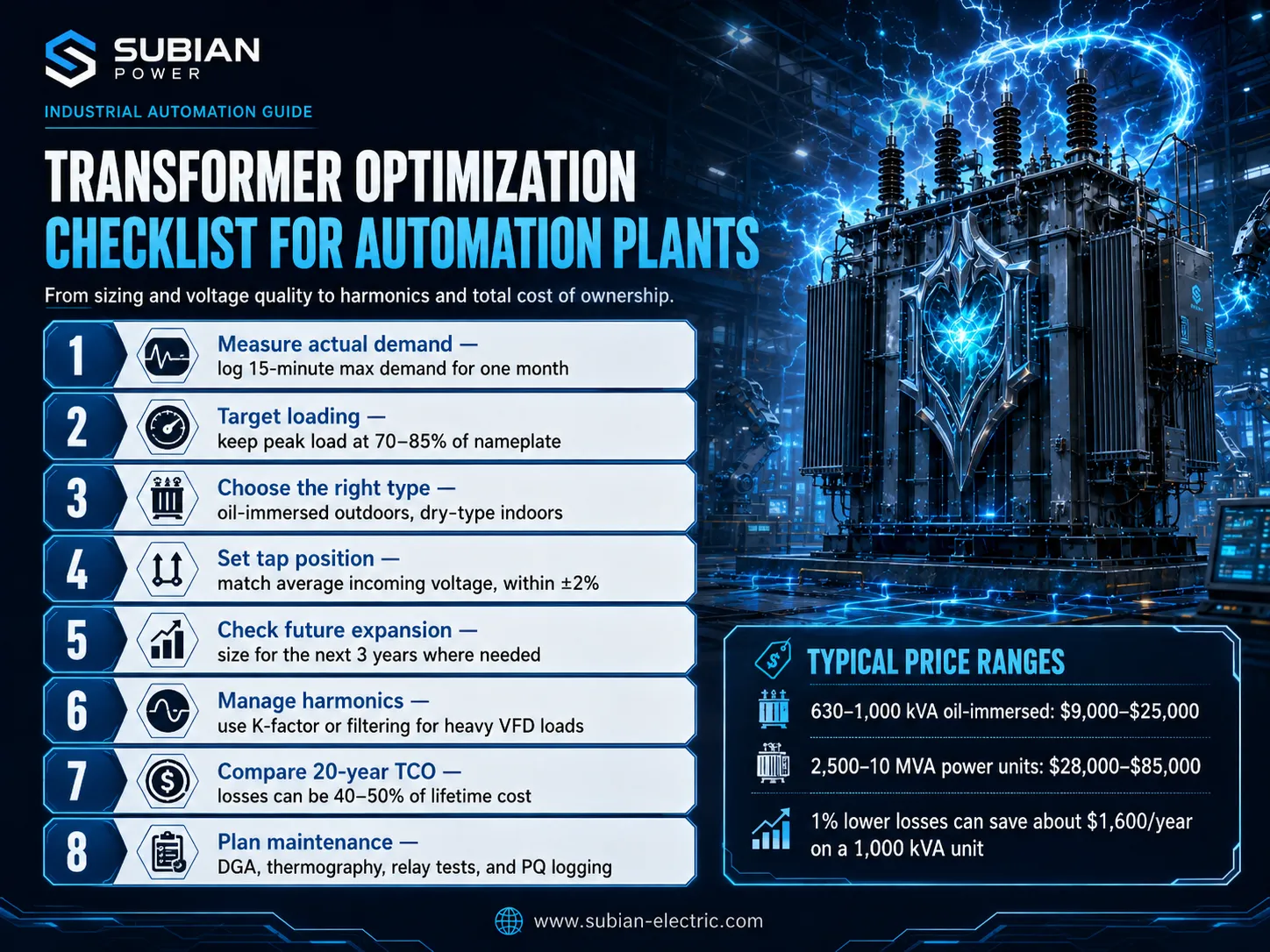
- Enregistrer la demande de 15 minutes pendant un mois ; dimensionner pour que la demande de pointe soit de 70–85% de la puissance nominale.
- Choisir immergé dans l'huile pour l'extérieur/coût faible, de type sec pour les zones sensibles au feu à l'intérieur.
- Spécifier la classe de pertes selon IEC 60076-1 et comparer le TCO sur 20 ans, pas le prix d'achat.
- Régler le point de prélèvement hors circuit pour correspondre à la tension moyenne entrante réelle.
- Ajoutez un OLTC ou un régulateur de tension uniquement là où la volatilité de l'alimentation ou le démarrage du moteur est significatif.
- Réduisez ou spécifiez le facteur K pour les installations avec plus de 30% de charge VFD ; vérifiez le THD par rapport à l'IEEE 519.
- Planifiez le commutateur d'unités parallèles où la charge varie largement entre les quarts.
- Contractez pour un enregistrement de la qualité de l'alimentation trimestriel et un DGA annuel dès le premier jour.
- Exigez le certificat de test IEC 60076 avec l'appel d'offres et comparez au moins trois marques — y compris des fournisseurs chinois certifiés IEC — avant d'attribuer.
Questions Fréquemment Posées
Comment déterminer la bonne puissance kVA pour mon usine ?
Enregistrez la demande maximale réelle sur 15 minutes pendant un mois complet, multipliez par un facteur de demande de 0,65 à 0,85 pour les charges d'automatisation, et choisissez la puissance standard au-dessus de cette valeur afin que la charge de pointe se situe entre 70 et 85% de la plaque signalétique. Une installation avec une pointe mesurée de 720 kVA devrait sélectionner une unité de 1 000 kVA — la marge absorbe l'inrush du variateur et les ajouts de ligne prévus.
Quel est le retour sur investissement pour le remplacement d'un ancien transformateur inefficace ?
Remplacer une unité de 1 000 kVA des années 1980 (perte à vide ~3,5 kW) par une unité moderne (perte à vide ~1,8 kW) permet d'économiser environ 12 000 kWh/an, soit $1 100 à $0,09/kWh. En incluant les différences de perte de charge et la réduction de la maintenance, le retour sur investissement est généralement de 5 à 8 ans — ou de 2 à 4 ans si l'ancienne unité présente également des anomalies DGA ou des problèmes thermiques.
Dois-je acheter un transformateur immergé dans l'huile ou un transformateur à sec pour mon usine ?
Lors de l'installation d'un transformateur à l'intérieur, il est fortement recommandé d'opter pour des transformateurs à sec (résine coulée), car ils sont ignifuges et ne nécessitent pas de confinement d'huile compliqué ni de barrières anti-incendie ; de plus, un tel transformateur peut être placé à l'intérieur du bâtiment lui-même. Pour les installations extérieures, l'avantage des transformateurs remplis d'huile est qu'ils sont également moins chers (environ 35-45% moins chers) et plus faciles à entretenir. Par exemple, le prix d'un transformateur à sec de 1 000 kVA se situe entre $18 000 et $32 000 par rapport à combien un transformateur à huile peut être produit ($12 000-$22 000).
Comment les harmoniques affectent-elles ma sélection de transformateur ?
Les charges VFD supérieures à environ 30% de capacité de transformateur créent des courants harmoniques qui chauffent les enroulements et provoquent une distorsion de tension. Les options sont : réduire la puissance du transformateur de 10 à 20%, spécifier une unité classée K-factor (K-4 à K-20), ou ajouter des réacteurs/filtres d'entrée aux variateurs. L'IEEE 519 recommande de maintenir le THD de tension en dessous de 5% au point de couplage commun ; un réacteur de $500 à $2 000 par groupe de variateurs atteint généralement cet objectif.
Quel est le coût total d'un transformateur industriel sur sa durée de vie ?
Pour une unité de 1 000 kVA à $15 000 d'achat, un TCO de 20 ans est d'environ $55 000 à $70 000 : 40 à 50% de cela est des pertes électriques ($3 000 à $4 000/an), 10 à 15% est la maintenance ($800 à $2 500/an), et le reste est le capital plus le risque d'arrêt. Une unité de classe C IEC à plus haute efficacité réduit généralement le composant de perte de 15 à 25%.
Références
- IEC 60076 série — Transformateurs de puissance — la norme de base pour le classement, les pertes, l'impédance et les tests de tous les transformateurs industriels discutés ici.
- IEEE 519 — Pratique recommandée pour le contrôle harmonique dans les systèmes électriques — définit les limites de THD utilisées pour les installations dominées par des variateurs.
- IEEE 493 — Pratique recommandée pour la conception de systèmes électriques industriels et commerciaux fiables — source des statistiques d'interruption de chute de tension citées dans cet article.
- NEMA TP-1 et normes NEMA pour les transformateurs de distribution — évaluations d'efficacité et conseils d'application pour les acheteurs industriels nord-américains.
- CIGRE — Conseil international sur les grands systèmes électriques — publie des rapports de groupes de travail sur les statistiques de défaillance des transformateurs et les pratiques de maintenance.
- Directives de sécurité électrique OSHA — contexte réglementaire pour la maintenance des transformateurs et le verrouillage/étiquetage dans les installations industrielles.
- Jiangsu Subian Electric Power — site officiel — fabricant de transformateurs de distribution et de puissance industriels conformes à la norme IEC 60076 avec support OEM/ODM.
Conclusion
Les transformateurs sont l'épine dorsale silencieuse de l'automatisation industrielle : ils isolent, adaptent et stabilisent l'énergie dont dépendent chaque variateur, PLC et instrument. L'optimisation ne concerne pas des équipements exotiques — il s'agit de la bonne dimension (charge de pointe à 70–85% de la plaque signalétique), des bons réglages de prises, du contrôle harmonique pour les charges VFD, et d'acheter sur le coût total de possession sur 20 ans plutôt que sur le premier prix. L'économie est concrète : économies de pertes de $1,000–$4,000/an par unité, optimisation des prises valant 1–3% de marge de tension, et événements d'arrêt évités valant $30,000–$120,000.
Points clés :
- Dimensionnez en fonction de la demande mesurée, pas de la plaque signalétique ; maintenez la charge opérationnelle entre 60–80%.
- Comparez le TCO sur 20 ans — les pertes représentent 40–50% du coût de vie.
- Gérez les harmoniques selon IEEE 519 pour les installations lourdes en variateurs.
- Comparez des marques mondiales telles qu'ABB, Siemens et Schneider avec des fournisseurs certifiés IEC comme Jiangsu Subian Electric Power pour équilibrer qualité et prix.
Appliquez la liste de contrôle ci-dessus à votre prochain projet et réalisez un audit de la qualité de l'énergie sur site avant d'acheter quoi que ce soit — les données vous indiqueront quelle optimisation est la plus rentable en premier. Pour un soutien à la sélection de transformateurs et des devis, visitez www.subian-electric.com.