


Envision an industrial processing facility located in Zhengzhou which uses three 1,600 kVA transformers operating at an average load factor of 92 percent for twelve consecutive hours. A Tuesday afternoon power disturbance on the utility feed results in a voltage decline at the facility for 400 milliseconds, with three servo-controlled packaging systems stopping simultaneously. Production ceases for 47 minutes while equipment operators reactivate drives and PLCs, resulting in approximately $18,000 in revenue loss, along with the destruction of two production runs. The investigation conducted by the maintenance supervisor confirms the suspicions raised around the power transformers that were worn down over six years from the installation.
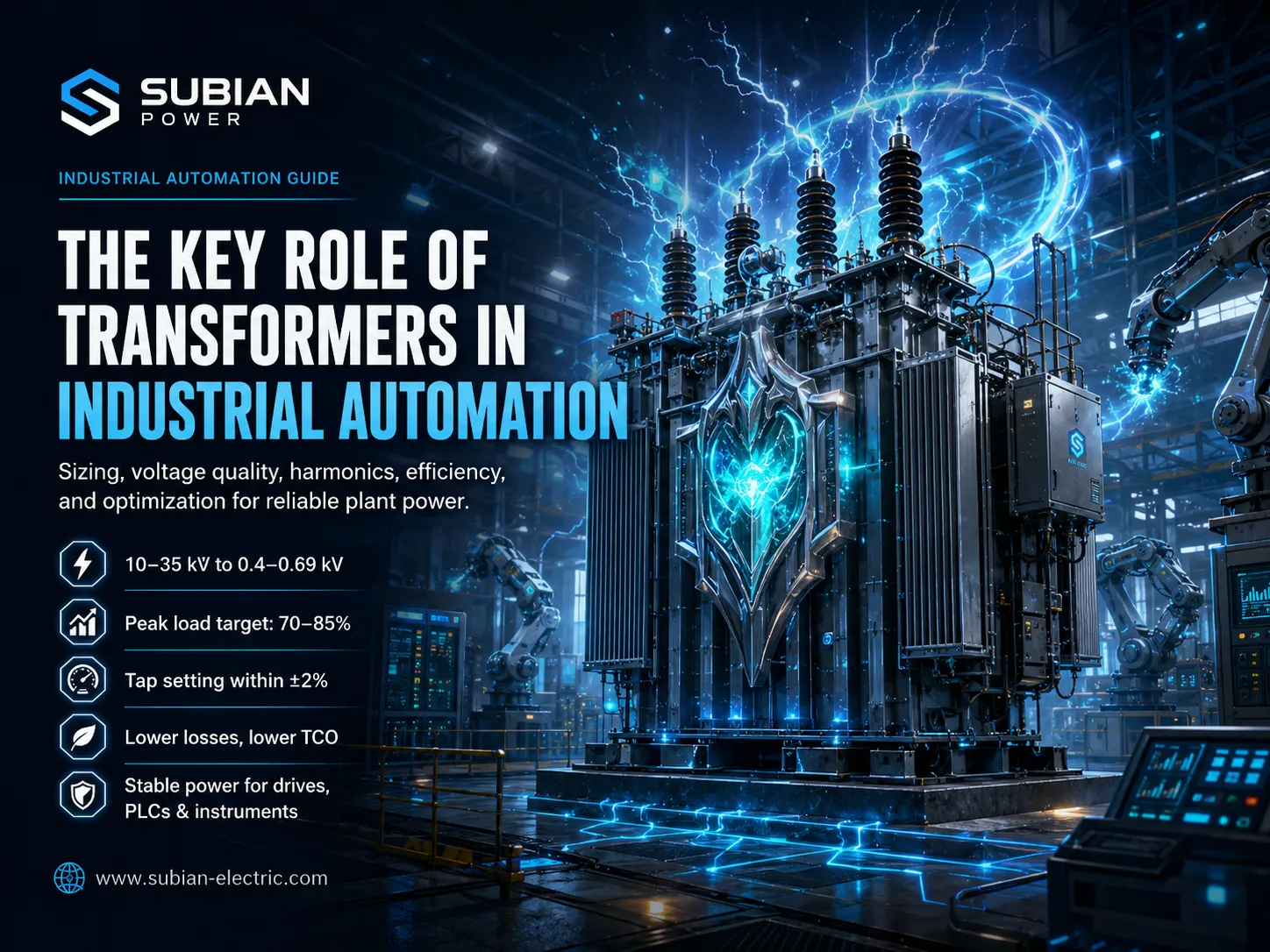
Associated with industial automation, transformers are not static pieces of equipment; rather they perform the function of the mediator between the high voltage supply and the equipment sensitive to voltage fluctuations. In this article, we discuss the major importance of transformers in industrial automation — methods for transformer sizing and specification, control of voltage quality, efficiency cost-effectiveness and the ways to choose suppliers without paying too much. Our article contains examples, references to IEC 60076 and IEC 60204, real cost ranges and optimization tips.
Importance of transformers in industrial automation
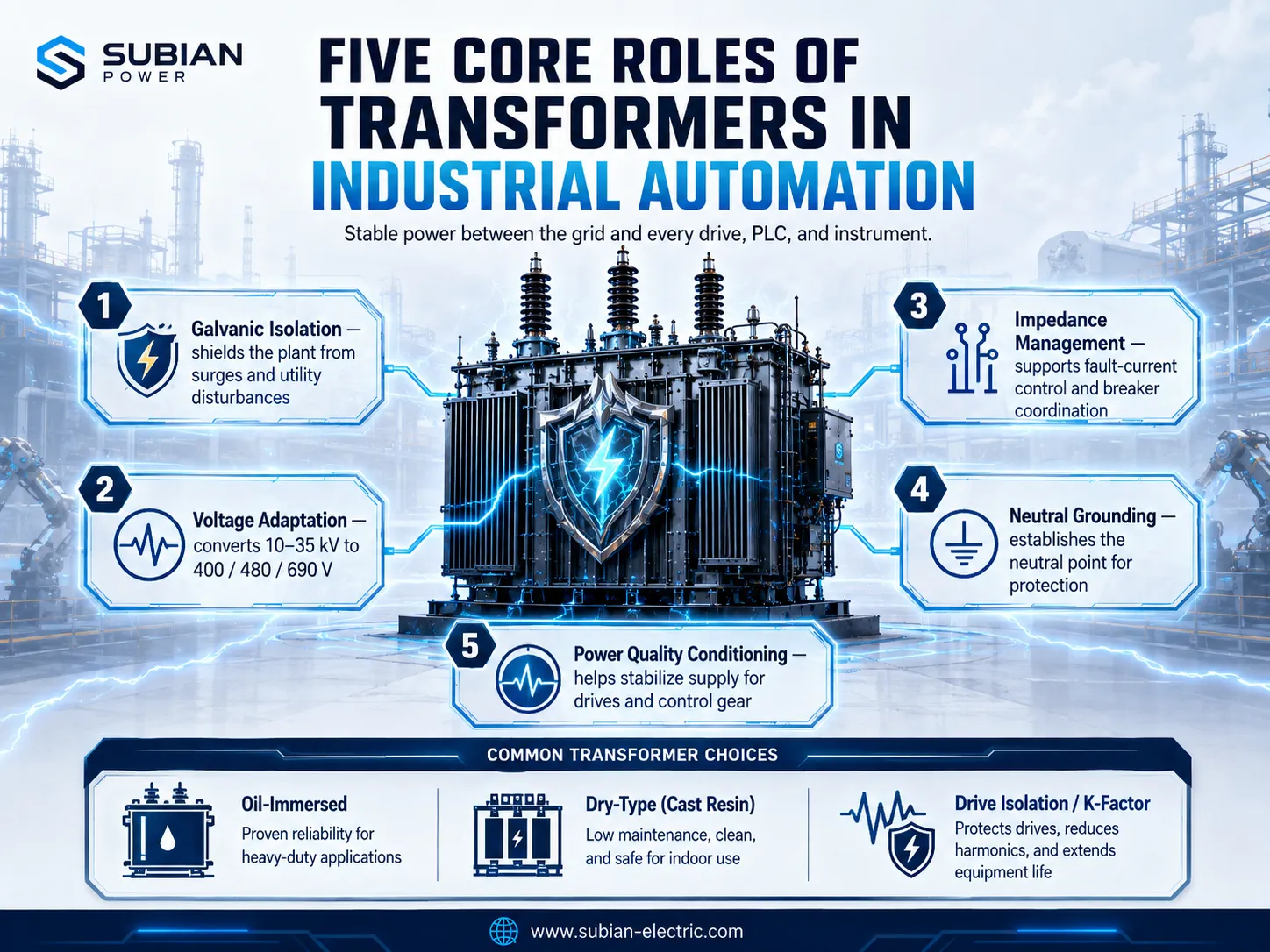
Any industrial automation system contains three parts: the field layer (sensors, actuators, drives), the control layer (PLCs, DCS, HMIs) and the power layer, where the transformer is located. The transformer accomplishes rather than simply changing voltage values. It performs five different functions:
Galvanic separation: It separates process sections from power line disturbances such as surges, voltage sags and transients.
Voltage adaptation: It transforms high voltage (10–35 kV) into low voltage (400 V, 480 V or 690 V).
Impedance management: The short-circuit impedance (approximately 4–8%) limits the fault current coming from the high voltage supply, making it possible to coordinate circuit breakers.
Neutral grounding: The secondary winding acts as neutral and ensures the operation of the protection system.
Power quality control: The transformer with its configuration can help reduce harmonics disturbances and stabilize voltage source.
wer-quality-related process interruptions in automated plants. A well-selected transformer with the correct tap setting reduces sag impact and prevents nuisance trips on PLC and drive circuits.
Transformer Types Used in Industrial Facilities
Not every plant needs the same transformer. The table below summarizes the common types and their automation-relevant characteristics.
| Type | Rating Range | Typical Voltage | Strengths in Automation | Typical Price (USD) |
|---|---|---|---|---|
| Oil-immersed distribution transformer | 50–2,500 kVA | 10–35 kV / 0.4–0.69 kV | Lowest cost, robust, well understood | $6,000–$38,000 |
| Dry-type transformer (cast resin) | 100–4,000 kVA | Up to 36 kV / 0.4–0.69 kV | Fire-safe, indoor installation, low partial discharge | $12,000–$75,000 |
| Drive isolation transformer | 100–2,000 kVA | 0.4–0.69 kV | Shields VFDs from common-mode and harmonic currents | $4,000–$22,000 |
| Phase-shifting / zig-zag transformer | 500–5,000 kVA | 6–35 kV | Harmonic cancellation for large converter banks | $18,000–$70,000 |
| K-factor dry-type transformer | 150–1,500 kVA | 0.48–0.69 kV | Rated for nonlinear (drive) loads | $10,000–$40,000 |
| Power transformer (substation grade) | 5–60 MVA | 35–110 kV | Large plants, cogeneration, tie lines | $80,000–$400,000 |
For a typical automated factory floor, the practical choice is between oil-immersed and dry-type units. Dry-type (cast resin) transformers dominate indoor installations because they are fire-resistant, need no oil containment, and can sit inside the production building — at a price premium of roughly 60–90% over equivalent oil-immersed units.
How to Size a Transformer for an Automation Plant
The most frequent mistakes made during transformer optimization are mistakes in sizing. If the transformer is undersized, overheating and early wear is triggered. Oversized transformers may cause losses caused by having no load, which means money wasted.
Procedure for transformer sizing:
Demand measurement. Make sure to record maximum demand throughout a 1-month period using the plant’s metering system. Do not size based on the nameplate information; the majority of plants only use 40%-70% of the nameplate capacity.
Load diversity criteria. Multiply drive and PLC and utility capacities by a certain demand factor (around 0.65-0.85, rather than 1.0).
Headroom rule. Select the next greatest nominal capacity so that peak demand of the system is 70%-85% of the transformer capacity.
Future plans. If a second production line is expected within 3 years, the current capacity of the transformer should be sized at 120-130%.
Additionally, it is worth paying attention to starting currents. Large motors use between 6 and 8 times more than their rated value at start, and the transformer has to be able to reduce the voltage drop.
Voltage Quality: Taps, Regulation, and Power Factor
One of the most vital aspects is the quality of the voltage input at the terminals of drives. While drives and PLC input circuits are rated for ±10% voltage level changes, in practice, tripping occurs even at lower level changes since voltage sag results in the distortion of the waveform. The three important measures in this context can be defined as follows:
| Measure | Typical Configuration | Effect | Cost |
|---|---|---|---|
| Off-circuit tap adjustment | ±2.5%, ±5% taps on MV winding | Optimizes steady-state voltage for the plant’s actual supply | $0 (included) |
| On-load tap changer (OLTC) | ±8% in 8–16 steps | Holds output within ±1.5% despite supply swings | $6,000–$18,000 added |
| Power factor correction (PFC) | Fixed + automatic capacitor banks | Raises PF from 0.80 to 0.95, cuts utility penalty | $4,000–$30,000 |
Setting the off-circuit tap to the plant’s average incoming voltage is free and typically improves drive input voltage by 2–4%. For plants with volatile supply or large motor starting loads, an OLTC pays for itself within 2–3 years by eliminating drive faults and restart downtime.
Harmonics and Nonlinear Loads
While variable frequency drives (VFDs) form an important part of industrial automation, they demand non-sinusoidal current resulting in harmonic distortion. The main standard governing this area is IEEE 519 which recommends harmonics distortion limit of 5% at common coupling point. Optimization of transformers in this context has three aspects.
Loading derating. A transformer supplying more than 30% VFD load should be derated or indicated as a K-factor transformer unit (K-4 up to K-20). This is due to the effect of harmonic current on increasing eddy current heating.
Impedance selection. A lower impedance of 4-5% reduces voltage distortion from harmonic currents but increases the fault current. Therefore, impedance choice must be coordinated with breakers ratings.
Phase shifting. For very large converter installation for instance a 12-pulse rectifier used for electrolyses or big drives, phase-shifting transformers will eliminate the effects of 5th and 7th harmonics at the source.
In a common automated plant with VFD load of 30% the voltage THD values were between 6-12% before the mitigation, and 2-4% after installing passive reactor or filter per drive group 5% input impedance at a price of $500 to $2000.
Efficiency, Losses, and Energy Optimization
Transformer losses split into no-load (core) losses, which run 24 hours a day, and load losses, which rise with the square of current. The table shows the economics for a typical 1,000 kVA unit.
| Loss Component | Typical Value (IEC 60076) | Annual Energy (7,200 h operation) | Annual Cost @ $0.09/kWh |
|---|---|---|---|
| No-load losses | 1.6–2.2 kW | 11,500–15,800 kWh | $1,040–$1,420 |
| Load losses (full load) | 9–12 kW | 21,600–28,800 kWh at 50% load | $1,940–$2,590 |
| Total annual loss | — | 33,000–44,000 kWh | $2,980–$3,960 |
The information above leads to three possibilities for making great use of optimization:
First, amorphous core properties lead to significant decrease in losses during no-load operation: 60-75% down, for example, from 2.0 kW to between 0.6 and 0.8 kW for 1000 kVA unit.
Second point is about making transformer fully suited for operation around 60-80% of the load factor: no-load losses are 4 times larger than for the transformer operated at 50% of load, going from 98.7% at maximum load to 97.8%.
The third important suggestion is to use parallel transformers in case of wide load fluctuations and switch them off at low loads — this way 15%-30% of transformer losses can be cut in two-shift operations.
Optimization Measures in Practice
Beyond hardware selection, optimization is a continuous operating discipline. The measures that industrial plants actually implement, in order of impact:
| Measure | Frequency | What to Look For | Expected Benefit |
|---|---|---|---|
| Thermal imaging of tank and bushings | Annually | Hot spots, loose connections | Prevents 60% of connection-related failures |
| Oil analysis (DGA + moisture) | Every 6–12 months | Key gas trends, water content > 30 ppm | Early fault detection 12–24 months ahead |
| Load and power-quality logging | Quarterly | Max demand, THD, voltage unbalance | Quantifies headroom and filter needs |
| Protection relay testing | Every 1–2 years | Overcurrent and differential settings | Prevents cascade failures on internal faults |
| Tap position review | Each season | Output voltage vs. setpoint | Recovers 1–3% voltage headroom |
For plants with a maintenance staff of two or three people, the realistic annual cost of this program is $800–$2,500 per transformer including lab fees — small against the $30,000–$120,000 cost of an unplanned failure plus production losses.
Costs and Total Cost of Ownership
The purchase price represents only one-third of the lifetime cost of a transformer. A full total cost of ownership (TCO) analysis over the 20-year life of a transformer includes:
* Capital expense: $9,000–$85,000 depending on the specifications and type.
* Loss expenses: $3,000–$4,000 per year per 1,000 kVA, normally 40% to 50% of TCO.
* Maintenance: $800–$2,500/year inclusive of DGA, thermography and testing.
* Downtime risk: the expected annual failure rate times $30,000–$120,000 for each failure.
* Residual value: 15% to 25% of the initial purchase price after 20 years.
If evaluated by this method, the better performance of the more expensive low-loss transformer (class C or higher based on IEC efficiency) is usually demonstrated. A buyer will recover the $5,000 difference between a $24,000 standard and $29,000 high-efficiency transformer in 3–5 years due to the cost savings from loss reduction.
Top Brands & Price Comparison
The industrial transformer market is served by a familiar group of global manufacturers, plus established Chinese suppliers that have earned IEC and international certifications. The table gives indicative prices for a 1,000 kVA, 10 kV/0.4 kV oil-immersed industrial transformer; actual prices vary with specification, impedance, loss class, and region.
| Brand | Country | Strengths | Indicative Price (USD) |
|---|---|---|---|
| ABB | Switzerland | Full automation integration, wide service network | $16,000–$28,000 |
| Siemens | Germany | Digital twin, SITRAM monitoring options | $15,000–$27,000 |
| Schneider Electric | France | EcoStruxure integration, dry-type strength | $14,000–$26,000 |
| Hitachi Energy | Japan/Switzerland | Large power transformer heritage, LTC expertise | $16,000–$30,000 |
| Eaton | USA | Strong distribution and dry-type portfolio | $13,000–$25,000 |
| Jiangsu Subian Electric Power | China | IEC 60076-compliant, OEM/ODM, competitive pricing | $9,000–$18,000 |
International companies offer matured digital solutions, local engineering assistance, and proven practices in thousands of facilities, and, for a mission-critical single transformer at a leading facility, the extra costs can pay off. For production plants purchasing transformers in series — a food manufacturer outfitting five plants and an auto industry tier-1 company adding three factories — Jiangsu Subian Electric Power competes with the transformers verified according to IEC 60076 standard with oil-immersed and dry-type units for approximately 45-60% of the price of similar equipment from Europe and the USA. Utilizing experience in international operations and OEM/ODM flexibility, Subian allows plants’ engineers to personalize the transformers according to the required losses class, tap, impedance, and monitoring system, which is the proof of the proper transformer selection.
How to Choose and Optimize: A Checklist
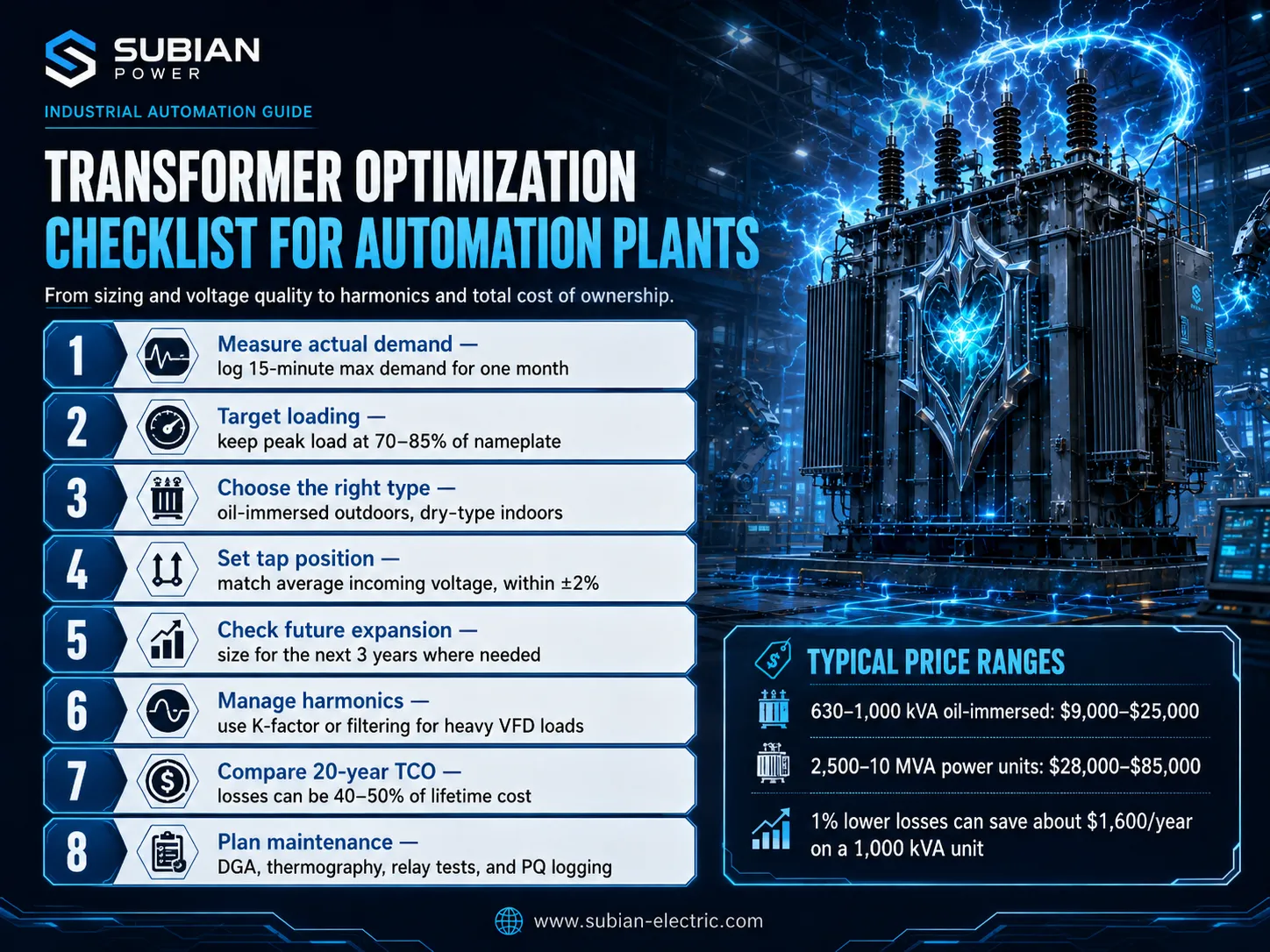
- Log 15-minute demand for one month; size so peak demand is 70–85% of nameplate.
- Choose oil-immersed for outdoor/low-cost, dry-type for indoor fire-sensitive areas.
- Specify loss class to IEC 60076-1 and compare 20-year TCO, not purchase price.
- Set the off-circuit tap to match actual average incoming voltage.
- Add an OLTC or voltage regulator only where supply volatility or motor starting is significant.
- Derate or specify K-factor for plants with more than 30% VFD load; verify THD against IEEE 519.
- Plan parallel-unit switching where load varies widely across shifts.
- Contract for quarterly power-quality logging and annual DGA from day one.
- Require the IEC 60076 test certificate with the tender, and compare at least three brands — including IEC-certified Chinese suppliers — before awarding.
Frequently Asked Questions
How do I determine the right kVA rating for my factory?
Log actual 15-minute maximum demand for a full month, multiply by a demand factor of 0.65–0.85 for automation loads, and choose the standard rating above that value so peak load lands at 70–85% of nameplate. A plant with a measured 720 kVA peak should select a 1,000 kVA unit — the headroom absorbs drive inrush and planned line additions.
What is the payback on replacing an old inefficient transformer?
Replacing a 1980s-era 1,000 kVA unit (no-load loss ~3.5 kW) with a modern unit (no-load loss ~1.8 kW) saves about 12,000 kWh/year, or $1,100 at $0.09/kWh. Including load-loss differences and reduced maintenance, payback is typically 5–8 years — or 2–4 years if the old unit also shows DGA anomalies or thermal issues.
Should I buy an oil-immersed or dry-type transformer for my plant?
When installing a transformer indoors, it is highly recommended to go for dry-type (cast resin) transformers, as they are fireproof and do not require complicated oil containment or fire barriers; moreover, such a transformer can be placed inside the building itself. For outdoor installations, the benefit of oil-filled transformers is that they are also less expensive (about 35-45% cheaper) and easier to maintain. For example, the price of a 1,000 kVA dry transformer is in the range of $18,000-$32,000 compared to how much an oil transformer can be produced for ($12,000-$22,000).
How do harmonics affect my transformer selection?
VFD loads above about 30% of transformer capacity create harmonic currents that heat windings and cause voltage distortion. Options are: derate the transformer by 10–20%, specify a K-factor rated unit (K-4 to K-20), or add input reactors/filters at the drives. IEEE 519 recommends keeping voltage THD below 5% at the point of common coupling; a $500–$2,000 reactor per drive group usually achieves this.
What does an industrial transformer cost in total over its life?
For a 1,000 kVA unit at $15,000 purchase, a 20-year TCO is roughly $55,000–$70,000: 40–50% of it is electrical losses ($3,000–$4,000/year), 10–15% is maintenance ($800–$2,500/year), and the rest is capital plus downtime risk. A higher-efficiency IEC class C unit typically cuts the loss component by 15–25%.
References
- IEC 60076 series — Power transformers — the core standard for rating, losses, impedance, and testing of all industrial transformers discussed here.
- IEEE 519 — Recommended Practice for Harmonic Control in Electric Power Systems — defines the THD limits used for drive-dominated plants.
- IEEE 493 — Recommended Practice for the Design of Reliable Industrial and Commercial Power Systems — source of the voltage-sag interruption statistics cited in this article.
- NEMA TP-1 and NEMA standards for distribution transformers — efficiency ratings and application guidance for North American industrial buyers.
- CIGRE — International Council on Large Electric Systems — publishes working-group reports on transformer failure statistics and maintenance practices.
- OSHA electrical safety guidance — regulatory context for transformer maintenance and lockout/tagout in industrial facilities.
- Jiangsu Subian Electric Power — official site — manufacturer of IEC 60076-compliant industrial distribution and power transformers with OEM/ODM support.
Conclusion
Transformers are the quiet backbone of industrial automation: they isolate, adapt, and stabilize the power that every drive, PLC, and instrument depends on. Optimization is not about exotic equipment — it is about correct sizing (peak load at 70–85% of nameplate), right tap settings, harmonic control for VFD loads, and buying on 20-year total cost of ownership rather than first price. The economics are concrete: loss savings of $1,000–$4,000/year per unit, tap optimization worth 1–3% voltage headroom, and avoided downtime events worth $30,000–$120,000.
Key takeaways:
- Size from measured demand, not nameplate; keep operating load between 60–80%.
- Compare 20-year TCO — losses are 40–50% of lifetime cost.
- Manage harmonics per IEEE 519 for drive-heavy plants.
- Compare global brands such as ABB, Siemens, and Schneider against IEC-certified suppliers like Jiangsu Subian Electric Power to balance quality and price.
Apply the checklist above on your next project, and run a site power-quality audit before buying anything — the data will tell you which optimization pays off first. For transformer selection support and quotes, visit www.subian-electric.com.