


Lorsque vous demandez le coût d'un transformateur de courant (CT), vous pourriez obtenir des réponses qui varient de $5 à $3000, qui sont toutes vraies en fonction du produit ! Un transformateur de courant est un petit morceau de métal composé de fer et de cuivre qui est placé sur le conducteur et réduit le courant à un chiffre compréhensible et mesurable (1A ou 5A en sortie). Par conséquent, il existe une certaine fourchette de prix en fonction de ce que fait le CT : le CT $5 qui est utilisé pour mesurer le courant dans des compteurs de panneau dans divers ateliers, le CT $50 utilisé pour des applications de comptage d'énergie commercial, le CT $300 qui pourrait être utilisé dans un système de protection de tableau électrique de 15 kV, et ensuite il y a les CT coûteux, ($1000+) utilisés pour des systèmes de comptage de revenus de services publics de haute précision. La différence n'est pas juste une question de chance, mais dépend de la classification du courant primaire, de la classe de précision, de la tension d'isolation, de la conception du noyau et du fabricant.
Dans ce guide, vous trouverez des fourchettes de prix réalistes possibles pour le prix du transformateur de courant selon son type et ses spécifications, ainsi que les dépenses supplémentaires impliquées (installation, test, personnalisation) accompagnées des réponses aux questions fréquemment posées sur les transformateurs de courant.
Le prix d'un transformateur de courant peut varier de $500 à $3,000 ou plus en fonction de facteurs tels que ; le type de transformateur de courant et sa précision, la classe d'isolation, etc. En regardant certaines fourchettes de prix raisonnables ; un CT de comptage basse tension coûterait seulement $5-50, qui est le prix moyen du fabricant chinois traditionnel. D'autre part, les CT basse tension similaires coûteront entre $50 et $200 chez de grands fabricants tels que Siemens SENTRON, ABB ou Schneider. Le coût des CT à noyau fendu se situe dans une fourchette de $40 à $350 tandis que le prix des CT de moyenne tension utilisés pour la protection de tableau électrique varie entre $300 et $1,500. Le coût des CT de revenus de haute précision varie de $500 à $3,000 en ajoutant des dépenses supplémentaires associées à l'installation, aux tests et à l'étalonnage.

Conclusion : Fourchettes de prix des CT
En se référant aux catalogues créés par les fabricants, aux listes établies par les grossistes et aux informations sur les prix à l'exportation :
| Type de CT / Application | Prix typique (USD) |
|---|---|
| CT à anneau basse tension, 0,66 kV, 50/5-3000/5, classe 0.5 (direct usine) | $5-50 (catalogue ¥7-61) |
| CT basse tension, grande marque (Siemens SENTRON, ABB, Schneider) | $50-200 |
| CT à noyau fendu (à clipser), rétrofit sans déconnexion | $40-350 |
| CT de type barre, basse tension, courant plus élevé (1000-5000/5) | $30-150 |
| CT de moyenne tension, classe 15 kV, isolé époxy | $300-800 |
| CT de moyenne tension, classe 33 kV, protection/comptage | $500-1,500 |
| CT de haute précision (0.2/0.2S, comptage de revenus, grade utilitaire) | $500-3,000+ |
Les coûts de planification pour presque tous les types de panneaux industriels et commerciaux : $20-100 pour un transformateur de courant basse tension et $300-1,000 pour un transformateur de courant de moyenne tension, le prix dépendant de la qualité et de la marque du transformateur.
Prix par type : Anneau, Barre, Enroulé, Noyau fendu
Le marché propose quatre types différents de dispositifs qui peuvent être considérés comme différents types de conception physique, chacun ayant sa propre logique particulière et la manière de déterminer le prix :
- Le CT à anneau ou à fenêtre est le dispositif qui a le noyau avec un trou à travers lequel le conducteur passe ; ce type de CT est connu pour être le moins cher et le plus couramment appliqué pour les applications basse tension. Les prix varient entre $5-50, déterminés par la taille du trou (30-120 mm) ainsi que par la charge de courant et la précision croissante.
- Le CT à barre – ce type de dispositif a une barre qui passe à travers le noyau du CT ; cet équipement est utilisé pour des charges de courant très élevées et a sa propre charge mécanique.
Le prix peut varier entre $30-150 pour les applications basse tension et plus élevé pour les applications moyenne tension. - Le CT à primaire enroulé – le fil est enroulé sur le noyau du CT et agit comme primaire pour des charges de courant faibles lorsque un passage n'est pas suffisant pour prendre le signal.
- Le CT à noyau fendu - ce type de dispositif se caractérise par le fait qu'il a un noyau qui peut être séparé ou fendu afin d'appliquer ce dispositif à un conducteur d'un équipement déjà monté sans le déconnecter.
Pour les applications de nouvelle conception, il semble raisonnable d'appliquer un CT à anneau, tandis que pour l'existant, l'option à noyau fendu serait plus appropriée. La gamme complète de produits — anneau, barre et noyau fendu, avec les classes de précision qui comptent pour chaque travail — est sur notre transformateur de courant page.
Prix par spécification : Rapport, Précision, Isolation
Trois spécifications déterminant le prix sont mentionnées ci-dessous :
- Un courant et son rapport. Des courants plus importants comme 1000/5, 2000/5 et 5000/5 signifient des noyaux de transformateurs plus grands. Par exemple, avec le CT 3000/5 qui appartient à cette catégorie, le prix est 2 à 4 fois plus élevé qu'avec le CT de 100/5 paramètres électriques (il y a des informations détaillées à ce sujet dans les catalogues avec des prix allant de ¥ 7 à ¥ 35, selon le courant, d'ailleurs).
- La classe de précision. La classification des CT de mesure est faite en classes basées sur leur précision, par exemple 0.5, 0.2, 0.2s (pour la mesure de revenus). Le prix peut différer de 30-100% entre les classes 0.5 et 0.2. Seuls les CT de classe 0.2s sont vendus à un prix élevé car ils montrent un niveau de précision approprié pour le CT de mesure. Une précision plus élevée signifie que l'entreprise paiera autant que nécessaire, tandis qu'une précision inférieure signifie que le dispositif coûte moins cher. Trouvez la définition de la classe de précision dans notre guide.
- La classe de tension d'isolation. Les CT basse tension sont fabriqués en plastique et sont très bon marché. Le dispositif moyenne tension est fabriqué en résine époxy et noyau contenant de l'huile, qui a des douilles fabriquées spécifiquement pour cela selon les exigences de l'État.
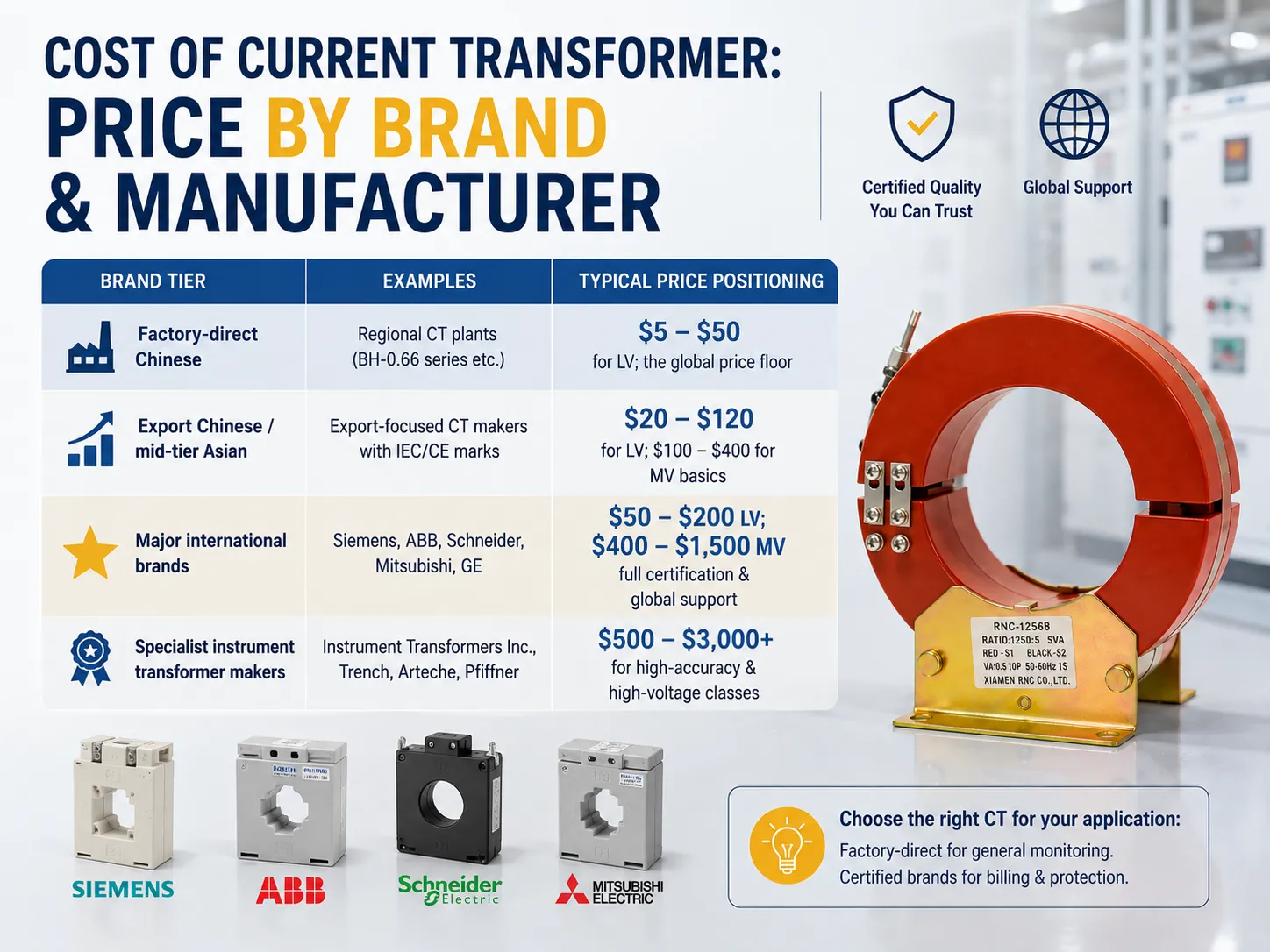
Prix par marque et fabricant
Le positionnement de la marque de CT reflète celui des dispositifs électriques dans le monde entier.
| Niveau de marque | Exemples | Positionnement de prix typique |
|---|---|---|
| Direct usine chinois | Usines de CT régionales (série BH-0.66, etc.) | $5-50 pour BT ; le prix plancher mondial |
| Export chinois / asiatique de milieu de gamme | Fabricants de CT axés sur l'exportation avec des marques IEC/CE | Lorsque vous demandez le coût d'un transformateur de courant (CT), vous pourriez vous retrouver avec … |
| Dans ce guide, vous trouverez des fourchettes réalistes possibles pour le transformateur de courant … | Le prix d'un transformateur de courant peut varier de $500 à $3,00 … | $50-200 LV; $400-1,500 MV; certification complète et support mondial |
| Fabricants spécialisés de transformateurs d'instrumentation | Instrument Transformers Inc., Trench, Arteche, Pfiffner | $500-3,000+ pour des classes de haute précision et haute tension |
Prenons l'exemple du Siemens SENTRON 500:5 CT (un appareil de mesure basse tension conventionnel) qui coûte environ $95, soit environ 10 à 20 fois le prix des CT standard – le prix élevé garantit sa précision, son assurance qualité, son installation certifiée et ses contrats avec les services publics. Les CT standard peuvent être utilisés pour des mesures non critiques tandis que les CT certifiés sont la meilleure option pour la mesure des revenus. notre gamme de transformateurs d'instrumentation couvre les options certifiées à travers les classes de précision que les applications de facturation exigent.
Les Coûts Supplémentaires : Installation, Test, Personnalisation
Le coût de l'appareil est souvent inférieur à la moitié des coûts engagés sur un site de mesure.
- Installation : les CT basse tension peuvent être fixés aux fils ou montés sur le bus de panneau – cela nécessite simplement un électricien facturant $50 – $150 par heure. L'installation des CT moyenne tension implique de les placer à l'intérieur de l'appareillage, nécessitant ainsi une équipe qualifiée, la gestion des coupures, et souvent l'arrêt de l'installation avec des frais allant de $500 à $3000 selon le type d'appareillage et son accessibilité. Les règles d'installation et les pièges courants sont abordés dans notre guide d'installation des CT.
- Les tests et la calibration représentent une dépense allant de $50 à $500 par CT pour confirmer le rapport et la précision (y compris le certificat de calibration si applicable pour les CT de revenus), où la calibration effectuée dans un laboratoire accrédité représente le coût de test à l'extrémité supérieure de la fourchette, ajoutant un coût entre $50 et $500 par CT.
- Câblage secondaire et articles auxiliaires : les CT de câblage secondaire (et leurs blocs de court-circuit respectifs et interrupteurs de test) ajoutent environ $50 à $300 par article — il est important de se rappeler que lors de l'utilisation d'un CT, il ne faut jamais ouvrir les circuits secondaires du CT, d'où la nécessité de terminer le CT avec des connecteurs et du matériel appropriés.
- Changements personnalisés : les personnalisations de prix sur mesure entraîneraient une augmentation des coûts d'environ 10 à 50% du prix de base du CT en raison du rapport personnalisé, des classes de précision personnalisées, des dimensions personnalisées des fenêtres pour le fonctionnement des CT dans un environnement corrosif.
Comment Acheter Malin : Obtenir le Bon CT au Bon Prix
- Répartition des tâches : la mesure (facturation) nécessite une certification précise, il est donc important de bien budgétiser ; la surveillance (tendances, efficacité) peut être effectuée sans une telle précision, mais ne gaspillez pas trop ; la protection nécessite que la classe de saturation du CT (type 5P10/10P10) soit compatible avec un relais – notre manuel de protection des CT vous conseillera à ce sujet.
- Choisir la taille de shunt appropriée : le taux primaire doit être compris entre 1,2 et 1,5 du courant de charge, car le fonctionnement avec un CT surdimensionné produit de mauvais résultats à faible charge.
- Calcul des coûts : n'oubliez pas d'inclure les frais de transport et de certification lors des achats transfrontaliers.
- Évitez d'acheter des appareils à noyau fendu sauf si cela est absolument nécessaire : les tableaux de distribution modernes avec des CT à anneau n'ont pas besoin de CT à noyau fendu.
- Combinez les achats d'accessoires : les blocs de court-circuit et les interrupteurs de contrôle seront moins chers s'ils sont achetés avec des CT.
Questions Fréquemment Posées
Quel est le coût moyen d'un transformateur ?
Le prix d'un transformateur varie en fonction du type de transformateur utilisé. Dans le cas des transformateurs de courant utilisés pour la mesure ou la protection des entités de conduction, le prix peut varier de $5 à $200 pour les transformateurs basse puissance et de $300 jusqu'à $1,500 pour les transformateurs moyenne tension. En ce qui concerne les transformateurs de puissance ou de distribution modifiant la tension, le prix moyen sera en réalité de $1,600 à $7,000 pour les transformateurs de 100 kVA. Le prix des transformateurs augmente avec l'augmentation de la puissance : par exemple, de $4,200 à $7,800 pour les transformateurs de 500 kVA ou de $7,500 à $13,500 pour les transformateurs de 1000 kVA et même des chiffres à six chiffres pour des transformateurs plus puissants. Il convient de noter que le fournisseur et le client doivent se référer au même type de transformateur acheté.
Quel est le coût d'un transformateur de 200 kW ?
Dans le cas d'un transformateur de 200 kW, il est conseillé de parler de 250 kVA. Lorsque nous parlons de transformateurs immergés dans l'huile, il faut prévoir entre $2,400 et $4,000 selon que le transformateur doit être fourni par un fournisseur réalisant des économies de coûts ou par des entreprises occidentales certifiées.
Quel est le coût d'un transformateur de 400 kW ?
Lorsque 400 kW sont attendus du transformateur, sa puissance doit être de 500 kVA. Il faut noter qu'avec les transformateurs de type huile, le prix peut se situer entre $4,200 et $6,200, tandis qu'avec les transformateurs de type sec, le coût sera encore plus élevé. Le prix des fabricants directs est compris entre $8,000 et $15,000, ce qui doit être suivi d'un supplément de 20-40% du coût total, etc. Tous les prix mentionnés restent valables pour le marché en 2025-2026.
Quel est le prix actuel d'un transformateur ?
De nos jours, le prix des transformateurs est dicté par la quantité de cuivre et d'acier au silicium pour l'entreprise où de bons transformateurs peuvent être vendus à partir de $5 et jusqu'à $1,500 selon la technologie appliquée et le niveau d'efficacité.
Références
- Yiwugo — Tarification de la série de transformateurs de courant BH-0.66 (direct usine)
- ECER — Références de tarification pour transformateurs de courant à noyau fendu et moyenne tension
- RS Online — Transformateur de courant Siemens SENTRON 500:5 (tarification de marque)
- Machinio — Annonces de transformateurs de courant neufs et d'occasion
- Unita Transformer — Fourchettes de prix des transformateurs 2026 par kVA
Conclusion
La fourchette de prix des transformateurs de courant varie de $5 à $3,000 en fonction principalement de la classe de tension d'isolation (le facteur le plus significatif) ainsi que de la classe de précision (le deuxième facteur le plus significatif), suivie de la capacité de courant nominal et du fabricant. Pour les applications basse tension, les prix des transformateurs de courant se situent entre $20 et $100, mais les prix d'achat directs peuvent être aussi bas que $5 et les détaillants les vendent autour de $50 jusqu'à $200. Pour les équipements de commutation moyenne tension, le prix varie de $300 à $1,500 pour l'appareil et le certificat. Le coût d'un instrument de mesure de qualité utilitaire peut aller de $500 jusqu'à $3,000 et plus, en fonction de la précision des relevés de consommation d'eau et de gaz.