


Il vous sera impossible d'acheter un transformateur correspondant à la taille que vous avez calculée, car les transformateurs sont fabriqués dans des catégories spécifiques de kVA basées sur les normes de l'industrie. Il vous appartient de choisir celui parmi les catégories existantes qui répondra à vos besoins. Prendre la mauvaise décision de taille entraînera soit des dépenses pour une puissance qui ne sera pas utilisée, soit le fonctionnement de votre transformateur en conditions de surcharge, ce qui le rendra défectueux plus tôt que prévu.
Les systèmes de classification des transformateurs de distribution à sec pour monophasés et triphasés diffèrent les uns des autres. Les classifications des modèles monophasés incluent : 1, 1,5, 2, 3, 5, 7,5, 10, 15, 25, 37,5, 50, 75, 100, 167, 250, 333 et 500 kVA, tandis que celles pour les équipements triphasés sont 15, 30, 45, 75, 112,5, 150, 225, 300, 500, 750, 1000, 1500, 2000 et 2500 kVA selon ANSI/IEEE C57.12.01 et NEMA ST-20. Prenons, par exemple, le transformateur triphasé de 150 kVA. Cette unité peut délivrer 180 A et 416 A à des tensions de 480 V et 208Y/120 V, respectivement. Les classifications de tension pour les transformateurs sont calculées à environ 75-80% de la tension nominale pour déterminer le pourcentage de charge et arrondies à la puissance standard la plus proche.
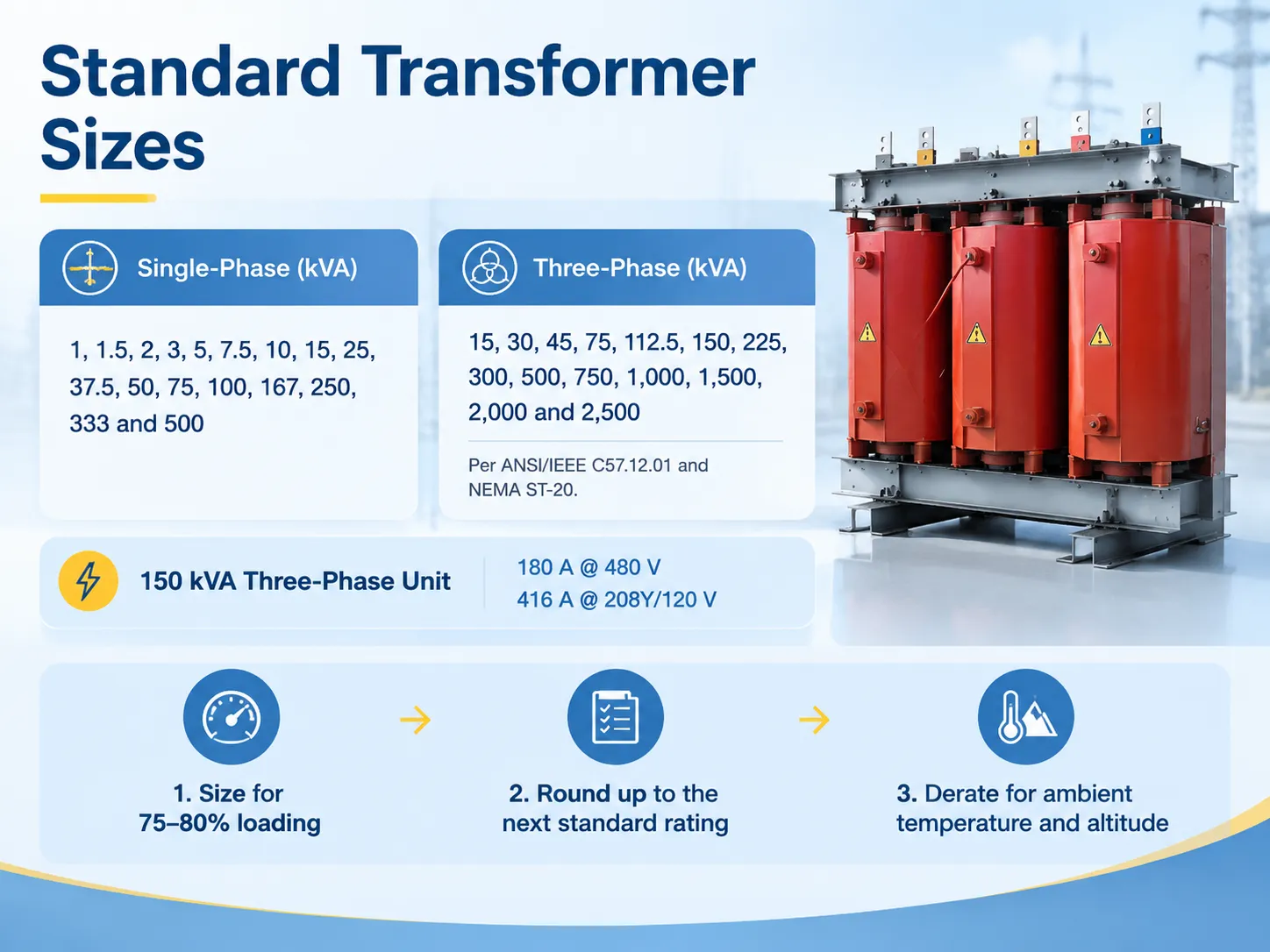
Pourquoi les tailles standard existent-elles ?
La ladder est une décision de fabrication qui est devenue une norme de l'industrie. Des composants comme les échangeurs de chaleur, les transformateurs et les raccords sont fabriqués selon des cadres définis, et ainsi les puissances standard sont facilement disponibles en tant qu'articles en stock, tandis que tout ce qui se trouve entre les deux doit être un travail sur mesure.
Il y a trois façons dont cette différence se révèle. Premièrement, le délai de livraison. Un transformateur standard de 112,5 kVA peut être expédié en mode opérationnel en quelques semaines ou à partir du stock. Cependant, ce n'est pas le cas pour un transformateur triphasé de 100 kVA, qui se situe entre les deux tailles standard et doit être expédié en tant que commande spéciale. Prix. Une unité sur mesure coûte autant qu'une unité standard mais engendre des coûts supplémentaires pour sa conception et sa production. Pièces de rechange. Une usine qui utilise des tailles standard n'a besoin de conserver qu'un seul type de pièce de rechange qui peut servir plusieurs installations.
La ladder n'est pas aussi intuitive qu'on pourrait le penser, et c'est pourquoi les gens commettent des erreurs dans son utilisation. L'échelle de puissance triphasée utilisant des valeurs standard n'est pas un système standard comme on peut le voir dans la ladder. Les valeurs ici vont de 75 kVA à 112,5 kVA puis à 150 kVA. En fait, 112,5 est le produit de 75 kVA multiplié par 1,5, ce qui correspond à la logique de croissance de charge utilisée par les services commerciaux. Ainsi, il est impossible d'obtenir un design standard pour un transformateur triphasé de 100 kVA, bien que ce soit ce que la plupart des gens pensent.
La ladder monophasée
| kVA | FLA à 240 V | FLA à 480 V | Utilisation typique |
|---|---|---|---|
| 1 | 4,2 A | 2,1 A | Circuit de contrôle, puissance de signal |
| 1.5 | 6,3 A | 3,1 A | Transformateur de contrôle, sonnette |
| 3 | 12,5 A | 6,3 A | Contrôle de machine, petit éclairage |
| 5 | 20,8 A | 10,4 A | Petit CVC, panneau à sortie unique |
| 10 | 41,7 A | 20,8 A | Service résidentiel, petit magasin |
| 15 | 62,5 A | 31,3 A | Petit commercial, montage sur poteau |
| 25 | 104,2 A | 52,1 A | Multi-familial, petit bâtiment |
| 37.5 | 156,3 A | 78,1 A | Unité de vente au détail, pompe de puits |
| 50 | 208,3 A | 104,2 A | Commercial moyen |
| 75 | 312,5 A | 156,3 A | Grand commercial, petite usine |
| 100 | 416,7 A | 208,3 A | Sous-panneau industriel |
| 167 | 695,8 A | 347,9 A | Distribution sur socle |
| 250 | 1 041,7 A | 520,8 A | Alimentation de distribution de service public |
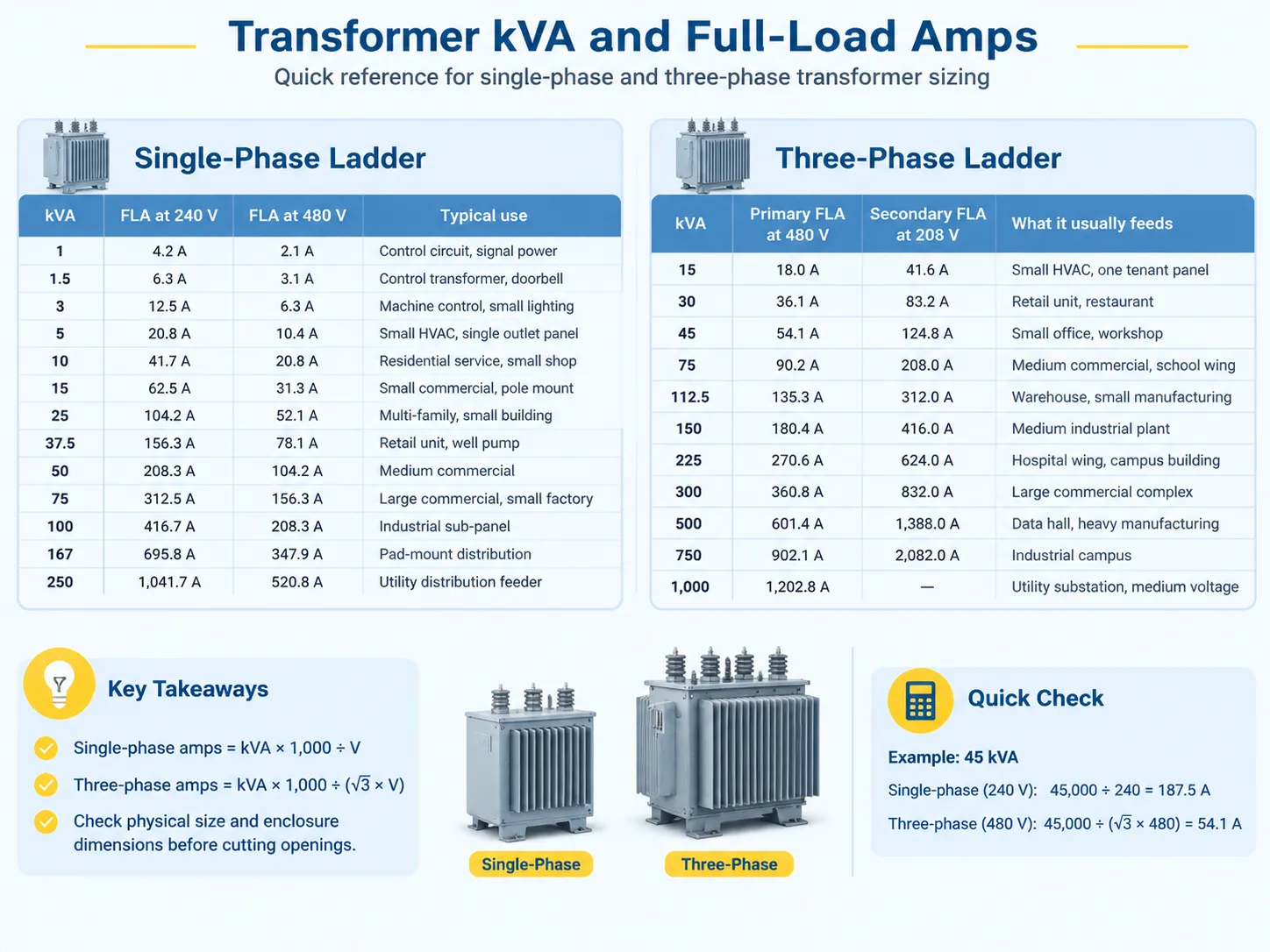
Les ampères à pleine charge monophasés sont simplement kVA × 1 000 ÷ volts. La taille physique qui correspond à chaque échelon vaut la peine d'être vérifiée avant qu'une ouverture dans le mur ne soit découpée, et les dimensions de l'enceinte pour les classifications plus petites, qui sont celles qui finissent dans un placard ou une armoire, sont établies avec le dimensions du transformateur de 112,5 kVA comme cas de référence.
L'échelle triphasée
La conversion des lectures d'ampèremètre de phase des systèmes triphasés implique également de diviser par √3. Cela signifie que les courants triphasés sont également plus bas par phase pour le même kVA. Le tableau suivant montre les tensions primaires et secondaires les plus populaires utilisées en Amérique du Nord : 480 V et 208Y/120 V.
| kVA | FLA primaire à 480 V | FLA secondaire à 208 V | Ce qu'il alimente généralement |
|---|---|---|---|
| 15 | 18,0 A | 41,6 A | Petit HVAC, panneau d'un locataire |
| 30 | 36,1 A | 83,2 A | Unité de vente au détail, restaurant |
| 45 | 54,1 A | 124,8 A | Petit bureau, atelier |
| 75 | 90,2 A | 208,0 A | Commercial moyen, aile d'école |
| 112.5 | 135,3 A | 312,0 A | Entrepôt, petite fabrication |
| 150 | 180,4 A | 416,0 A | Usine industrielle moyenne |
| 225 | 270,6 A | 624,0 A | Aile d'hôpital, bâtiment de campus |
| 300 | 360,8 A | 832,0 A | Grand complexe commercial |
| 500 | 601,4 A | 1 388,0 A | Salle de données, fabrication lourde |
| 750 | 902,1 A | 2 082,0 A | Campus industriel |
| 1,000 | 1 202,8 A | — | Sous-station utilitaire, moyenne tension |
Il y a deux aspects qui se démarquent dans le tableau. Le premier est que le courant secondaire est environ 2,31 fois plus élevé que le courant primaire, ce qui reflète le rapport de tension 480/208, assurant ainsi la cohérence des calculs. La deuxième préoccupation est qu'une fois que l'on arrive au paramètre des classifications de kVA, il n'y a pas de valeur de 400 kVA donnée dans les spécifications ANSI.
La conversion des charges d'ampères en kVA est réalisée en effectuant les mêmes calculs dans l'ordre inverse, donc la meilleure façon d'apprendre cette conversion est d'examiner l'une des applications réelles. Cet exemple concret d'un transformateur de 45 kVA en ampères effectue les calculs pour les connexions monophasées et triphasées.
Le kVA dont vous avez besoin par rapport au kVA que vous commandez
Vous devez suivre quatre étapes dans l'ordre indiqué ci-dessous.
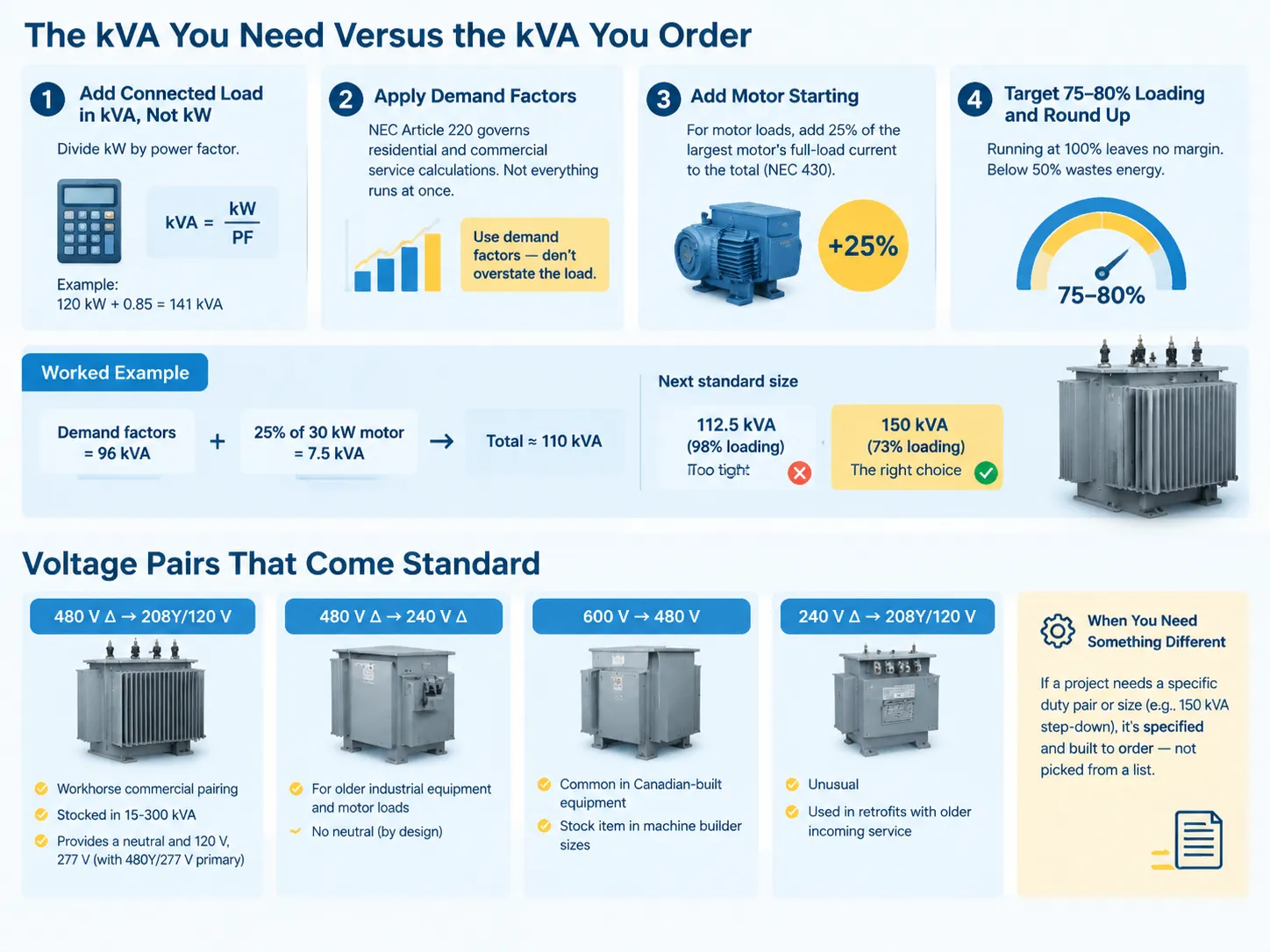
- Prenez la charge connectée en kVA, pas en kW. Divisez les kW par le facteur de puissance. Une charge de 120 kW avec un facteur de puissance de 0,85 équivaut à 141 kVA, ce qui signifie que tout transformateur dimensionné sur 120 serait en surcharge dès le départ.
- Appliquez les facteurs de demande. Article 220 of the NEC regulates calculation for residential and commercial services since not everything operates simultaneously. Ignoring demand factors increases the load unnecessarily.
- Take into account the motor starting. In case of motor loads, you should add 25% of the full-load current of the biggest motor to your total using NEC 430 in order to account for both starting and accelerating.
- Aim for 75%-80% loading at this demand, rounding up afterward. A transformer operating at 100% of its capacity offers no safety margin for hot days, for increasing loads next year, and has a shorter life than one working at 75%. Operating at below 50% brings about the opposite problem where no-load losses dominate and the efficiency curve is poor, which means real costs over the period of project operation.
Let’s make an example. A small plant calculated 96 kVA after taking demand factors into account. By adding 25% of a 30 kW motor, the result equals around 110 kVA. The next three-phase standard rating is 112.5 kVA, meaning that the loading rate is 98%, which is too much. The right answer is 150 kVA at 73% loading.
Voltage Pairs That Come Standard
The kVA ladder is only one aspect of the standard. The voltage combination is the other half, and there are only a few cases in North America.
- 480 delta to 208Y/120 is widely used in commercial applications, with all ratings available from 15 kVA to 300 kVA. It provides neutral for 120 V loads and enables the lighting with 277 V.
- The 480 delta to 240 delta voltage does not need a neutral. The fact that there is no neutral is a design consideration, not a mistake, which can confuse some people who think that 240 V voltage output can be used to supply 120 V loads.
- The 600 to 480 transformers are more common in Canadian equipment manufactured for the US, which uses standard sizes for machine builders.
- The 240 delta to 208Y/120 V voltage is not often seen, but it is sometimes used in upgraded facilities when old equipment receives new power supply.
All other combinations are custom orders or completely different products. Where a project needs a specific duty pair rather than a stock combination, the unit is specified rather than ordered, and a dedicated size such as a 150 kVA step-down transformer is the sort of thing that gets built to the project rather than picked from a list.
Derating: Temperature, Altitude and Harmonics
| État | Effect on usable kVA | What to do |
|---|---|---|
| Ambient above 40°C | Reduced; published rules of thumb run 0.33–0.5% per °C | Use the manufacturer’s derating curve, not a rule of thumb |
| Altitude above 1,000 m | Reduced cooling effectiveness | Derate per manufacturer; ventilate the enclosure |
| Harmonic-rich load | Reduced; eddy losses rise faster than fundamental current | Specify K-factor instead of derating a standard unit |
| Enclosed without ventilation | Reduced; the enclosure is the real ambient | Size the enclosure, not just the transformer |
| Continuous 100% loading | No margin; accelerated insulation ageing | Design for 75–80% |
There is a need for caution when it comes to ambient heat. There are many rules of thumb around, from 0.33% to 0.5% for each degree above 40°C, though they vary with 50°C. The only good way to know is to look up the derating graph from the manufacturer of the particular insulation system, as the derating of a unit that works at 150°C is different from that of a unit taking an 80°C rise.
Harmonics is the most often neglected derating, because everything looks normal on a clamp meter. A transformer, for example, that supplies six-pulse drives experiences harmonic currents that make the windings and core run hotter than indicated by the kVA. The weight and physical size of a larger rating, which is where the thermal mass actually lives, are covered alongside the poids du transformateur de 500 kVA figures.
Impedance and Fault Current
The percent impedance (%Z) is the proportion of the voltage drop during full load to the rated voltage and indicates how much fault current will be available.
In practice, distribution transformers have a %Z ranging from 2% to 5.75%. The higher the transformer rating is, the higher the %Z value. Transformers with a lower value of %Z provide better voltage regulation at the same time enabling the maximum fault current to be delivered. In turn, higher %Z values limit the fault current and simplify overcurrent protection coordination.
Changing the rating of a transformer without modifying the panel schedule is risky. Changing from 112.5 kVA to 150 kVA without changing the %Z value implies raising the amount of available fault current and thereby putting a 10 kA breaker into danger since it may work at current higher than it is designed for.
The Sizes People Actually Order
A total of five ratings make up for most of the volume, and the reason for that is practical rather than technical.
- 45 kVA is the default of small commercial – a single tenant or a workshop or a small office with 200 A panel at 208Y/120 V.
- 75 kVA is used for a restaurant or retail unit with kitchen equipment, and it is commonly available.
- 112.5 kVA can serve a warehouse or light manufacturing site, and it is the standard substitute for the missing 100 kVA.
- 150 kVA is used as a standard medium industrial rating and is the most common option when a plant is adding a second shift.
- 300 and 500 kVA are the larger commercial and data-hall sizes, where the decision moves from catalogue to engineered order and the price conversation changes shape, as the spread in transformer pricing across ratings shows.
Reading the Nameplate
Six parameters determine whether the unit is what you requested.
kVA rating and the number of phases. Primary and secondary voltages including the connection like 480 V delta/208Y120 V. Temperature rise, which is generally 80°C, 115°C or 150°C. Insulation class which usually happens to be 180°C or 220°C. %Z. And taps, often ±2 × 2.5% on the primary winding.
Taps on the high side are the usual configuration of a transformer used for step-down duty because it is at high side where the supply voltage changes. A transformer with taps on the low side is manufactured for step-up application which is completely different animal although the kVA rating is the same.
FAQ
What are the standard transformer kVA sizes?
The standard ratings available for single-phase transformers include 1, 1.5, 2, 3, 5, 7.5, 10, 15, 25, 37.5, 50, 75, 100, 167, 250, 333 and 500 kVA. Three-phase transformers on the other hand produce 15, 30, 45, 75, 112.5, 150, 225, 300, 500, 750, 1000, 1500, 2000 and 2500 kVA. The sequence mentioned above is detailed in ANSI/IEEE C57.12.01 and NEMA ST-20 and this sequence is strictly adhered to with regards to stock availability.
Is there a 100 kVA three-phase transformer?
Not in the context of a standard rating. The ANSI three-phase range includes ratings of between 75 kVA and 112.5 kVA, meaning a three-phase unit with a rating of 100 kVA must either have been custom-made or ordered incorrectly. There is a standard size of single-phase 100 kVA that causes most of the confusion.
How do I convert kVA to amps?
The formula for single-phase is amps = kVA x 1000 / volts. The formula for three-phase is amps = kVA x 1000 / (volts x 1.73). For instance, a 150 kVA three-phase system at 480 V gives 180 A, whereas the same system will give 416 A at 208 V.
Should I size a transformer at 100% of load?
The formula for single-phase is amps = kVA x 1000 / volts. The formula for three-phase is amps = kVA x 1000 / (volts x 1.73). For instance, a 150 kVA three-phase system at 480 V gives 180 A, whereas the same system will give 416 A at 208 V.
Références
- Hammond Power Solutions — Standard kVA Ratings and Selection Data
- SGB-SMIT Group — Transformer Ratings and Technical Data
- UL Solutions — Transformer Listing and Marking
- NFPA 70 — National Electrical Code, Articles 220, 430 and 450
- U.S. Department of Energy — Normes d'Efficacité des Transformateurs de Distribution
Conclusion
Determining transformer size is more of an art rather than a science. The following steps delineate the one to take in order to arrive at the conclusion. To begin with one needs to determine the kVA load. After ensuring load factors one has to consider the starting of engines and take 75 to 80 percent capacity for next larger size.There are two points that can render correct transformer sizing incorrect, namely ambient temperature and fault current rating of panel to which transformer ratings belong.