


Será imposible que compres un transformador que corresponda al tamaño que calculaste, ya que los transformadores se fabrican en categorías específicas de kVA basadas en los estándares de la industria. Depende de ti elegir uno entre las categorías existentes que satisfaga tus necesidades. Tomar la decisión incorrecta sobre el tamaño llevará a gastar dinero en la potencia que no se utilizará o a que tu transformador opere bajo condiciones de sobrecarga y se vuelva defectuoso antes de lo calculado.
Los sistemas de clasificación para transformadores de distribución de tipo seco para monofásicos y trifásicos difieren entre sí. Las clasificaciones de los monofásicos incluyen: 1, 1.5, 2, 3, 5, 7.5, 10, 15, 25, 37.5, 50, 75, 100, 167, 250, 333 y 500 kVA, mientras que las de los equipos trifásicos son 15, 30, 45, 75, 112.5, 150, 225, 300, 500, 750, 1000, 1500, 2000 y 2500 kVA de acuerdo con ANSI/IEEE C57.12.01 y NEMA ST-20. Tomemos, por ejemplo, el transformador trifásico de 150 kVA. Esta unidad puede entregar 180 A y 416 A a voltajes de 480 V y 208Y/120 V, respectivamente. Las clasificaciones de voltaje para los transformadores se calculan en aproximadamente 75-80% del voltaje nominal al determinar el porcentaje de carga y se redondean al wattage estándar más cercano.
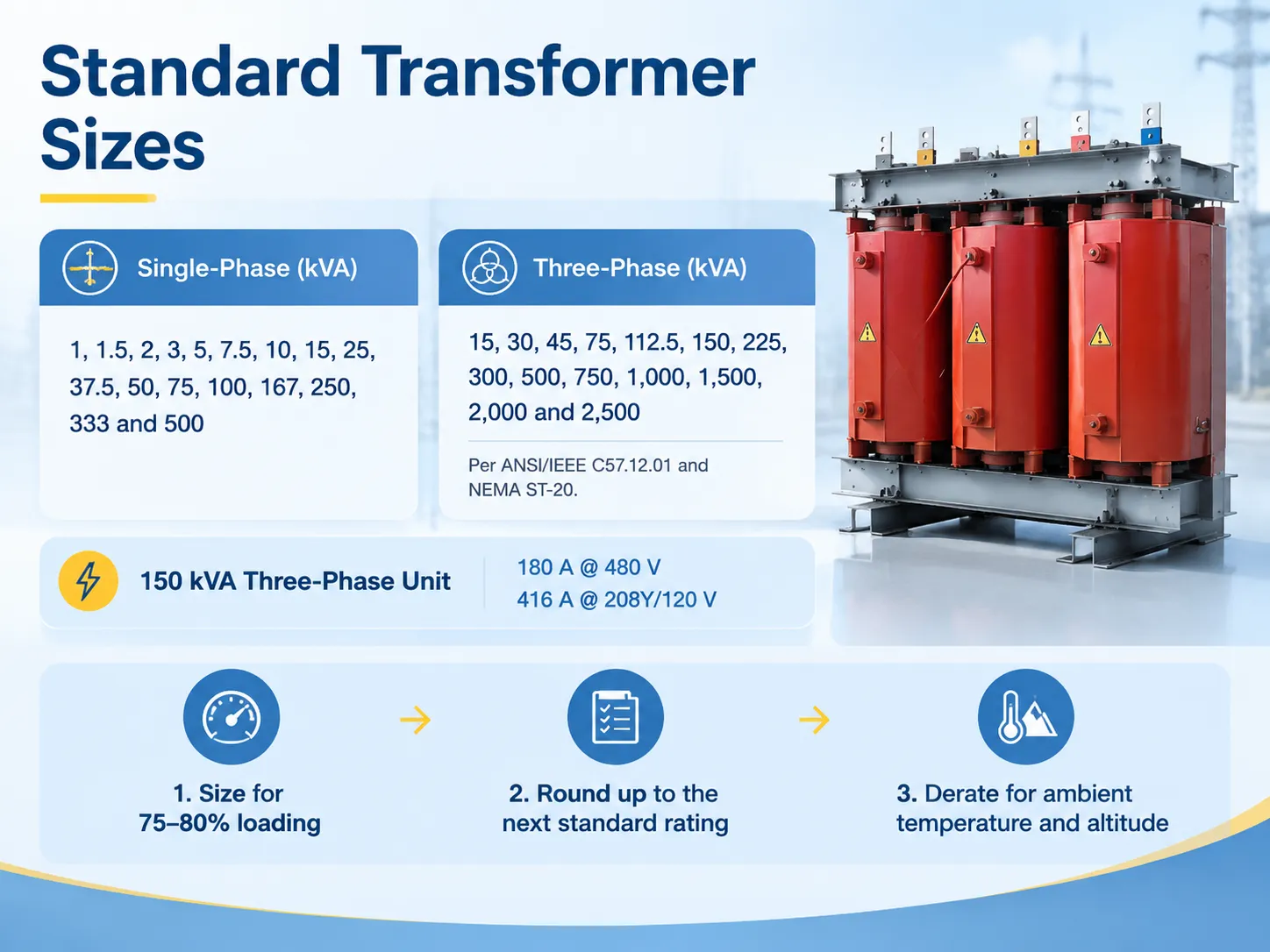
Por qué existen tamaños estándar
Ladder es una decisión de fabricación que se convirtió en un estándar de la industria. Componentes como intercambiadores de calor, transformadores y accesorios se fabrican de acuerdo con marcos establecidos, y así las clasificaciones estándar están fácilmente disponibles como artículos en stock, mientras que todo lo intermedio tiene que ser un trabajo a medida.
Hay tres formas en que esta diferencia se revela. Primero, el tiempo de entrega. Un transformador estándar de 112.5 kVA puede ser enviado en modo operativo en unas pocas semanas o desde stock. Sin embargo, este no es el caso de un transformador trifásico de 100 kVA, que cae entre los dos tamaños estándar y debe ser enviado como un pedido especial. Precio. Una unidad personalizada cuesta tanto como una estándar pero tiene costos adicionales incurridos por su diseño y producción. Piezas de repuesto. Una planta que utiliza tamaños estándar solo necesita mantener un tipo de repuesto que puede servir a múltiples instalaciones.
Ladder no es tan intuitivo como uno podría pensar, y por eso la gente comete errores en su uso. La escala de clasificación trifásica que utiliza valores estándar no es un sistema estándar como se puede ver en la escalera. Los valores aquí van de 75 kVA a 112.5 kVA y luego a 150 kVA. De hecho, 112.5 es el producto de 75 kVA multiplicado por 1.5, que corresponde a la lógica de crecimiento de carga utilizada por los servicios comerciales. Por lo tanto, es imposible obtener un diseño estándar para un transformador trifásico de 100 kVA, aunque eso es lo que la mayoría de la gente piensa.
La Escalera Monofásica
| kVA | FLA a 240 V | FLA a 480 V | Uso típico |
|---|---|---|---|
| 1 | 2 A | 1 A | Circuito de control, potencia de señal |
| 1.5 | 3 A | 1 A | Transformador de control, timbre |
| 3 | 5 A | 3 A | Control de máquina, iluminación pequeña |
| 5 | 8 A | 4 A | HVAC pequeño, panel de salida único |
| 10 | 7 A | 8 A | Servicio residencial, tienda pequeña |
| 15 | 5 A | 3 A | Comercial pequeña, montaje en poste |
| 25 | 2 A | 1 A | Multifamiliar, edificio pequeño |
| 37.5 | 3 A | 1 A | Unidad de venta al por menor, bomba de pozo |
| 50 | 3 A | 2 A | Comercial mediana |
| 75 | 5 A | 3 A | Comercial grande, fábrica pequeña |
| 100 | 7 A | 3 A | Subpanel industrial |
| 167 | 8 A | 9 A | Distribución de montaje en base |
| 250 | 1,041.7 A | 8 A | Alimentador de distribución de servicios públicos |
Los amperios de carga completa monofásicos son simplemente kVA × 1,000 ÷ voltios. El tamaño físico que corresponde a cada peldaño vale la pena verificar antes de cortar una abertura en la pared, y las dimensiones de la caja para las clasificaciones más pequeñas, que son las que terminan en un armario o un closet, se establecen con el dimensiones del transformador de 112.5 kVA como el caso de referencia.
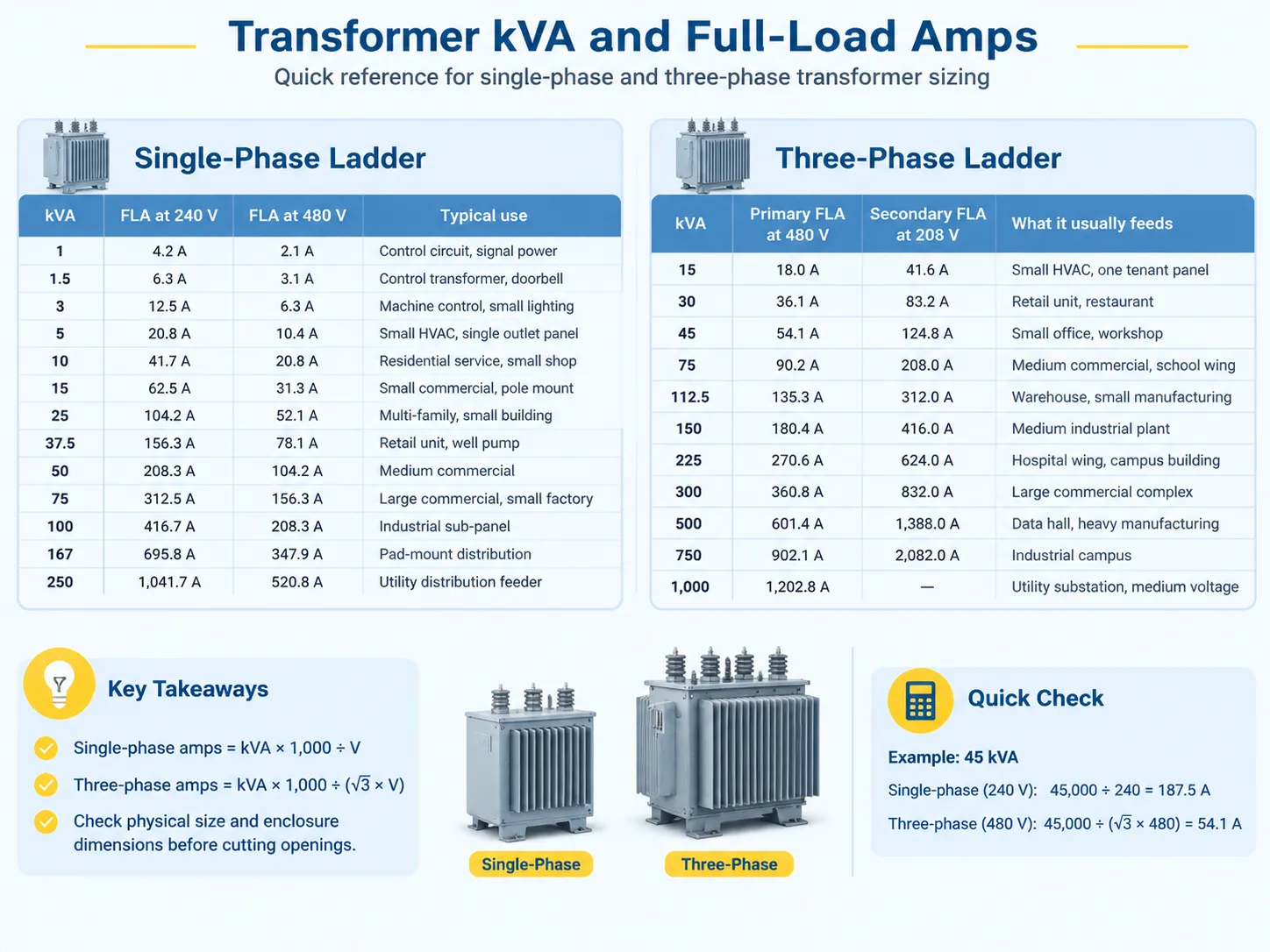
La Escalera Trifásica
La conversión para lecturas de amperímetro de fase de sistemas trifásicos implica dividir también por √3. Esto significa que las corrientes trifásicas son también más bajas por fase en el mismo kVA. La siguiente tabla muestra los voltajes primarios y secundarios más populares utilizados en América del Norte: 480 V y 208Y/120 V.
| kVA | FLA primario a 480 V | FLA secundario a 208 V | Lo que normalmente alimenta |
|---|---|---|---|
| 15 | 0 A | 6 A | Pequeño HVAC, panel de un inquilino |
| 30 | 1 A | 2 A | Unidad comercial, restaurante |
| 45 | 1 A | 8 A | Pequeña oficina, taller |
| 75 | 2 A | 0 A | Comercial mediano, ala escolar |
| 112.5 | 3 A | 0 A | Almacén, pequeña manufactura |
| 150 | 4 A | 0 A | Planta industrial mediana |
| 225 | 6 A | 0 A | Ala de hospital, edificio del campus |
| 300 | 8 A | 0 A | Gran complejo comercial |
| 500 | 4 A | 1,388.0 A | Sala de datos, manufactura pesada |
| 750 | 1 A | 2,082.0 A | Campus industrial |
| 1,000 | 1,202.8 A | — | Subestación de utilidad, voltaje medio |
Hay dos aspectos que destacan en la tabla. El primero de estos es que la corriente secundaria es aproximadamente 2.31 veces mayor que la corriente primaria, lo que refleja la relación de voltaje 480/208, dando así consistencia a los cálculos. La segunda preocupación es que una vez que se llega al parámetro de las clasificaciones de kVA, no hay un valor de 400 kVA dado en las especificaciones de ANSI.
La conversión de cargas de amperios a kVA se logra realizando los mismos cálculos en el orden inverso, por lo que la mejor manera de aprender sobre esta conversión es examinar una de las aplicaciones reales. Este ejemplo práctico de un transformador de 45 kVA en amperios calcula los números tanto para conexiones monofásicas como trifásicas.
El kVA que necesitas frente al kVA que pides
Necesitas seguir cuatro pasos en el orden que se indica a continuación.
- Toma la carga conectada en kVA, no en kW. Divide kW por el factor de potencia. Una carga de 120 kW con un factor de potencia de 0.85 equivale a 141 kVA, lo que significa que cualquier transformador dimensionado en 120 estaría sobrecargado desde el principio.
- Aplica factores de demanda. Article 220 of the NEC regulates calculation for residential and commercial services since not everything operates simultaneously. Ignoring demand factors increases the load unnecessarily.
- Take into account the motor starting. In case of motor loads, you should add 25% of the full-load current of the biggest motor to your total using NEC 430 in order to account for both starting and accelerating.
- Aim for 75%-80% loading at this demand, rounding up afterward. A transformer operating at 100% of its capacity offers no safety margin for hot days, for increasing loads next year, and has a shorter life than one working at 75%. Operating at below 50% brings about the opposite problem where no-load losses dominate and the efficiency curve is poor, which means real costs over the period of project operation.
Let’s make an example. A small plant calculated 96 kVA after taking demand factors into account. By adding 25% of a 30 kW motor, the result equals around 110 kVA. The next three-phase standard rating is 112.5 kVA, meaning that the loading rate is 98%, which is too much. The right answer is 150 kVA at 73% loading.
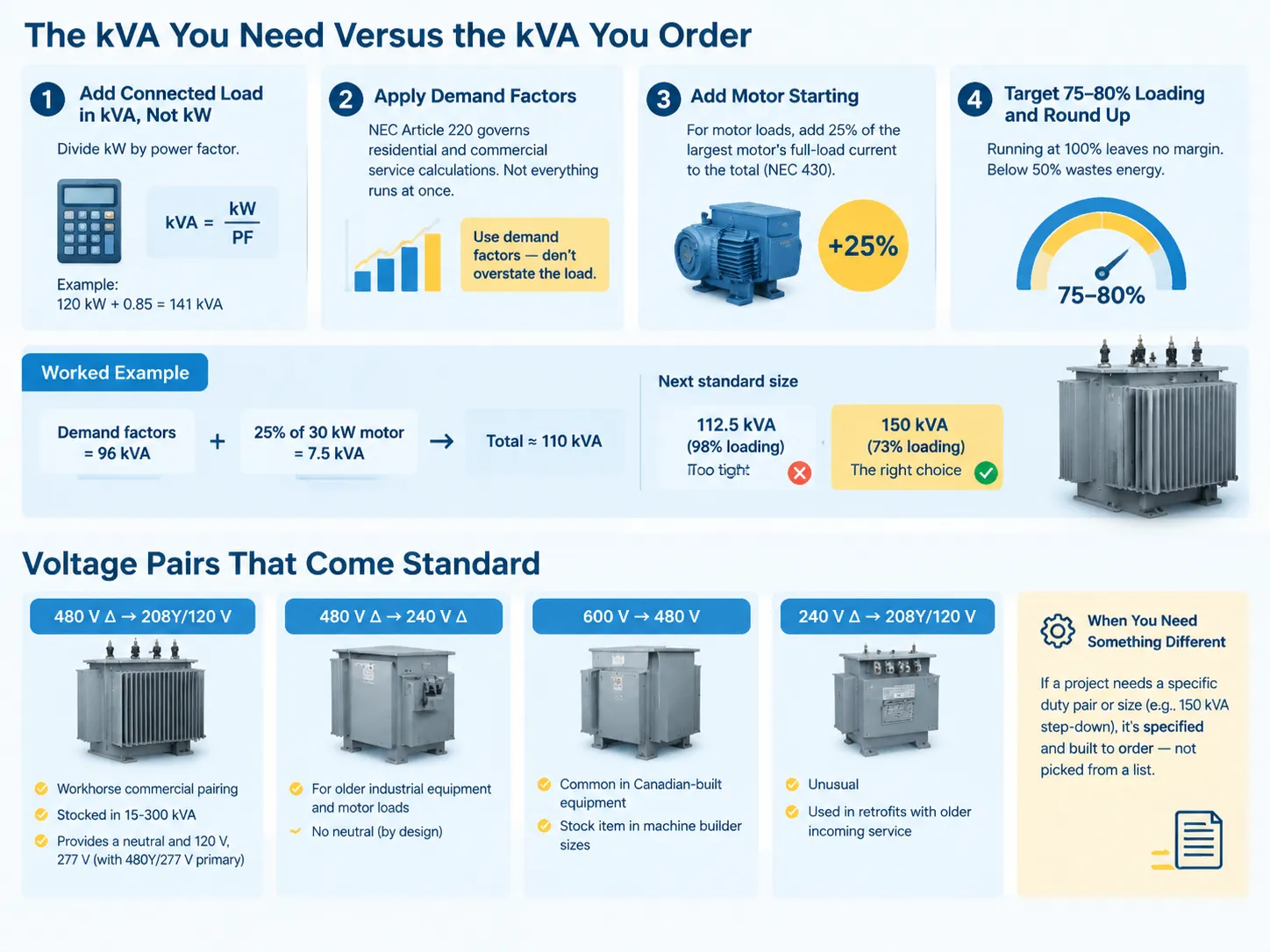
Voltage Pairs That Come Standard
The kVA ladder is only one aspect of the standard. The voltage combination is the other half, and there are only a few cases in North America.
- 480 delta to 208Y/120 is widely used in commercial applications, with all ratings available from 15 kVA to 300 kVA. It provides neutral for 120 V loads and enables the lighting with 277 V.
- The 480 delta to 240 delta voltage does not need a neutral. The fact that there is no neutral is a design consideration, not a mistake, which can confuse some people who think that 240 V voltage output can be used to supply 120 V loads.
- The 600 to 480 transformers are more common in Canadian equipment manufactured for the US, which uses standard sizes for machine builders.
- The 240 delta to 208Y/120 V voltage is not often seen, but it is sometimes used in upgraded facilities when old equipment receives new power supply.
All other combinations are custom orders or completely different products. Where a project needs a specific duty pair rather than a stock combination, the unit is specified rather than ordered, and a dedicated size such as a 150 kVA step-down transformer is the sort of thing that gets built to the project rather than picked from a list.
Derating: Temperature, Altitude and Harmonics
| Condición | Effect on usable kVA | What to do |
|---|---|---|
| Ambient above 40°C | Reduced; published rules of thumb run 0.33–0.5% per °C | Use the manufacturer’s derating curve, not a rule of thumb |
| Altitude above 1,000 m | Reduced cooling effectiveness | Derate per manufacturer; ventilate the enclosure |
| Harmonic-rich load | Reduced; eddy losses rise faster than fundamental current | Specify K-factor instead of derating a standard unit |
| Enclosed without ventilation | Reduced; the enclosure is the real ambient | Size the enclosure, not just the transformer |
| Continuous 100% loading | No margin; accelerated insulation ageing | Design for 75–80% |
There is a need for caution when it comes to ambient heat. There are many rules of thumb around, from 0.33% to 0.5% for each degree above 40°C, though they vary with 50°C. The only good way to know is to look up the derating graph from the manufacturer of the particular insulation system, as the derating of a unit that works at 150°C is different from that of a unit taking an 80°C rise.
Harmonics is the most often neglected derating, because everything looks normal on a clamp meter. A transformer, for example, that supplies six-pulse drives experiences harmonic currents that make the windings and core run hotter than indicated by the kVA. The weight and physical size of a larger rating, which is where the thermal mass actually lives, are covered alongside the peso del transformador de 500 kVA figures.
Impedance and Fault Current
The percent impedance (%Z) is the proportion of the voltage drop during full load to the rated voltage and indicates how much fault current will be available.
In practice, distribution transformers have a %Z ranging from 2% to 5.75%. The higher the transformer rating is, the higher the %Z value. Transformers with a lower value of %Z provide better voltage regulation at the same time enabling the maximum fault current to be delivered. In turn, higher %Z values limit the fault current and simplify overcurrent protection coordination.
Changing the rating of a transformer without modifying the panel schedule is risky. Changing from 112.5 kVA to 150 kVA without changing the %Z value implies raising the amount of available fault current and thereby putting a 10 kA breaker into danger since it may work at current higher than it is designed for.
The Sizes People Actually Order
A total of five ratings make up for most of the volume, and the reason for that is practical rather than technical.
- 45 kVA is the default of small commercial – a single tenant or a workshop or a small office with 200 A panel at 208Y/120 V.
- 75 kVA is used for a restaurant or retail unit with kitchen equipment, and it is commonly available.
- 112.5 kVA can serve a warehouse or light manufacturing site, and it is the standard substitute for the missing 100 kVA.
- 150 kVA is used as a standard medium industrial rating and is the most common option when a plant is adding a second shift.
- 300 and 500 kVA are the larger commercial and data-hall sizes, where the decision moves from catalogue to engineered order and the price conversation changes shape, as the spread in transformer pricing across ratings shows.
Reading the Nameplate
Six parameters determine whether the unit is what you requested.
kVA rating and the number of phases. Primary and secondary voltages including the connection like 480 V delta/208Y120 V. Temperature rise, which is generally 80°C, 115°C or 150°C. Insulation class which usually happens to be 180°C or 220°C. %Z. And taps, often ±2 × 2.5% on the primary winding.
Taps on the high side are the usual configuration of a transformer used for step-down duty because it is at high side where the supply voltage changes. A transformer with taps on the low side is manufactured for step-up application which is completely different animal although the kVA rating is the same.
Preguntas Frecuentes
What are the standard transformer kVA sizes?
The standard ratings available for single-phase transformers include 1, 1.5, 2, 3, 5, 7.5, 10, 15, 25, 37.5, 50, 75, 100, 167, 250, 333 and 500 kVA. Three-phase transformers on the other hand produce 15, 30, 45, 75, 112.5, 150, 225, 300, 500, 750, 1000, 1500, 2000 and 2500 kVA. The sequence mentioned above is detailed in ANSI/IEEE C57.12.01 and NEMA ST-20 and this sequence is strictly adhered to with regards to stock availability.
Is there a 100 kVA three-phase transformer?
Not in the context of a standard rating. The ANSI three-phase range includes ratings of between 75 kVA and 112.5 kVA, meaning a three-phase unit with a rating of 100 kVA must either have been custom-made or ordered incorrectly. There is a standard size of single-phase 100 kVA that causes most of the confusion.
How do I convert kVA to amps?
The formula for single-phase is amps = kVA x 1000 / volts. The formula for three-phase is amps = kVA x 1000 / (volts x 1.73). For instance, a 150 kVA three-phase system at 480 V gives 180 A, whereas the same system will give 416 A at 208 V.
Should I size a transformer at 100% of load?
The formula for single-phase is amps = kVA x 1000 / volts. The formula for three-phase is amps = kVA x 1000 / (volts x 1.73). For instance, a 150 kVA three-phase system at 480 V gives 180 A, whereas the same system will give 416 A at 208 V.
Referencias
- Hammond Power Solutions — Standard kVA Ratings and Selection Data
- SGB-SMIT Group — Transformer Ratings and Technical Data
- UL Solutions — Transformer Listing and Marking
- NFPA 70 — National Electrical Code, Articles 220, 430 and 450
- Departamento de Energía de EE. UU. — Normas de Eficiencia de Transformadores de Distribución
Conclusión
Determining transformer size is more of an art rather than a science. The following steps delineate the one to take in order to arrive at the conclusion. To begin with one needs to determine the kVA load. After ensuring load factors one has to consider the starting of engines and take 75 to 80 percent capacity for next larger size.There are two points that can render correct transformer sizing incorrect, namely ambient temperature and fault current rating of panel to which transformer ratings belong.