


Un résident du Texas apprend que son transformateur commandé sera livré en 2026 – quatre ans après avoir passé la commande. Un producteur d'éoliennes d'Allemagne attend la livraison qui est bloquée en raison des transformateurs manquants. Un entrepreneur d'un centre de données en Virginie a découvert que son installation d'IA de 100 MW est impossible à mettre en fonctionnement sans un transformateur qui ne sera pas produit avant les deux prochaines années. C'est ainsi que se manifeste ce déficit mondial de transformateurs, une crise mondiale qui a commencé à croître en 2021 et a atteint le stade d'un déficit structurel d'ici 2024.
Le document illustre l'état actuel des affaires en chiffres et indique ce qui cause cette crise des deux côtés de l'offre et de la demande et quel impact cela a sur les projets énergétiques, les prix et les stratégies d'achat à travers le monde. Il présente un manuel expliquant comment acheter des transformateurs sur un marché où le délai de livraison est mesuré en années plutôt qu'en semaines et où un fournisseur a une capacité engagée plutôt qu'un nom bien connu.
La crise mondiale des transformateurs peut être comprise à travers deux chiffres. Les délais de livraison typiques pour les transformateurs de puissance qui étaient auparavant d'environ 30-60 semaines ont maintenant atteint 115-130 semaines en 2024, avec de grandes unités à 120-210 semaines (2,3-4 ans). Les prix ont augmenté de 60-80% depuis janvier 2020 en raison du doublement du prix de l'acier électrique orienté grain et d'une augmentation de 50% pour le cuivre. La demande des centres de données IA, des projets renouvelables, de la recharge de VE et le vieillissement de la flotte entraînent une augmentation de la demande, tandis que l'offre a diminué en raison de la nature capitalistique de la fabrication, de la rareté de la main-d'œuvre qualifiée et de la réduction de la capacité dans les années 2010.
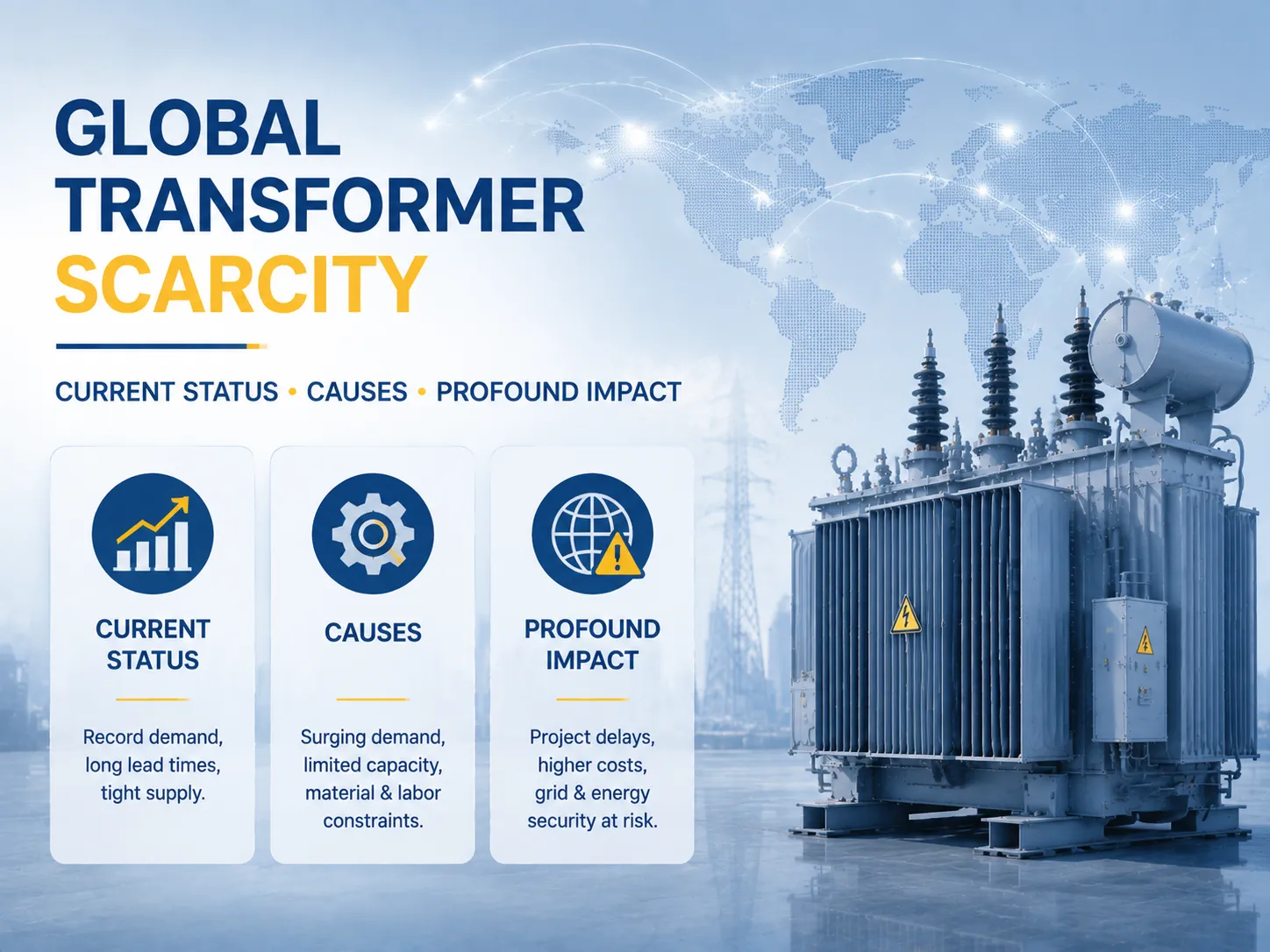
État actuel : La Pénurie en Chiffres
Le délai de livraison est connu pour être le meilleur indicateur de la rareté car il représente le ratio entre les commandes et l'offre mieux que tout autre indicateur. Selon l'étude de la chaîne d'approvisionnement réalisée par Wood Mackenzie, le délai de livraison standard des transformateurs sera de 115–130 semaines en 2024, ce qui est plus de deux fois plus long que la moyenne de 50 semaines en 2021. Les transformateurs à grande échelle comme les sous-stations et les unités de montée de générateur auront un délai de livraison de 80-210 semaines et certains fabricants rapportent qu'ils n'ont tout simplement aucune commande qu'ils peuvent accepter.
| Classe de transformateur | Délai de Livraison Avant 2021 | Délai de Livraison 2024 |
|---|---|---|
| Transformateurs de distribution (100-2 500 kVA) | 4-12 semaines | 20-60 semaines |
| Transformateurs de puissance moyenne (10-40 MVA) | 30-60 semaines | 80-160 semaines |
| Transformateurs de puissance grande (40-500 MVA) | 30-60 semaines | 120-210 semaines |
| Moyenne, toutes classes (Wood Mackenzie) | ~50 semaines (2021) | 115-130 semaines |
La situation des prix est également sévère. Les prix moyens des transformateurs renouvelables ont augmenté entre 60% et 80% depuis le début de janvier 2020, certains nécessitant plus de 80% de frais supplémentaires. Les prix de ces transformateurs ont continué à grimper même après que les prix des matériaux ont commencé à se stabiliser, les entreprises concernées continuant à profiter de la situation pour reconstituer leurs bénéfices et essayer de compenser l'augmentation des coûts de la main-d'œuvre et du transport.
À quoi ressemble la pénurie en pratique
Le concept de rareté n'est pas seulement théorique, comme en témoignent certains événements tangibles. Par exemple, il y a un grand réseau électrique au Texas qui doit remplacer 15 000 transformateurs où aucun inventaire de transformateurs n'est disponible et les commandes s'étendent jusqu'en 2026. La construction des centres de données au Texas a été retardée en partie parce que leurs transformateurs haute tension ne pouvaient pas être livrés. De plus, en Allemagne, les parcs éoliens attendaient les transformateurs élévateurs tandis que les éoliennes étaient prêtes mais déconnectées. En Inde, les calendriers de projets des développeurs renouvelables ont été retardés car ils ne pouvaient pas obtenir de transformateurs.
Les assureurs considèrent désormais la disponibilité des transformateurs comme un risque pour la continuité de leurs activités. Selon l'analyse de l'IF Insurers, le délai de livraison pour les grands transformateurs est passé de 12-24 semaines à 1-3 ans, le prix a augmenté de 70%, et les chercheurs concluent que si un seul transformateur échoue dans une installation, cela entraînera des mois d'arrêt car il faudra attendre le nouveau.
Causes, Partie 1 : L'explosion de la demande
La croissance de la demande a dépassé toutes les prévisions de capacité faites avant 2021. Quatre moteurs de demande dominent :
| Moteur de demande | Échelle de l'effet | Exemple |
|---|---|---|
| IA et centres de données | La demande de transformateurs augmente d'environ 120% rien qu'en 2024 | Un campus IA de 100 MW a besoin de plusieurs grands transformateurs GSU |
| Développement des renouvelables | Les centrales photovoltaïques ont besoin d'environ 1,8 fois plus de capacité de transformateur par MW que le charbon | Unités élévatrices éoliennes et solaires dans les centaines de milliers par an |
| Recharge de véhicules électriques | Environ 5-6 transformateurs par véhicule électrique contre 1-2 par véhicule à moteur à combustion interne | Plus de 17 millions de nouveaux véhicules électriques dans le monde en 2024 |
| Remplacement de la flotte vieillissante | Flotte américaine dépassant la durée de vie de conception de 35-40 ans | Environ 15 000 unités au Texas doivent être remplacées |
L'élément IA est important en raison du fait qu'il est le moins prévisible. Un cluster d'entraînement LLM à grande échelle consomme 70 mégawatts d'énergie, ce qui correspond à la consommation électrique d'une ville d'environ 200 000 habitants. Chaque centre de données de cet ordre a besoin de transformateurs haute tension spécialement construits qui rivalisent pour la capacité limitée de fabrication de transformateurs avec les transformateurs de puissance standard. Selon l'étude de l'AIE de 2024, l'investissement dans le système électrique, y compris les transformateurs et les interrupteurs, devrait augmenter d'environ deux fois d'ici 2030 afin de répondre aux exigences fixées par l'électrification et les énergies renouvelables.
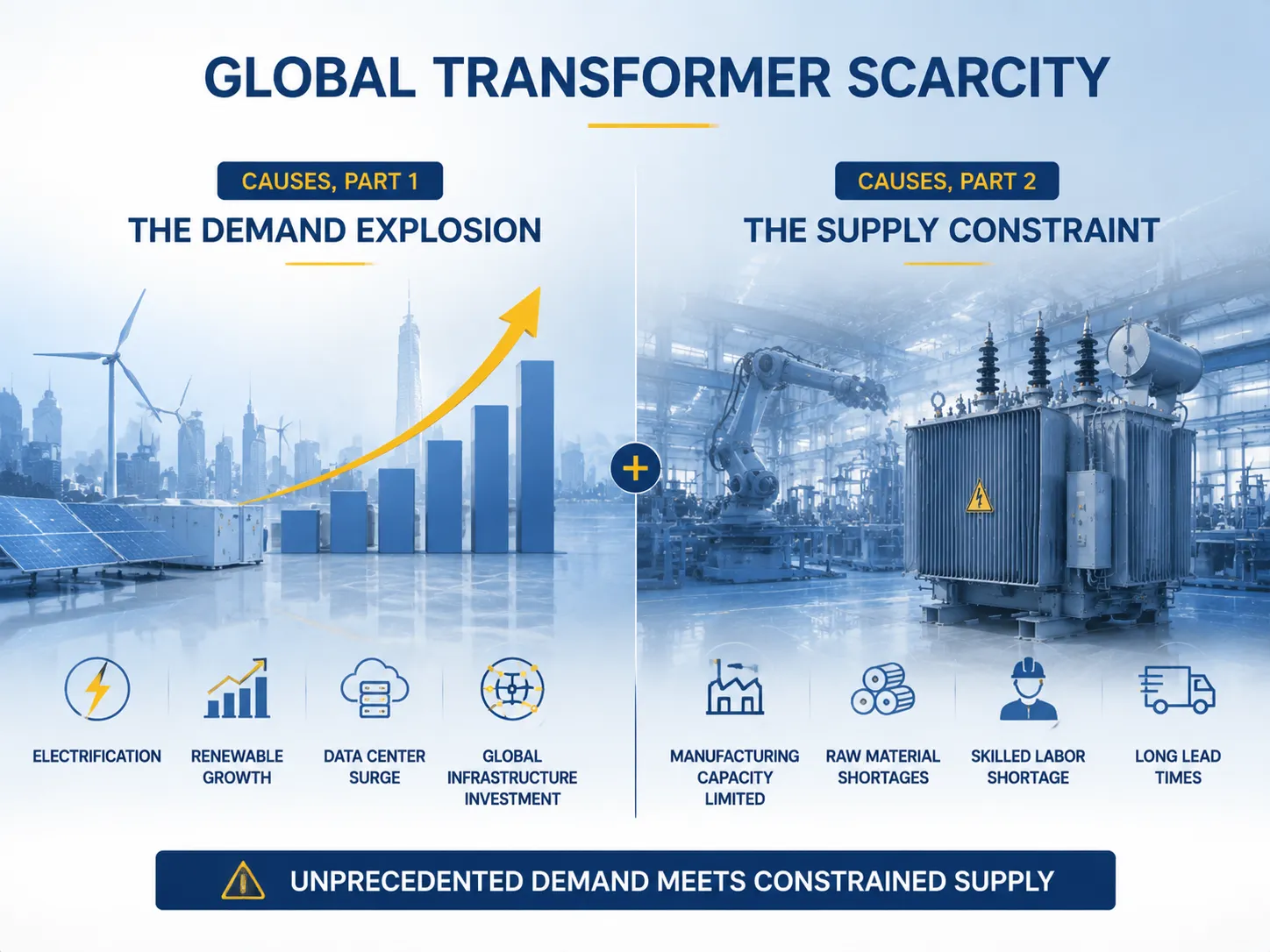
Causes, Partie 2 : La contrainte d'approvisionnement
La capacité du côté de l'offre à réagir est assez limitée en raison de certaines raisons structurelles. La construction d'usines de production de transformateurs prend beaucoup de temps et d'investissement. Il faut généralement entre trois et cinq ans pour terminer la construction et obtenir les autorisations nécessaires, car la fabrication de transformateurs nécessite des professionnels spécialisés. Quelques entreprises de fabrication ont fermé la production après la crise de 2010, tandis que d'autres fonctionnent à plein régime.
- Le nombre limité d'usines certifiées. La grande majorité des fabricants de transformateurs de puissance travaillent dans quelques usines certifiées, et aux États-Unis, seulement environ vingt pour cent des transformateurs sont produits localement.
- Le manque de personnel qualifié. C'est un emploi nécessitant une formation adéquate et des finances.
- Le problème de la conception individuelle. La fabrication de transformateurs nécessite une conception individuelle. Cela entraîne des difficultés supplémentaires dans le processus de production.
- Hésitation à investir. La nécessité d'investissements significatifs qui peuvent prendre des décennies à rentabiliser rend de nombreuses entreprises réticentes à investir.
- L'expansion est lente mais continue. Plusieurs annonces concernant de nouveaux investissements et l'ouverture de nouvelles usines ont été faites. Cependant, selon les estimations de Wood Mackenzie, la situation ne changera pas de manière significative avant les premières années de 2020.
La pénurie de matières premières : GOES, cuivre et acier
Les matières premières ont conduit à une situation où les prix ont commencé à augmenter même avant que la demande n'ait considérablement augmenté. L'acier électrique orienté grain (GOES) – le type de matériau de noyau – est devenu deux fois plus cher depuis le début de 2020 en raison du manque sur le marché et de la production limitée pendant la pandémie. Le cuivre a montré une augmentation d'environ 50% au cours de la même période, ce qui, combiné à la hausse du GOES, a entraîné une augmentation de l'exposition des transformateurs de montée de générateur aux coûts du GOES de 4% – 15%.
| Matière première | Mouvement des prix depuis janvier 2020 | Effet sur le coût des transformateurs |
|---|---|---|
| Acier électrique orienté grain (GOES) | +100% (doublé) | Noyau = 25-35% de coût matériel |
| Cuivre | +50% | Enroulements = 25-30% de coût matériel |
| Main-d'œuvre et logistique | +20-40% | Répercuté dans les prix |
| Prix globaux des transformateurs | +60-80% | – |
Comme le GOES et le cuivre représentent plus de 50% du coût matériel d'un transformateur, tout changement dans ces coûts se reflète dans le prix final. Les prix ont baissé après avoir atteint le point culminant au T4 de 2023, mais restent volatils, et les fournisseurs sont susceptibles de maintenir leurs marges alors que les commandes sont abondantes.
L'impact profond sur les projets et les économies
Les conséquences de la pénurie se répercutent bien au-delà des délais de livraison plus longs :
| Zone d'impact | Effet | Échelle |
|---|---|---|
| Retards de projets renouvelables | Les projets glissent ou s'arrêtent faute de transformateurs | Jusqu'à 25% de renouvelables mondiaux à risque |
| Fiabilité du réseau | Les unités vieillissantes fonctionnent au-delà de leur durée de vie de conception, les pannes augmentent | La majorité de la flotte américaine a dépassé une durée de vie de 35-40 ans |
| Constructions de centres de données | L'énergisation des campus retardée de 1 à 2 ans | Capacité d'IA contrainte aux États-Unis, en Europe |
| Expansion industrielle | Les nouvelles usines attendent des transformateurs de sous-station | Les investissements directs étrangers dans la fabrication retardés à l'échelle mondiale |
| Assurance et finance | Conditions de couverture resserrées, primes en hausse | Plans de continuité des affaires réécrits |
Pour les entreprises de services publics, le résultat est un retard dans les plans de remplacement des transformateurs, ce qui entraîne un risque accru pour la flotte. Pour les développeurs de projets, l'obtention de transformateurs n'est plus un facteur mineur dans le processus de planification temporelle – cela est devenu un élément fondamental de leurs activités. En ce qui concerne les gouvernements, la situation est devenue un problème de sécurité énergétique alors que des politiques industrielles aux États-Unis, dans l'UE et en Inde sont établies pour soutenir les capacités de production domestiques.
Le tableau régional : États-Unis, Europe, Asie
Différentes zones ressentent les effets de la pénurie de manière contrastée. Les États-Unis répondent à presque toute leur demande de transformateurs en provenance d'autres pays (près de 80%), luttent depuis des décennies contre les pénuries de remplacement et ont poursuivi la construction dans leurs usines, dont les résultats ne seront visibles que des années plus tard. L'Europe vend principalement des transformateurs provenant de quelques usines dont les réseaux de distribution dépassent 40% en âge, l'UE a prévu de dépenser 584 milliards d'euros pour des mises à niveau du réseau, ce qui augmentera le besoin de transformateurs dans un avenir proche. L'Inde a une grande production domestique mais subit toujours des retards dans les projets en raison de pénuries de transformateurs et la Chine est le plus grand fournisseur et consommateur sur son territoire ; ses exportations en 2023 étaient deux fois plus importantes que celles de 2022, ce qui en fait le plus grand taux atteint en 13 ans, tandis que les trois premiers trimestres de 2024 montrent une augmentation des exportations de 46% par rapport à l'année dernière.
Cette augmentation a équilibré la situation bien que les fabricants chinois restent les seuls fournisseurs pour d'autres pays.
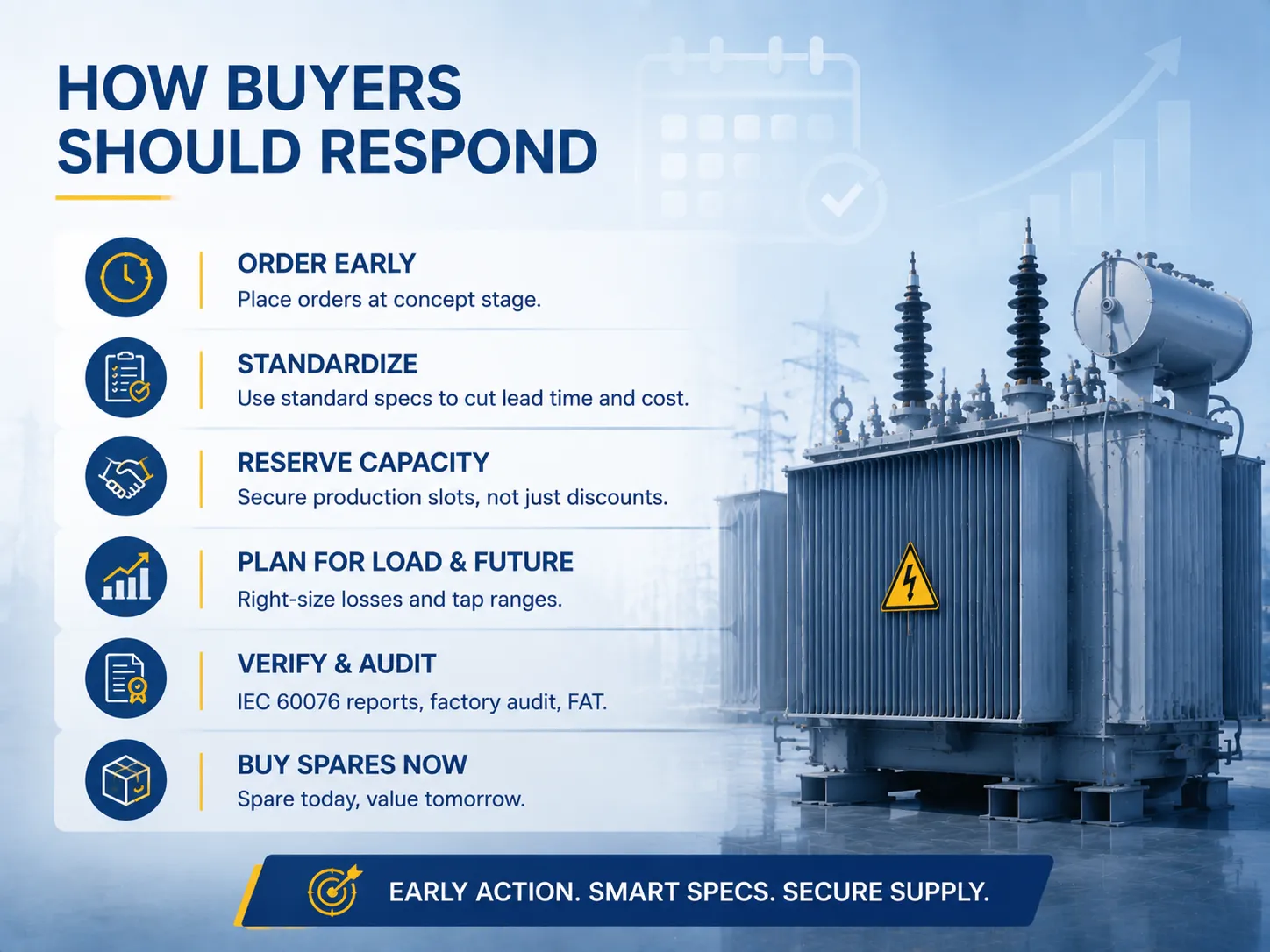
Comment les acheteurs doivent répondre
Étant donné la durée de livraison de plusieurs années, le processus d'approvisionnement est grandement amélioré :
- Commencez à commander dès que les permis de projet sont obtenus. Considérez les transformateurs comme l'élément sur le chemin critique avec le plus long délai ; passez une commande dès le temps de conception et non après le financement.
- Standardiser à la fois de manière rigoureuse et méthodologique. La standardisation des classes de tension, de l'impédance et des plages de prises conduit à des délais de livraison courts et, par conséquent, à des prix plus bas, tandis que des spécifications personnalisées entraînent une augmentation de prix allant jusqu'à 25% et de nombreux mois de délai.
- Réserver de la capacité en s'engageant avec les fournisseurs. Établir un accord-cadre avec les fournisseurs et des créneaux réservés s'avère beaucoup plus bénéfique que des réductions de prix en période de pénurie.
- Acheter pour anticiper l'avenir et le chargement partiel. Spécifier les pertes selon des facteurs de charge réalistes et la plage de prises vous évitera un second cycle d'approvisionnement dans 5 ans.
- Vérifiez les références ainsi que la réalité dans les usines. Obtenez le rapport d'essai de type IEC 60076, auditez le carnet de commandes et vérifiez le contrat d'approvisionnement GOES, et assistez aux tests d'acceptation en usine.
- Traitez votre pièce de rechange comme un capital. Si votre flotte en a besoin, achetez-les maintenant ; en 2027, cela vaudra encore plus que ce que cela coûte maintenant.
Opportunités et les fabricants capables de livrer
Les contraintes de la chaîne d'approvisionnement ont également conduit à l'émergence de différents fournisseurs capables de livrer. Les leaders mondiaux du secteur – Hitachi Energy, Siemens Energy et ABB – sont dans la première catégorie avec des arriérés mesurés en années. Schneider Electric est le leader des acteurs travaillant dans le domaine de la basse tension et du réseau numérique. Les entreprises investissent massivement, mais leur expansion prend un temps significatif. Des entreprises chinoises telles que TBEA, Baoding Tianwei, China XD Group et d'autres fournisseurs de taille intermédiaire sont les nouveaux venus à la croissance la plus rapide sur le marché.
| Fabricant | Positionnement | Réalité des délais de livraison (2024) |
|---|---|---|
| Hitachi Energy | Premium, mondial | 2-4 ans pour les grandes unités |
| Siemens Energy | Premium, mondial | 2-4 ans pour les grandes unités |
| ABB | Premium, large | 1-3 ans selon la classe |
| Schneider Electric | Milieu de gamme, LV/digital | 6-18 mois pour la distribution |
| TBEA / Baoding Tianwei / Groupe XD | Volume, exportation | 6-18 mois pour la distribution ; 1-2 ans pour la puissance |
| Jiangsu Subian Electric Power | Compétitif, certifié IEC 60076 | 8-16 semaines pour les unités de distribution standard |
La fabrication chinoise de niveau intermédiaire devient la solution viable pour les acheteurs de transformateurs de distribution certifiés et de transformateurs de puissance moyenne qui doivent respecter un calendrier. Jiangsu Subian Electric Power est un exemple d'opérations reconnues comme certifiées par la norme IEC 60076 et produisant des transformateurs immergés dans l'huile et des transformateurs à sec dans des délais raisonnables de 8 à 16 semaines. Ce fabricant s'adresse aux services publics, aux développeurs d'énergie renouvelable et aux clients industriels en Asie, en Afrique, au Moyen-Orient et en Amérique latine.
Questions Fréquemment Posées
Combien de temps prennent réellement les délais de livraison des transformateurs en 2024 ?
Selon Wood Mackenzie, le temps moyen pour les transformateurs de distribution est compris entre 115 et 130 semaines, soit plus de deux ans. Un transformateur de distribution a un délai estimé de 20 à 60 semaines, tandis qu'un transformateur moyen a un délai de 80 à 160 semaines, et les grands transformateurs prennent entre 120 et 210 semaines (2,3 à 4 ans). Avant 2021, la plupart des classes étaient expédiées dans un délai de 30 à 60 semaines, certaines entreprises n'acceptant plus de commandes pour certaines classes.
Pourquoi les prix des transformateurs ont-ils tant augmenté ?
Les prix ont augmenté de 60 à 80% depuis janvier 2020. L'acier électrique pour les usages orientés grain a vu ses prix doubler, le cuivre a connu une augmentation de 50 %, et la demande a dépassé toutes les prévisions. Même si les matières premières ont chuté par rapport à leur pic au quatrième trimestre 2023, les fournisseurs ont maintenu des prix élevés en raison de leurs carnets de commandes pleins et de la nécessité de reconstruire leurs marges.
La pénurie est-elle causée par la demande ou l'offre ?
Les deux se soutiennent mutuellement. La demande a explosé, alimentée par les centres de données AI avec une augmentation d'environ 120% en 2024, les projets renouvelables étant accélérés, la recharge des véhicules électriques, et une flotte déjà opérationnelle vieillissante. Du côté de l'offre, il existe à la fois des contraintes de temps et d'approvisionnement, car la fabrication de transformateurs est capitalistique, prend plus de 4 ans à se développer, et la main-d'œuvre qualifiée ne peut pas être embauchée assez rapidement.
Les fabricants chinois combleront-ils le vide ?
Ils le font déjà. En 2023, le chiffre du premier semestre a doublé par rapport à 2022, et les 9 mois de l'année 2024 ont enregistré une augmentation de 46%. Les usines chinoises fournissent la seule source matérielle de capacité supplémentaire disponible à court terme. Les acheteurs doivent s'assurer qu'ils vérifient la certification IEC 60076 et entreprennent l'audit de l'usine, car il existe une large gamme de qualité dans le niveau intermédiaire.
Que devrais-je faire si j'ai besoin d'un transformateur cette année ?
Assurez-vous que votre spécification est uniforme, vérifiez que votre fournisseur s'est engagé à fournir du GOES, qu'il a un créneau de production libre et gardez à l'esprit que seuls les transformateurs de classe de distribution peuvent être expédiés relativement rapidement – réalistement dans un délai de 8 à 20 semaines auprès de fabricants certifiés en Chine. Les grands transformateurs de puissance sont, en fait, un élément de planification pluriannuelle, donc envisagez de redessiner vos projets pour utiliser des classes déjà existantes lorsque cela est possible et d'acheter des pièces de rechange comme investissement en capital.
Références
- Wood Mackenzie – Source des données sur les délais de livraison (moyenne de 115-130 semaines ; 120-210 semaines pour les grandes unités) et l'estimation selon laquelle jusqu'à 25% de projets renouvelables font face à un risque de retard.
- IEA Électricité 2024 – Analyse des besoins d'investissement dans le réseau et de la demande d'équipement créée par l'électrification et les objectifs d'énergie propre.
- Département de l'Énergie des États-Unis – Stratégie de chaîne d'approvisionnement – Évaluation par le gouvernement américain de la capacité de fabrication de transformateurs domestiques et de la dépendance à l'importation d'environ ~80%.
- Laboratoire national des énergies renouvelables (NREL) – Recherche sur le vieillissement de la flotte de transformateurs et les exigences de remplacement en Amérique du Nord.
- IEC 60076-1 : Transformateurs de puissance – Général – La norme internationale contre laquelle les transformateurs sont testés par type, et une exigence clé de vérification lors de l'approvisionnement.
- Revue statistique de l'énergie mondiale de l'Energy Institute – Données mondiales sur la croissance de la demande d'électricité et l'expansion du réseau pertinentes pour le côté demande de la pénurie.
- Jiangsu Subian Electric Power – Fabricant certifié IEC 60076 offrant des transformateurs de distribution et de puissance moyenne avec des délais de livraison de conception standard de 8 à 16 semaines.
Conclusion
La pénurie mondiale de transformateurs est une situation qui n'existe pas temporairement mais comme une réalité à long terme : elle se caractérise par des délais de livraison de plus de deux ans en moyenne, des prix qui sont plus élevés de 60-80% depuis 2020, et il faudra beaucoup de temps avant que cette pénurie soit résolue. La demande de transformateurs liée à l'IA, aux énergies renouvelables, aux véhicules électriques et au remplacement de la flotte poussera la chaîne d'approvisionnement qui ne peut pas s'étendre rapidement. En conséquence, aujourd'hui, chaque projet utilisant des transformateurs est un problème logistique ainsi qu'un problème d'ingénierie. La stratégie clé en matière d'approvisionnement est de commencer le plus tôt possible, d'utiliser des conceptions standard, de réserver de la capacité et de vérifier la certification des biens. Dans un marché d'attente, un fournisseur qui a la possibilité de fournir suffisamment de créneaux et de biens certifiés devient la principale marchandise de l'industrie. Jiangsu Subian Electric Power est un exemple de tel fournisseur et fournit des transformateurs de distribution et de puissance moyenne certifiés IEC 60076 disponibles en 8 à 16 semaines.