


Cette année, l'industrie mondiale des transformateurs fait face à des difficultés pour honorer les commandes, les organisations à la recherche de transformateurs étant contraintes d'attendre plusieurs mois. Au cours des années 2022 à 2024, les délais de livraison des transformateurs pour les grands transformateurs de puissance ont augmenté à presque 30 à 50 semaines, et les prix ont considérablement augmenté dans de nombreuses économies de 20 à 40 pour cent, ce qui confirme que la demande pour les infrastructures de réseau dépasse les capacités de production de transformateurs.
Cet article expliquera comment le transformateur devient la force motrice la plus puissante dans la transformation énergétique mondiale. L'objectif de l'article est de présenter des informations sur la demande en forte augmentation de transformateurs, le développement de technologies qui fournissent de nouvelles normes de performance, la dynamique des prix causée par les fluctuations de l'offre et de la demande, ainsi que les problèmes liés à la livraison des transformateurs de puissance dans les conditions difficiles du marché actuel.
La transformation énergétique mondiale et ses caractéristiques
La transformation énergétique mondiale peut être décrite comme un changement de focus de la production d'énergie à partir de combustibles fossiles vers la production d'énergie électrifiée décentralisée. Au cours de ce processus, l'éolien et le solaire remplacent les centrales à charbon pour produire de l'énergie, les pompes à chaleur et les véhicules électriques rendent le transport et le chauffage électrifiés, et la technologie de l'information transforme les connexions en instruments hautement efficaces. Le rôle des transformateurs dans l'accomplissement de ces phénomènes est essentiel.
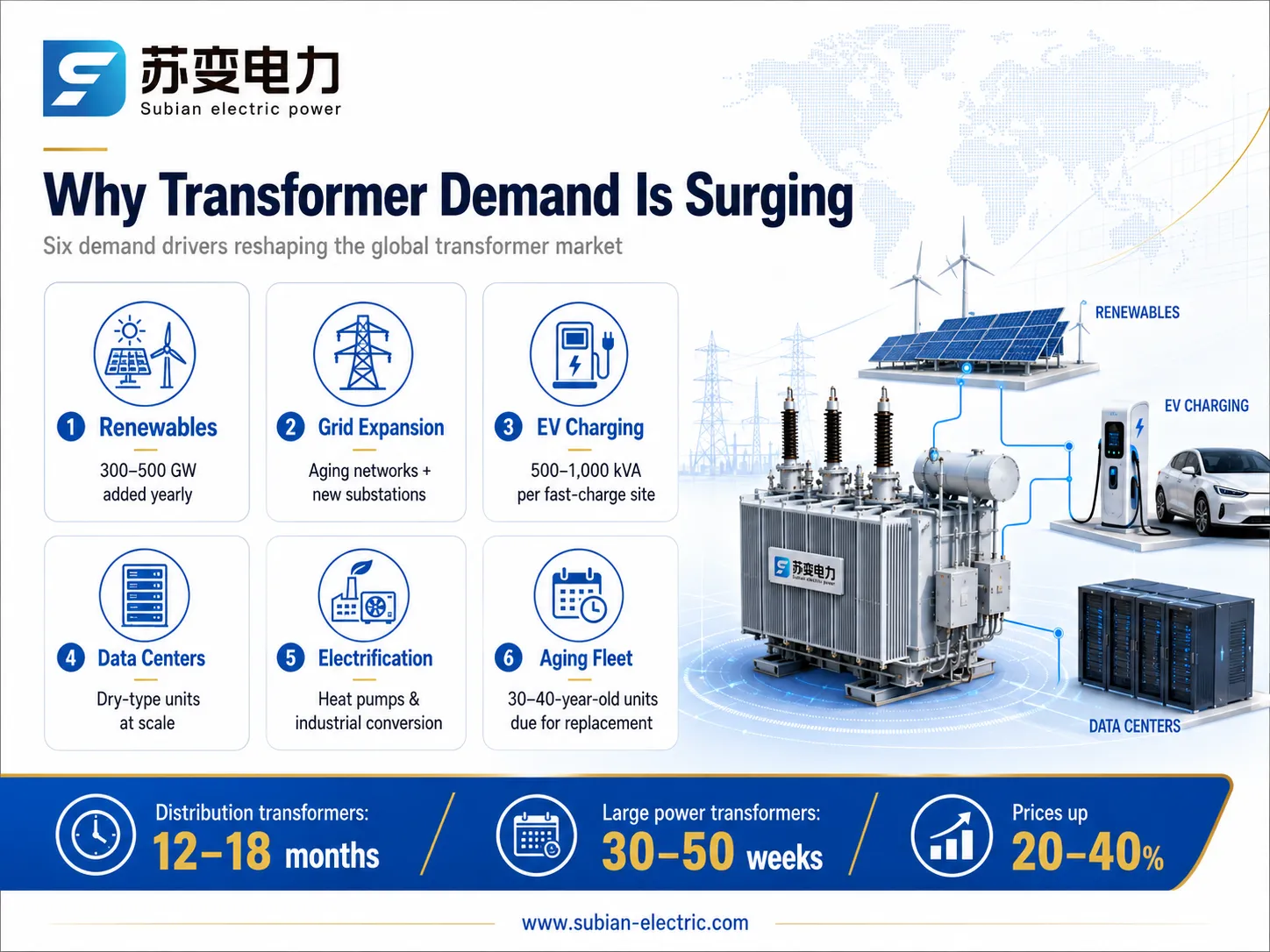
Examinons les calculs. Pour développer 1 mégawatt de puissance à partir du vent ou du soleil, une capacité de transformateur d'environ 1,5 à 2 MVA est nécessaire. Une station de recharge rapide typique pour véhicules électriques nécessite une capacité de transformateur de distribution de 500 à 1 000 kVA. Chaque campus de technologie de l'information d'un gigawatt consomme des dizaines de transformateurs à sec. Par conséquent, alors que l'Agence internationale de l'énergie prévoit une augmentation de la consommation d'électricité d'environ 4 à 5 pour cent par an jusqu'en 2030, il est facile de deviner que la production de transformateurs devrait augmenter dans la même proportion.
Pourquoi la demande de transformateurs augmente-t-elle ?
| Conducteur | Impact de la demande de transformateurs | Échelle |
|---|---|---|
| Énergies renouvelables | Unités de surélévation dans chaque usine | 300 à 500 GW ajoutés chaque année |
| Expansion du réseau | Remplacement et nouvelles sous-stations | Base vieillissante + développement du réseau |
| Recharge de véhicules électriques | Transformateurs de distribution par site | Millions de chargeurs prévus |
| Centres de données | Unités à sec à grande échelle | Campus de 50 à 150 MW |
| Électrification | Pompes à chaleur, conversion de l'industrie | Charge croissante par connexion |
| Flotte vieillissante | Remplacement d'unités de 30 à 40 ans | Grande part de la base installée |
Inclure le fait que de nombreux transformateurs électriques du monde ont été fabriqués dans les années 1980 à 1990 et approchent maintenant de la fin de leur vie, et nous avons une situation qui a poussé la croissance de la production manufacturière de l'industrie à un étonnant 2 à 3%. En d'autres termes, nous faisons face à de longs délais de livraison, des coûts plus élevés et de nouveaux investissements dans des usines de transformateurs à travers le monde.
Les avancées technologiques redéfinissent les transformateurs
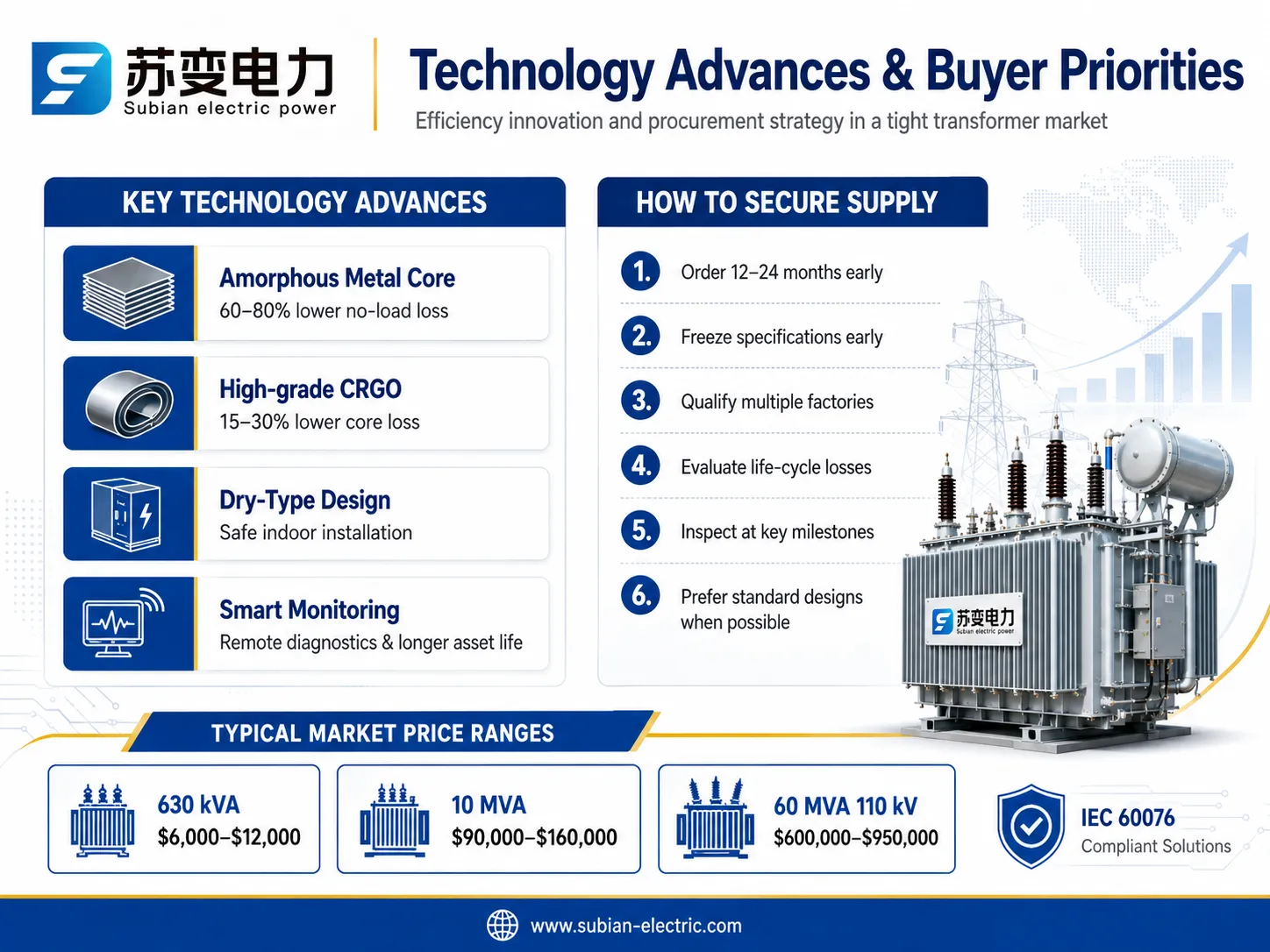
- Cœurs en métal amorphe : fabriqués à partir d'alliages solidifiés rapidement, ils réduisent les pertes sans facteur de charge de 60 à 80 % par rapport à l'acier au silicium conventionnel, ce qui est critique pour les transformateurs qui fonctionnent 24 heures sur 24.
Acier au silicium à faible perte : des grades à haute perméabilité avec une technologie de gravure au laser permettent une réduction des pertes de 15 à 30 % avec des coûts minimaux.
Types secs en résine coulée : l'isolation époxy non combustible permet une installation sûre à l'intérieur et un faible entretien ; elle est excellente pour les zones urbaines et les endroits à risque d'incendie.
Surveillance intelligente : l'analyse des gaz dissous, les capteurs de décharge partielle et les jumeaux numériques transforment les transformateurs en dispositifs surveillés pouvant être gérés à distance.
Éco-conception et réglementations : des réglementations telles que le Règlement européen sur l'éco-conception (UE) 2019/1783 et le DOE américain 10 CFR 431 augmentent les normes d'efficacité à chaque nouvelle itération.
Efficacité et réduction des pertes
| Technologie | Réduction des pertes à vide | Impact sur le coût initial | Retour sur investissement |
|---|---|---|---|
| CRGO standard (M5) | Référence | — | — |
| CRGO de haute qualité (M3/M4) | 15–30% | +5–10% | 3–6 ans |
| Noyau en métal amorphe | 60–80% | +15–30% | 4–8 ans |
| Conception amorphe + à faible perte | 70–85% | +20–35% | 5 à 9 ans |
Pour un transformateur de distribution de 630 kVA qui fonctionne en continu, réduire la perte à vide de 1 100 W à 450 W avec un noyau amorphe permet d'économiser environ 5 700 kWh par an—environ 1 500 à 1 750 par an à 0,09 à 0,13 €/kWh, soit 10 000 à 15 000 sur 20 ans. C'est pourquoi les services publics et les régulateurs poussent à la transition vers des transformateurs à faible perte malgré des coûts initiaux plus élevés.
Dynamique du marché : prix et délais
Le marché des transformateurs est devenu extrêmement tendu depuis le début de 2021. Les prix des matières premières telles que le GOES (acier électrique orienté grain), le cuivre et l'huile de transformateur ont augmenté tandis que les capacités de production n'ont pas réussi à se redresser aussi rapidement que nécessaire. En 2024, les délais de livraison ont atteint environ douze à dix-huit mois pour les transformateurs de distribution et trente à cinquante semaines pour les grands transformateurs de puissance (et certains ont dépassé deux ans), tandis que les prix ont augmenté de vingt à quarante pour cent par rapport aux prix d'avant 2020. Beaucoup pensent que le marché passera d'environ 50 à 60 milliards à environ 70 à 90 milliards d'ici 2030 grâce à des investissements en capital.
L'implication pour les clients est que les montants de planification et de paiement sont différents de ceux d'avant. Les projets qui commandaient auparavant les transformateurs quelques mois avant la mise en service ont maintenant commencé à passer les commandes douze à vingt-quatre mois à l'avance, et un prépaiement moyen de vingt à quarante pour cent est devenu une pratique courante.
Transformateurs dans le réseau moderne
Le système de réseau actuel utilise les transformateurs de manière extensive et avec une grande efficacité. L'énergie provenant de sources renouvelables est transmise à travers divers transformateurs car ils sont responsables de l'interface avec des équipements de régulation comme les transformateurs GSU, les transformateurs de distribution, etc. De plus, le système actuel de batteries de stockage repose également sur l'utilisation de transformateurs. Les convertisseurs HVDC qui nécessitent des connexions AC, et les stations de production d'énergie solaire, ainsi que la recharge de véhicules électriques qui utilisent des transformateurs de distribution, impliquent que les transformateurs doivent être capables de produire un flux d'énergie bidirectionnel.
Types de transformateurs clés pour la transition
| Taper | Rôle dans la transition | Évaluation typique |
|---|---|---|
| Élévation du générateur | Centrale éolienne/solaire → réseau | 1–60 MVA |
| Transformateur de distribution | Chargeurs EV, maisons, approvisionnement C&I | 50–2 500 kVA |
| Type sec | Centres de données, approvisionnement urbain intérieur | 100–5 000 kVA |
| Distribution à noyau amorphe | Réseaux ruraux et urbains à faibles pertes | 100–2 000 kVA |
| Transformateur de conversion | Interfaces HVDC et stockage de batterie | 50–500 MVA |
Spécifications pour les projets de transition énergétique
| Puissance | Application | Pertes à vide | Pertes en charge | Efficacité |
|---|---|---|---|---|
| 1 000 kVA | Site EV, petit parc solaire | 800–1 400 W | 7 500–10 500 W | 98.5–99.0% |
| 2,500 kVA | Hall de centre de données | 1 800–3 200 W | 15 500–22 000 W | 98.7–99.1% |
| 10 MVA | Collecte solaire/éolienne | 8 000–11 000 W | 55 000–75 000 W | 99.0–99.3% |
| 60 MVA | Sous-station électrique | 35 000–50 000 W | 240 000–330 000 W | 99.3–99.5% |
Marques et gammes de prix
| Marque | Pays | 1 000 kVA | 10 MVA | Force |
|---|---|---|---|---|
| Hitachi Energy | Suisse/Japon | $15 000–$25 000 | $140 000–$220 000 | Leadership en réseau et énergies renouvelables |
| Siemens Energy | Allemagne | $15 000–$24 000 | $135 000–$210 000 | Grande puissance et service |
| ABB | Suisse | $14 500–$24 000 | $135 000–$210 000 | Empreinte mondiale |
| Schneider Electric | France | $14 000–$23 000 | Sur demande | Éco-conception de distribution |
| Hyosung / HD Hyundai | Corée du Sud | $15 000–$25 000 | $140 000–$220 000 | Force EHV et d'exportation |
| TBEA / China XD | Chine | $9 000–$15 000 | $80 000–$135 000 | Capacité massive, valeur |
| Jiangsu Subian Electric Power | Chine | $8 500–$14 000 | $75 000–$125 000 | IEC 60076 testé, OEM/ODM, export |
Des entreprises internationales comme Hitachi Energy, Siemens Energy, ABB et Schneider Electric dominent le marché grâce à leur expertise en ingénierie, leur compétence EHV et leur soutien mondial. Ce fait se reflète dans leurs prix plus élevés. Pendant ce temps, dans les domaines de la distribution et de la puissance moyenne, où il y a un grand besoin de technologie de transition énergétique, la disponibilité est un problème. La Chine aide à cela car elle produit un certain nombre de technologies dans ce domaine. Jiangsu Subian Electric Power est un leader mondial dans la production de transformateurs conformes à la norme IEC 60076 de 50 kVA à 110 kV pour les secteurs solaire, éolien, EV et utilitaires. Les clients peuvent mettre en œuvre leur propre logo et obtenir des inspections tierces de Jiangsu Subian Electric Power à un coût bien inférieur à celui de les faire en Europe.
Comment sécuriser l'approvisionnement dans un marché tendu
- Commencez l'approvisionnement 12 à 24 mois avant la mise en service de toute grande unité ; considérez le délai de livraison des transformateurs comme une planification critique.
- Gel des spécifications tôt : tension, impédance, pertes, accessoires—les changements tardifs coûtent du temps dans un carnet de commandes complet.
- Diversifiez l'approvisionnement : qualifiez au moins deux usines (une internationale, une usine directe) avant d'en avoir besoin.
- Évaluez la technologie de réduction des pertes (noyau amorphe, GOES de haute qualité) avec une évaluation de $3,000–$8,000 par kW.
- Négociez des paiements d'étape et inspectez à des étapes clés plutôt que d'accepter une surprise en fin de ligne.
- Renseignez-vous sur la capacité excédentaire et les conceptions standard—les unités standard expédient plus rapidement que les unités sur mesure dans tous les marchés.
Questions Fréquemment Posées
Pourquoi les délais de livraison des transformateurs sont-ils si longs en ce moment ?
La demande a explosé en raison des énergies renouvelables, de l'électrification, des mises à niveau du réseau et d'une base installée vieillissante, tandis que la capacité de fabrication a crû lentement. Les délais de livraison pour les transformateurs de grande puissance ont atteint 30 à 50 semaines (et plus de 2 ans pour certaines unités EHV), avec des transformateurs de distribution à 12 à 18 mois dans plusieurs marchés. Les investissements en capacité annoncés depuis 2023 devraient progressivement atténuer cela, mais commander tôt reste essentiel.
Comment les prix des transformateurs ont-ils changé ces dernières années ?
Les prix ont augmenté de 20 à 40% par rapport aux niveaux d'avant 2020 en raison de la hausse des coûts des matériaux (GOES, cuivre, huile) et de la capacité limitée. Un transformateur de distribution de 630 kVA coûte désormais $6,000–$12,000, une unité de 1,000 kVA $9,000–$18,000, et un transformateur de puissance de 10 MVA $90,000–$160,000. Attendez-vous à une variation régionale supplémentaire à mesure que les coûts de capacité et de fret s'ajustent.
Quelle technologie de transformateur est la plus importante pour la transition énergétique ?
Transformateurs à noyau amorphe pour des pertes à vide ultra-basses, plus des unités de type sec pour un déploiement sûr en intérieur dans des environnements urbains et de centres de données. Pour les grandes installations, les transformateurs GSU et de conversion à haute efficacité intègrent les énergies renouvelables et le stockage au réseau. La surveillance et la technologie de jumeau numérique deviennent standard sur les actifs plus importants.
Quelle capacité de transformateur l'énergie renouvelable nécessite-t-elle ?
Environ 1,5 à 2 MVA de capacité de transformateur par MW de génération renouvelable, selon l'architecture de l'installation. Un parc solaire de 100 MW nécessite généralement plusieurs transformateurs élévateurs de 25 à 40 MVA ainsi que des dizaines d'unités de distribution à moyenne tension, et la même rareté des transformateurs qui affecte les services publics touche chaque développeur d'énergie renouvelable.
Que doivent faire les acheteurs pour éviter les retards d'approvisionnement ?
Planifiez 12 à 24 mois à l'avance, figez les spécifications tôt, qualifiez plusieurs usines, préférez les conceptions standard et envisagez des partenaires directs d'usine qui peuvent réserver des créneaux de production. Inclure un spécialiste des transformateurs dans l'équipe de projet dès le premier jour est la mesure la plus efficace pour éviter les retards.
Références
- Perspectives de l'énergie mondiale de l'IEA 2023 — projections sur la demande d'électricité, les énergies renouvelables et les besoins en infrastructure de réseau.
- Rapport sur le marché de l'électricité de l'AIE — croissance de la demande et tendances du système électrique jusqu'en 2030.
- IEC 60076-1 : Transformateurs de puissance – Exigences générales — référence mondiale pour les classifications, tolérances et tests.
- Règlement de l'UE sur l'écoconception (UE) 2019/1783 pour les transformateurs — niveaux d'efficacité minimale obligatoires dans l'UE.
- U.S. DOE : Normes d'efficacité des transformateurs de distribution — règles d'efficacité obligatoires pour le marché américain.
- NEMA TP-1 — la référence d'efficacité nord-américaine pour les transformateurs de distribution.
- Jiangsu Subian Electric Power — fabricant de transformateurs fournissant des unités conformes à la norme IEC 60076 pour des projets renouvelables, utilitaires et industriels dans le monde entier.
Conclusion
Le transformateur est la force clé qui mène la transformation énergétique mondiale car chaque mégawatt renouvelable, chaque chargeur de véhicule électrique, chaque salle de centre de données et chaque mise à niveau de réseau est construit autour de lui. L'industrie est sous pression : des délais de livraison longs et des prix plus élevés sont la manière dont le marché indique que le monde a besoin de plus et de meilleurs transformateurs, mais la technologie progresse pour répondre à ce besoin : des noyaux amorphes, des normes d'éco-conception et une surveillance intelligente rendent les hubs du futur moins coûteux à exploiter et plus faciles à gérer.
- La croissance des renouvelables nécessite 1,5 à 2 MVA de capacité de transformateur par MW — commandez tôt.
- Les noyaux amorphes et de haute qualité réduisent les pertes à vide de 15 à 80% avec un retour sur investissement en 3 à 9 ans.
- Diversifiez l'approvisionnement et figez les spécifications pour survivre à un marché avec des délais de livraison de 30 à 50 semaines.
Que vous vous associiez à un leader mondial comme Hitachi Energy ou Siemens Energy ou à un fabricant direct comme Jiangsu Subian Electric Power, commencez la conversation tôt, vérifiez la documentation des tests et privilégiez l'efficacité sur l'ensemble de la durée de vie de l'actif. Les transformateurs que vous commandez aujourd'hui porteront la transformation énergétique pour les trente prochaines années.