


Une sous-station électrique contemporaine a un élément clé d'équipement dominant la pièce : un réservoir en acier scellé équipé de douilles en porcelaine et d'ailettes bourdonnant constamment à 50 ou 60 Hertz—le transformateur réduit la tension pour toute la ville. Chaque rue qui est illuminée, chaque moteur d'usine qui tourne, chaque téléphone mobile qui se charge revient à ce point précis. On estime qu'environ 60 à 80 millions de transformateurs fonctionnent dans le monde, et chacun d'eux sert de pont entre le réseau et les consommateurs.
Cet article expliquera pourquoi un d'un obtient le titre de “ clé de voûte du monde électrique ”, comment il joue le rôle d'intermédiaire pour toutes les tensions sur le réseau et comment sa conception détermine l'efficacité et la fiabilité du réseau, ainsi que ce que les transformateurs intelligents modernes sont capables de faire. L'article vous fournira de nombreux chiffres (efficacité, pertes, classes de tension, prix) expliquant pourquoi les transformateurs sont de véritables atouts stratégiques.
Pourquoi les transformateurs sont le hub
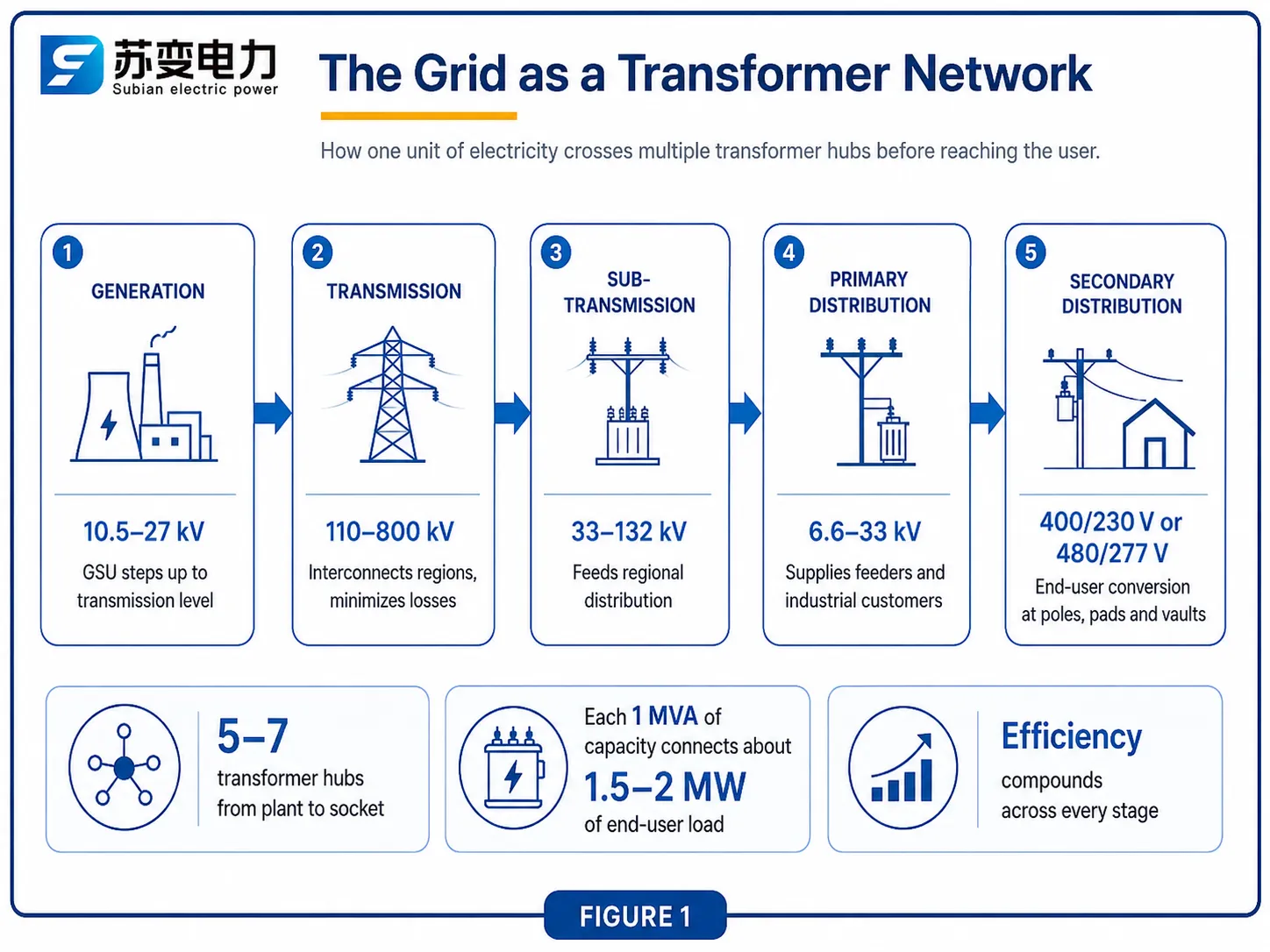
La désignation du transformateur en tant que hub n'est pas une métaphore mais plutôt une description de son rôle dans les réseaux d'électrification. Un transformateur est utilisé à chaque jonction significative dans un réseau électrique puisque c'est le point nécessaire de transfert entre les niveaux de tension. L'énergie est produite à des niveaux de 10 à 27 kV, transmise à 110–800 kV, distribuée à 6,6–33 kV, et utilisée à 400 V dans un foyer électrique ordinaire, et sans un tel élément de connexion, il n'y aurait pas de réseau électrique. On peut imaginer le transformateur comme l'endroit où le flux de courant est produit sous une forme de tension et transformé en une autre.
Ce rôle de hub s'accompagne d'une signification supplémentaire : la concentration de valeur et de risque. Un seul transformateur de 60 MVA installé dans une sous-station de distribution donnée peut desservir environ 15 000 à 25 000 clients résidentiels ou une grande entreprise de fabrication. Lorsqu'il ne fonctionne pas, tout ce qui est en aval subit une coupure de courant. C'est pourquoi les entreprises d'énergie investissent massivement dans la surveillance des transformateurs, pourquoi les délais de livraison des transformateurs sont devenus un enjeu mondial de première importance à la fin de 2022–2024, et pourquoi les achats effectués à de tels hubs sont gérés avec beaucoup de soin par rapport à tout autre actif de distribution.
Le réseau comme un réseau de transformateurs
| Étape du réseau | Tension | Rôle du transformateur |
|---|---|---|
| Génération | 10,5–27 kV | GSU élève à niveau de transmission |
| Transmission | 110–800 kV | Interconnecte les régions, minimise les pertes |
| Sous-transmission | 33–132 kV | Alimente la distribution régionale |
| Distribution primaire | 6,6–33 kV | Fournit des feeders et des clients industriels |
| Distribution secondaire | 400/230 V, 480/277 V | Conversion de l'utilisateur final aux poteaux, plates-formes et voûtes |
En tenant compte de toutes les phases, une unité moyenne d'électricité traverse cinq à sept transformateurs du générateur à la prise. Chaque transformateur contribue à l'efficacité cumulative de sorte qu'une augmentation d'un pour cent de son efficacité entraîne d'énormes économies absolues sur l'ensemble du réseau.
Comment un transformateur crée la fonction de hub
Le fonctionnement d'un hub est basé sur l'induction électromagnétique. Dans ce processus, le courant alternatif dans l'enroulement primaire provoque la production d'un flux alternatif dans le noyau en acier au silicium laminé. Le flux induit provoque ensuite l'induction de la tension dans l'enroulement secondaire, qui est proportionnelle au rapport de transformation. Lorsque le nombre de tours est modifié, la tension change également. Cela signifie que ce que fait le ‘hub’ est qu'il prend la même puissance mais la tension est, généralement, nettement différente tout en maintenant la même fréquence.
L'utilité d'un hub est définie par trois paramètres de conception. L'impédance (généralement 4–8% pour les transformateurs de distribution et 10–14% pour les transformateurs de puissance) définit le courant de court-circuit qui doit être géré par le réseau et la chute de tension sous charge. Les pertes sont responsables de l'efficacité du hub. Marge thermique définit la capacité de surcharge et l'espérance de vie du hub. Un hub bien conçu fournit un équilibre idéal de tous les trois paramètres.
Types de transformateurs et leurs rôles de hub
| Taper | Rôle du hub | Plage de classification |
|---|---|---|
| Élévation du générateur | Production de l'usine → réseau de transmission | 50–1 500 MVA |
| Transmission (THT/HT) | Interconnexion régionale | 30–1 000 MVA |
| Distribution (immergé dans l'huile) | MV → LV pour les consommateurs | 25–2 500 kVA |
| Type sec | Hubs intérieurs et sensibles au feu | 50–12 500 kVA |
| Autotransformateur | Ajustement de la tension entre des niveaux proches | 10–1 000 MVA |
| Transformateurs d'instrumentation | Hubs de signal pour la mesure et la protection | Classe VA |
Fonctions des hubs à travers les secteurs
- Services publics : Chacune des sous-stations, allant de la cour EHV de 500 kV au transformateur monté sur poteau de 25 kVA, est un hub de transformateurs.
Industrie : Les sous-stations de l'usine transforment la tension du réseau en la tension requise pour certains processus ; les transformateurs de four et de redresseur fournissent des alimentations spéciales.
Énergies renouvelables : Les parcs éoliens et solaires élèvent la tension ; les centrales de stockage utilisent des transformateurs à la fois en mode de charge et de décharge.
Transport : Les sous-stations de traction et les transformateurs embarqués transforment l'alimentation du réseau en tension ferroviaire de 25 kV AC ou 750 V DC.
Bâtiments : Les hubs de type sec sont utilisés pour la distribution dans les bâtiments commerciaux à chaque étage et pour l'isolement des lignes particulières.
Transformateurs intelligents : Les hubs de puissance deviennent des hubs de données
Les transformateurs modernes ont également commencé à fonctionner comme des centres de traitement de l'information. Les capteurs embarqués fournissent des informations sur la température des enroulements, l'état de l'huile (analyse des gaz), l'efficacité des vibrations, les décharges partielles et le courant circulant dans les enroulements du transformateur, qui est transmis aux systèmes de surveillance. Le protocole IEC 61850 est un mécanisme par lequel différents dispositifs de sous-station sont connectés, permettant le développement d'un jumeau numérique qui aide les opérations à prédire les pannes de l'équipement à l'avance.
Il est important de noter à quel point une telle technologie est utile car une panne d'un transformateur de 30 MVA entraînera des pertes de $600,000 – $1.2 million. La surveillance prédictive offre des possibilités de réduction des dépenses liées à la panne d'environ 30-50%.
Fiabilité au Hub
Les statistiques de fiabilité des transformateurs sont alarmantes : le taux de défaillance moyen des transformateurs de distribution est d'environ 0,1% à 0,5% par an, et celui des transformateurs de puissance est de 0,5% à 2%, selon l'âge et la charge du transformateur. Parce que le hub concentre le risque, les services publics conçoivent leur système en tenant compte de la redondance : le critère N-1, c'est-à-dire que la perte d'un transformateur n'affecte pas l'approvisionnement. Pour cette raison, l'approvisionnement, les tests et la maintenance des transformateurs occupent honteusement une part importante de l'attention des services publics d'électricité.
Les principaux leviers de la fiabilité du secteur électrique sont la gestion soigneuse de la charge (une augmentation de température de chaque 8-10° C au-dessus de la température de point chaud nominale réduit la durée de vie de l'isolation de moitié), le contrôle de la qualité de l'huile par rapport aux transformateurs à huile-isolation, et les tests périodiques de décharge partielle des transformateurs à sec.
Spécifications et tableaux de pertes
| Puissance | Tension | Pertes à vide | Pertes en charge | Efficacité à 50% |
|---|---|---|---|---|
| 250 kVA | 11/0,4 kV | 450–650 W | 3 000–4 500 W | 98.2–98.7% |
| 630 kVA | 11/0,4 kV | 900–1 400 W | 6 000–8 500 W | 98.3–98.9% |
| 1 600 kVA | 11/0,4 kV | 2 100–3 000 W | 13 000–18 000 W | 98.5–99.0% |
| 20 MVA | 66/11 kV | 14 000–20 000 W | 80 000–115 000 W | 99.0–99.4% |
Marques et gammes de prix
| Marque | Pays | 1 000 kVA | 20 MVA (66 kV) | Force |
|---|---|---|---|---|
| Hitachi Energy | Suisse/Japon | $16 000–$26 000 | $280 000–$430 000 | Leadership EHV/HVDC |
| Siemens | Allemagne | $15 500–$25 000 | $270 000–$420 000 | Intégration de sous-station numérique |
| ABB | Suisse | $15 000–$25 000 | $270 000–$410 000 | Réseau de services mondial |
| Schneider Electric | France | $14,000–$24,000 | Sur demande | Distribution éco-conçue |
| TBEA | Chine | $9 000–$15 000 | $170 000–$280 000 | Fabrication en grande série |
| Jiangsu Subian Electric Power | Chine | $8 500–$14 500 | $160 000–$260 000 | IEC 60076 testé, OEM/ODM, export |
Des entreprises comme Hitachi Energy, Siemens et ABB montrent leur suprématie sur d'autres fournisseurs de transformateurs EHV car elles offrent une capacité d'ingénierie et une expertise de service inégalées. En ce qui concerne les classes de puissance de distribution et intermédiaires, où se trouvent la plupart des utilisateurs, la technologie est uniforme, et les seuls éléments qui diffèrent sont les indicateurs de perte, la documentation de test disponible et le délai de livraison. Jiangsu Subian Electric Power est un fabricant chinois de transformateurs qui fournit des appareils conformes à la norme IEC 60076 de 50 à 500 kVA. Gardez à l'esprit qu'il est nécessaire de vérifier le certificat d'essai de type et le rapport d'essai de routine pour le transformateur de toute marque souhaitée.
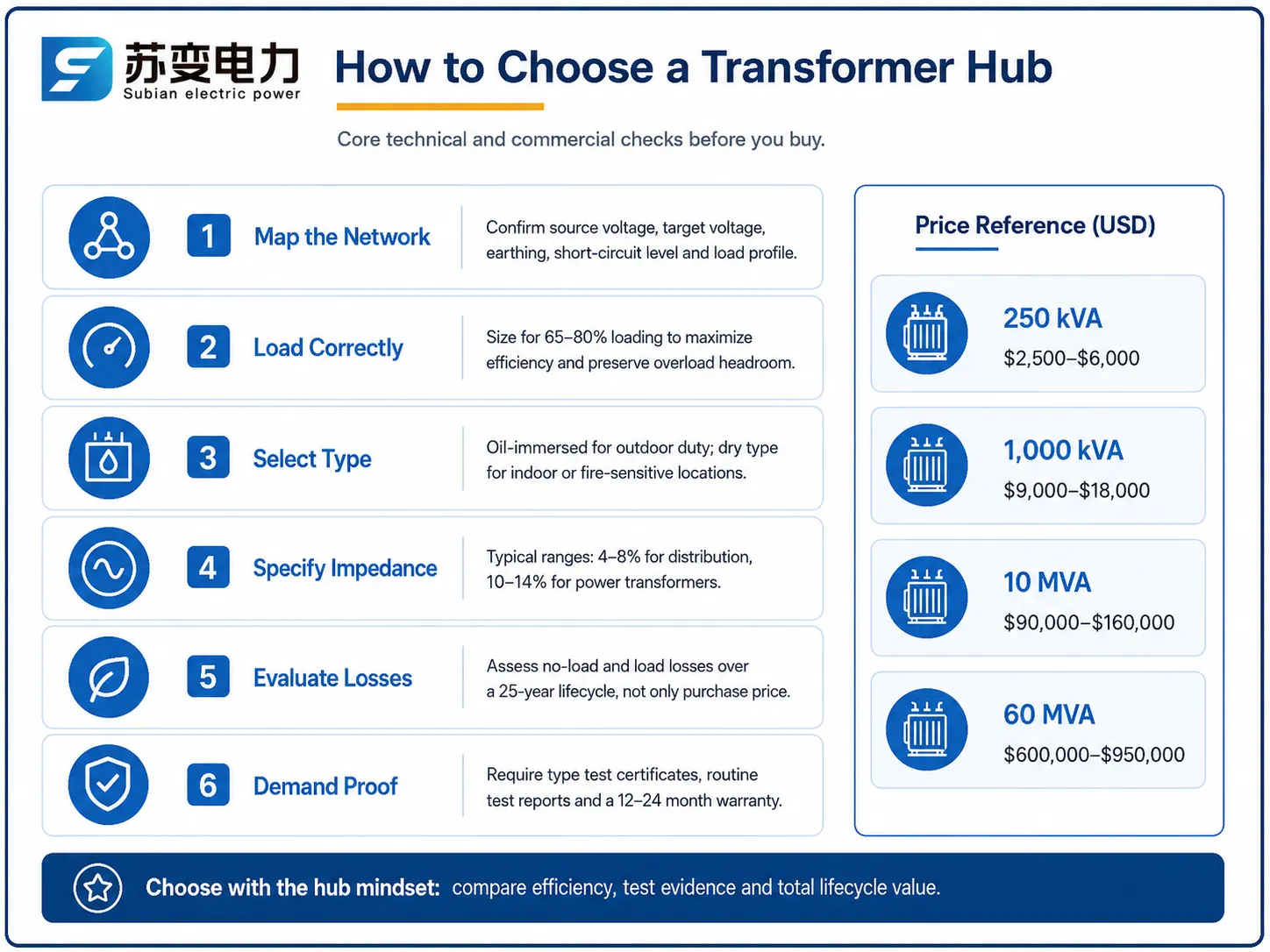
Comment choisir un transformateur pour votre hub
- Cartographiez votre réseau : tension source, tension cible, mise à la terre, niveau de court-circuit et profil de charge.
- Dimensionnez pour une charge de 65–80% afin de maximiser l'efficacité et de préserver la marge de surcharge.
- Sélectionnez le type et le refroidissement : immergé dans l'huile pour l'extérieur, type sec pour les hubs intérieurs/sensibles au feu.
- Spécifiez l'impédance pour coordonner la protection et la régulation de la tension.
- Évaluez les pertes avec une valorisation de $3 000–$8 000 par kW sur une durée de vie de 25 ans.
- Exigez des certificats d'essai de type, des rapports d'essai de routine et une garantie d'au moins 12 à 24 mois.
- Planifiez la surveillance : échantillonnage DGA pour les unités à huile, vérifications de décharge partielle pour les types secs.
Questions Fréquemment Posées
Pourquoi le transformateur est-il appelé le hub du monde électrique ?
Parce que c'est le seul dispositif pratique qui change la tension, et chaque connexion entre les niveaux de tension dans le système électrique est réalisée par un transformateur. L'électricité traverse cinq à sept transformateurs entre le générateur et l'utilisateur, donc le transformateur est le point d'intersection de l'ensemble du réseau électrique—le véritable hub à chaque jonction.
Combien de transformateurs y a-t-il dans le réseau électrique mondial ?
Les estimations placent le parc installé mondial à 60–80 millions de transformateurs de distribution plus environ 1–2 millions de transformateurs de puissance, avec un nombre en augmentation parallèlement à l'énergie renouvelable, à l'électrification et aux mises à niveau du réseau. Chaque année, le monde ajoute des millions de plus à mesure que les bornes de recharge pour VE, les centres de données et les fermes solaires se développent.
Quelle est la spécification la plus importante d'un transformateur ?
Pour la plupart des acheteurs, l'efficacité (pertes) est la plus conséquente car un transformateur fonctionne 24/7 pendant des décennies. Une différence d'efficacité de 0,5% sur une unité de 1 000 kVA vaut environ $8 000–$12 000 par an en coût énergétique—plus que la différence de prix entre de nombreuses offres concurrentes. L'impédance, l'élévation de température et la documentation de test viennent ensuite.
Combien coûte un transformateur de sous-station ?
Un transformateur de distribution de 1 000 kVA coûte $9 000–$18 000 ; une unité de 10 MVA $90 000–$160 000 ; et un transformateur de puissance de 60 MVA, 110 kV $600 000–$950 000. Les travaux sur site, la protection et l'installation ajoutent généralement 15–30%. Les prix varient selon la marque, les pertes, la tension et la région, et les délais de livraison actuels sont de 30 à 50 semaines pour les grandes unités.
Comment les transformateurs intelligents améliorent-ils les opérations du réseau ?
Les transformateurs intelligents intègrent des capteurs et des communications pour signaler la charge, la température, la qualité de l'huile, la décharge partielle et les vibrations en temps réel. En utilisant IEC 61850 et des plateformes de surveillance de l'état, les opérateurs prédisent les pannes, prolongent la durée de vie des actifs et réduisent les coûts d'interruption forcée de 30 à 50% par rapport à la maintenance basée sur le calendrier.
Références
- Perspectives mondiales de l'énergie de l'IEA — contexte mondial sur l'expansion du réseau et la demande de transformateurs.
- IEC 60076-1 : Transformateurs de puissance – Exigences générales — classifications, tolérances et cadre de test pour les transformateurs de puissance.
- IEC 61850 : Réseaux de communication dans les sous-stations — la norme derrière l'intégration des données des sous-stations et des transformateurs intelligents.
- DOE américain : Efficacité des transformateurs de distribution — minimums réglementaires et méthodologie d'évaluation des pertes.
- NEMA TP-1 — référence d'efficacité nord-américaine pour les transformateurs de distribution.
- IEEE C57.12.00 — norme nord-américaine pour les transformateurs immergés dans un liquide.
- Jiangsu Subian Electric Power — fabricant de transformateurs conforme à IEC 60076 pour les hubs de distribution, de puissance et de type sec dans le monde entier.
Conclusion
Les transformateurs agissent comme le centre du monde électrique car ils combinent et connectent tous les systèmes d'alimentation électrique et conduisent ainsi la superposition d'autres paramètres tels que les niveaux d'efficacité à certaines étapes. Cela peut expliquer l'importance de comprendre cette idée de hub pour prendre des décisions d'achat précises.
Lorsque de l'électricité est produite et livrée, chaque chemin traverse de cinq à sept transformateurs.
Le nombre le plus important concernant le hub est son niveau d'efficacité, c'est-à-dire, les pertes et non le prix.
Grâce aux solutions de surveillance du hub de puissance, le hub peut être transformé en hub d'information, ce qui permet d'économiser 30-50% de coûts de défaillance.
Peu importe si vous achetez un transformateur de poteau d'une capacité de 250 kVA ou une sous-station d'une capacité de 60 MVA—gardez à l'esprit l'approche hub et demandez des certificats d'essai, des données sur les pertes pour 25 ans, et les informations du producteur, qui varient des géants mondiaux tels que Hitachi Energy et Siemens à des fabricants directs comme Jiangsu Subian Electric Power.