


Whenever an appliance group stops working altogether, like refrigerators, televisions, microwaves or garage door closers, the transformer of the electric line is blamed. Although at times this may be true, there could be cases when the cause of failure is much more complicated than just saying that “the transformer failed.” This indicates that discovering the real cause will allow to prevent the failure in future as well as to know whether the liable party should take responsibility or not. This article will explain how transformers can damage appliances, give five main malfunctions that cause devices to break, and check whether the worst breakage exists. Besides, it will warn readers about the symptoms of malfunctions in devices.
To put it simply, if a transformer is not functioning properly, there may be a problem with appliances. Usually, it is not the case of transformer failing, but there is another issue with neutral wire. Neutral wire is what creates a neutral point in the transformer and creates stable 120 V lines. If neutral wire breaks, both wires will be receiving 240 V voltage. Depending on the load, some energy will be lost in the transformer. One of the outputs will have a small amount of voltage (in case load is small,) and output voltage will not exceed 70 V. In this situation electric appliances will be ruined and burned out by that energy, and some machines with motors, such as coolers and ACs will also break down.
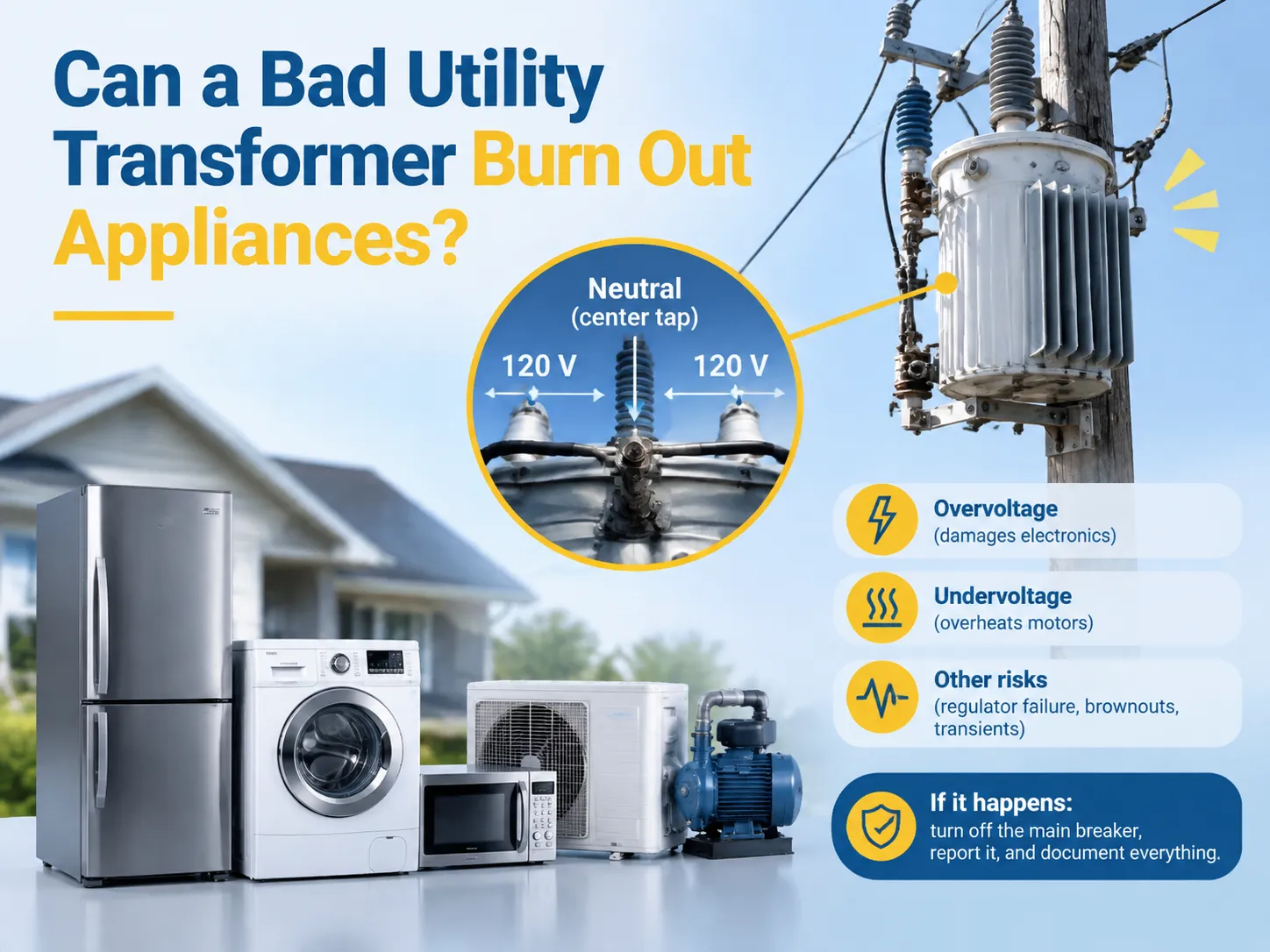
How a Transformer Damages Appliances
Transformers keep the working voltage of a transformer low enough to be used in residential buildings such as houses. In North America, the distribution transformer reduces the high voltage through the use of a center-tapped wire. This wire works as the reference point or neutral wire. This wire stays on ground making it function thus without any ad hoc connections.
The outgoing wires carry the voltage in between different points. In both cases, the wires have a fixed voltage. No matter how many appliances are connected to either source of power, the transformer always keeps the benefits of the existing system.
Thus, it can be said that in connection problems with appliances lead to damage related to the appliance, rather than to the transformer. In rare cases it does happen that the transformer could be faulty. But most of the cases relate to neutral wires. The underlying physics of the supply arrangement is worth understanding before diagnosing a failure, and it is explained from first principles in our guide to nozioni di base sui trasformatori di distribuzione.
The Lost Neutral: The Real Culprit
The open neutral issue, which is sometimes also known as a lost neutral or a loose neutral fault, is the most common fault seen in residential power supply. The cause can also be missed because symptoms of this problem usually appear to be random breakdowns of different appliances and not a supply fault.
The process in such an event involves the two legs of the power being connected by the neutral at all times. When the neutral fails, however, the two legs no longer have a stable reference. The two legs act as a series-connected circuit. The load on one leg must experience the same amount of current as the load on the other leg, because the two legs become one circuit. Therefore, the voltage gets distributed between the two legs of the circuit relative to their resistances.
The situation can be quite different depending on what kind of load is connected to each leg. In one case, if one leg carries only a little load and the other leg carries a big load, most of the voltage will be supplied to the load that is consuming less power. For instance, if the load on one leg is 6 amps and on the other one is 4 amps, there would be 144 volts on the lighter load and 96 volts on the heavier load.
There are two different ways in which damage can occur as a result of electrical problems with an open neutral. In the case of the overloaded leg, too much voltage allows for too much current to flow through certain components of the circuit causing them to heat too fast and malfunction. In turn, on the second leg, appliances will try to achieve the same output but they have less voltage thus they will draw more current and overheat.
The asymmetry that influences the process is that bigger appliances such as electric stoves, water heaters, and dryers are connected to both legs of the system and would get approximately the same voltage even if the neutral is lost. The rest of the skirting involves the actual 120 volt lines, which is the case in most modern households.
The neutral is also the part of the system most exposed to the elements, and the connection that fails most often is the one nobody inspects. A loose or corroded neutral at the transformer, at the weatherhead, or at the meter base is a maintenance problem, and it belongs in a preventive programme rather than a repair call, as set out in our lista di controllo per la manutenzione del trasformatore.
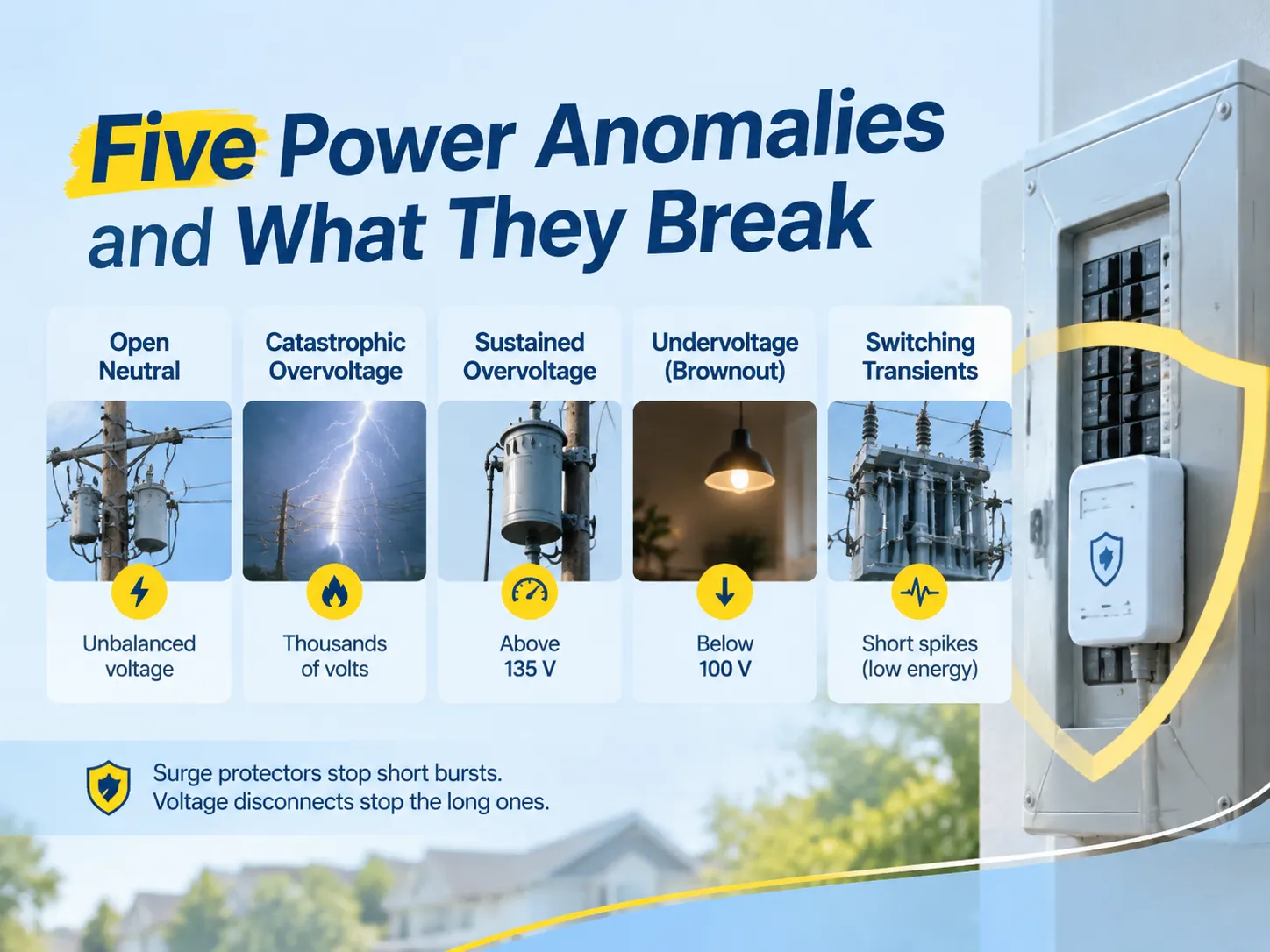
Five Power Anomalies and What They Break
Recognizing the differences in these cases because each must be approached with a different prevention plan and liability situation.
| Anomaly | What causes it | Voltage behaviour | Typical damage |
|---|---|---|---|
| Open neutral | Broken, corroded, or high-resistance neutral at the transformer, service drop, weatherhead, meter base, or panel | One leg rises above 120 V (up to about 170-240 V), the other falls below (sometimes under 70 V) | Electronics and control boards on the high leg; motor windings on the low leg |
| Catastrophic overvoltage | High-voltage line contacting a lower-voltage line through ice, falling trees, or vehicle accidents | Thousands of volts may enter the service | Widespread destruction of connected equipment; fire risk |
| Sustained overvoltage | Failed utility voltage regulator or a damaged distribution transformer | Typically above about 135 V on a 120 V service | Premature failure of electronics, lamps, and motor insulation |
| Undervoltage (brownout) | Overloaded transformer, overloaded utility or building wiring, faulty regulator | Typically below about 100 V on a 120 V service | Motors overheat and fail; electronics behave erratically |
| Switching transients | Utility switching operations | Short-duration voltage spikes, generally low energy | Usually controlled by suppression; minor cumulative stress |
The chart also shows a restriction that surprises many homeowners. A surge arrestor that is located at the point of service entry is engineered to shield against brief, but powerful surges. However, it does not significantly protect against prolonged over-voltage or loss of the neutral since those conditions exceed the limits of the surge arrestor, meaning that this piece of equipment, such as a metal oxide surge arrestor, will suffer thermal runaway, burn and stop functioning. The actual protective tool in such cases is a circuit breaker which disconnects the supply in an over-voltage situation.That distinction, and the maintenance regime that keeps protective components healthy, is covered alongside the failure modes in our article on what causes transformers to fail.
Warning Signs
A faulty neutral or transformer gives signals before electrical failures occur. The signs are easily recognizable.
- Lights that flicker when other equipment is switched on or off. This is the main sign, which might appear trivial.
- Lights that are extremely bright while some of the others are dimming at the same time. These differences provide a clue.
- Bulbs that blow out much more frequently than they should, especially one one side of the house.
- Some devices performing in an unusual way — a fridge working strangely, a microwave resetting itself, a computer being rebooted, a garage door opener malfunctioning.
- A burning odor near wall sockets, or colored faceplates.
- Receiving an electric shock from an appliance with a metallic case means that the electricity has found an unintended route.
- Burnt or damaged surge protectors, especially if happened with several devices simultaneously.
Any combination of these symptoms needs an immediate reaction instead of beain observing. A voltage test on several wall sockets that are connected to different circuits will give a quick answer: one leg of the circuits shows 120V voltage while the other one demonstrates much lower values.
What to Do When It Happens
One needs to focus on the order of the process since the first thing to do is to turn off the electricity.
- The first step would be to disconnect the main switch. Turning off the source of power stops the losses and takes away the chances of fire while there is still a defect. This is the most important thing here.
- You need to contact the utility immediately and use the emergency number instead of the regular inquiry department. The problem is usually in their part of the meter, for example, at the transformer, and only they can fix it.
- The main switch may not be turned on again until the utility personnel or a licensed specialist have checked the source of power supply. If you turn the electricity back while the problem is still there, the problem may reappear even worse than it was before.
- Write down everything. Take photos of the damaged appliances, make sure they are kept and not thrown away, keep bills and some information on when the event happened or when the appliances were bought.
- One needs to provide the diagnosis in writing. A statement that will identify the cause of the failure will be crucial for the claim and will separate issues with the service provider from the failure of your system.
- When the electricity is back to normal, have an electrician visit and check the panel and service drop since it can be damaged, with the grounding connection being broken.
Who Pays for the Damage
The straightforward answer to the aforementioned question is that it relies on the location of where the fault occurs. Nevertheless, it can still be stated that the system is reliable enough to respond in a similar manner each time.
If the issue occurs in the utility’s area of the meter (e.g., transformer, service drops, connection points on poles), the utility will be liable in this case, and most utilities have a claims procedure in place for the equipment that is damaged in this respect. When the damage happened from the point where the meter is found and in the building’s electrical system, this may be termed as the property owner’s responsibility, thus the electrician should be contacted for further assistance. It is essential to point out that in case a landlord, property manager, or body corporate is responsible for the distribution equipment, the liability for the fault lies with them instead of the utility, so it is advisable to check on this matter before turning to a utility for compensation.
In practice, there are three key factors that determine whether the claim would be successful, namely timely notice depending on the timeframe set by the utility, proof that the fault originated from an equipment problem and proof of the damage of equipment. It is worth considering that homeowner’s insurance may insure the loss, or some surge protection devices have equipment coverage, but the insurance limits in this case are not significant. The main point remains that it is advisable to report the accident on the same day, keep the damaged devices and learn more about the utility’s claims process instead of having a false assumption that the matter has no value.
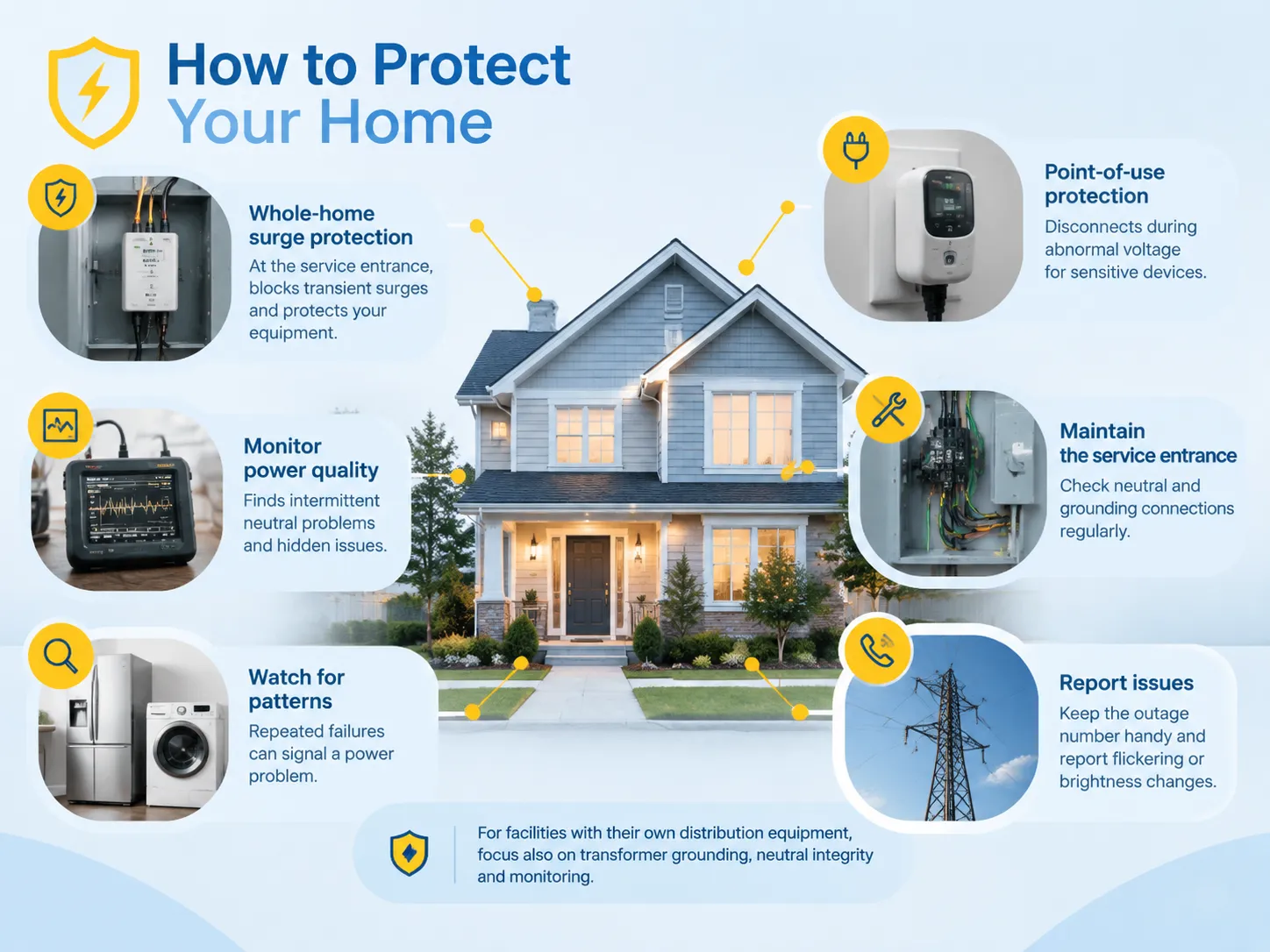
How to Protect Your Home
A homeowner may not be able to stop the corroding of the utility neutral, but it can be minimized.
- Buy a whole-house surge protection device. This piece of safety equipment does not help in case of overvoltage or loss of the neutral, but it does eliminate momentary malfunctions useful in prolonging the life of equipment and saving lots of money.
- Think about adding point-of-use protection in regard to touchy electronic devices. Devices helping with electrical protection through electrical disconnection when voltage is outside the acceptable range are nice to use and are much better than non-active devices.
- Think about purchasing a voltage monitor or power quality recorder. Problems with neutral may be rather hard to detect so the recorder left for a week can do what a single measurement cannot.
- Check service equipment regularly. Ensure connections for the neutral and grounding are checked regularly by an electrician.
- Make sure to check if there are similar failures. One appliance failure can be perceived as a coincidence; three failures in a small period of time may be a key to what is happening.
- Also remember about utility outage phone number and don’t hesitate calling them in case of flickering even if nothing bad has happened yet.
For facilities with their own distribution equipment, the same logic applies with more at stake, and the protective measures available at the transformer level — earthing arrangements, neutral integrity, and monitoring — are covered in our guide to basi della messa a terra dei trasformatori.
Where a site is specifying new distribution equipment and wants documented protection characteristics rather than assumptions, a certified unit with published test data is the starting point. Our gamma di trasformatori di distribuzione shows the specification detail a buyer should expect to see.
Why Transformers Fail in the First Place
The comprehension of several types of failures is Valuable because it gives distinction between failure-provoking events and those that are just turning off power supply.
- Overloading and overheating. A transformer which is overloaded deteriorates faster, as the insulation is temperature-dependent; the relation between the temperature and insulation quality is strict and clear – the insulation will last half as less at 6-8 degrees higher than its norm.
- Insulation deterioration. Paper insulation degrades chemically within decades of time making it fragile and losing its dielectric qualities until the failure takes place.
- Lightning strikes and switching type surge. Lightning strikes take a toll on the insulation of transformer windings over many years.
- Oil deterioration and moisture ingress. In oil-filled transformers, moisture and oxidation make the dielectric properties lower.
- Corroded or loosened joints. The terminations of transformer and neutral become corroded and unattached with time. It is not the most interesting type of failures because just having failed neutral one can’t see anything apart from gradual minor failures of equipment till someone checks voltage.
- External damage. Broken vehicles, storm debris, and animals cause many failures.
The key factor is that failures that cause damage are of least evident nature. A transformer that fails catastrophically causes visible power outage and calling a repair crew, while the failed neutral only generates slow accumulation of new non-explained failures of equipment.
FAQ
What are the signs that a transformer is going bad?
From the consumer’s perspective, signs of transformer trouble are electrical rather than mechanical. For example, lights flickering or dimming every time equipment on different circuits is used, strange bulb brightness (sometimes one bulb is too bright while others are dim), lamp burning out frequently, malfunction of electronic gadgets, unusual smell. From the electrical supplier’s viewpoint, the signs include leakage of oil, strange sound, overheating, and increased level of gas dissolved in the insulating oil. Importantly, sometimes malfunctioning transformers give no visible signs on the outside so as soon as electricity-related problems occur, one should take measurements to identify faulty equipment instead of ascribing everything to bad luck.
Who pays when a power surge ruins your appliances?
It is possible to determine the responsibility depending on the specific circumstances. In general, when a power surge takes place due to an issue occurring on the electricity supply side of the meter (e.g., faulty transformer neutral, damaged service drop, faulty regulator), the electricity supplier will be liable and may offer you a formal procedure for making a complaint for damaged appliances. On the other hand, if the electrical failure took place after the meter and was linked to the building wiring, the property owner will be responsible for that. If the distribution cable is owned by the landlord/property management company, the latter will be liable for damages. To get reimbursement, one should report the issue to the electricity company as soon as possible within the time frame the utility specifies.
What causes a transformer to burn out?
The leading reasons for transformer malfunction are prolonged overload, insulation aging over the decades, lighting and switching surges, humidity and oil deterioration for oil-filled transformers, and damage from rain, cars, and animals. Out of all these causes, overloading and aging insulation makes up the majority of cases. In fact, transformer burnout causes blackout, while failure of the transformer neutral connection may result in burning of the electrical appliances.
Does the power company know when a transformer blows?
Usually, utility companies are aware of the situation sometimes. New generating plants are equipped with various monitoring systems that help identify problems that have occurred at substations and along the feeder lines, while smart meters give them information about the voltage at particular houses. In case of dramatic transformer failure, protection systems will go off and alert the utility. However, in case of slow neutral problems or gradual insulation degradation, no alerts can be sent by the transformer which is why customers’ reports are so important.
Riferimenti
- NFPA — National Electrical Code, Service Grounding and Bonding Requirements
- U.S. Department of Energy — Power Quality and Distribution System Reliability
- EPRI — Distribution Transformer Failure Modes and Condition Assessment
- IEEE — Power Quality Standards and Transformer Loading Guides
- UL Solutions — Surge Protective Devices (UL 1449)
Conclusione
When considering transformers, it is uncommon to think of disasters caused by a faulty transformer. Most transformer failures are awesome events where transformers burn out, generating a lot of electricity without harming other electrical devices. In contrast, when a failure occurs that shuts down all the appliances in the kitchen, it makes no noise at all: because of the loose or corroded neutral connection, the reference voltage may fluctuate from 40 V to 200 V instead of being constant at 120 V. Some indicators could be used to identify the issue: brightness of appliances, light in the two circuits mentioned above. In solving the problem, one has to turn off the main breaker, call the utility crew and register the incident.