

見積もりをリクエスト
ニュース

Transformer Technology Innovation Drives Industrial Upgrading and Business Model Transformation

In 2023, a German mid-sized production company replaced its twelve traditional transformers by newer amorphous-core models and acquired a global monitoring platform. The decision was not taken by the engineering department but by the CFO of the company who realized that the 40% rise in energy prices can be minimize by cutting transformer losses. This is the birth of the transformer technology revolution: from being a pure technological issue, it became a business machine. Technologies of high efficiency, digital monitoring, and service-oriented models are making transformations in the way utilities, manufacturing, and energy companies acquire, own, and operate transformers.

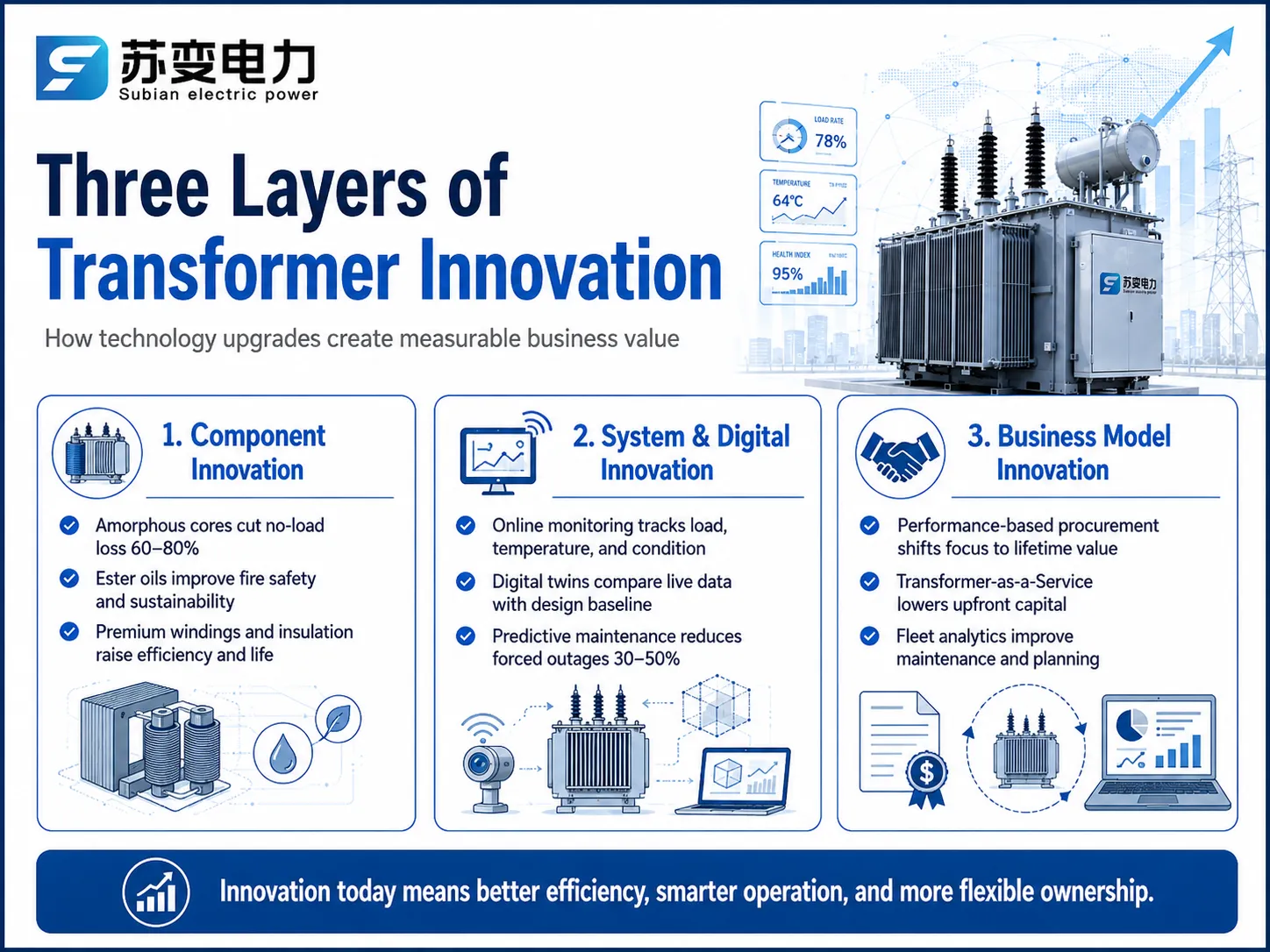
The article examines innovation at three different levels: component technology, system and digital integration, and business model innovation, showing how each level contributes to financial gains. You will find numeric data supporting efficiency improvement, the financial logic of transformer-as-a-service and the steps taken by the companies to switch from buying transformers to acquiring managed power conversion capabilities.

What Is Industrial Upgrading Through Transformer Innovation?

When we talk about industrial upgrading in terms of transformers, it refers to the process of replacing old models of equipment and operating techniques with the most modern efficient and digital technologies, such as changes in a business model that make such technologies useful and usable. This is a process that has two sides. On the one hand, in terms of a piece of equipment, it has to do with new components like: amorphous cores, special steel, copper wire windings, and ester oil which are used to help save energy and improve the lifespan of the machinery. At the same time, in regards to the digital side of the technologies, it involves such aspects like sensors, communication processes, and analytics that allow us to transform our passive equipment into a source of information that needs to be optimized, scheduled, and resource priced. On the business side, all these aspects help to implement new approaches to ownership and service delivery.

This process is important now since the majority of transformers were built in the 1980s and 1990s and thus are close to their expiry date because of more than 25 years of use. It should also be noted that most transformers were created many years ago and have to serve 30 to 40 years, which means that they are very close to the end of their lifetime. At the time of the surge of renewable energy and increasing electrification, the new technology development is what should be used to help the old industry grow effectively in response to the demand.

Layer 1: Component Technology Innovation

Innovation What Changes Business Impact Cost Premium
アモルファス金属コア No-load loss down 60–80% Lower energy bills on lightly loaded units; meets efficiency regulation +15–30%
High-grade GOES + laser domain refinement Core loss down 15–30% Efficiency class compliance at moderate premium +5–15%
Ester oils (natural & synthetic) Fire point > 300 °C, biodegradable Indoor/sensitive siting allowed; lower insurance premiums +10–25%
Aramid / NOMEX insulation 220 °C class systems Higher overload margin, longer thermal life +20–40% (dry-type)
High-purity copper windings Load loss down 20–30% vs. aluminum Lower losses on high-load-factor duty +10–20%
Compact modular designs Standardized building blocks Faster delivery, simpler spares, easier fleet planning ±0–5%

Innovation in components can bring about revolutionary changes in everything as far as costs of transformers are concerned. However, this is also the area in which buyer diligence plays the most important role because the term “high efficiency” has no meaning without a reference to a standard and a test report. Indicate IEC 60076-20, class 1 or 2, and get losses measured in accordance with IEC 60076-1, because that’s what makes marketing claims bankable.

Layer 2: System & Digital Innovation

Digital advancements change a transformer from simple property into a point of an information network. Digital monitoring with dissolved gas measurements, temperature measurement for windings, moisture measurement, and load measurement provides constant data about the status of transformers. The computer processing of incoming data can reveal a load estimate to redistribute loads between transformers so that they work efficiently, give a signal to try to avoid loading and warning the operator about gas rising before failures occur, or assess service life of transformers. Digital copy of transformer can see the current data and compare it with the preset value and estimate the deviation much better than it is done with any other methods of testing.

The economic effect is evident. Researches of power distribution companies that employ online monitoring show a reduction in failure forecast by 30-50% because the majority of failures can be found in the early “moderate” stage when the repair costs are very low compared to the costs of catastrophic failure. Thus, the value chain is: sensor data → anomaly detection → planned intervention → outage avoided, and each step of the process gets more and more automated. That is why monitoring devices are now regarded as the necessity for the critical transformers and are regularly supplied in newly manufactured distribution and transformer.

Layer 3: Business Model Transformation

The most disruptive change currently present in the industry is not technological, but rather a transition from buying equipment to buying the outcome. There are three models dominating the market. The first is performance-based procurement, which is characterized by the buyer indicating the efficiency guaranteed and the availability and loss values. The supplier’s payment largely depends on the achieved performance level. The other model is transformer as a service, which means that the manufacturer retains ownership and sells uptime and power conversion capability, as well as covers maintenance services, and other services embraced in one contract. Another model is fleet optimization services, which means that the manufacturers and specialized companies provide services to the client’s transformer fleet based on a service contract and use data-driven decisions regarding the loading, maintenance, and retirement process that the client is rarely qualified to manage.

These models are critical for two groups of buyers: companies having lack of funds (opting for opex-based transformer as a service approach rather than incurring funds for capex), and asset-heavy businesses (preferring guaranteed availability over purchasing spare capacity). From the perspective of manufacturers, the transition from transactions to relationships helps to create recurring income and transform customer lock-in, which is exactly why the leading industry companies invest so much into monitoring services and organizations.

Old Model vs. New Model

Dimension Traditional Model Innovation-Driven Model
Procurement basis Lowest first cost Total cost of ownership / performance
Efficiency target Minimum regulatory level IEC 60076-20 class 1–2, verified losses
Condition monitoring 年次ラボDGA Online sensors + predictive analytics
メンテナンス Time-based, scheduled Condition-based, predictive
Asset ownership Customer buys and owns As-a-service / performance contracts
Data & visibility Minimal, paper records Digital twin, cloud platform
Failure economics Forced outage, reactive Predicted, planned intervention
Revenue model for vendor One-time sale Recurring service revenue

Both types of models have their unique pros and cons. In a less hazardous location, the remote distribution transformer does not need a package of online monitoring that costs $20,000; however, when the application involves a hospital substation or a data center feed, a high-end technology should be employed. However, the strategic highlight is that there is a modern possibility of having a combination of both options, which is mainly effective for experienced buyers who are ready to adopt traditional purchase model for regular units and performance or service models for vitally important equipment.

The Economics: Numbers That Justify Upgrading

Upgrade Scenario Investment Annual Saving / Value Payback
Fleet of 100 transformers to class 1 (avg 500 kVA) $900,000–$1,800,000 $120,000–$300,000 (energy + reduced failures) 4–9 years
Single 2,000 kVA unit, amorphous vs. conventional +$4,000–$8,000 premium $1,000–$2,500/year no-load savings 3–8 years
Online monitoring on 10 critical units $150,000–$450,000 $50,000–$200,000 (avoided outages, 30–50% fewer forced outages) 1–4 years
Transformer-as-a-service vs. capex purchase (10 MVA) 0 capex; $3,000–$8,000/month Capital released; risk transferred Immediate cash-flow benefit

These numbers are planning estimates; actual results must be adjusted further for such factors as tariffs, loading factors, and site conditions. What we should note is the layering effect: component innovation pays off over the years; monitoring earns fast, avoiding single failures; while the innovation of business models pays back straight away in cash flows and risk. An advanced buyer applies all three levers rather than sticking to one.

Industry Applications: Who Gains and How

Digital platforms provide companies with optimization potential through adjusting electrical load between transformers, prolonging the equipment and minimizing risks. Producers gain over energy expenditures and supply reliability: for instance, a monitored machine can predict its own breakdown, and thus its price is bigger than the price for an unmonitored machine with lower prices while the failure costs $10,000 per hour; Therefore, data centers and hospitals employ a monitoring system together with reliable designs to reach an availability rate that equals 99.999% and tolerate no breakdown in the transformer unit. Developers of renewable energy sources use ester-oil and energy-efficient transformers to cope with the impact of solar and wind energy variability and actively use transformer lease to avoid difficulties with the capital balance of their projects. The booming demand in transformer units comes from new loads like electric vehicle charging and other innovations and offers a great opportunity for buyers to obtain modern, monitored transformers.

Thus, in the end, the strategy of winning is the same: determine the goals, i.e. energy efficiency, reliability, and capital efficiency, select the needed innovations.

Innovation Layer Business Outcome Typical Investment Measurable Result
Amorphous core / class-1 efficiency Lower energy cost +15–30% first cost 30–50% lower no-load loss
Online monitoring package Higher availability $15,000–$45,000 per unit 30–50% fewer forced outages
Performance-based procurement Guaranteed lifetime cost Contract negotiation cost Verified losses, penalties enforced
Transformer-as-a-service Capital release, risk transfer $3,000–$8,000/month (10 MVA) Zero capex, fixed opex
Fleet analytics platform Optimized maintenance spend $500–$2,000 per unit per year 15–30% lower maintenance cost

Suppliers & Price Landscape

Supplier Innovation Strengths Typical Price (2,000 kVA class) 注記
日立エナジー HVDC, grid digitalization, service platforms $35,000–$70,000 Global service network
シーメンスエナジー Digital twin, condition monitoring suites $38,000–$75,000 Strong IoT integration
シュナイダーエレクトリック Smart distribution, EcoStruxure platform $25,000–$55,000 Building & industrial focus
TBEA Amorphous cores, large units $20,000–$45,000 Scale producer
China XD / Baoding Tianwei UHV, large power transformers $22,000–$50,000 Transmission focus
江蘇省蘇辺電力 IEC 60076 compliance, monitoring-ready, export service $15,000–$38,000 Competitive price with modern features

The criteria for differentiation are digital capabilities and geography. Leaders in the market all deploy sophisticated digital ecosystems – Siemens Energy’s monitoring systems and Hitachi Energy’s portal for services have set the standard. This allows them to charge extra for their products. Chinese companies like Jiangsu Subian Electric Power offer similar IEC 60076 hardware with monitoring capabilities at 20-40% lower price, becoming the preferred choices for customers searching for both commodity and critical assets. Regardless of who customers choose to supply them, the essentials will remain generally the same: verification of loss, the existence of digital as-built information, capability to monitor, as well as a service level agreement that matches the importance of the asset.

A Practical Upgrade Roadmap: 7 Steps

Perform a fleet audit. Identify every transformer along with its age, load profile, efficiency class, and failure record, ranking them based on importance and cost of energy usage.

1.Determine the loss level. Compute the annual energy losses with and without load for each unit under analysis by using the measured or rated losses and your electricity rates.

2.Identify the results for the business. Are you looking for energy savings, lower downtime, investment payback, or compliance with regulations? The priorities differ among owners.

3.Select the desired innovations. The different options for innovation include upgrades of the components related to energy use, the monitoring devices responsible for reliable operation, and the models of the service used regarding capital efficiency.

4.Calculate the payback period of investments in innovations. Get a comparison of the investment made in upgrading the facilities including the losses incurred during 15-20 years.

5.Use evidence when purchasing. Specify the class in accordance with IEC 60076-20, ask about the factory test results, and state the clause about losses guarantees.

6.Use data in your operation. Start data monitoring on significant units, register your construction data, and analyze the data concerning the load and conditions every quarter.

よくある質問

How much can transformer technology innovation actually reduce my energy bill?

When a fleet of distribution transformers transitions from old designs to those manufactured in accordance with the IEC 60076-20 standard Class 1, the overall losses experienced by such units can decrease by approximately 30-50%. In financial terms, in the case where a fleet has 100 units with an average power of 500 kVA, the savings can be around $120,000 – $300,000 based on lost electrical energy. In addition, a single 2,000 kVA unit which has been modified with an amorphous core can decrease the electricity consumption by 8,000 – 15,000 kWh per year, which can be estimated in the amount of $1,000 – $2,500 as per commercial electricity charges. The final sum is defined by the most popular energy tariffs and the load factor.

What is transformer-as-a-service and who is it for?

Transformer-as-a-service is a type of contract under which the producer or a specialized company uses the transformer and licenses its availability and ability to convert energy for monthly or per-MWh payments, packing monitoring, maintenance, and replacement into the service. It is advantageous for companies with limited capital resources, like renewable energy developers or new manufacturing facilities, that wish to have predictable operating expenses instead of hefty investments and organizations that wish to shift technical risks. Monthly rates for a transformer with a 10 MVA capacity generally range from $3,000 to $8,000 depending on the terms.

Is online transformer monitoring worth the cost?

Generally speaking, this is true for critical systems. For ten crucial parts, the online monitoring system will cost between $150,000 and $450,000, including equipment and installation costs plus the cost of a monitoring system. Thanks to 30-50% reduction in forced outages, its return on investment would take only 1-4 years, with a typical example of the first return coming from the very first preventive outage. As concerns low-importance transformers in rural areas, performing regular laboratory DGA tests is the best option. When exploring reliability, it is necessary to establish a relation between monitoring and the cost of the transformation failure, rather than between monitoring and transformer costs.

How is industrial upgrading changing transformer procurement?

Procurement is evolving towards total cost of ownership rather than lowest first cost, and towards performance-based contracts rather than purchase contracts. Buyers now specify validated efficiency classes, loss guarantee provisions, digital as-built records and monitoring provisions, and they increasingly compare not just prices but also functionality of the provided services. The practical aspect of this transformation is that the manufacturers need to compete not only based on kVA price but rather performance and quality of data which is the reason why modern factories invest a lot into testing and traceability.

Why are transformer lead times so long right now?

Demand for transformers in the global market is increasing by around 6% to 8% every year, and this is attributed to investments in grids as well as the cost of using electricity for production. However, the production of transformers has not increased as fast as demand and lead times for transformers now goes beyond 24 months in market conditions. When making procurement decisions, companies should utilize the following recommendations: secure production capacity in advance, use available designs whenever possible and select suppliers that have innovative lines.

参考文献

結論

トランス技術の新しい時代の始まりは、生産の技術的近代化のための三層プラットフォームの創造に対応しています。まず、アモルファスコア、エステルオイル、高純度巻線材料の開発などのコンポーネント革新により、損失を削減し、設置オプションを広げることが可能になります。次に、監視、デジタルツイン、予測分析などのシステム革新により、資産がデータの源に変わり、強制的な停電を30から50 %削減します。最後に、パフォーマンス調達やトランスフォーマー・アズ・ア・サービスのようなビジネスモデル革新により、リスクと資本の所有権が変更されます。進行中の三方向の革命は、トランスの調達を単なる購入からデータ駆動型の戦略的意思決定プロセスに変えます。.

IEC 60076-20 クラス 1 への効率のアップグレードにより、30から50%の損失削減が可能になり、4年から9年で投資回収が実現します。.
監視への投資は、重要な資産に対する最も迅速な投資回収を保証し、しばしば最初の事故を防いだ後にすでに回収を提供します。.
サービスモデルは、資本の解放とリスクの移転を可能にし、特にキャッシュフローの目的において重要です。.
信頼性保証、デジタル文書、監視下でのテストを伴うトランスを購入すべきです。.
江蘇省スビアン電力は、現代的なトランスと、手頃な価格で監視ソリューションのアップグレードに対応したトランスの製造業者です。.