

見積もりをリクエスト
ニュース

7 Tips for Choosing the Best Auxiliary Transformer for Your Project

Envision the task of a commissioning engineer working at a new 110 kV substation: the main transformer completes all tests yet the control room is dark because of the fact that the auxiliary transformer, which ensures the functioning of charging, cooling and protection, was 20% undersized. Such a picture can be encountered on many projects worldwide its reason being the little attention that the station service transformers get as compared to the large ones which are installed nearby. The article presents seven valuable piece of advice on how to choose the right auxiliary transformer.

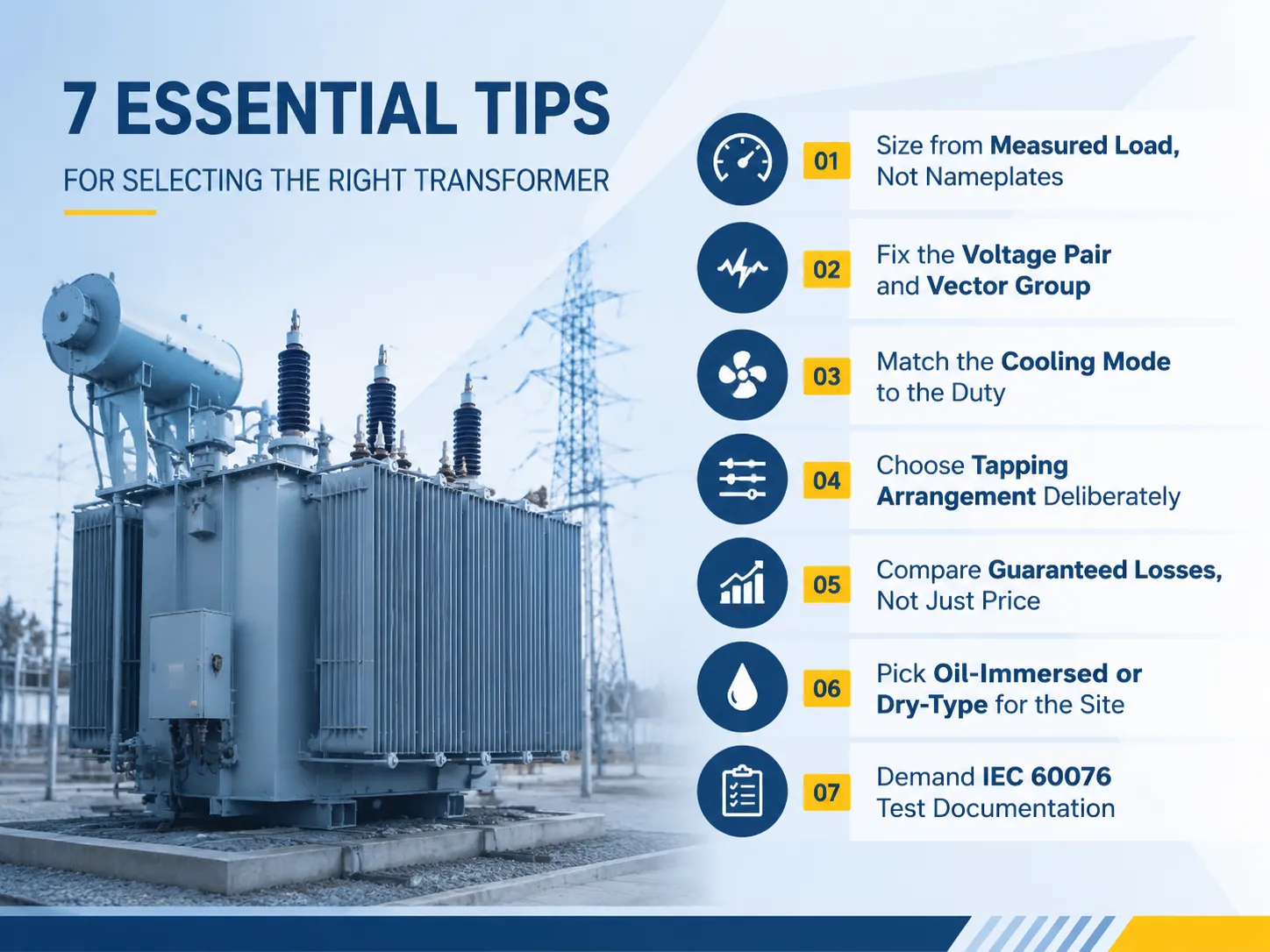
An auxiliary transformer, known also as a station service transformer, delivers the necessary in-plant services at substations, power plants, or industrial plants. Basically, it steps the line voltage, which may be 35,000 volts or 10,000 volts, down to about 0.4 volt to provide lighting, control circuitry, protections, and cooling fans, and battery charging. Seven things to keep in mind with an auxiliary transformer are the size of the transformer, based on calculated load and adding 15-20% margin; decide the voltage and vector groups; choose the cooling method; decide on use of an on-load tap changer or off circuit tap; compare the loss guarantees because the transformer works all the time; number six outlines the difference between oil-immersed and dry type transformer; and request IEC 60076 testing reports.

7 Tips for Choosing the Best Auxiliary Transformer for Your Project


What Is an Auxiliary Transformer and What Types Exist?

An auxiliary transformer is also known as a unit auxiliary transformer or station service transformer and it is designed to feed the substation, power station or large industrial plant auxiliaries. It reduces the main bus voltage to low voltage distribution levels (most typically 35/0.4 kV, 10/0.4 kV and 6.6/0.4 kV). The supplied electrical energy is used for operating motors, heating and lighting, battery charging and control/protection circuits. Because the load is important for the operation of the plant all the time, this type of equipment is rated at continuous operation and high load factor – this means that failure of the unit can result in stopping operation of the healthy plant. Thus it is necessary to treat the selection of parameters of the auxiliary transformer seriously.

タイプ 一般的な定格 Cooling / form Best suited for
Oil-immersed, self-cooled (ONAN) 50–2,500 kVA Mineral oil, outdoor tank Outdoor substation service
Oil-immersed with fans (ONAF) Above 1,000 kVA Mineral oil, forced air High load factors, hot climates
Dry-type cast resin 100–2,000 kVA Epoxy cast, indoor Indoor, fire-sensitive areas
Dual-secondary winding カスタム Any cooling mode Separate motor and control feeds
With on-load tap changer 100–2,500 kVA Any cooling mode Unstable grid voltage

Tip 1: Size from Measured Load, Not Nameplates

The most frequent reason for auxiliary transformer failure is under-sizing. Nameplate values of attached equipment exaggerate actual demand, but the designer who disregards diversity factor by summing up the nameplate value of all the connected loads will produce an unnecessarily large and inefficient solution. A professional solution would be to take into consideration the running load, the biggest starting load, which either will be the cooling fan or a compressor that requires 5-8 times the amount of the running load, and a margin of 15-20% for future growth and season variations. If the facility is likely to be automated or expanded soon, it would be the best course of action to observe the actual demand for one season before determining the required kVA. An auxiliary transformer rated for 50 kVA would cost $2,000 to $4,000 at a small substation, while a transformer rated for 80 kVA would not cost much more, but would create extra headroom.

Tip 2: Fix the Voltage Pair and Vector Group

The voltage ratio must correspond to the bus voltage level of the facility and the low voltage panel. It needs to be decided whether your company will use 35/0.4 kV, 10/0.4 kV, or any other voltage ratio on the site. Whichever of these ratios you choose, it should be kept constant across the facilities to have spare parts and electrical substations with a unified pattern. The category of voltage transformer can be as important. When asking for assistance for auxiliary supply of the substation, it is preferable to choose Dyn11, as it provides the stable neutral for the single-phase load and clear phase displacement, nevertheless, there can be some applications that will mention something different like Dyn5 or YNd11 according to earthing policy and demands for parallel work. The category of the transformer should be indicated in the order and confirmed in the regular report, as the device with the wrong transformer category is faced with protection trip or cannot work in parallel.

Voltage pair Typical vector group Where it is used
35/0.4 kV Dyn11 Large substations, power plants
10/0.4 kV Dyn11 Distribution substations
11/0.4 kV Dyn11 UK and Commonwealth networks
6.6/0.4 kV Dyn11 or Dyn5 Industrial and older plant buses
33/0.4 kV Dyn5 or custom Special earthing schemes

Tip 3: Match the Cooling Mode to the Duty

Auxiliary power transformers are typically operated continuously, making the cooling class an important determining factor for the amount of margin present at high temperatures, with ONAN (oil natural air natural) being the easiest and least complicated option which is applicable for most cases up to 1,000 kVA. For larger and/or harsher environments with limited airflow, ONAF (oil natural air forced) type of transformers will introduce fans which can increase the operating capacity by approximately 20–33%. Thus, it is important to specify ambient temperatures and heights (for example, a baseline is 40°C degrees ambient and 1,000 m altitude so that the manufacturer downgrades ratings properly.

環境温度 Correction for ONAN rating Recommended action
40°C 100% of nameplate Standard design point
45°C ~93–95% De-rate or add fans (ONAF)
50°C ~85–88% De-rate, ONAF, or larger kVA
55°C ~78–82% Special high-ambient design
Above 1,000 m altitude De-rate ~1% per 100 m over 1,000 m Confirm insulation and cooling

Tip 4: Choose Tapping Arrangement Deliberately

The bus voltage level at a substation seldom is at the rated value; it varies from time to time depending on the load and network situation. Off-load tap changers (±2 × 2.5% is normal) deal with variations that occur slowly and happen without any extra costs. But when the voltage levels fluctuate considerably during a day, on-load tap changers (OLTCs) allow the system to remain within tolerance through the course of the day without turning off the substation but with adding around 10-25% to the cost and requiring periodic maintenance.

7 TIPS

Tip 5: Compare Guaranteed Losses, Not Just Price

Because the auxiliary transformer has a high load factor throughout the day, operating losses become an unavoidable cost. No-load loss (core loss) is incurred such as during no-load loss; load loss happens depending on the usage. Evaluate proposals based on the losses and compare them. At an average cost of power around $0.10-$0.15/kWh, 500 W of no-load loss may cost around $440-$660 per year, resulting in a total cost of $11,000-$16,500 over 25 years of operation. Request no-load and load loss data from vendors in accordance with IEC 60076-1 and compare it.

No-load loss difference Annual cost @ $0.10/kWh Annual cost @ $0.15/kWh 25-year capitalized value
100 W $88 $131 $2,200–$3,300
300 W $263 $394 $6,600–$9,900
500 W $438 $657 $11,000–$16,400
1,000 W $876 $1,314 $21,900–$32,900

Tip 6: Pick Oil-Immersed or Dry-Type for the Site

Insulation systems functions according to the physical environment. Most often outdoor substations use oil-filled transformers. This technology is rugged, weatherproof and easy to maintain, the oil cools and insulates. Indoor installations, underground vaults and places with fire hazards (close to control rooms and people’s facilities) use the dry types of cast resin transformers that do not require oil containment together with very low fire risk and less maintenance. The cost of cast resin transformers can be 20 – 40 % higher than that of oil-filled counterparts, but the effectiveness of elimination of fire walls, oil pits and dealing with oil can make the issue swing back towards dry transformers in case of the necessity of locating a transformer inside according to fire code.

Tip 7: Demand IEC 60076 Test Documentation

The testing report serves as the only conclusive proof that the item in terms of its specifications meets the required standards. It is necessary to ask for a standard test report according to the standards of IEC 60076 detailing the voltage ratio, vector group, resistance of windings, impedance and losses in the form of load loss, no-load loss, and current in addition to the dielectric tests. For critical projects, the type test report (test of temperature rise, test of short-circuit strength according to IEC 60076-5, sound level) and, if required by the project, a witnessed test or inspection at the factory performed by a third party should be requested. It is crucial to make sure that the test report is sent within the shipment for the customs procedure.

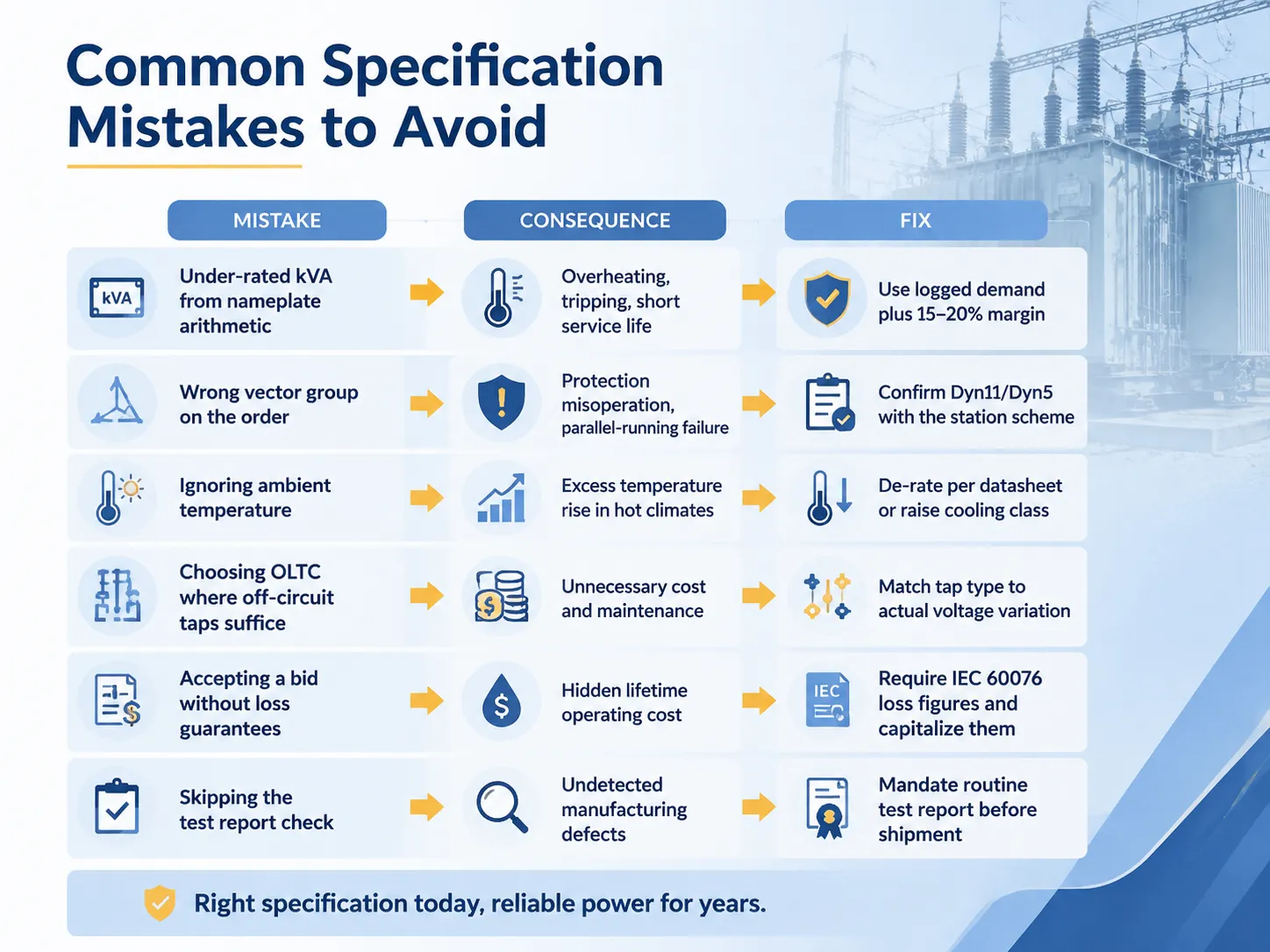
Common Specification Mistakes to Avoid

Mistake Consequence Fix
Under-rated kVA from nameplate arithmetic Overheating, tripping, short service life Use logged demand plus 15–20% margin
Wrong vector group on the order Protection misoperation, parallel-running failure Confirm Dyn11/Dyn5 with the station scheme
Ignoring ambient temperature Excess temperature rise in hot climates De-rate per datasheet or raise cooling class
Choosing OLTC where off-circuit taps suffice Unnecessary cost and maintenance Match tap type to actual voltage variation
Accepting a bid without loss guarantees Hidden lifetime operating cost Require IEC 60076 loss figures and capitalize them
Skipping the test report check Undetected manufacturing defects Mandate routine test report before shipment

Common Specification Mistakes to Avoid

Top Brands and Price Ranges

ブランド Product focus Indicative price range (US$)
ABB スイス/スウェーデン Full-range station service transformers $4,000–$60,000
シーメンス ドイツ Utility and industrial auxiliary units $3,500–$55,000
シュナイダーエレクトリック フランス Dry-type and cast resin units $2,500–$40,000
日立エナジー Switzerland Utility-grade auxiliary transformers $4,500–$70,000
イートン USA Commercial and light industrial units $2,000–$35,000
江蘇省蘇辺電力 中国 Oil-immersed and dry-type, custom vector groups $2,000–$35,000

The price ranges are indicative for transformers with ratings of between 50kVA and 2,500kVA and will depend on a number of factors including the losses, vector group, and additional features that may be included. Names such as ABB, Siemens, Schneider Electric, Hitachi Energy, and Eaton have defined the engineering quality standards for this field of transformers, so their documentation could be treated as a reference point for development. If one is looking for a provider that is able to deliver the same level of compliance with IEC 60076 but with a lower price tag, one of the Chinese producers that gift the widest experience in export is Jiangsu Subian Electric Power Co., Ltd. The Chinese company produces both oil-immersed and dry-type transformers of different ratings from tens of kVA to dozens of MVA, offers traditional or custom-made vector groups, dual secondary options, as well as on-load and off-circuit transformers. You can review the product range on the Subian Electric website.

よくある質問

What is the difference between an auxiliary transformer and a distribution transformer?

The principles of the design are the same; the distinction lies in the objective and the position. A distribution transformer provides power to consumers — residences, stores, small factories — along the grid. An auxiliary transformer supplies power to the systems within a power plant or substation — control, protection, lighting, cooling, and battery charging. Since its load keeps the plant functioning, an auxiliary transformer often operates at a higher load factor than a distribution transformer and is designed with greater consideration for losses and reliability.

What kVA rating is typical for a station service transformer?

Having an auxiliary load requirement. A small distribution substation will likely only require around 50–200 kVA for its auxiliaries, while a large EHV substation or power plant may have several units varying from 1,000–2,500 kVA, sometimes featuring dual secondaries for motors and control feeds. Select a size based on the actual auxiliary load plus 15–20% margin instead of following the rule of thumb.

Can an auxiliary transformer be installed indoors?

Sure. When it comes to indoor installation, it is more advisable to use a dry-type cast resin auxiliary transformer since it is not subject to an oil containment requirement, has a low probability of fire, and features lower maintenance needs. In the case of outdoor substations, oil-immersed unit are practically always used. The insulation system’s selection should not rely on the rule of thumb; it should depend on site characteristics and fire code requirements.

Should the auxiliary transformer have an on-load tap changer?

Only if your bus voltage changes enough to affect the 0.4 kV supply do you need an OLTC. Off-circuit taps (±2 x 2.5%) are effective in dealing with slow variations in voltage at no extra cost. An OLTC increases the system price and running costs by 10-25%, but it protects vulnerable control electronics in unstable networks, where one outage is usually worth the cost incurred.

Does Subian provide test reports with auxiliary transformers?

Absolutely. All auxiliary transformers of Subian come with a standard test report before shipment according to the IEC 60076 which is inclusive of tests such as the ratio, vector group, impedance, losses, and dielectric tests. It is possible to arrange for other types of test reports required for projects such as witnessed tests and third-party inspection before the order is finalized.

参考文献

結論

The auxiliary transformer is the silent workhorse of any dependable substation, and its proper selection is based on seven key decisions: to define the size taking into account the load requirements and allowing 15-20% overheads; to fix the voltage pair and the vector group; to provide the match of the cooling mechanism with the conditions of use; to be careful while choosing the tap connection; to compare the costs of the capitalized losses; and to select either the oil-immersed unit or dry-type based on the requirements of the installation site; and to ask for IEC 60076 test results. All decisions can be practically verified, and it is the totality of the decisions that allows to differentiate a 25-year station from a station failing in the initial summer. Jiangsu Subian Electric Power is a reputable manufacturer of both oil-immersed and dry-type auxiliary transformers compliant with IEC 60076 standards, providing full test evidence and very fair prices. Contact the company through the official website with your station load data and voltage scheme to receive a specification-matched proposal.