


북미에서 3상 전력 분배에 사용되는 표준 kVA 등급은 112.5 kVA입니다. 이 숫자와 건식 설치에 관한 국가 전기 규정(National Electrical Code) 요구 사항을 고려할 때, 그 보편성을 이해하기가 쉬워집니다. 이는 예상치 못한 사실일 수 있지만, 동일한 kVA와 전압 비율을 공유하는 두 개의 변압기는 부피와 무게에서 수백 파운드 차이가 나는 등 많은 특성에서 상당히 다를 수 있습니다. 이 기사에서는 정확한 사양을 제공하고 변압기 크기에 중요한 영향을 미치는 요소를 탐구합니다.
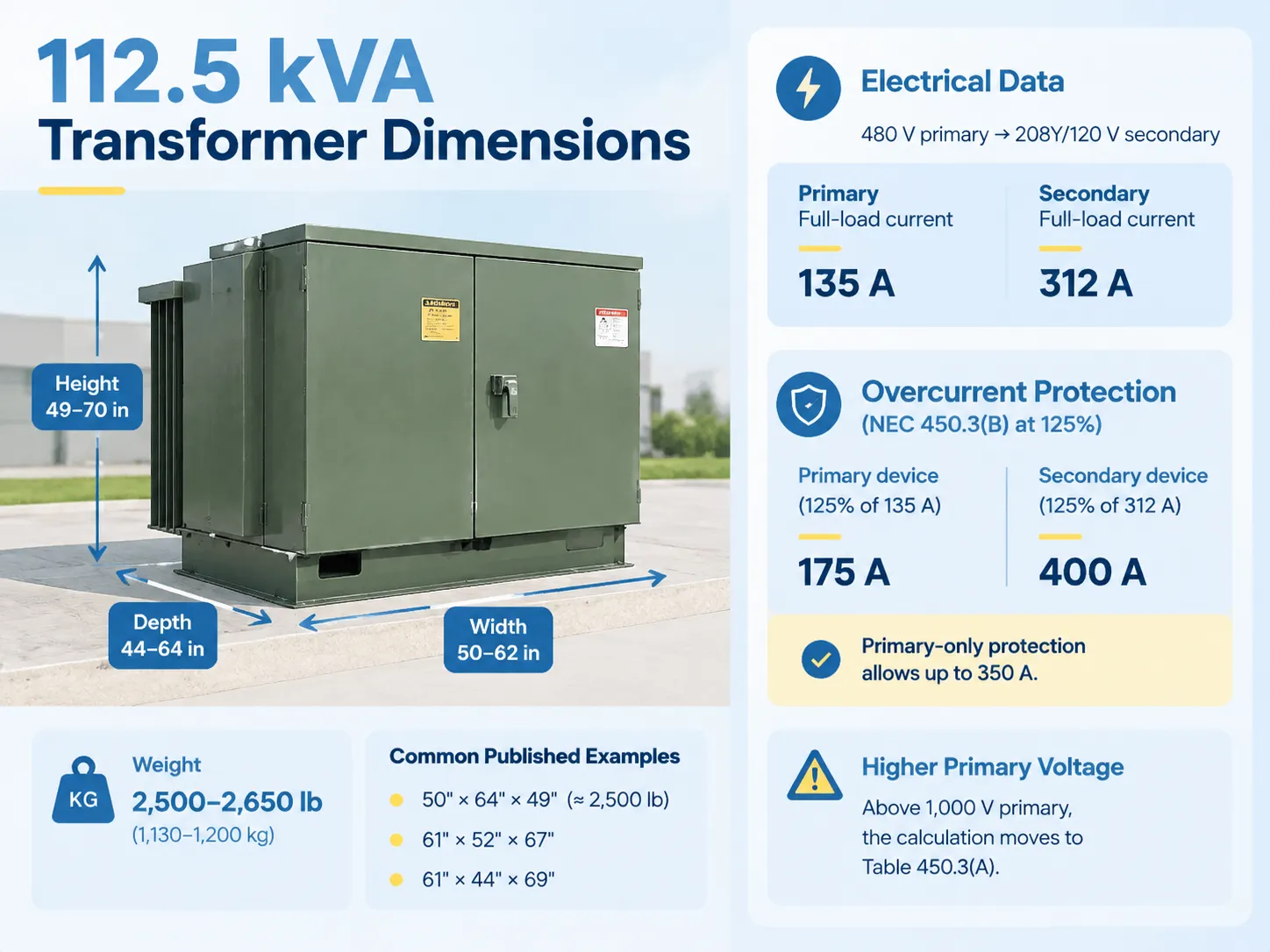
간단히 말해, 112.5 kVA로 평가된 3상 변압기는 폭이 약 50–62인치, 깊이가 44–64인치, 높이가 49–70인치이며, 무게는 약 2,500–2,650 lb(1,130–1,200 kg)입니다. 예를 들어, 이 변압기의 발표된 치수는 50″ × 64″ × 49″ 및 약 2,500 lb, 61″ × 52″ × 67″, 61″ × 44″ × 69″입니다. 용량 측면에서, 480V가 208Y/120V를 공급하는 기본 전압일 때, 기본 전체 부하 스케일은 135A를 읽고, 보조 전체 부하 전류는 312A를 읽습니다. 따라서 기본 장치 175A와 보조 장치 400A는 국가 전기 규정 450.3(B)에 따라 충분한 보호를 제공합니다.
5 kVA의 실제 의미
5 kVA는 일반 ANSI 분배 시리즈에 속합니다. 표준 등급은 15-30-45-75-112.5-150-225-300-500-750-1000 및 그 이상으로 확장됩니다. 이는 75와 150 사이에 위치한 숫자로, 75 kVA가 정당화할 수 있는 부하 수준을 초과할 수 있도록 하여 상업용 건물에서 선호되는 숫자입니다.
이 수치는 코드의 기준 수치 역할도 합니다. 112.5 kVA 이하의 건식 변압기는 NEC 450.21(A)에 따라 금고 없이 야외에 설치할 수 있으며, 가연성 물질로부터 최소 1피트 떨어져 있어야 하며, 절연 장벽이나 완전히 밀폐된 변압기를 사용하는 경우(환기 구멍 제외)에는 예외가 적용됩니다. 112.5 kVA를 초과하는 용량의 경우, 내부에 위치한 건식 장치는 화재 저항 요구 사항을 충족하는 변압기실에 배치되어야 하며, 클래스 155 절연 재료 이상으로 설치하는 경우에는 면제됩니다. 따라서 112.5 kVA 범위에서 150 kVA 범위로 이동하면 건설해야 하는 방의 특성이 변경될 수 있으며, 구매하는 장비의 유형뿐만 아니라 영향을 미칠 수 있습니다.
kVA가 전기적 관점에서 무엇을 나타내는지 주목하는 것이 중요합니다. kVA는 kW와 같지 않습니다. 112.5 kVA의 정격 용량을 가진 변압기는 순수 저항 부하에 대해 112.5 kW만 생성합니다. 실제로는 권선이 전체 kVA 양을 소비하더라도 실제 와트 출력은 더 낮습니다. 실제 연결된 부하에 대해 어떻게 크기를 조정하는지에 대한 관계는 다음 설명에 설정되어 있습니다. kVA 변압기 등급이란.
계획해야 할 치수
주어진 숫자는 112.5 kVA 3상 패드 장착 장치에서 얻은 원본 데이터에서 가져온 것으로, 완전히 자가 냉각(KNAN)되며, 온도 상승이 65 °C이고, DOE 2016 표준 및 ANSI/IEEE C57.12 표준에 따라 60 Hz 주파수에서 작동합니다.
| 구성 | 너비 | 깊이 | 높이 | 무게 |
|---|---|---|---|---|
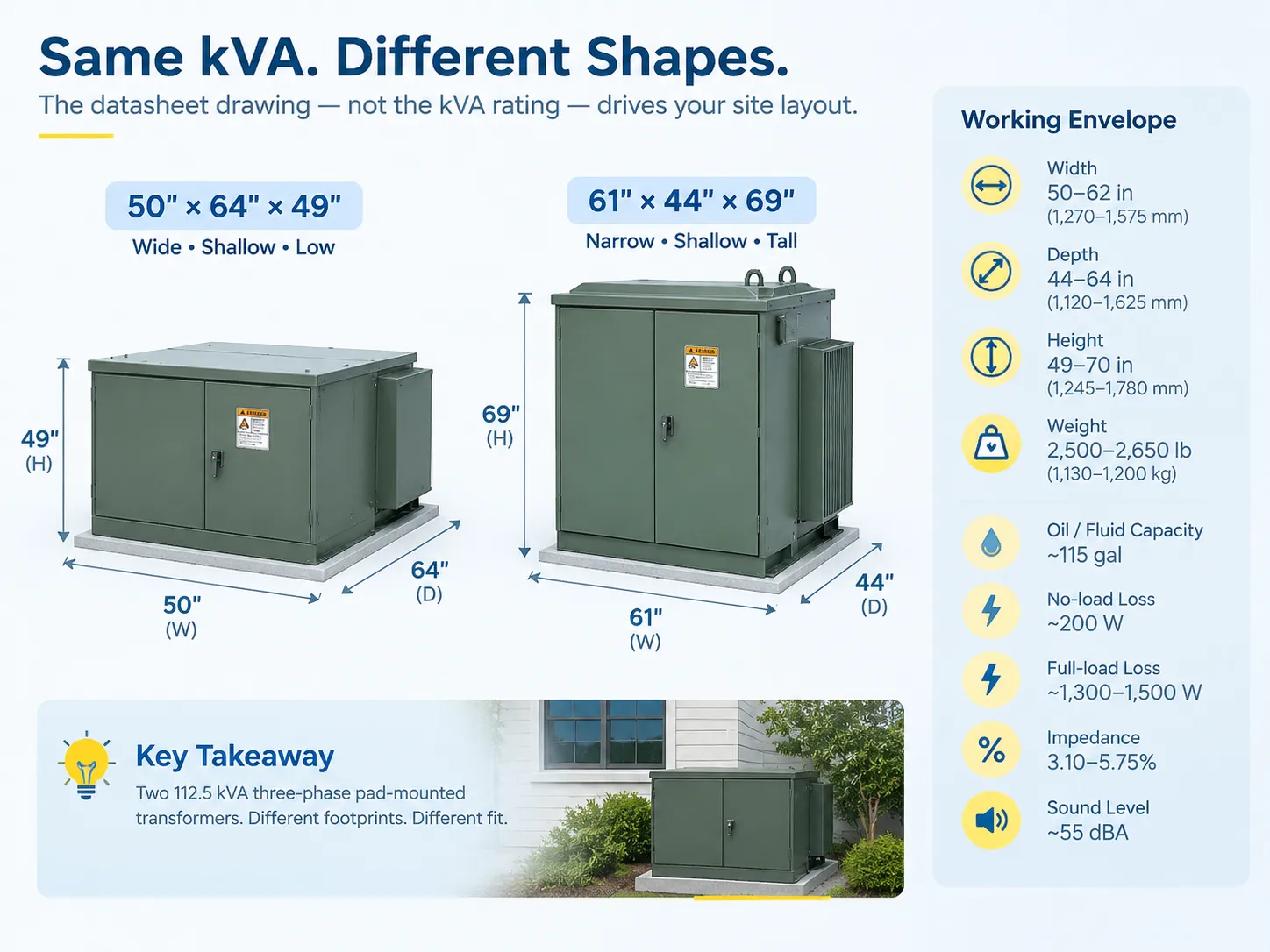
| 21,600Y/12,470 V → 208Y/120 V, 데드 프론트, 루프 피드, 알루미늄 권선 | 50 인치 | 64 인치 | 49 인치 | ±2,500 lb |
| 4,160 V → 480Y/277 V, 구리 권선 | 61 인치 | 52 인치 | 67 인치 | — |
| 13,200 V → 480Y/277 V, 구리 권선 | 61 인치 | 44 인치 | 69 인치 | — |
| 일반 3상 패드 장착 가족, 다양한 전압 옵션 | — | — | — | 2,640 lb |
사양에 대한 작업 범위로 변환됨:
| 매개변수 | 계획 범위 |
|---|---|
| 너비 | 50–62 인치 (1,270–1,575 mm) |
| 깊이 | 44–64 인치 (1,120–1,625 mm) |
| 높이 | 49–70 인치 (1,245–1,780 mm) |
| 무게 | 2,500–2,650 lb (1,130–1,200 kg) |
| 오일 또는 유체 용량 | 밀폐 탱크 설계에서 대략 115 US gal |
| 무부하 손실 | 약 200 W |
| 정격 부하 손실 | 약 1,300–1,500 W |
| 임피던스 | 3.10–5.75% |
| 소음 수준 | 약 55 dBA |
변압기의 치수를 비교할 때 숫자보다 형태에 더 신경 써야 합니다. 너비가 50인치, 길이가 64인치, 높이가 49인치인 변압기는 넓고 낮은 형태를 가지고 있는 반면, 길이가 61인치, 너비가 44인치, 높이가 69인치인 변압기는 좁고 높은 형태를 가지고 있습니다. 두 변압기의 kVA 정격이 112.5로 동일하지만, 하나는 창 아래에 배치할 수 있는 반면 다른 하나는 그렇지 않습니다. 따라서 현장 배치 과정은 kVA 정격이 아닌 데이터 시트의 도면에 의해 주도되어야 합니다.
숫자를 움직이는 여섯 가지 변수
수치를 이해함으로써, 견적이 들어오기 전에 양을 추정할 수 있습니다.
- 1차 전압 및 BIL. 4160볼트 1차는 중간 정도의 절연만 필요하지만, 21,600볼트 접지 와이 1차는 95 kV의 BIL을 가집니다. BIL의 증가로 인해 탱크 내부의 간격이 증가하고, 부싱 높이가 증가하며, 깊은 인클로저가 필요합니다. 4.16 kV 변압기는 52인치 길이인 반면, 다른 변압기는 64인치 높이를 가지고 있습니다.
- 데드 프론트 변압기와 라이브 프론트 변압기. 데드 프론트 설계는 절연된 고전압 종단 및 엘보 연결을 포함하므로 더 큰 구획이 필요합니다. 현대 변압기가 1990년대 아날로그보다 부피가 더 큰 이유는 현대 데드 프론트 장비의 사양을 충족해야 하기 때문입니다.
- 구리 변압기 권선은 알루미늄 변압기 권선과 상반됩니다. 구리 권선은 알루미늄보다 공간을 덜 차지하므로 구리 권선이 사용될 경우 변압기의 전체 크기가 줄어듭니다. 이 요소는 제조업체가 변압기의 패드 발자국을 결정할 때 특히 중요합니다.
- 권선 방법: 루프 피드 대 방사형 피드. 루프 피드 권선 방법은 더 많은 연결 지점과 추가 기술 개발이 필요하므로 변압기의 치수를 증가시킵니다. 그래서 서로 다른 권선 방법에 따라 제작된 “동일한” 설계의 두 변압기는 서로 다른 매개변수를 가질 것입니다.
- 냉각 클래스. 냉각 클래스가 증가함에 따라 냉각 온도도 증가합니다. 따라서 KNAF 냉각 클래스는 KNAN보다 크지만 변압기의 매개변수는 변경되지 않습니다. 예를 들어, 65 °C 상승을 가진 변압기는 55 °C 상승을 가진 변압기보다 클 것입니다.
- 효율 클래스. 2016년에 제조업체에 부과된 효율 요구 사항에 따라 10 CFR Part 431에 명시된 바와 같이, 이러한 한계 이전과 이후에 제조된 변압기의 크기는 다를 것이며, 중고 장비의 가격은 정확한 수치를 제공하지 않을 것입니다.
변압기 유형별 치수
5 kVA 등급은 여러 제품군에 나타나며, 제품군의 형태는 동일하지 않습니다.
| 유형 | 일반적인 발자국 특성 | 사용되는 곳 |
|---|---|---|
| 삼상 패드 장착, 오일 충전 | 콘크리트 패드 위에 넓고 낮으며 변조 방지 기능이 있는 인클로저 | 상업 및 주거 개발, 야외 배전 |
| 삼상 건식, 환기형 | 더 높고 좁으며 환기 공간과 공기 흐름을 위한 공간이 필요합니다. | 실내 전기실, 480 V에서 208Y/120 V로 강하 |
| 삼상 건식, 주조 수지 | 환기형과 유사한 발자국이지만 호흡 공간이 없습니다. | 병원, 데이터 센터 및 오일이 바람직하지 않은 모든 실내 위치 |
| 기둥 장착 단상 | 더 작은 탱크, overhead에 장착, 다른 등급 시리즈 | overhead 배전; 단상 시리즈는 112.5가 아닌 5, 10, 15, 25, 37.5, 50, 75, 100, 167, 250 kVA로 운영됩니다. |
| 유닛 변전소 / 컴팩트 | 변압기, 주 스위치 및 보조 보드가 하나의 인클로저에 있습니다. | 조립된 블록이 선호되는 산업 공장 및 유틸리티 설치 |
주어진 표에서 고려해야 할 두 가지 실용적인 점이 있습니다. 첫째, 프로젝트에서 480 V에서 208Y/120 V로의 강하가 필요한 경우, 프로젝트에 필요한 유닛은 일반적으로 패드 장착형 또는 건식 삼상 변압기로 112.5 kVA가 필요합니다. 둘째, 패드 장착 변압기와 건식 변압기 간의 비교가 있다면, 이는 넓고 낮은 야외 박스와 높고 좁은 실내 박스 간의 차이를 의미합니다. 두 제품군 모두 패드 장착 삼상 변압기 범위에 포함됩니다..
패드 크기 및 작업 공간, 단순히 박스가 아닙니다.
변압기의 크기는 사소한 측면일 뿐입니다. 그러나 실제로 필요한 공간은 중요하며, 이는 현장 계획이 일반적으로 실패하는 이유입니다.
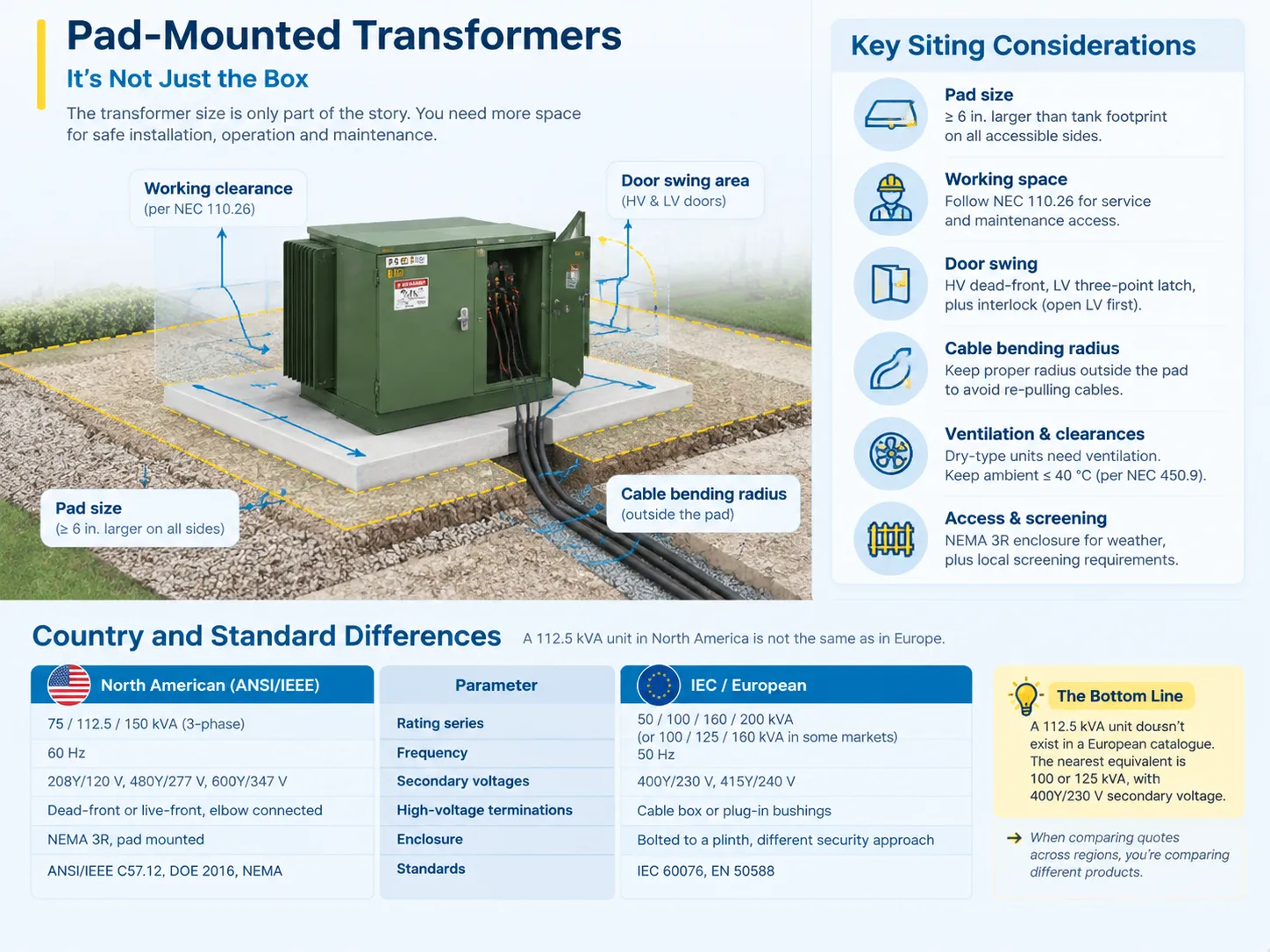
- 패드의 크기. 콘크리트 패드는 탱크 발자국보다 모든 노출된 면에서 최소 6인치 더 크게 설계되어야 하며, 이는 관 및 케이블 도랑의 위치와 일치해야 합니다.
- 접근 가능한 영역. NEC의 110.26 조항은 서비스 가능한 장비에 대한 작업 공간 여유 규정을 설명하며, 패드 장착 변압기에 작업할 경우 각 고전압 및 저전압 문 주위에 충분한 여유 공간이 있는지 확인해야 합니다.
- 문이 열리는 범위. 고전압 문과 저전압 문이 있는 경우, 문이 열릴 때 유닛 앞에서 쓸어야 하는 공간도 고려하는 것이 중요합니다.
- 케이블 굽힘 반경. 변압기 내부에는 케이블을 위한 공간이 있지만, 패드 옆에 배치할 때 케이블이 무릎 꿇지 않도록 충분한 굽힘 반경이 필요합니다.
- 환기 및 여유 공간. Vegiper 유닛은 적절한 작동을 위해 공기 공급원이 필요하며, 이는 가연성 물질의 존재에 의존해서는 안 됩니다.
- 배치. 일반적으로, 변조 방지 케이스는 분명히 작업을 수행하지만, 지역 규칙에 따라 전기 장비를 차단하는 역할을 하는 구조물과 이 인클로저에 연결하는 것도 필요할 수 있습니다.
여러 개의 패드를 배치하는 개발에서는 클리어런스 규칙이 변압기 선택보다 플롯 계획에 더 많은 영향을 미칩니다. 주거 또는 상업 개발에서 실제로 중요한 위치 고려 사항은 다음을 살펴보는 것입니다. 현대 커뮤니티를 위한 패드 장착 변압기.
국가 및 표준 차이
IEC 표준에 따라 제작되어 유럽에 설치된 112.5 kVA 등급의 장치는 ANSI 대응물과 동일한 객체가 아니며, 치수도 이를 반영합니다.
| 매개변수 | 북미 (ANSI/IEEE) | IEC / 유럽 |
|---|---|---|
| 등급 시리즈 | 75 / 112.5 / 150 kVA의 삼상 | 50 / 100 / 160 / 200 kVA, 또는 일부 시장에서 100 / 125 / 160 kVA |
| 빈도 | 60 Hz | 50 Hz |
| 2차 전압 | 208Y/120 V, 480Y/277 V, 600Y/347 V | 400Y/230 V, 415Y/240 V |
| 고전압 종단 | 데드 프론트 또는 라이브 프론트, 엘보 연결 | 종종 케이블 박스 또는 플러그인 부싱 |
| 인클로저 | 변조 방지, NEMA 3R, 패드 장착 | 종종 플린스에 볼트로 고정되며, 보안 접근 방식이 다릅니다. |
| 표준 | ANSI/IEEE C57.12 시리즈, DOE 2016, NEMA | IEC 60076 시리즈, EN 50588 효율성 |
결과적으로 112.5 kVA 모델은 유럽 카탈로그에서 발견되지 않습니다. IEC에서 다음으로 가장 좋은 동등 사양은 100 또는 125 kVA이며, 2차 전압은 208Y/120 V 대신 400Y/230 V입니다. 입찰의 지역 비교를 할 때, 동일한 가격 범위에 속하는 두 가지 다른 제품을 비교하는 것입니다. 국경 간 조달 전에 전체 비교를 읽는 것이 가치가 있으며, 이는 다음의 주요 차이점에 대한 분석에 설정되어 있습니다. 미국과 유럽 변압기 간의 주요 차이점.
브랜드가 다릅니까?
전압 클래스는 공급자마다 영향을 미치지만, 장비의 물리적 차이와는 훨씬 덜 관련이 있습니다. 실제로, 북미 전역에서 동일한 기본, 2차, 냉각 클래스 및 공급을 가진 112.5 kVA 유닛을 제조하는 패드 장착 변압기 제조업체를 살펴보면, 크기 치수는 사실상 동일합니다: 치수 간의 차이는 몇 인치에 불과합니다. 인식된 “브랜드” 변동은 단순히 사실이 아니며, 회사는 95 kV BIL의 루프 공급 또는 더 낮은 BIL의 방사형 공급을 처리할 수 있으며, 이름의 차이를 완전히 다른 장비에 귀속시킵니다.
There are, however, three tangible differences among the products. Winding material choice plays a role but is rather a function of specification than brand characteristic. Efficiency tiers are important to consider, given that in 2016, the DOE regulations segmented products into pre-and post-2016 designs, meaning that a transformer used in 2012 will occupy less volume than the work of both years. Finally, it is enclosure design that really shows up competition among manufacturers. Enclosure that falls into the utility’s standard dimensions without variances gives one a commercial advantage.
What is ultimately required is to stop comparing brands and comparing transformer dimensions with the pad one has instead. Brand differences among inch dimensions between suppliers are negligible; for instance, a 12-inch depth gap between a 12.47 kV transformer and a 4.16 kV transformer is significant.
Breaker and Conductor Sizing for a 112.5 kVA Unit
This is the question that follows the dimension question, and the arithmetic is straightforward once you fix the voltages.
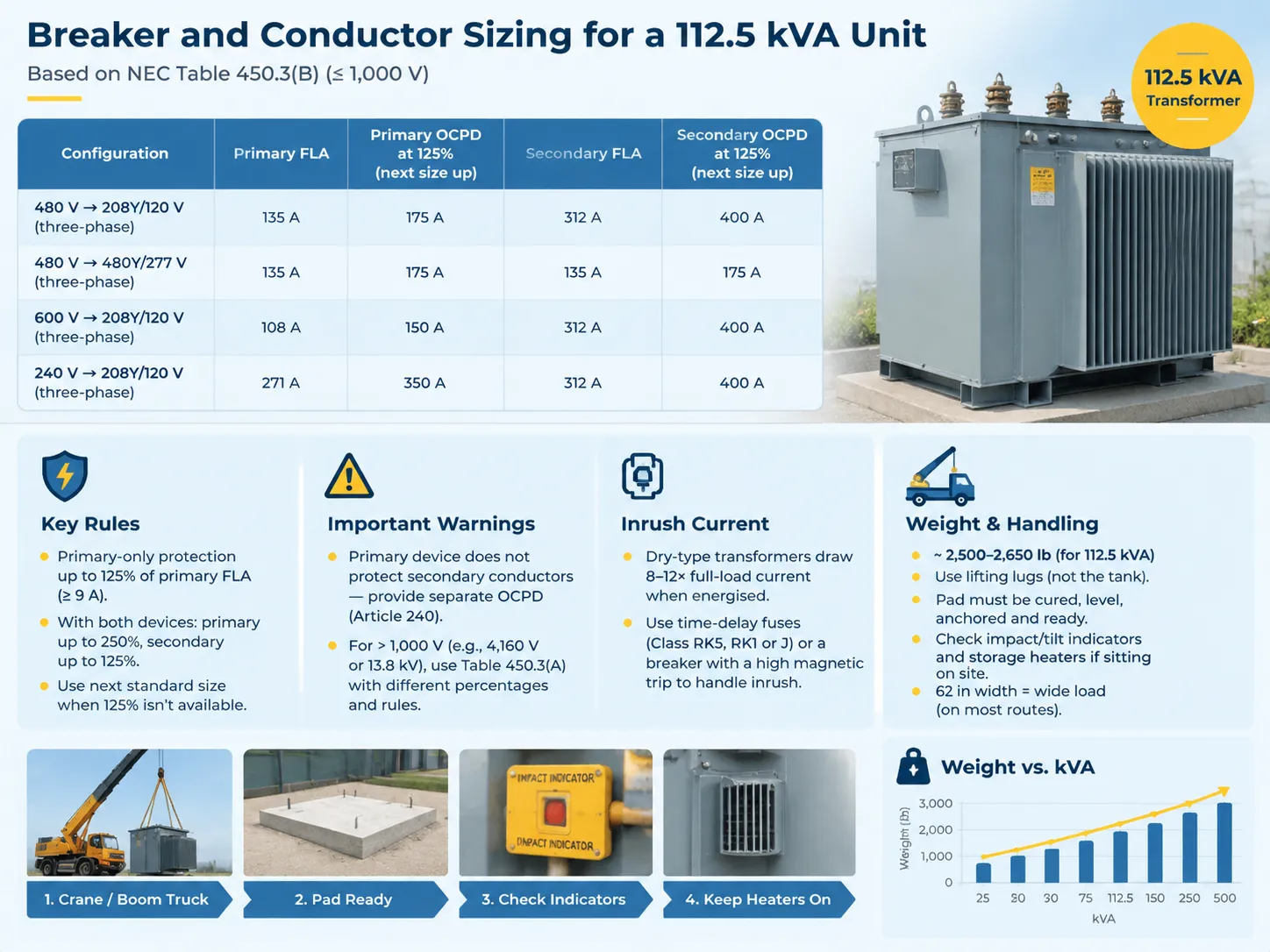
| 구성 | Primary FLA | Primary OCPD at 125% (next size up) | Secondary FLA | Secondary OCPD at 125% (next size up) |
|---|---|---|---|---|
| 480 V → 208Y/120 V, three-phase | 135 A | 175 A | 312 A | 400 A |
| 480 V → 480Y/277 V, three-phase | 135 A | 175 A | 135 A | 175 A |
| 600 V → 208Y/120 V, three-phase | 108 A | 150 A | 312 A | 400 A |
| 240 V → 208Y/120 V, three-phase | 271 A | 350 A | 312 A | 400 A |
The guidelines for those data are found in Table 450.3(B), which is valid for transformers with a voltage rating up to 1,000 V. For transformers with a primary current of 9 A and more, primary only protection is allowed; the minimum value for this device is 125% of the full-load current (FLC). If 125% cannot be achieved with the help of the available number of values, the nearest value can be used instead. In case both primary and secondary devices are used, the ratio for the primary device can be 250% of the FLC and for the secondary device – 125% of the SLC. For instance, in case of a 112.5 kVA transformer connected to a primary voltage of 480 V, such a transformer can have a primary protection rated for 350 A when a secondary protection is provided.
However, there are two warnings with this table. First, the primary device does not protect any secondary conductors, for which separate overcurrent protection should be applied according to Article 240. One should also keep in mind that the table is valid for voltages lower than 1,000 V. For a 112.5 kVA transformer with a primary voltage of either 4,160 V or 13.8 kV, Table 450.3(A) should be used instead.
The second size consideration is inrush. Dry-type transformers consume 8 to 12 times of the rated or FLC for a very limited period of time when becoming operational. For this reason, a fuse with a rating of 125% must be used, which will burn off on activation. Instead, a time delay fuse (Class RK5, RK1 or J) or magnetic circuit breaker has to be used in order for inrush currents not to create problems in case there is a fault in an electrical circuit.
Weight, Handling and Delivery
Weight is a factor in the cost of the project since moving a unit weighing 2500-2650 lbs is something that a small team cannot do manually and not every type of transport can deliver such a unit.
- Crane or boom truck. There must be a plan describing which area will be used for lifting the unit and where it will be put after the lifting. The rigging needs to be connected to the tank lifting lugs instead of the tank.
- Pad readiness. Before the unit’s arrival the pad has to be leveled, cured, and tested for anchoring and the conduit stubs must be installed. The transformer cannot be left on a truck if the pad is not ready.
- Impact and tilt indicators. The unit must have been delivered with all necessary indicators; if one of the indicators was triggered it means it is necessary to carry out an internal inspection before the unit is energized.
- Storage. If the unit stays on site for weeks prior to installation its heaters must be energized so that no moisture gets into the insulation.
- Transport clearance. A unit of 62 inches in width is a wide load and so it may require special permits and have specific time limitations on the transport route.
How the weight and loss figures scale with rating is worth understanding before you decide between 112.5 kVA and its neighbours, and the trend across the distribution series is illustrated in this study of 500 kVA transformer weight. The short version: weight rises roughly with kVA but not exactly linearly, because the enclosure, tank and accessories form a fixed component that stops growing once it is big enough to hold the core and coils.
자주 묻는 질문
What are the dimensions of a 112.5 kVA transformer?
50 in. to about 62 in. in width, about 44 in. to 64 in. in depth, and from about 49 in. to approximately 70 in. in height, while weighing around 2,500 lb (1,130 kg to 1,200 kg). Some published examples include a specification of 50 in. × 64 in. × 49 in. with a weight of about 2,500 lb, and others 61 in. × 52 in. × 67 in. and 61 in. × 44 in. × 69 in. All dry-type indoor units with the same capacity usually have a narrower profile, but different size in the depth is expected in the very case of ventilation requirements, rather than simply enclosures of the units.
What size breaker for an 112.5 kVA transformer?
The voltages dictate the regulations. For a primary voltage of 480 V to supply a 208Y/120 V circuit, the typical full-load primary current would equal 135 A, while concerning the secondary it would be equal to 312 A. If both the primary and the secondary protection schemes are used, according to NEC Table 450.3(B) it would be allowed to use a primary device with the rating of 125% of the current to be equal to 169 A, it would be rounded to the next standard size which is 175 A, and concerning the secondary protection it should not be more than 125% of the current which is 312 A, that would give the rating of 390 A rounded to 400 A. If only the primary protection scheme is implemented, the primary device should be rated how much could be 250% of the primary current which would give 338 A rounded to 350 A. In case there are primary voltages above 1,000 V NEC Table 450.3(A) shall be used. It’s recommended to use time delay fuses or trip high-magnetic breaker to protect the device from damaging due to magnetizing inrush.
What are the dimensions of a 100 kVA transformer?
The voltages serve as a guiding factor for the laws. In the case where the primary voltage of 480 V has been utilized in the circuit of 208Y/120 V, the full-load primary current’s value would be up to 135 A and the full-load current of the secondary power source would be 312 A. It would allow for the use of the primary device rated at 125% of the proposed current which would be equal to 169 A if both of the primary and the secondary protection schemes have been used according to the provided information from NEC Table 450.3(B) and it would be rounded to the nearest available size equal to 175 A. It should be mentioned that the secondary power source device must not exceed 125% of its full-load capacity meaning not more than 312 A and the final rounding procedure would give the result in the form of 400 A from 390 A. If only the primary protection mechanism has been employed, the device must be rated at 250% of its current that would provide a result of 338 A which should be rounded to 350 A. For the primary voltages in excess of 1000 volts the standard presented in NEC Table 450.3(A) must be referenced. Time delay or high-magnetic circuit breakers are recommended for the situation where magnetizing inrush may occur.
What is the size of a kVA transformer?
kVA mentions capacity; physical size is not mentioned. The physical size of the transformer depends on kVA and four more parameters: voltage class and impulse power, cooling class, winding material, and type of enclosure. As a rough guide, a three-phase oil-immersed pad-mounted transformer varies from about 75 kVA (about 30″ wide) to over 2,500 kVA (more than 100″), but for dry-type indoor designs, the same kVA will be in a completely different shape. Therefore, always ask for dimensional drawings with kVA.
Do 112.5 kVA transformers differ between brands?
In almost all cases, the difference between two units is due to configuration instead of popularity. If two machines have the same specifications concerning primary, secondary, cooling class, arrangement of feed, and efficiency, their sizes will be practically the same, regardless of the manufacturer. If the specifications provided bring about the change in the size of the machine, it is usually due to the use of a different specification, e.g., looping and radial feeds, the application of higher BIL for the primary winding or the use of another winding material, but not due to the brand’s differences.
Is 112.5 kVA relevant to the electrical code?
Yes, it is indeed a threshold value. NEC 450.21(A) allows the installation of dry-type transformers rated at 112.5 kVA or lower in the open without a vault, provided it is kept 12 in away from combustibles, unless a fire-resistant heat-insulating barrier is used, or unless the unit is enclosed with the exception of ventilating openings. Above 112.5 kVA, dry-type transformers usually need to be installed in a fire-resistant transformer room, except in the case of insulation systems with the Class of 155 or higher. The surpassing of the value may alter the room, and not only the equipment.
참고 문헌
- IEEE Standards Association — ANSI/IEEE C57.12 series, distribution transformer standards
- NFPA — NFPA 70, 국가 전기 규정 (제450조, 변압기)
- UL Solutions — transformer testing and certification services
- UL 표준 및 참여 — UL 1562, 변압기, 배급, 건식 타입
- International Electrotechnical Commission — IEC 60076 series, power transformers
결론
The response to the question “how significant is a 112.5 kVA transformer?” is not easy and the ones who provide an answer generally reference and depend on their own catalogues. The right answer to this question is a range, approximately 50 to 62 inches in width, about 44 to 64 inches in depth, between 49-70 inches (high) in height, and from 2500 to 2650 pounds for a three-phase pad-mounted model.
Three steps can be taken in relation to this knowledge. First, before purchasing the pad, obtain the creation drawing as well as the weight; depth is where the voltage class comes into focus. Secondly, ensure that the model and type are checked before starting a comparison of the prices since it is the four reasons that cause price differences which people connect with the brands. Finally, do not forget that the 112.5 kVA transformer is the number in NEC 450.21 meaning it is the limit that you need to focus on.