


엔지니어가 중전압 배전 링의 사양을 결정할 때, 결정은 거의 항상 링 메인 유닛 사양 데이터 시트에 있습니다. 정격 전압, 정격 전류, 단시간 내전류, 절연 유형 및 관련 IEC 표준이 함께 결합되어 장치가 고장을 견딜 수 있는지, 변전소 설치에 적합한지, 수년간 기능할 수 있는지를 결정합니다. 이 가이드는 전체 링 메인 유닛 사양 및 기능 을 한 곳에 정리하여 각 매개변수가 의미하는 바와 읽는 방법, 설명, 읽는 방법, 그리고 전 세계 최고의 RMU 설계 간의 비교를 설명합니다. 이 문서는 입찰 준비 또는 견적 평가 시 사용할 수 있습니다.
링 메인 유닛(RMU)란 무엇인가?
링 메인 유닛 또는 RMU는 중전압 스위치기어로 공장에서 조립된 컴팩트하고 통합된 장치입니다. 이는 지하 또는 공중 케이블의 루프에 연결할 수 있는 능력 덕분에 2개의 네트워크 측에서 소비자가 전력을 받을 수 있도록 하여 2차 배전선에서 사용됩니다. 따라서 현대 도시와 산업의 신뢰성은 RMU에 의존하며, 네트워크의 한 쪽이 손실되면 링 회로의 다른 쪽이 여전히 작동하여 소비자는 계속해서 전기를 받을 수 있습니다.
이 장치는 일반적으로 들어오는 케이블과 나가는 케이블에 연결된 여러 개의 부하 차단 스위치와 변압기에 전원을 공급하는 보호된 분기(스위치 퓨즈 또는 진공 차단기)를 통합합니다. 스위치기어의 전체 설계는 컴팩트하고 밀폐되어 있어 수명 동안 유지보수가 필요하지 않습니다. 링 메인 유닛 사양 이해는 이러한 모든 기능이 동일한 전압, 전류 및 고장 수준에 대해 정격되어야 한다는 것을 이해하는 것에서 시작됩니다.
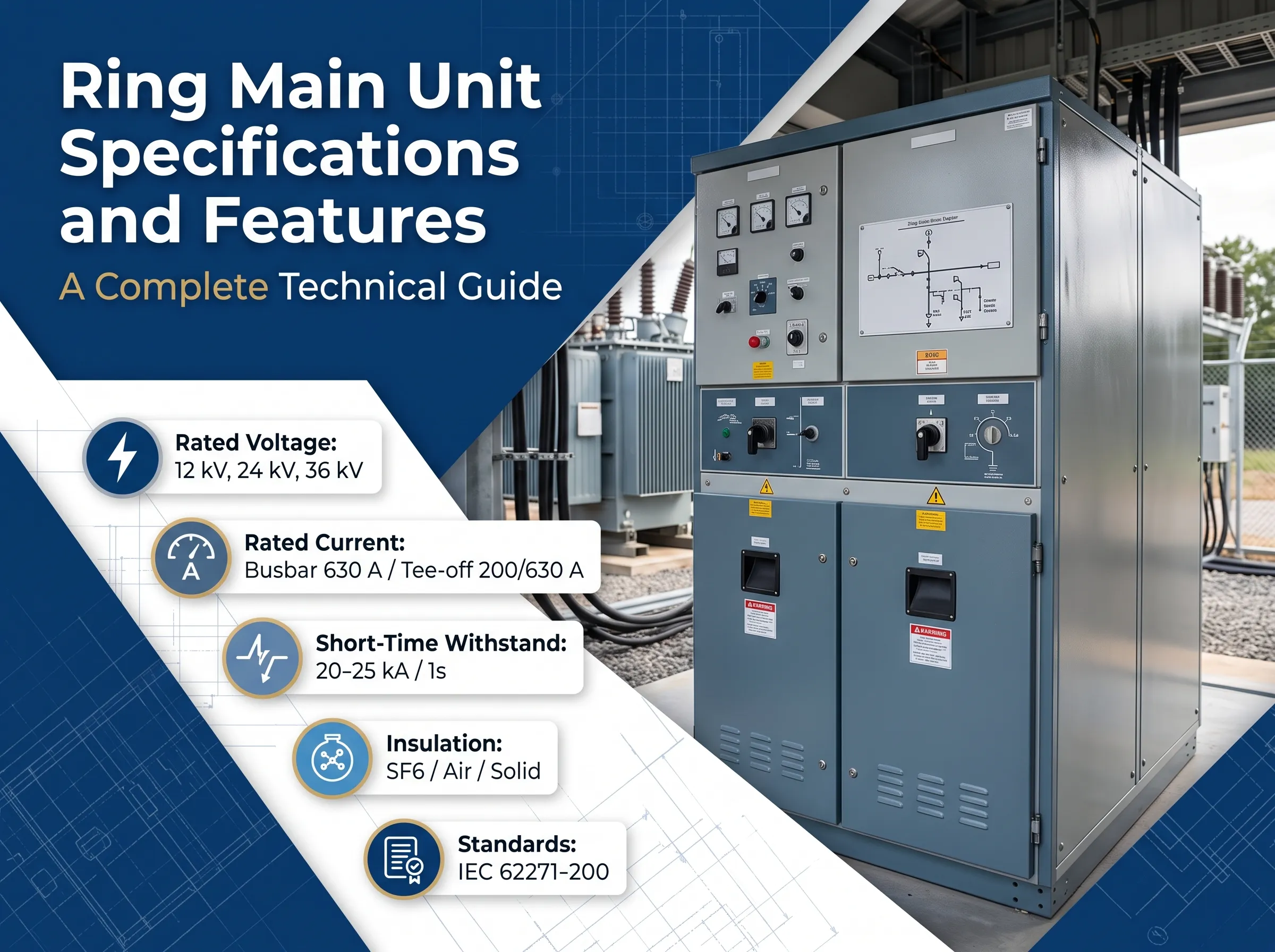
링 메인 유닛 사양 한눈에 보기
각 매개변수를 자세히 살펴보기 전에 12 kV 클래스 유닛을 정의하는 전체 사양 세트를 보는 것이 도움이 됩니다. 이러한 것은 거의 모든 데이터 시트와 입찰 문서에 나타나는 핵심 링 메인 유닛 사양 입니다:
- 정격 전압: 12kV (17.5kV, 24kV, 36kV에서도 사용 가능).
정격 주파수: 50Hz 또는 60Hz.
정격 메인버스 전류: 630A (더 큰 모델의 경우 1250A 이상).
정격 분기 전류: 200A (스위치 퓨즈) 또는 630A (차단기 유형).
단락 내전류의 정격 전류: 1초 동안 20 또는 21 kA (최대 25 kA).
정격 피크 내전류: 50 또는 52.5kA (단시간 값의 2.5배).
정격 단락 지속 시간: 요청 시 1초 또는 3초.
낙뢰 임펄스 내전압(LIWL): 75 kV.
전력 주파수 내전압: 1분 동안 28 또는 42.
절연 매체: SF6 가스, 공기 또는 고체.
보호 등급: 가스 탱크에 대해 IP65, 인클로저에 대해 IP3X.
적용 표준: IEC 62271-200 및 IEC 62271-100/105.이 박스는 이 기사에 제안된 두 개의 기술 도면 중 첫 번째로, “링 메인 유닛 기술 사양”이라는 단일 인포그래픽으로, 위에서 언급한 전압, 전류, 내전 및 IEC 매개변수와 함께 구조에 대한 좋은 요약입니다. 아래는 엔지니어가 오해하지 않아야 할 도면을 설명하는 섹션입니다.
정격 전압 및 전류: 12 kV, 17.5 kV, 24 kV 및 36 kV
정격 전압은 RMU가 제대로 작동하고 한계 내에서 기능할 수 있는 최대 전압을 정의합니다. 2차 배전은 몇 가지 표준 클래스에만 기반하며, 올바른 링 메인 유닛 사양 이 값을 네트워크와 일치시키는 것으로 시작합니다:
- 12 kV는 10 kV 및 11 kV 정격 전압을 가진 네트워크에 사용되는 기본 클래스입니다;
5 kV는 13.8 kV 및 15 kV로 정격된 시스템에 해당합니다;
24 kV는 주로 유럽, 아시아 및 중동에서 20 kV 및 22 kV로 여전히 정격된 네트워크에 사용됩니다;
36 kV는 33 kV 시스템에 적용 가능한 2차 배전의 마지막 범위를 나타냅니다.정격 전류는 장비가 온도 조건으로 인해 견딜 수 있는 전류의 양을 나타냅니다. 두 가지 측정값이 있습니다. 주 배전반과 링 부하 차단 스위치는 일반적으로 630 A로, 이는 이 값이 네트워크 루프의 전류를 사용할 수 있게 해줍니다. 변압기 분기점은 일반적으로 200 A의 스위치 퓨즈 조합을 사용하여 낮은 정격을 가질 수 있으며, 보호를 위해 진공 차단기를 사용할 경우 동일한 630 A를 가질 수 있습니다. 읽는 동안 가장 흔히 발생하는 실수는 링 메인 유닛 사양 배전반의 정격을 분기점의 정격과 혼동하는 것입니다.
단락 내전 및 차단 용량
품질은 고장 순위 단기 내전 전류(Icw)에서 나타납니다. 장치가 특정 기간 동안 처리할 수 있는 RMS 고장 전류는 일반적으로 20 또는 21 kA로, 열적 또는 기계적 손상 없이 1초 동안 견딜 수 있습니다. 더 큰 고장 수준의 네트워크의 경우 25 kA도 지정할 수 있습니다. 또한 일부 입찰에서는 3초를 지정합니다.
정격 피크 내전 전류(Ipk). 장치가 견딜 수 있는 순간 전류의 최대량으로, 단기 정격의 2.5배(IEC 기준)에 해당하며, 정격이 20 kA인 장치의 경우 피크 내전 전류는 50 kA입니다.
정격 단락 차단 용량. 보호 장치가 차단할 수 있는 고장 전류의 양입니다. 진공 차단기 분기점에서는 내전 정격과 동일하며, 20에서 25 kA입니다; 스위치-퓨즈 분기점에서는 퓨즈가 큰 고장 전류를 처리하고 스위치가 전류 부하를 차단합니다.
네트워크의 고장 전류보다 내전 정격이 낮은 장치는 안전하지 않으며, 이는 엔지니어들이 서로 확인하는 첫 번째 이유입니다.
좋은 링 메인 유닛의 사양에는 항상 Icw, 지속 시간 및 Ipk를 함께 설명하는 데이터가 포함됩니다.
유닛은 사용된 절연 매체에 따라 분류되며, 이는 유닛 크기, 유지보수 요구 사항 및 생태적 특성을 결정하는 중요한 요소로, 유닛을 서로 구분합니다.
RMU의 절연 유형: SF6, 공기 및 고체
절연이 전기 도체를 분리하고 스위치를 끊을 때 방전 아크를 소멸시키는 데 중요한 역할을 한다는 결론을 내리면서, 그 특성 장비를 결정할 수 있음을 언급할 수 있습니다. 절연 선택은 모든 링 메인 유닛 사양에 있어 중요한 요소라는 점을 염두에 두어야 합니다.
SF6 가스 절연. 전도성 부품은 강철 탱크 내부의 SF6 가스로 보호됩니다. SF6는 뛰어난 유전 저항 수준을 제공하며, 습기, 먼지 및 응축에 강한 밀폐된 유닛에서도 아크를 소멸할 수 있게 합니다. 이 절연 유형은 주로 2차 RMU 및 열악한 조건이나 해안 지역에서 사용됩니다.
공기 절연. 장비는 금속 인클로저 내에서 공기로 절연된 전도체로 구성됩니다. 이 유닛은 덜 컴팩트하지만, 온실가스가 없으며 실내에 배치된 상태에서도 시각적 검사가 가능합니다.
고체 절연체(SIS). 전도체는 고체 에폭시와 같은 절연체로 절연됩니다. 이는 장치 내에서 가스를 사용하지 않는 새로운 유형의 절연 기술입니다.
링 메인 유닛의 주요 특성
링 메인 유닛 사양의 특정 값과 함께, 안전하고 편리한 작동을 보장하는 엔지니어링 관점에서 좋은 설계가 구별됩니다. 구매 시 고려해야 할 몇 가지 중요한 특성은 다음과 같습니다:
삼위치 스위치. 장비는 세 가지 위치를 가진 부하 차단 스위치를 하나 보유하고 있으며, 접지 여부에 관계없이 하나의 인클로저 내에서 닫힘에서 열림으로 전환할 수 있습니다.
다섯 가지 작업의 인터로킹 메커니즘. 설계에는 전기 시스템과 관련된 다섯 가지 일반적인 작업에 대한 실수를 제거하기 위한 기계적 및 전기적 메커니즘이 포함되어 있습니다.
Hermetically-sealed tank. The service life of the tank is unlimited when it is properly sealed.
Small footprint. It occupies little space while being installed in the compact enclosure that is used mostly in prefabricated buildings. It is very important.
Ability to expand. It is important to observe that the expansion possibilities exist from the functional device and till the busbar extension.
Cable testing and fault indication systems. The equipment allows for cable testing as well as tracking faults along through the unit.
Internal arc classification. The available IAC rating gives you an idea of how the device prevents internal arc faults.
Therefore, it can be stated that the above-mentioned characteristics are those things that can separate the units of equal technical specifications.
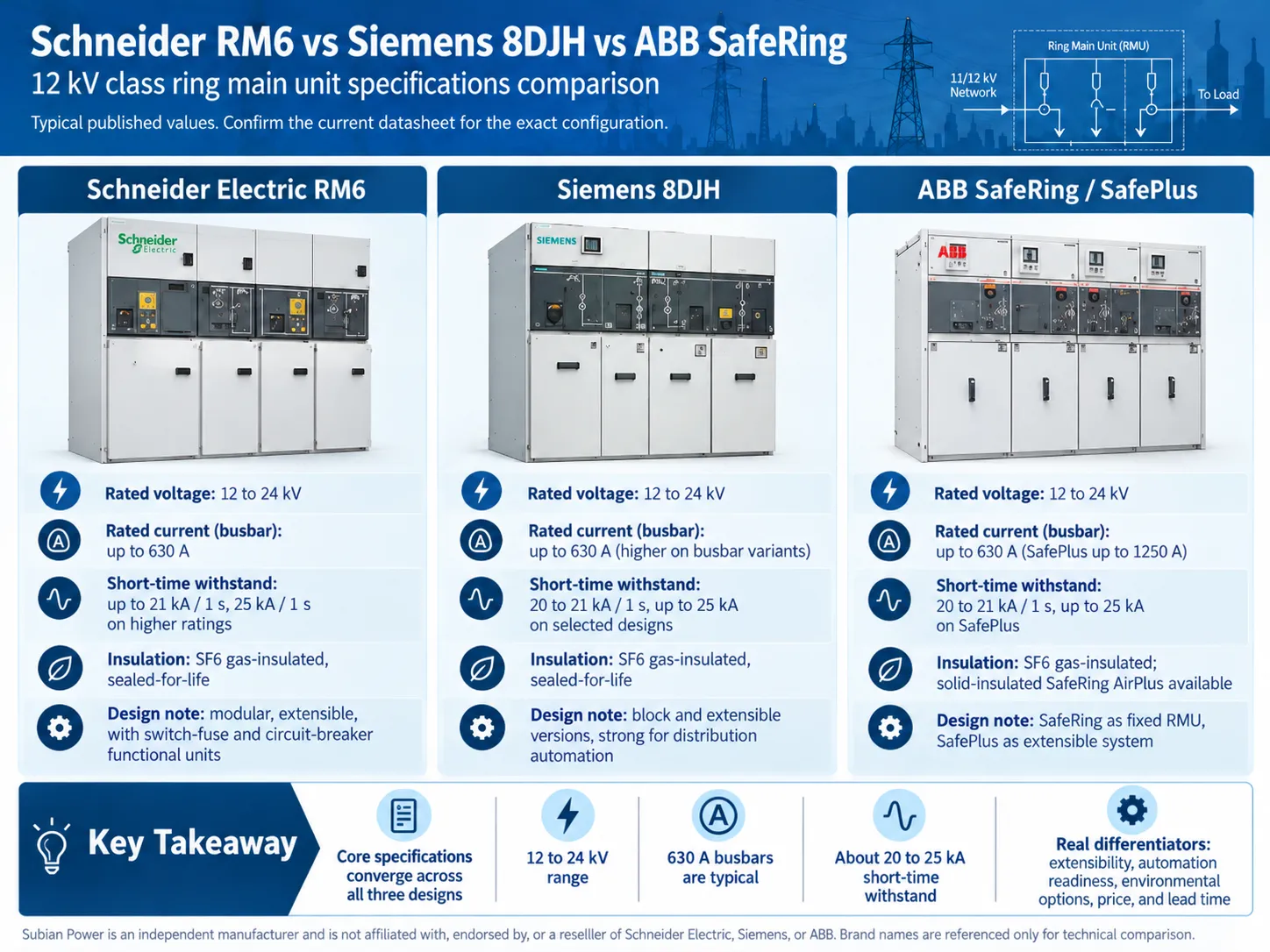
Schneider RM6 vs Siemens 8DJH vs ABB SafeRing
When it comes to ratings, buyers often carry out a side-by-side analysis of the top three internationally established designs since it’s quite common to find specifications of 12 kV class published ring main units available for comparison if their specifications are similar. The following figures represent the general figures generally found in catalogs which need to be checked against the most current configuration datasheets available. This comparison figure is the second of those recommended through this article. It should be stated that Subian Power is an independent manufacturer and has no association with, marketing authorizations from, or intentions of selling Schneider Electric, Siemens, or ABB products – these trademarks serve only for technical reference purposes.
Schneider Electric RM6
Rated voltage: from 12 kV to 24 kV.
Rated current: up to 630 A (should be more for some busbar designs).
Short-time withstand: from 20 kA to 21kA within a 1 s period; moreover, there are some designs at the limit of 25kA/1 s figures.
Insulation: with all parts insulated with SF6 gas and available for sealing life.
Note: all designs are extensible and modular and can be fitted with switch-fuse and circuit breaker units.
Siemens 8DJH
Rated voltage: from 12 kV to 24 kV.
Rated current: up to 630 A (higher for busbar variants).
Short-time withstand: from 20 to 21 kA for a 1 s withstand period with higher models rated at 25 kA.
Insulation: all materials are gas insulated – SF6; there also some elements sealed for life.
Note: all units are available in extensible and block forms.
ABB SafeRing / SafePlus
Rated voltage: from 12 to 24 kV.
Rated current: up to 630 A (for SafePlus – 1250 A).
Short-time withstand: from 20 to 21 kA and with the value of up to 25 kA for SafePlus.
Insulation: all models feature e.g. complete insulation with SF6; models with solid insulation are available.
Note: SafeRing RMUs are fixed ones while SafePlus designs are extensible ones.
The trend discussed above has been observed amongst all three brands that converge on a range of 12 to 24 kV rated voltage values, an even rated current of 630 A, short-time withstand values of 20 to 25 kA, and SF6 insulation, thus complying with IEC 62271 standards. Hence, the most important distinguishing factors are extensibility, automation readiness, eco-friendliness, and also cost and delivery terms where Subian Power, as a competitor manufacturer, is the winner.
IEC 62271 Standards for Ring Main Units
Valid ring main unit specifications cannot exist without a support of the applicable standards and approval through type tests. The main standards are:
– IEC 62271-200: AC switchgear and controlgear in metal-enclosed design which operates at voltage range starting from 1 kV and up to 52 kV, which serves as the main standard for RMU systems and defines internal arc classification rules.
– IEC 62271-100: High-voltage AC circuit-breakers which defines general rules for the tee-off of breakers.
– IEC 62271-102: Disconnectors and earthing switches.
– IEC 62271-103: Switches which is applicable to load-break switches in the ring.
– IEC 62271-105: AC fusible switch combinations which defines the rules of tee-off with fuses.
A reliable supplier always produces type-test certificates according to these standards instead of merely providing proof of conformity. If there is no information in the technical specification where each RMU characteristic has been tested, it should be treated cautiously.
How to Choose RMU for Prefabricated Substation
If specifications are properly followed, the choice will automatically flow from that. In the case of a prefabricated or compact substation, choose the RMU specifications in the following order:
– Rated voltage should correspond to the network class (12, 17.5, 24, 36 kV).
– Short-time withstand current should be greater than site prospective fault current with some safety margin.
– The type of tee-off should be chosen: use a switch-fuse for smaller transformers in terms of economy, and choose circuit breaker to ensure full safety, if bigger and more critical loads are expected.
– The insulation type should be determined by the environment: choose SF6 for compact/harsh environments, and use air or solid insulation in case the gas-free design should be used.
– The dimensions should correspond to the substations and there should be enough space for future expansion.
Subian Power Ring Main Units
Jiangsu Subian Power Equipment Co., Ltd. specializes in medium-voltage switchgear, transformers, and substations construction rated up to 110 kV. The company, which was founded in 2019 in the Chinese city of Xuzhou, supplies power plants and industries, and constructs ring main units to IEC 62271 and GB 3906 standards. There are two designs to meet most secondary distribution applications:
- 방법 HXGN15-12 metal-enclosed ring network switchgear is a 12 kV, 50 Hz unit with a spring-operated mechanism (manual or electric), load-break switches, and an optional VS1 fixed vacuum circuit breaker for the transformer tee-off, suited to urban distribution and ring networks.
- 방법 XGN15-12 inflatable (SF6) ring network switchgear is a 12 kV, 50 Hz gas-insulated unit with a three-position SF6 load switch and five-prevention interlocking, built compact and expandable for distribution automation, urban networks, and compact substations.
Both units meet the core 링 메인 유닛 사양 described in this guide, and Subian provides type-test documentation on request. Because Subian also manufactures the transformer and the enclosure, an RMU can be supplied as part of a complete YB-series prefabricated substation, with the ring switchgear, transformer, and low-voltage equipment engineered and tested together. The engineering team can match the rated voltage, current, withstand level, insulation type, and tee-off configuration to your exact network.
자주 묻는 질문
How many kW can you run on a ring main?
The limits on apparent power are determined by the combination of voltage and rated current of the ring and not just by the RMU. For example, a 630 A 12 kV ring with load-break switches is capable of providing around 13 MVA of apparent power at full rated current, equating to around 11 MW at 0.85 power factor. In reality the limit is imposed by the distribution transformer that feeds from the tee-off, with ratings ranging typically from a few hundred kVA to about 1,600 kVA per RMU, which means that one transformer tee-off serves an actual load in the range of hundreds of kW to just over 1 MW.
What is RMU configuration?
The configuration of the RMU specifies the different functional parts of the unit and their arrangement. The construction of an RMU comprises the two types of module: ways of load break switch (to connect the incoming and outgoing cables of ring) and ways of protected tee-off (to connect the transformer via switch fuse or circuit breaker). The configuration is usually noted using a short symbolic term. For instance, 2 + 1 means that two load switch ways and one tee-off switch way are included in the configuration. The most common layouts include 2 + 1, 3 + 1 and others.
What is the standard size of main cable for a ring circuit?
In the case of a medium voltage distribution ring at 12 kilovolt, the ring cable is usually a three-core XLPE with either copper or aluminum conductor ranging between 95 and 300 square millimetres, depending on the load current and the fault level. The standard sizes of 185 and 240 square millimetre aluminum XLPE are often employed for this purpose. However, the exact size is determined depending on the continuous current, short-circuit withstand, RMU, voltage drop along the ring and the method of installation, thus the precise size is always verified through calculation for the specific network.
What is a 3 way RMU?
A RMU having 3 ways is known as a ring main unit having three functional units or ways. We may come across the most common variant in the form of either 2 ways or 1 way arrangement. Two ways would be load break switch ways for the incoming and outgoing ring cable and the remaining way would be the protected tee-off way. A 3-way unit is the basic component of a distribution/substation connecting to the ring supply unit and feeding one transformer although additional ways can always be added to it as the network expands.
참고 문헌
- IEC — IEC 62271-200 AC Metal-Enclosed Switchgear and Controlgear
- IEEE — Standards and Guides for Medium-Voltage Switchgear
- Electrical Engineering Portal — Ring Main Units and Secondary Distribution
- Wikipedia — Ring Main Unit
- Wikipedia — Electric Power Distribution Overview
결론
방법 링 메인 유닛 사양 that matter most, rated voltage, rated current, short-time and peak withstand current, insulation type, and IEC 62271 compliance, together decide whether a unit is safe, reliable, and the right fit for a distribution ring. Read the withstand ratings against your fault level, match the tee-off to your transformer, choose the insulation for your environment, and insist on type-test certificates. Subian Power builds HXGN15-12 and XGN15-12 ring main units to these 링 메인 유닛 사양 및 기능, and can supply them as part of a complete prefabricated substation. To request a datasheet, type-test documentation, or a quotation matched to your network, contact the Subian Power 엔지니어링 팀에 연락하십시오..