


A panel builder gets a transformer with a capacity of 15 kVA. The transformer operates at 480 volts and has a single phase-connection but becomes a useless piece of equipment for six long months after being installed and placed upstream of a programmable logic controller and four servo drives. After half a year, somebody undertakes an analysis using a clamp meter and finds that 11 amperes of triplen harmonic current are present at the neutral conductor.
The fault was not with the transformer, since it was chosen to be used in general-purpose applications. Thus, this is the problem that most often occurs in the field of industrial automation.
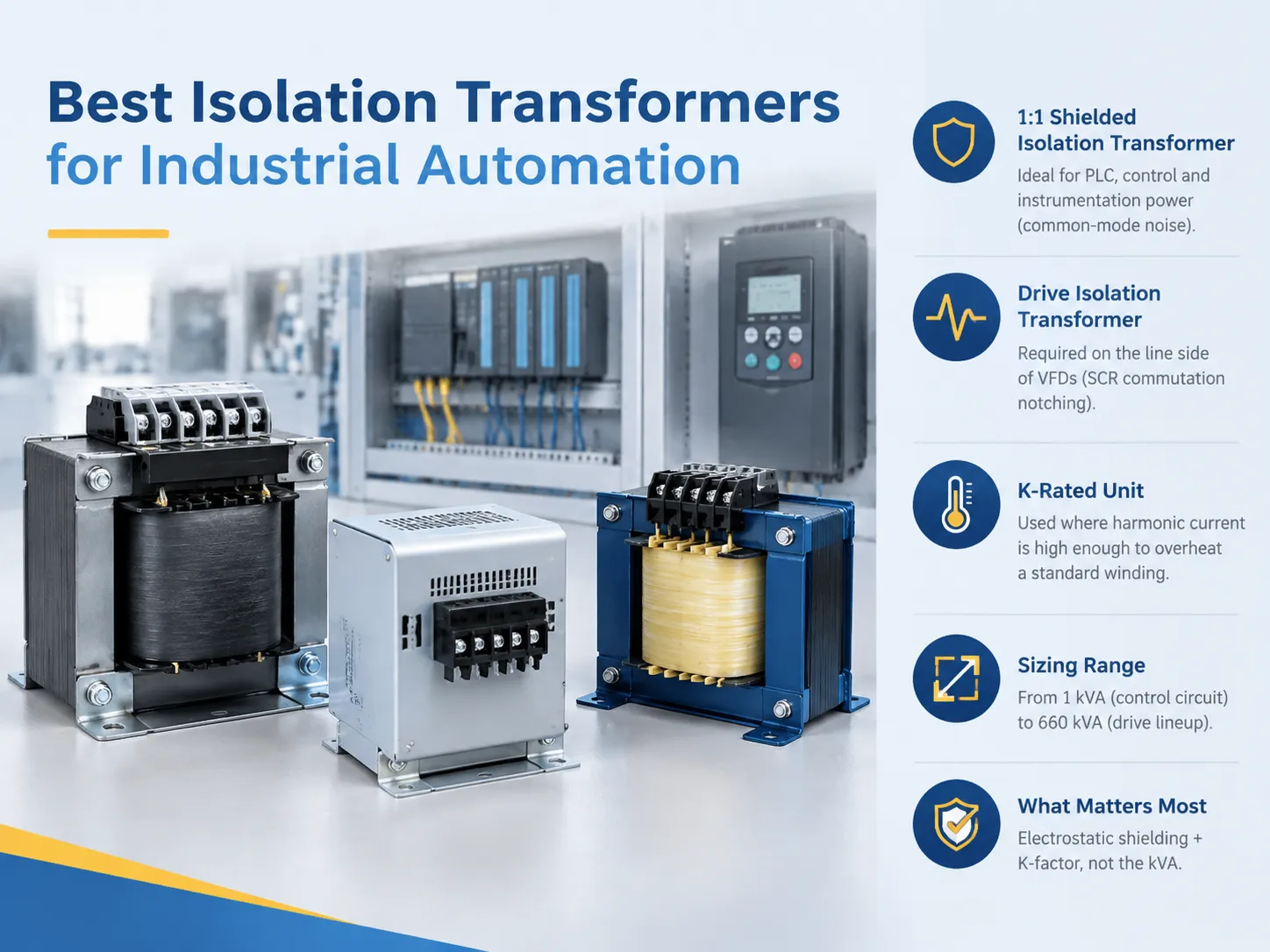
The right isolation transformer for industrial automation depends on the load rather than the voltage. PLCs, control and instrumentation power need a 1:1 shielded isolation transformer (from Hammond Power Solutions, SolaHD, Acme, and Rex Power Magnetics), while a drive isolation transformer must be used at the line side of VFDs due to the notching caused by the SCR commutation process. A K-rated isolation transformer is necessary if harmonic currents are sufficiently strong to result in overheating of regular windings. Power ranges from 1 kVA for control circuits to 660 kVA for drives; the most important specifications are electrostatic shielding and K-rating factors, not the kVA rating.
What an Isolation Transformer Actually Does
Every transformer gives galvanic isolation. With two windings sharing a magnetic core and no metallic path between its primary and secondary, step-down distribution transformers are already isolating devices that buyers think they are purchasing.
Isolation transformers are labeled as such because of an electrostatic shield, made from copper or aluminum foil and put in between the windings. If not for that shield, the capacitance available between the windings would allow very high frequency noises to cross the barrier. The common-mode transients that are present in electricity would end up on the secondary side in the same form as they came to the primary side.
The shield prevents this from happening by transferring the energy for safe disposal into the earth. It does not provide filtering of differential noises, does not regulate voltage and it will not eliminate the lightning surge. One could clearly see that there are three different devices, but the market brands all of them as one product.
An accurate description of such a shielded isolation transformer would be: a transformer that does not change the voltage and power of what it passes while filtering common mode noise above the frequency of about 1 KHz.
The Four Duties That Get Confused
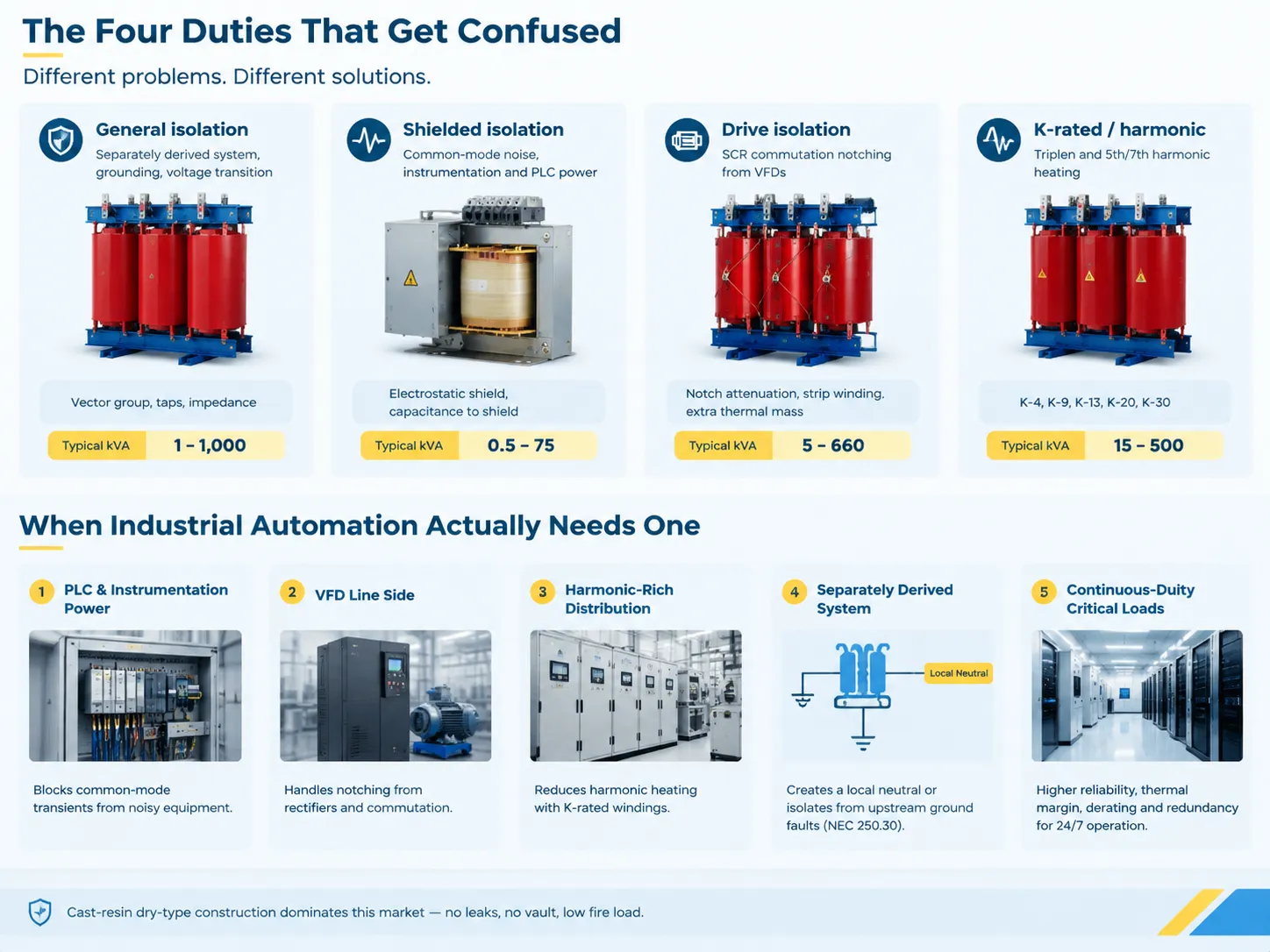
| Dever | Part it solves | Key spec | Typical kVA |
|---|---|---|---|
| General isolation | Separately derived system, grounding, voltage transition | Vector group, taps, impedance | 1–1,000 |
| Shielded isolation | Common-mode noise, instrumentation and PLC power | Electrostatic shield, capacitance to shield | 0.5–75 |
| Drive isolation | SCR commutation notching from VFDs | Notch attenuation, strip winding, extra thermal mass | 5–660 |
| K-rated / harmonic | Triplen and 5th/7th harmonic heating | K-4, K-9, K-13, K-20, K-30 | 15–500 |
Out of the four methods specified, two are practically equivalent every time. A drive isolation transformer must also be K-rated, since its role is to eliminate notching as a system, and a VFD system generates both original notching and harmonic currents. Buying a K-rated transformer instead of one that has been DIT (advanced technology for isolation transformers) gives you thermal load without notching correction. In contrast, acquiring a DIT without concern for the K-factor makes the immersion transformer solution available, but the winding will operate at excessive temperatures.
Cast-resin and dry-type constructions clearly prevail in this particular case for one simple reason: there are no leaks, no vaults, and the combustion load is so small that no issues are raised by the insurers. The construction differences between cast-resin designs and the alternatives are set out in this comparison of SCB13 units against international cast-resin transformers, which matters when a project mixes imported drives with domestic distribution equipment.
When Industrial Automation Actually Needs One
There are five situations requiring spending money. In all of the rest cases, the matter isn’t being discussed.
- Power and PLC instrumentation in a plant with a lot of noise. 480V-120V isolation transformer is being ahead of the control power supply that is able to eliminate any common-mode disturbances caused by welding machines, contactors, and other drives. This is the case in practice and it works unless the filter has a good ground and the secondary wires are short.
- The line side of VFD. Six-phase motor operation results in shorting two of the phases with every commutation, leading to the formation of the notched voltages that stressed the upstream transformer mechanically and thermally. The application of the transformer was done in the way that the use of strip conductors enables the reduction of eddy losses and the good heating margin.
- Distributing harmonic currents. When the transformer powers the groups of drives, UPS rectifiers, and LED drivers, the resulting harmonic currents heat up the winding much higher than expected, referring to the kVA rating of the transformer. In contrast to the K-rated transformer, the classic technology can work without being oversized to a certain extent.
- Start relating to the derived system. In case the plant needs a local neutral point or different grounding or wants to cut off the ground fault path, the transformer should be used to achieve this goal according to NEC 250.30.
- Powering critical devices with continuous operation. Powers around data halls, clean rooms, and other devices are of utmost importance for any business. What that looks like in practice, including the derating and redundancy choices, is covered in this look at high-reliability dry-type transformers for data centres, and the reasoning transfers directly to a process line that runs 8,000 hours a year.
Sizing: The Arithmetic Most Bids Get Wrong
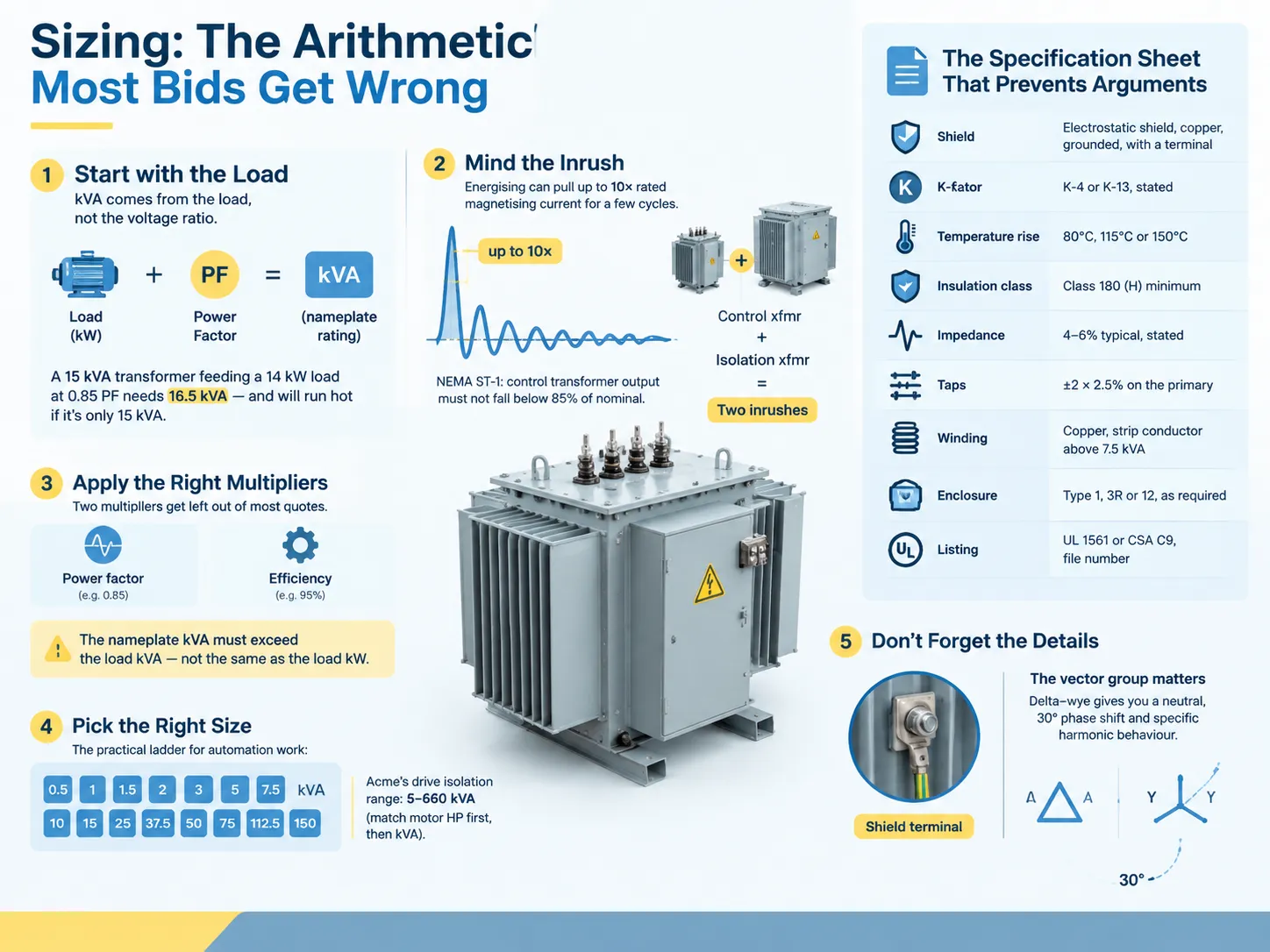
Load dictates kVA, not the ratio of the voltage. First, determine the total load connected, calculate all the diversity that can be justified, and select the nearest larger standard size. In a 1:1 transformer, the transformer does not transfer the same kVA as the voltage ratios are equal. It simply transfers the calculated kVA and keeps the current level equal at both primary and secondary terminals since the voltage will also be the same.
There are two correction factors missing in most quotes.
Efficiency. For instance, if a 15 kVA transformer is connected to a 14 kW load at a power factor of 0.85, it could be rated at 16.5 kVA and operate with overheating. The kVA value on the nameplate should be higher than the kVA value of the load which can differ from the load kW value.
Inrush. When the transformer is energized, it consumes magnetizing current which can be up to 10 times of rated for several cycles. Thus, according to the NEMA ST-1 standard, the output of the control transformer should not be less than 85% of the nominal value during the inrush process. For this reason, control transformers are designed to operate below the flux level than distribution transformers. If a control transformer is supplied from an isolating transformer, there would be an inrush current again, and the upstream circuit breaker will detect it.
The standard table for automation applications has values 0.5, 1, 1.5, 2, 3, 5, 7.5, 10, 15, 25, 37.5, 50, 75, 112.5, 150 kVA. Acme produce a range from 5 kVA to 660 kVA because in most cases the DIT process brings about the matching between the rated power available and the motors installed, thus the selection tables are arranged according to HP and kVA respectively.
The Specification Sheet That Prevents Arguments
| Line item | Write this | Por que isso importa |
|---|---|---|
| Shield | Electrostatic shield, copper, grounded, brought to a terminal | Without a terminal you cannot verify the bond |
| Fator K | K-4 or K-13, stated | Unstated means K-1 by default |
| Aumento de temperatura | 80°C, 115°C or 150°C | 150°C is smaller and shorter-lived |
| Classe de isolamento | Class 180 (H) minimum | Margin against harmonic heating |
| Impedância | 4–6% typical, stated | Sets downstream fault current |
| Taps | ±2 × 2.5% on the primary | Corrects a supply running high or low |
| Enrolamento | Copper, strip conductor above 7.5 kVA | Lower eddy loss, better short-circuit strength |
| Invólucro | Type 1, 3R or 12, as the location requires | Washdown and outdoor areas are not Type 1 |
| Listing | UL 1561 or CSA C9, file number | Inspectors ask, and so do insurers |
Most commonly, the shield terminal is disregarded. Even though a shield that has been bonded to the core as well as the core which has merged into the enclosure can carry current, it is impossible to measure the terminal before taking it apart which is often not done by many when assembling the machinery.
The vector group also deserves thorough investigation. For instance, a delta-wye transformer used to produce a separately derived system will give you neutral, 30-degree phase shift, and define the way harmonic behaviour works based on the mechanics of the circuit. This explanation of the delta–wye transformer and how it works covers the part that matters at commissioning rather than in theory.
Brands and Product Families Worth Shortlisting
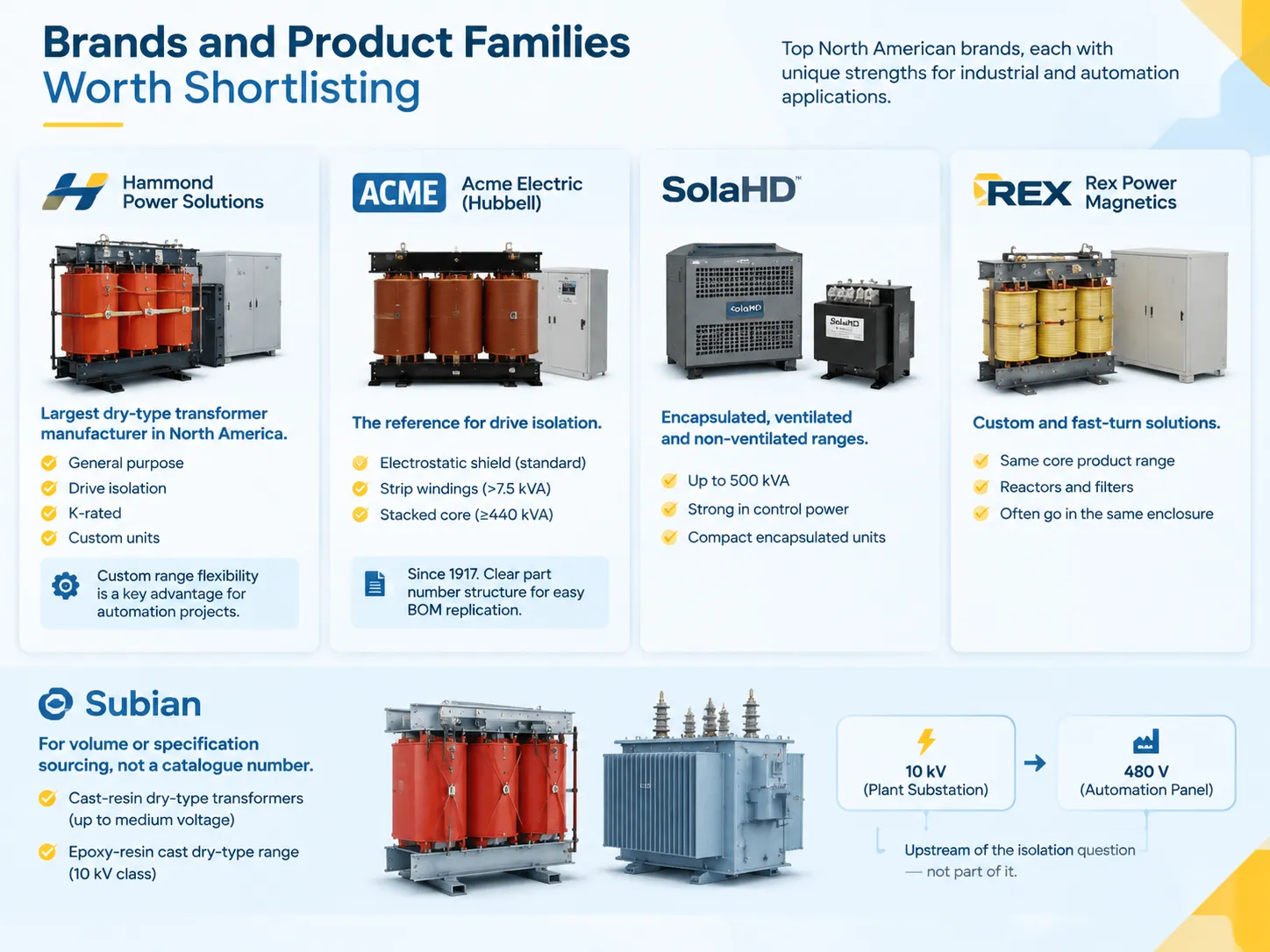
In North America, four names stand out clearly. However, one is actually an established specialist rather than a catalog brand.
- Hammond Power Solutions, which happens to be the biggest dry-type transformer producer in North America, is known for typical transformers such as general-purpose transformers, drive isolation transformers, K-rates transformers, and customized transformers. The company’s main advantage in automation is the ability to provide a comprehensive range of customized transformers, which is necessary when a manufacturer requires 575 V input and 480 V output in a special enclosure.
- Acme Electric (Hubbell) is the main brand in terms of drive isolation. The electrostatic shield is a standard quality of the DIT series and is not an option. All transformers of above 7.5 kVA contain strip windings, whereas the ones of 440 kVA and more do use a stacked core. The company has been working on the production of such transformers since the year of 1917.
- SolaHD is a competitor of the same type of transformer. However, their product is encased and ventilated, with the non-ventilated one included in this group of products. However, in terms of control power units, their encapsulated equipment is much more powerful.
- Rex Power Magnetics has entered the same market, however, the company is known for its customized solutions and quick delivery, as well as reactors and filters that are commonly included in the same enclosure.
For buyers sourcing at volume or to a specification instead of a catalogue number, the manufacturer side looks different. Subian builds cast-resin dry-type transformers up to medium voltage, and the epoxy-resin cast dry-type range covers the 10 kV class that feeds a plant substation before anything reaches a 480 V automation panel. That is upstream of the isolation question, not part of it, and knowing where the boundary sits stops the wrong enquiry going to the wrong supplier.
Installation Details That Decide Whether It Works
If a shielded isolation transformer is mounted incorrectly, it becomes ineffective because of the unshielded version’s characteristics, and the issues involved are always the same.
Long secondary leads. Noise is induced into each meter-long section of the conductor making it possible to make use of the transformer shield only for what takes place inside the transformer. Place the transformer close enough to the load, make the secondary lines as short as possible, and do not keep them parallel to the power cables for 10 meters.
Ground loops through the shield. On the one hand, the shield needs to be grounded in one area, which means that one should not do it at both ends, otherwise, a loop antenna is created around noise. The shield must be connected to the panel not through painted metal but through a conductive lead.
Then the usual electrical checks. Overcurrent protection on both primary and secondary, bonding jumper on the secondary if the transformer creates a separately derived system and the full commissioning set including the insulation resistance check, turns ratio check, polarity check, and load test before handing it over to the customer. The sequence and acceptance values are set out in this guide to testing a transformer before energisation, and skipping the ratio check is how a reversed winding reaches a live PLC.
Mistakes That Show Up in Commissioning
- Ordering a 1:1 device when a step-down transformer is required. A 480 to 120 volt control supply is meant to perform step-down operations with the benefit of isolation; it is certainly not a 1:1 transformer. Customers ordering a 1:1 transformer along with a separate 120 V power supply would end up paying more and taking up more panel space for achieving the exact same goal.
- Assuming that the shield takes care of earth loops. It does remove common mode noise, but does not tackle the issue of the difference between two ground references.
- Disregarding sounds. A transformer installed outside the control room wall, creating 55 dB noise, becomes a ground for complaints. Core construction and isolation in mounting are given a lot of attention, but placing the unit in the corridor is no way to design it.
- Ignoring the heat. A transformer with 15 kVA power rating and 97% efficiency generates about 460 W in the enclosure. Enclosing it in the sealed cabinet based only on drive losses will cause the equipment to run 15°C above expected temperatures.
Perguntas Frequentes
Do I need a 1:1 isolation transformer or a shielded step-down?
When the load voltage is different, a stepdown unit with a shield is needed instead of a 1:1 unit. If the load voltage is already the same as the supply voltage and the problem is common mode noise, the 1:1 shielded unit is the right choice. The term 1:1 represents the ratio of the unit and not its noise characteristics and the shield works for noise suppression.
Does an isolation transformer protect against power surges?
In a way, yes. The inductance lessens sharp voltage spikes, and the shield prevents noise interference but does not provide surge protection and, therefore, has no UL 1449 classification; surge protection devices are found at the point of entrance to the service, as well as in the panel of the building.
K-rated or oversized: which is better for harmonic loads?
The cleaner answer is K-rated. A K-13 unit fulfills the necessity to transport the harmonic current while maintaining the temperature rise below the rated limit. When a K-rated unit is unavailable in the required size as well as lead time, the solution is oversizing by a factor of 1.5 to 2 times without any effect on the performance but with an impact on the panel space for the gear.
Can I bond the neutral on the secondary?
When it comes to transformers that are separately derived systems, NEC 250.30 provides guidance; there must be a system bonding jumper connecting the secondary neutral to the equipment grounding conductor, either at the transformer or at the first disconnecting means, but not at both locations. In cases when the transformer is not a separately derived system, the neutral will not be bonded at the transformer. Failing to understand this can lead to the creation of a parallel ground path and an un-clearing ground fault.
Referências
- Hammond Power Solutions — Dry-Type Transformer Catalogue
- Hubbell — Acme Electric Drive Isolation Transformers
- SolaHD (Emerson) — Power Quality and Control Transformers
- Rex Power Magnetics — Dry-Type Transformers and Reactors
- NFPA 70 — National Electrical Code, Articles 250 and 450
Conclusão
The best isolation transformer for an automation panel is not necessarily the most costly. Rather, it is the one that has characteristics matching the load: shielded from noise, drive-rated for notching, K-rated for harmonics, and sized from kVA, rather than voltage ratios.
Just four lines of specification will determine whether a certain unit does anything useful at all. First is a shield with a terminal to measure. Second is that the K factor is stated. Third is that the temperature rise is stated. Finally is the proximity of the mounting site to the load so that any potential for malfunction through design failure is minimized.