


Um empreiteiro elétrico baseado em Nairóbi está substituindo antigos transformadores montados em postes de 50 kVA em três subúrbios, e ele foi informado por seu comprador em Guangzhou que a fábrica está pronta para entregar 120 unidades em apenas 60 dias a um preço que mostra claramente como o distribuidor local está chocado. Histórias como essa são diferentes, mas semelhantes a milhares de acordos concluídos em um ano. De fato, a principal razão para a popularidade de transformadores elétricos montados em postes chineses é porque eles são amplamente utilizados para a eletrificação de redes rurais na África Oriental, Sudeste Asiático, Oriente Médio e América do Sul. O fato de que as empresas de manufatura chinesas representam aproximadamente 60% de todo o mercado de transformadores de distribuição é um fato confirmado pelos transformadores montados em postes sendo os itens mais vendidos na lista de exportação dos dispositivos elétricos da linha de energia mais ecológica.
Este artigo explicará as razões para a percepção favorável dos transformadores montados em postes fabricados na China entre os consumidores internacionais, suas diferenças em comparação com as transformações feitas no Ocidente, os preços médios aos quais esses dispositivos são vendidos e a certificação que os dispositivos precisam passar antes de serem conectados a qualquer linha de energia. Se você está em busca de uma cadeia de suprimentos confiável dos dispositivos elétricos que participarão de seus projetos de utilidade ou iniciativas de eletrificação rural, este conselho ajudará em sua análise das cotações recebidas ou fornecerá algumas ideias do que você precisa para comparação.
O que é um transformador de poste de energia?
Um transformador instalado em um poste de energia pode ser tipicamente observado em postes elétricos de madeira ou concreto ao longo das ruas da cidade e áreas rurais. Ele se conecta ao sistema de distribuição de média tensão (que é 11, 22 ou 33 kV se seguirmos os padrões IEC) para que a tensão seja reduzida a um nível adequado para uso doméstico, que geralmente é de 400/230 volts trifásicos. Na América do Norte, a tensão primária varia de 12,47 kV a 13,8 kV, e a secundária é de 240/120 fase dividida. Os tipos de transformadores incluem aqueles feitos em design monofásico ou trifásico, com a capacidade fornecida variando de 5 kVA a 500 kVA, dependendo do número de conexões de algumas fazendas ou do cálculo de energia consumida em estabelecimentos industriais, vilarejos e centros em geral.
A construção do transformador pode ser de dois tipos também: transformadores de tanque selado e transformadores imersos em óleo. De fato, no poste de energia, geralmente lidamos com versões imersas em óleo. O óleo desempenha dois papéis: fornece a isolação dos enrolamentos. Nesse sentido, se um transformador de cem kVA estiver em consideração, seu peso varia de 400 a 600 kg, dependendo das características construtivas do núcleo feito de aço ou alumínio.
Por que os transformadores de poste chineses dominam os mercados globais
A escala é o primeiro fator. A China é o maior fabricante de transformadores do mundo e produz milhões de transformadores de distribuição anualmente. Transformadores montados em postes são um dos produtos mais padronizados em todo o catálogo de transformadores. Devido a essa padronização, as fábricas podem armazenar as ferramentas e suprimentos necessários para a classificação de produção comum de transformadores, o que reduz os custos de produção e permite que o processo de fabricação leve de 30 a 60 dias para a maioria dos pedidos. Assim, é evidente que se a empresa de utilidade em Gana precisar comprar 500 transformadores de 50 kVA, nenhuma fábrica europeia ou americana levará o mesmo tempo para fazê-lo.
O segundo fator é a integração dos suprimentos de materiais. As fábricas na China têm influência em todas as cadeias de suprimentos do aço silício orientado retilinear, fios de cobre, isolamento a óleo e isolamento de eixo, o que significa que podem ser menos afetadas pelas flutuações dos preços das matérias-primas do que outros países. Assim, é evidente que uma fábrica chinesa venderá um transformador de 50 kVA a um preço muito mais baixo do que um similar alemão ou japonês.
O terceiro fator é a flexibilidade com os padrões. Os fabricantes chineses são fáceis de trabalhar e estão prontos para produzir transformadores de acordo com as regulamentações IEC 60076, IEEE C57.12 ou as regulamentações específicas da rede em qualquer local desejado do mundo, como Inglaterra, Austrália ou Arábia Saudita, entre outros. Além disso, estão prontos para produzir transformadores com alterações personalizadas.
Tipos e Classificações de Transformadores Montados em Postes
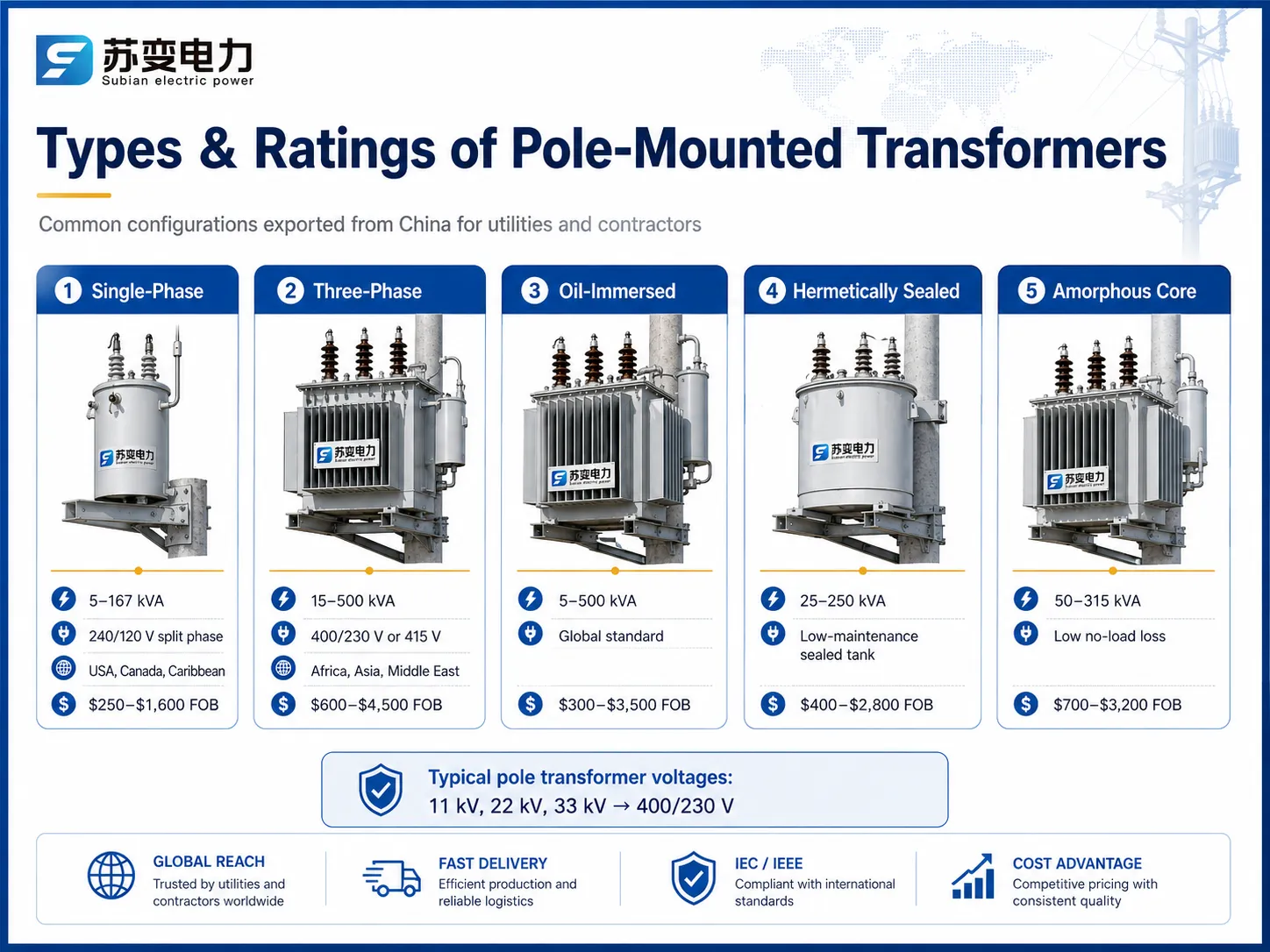
Transformadores montados em postes se dividem em três linhas: contagem de fases, meio de resfriamento e estilo de montagem. Compreender as diferenças ajuda você a solicitar a unidade certa na primeira vez.
| Tipo | Classificação Típica | Tensão Secundária | Mercados Comuns | Preço Indicativo (FOB China) |
|---|---|---|---|---|
| Transformador de poste monofásico | 5-167 kVA | 240/120 V fase dividida | EUA, Canadá, Caribe | $250-$1,600 |
| Transformador de poste trifásico | 15-500 kVA | 400/230 V ou 415 V | África, Ásia, Oriente Médio | $600-$4,500 |
| Imerso em óleo (convencional) | 5-500 kVA | Dependendo da rede | Padrão global | $300-$3,500 |
| Hermeticamente selado (sem conservador) | 25-250 kVA | Dependendo da rede | Europa, Ásia, África | $400-$2,800 |
| Núcleo amorfo (economia de energia) | 50-315 kVA | 400/230 V | Ásia, UE, projetos verdes | $700-$3,200 |
Na maioria das operações internacionais de distribuição, o transformador trifásico imerso em óleo de 11/0,4 kV ou 33/0,4 kV é indispensável. Embora os transformadores do tipo núcleo amorfo custem 15-25% mais do que os transformadores tradicionais de aço silício, eles efetivamente diminuem as perdas em vazio em 60-80% em comparação com núcleos de aço silício orientado a grão e são preferidos por muitas redes de energia que envolvem requisitos de eficiência energética.
Principais Características de Design que Importam
Nem todos os transformadores de poste são criados iguais, e as diferenças aparecem ao longo de uma vida útil de 20-30 anos. Aqui está o que observar em uma ficha técnica.
Material do núcleo: aço silício orientado a grão laminado a frio (CRGO) é o padrão; metal amorfo é a opção premium de baixa perda.
Condutor de enrolamento: cobre apresenta perdas de carga mais baixas do que alumínio. Uma unidade de cobre de 100 kVA geralmente custa de 10 a 15% a mais do que um equivalente de alumínio, mas economiza de 15 a 20% em perdas de carga.
Vedação do tanque: tanques totalmente selados (herméticos) com tampas soldadas evitam o conservador e sua manutenção; paredes do tanque corrugadas maximizam a dissipação de calor.
Isoladores: isoladores de porcelana ou resina, escolhidos para combinar com o hardware de cabo ou barramento do destino.
Mudador de derivação: um mudador de derivação fora de circuito com derivação ±2×2,5% é padrão em unidades de 25 kVA e acima para ajustar a queda de tensão da linha.
Proteção contra corrosão: tanque galvanizado a quente mais uma camada final de tinta é o mais importante em instalações costeiras.
Uma especificação que os compradores frequentemente esquecem é a tensão de impedância. A impedância de um transformador de poste (tipicamente 4% para unidades pequenas) define a corrente de falta disponível e interage com a coordenação de proteção da concessionária. Se você encomendar um transformador com a impedância errada, as configurações do fusível a montante podem não operar corretamente. Sempre confirme a impedância de 1% com seu operador de rede antes de fazer o pedido.
Especificações Típicas (Com Tabela)
Estes são valores representativos para um transformador de poste trifásico padrão de 100 kVA, 11/0,4 kV, construído de acordo com a IEC 60076. Os números exatos variam de acordo com o fabricante e a classe de eficiência, portanto, trate-os como números de planejamento.
| Parâmetro | Valor Típico |
|---|---|
| Potência nominal | Tipo Seco (típico) |
| Relação de tensão | 000/400-230 V (outras relações conforme a rede) |
| Frequência | 50 Hz (60 Hz opcional) |
| Grupo vetorial | Dyn11 ou Yyn0 |
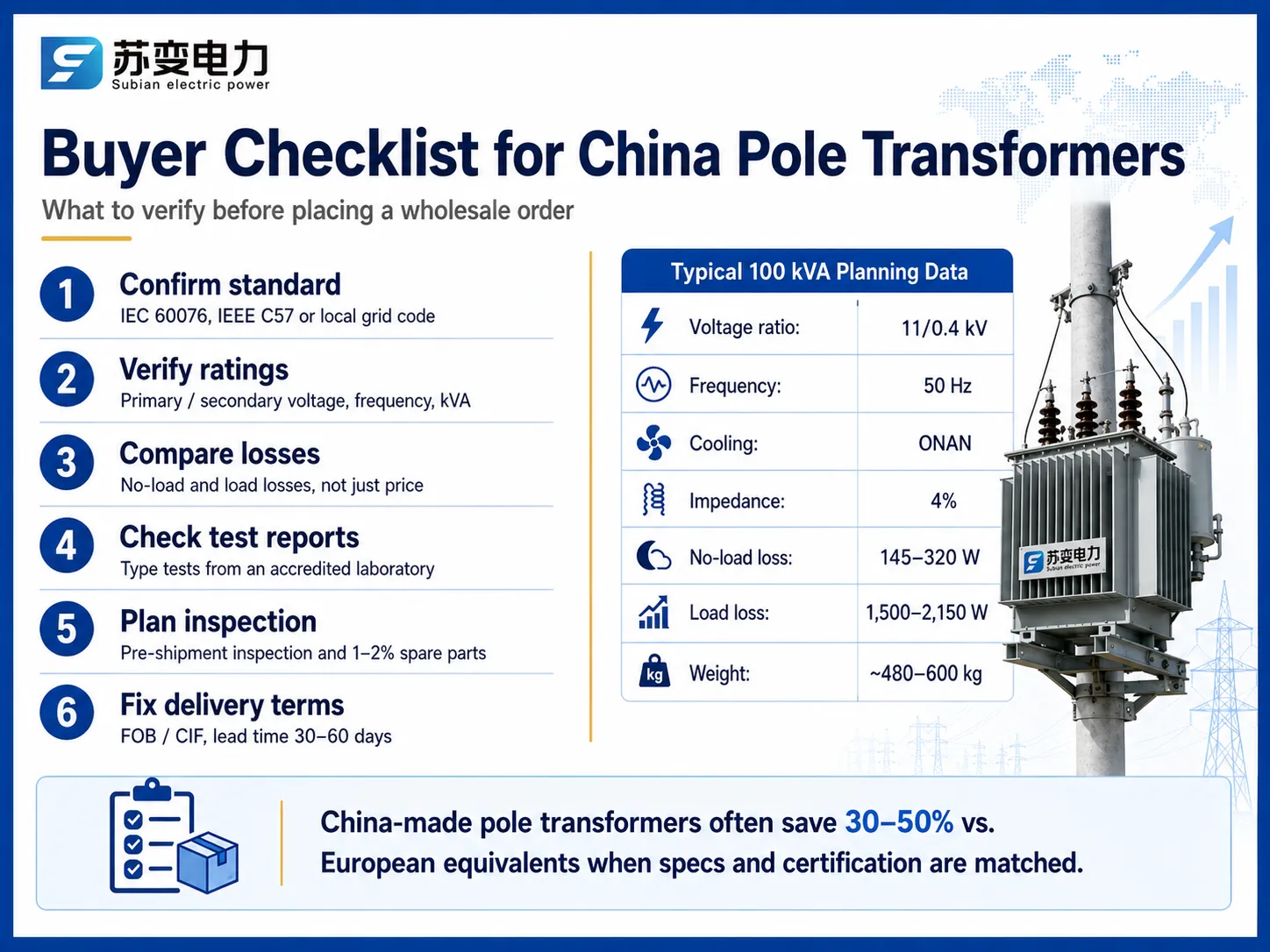
| Perda em vazio | 145-320 W dependendo da classe do núcleo |
| Perda de carga (75 °C) | 500-2.150 W |
| Tensão de impedância | 4% |
| Corrente em vazio | 0.6-1.0% |
| Método de resfriamento | ONAN |
| Peso total | ~480-600 kg |
| Nível de som | ≈55 dB(A) |
Classes com alta eficiência (como o Tier 2 da UE e o Grau 2 da China GB 20052-2020) têm limites de perda mais rigorosos. Quando se opta por um transformador de núcleo amorfo ou de Grau 1 em vez de um transformador CRGO padrão, por exemplo, acaba-se pagando um excesso de apenas 15-25% do preço do transformador CRGO por um transformador de 100 kVA, mas, por outro lado, reduz as perdas em vazio para cerca de 60-80 W, que podem ser economizadas ao longo do uso.
Normas: IEC vs IEEE vs Códigos de Rede Locais
O maior erro na aquisição pode ser assumir que apenas uma norma se aplica a diferentes mercados. Um transformador em conformidade com a IEC 60076 com 11/0,4 kV e 50 Hz não funcionará na linha de 12,47 kV, 60Hz dos EUA, a menos que modificado. Primeiro, antes de obter cotações de fornecedores, verifique quatro parâmetros com a empresa elétrica ou o consultor: tensão primária, tensão secundária, frequência (50 ou 60 Hz) e norma.
| Padrão | Região | Requisitos Principais |
|---|---|---|
| IEC 60076 | Global (Europa, África, Ásia, Oriente Médio) | Classificação, perdas, testes conforme IEC |
| IEEE C57.12 | EUA, Canadá | Dimensões de bucha ANSI, 60 Hz, 240/120 V |
| GB 20052-2020 | China | Classes de eficiência energética obrigatórias |
| EN 50464 / EN 50588 | União Europeia | Níveis de eficiência e limites de ruído |
| Especificações da concessionária local | Específico do país | Tipo de bucha, faixa de derivação, acabamento do tanque, idioma da placa de identificação |
Um fornecedor chinês bem conhecido possui linhas de produção diferentes ou arquivos de design diferentes para dispositivos IEC e IEEE, uma vez que diferentes construções estão envolvidas em buchas, óleo ou até mesmo tamanhos de tanque. Solicite o certificado de teste de tipo para seu design específico, e não para um semelhante.
Onde Eles São Usados ao Redor do Mundo
Transformadores de poste desempenham um papel fundamental nos sistemas de distribuição elétrica, conectando a alimentação de média tensão com ramificações de baixa tensão de subestações elétricas para residências, fazendas e pequenas instalações comerciais. Alguns exemplos típicos do uso de transformadores de poste incluem:
Projetos de eletrificação rural: projetos de eletrificação rural financiados pelo governo nas regiões da África subsaariana, Sul da Ásia e Sudeste Asiático utilizam milhares de transformadores de 25-100 kVA a cada ano.
Distribuição em vilas e pequenas cidades: na cidade ou em cidades menores, uma unidade com capacidade de 100-250 kVA normalmente atende de 100 a 500 domicílios.
Distribuição urbana de rua: unidades de transformadores de poste de 200-500 kVA ou alguns transformadores de poste monofásicos menores atendem áreas da cidade.
Aplicações de irrigação e bombeamento em fazendas: transformadores de poste dedicados para bombas de irrigação, na faixa de 25-50 kVA, são instalados longe das vilas.
Fornecimento de energia temporário e de construção: pequenos transformadores de poste em postes de madeira fornecem eletricidade para as áreas de construção até que a conexão permanente seja instalada.
Empresas de mineração e industriais: transformadores de poste fornecem energia para pequenas oficinas e empresas nas áreas onde as operações de mineração e industriais são realizadas.
Como os transformadores de poste estão expostos a elementos climáticos, tempestades, pássaros, raios, a maioria das concessionárias de energia geralmente instala para-raios e fusíveis a montante dos transformadores. Alguns clientes também solicitam transformadores com caixas de terminais à prova de curto-circuito e design de parafuso contra roubo em áreas com alta taxa de furto.
Principais Marcas e Comparação de Preços (Com Tabela)
Na Ásia, grandes empresas internacionais e dezenas de fabricantes chineses atendem ao mercado de transformadores de poste. Os preços abaixo devem ser tratados como um custo indicativo de uma unidade trifásica imersa em óleo de 100 kVA com base FOB ou ex-works, portanto, o preço final dependerá da configuração de qualquer maneira.
| Marca | País | Posição no Mercado | Preço Indicativo (100 kVA) |
|---|---|---|---|
| ABB | Suíça/Suécia | Portfólio completo, forte rede de serviços | $2,200-$3,500 |
| Siemens | Alemanha | Engenharia premium, opções de monitoramento digital | $2,400-$3,800 |
| Schneider Electric | França | Ampla gama de baixa tensão, bom em licitações europeias | $2,100-$3,400 |
| Hitachi Energy | Suíça | Antiga ABB Power Grids, qualidade de transformador de primeira linha | $2,300-$3,700 |
| Eaton | EUA/Irlanda | Forte na América do Norte, unidades estilo EUA | $1,900-$3,200 |
| Sanbian / Tianwei | China | Grandes produtores apoiados pelo estado, grandes volumes de exportação | $800-$1,400 |
| Jiangsu Subian Electric Power | China | Fabricante de transformadores de distribuição certificado pela IEC 60076, focado em exportação, suporte OEM/ODM | $700-$1,300 |
Marcas internacionais ganham seu prêmio com décadas de histórico de testes de tipo, redes de serviços densas e margens de engenharia conservadoras. Uma unidade chinesa em $700-$1,300 é funcionalmente equivalente se a fábrica estiver certificada e os testes de tipo forem reais. Jiangsu Subian Electric Power está neste ponto ideal: um fabricante chinês de transformadores de distribuição e montados em poste que possui certificação IEC 60076, constrói de acordo com IEC, IEEE ou normas específicas do cliente, e apoia compradores globais com testes de fábrica, documentação em inglês e produção OEM/ODM. Para um gerente de projeto que pode gerenciar inspeção e logística, essa combinação geralmente economiza 30-50% em relação aos preços de marcas internacionais sem sacrificar a conformidade.
Como Comprar no Atacado da China Sem Ser Enganado
Comprar transformadores de poste em grande quantidade da China é uma prática comum, mas existem várias regras que distinguem uma transação tranquila de uma dor de cabeça completa.
Obtenha verificação da fábrica em vez de folheto. Peça licença comercial, experiência anterior em exportação (documentos aduaneiros ou referências) e o vídeo ao vivo da montagem de bobinas e tanque.
Verifique os testes. Solicite que um laboratório certificado produza um certificado de teste para o kVA e a relação de tensão exigidos.
Confirme um padrão. IEC, IEEE ou especificações locais? Insista nisso no contrato de compra.
Tabela de perdas de solicitação. Procure a classe de eficiência e compare as perdas em vazio e em carga.
Acordar sobre a inspeção. $1,000-$2,500 é uma boa estimativa para uma inspeção de terceiros cobrindo perdas, relação, qualidade do óleo e aparência.
Estabelecer condições de entrega. FOB ou CIF? Certifique-se de descobrir quem pagará pelo transporte marítimo e terrestre no país de destino.
Planejar peças de reposição. Prepare-se para encomendar 1-2% de peças sobressalentes (geralmente incluindo buchas adicionais, juntas e várias unidades sobressalentes) para manter a taxa de falhas razoável.
Em termos de pagamentos, geralmente é 30% de depósito + 70% contra um conhecimento de embarque, enquanto novos clientes pagam com uma carta de crédito à vista. É melhor não pagar 100% antes de visitar a fábrica.
Notas sobre envio e instalação
O peso de um transformador de poste trifásico de 100 kVA é em torno de 500 kg e é enviado em uma caixa de madeira. Isso significa que cerca de 40-50 transformadores cabem em um contêiner de 40 pés. O custo de envio por mar da China (Xangai, Qingdao e Ningbo) para a maioria dos portos africanos e do Oriente Médio varia de $3,000 a $7,000 para o contêiner inteiro; o custo aproximado de transporte é, portanto, de $60-$180 por transformador, dependendo da rota e da época do ano. O transporte aéreo é raramente utilizado devido ao peso; a única exceção é a substituição urgente de um dispositivo, onde o cliente paga mais pela entrega rápida.
No local, uma equipe certificada de especialistas monta o dispositivo no poste com uma braçadeira ou na viga de aço, conecta o lado de alta tensão através do corte de fusível e do para-raios, e conecta o lado de baixa tensão à rede de serviço. Normalmente, leva de 2 a 4 horas para instalar o transformador quando se trata de uma peça. Exportadores chineses geralmente fornecem guias de instalação em inglês e muitos deles oferecem suporte via vídeo; alguns organizam a visita de um engenheiro para ajudar na instalação a cerca de $200-$400 por dia de trabalho, além das despesas de viagem.
Perguntas Frequentes
Quanto custa um transformador de poste chinês?
Um dispositivo trifásico típico de 25 kVA custará cerca de $300-$600 no ponto de venda. O dispositivo de 50 kVA será mais caro, variando de $500 a $900, enquanto o equipamento de 100 kVA custará ao comprador de $700 a $1,400. Neste caso, no entanto, equipamentos monofásicos ao estilo americano tendem a ser mais caros do que seus equivalentes trifásicos. Os preços reais variarão de acordo com a escolha entre enrolamento de cobre ou alumínio, relação de tensão e a eficiência geral da máquina.
Os transformadores de poste chineses podem atender aos padrões IEC ou IEEE?
A IEC 60076 diz respeito a classificações, perdas e testes, enquanto a IEEE C57.12 se refere a designs norte-americanos. Um exportador credível deve apresentar certificações de teste de tipo emitidas por laboratórios acreditados para a configuração precisa fornecida. Qualquer fornecedor que não puder produzir tal certificação deve ser descartado e alternativas devem ser buscadas—há muitas disponíveis.
Quanto tempo leva a entrega?
Normalmente, leva cerca de 30-60 dias para produzir classificações padrão e mais 25-50 dias de tempo de envio pelo oceano até o destino. Para núcleos amorfos ou unidades personalizadas de maior frequência, prepare-se para adicionar 2-4 semanas ao seu cronograma. Se o pedido se referir a grandes programas, divida o pedido entre dois ou três lotes para verificar o primeiro envio antes de se comprometer com o restante.
Qual é a diferença entre enrolamentos de cobre e alumínio?
O cobre tem cerca de 60% menor resistividade do que o alumínio, portanto, um transformador com enrolamento de cobre tem menores perdas de carga para a mesma seção transversal e opera mais frio. Uma unidade de 100 kVA em cobre normalmente custa 10-15% a mais, mas perde aproximadamente 15-20% menos em plena carga, o que geralmente se paga em 5-8 anos de operação contínua.
Quanto tempo dura um transformador de poste?
Com instalação adequada, resfriamento adequado e verificações regulares de óleo, um transformador de poste imerso em óleo normalmente opera de 20 a 30 anos. A amostragem periódica dos gases dissolvidos no óleo (DGA) e do teor de umidade é a maneira mais confiável de detectar falhas em desenvolvimento antes que causem uma falha.
Referências
- IEC 60076-1: Transformadores de Potência – Geral — Norma reguladora para classificação de transformadores, perdas e testes.
- IEEE Std C57.12 — Normas de transformadores de distribuição da América do Norte, incluindo unidades montadas em postes.
- IEEE — Fonte de orientação e normas de engenharia para transformadores de distribuição.
- NEMA — Publica normas de transformadores dos EUA e orientações de aplicação.
- Departamento de Energia dos EUA — Regulamentações de eficiência energética para transformadores de distribuição.
- ABB — Referência do fabricante para especificações de transformadores de distribuição premium.
- Siemens Energy — Referência do fabricante para design e serviços de transformadores de distribuição.
Conclusão
- Os transformadores de poste da China fizeram sua entrada no mercado global através de alto volume, preços competitivos e especificações flexíveis. Por exemplo, um transformador trifásico padrão de 100 kVA de um fornecedor chinês certificado custa de $700 a $1,300 FOB, o que é 30-50% mais baixo em comparação com marcas estrangeiras. Seu tempo de entrega é de cerca de 30-60 dias, enquanto a conformidade com IEC, IEEE ou qualquer especificação local também está disponível.
①.Verifique a tensão primária/secundária, frequência e norma ao comparar ofertas.②.Obtenha o relatório de teste de tipo para sua classificação específica de um laboratório respeitável.
③.Ao comparar preços, certifique-se de calcular também as perdas em vazio.
④.Faça provisões para inspeção de terceiros (1-2% para peças de reposição)
Se você estiver adquirindo transformadores de distribuição e montados em postes para um projeto de utilidade ou empreiteiro, a Jiangsu Subian Electric Power fabrica unidades certificadas pela IEC para mercados globais e pode cotar sua tensão exata, classificação e classe de eficiência. Envie as especificações e um volume alvo, e compare o custo total com seu fornecedor atual antes de assinar qualquer coisa.