


A técnica está realizando uma inspeção matinal quando ela vê que a cor do gel de sílica no dessecador do transformador mudou de azul para rosa brilhante na parte superior da coluna, enquanto o nível de óleo no conservador está próximo do mínimo. Ela verifica para registrar ambos os eventos, mas se lembra do manual de manutenção que essas observações indicam dois sinais de alerta precoce de um problema: umidade e ar entrando no sistema fechado de óleo do transformador. A mesma coisa aconteceu em um transformador de outra empresa quando, há dez anos, o equipamento falhou ao experimentar os mesmos problemas. Após o acidente, o relatório de análise de gás dissolvido indicou que havia sinais de aumento nos níveis de hidrogênio que já eram visíveis há muito tempo na condição do dessecador. O problema foi detectado pelo relé de gás – neste caso, ele possui um relé Buchholz.
O artigo fornece os detalhes sobre como os dessecadores e relés de gás operam em um transformador a óleo, sua importância, como interpretar seus sinais e quanto custa uma nova unidade.
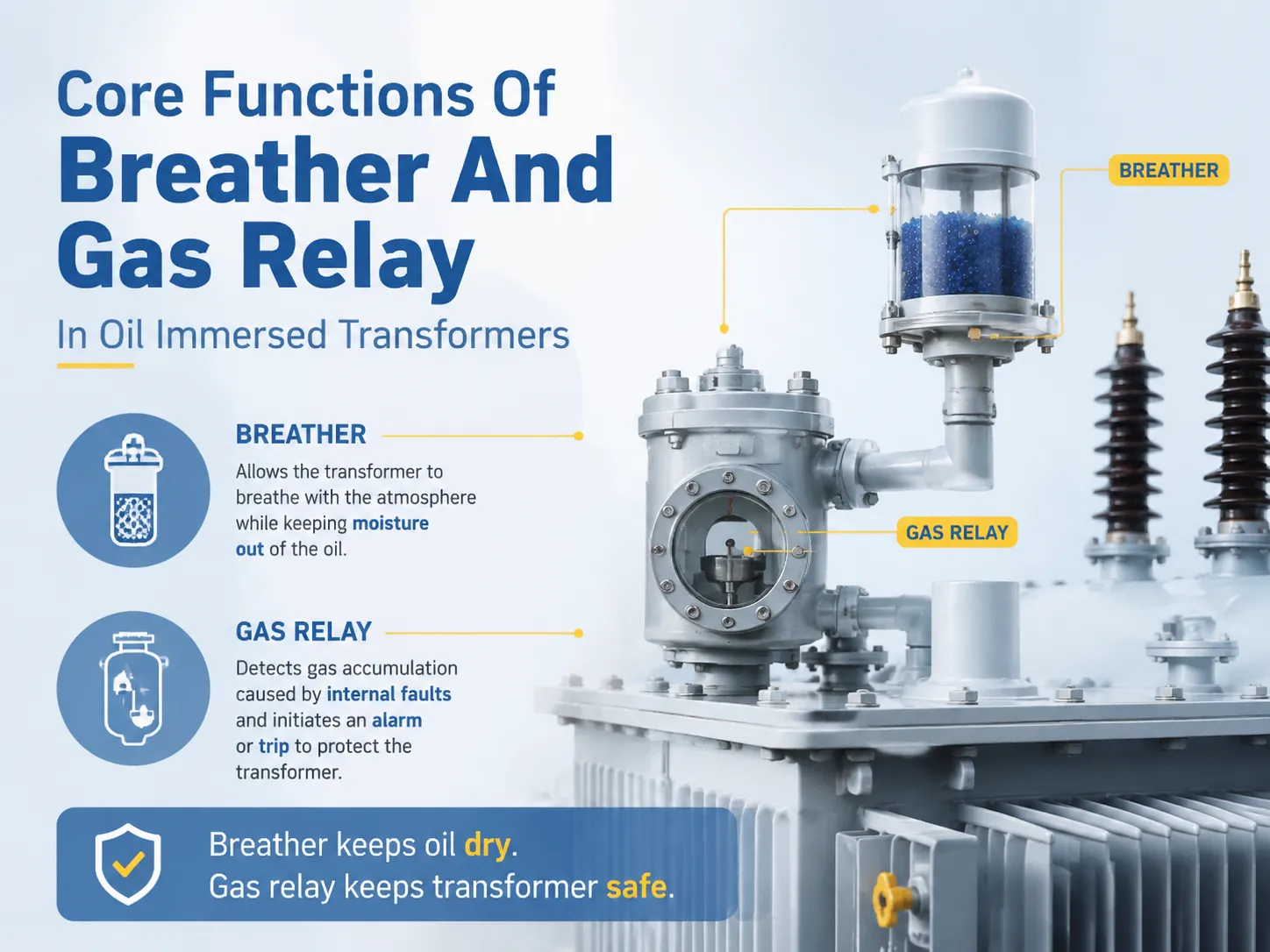
O dessecador é uma parte do conservador de óleo. É um dispositivo à base de gel de sílica que remove a umidade do ar aspirado através do conservador de óleo enquanto o transformador respira. O relé de gás é outro dispositivo de proteção que normalmente é instalado entre o conservador e o tanque para detectar acúmulo de gás devido a falhas no transformador. O preço de um dessecador normalmente varia entre $50 e $300 e o relé de gás geralmente custa entre $100 e $600. Geralmente, todos os transformadores de potência com classificação acima de 1 MVA devem ser equipados com relés de gás (norma IEC 60076-1). É obrigatório que todos os tipos de conservadores utilizem dessecadores. O gel de sílica no dessecador deve ser verificado regularmente a cada 3 a 6 meses e regenerado quando mudar de cor.
Por que Transformadores Imersos em Óleo Precisam de Ambos
O óleo utilizado no transformador imerso em óleo desempenha funções duplas de resfriamento e isolamento. Ambas as funções podem ser comprometidas pelos dois inimigos contra os quais os relés de gás e dessecadores protegem — umidade e gás de falhas internas. Um transformador preenchido com óleo respira porque o óleo se expande e contrai com a temperatura: à medida que a carga aumenta, o óleo aquece e se expande, empurrando o ar para fora através do dessecador. Quando o óleo esfria, o ar volta para o tanque. Sem um dessecador dessecante, o ar traria a umidade para o óleo, pois a água é a maneira mais rápida de falha de isolamento. Apenas algumas centenas de partes por milhão de água no óleo do transformador podem afetar dramaticamente sua resistência dielétrica — a tensão de ruptura pode ser reduzida de 60+ kV para abaixo de trinta kV com o aumento da umidade.
Os relés de gás lutam a outra batalha. Falhas internas — enrolamentos em curto, falhas no núcleo, conexões soltas — criam calor e descarregam arcos elétricos, que decompõem o óleo em gases. Os gases formados sobem para o topo do tanque e vão para o conservador através do tubo que leva ao relé de gás, permitindo assim que o relé de gás detecte o gás muito antes que outras proteções possam vê-lo.
O Breather: Função e Design
Um breather desidratante é uma unidade cilíndrica que é instalada na entrada de ar de um conservador, geralmente no topo de um tanque de conservador. O breather utiliza um material dessecante que geralmente é gel de sílica, através do qual todo o ar que entra passa. O gel de sílica retira a umidade do ar que entra antes que ele chegue ao óleo. Uma mudança na cor do gel de sílica do status ativo (principalmente azul) para o hidratado (rosa, branco ou laranja, dependendo da qualidade) indica a quantidade de capacidade restante para o dessecante absorver a umidade.
A unidade normalmente possui um selo de óleo ou uma válvula de retenção para evitar a saturação do dessecante com água devido a respingos de chuva. O dispositivo também permite que o gás escape e não permite que a umidade entre. Os breathers modernos podem vir com uma janela indicadora, cartucho removível com dessecante para renovação e um aquecedor em ambientes frios onde a umidade pode se condensar dentro da unidade. Um breather desidratante usual pode pesar entre um e três quilos de gel de sílica e funcionar para muitos transformadores de apenas alguns MVA; uma escala maior requer um alojamento maior ou uma combinação de alguns breathers.
O Relé de Gás: Função e Design
O relé de gás — comumente referido como relé Buchholz em homenagem ao seu inventor Max Buchholz (1921) — é posicionado no sistema de tubulação que conecta o tanque principal ao conservador, tendo uma leve inclinação que leva ao acúmulo de gás. Inclui dois interruptores de flutuação e alguns tipos têm uma barreira que distingue ondas.
- Acúmulo de gás: Pequenas falhas internas causam acúmulo lento de gás. Como resultado, isso empurra o óleo para cima na câmara do tanque superior, o que reduz o nível do flutuador superior e fecha o contato de alarme. Então, o técnico pode ventilar o relé e fazer amostras de gás para exame.
- Surto de óleo: Quando uma grande falha acontece, por exemplo, um curto-circuito do enrolamento, o óleo começa a jorrar do tanque para o conservador em alta velocidade. O defletor é liberado e faz o flutuador inferior se mover para baixo, fechando assim a conexão de disparo que leva à desconexão do transformador.
Dessa forma, o relé Buchholz se torna o primeiro e mais eficaz dispositivo de proteção, pois percebe a emergência de falha mesmo antes que a corrente aumente o suficiente para desconectar o transformador.
Tipos de Relés de Gás e Breathes
| Tipo | Descrição | Faixa de Preço Típica |
|---|---|---|
| Breather padrão de gel de sílica | Coluna de dessecante de 1-3 kg, selo de óleo, janela | $50-$300 |
| Breather de grande capacidade / industrial | Coluna de 5-15 kg para transformadores de potência, opção de aquecedor | $300-$1,500 |
| Breather indicativo de mudança de cor | Gel de sílica azul para rosa, cartucho substituível | $80-$400 |
| Relé Buchholz clássico (tipo flutuador) | Dois flutuadores, alarme de gás + disparo de surto, visor de vidro | $100-$500 |
| Relé de gás eletrônico / inteligente | Sensores adicionais, indicação remota, porta pronta para DGA | $400-$1,200 |
No caso de um transformador de distribuição ou industrial, o relé tipo flutuador Buchholz e um desumidificador de gel de sílica de mudança de cor são as ferramentas preferidas, simplesmente porque são os mais confiáveis e os mais baratos. As versões eletrônicas oferecem dados sobre a operação do relé em locais remotos.
Lendo os Sinais: O Que Cada Dispositivo Te Diz
| Observação | Significado Provável | Ação |
|---|---|---|
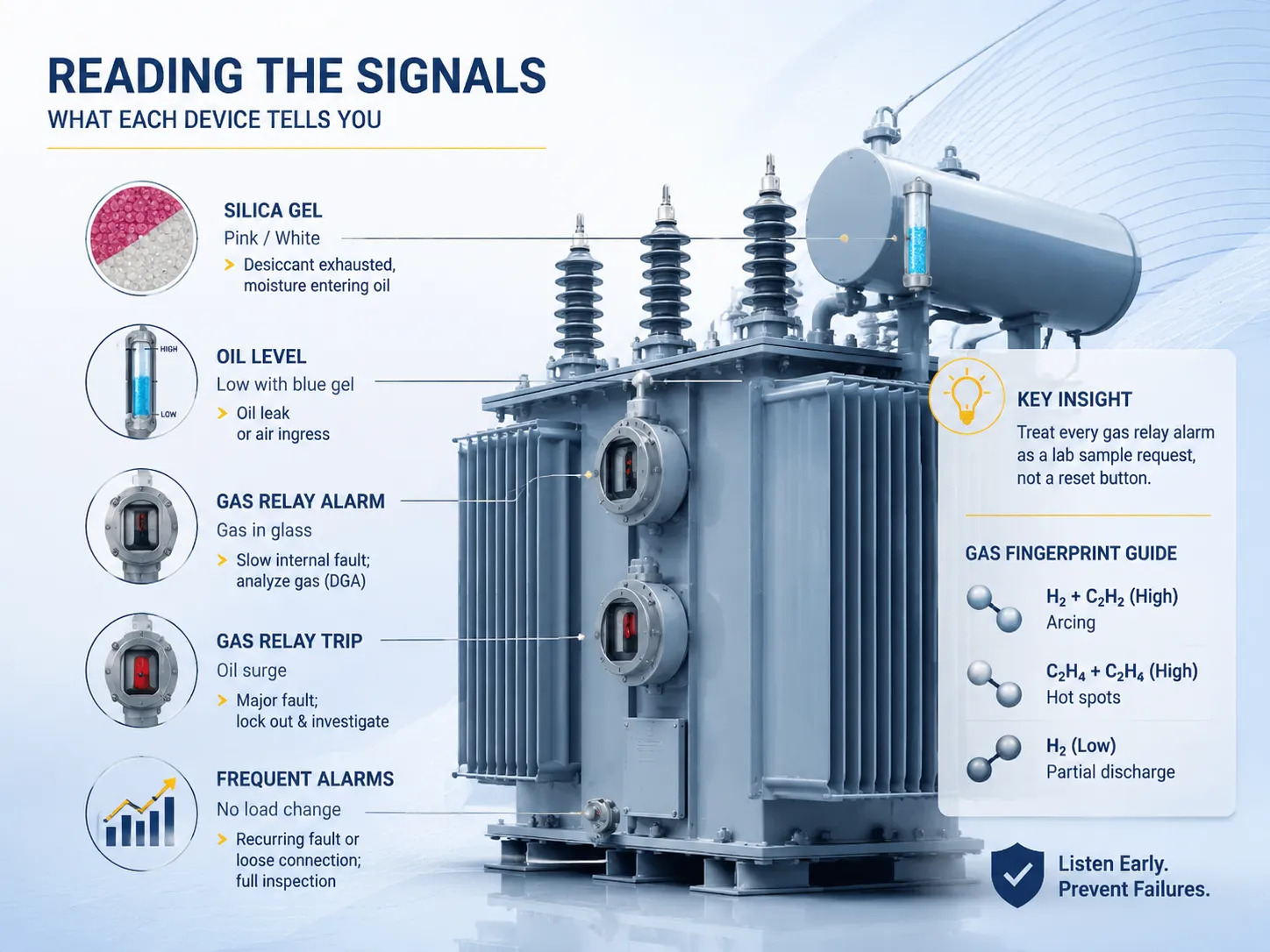
| Gel de sílica ficou rosa / branco | Dessecante esgotado; umidade entrando no óleo | Regenerar ou substituir o gel de sílica; verificar o teor de água no óleo |
| Nível de óleo baixo no conservador com gel azul | Vazamento de óleo ou entrada de ar | Encontrar e corrigir vazamento; completar o óleo |
| Alarme do relé de gás acionado, gás no vidro | Falha interna lenta; a composição do gás a identifica | Coletar amostra de gás para DGA; não reiniciar sem análise |
| Disparo do relé de gás acionado | Falha maior; surto de óleo | Isolar o transformador; investigar antes de reenergizar |
| Alarmes frequentes do relé de gás, sem mudança de carga | Falha interna recorrente ou conexão solta | Inspeção interna completa; testes de resistência de enrolamento e relação de espiras |
A prática mais importante em relação à manutenção de transformadores é considerar o alarme do relé de gás como um pedido de amostra de laboratório, não apenas um reset. A presença de hidrogênio (H₂) e acetileno (C₂H₂) indica a ocorrência de arco, a presença de etileno (C₂H₄) e etano (C₂H₆) indica pontos quentes, enquanto a baixa concentração de hidrogênio aponta para descarga parcial. Cada caso leva a uma área diferente do transformador.
Especificações e Seleção
| Parâmetro | Desumidificador | Relé de Gás |
|---|---|---|
| Capacidade / classificação | Massa do dessecante: 1-15 kg por volume de óleo | Tamanho do tubo: DN50-DN100 tubo de conservador correspondente |
| Padrão | IEC 60076-1 relacionado; especificação do fabricante | IEC 60076-1; relé testado conforme padrão do fabricante |
| Materiais | Corpo galvanizado / inoxidável, janela de vidro ou policarbonato | Corpo fundido com portas de visão em vidro, flutuadores de latão/aço |
| Contatos de alarme / disparo | Nenhum (apenas visual) ou alarme opcional em alta umidade | Dois contatos independentes: alarme de gás, disparo de surto (por exemplo, 250 V, 2-3 A AC) |
| Montagem | Parte superior do conservador, entrada de ar | Tubo entre o tanque e o conservador, inclinação de 1-5° |
Escolha o tamanho do furo do tubo considerando o relé de gás utilizado e a classificação dos contatos, seja AC ou DC. Para dessecadores, use a quantidade de dessecante de acordo com a capacidade de óleo do transformador e a taxa de respiração, com uma regra geral de que, para equipamentos de distribuição, use cerca de 1 kg de gel de sílica para cada 1.000-2.000 litros de óleo.
Intervalos e Procedimentos de Manutenção
Ambos os dispositivos são baratos, fáceis de usar e frequentemente ignorados, o que faz com que os dispositivos não desempenhem suas funções de forma eficaz. Um plano lógico é o seguinte:
- Desumidificador – a cada três a seis meses verifique a cor do gel de sílica. Substitua ou regenere o gel quando ele se tornar ineficaz. O gel de sílica azul pode ser seco colocando-o em um forno ajustado para 105-120° C e mantendo-o lá por várias horas até que retorne à sua cor azul.
- Relé de gás – uma vez por ano verifique se o dispositivo funciona abrindo a válvula de teste pela qual o contato de alerta se fecha sempre que o dispositivo opera.
- Relé de gás – para cada análise de gás dissolvido no óleo, compare o conteúdo de gás acumulado com os registros de gás dentro do corpo do transformador.
- Vedação do desumidificador – uma vez por ano, assegure-se de que os níveis de óleo e as válvulas de retenção estejam em um nível apropriado. A vedação seca significa potencial umidade entrando pela própria porta do desumidificador.
O custo desse monitoramento simples pode ser de algumas centenas de dólares por ano, enquanto os custos de não monitorá-los podem levar a enrolamentos afetados pela umidade ou falhas internas não detectadas, levando a uma recondição completa do transformador que custa, em média, de 50 a 80 por cento de um novo transformador.
Quando o relé de gás obtém uma amostra, a concentração de gás mostra o que causou a falha, pois isso é o que o laboratório envolvido na análise de gás dissolvido sempre verifica primeiro.
| Assinatura de Gás | Falha Indicada | Próximo Passo Recomendado |
|---|---|---|
| Alto H₂ + C₂H₂ (acetileno) | Arco no enrolamento ou núcleo | Inspeção interna; testes de resistência do enrolamento e relação de espiras |
| Alto H₂ sozinho (baixa concentração) | Descarga parcial | Continuar monitoramento DGA; verificar hardware solto |
| Alto C₂H₄ + C₂H₆ (etileno/etano) | Ponto quente térmico (superaquecimento) | Verificar perfil de carga, resfriamento, nível de óleo; repetir DGA em 1-3 meses |
| Alto CO + CO₂ | Envelhecimento do papel/isolamento ou superaquecimento | Análise de furanos; estimar a vida útil restante do isolamento |
| Dominado por nitrogênio sem gases de falha | Respiração normal / sem falha interna | Continuar monitoramento rotineiro |
Onde Eles São Usados
Os respiradores e relés de gás podem ser encontrados em muitos transformadores preenchidos com óleo com conservadores, tipicamente a partir de 50 kVA e acima. A configuração padrão inclui:
- Transformadores de distribuição (50-2.500 kVA): respirador padrão com um relé de gás que é fortemente recomendado para acima de 1 MVA.
- Transformadores de potência (5-100 MVA): Um respirador maior, relé Buchholz com alarme e capacidade de desligamento, que é obrigatório conforme IEC 60076-1.
- Transformadores de elevação de gerador e de rede: Vários respiradores e relés são geralmente instalados com a possibilidade de monitoramento eletrônico.
- Transformadores com designs hermeticamente selados e de tanque de expansão: o respirador pode ser representado apenas por uma bolsa de expansão; no entanto, o relé de gás ainda é um fator acima de 1 MVA.
Transformadores hermeticamente selados e com bloqueio de ar (usando nitrogênio) simplificam o trabalho de um respirador; no entanto, o conservador com um respirador prevalecerá por muitos anos, especialmente em locais com carga variável e altas taxas de umidade.
Comparação de Marcas e Preços
| Marca | Origem | Produtos | Faixa de Preço Aproximada |
|---|---|---|---|
| SR Reinhausen | Alemanha | Relés de gás e acessórios premium | $300-$1,500 |
| ABB | Suíça/Suécia | Relés e respiradores como acessórios de transformador | $150-$1,000 |
| Schneider Electric | França | Acessórios de proteção de classe de distribuição | $80-$500 |
| Comem (Itália) / Lokato | Itália / China | Fabricantes especializados de relés de gás e acessórios de conservador | $100-$600 |
| Fornecedores gerais de acessórios | Vários | Desumidificadores de gel de sílica, todos os tamanhos | $50-$1,200 |
| Jiangsu Subian Electric Power | China | Desumidificadores, relés Buchholz, conjuntos completos de tanque com acessórios | $60-$700 |
No segmento de acessórios, fabricantes como MR Reinhausen e Comem estabelecem os padrões de qualidade para relés de gás, enquanto fabricantes da Europa enfrentam séria popularidade entre compradores de soluções de transformadores de potência. O transformador completo — tanque, conservador, desumidificador e relé Buchholz testados como um único conjunto — é fornecido por fabricantes como Jiangsu Subian Electric Power, que realiza todo o trabalho no local do fabricante e oferece preços baixos que são cerca de 40-60% mais baixos do que os dos fabricantes ocidentais. A diferença reside no fato de que a qualidade do relé de gás e do desumidificador não é a área onde você economiza dinheiro ao comprar um transformador, mas sim a área que define se um bom fabricante trata os acessórios como parte do design do transformador ou não.
Como Escolher e Instalar
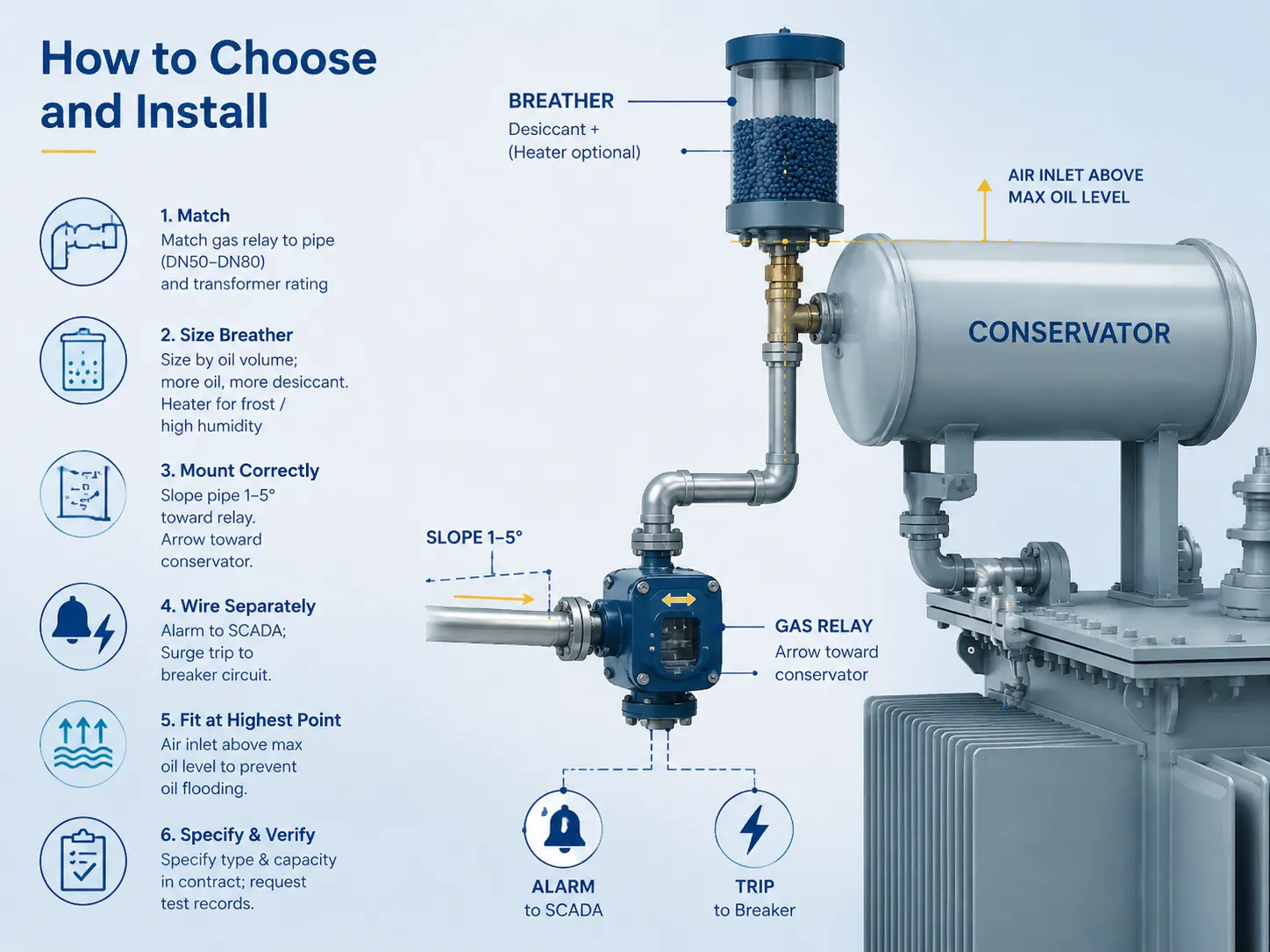
- Conecte o relé de gás ao tubo. Escolha um diâmetro de conexão do conservador (bore nominal DN50-DN80) e a classificação do transformador para garantir que as classificações de contato para o circuito de disparo sejam adequadas.
- O desumidificador deve ser selecionado de acordo com o volume de óleo no transformador. Quanto maior o volume de óleo, maior a taxa de respiração e a quantidade de dessecante; certifique-se de que você tenha um aquecedor instalado se estiver trabalhando em condições de frio ou umidade.
- Certifique-se de que o relé esteja posicionado corretamente. Uma inclinação de 1-5° em direção ao relé é recomendada para garantir que o gás se acumule no relé — certifique-se de que a seta no relé indique o conservador.
- Conecte os circuitos de alarme e de disparo separadamente. O alarme de gás deve ser conectado ao SCADA; por outro lado, o disparo de surto deve ser ligado ao circuito do disjuntor do transformador.
- Coloque o desumidificador no ponto mais alto do tubo. A entrada de ar deve ser colocada acima do nível máximo de óleo no conservador para que o óleo não possa inundar o dessecante.
- Especifique os dispositivos no contrato. Indique o tipo de relé e a capacidade do desumidificador na ordem de compra e certifique-se de ter seus relatórios de teste no certificado de entrega.
Perguntas Frequentes
Quanto custa um desumidificador e um relé de gás?
O preço de um desumidificador de gel de sílica padrão com peso entre 1 kg e 3 kg varia de 50 a 300 dólares; o de um desumidificador de transformador de potência grande está na faixa de $300 a $1.500 ou mais. Um relé de gás Buchholz tradicional custa entre $100 e $500, enquanto um eletrônico com monitoramento remoto custa entre $400 a $1.200. Ambos os acessórios representam não mais do que três por cento do preço de um transformador completo.
Com que frequência devo verificar ou trocar o gel de sílica no desumidificador?
Realize verificações visuais na cor pelo menos a cada três a seis meses, com mais frequência em ambientes úmidos. Se o gel azul se tornar rosa ou branco, ele está totalmente utilizado. Regenerá-lo aquecendo-o entre 105 °C e 120 °C até que sua cor volte a ser azul ou substitua-o completamente. Se o desumidificador saturado não for substituído, a umidade entrará no óleo levando à falha do sistema de isolamento.
O que o relé de gás realmente detecta?
Este dispositivo pode identificar dois tipos de falhas. A primeira é o acúmulo de gás causado por uma falha interna lenta, onde o gás força o óleo a deslocar a boia, o que causa um contato de alarme. A segunda é um aumento repentino de óleo causado por uma falha severa que move uma defletora que abre instantaneamente o disjuntor do transformador. O gás coletado pode ser analisado para determinar sua composição (hidrogênio, acetileno, etileno), informando assim se a falha foi devido a arco elétrico, pontos quentes ou descarga parcial.
Por que meu alarme de relé de gás continua operando sem mudança de carga?
Um alarme de gás repetido com carga normal geralmente indica que há uma falha interna, geralmente uma conexão solta, uma volta em curto ou superaquecimento do núcleo. Evite redefinir o alarme sem primeiro coletar amostras de gás e realizar análise de gás-em-óleo. Se o alarme de gás estiver disparando com frequência, isso indica que o transformador requer a realização de testes internos (resistência de isolamento, relação de voltas e testes de resistência de enrolamento).
Um transformador pode funcionar sem um relé de gás?
A afirmação é tecnicamente correta. No entanto, é uma má prática e não conformidade usar Buchholz em transformadores com uma classificação de potência superior a aproximadamente 1 MVA, onde a proteção é obrigatória, de acordo com a IEC 60076-1. O relé Buchholz é o único equipamento que detecta as falhas internas em desenvolvimento antes que ocorra um curto-circuito fase a fase. Sem ele, o primeiro sinal de falha pode ser a parada catastrófica ou incêndio. O custo do relé varia entre $100 e $600, e este relé é considerado uma das formas mais baratas de proteção em subestações.
Referências
- IEC 60076-1 — Transformadores de Potência, Requisitos Gerais — O padrão mestre que cobre acessórios como relés de gás em transformadores imersos em óleo.
- IEEE C57.106 — Guia para Aceitação e Manutenção de Óleo Mineral Isolante — Limites de umidade e orientações sobre a condição do óleo que a manutenção do desumidificador protege.
- IEEE 62 — Guia para Testes Diagnósticos de Campo de Aparelhos de Energia Elétrica — Contexto de testes de campo para relés e isolamento.
- MR Reinhausen — Acessórios e Relés de Gás — Documentação de referência para designs de relés de gás premium.
- Orientação de Segurança Elétrica OSHA — Contexto de segurança no local de trabalho para trabalhar em sistemas de proteção de transformadores energizados.
- Revista Transformers — Publicação da indústria com artigos práticos sobre manutenção de desumidificadores e relés.
Conclusão
Os primeiros a aparecer na lista de componentes de baixo custo e informativos que estão quase esquecidos, mas ainda são muito necessários em um transformador preenchido com óleo, são o relé de gás e o respirador. O primeiro alerta sobre quaisquer possíveis problemas dentro do transformador e indica quando algo dá errado.
- Verifique a cor do gel de sílica a cada 3 a 6 meses e, quando não funcional, regenere ou substitua-o.
- Não trate nenhum alarme do relé de gás como um botão de exclusão; trate-o como um pedido de uma amostra de DGA.
- Faça uma verificação do relé de gás para funcionamento a cada ano e assegure-se de que o circuito de disparo funcione corretamente.
- No contrato do transformador, inclua esses dois componentes e solicite os registros de seus testes.