


Em uma fábrica de transformadores de médio porte em Guangdong, o gerente de conformidade estava atualmente inserindo sua terceira planilha do ano. A primeira planilha monitorava as classificações de eficiência GB 20052 em todas as linhas de produtos, e a segunda acompanhava os incentivos provinciais para transformadores amorfos, mas a terceira, a que ele mais odiava, era sobre quanto do consumo de eletricidade da fábrica tinha que vir de fontes renováveis sob a avaliação local de fabricação verde. Por 3 anos, o setor de manufatura havia mudado de “vender transformadores não importa como são feitos” para “provar a classificação de eficiência, provar a cadeia de suprimentos, provar a pegada de carbono.” Sua fábrica estava bem, mas ele notou que 2 concorrentes menores tiveram que parar de exportar, pois não conseguiam mais atender aos requisitos de eficiência dos clientes.
Este artigo explica como política e regulamentação estão reformulando a indústria de transformadores, quais são os principais padrões e regras, o que a direção de desenvolvimento verde significa na prática e como compradores e fabricantes devem responder.
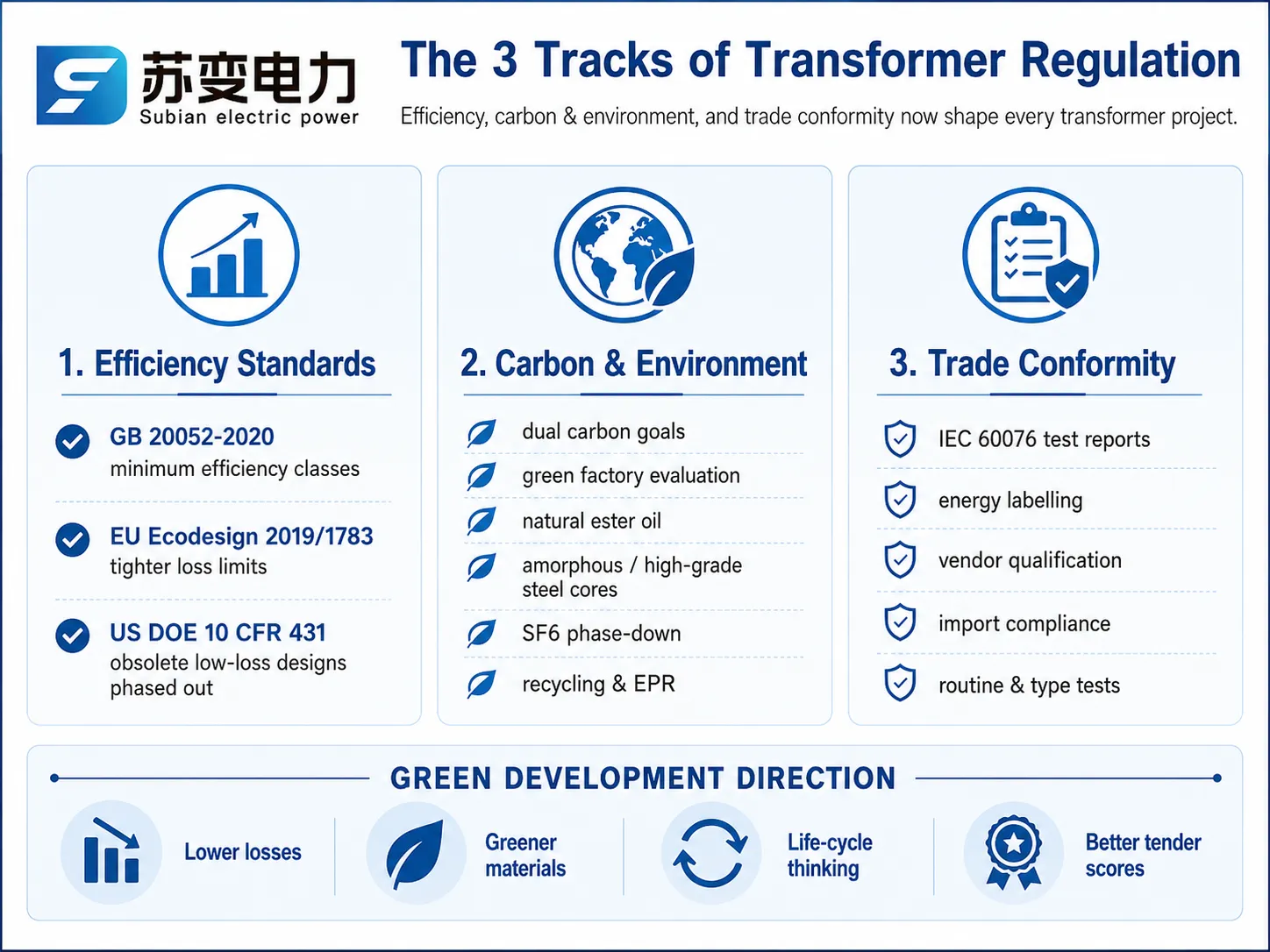
As Três Trilhas da Regulamentação de Transformadores
A regulamentação de transformadores não pode mais ser considerada uma única regra. Em vez disso, empresas e clientes têm que lidar com uma combinação de requisitos aplicados por várias organizações. Existem três áreas principais nas quais novas regulamentações foram introduzidas nos últimos anos — eficiência, carbono e comércio. Por exemplo, um transformador que atende aos requisitos da IEC 60076, mas não passa em uma classe de eficiência local, não pode ser vendido, enquanto um fabricante que está em conformidade com todos os padrões de produto relevantes, mas não passa na avaliação verde, não poderá obter apoio financeiro.
Não há dúvidas sobre o progresso dos desenvolvimentos nesta esfera. Todos os mercados significativos, como China, UE, EUA, Japão e Índia, aplicaram regras de eficiência mais rigorosas para transformadores do que nos últimos cinco anos, enquanto um número de novas regulamentações deve aparecer em breve. Um termo familiar que pode ser encontrado em toda parte (em escritos, brochuras) é desenvolvimento verde.
Padrões de Eficiência: GB 20052, Ecodesign da UE, DOE dos EUA
Três estruturas de eficiência dominam a aquisição global:
| Estrutura | Mercado | Estrutura | Requisito chave |
|---|---|---|---|
| GB 20052-2020 | China | Classes 1–3 para transformadores de distribuição | Linha de base da classe 2; classe 1 exigida para programas de incentivo |
| Regulamento Ecodesign da UE 2019/1783 | UE | Limites de perda do Nível 1 (Jul 2021) e Nível 2 (Jul 2024) | Limites de perda por classificação; nível 2 aproximadamente 10–15% mais rigoroso |
| DOE dos EUA 10 CFR 431 | Estados Unidos | Padrões mínimos de eficiência | Classes de eficiência de transformadores de distribuição desde jan 2016, revisadas para 2024–2026 |
O conceito central é a perda em vazio, que é o termo para a perda que ocorre a cada hora de cada dia. O regulamento de nível 2 na Europa levou muitos projetos a seguir o caminho do ferro de alta permeabilidade e núcleos amorfos, enquanto a regulamentação de primeira categoria da China exige o mesmo de muitos transformadores. Isso leva à situação em que o que se chama de “transformador padrão” em 2015 se torna um “transformador ineficiente” em 2026 para compradores no mercado regulado que não mencionam qual é a classificação de eficiência atual.
Carbono Duplo e a Direção de Desenvolvimento Verde
Os duplos objetivos de pico de carbono e neutralidade têm guiado as políticas da China no campo da tecnologia de transformadores de potência desde sua adoção. Os números mostram que os transformadores têm um impacto tangível nas perdas da rede. Por exemplo, nas redes elétricas da China, as perdas de distribuição são estimadas em 5-8% da energia transmitida através delas, o que significa que as perdas atribuíveis aos transformadores são bastante consideráveis e decorrem do conteúdo de cobre dos fios, bem como das perdas de ferro causadas pelo núcleo do transformador.
Sob os objetivos de carbono duplo da China, as seguintes direções liderarão iniciativas verdes para a indústria de transformadores:
Classes de transformadores mais eficientes estão se tornando mais uma exigência em vez de um luxo.
O estabelecimento de um selo de fábrica verde que verifica a eco-amizade dos produtores de transformadores com base em seu consumo de energia, emissões, bem como atividades de resíduos e reciclagem.
Uso de materiais ecológicos, incluindo material amorfo para o núcleo do transformador, bem como óleos de éster natural.
Ênfase no processo de produção e desmontagem da compra do transformador, em vez de apenas focar no custo inicial.
Como resultado, as práticas atuais de avaliação de compras exigem uma consideração da contagem de carbono além dos fatores econômicos.
| Instrumento de política | Quem ele vincula | Força de aplicação | Efeito típico na aquisição |
|---|---|---|---|
| Classes mínimas de eficiência (GB 20052 / EU Ecodesign / DOE) | Fabricantes e importadores | Obrigatório, acesso ao mercado | Modelos de baixa eficiência desaparecem dos catálogos |
| Rotulagem de energia | Fabricantes | Obrigatório onde existem esquemas | Classe de eficiência visível na placa de identificação e na cotação |
| Pontuação de compras verdes em licitações | Compradores (utilitários, governos) | Contratual, 5–10% de pontuação | Unidades certificadas de baixa perda ganham licitações |
| Subsídios e incentivos para unidades de grau 1 / amorfas | Compradores | Adoção voluntária | Reduz o preço efetivo da eficiência premium |
| Comércio de carbono e certificados verdes | Emissores e compradores | Baseado no mercado | Aumenta o valor das perdas de transformador evitadas |
Leia a tabela e a direção é clara: o bastão das classificações mínimas combina com a cenoura dos subsídios e o portão da pontuação verde para empurrar todo o mercado em uma direção.
Regras Ambientais: SF6, Óleo e Reciclagem
Além da eficiência, uma segunda onda de regulamentação visa a pegada ambiental da tecnologia de transformadores em si:
| Regra / questão | Escopo | Implicação do transformador |
|---|---|---|
| Regulamento da UE sobre gases fluorados 2024/573 | Redução e restrições de uso do SF6 | Equipamentos de manobra isolados por SF6 descontinuados; pressão sobre soluções de transformadores baseadas em SF6 |
| Regras sobre óleo residual e contaminação do solo | Manuseio, descarte e vazamento de óleo mineral | Favorece óleos naturais biodegradáveis |
| Responsabilidade estendida do produtor (REP) | Retorno de fim de vida na UE | Reciclabilidade e descarte de óleo projetados desde o início |
| Códigos de incêndio e segurança da vida | Instalações internas e urbanas | Impulsiona a adoção de tipo seco e óleos de éster para locais internos e de alta densidade |
A história do SF6 reflete o sinal mais forte. Como o SF6 tem uma capacidade de efeito estufa 25.200 vezes maior que o CO2, as autoridades da UE e partes da América do Norte têm limitado o uso dele em equipamentos elétricos de alta tensão. Os produtores de transformadores reagiram com soluções de tecnologias de éster e secas. Agora, alguns designs operando em 10-35kV e usando SF6 como meio isolante têm utilizado isolamento líquido/sólido.
Comércio e Conformidade: IEC, Rotulagem, Importações
A conformidade comercial é a terceira opção, que é a evidência mecânica de um transformador que atende às necessidades do mercado do importador. Algumas implicações para compradores internacionais são as seguintes:
Relatórios de teste IEC 60076 (testes de tipo e testes de rotina) formando a base para a maioria dos mercados de exportação;
Sistemas de rotulagem de energia onde aplicável e exibindo a classe de eficiência no rótulo e documentos;
Direitos aduaneiros e tarifas em algumas regiões que imporiam direitos aduaneiros sobre importações de transformadores de baixa eficiência para proteger a produção doméstica da concorrência;
Qualificação de fornecedores, onde as concessionárias frequentemente exigem evidências da classe de eficiência para pré-qualificação e rejeitam aqueles que não podem verificar o nível de perdas.
O ônus de provar a conformidade é, acima de tudo, um problema de fabricantes menores, é precisamente por isso que a planilha do gerente da fábrica de Guangdong foi criada. Para os compradores, o benefício será a informação fornecida, uma vez que cada transformador agora é vendido com dados de perda e, assim, tornou-se possível verificar isso em relação ao padrão e tomar decisões comparáveis.
Como a Regulamentação Reformula Produtos e Preços
O efeito cumulativo dessas regras no design do produto é visível em todo o catálogo:
| Característica do produto | Típico pré-regulamentação | Típico pós-regulamentação |
|---|---|---|
| Aço do núcleo | 0,30–0,35 mm GOES convencional | 0,23–0,27 mm fita de alta permeabilidade ou amorfa |
| Perda em vazio, 1.000 kVA | 500–2.100 W | 700–1.100 W (classe 2), 350–500 W (amorfo) |
| Óleo isolante | Óleo mineral quase universal | Mineral mais participação crescente de óleo éster |
| Dados da placa de identificação | Classificação e dados básicos | Classe de eficiência, valores de perda, referências de teste |
| Vida útil de projeto | 20–25 anos | 25–35 anos com disciplina de carga |
Os preços mudaram junto com os produtos. Uma unidade conforme a classe 2 tem um preço de 5–15% a mais em comparação com uma unidade não conforme de uma década atrás, enquanto as unidades de núcleo amorfo estão precificadas 20-40% acima das unidades de alta eficiência regulares. O aspecto do custo operacional, no entanto, favorece ainda mais o comprador: as perdas mais baixas dos equipamentos modernos podem contribuir com mais valor presente dentro de 20 anos do que toda a diferença de preço – que é a justificativa por trás da regulamentação.
O Que Isso Significa para os Compradores
O ambiente regulatório alterado influencia as equipes de compras não apenas em termos do processo de aquisição, mas também nos produtos que compram:
Declare a classe de eficiência — categoria GB 20052, grau da UE ou classificação DOE juntamente com os requisitos de dados de perda na proposta.
De acordo com a norma IEC 60076, solicite evidências dos resultados dos testes — o relatório sobre testes padrão e resultados de testes de tipo deve ser fornecido.
Considere os benefícios locais — cerca de 5-15% do preço do produto pode ser coberto por subsídios oferecidos em algumas partes da China e em alguns programas da UE.
Inclua carbono na pontuação — se critérios verdes estiverem presentes no processo de licitação, a perda em vazio deve ser observada, o tipo de óleo utilizado deve ser especificado e a certificação da fábrica deve ser incluída.
Compre pelo menos uma classe de eficiência acima do padrão mínimo que atenda aos requisitos de retorno, uma vez que os requisitos mínimos se tornarão mais rigorosos com o tempo.
Empresas compradoras que tratam regulamentos como uma lista de verificação estão perdendo, enquanto empresas que os utilizam para um retorno mais curto por meio de subsídios estão em uma posição melhor.
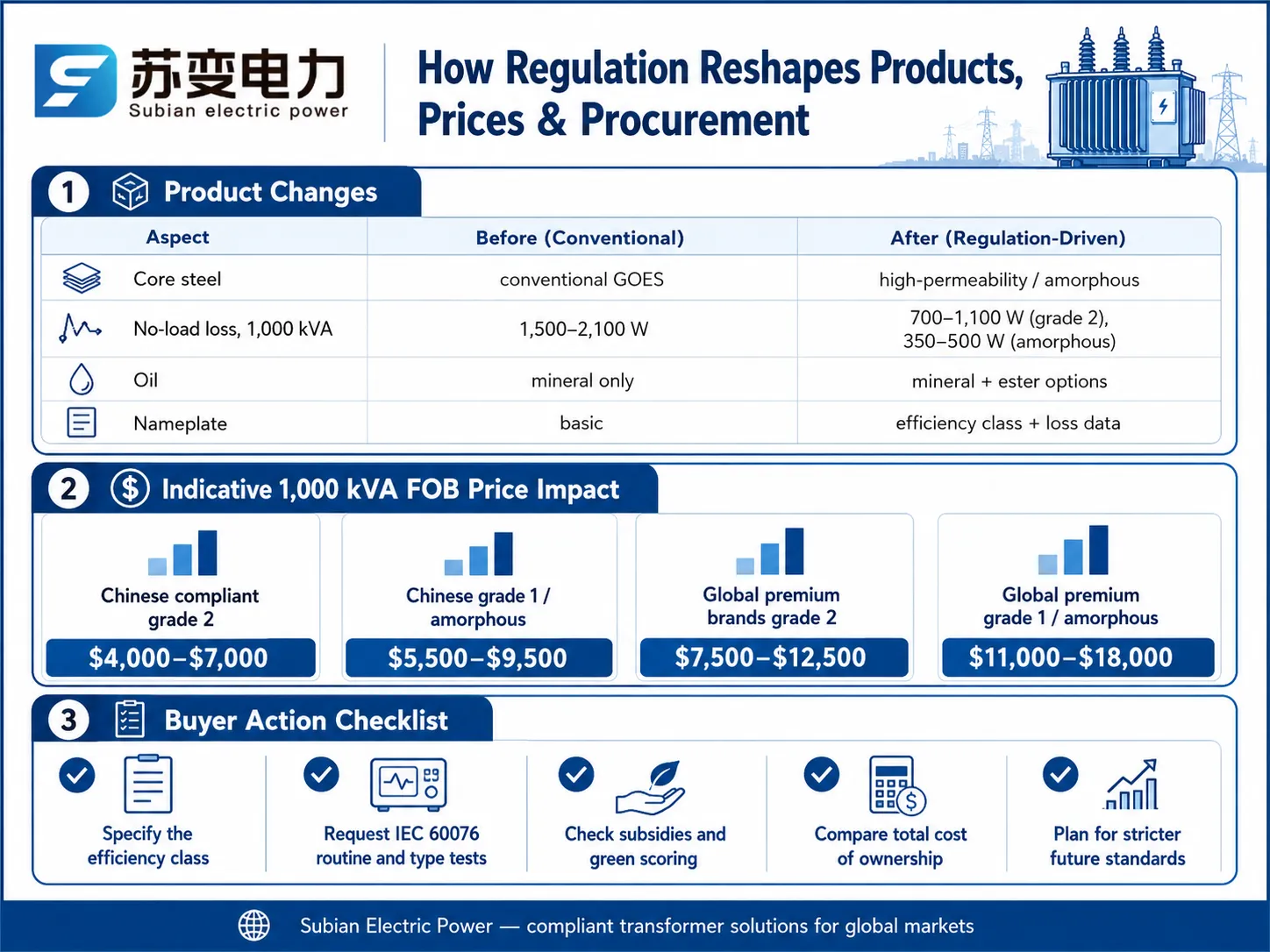
Conformidade por Marca e Impacto no Preço
Preços indicativos para um transformador de distribuição de 1.000 kVA 10/0,4 kV em conformidade, FOB por marca:
| Marca | Origem | Preço da Classe 2 | Preço da Classe 1 / amorfo |
|---|---|---|---|
| Hitachi Energy | Japão/Global | $9.000–$12.500 | $12.500–$18.000 |
| ABB | Suíça/Global | $8.500–$12.000 | $12.000–$17.000 |
| Siemens Energy | Alemanha/Global | $8.000–$11.500 | $11.500–$16.500 |
| Schneider Electric | França/Global | $7.500–$11.000 | $11.000–$15.500 |
| Jiangsu Subian Electric Power | China | $4.000–$7.000 | $5.500–$9.500 |
Os preços variam com a classe de perda, acessórios, preços do cobre e termos de entrega; trate esses como faixas de planejamento, não como cotações.
As marcas premium ancoram o mercado com programas de teste globais e redes de serviço. O nível chinês compete em oferecer as mesmas classes de eficiência a um custo inicial 40–50% mais baixo, o que é relevante quando incentivos e tarifas já tornam a economia de eficiência favorável. Jiangsu Subian Electric Power é um fabricante chinês de transformadores cujas linhas de transformadores de distribuição e potência são construídas e testadas de acordo com a IEC 60076, com designs de grau 1–2 da GB 20052, incluindo opções de núcleo amorfo e óleo de éster. A Subian possui credenciais de fábrica verde, publica valores de perda com cada cotação e exporta unidades em conformidade para concessionárias em toda a Ásia, África, Oriente Médio e América do Sul — sua gama de produtos e certificações estão em subian-electric.com.
A Perspectiva para Transformadores Verdes
Os cenários iminentes indicam três certezas em relação às regulamentações para o período de cinco a dez anos à nossa frente. Para começar, espera-se que os padrões relacionados aos mínimos de eficiência voltem a se intensificar. O anúncio de que a UE realizará revisões de nível além de 2024 confirma que regulamentações mais rigorosas também serão introduzidas na China. Além disso, a contabilidade de carbono evoluirá de ser baseada em fábricas para ser baseada em produtos. Portanto, os fabricantes terão que apresentar a documentação sobre a pegada de carbono de forma semelhante a como os valores de perda são fornecidos atualmente. Finalmente, a compra verde será impulsionada por seu status padrão em vez de ser uma exceção. Assim, as empresas que utilizam compras verdes provavelmente empregarão suas condições ambientais ao fazer grandes propostas.
Os fabricantes que conseguirem fazer uma transição bem-sucedida de testes para atender aos padrões serão aqueles que veem a conformidade como um fator de design em vez de apenas atender às regulamentações. Esta é exatamente a diferença fundamental entre aqueles fabricantes que apenas testam seus produtos em comparação com aqueles que cumprem as regulamentações ambientais relevantes.
Perguntas Frequentes
Qual é o padrão de eficiência de transformadores mais importante globalmente?
A IEC 60076 continua sendo a base internacional de testes e classificações, mas a eficiência em si é regulamentada regionalmente: GB 20052 na China, Regulamento de Ecodesign da UE 2019/1783 na UE e 10 CFR 431 (DOE) nos EUA. Para compras de exportação, especifique tanto os testes da IEC 60076 quanto a classe de eficiência do mercado de destino.
Quanto mais custa um transformador verde em conformidade?
Uma unidade de 1.000 kVA de grau 2 GB 20052 custa cerca de $4.000–$7.000 FOB de fabricantes chineses; versões de grau 1 com núcleo amorfo custam entre $5.500–$9.500. Marcas europeias e japonesas premium costumam ser 50–80% mais caras. Os prêmios de classe de perda são parcialmente compensados por subsídios de eficiência em vários mercados.
A regulamentação realmente afeta os preços dos transformadores?
Sim, em ambas as extremidades. As regras de eficiência mínima aumentam os custos iniciais em 5–15% em comparação com designs mais antigos, e materiais premium (núcleos amorfos, óleo ester) adicionam 20–40%. Mas os custos operacionais caem porque as perdas são menores; ao longo de uma vida útil de 20 anos, o ganho de eficiência geralmente supera o aumento de preço.
Quais são as metas de carbono duplo da China e como elas afetam os transformadores?
A China se comprometeu a atingir o pico de emissões de carbono antes de 2030 e a alcançar a neutralidade de carbono antes de 2060. Para os transformadores, isso significa graus de eficiência mais rigorosos, certificação de fábrica verde para fabricantes, materiais de baixo carbono como núcleos amorfos e óleos ester, e pontuação de compras ponderadas por carbono em licitações de utilidades.
Preciso de documentação diferente para importar transformadores agora?
Sim — espere mostrar relatórios de testes de rotina e tipo conforme IEC 60076, valores de perda, classe de eficiência e, às vezes, rotulagem de energia. Vários mercados restringem importações de baixa eficiência, e as concessionárias cada vez mais recusam licitantes sem evidência de classe de eficiência. A inspeção de terceiros dos relatórios de teste é uma prática padrão para pedidos maiores.
Referências
- IEC 60076-1: Transformadores de potência – Geral — Base de teste e classificação internacional para transformadores.
- Regulamento de Ecodesign da UE 2019/1783 — Requisitos vinculativos de eficiência de transformadores para o mercado da UE.
- US DOE 10 CFR Parte 431 (eficiência energética) — Padrões mínimos de eficiência dos EUA para transformadores de distribuição.
- GB 20052: Classes de eficiência energética para transformadores de potência — Padrão de classe de eficiência da China para transformadores de distribuição.
- Programa de eficiência energética da IEA — Análise da participação de perda de transformadores e contexto da política de eficiência.
- Programa de eficiência de transformadores do US DOE — Análise de fundo e econômica das regras de eficiência.
- Site oficial da Jiangsu Subian Electric Power — Faixa de transformadores com certificação de eficiência e credenciais de fábrica verde.
Conclusão
Política e regulamentação mudaram das margens para o centro da indústria de transformadores, e o direção de desenvolvimento verde agora é a única direção com um futuro a longo prazo. Classes de eficiência, metas de carbono, restrições de SF6 e avaliações de fábricas verdes não são listas de verificação separadas — elas formam uma pressão coerente em direção a transformadores documentados com menores perdas e menor carbono.
Principais conclusões:
- A regulamentação de eficiência existe em todos os principais mercados: GB 20052, EU Ecodesign 2019/1783, US DOE 10 CFR 431.
- Metas de carbono duplas e a redução do SF6 empurram a indústria em direção a núcleos amorfos, óleos éster e contabilidade de carbono do ciclo de vida.
- Transformadores verdes em conformidade custam 5–15% a mais inicialmente, mas vencem em custo total de propriedade e incentivos.
- Os compradores devem especificar a classe de eficiência e exigir evidências de teste — a regulamentação só ajuda aqueles que a utilizam.
Se você está adquirindo transformadores para um mercado regulamentado, Jiangsu Subian Electric Power fornece opções de grau 1–2 GB 20052 e óleo éster testadas de acordo com IEC 60076, com certificação de fábrica verde e valores de perda documentados. Revise a gama em conformidade em subian-electric.com.