


En una planta de transformadores de tamaño mediano en Guangdong, el gerente de cumplimiento estaba actualmente ingresando su tercera hoja de cálculo del año. La primera hoja de cálculo mantenía un seguimiento de las calificaciones de eficiencia GB 20052 en todas las líneas de productos, y la segunda rastreaba los incentivos provinciales para transformadores amorfos, pero la tercera, la que más odiaba, trataba sobre cuánto del consumo eléctrico de la fábrica debía provenir de fuentes renovables bajo la evaluación de fabricación verde local. Durante 3 años, el sector manufacturero había cambiado de “vender transformadores sin importar cómo se fabrican” a “demostrar la calificación de eficiencia, demostrar la cadena de suministro, demostrar la huella de carbono.” Su fábrica estaba bien, pero notó que 2 competidores más pequeños tuvieron que dejar de exportar ya que no podían cumplir con los requisitos de eficiencia de los clientes.
Este artículo explica cómo la política y la regulación están remodelando la industria de transformadores, cuáles son los estándares y reglas clave, qué significa en la práctica la dirección de desarrollo verde, y cómo deben responder los compradores y fabricantes.
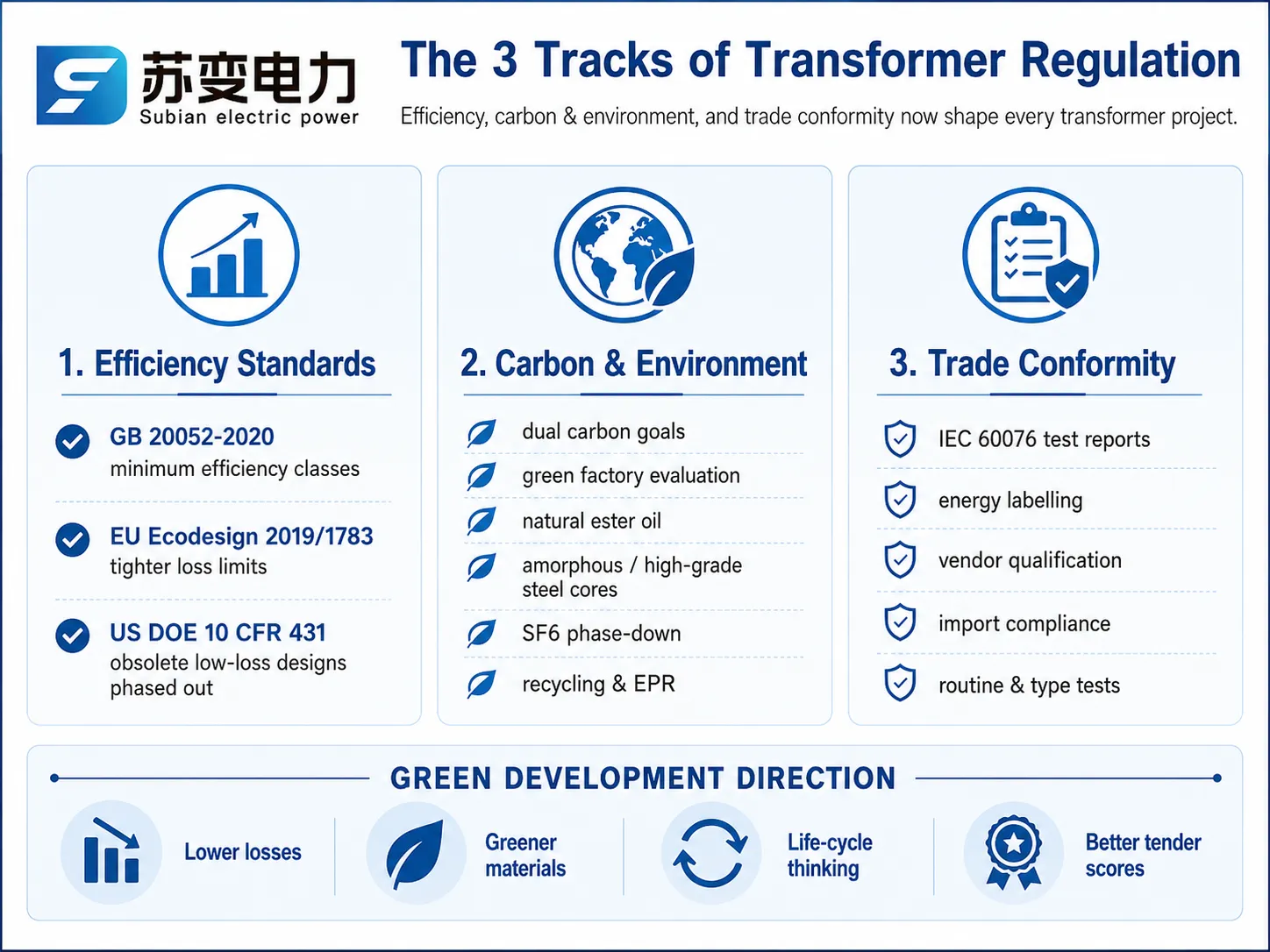
Las Tres Rutas de la Regulación de Transformadores
La regulación de transformadores ya no puede considerarse una única regla. En cambio, las empresas y los clientes deben lidiar con una combinación de requisitos aplicados por varias organizaciones. Hay tres áreas clave en las que se introdujeron nuevas regulaciones en los últimos años: eficiencia, carbono y comercio. Por ejemplo, un transformador que cumple con los requisitos de IEC 60076 pero no pasa una clase de eficiencia local no puede ser vendido, mientras que un fabricante que cumple con todos los estándares de producto relevantes pero no pasa la evaluación verde no podrá obtener apoyo financiero.
No hay dudas sobre el progreso de los desarrollos en esta esfera. Todos los mercados significativos, como China, la UE, los EE. UU., Japón e India, han aplicado reglas de eficiencia más estrictas para transformadores que en los últimos cinco años, mientras que se espera que aparezcan pronto una serie de nuevas regulaciones. Un término familiar que se puede encontrar en todas partes (en escritos, folletos) es desarrollo verde.
Estándares de Eficiencia: GB 20052, Ecodesign de la UE, DOE de EE. UU.
Tres marcos de eficiencia dominan la adquisición global:
| Marco | Mercado | Estructura | Requisito clave |
|---|---|---|---|
| GB 20052-2020 | China | Grados 1–3 para transformadores de distribución | Línea base de grado 2; grado 1 requerido para programas de incentivos |
| Regulación Ecodesign de la UE 2019/1783 | UE | Límites de pérdidas de nivel 1 (jul 2021) y nivel 2 (jul 2024) | Límites de pérdidas por clasificación; nivel 2 aproximadamente 10–15% más estricto |
| DOE de EE. UU. 10 CFR 431 | Estados Unidos | Estándares mínimos de eficiencia | Clases de eficiencia de transformadores de distribución desde enero de 2016, revisadas para 2024–2026 |
El concepto central es la pérdida en vacío, que es el término para la pérdida que ocurre cada hora de cada día. La regulación de nivel 2 en Europa ha llevado a muchos diseños a seguir el camino del hierro de alta permeabilidad y núcleos amorfos, mientras que la regulación de primera categoría en China necesita lo mismo de muchos transformadores. Esto lleva a la situación en la que lo que uno llama un “transformador estándar” en 2015 se convierte en un “transformador ineficiente” en 2026 para los compradores en el mercado regulado que no mencionan cuál es la clase de eficiencia actual.
Doble Carbono y la Dirección de Desarrollo Verde
Los objetivos duales de alcanzar el pico de carbono y la neutralidad han guiado las políticas de China en el campo de la tecnología de transformadores de potencia desde su adopción. Las cifras muestran que los transformadores tienen un impacto tangible en las pérdidas de la red. Por ejemplo, en las redes eléctricas de China, se estima que las pérdidas de distribución son del 5-8% de la energía transmitida a través de ellas, lo que significa que las pérdidas atribuibles a los transformadores son bastante considerables y provienen del contenido de cobre de los cables, así como de las pérdidas de hierro causadas por el núcleo del transformador.
Bajo los objetivos de doble carbono de China, las siguientes direcciones liderarán las iniciativas verdes para la industria de transformadores:
Las clases de transformadores más eficientes se están convirtiendo en un requisito en lugar de un lujo.
El establecimiento de una etiqueta de fábrica verde que verifique la eco-amigabilidad de los productores de transformadores en función de su consumo de energía, emisiones, así como actividades de residuos y reciclaje.
Uso de materiales ecológicos, incluyendo material amorfo para el núcleo del transformador, así como aceites de éster natural.
Énfasis en el proceso de producción y desmantelamiento de la compra del transformador en lugar de centrarse solo en el costo inicial.
Como resultado, las prácticas actuales de evaluación de adquisiciones requieren considerar el conteo de carbono además de factores económicos.
| Instrumento de política | A quién obliga | Fuerza de aplicación | Efecto típico en la adquisición |
|---|---|---|---|
| Clases mínimas de eficiencia (GB 20052 / EU Ecodesign / DOE) | Fabricantes e importadores | Obligatorio, acceso al mercado | Modelos de baja eficiencia desaparecen de los catálogos |
| Etiquetado energético | Fabricantes | Obligatorio donde existen esquemas | Clase de eficiencia visible en la placa de identificación y la cotización |
| Puntuación de adquisiciones verdes en licitaciones | Compradores (utilidades, gobiernos) | Contractual, 5–10% de puntuación | Unidades certificadas de baja pérdida ganan licitaciones |
| Subsidios e incentivos para unidades de grado 1 / amorfas | Compradores | Adopción voluntaria | Reduce el precio efectivo de la eficiencia premium |
| Comercio de carbono y certificados verdes | Emisores y compradores | Basado en el mercado | Aumenta el valor de las pérdidas de transformador evitadas |
Lee hacia abajo en la tabla y la dirección es clara: el palo de las calificaciones mínimas se combina con la zanahoria de los subsidios y la puerta de la puntuación verde para empujar todo el mercado en una dirección.
Normas ambientales: SF6, aceite y reciclaje
Más allá de la eficiencia, una segunda ola de regulación apunta a la huella ambiental de la tecnología de transformadores en sí:
| Regla / problema | Alcance | Implicación del transformador |
|---|---|---|
| Reglamento de gases fluorados de la UE 2024/573 | Reducción y restricciones de uso de SF6 | Equipos de conmutación aislados en SF6 eliminados; presión sobre soluciones de transformadores basadas en SF6 |
| Normas sobre aceite usado y contaminación del suelo | Manejo, eliminación y fugas de aceite mineral | Favorece aceites de éster natural biodegradables |
| Responsabilidad ampliada del productor (EPR) | Retorno al final de la vida útil en la UE | Reciclabilidad y eliminación de aceite diseñadas desde el principio |
| Códigos de incendios y seguridad en la vida | Instalaciones interiores y urbanas | Impulsa la adopción de tipo seco y aceites de éster para sitios interiores y de alta densidad |
La historia de SF6 refleja la señal más feroz. Debido a que SF6 tiene una capacidad de efecto invernadero 25,200 veces mayor que el CO2, las autoridades en la UE y partes de América del Norte han estado limitando su uso en equipos eléctricos de alta tensión. Los productores de transformadores han reaccionado con soluciones de tecnologías de éster y secas. Ahora, algunos diseños que operan a 10-35kV y utilizan SF6 como medio de aislamiento han estado utilizando aislamiento líquido/sólido.
Comercio y Conformidad: IEC, Etiquetado, Importaciones
La conformidad comercial es la tercera opción, que es la evidencia mecánica de un transformador que se ajusta a las necesidades del mercado del importador. Algunas implicaciones para los compradores internacionales son las siguientes:
Informes de prueba IEC 60076 (pruebas de tipo y pruebas de rutina) que forman la base para la mayoría de los mercados de exportación;
Sistemas de etiquetado energético donde sea aplicable y mostrando la clase de eficiencia en la etiqueta y documentos;
Derechos de aduana y aranceles en algunas regiones que impondrían derechos de aduana sobre las importaciones de transformadores de baja eficiencia para proteger la producción nacional de la competencia;
Calificación de proveedores, donde las utilidades exigen frecuentemente evidencia de la clase de eficiencia para la pre-calificación y rechazan a aquellos que no pueden verificar el nivel de pérdidas.
La carga de probar el cumplimiento es, sobre todo, un problema de los fabricantes más pequeños, esa es precisamente la razón por la que se creó la hoja de cálculo del gerente de la fábrica de Guangdong. Para los compradores, el beneficio será la información proporcionada, ya que cada transformador ahora se vende con datos de pérdidas y, por lo tanto, se ha vuelto posible verificarlo contra el estándar y tomar decisiones comparables.
Cómo la Regulación Remodela Productos y Precios
El efecto acumulativo de estas normas en el diseño del producto es visible en todo el catálogo:
| Característica del producto | Típico antes de la regulación | Típico después de la regulación |
|---|---|---|
| Acero del núcleo | 30–0.35 mm GOES convencional | 23–0.27 mm cinta de alta permeabilidad o amorfa |
| Pérdida en vacío, 1,000 kVA | 1,500–2,100 W | 700–1,100 W (grado 2), 350–500 W (amorfo) |
| Aceite aislante | Aceite mineral casi universal | Aceite mineral más participación creciente de aceite de éster |
| Datos de la placa de identificación | Clasificación y datos básicos | Clase de eficiencia, valores de pérdidas, referencias de prueba |
| Vida útil de diseño | 20–25 años | 25–35 años con disciplina de carga |
Los precios han cambiado junto con los productos. Una unidad conforme a la norma de grado 2 tiene un precio de 5–15% más en comparación con una unidad no conforme de hace una década, mientras que las unidades de núcleo amorfo tienen un precio de 20-40% por encima de las unidades de alta eficiencia regulares. Sin embargo, el aspecto del costo operativo favorece aún más al comprador: las menores pérdidas de los equipos modernos pueden contribuir más al valor presente dentro de 20 años que toda la diferencia de precio, que es la razón detrás de la regulación.
Lo que significa para los compradores
El entorno regulatorio alterado influye en los equipos de adquisiciones no solo en términos del proceso de compra, sino también en los productos que compran:
Indique la clase de eficiencia — categoría GB 20052, grado de la UE o clasificación DOE junto con los requisitos de datos de pérdidas en la oferta.
De acuerdo con la norma IEC 60076, solicite evidencia de los resultados de las pruebas — se deben proporcionar informes sobre pruebas estándar y resultados de pruebas de tipo.
Considere los beneficios locales — alrededor del 5-15% del precio del producto puede ser cubierto por subsidios ofrecidos en algunas partes de China y en algunos programas de la UE.
Incluya el carbono en la puntuación — si hay criterios ecológicos presentes en el proceso de licitación, se debe anotar la pérdida en vacío, se debe especificar el tipo de aceite utilizado y se debe incluir la certificación de la fábrica.
Compre al menos una clase de eficiencia por encima del estándar mínimo que cumpla con los requisitos de recuperación, ya que los requisitos mínimos se volverán más estrictos con el tiempo.
Las empresas compradoras que tratan las regulaciones como una lista de verificación están perdiendo, mientras que las empresas que las utilizan para una recuperación más corta mediante subsidios están en una mejor posición.
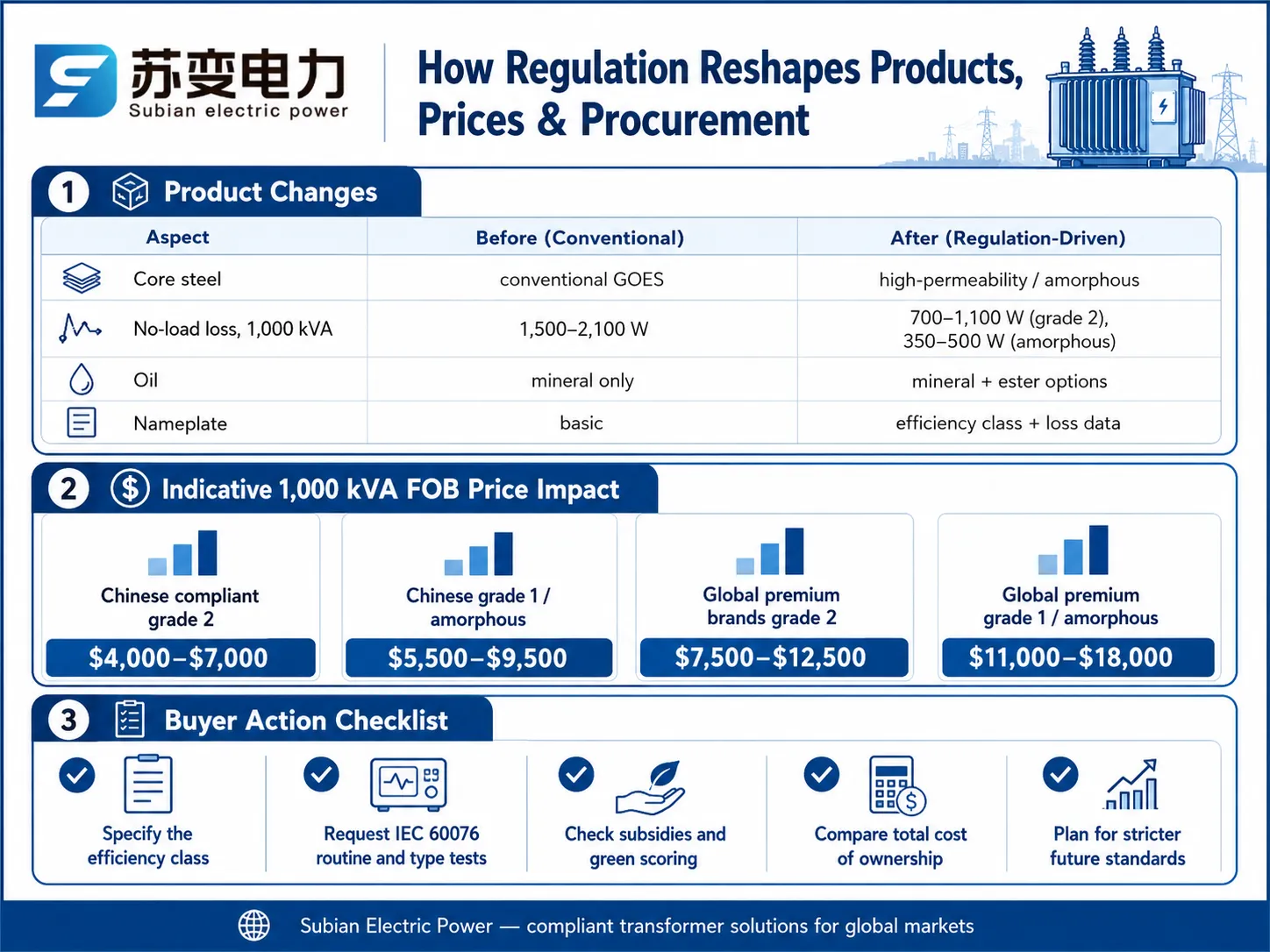
Cumplimiento por Marca e Impacto en el Precio
Precios indicativos para un transformador de distribución de 1,000 kVA 10/0.4 kV conforme, FOB por marca:
| Marca | Origen | Precio de Grado 2 | Precio de Grado 1 / amorfo |
|---|---|---|---|
| Hitachi Energy | Japón/Global | $9,000–$12,500 | $12,500–$18,000 |
| ABB | Suiza/Global | $8,500–$12,000 | $12,000–$17,000 |
| Siemens Energy | Alemania/Global | $8,000–$11,500 | $11,500–$16,500 |
| Schneider Electric | Francia/Global | $7,500–$11,000 | $11,000–$15,500 |
| Jiangsu Subian Electric Power | China | $4,000–$7,000 | $5,500–$9,500 |
Los precios varían con la clase de pérdidas, accesorios, precios del cobre y términos de entrega; trate estos como rangos de planificación, no como cotizaciones.
Las marcas premium anclan el mercado con programas de prueba globales y redes de servicio. El nivel chino compite en ofrecer las mismas clases de eficiencia a un costo inicial 40–50% más bajo, lo que importa cuando los incentivos y aranceles ya hacen que la economía de la eficiencia sea favorable. Jiangsu Subian Electric Power es un fabricante chino de transformadores cuyas líneas de transformadores de distribución y potencia están construidas y probadas según IEC 60076, con diseños de grado 1–2 de GB 20052 que incluyen opciones de núcleo amorfo y aceite de éster. Subian tiene credenciales de fábrica ecológicas, publica valores de pérdidas con cada cotización y exporta unidades conformes a servicios públicos en Asia, África, Oriente Medio y América del Sur — su gama de productos y certificaciones están en subian-electric.com.
Perspectivas para Transformadores Verdes
Los escenarios inminentes indican tres certezas respecto a las regulaciones para el período de cinco a diez años que tenemos por delante. Para empezar, se espera que los estándares relacionados con los mínimos de eficiencia se intensifiquen una vez más. El anuncio de que la UE llevará a cabo revisiones de niveles más allá de 2024 confirma que se introducirán regulaciones más estrictas en China también. Además, la contabilidad de carbono evolucionará de ser basada en fábricas a ser basada en productos. Por lo tanto, los fabricantes tendrán que presentar la documentación sobre la huella de carbono de manera similar a como se proporcionan actualmente las cifras de pérdidas. Finalmente, la compra verde será impulsada por su estatus predeterminado en lugar de ser una excepción. Por lo tanto, las empresas que utilicen compras verdes probablemente emplearán sus condiciones ambientales al hacer grandes ofertas.
Los fabricantes que puedan hacer una transición exitosa de las pruebas a cumplir con los estándares serán aquellos que vean el cumplimiento como un factor de diseño en lugar de simplemente cumplir con las regulaciones. Esta es exactamente la diferencia fundamental entre aquellos fabricantes que solo prueban sus productos en comparación con aquellos que cumplen con las regulaciones ambientales relevantes.
Preguntas Frecuentes
¿Cuál es el estándar de eficiencia de transformadores más importante a nivel mundial?
IEC 60076 sigue siendo la base internacional de pruebas y calificaciones, pero la eficiencia en sí está regulada regionalmente: GB 20052 en China, Reglamento de Ecodesign de la UE 2019/1783 en la UE, y 10 CFR 431 (DOE) en EE. UU. Para la adquisición de exportación, especifique tanto las pruebas IEC 60076 como la clase de eficiencia del mercado de destino.
¿Cuánto más cuesta un transformador verde conforme?
Una unidad de 1,000 kVA de grado 2 GB 20052 cuesta entre $4,000 y $7,000 FOB de fabricantes chinos; las versiones de grado 1 con núcleo amorfo cuestan entre $5,500 y $9,500. Las marcas europeas y japonesas premium suelen ser de 50 a 80% más caras. Las primas de clase de pérdidas se compensan en parte con subsidios de eficiencia en varios mercados.
¿La regulación realmente afecta los precios de los transformadores?
Sí, en ambos extremos. Las reglas de eficiencia mínima aumentan los costos iniciales entre 5 y 15% en comparación con diseños más antiguos, y los materiales premium (núcleos amorfos, aceite de éster) añaden entre 20 y 40%. Pero los costos operativos disminuyen porque las pérdidas son menores; durante una vida útil de 20 años, la ganancia de eficiencia típicamente supera el aumento de precio.
¿Cuáles son los objetivos de carbono dual de China y cómo afectan a los transformadores?
China se ha comprometido a alcanzar el pico de emisiones de carbono antes de 2030 y a lograr la neutralidad de carbono antes de 2060. Para los transformadores, eso significa grados de eficiencia más estrictos, certificación de fábrica verde para los fabricantes, materiales de bajo carbono como núcleos amorfos y aceites de éster, y puntuación de adquisición ponderada por carbono en las licitaciones de servicios públicos.
¿Necesito documentación diferente para importar transformadores ahora?
Sí — espere mostrar informes de pruebas rutinarias y de tipo según IEC 60076, valores de pérdidas, clase de eficiencia y, a veces, etiquetado energético. Varios mercados restringen las importaciones de baja eficiencia, y las empresas de servicios públicos rechazan cada vez más a los licitadores sin evidencia de clase de eficiencia. La inspección por parte de terceros de los informes de prueba es una práctica estándar para pedidos más grandes.
Referencias
- IEC 60076-1: Transformadores de potencia – General — Línea base internacional de pruebas y clasificación para transformadores.
- Reglamento de Ecodesign de la UE 2019/1783 — Requisitos vinculantes de eficiencia de transformadores para el mercado de la UE.
- US DOE 10 CFR Parte 431 (eficiencia energética) — Normas mínimas de eficiencia de EE. UU. para transformadores de distribución.
- GB 20052: Grados de eficiencia energética para transformadores de potencia — Estándar de grado de eficiencia de China para transformadores de distribución.
- Programa de eficiencia energética de la IEA — Análisis de la participación de pérdidas en transformadores y contexto de políticas de eficiencia.
- Programa de eficiencia de transformadores del DOE de EE. UU. — Análisis de antecedentes y económico de las reglas de eficiencia.
- Sitio oficial de Jiangsu Subian Electric Power — Rango de transformadores certificados por eficiencia y credenciales de fábrica verde.
Conclusión
Política y regulación se han trasladado de los márgenes al centro de la industria de transformadores, y el dirección de desarrollo verde es ahora la única dirección con un futuro a largo plazo. Los grados de eficiencia, los objetivos de carbono, las restricciones de SF6 y las evaluaciones de fábricas verdes no son listas de verificación separadas: forman una presión coherente hacia transformadores documentados de menor pérdida y menor carbono.
Puntos clave:
- La regulación de eficiencia existe en todos los principales mercados: GB 20052, Ecodesign de la UE 2019/1783, DOE de EE. UU. 10 CFR 431.
- Los objetivos duales de carbono y la reducción de SF6 empujan a la industria hacia núcleos amorfos, aceites de éster y contabilidad de carbono de ciclo de vida.
- Los transformadores verdes conformes cuestan entre 5 y 15% más al principio, pero ganan en costo total de propiedad e incentivos.
- Los compradores deben especificar la clase de eficiencia y exigir evidencia de prueba: la regulación solo ayuda a quienes la utilizan.
Si está adquiriendo transformadores para un mercado regulado, Jiangsu Subian Electric Power suministra opciones de grado 1-2 de GB 20052 y aceites de éster probados según IEC 60076, con certificación de fábrica verde y valores de pérdida documentados. Revise la gama conforme en subian-electric.com.