


Você pode vê-lo em fábricas, oficinas e até mesmo em grandes casas: o transformador em um poste, na parede ou no vault está zumbindo mais alto quando algumas máquinas estão funcionando. O som pode às vezes ser devido à magnetostrição, mas às vezes serve como um sinal de alerta de que o transformador está sobrecarregado, está carregado de forma desigual ou está com mau funcionamento. Neste guia, discutiremos as razões para o zumbido de um transformador, o que muda quando várias máquinas estão funcionando, quais sons são normais e quando o zumbido se torna motivo de preocupação.
Resposta em resumo: Transformadores emitem constantemente um som, que se deve ao processo de magnetostrição — o fenômeno de uma leve deformação física de um núcleo de aço laminado ocorrendo a uma taxa de 100-120 vezes por segundo (duas vezes mais rápido que a frequência de 50/60 Hz), juntamente com vibrações dos componentes do núcleo e do enrolamento. O zumbido de um transformador se torna mais alto sob a ação de várias máquinas por três razões principais: aumento de carga (o aumento da corrente causa aumento do fluxo magnético), harmônicos de ciclos e motores de solda (vários motores transmitem correntes distorcidas produzindo sons de novas frequências e, assim, aquecendo o transformador), condições de tensão (mesmo o transformador levemente carregado pode zumbir mais alto quando sobrecarregado porque o fluxo é definido pela tensão, não pela carga).

Por que os Transformadores Zumbem
O zumbido do transformador é um fenômeno que ocorre devido ao princípio da física e não é algo que indica uma falha. O núcleo do transformador é composto de chapas de aço finamente laminadas, e, portanto, desenvolve um campo magnético no núcleo. Quando uma corrente alternada passa pelos fios, o campo magnético muda de direção 100 vezes por segundo (para fornecimento de 50 Hz) ou 120 vezes por segundo (para 60 Hz). Cada vez que o campo magnético muda de direção, os cristais de aço são ligeiramente esticados. Assim, ocorre a magnetostrição e ela é responsável pelo zumbido do transformador produzindo um sinal de frequência igual ao dobro da frequência da fonte de energia. Além disso, mudanças nos fios e nas juntas fazem outros componentes vibrarem. O tanque do transformador se comporta como um alto-falante comum.
A partir disso, podemos concluir que o zumbido do transformador é um fenômeno elétrico comum, mas a intensidade da vibração aumenta com o aumento da densidade de fluxo que é determinada pela tensão aplicada. As especificações que governam quão alto um transformador pode ser — e os níveis de som audíveis ligados à classificação em kVA — fazem parte dos dados de projeto que você encontrará em uma boa ficha de especificação, conforme abordado no guia de especificações do transformador.
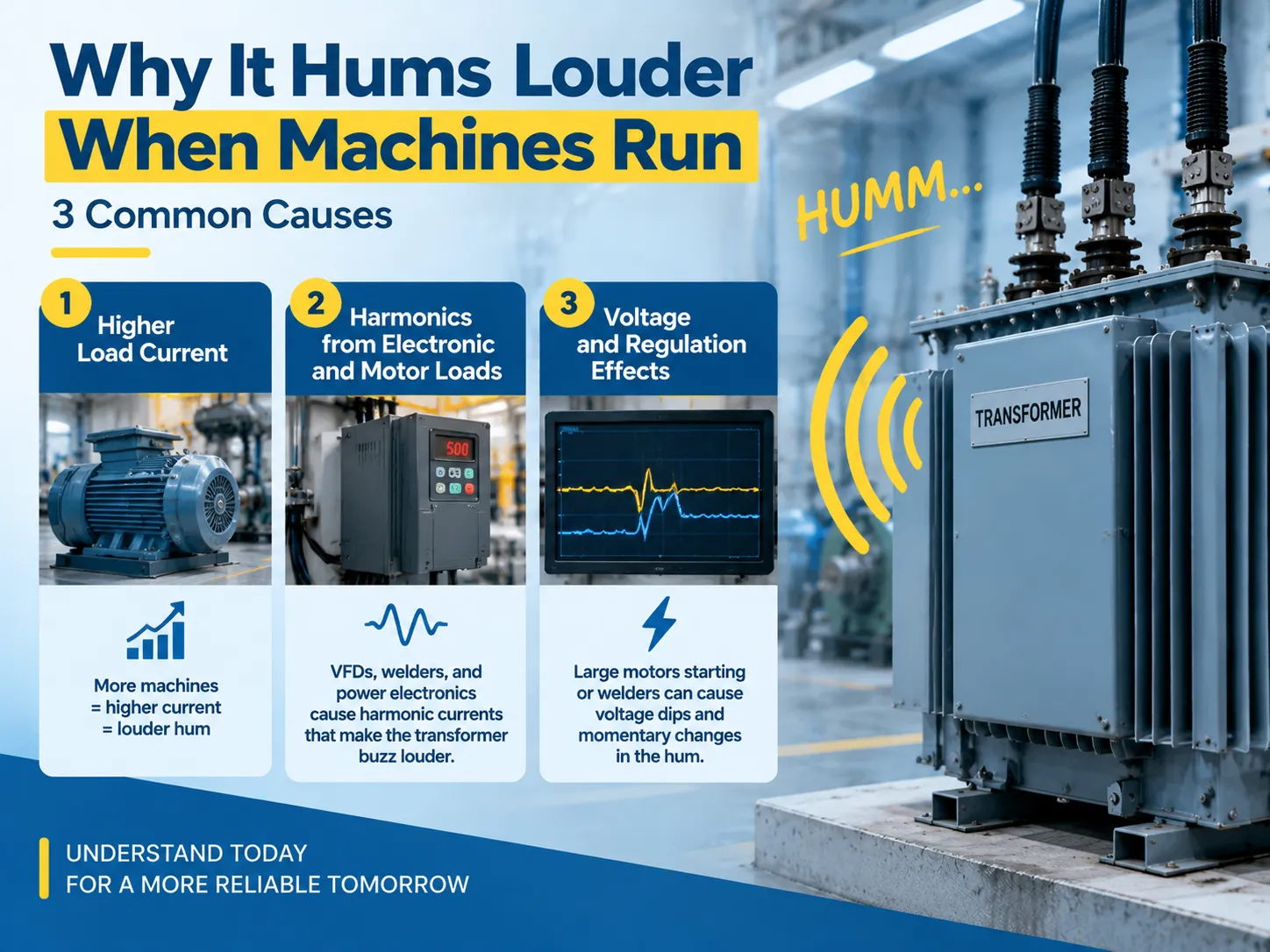
Por que Zumba Mais Alto Quando as Máquinas Funcionam
Os ruídos variáveis relacionados à operação de “diferentes máquinas” podem quase certamente ser rastreados até três causas:
- Corrente de carga mais alta. Um motor ou aquecedor grande está puxando corrente levando a um aumento da corrente de enrolamento resultando em uma força de fluxo de fuga aumentada atuando no enrolamento e mais vibração do núcleo. É um fato que um transformador sobrecarregado zumbem mais do que um transformador que não está sob carga.
- Harmônicos de cargas eletrônicas e de motores. As cargas eletromecânicas de acionamento, como VFDs, causam distorção da corrente de maneira não senoidal. Harmônicos causam vibração mecânica do núcleo do transformador e mais perdas no núcleo e nas bobinas quando as máquinas operam, fazendo com que ele zune e cante.
- Problemas de tensão e regulação. Uma carga grande inesperada aplicada a um transformador pode levar a quedas de tensão instantâneas causadas por grandes motores de partida, causando a mudança na tonalidade do seu zumbido durante tais eventos.
A tarefa de diagnóstico é determinar o tipo de zumbido que temos em relação à forma como ele muda durante a operação de diferentes equipamentos (se muda continuamente em linha com o número de cargas, é considerado relacionado à carga e é normal). Distinguir os dois é o cerne da análise, e a lógica de carga e de serviço por trás disso é abordada no fundamentos do transformador de distribuição artigo.
Como é o Som Normal de um Transformador
A maneira mais rápida de compreender o que anormal significa é aprender como é o som normal.
- Normal: um som contínuo e de baixa frequência, que é igual a duas vezes a frequência da rede (100 Hz ou 120 Hz). Você pode imaginar o som de uma corda de guitarra baixa ou o som de uma subestação, ouvido à distância. Talvez, ele ganhe um pouco de volume e tonalidade à medida que a carga aumenta.
- Anormal: um ruído metálico de batida (laminação do núcleo solta ou fixações ou montagens do tanque soltas), um ruído muito agudo (devido a descarga elétrica ou a uma conexão solta), um ruído crepitante (que indica arco elétrico), ou uma mudança no caráter geral do transformador (que pode ser caracterizada por um aumento repentino de volume ou um som de chiado fundido).
Uma boa prática: ouça atentamente o som do transformador em seu modo de operação normal até aprender seu som normal. Essa disciplina de base é a mesma que fundamenta o monitoramento de condição, seja pelo ouvido ou por instrumento, e se conecta diretamente às rotinas de teste e inspeção no guia de testes de transformadores.
Como o Tamanho e a Carga Afetam o Ruído
A maior parte do que se diz sobre transformadores pode ser atribuída a dois princípios.
| Fator | Efeito no Ruído | Por quê |
|---|---|---|
| Tamanho em kVA | Transformadores maiores zumbem mais alto | Núcleos e tanques maiores irradiam mais som |
| Nível de carga | O ruído aumenta com a carga | Corrente de bobina mais alta aumenta forças e vibração |
| Nível de tensão | O ruído aumenta com a tensão (mesmo sem carga) | A densidade de fluxo é definida pela tensão; sobretensão satura o núcleo |
| Conteúdo harmônico | Novas frequências, zumbido, calor extra | Corrente distorcida de acionamentos e soldadores excita o núcleo |
A situação prática: quando as máquinas estão em funcionamento, alguns transformadores produzem um zumbido que significa que tudo está funcionando como pretendido em termos de carga. A regra de carga que exige que as máquinas operem em cargas temporárias não superiores a cerca de 80% existe por esse motivo. Em outras palavras, aplicar a regra ajuda a evitar alimentar os transformadores com muita potência, o que produz ruído e calor e diminui sua vida útil. Ter um transformador que está zumbindo e apresenta um sinal de carga alta não significa necessariamente que ele está com defeito; essa é a mesma conclusão que pode ser lida abaixo ao falar sobre a regra de 80%.
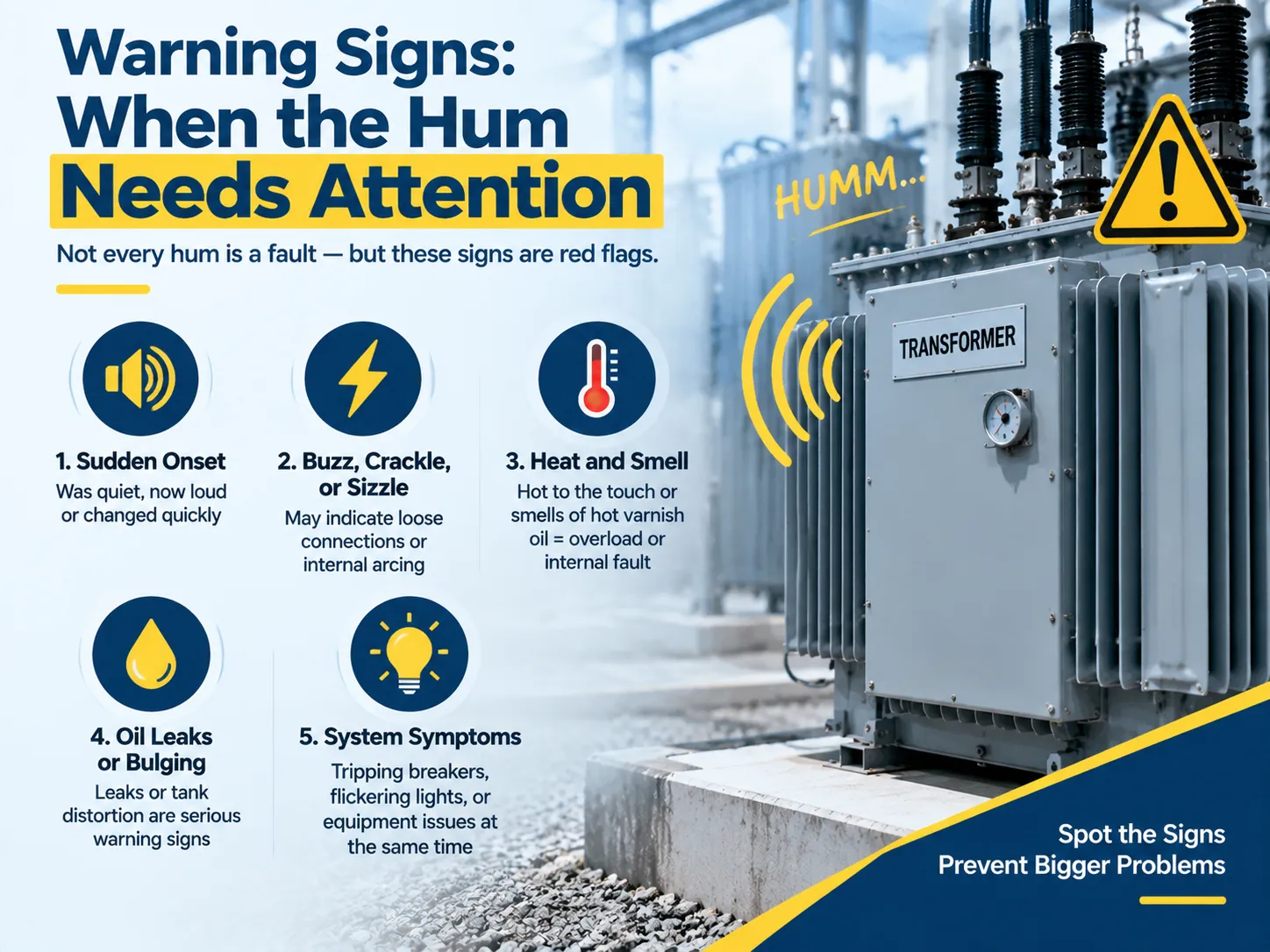
Sinais de Alerta: Quando o Zumbido Precisa de Atenção
Nem todo ruído agudo significa um problema, mas certos sons são sinais de alerta:
- Aparecendo repentinamente: um transformador que estava silencioso e de repente começou a fazer barulho deve ser investigado.
- Zumbidos, estalos e chiados são sinais de conexões defeituosas, quebra de isolamento e faíscas dentro do transformador — este é um dos problemas mais perigosos dependendo dos tipos de transformadores.
- Calor e cheiro: se o transformador está quente e cheira a óleo queimado e verniz, há uma possibilidade de que ele esteja superaquecendo ou com mau funcionamento.
- Vazamento ou expansão: o vazamento de óleo e a deformação da carcaça do transformador indicam problemas graves dentro dele.
- Indicadores de desempenho defeituoso: desarme do disjuntor, luzes piscando e mau funcionamento do equipamento no momento do surgimento do zumbido mostram que o som é real e não inofensivo.
Muitos desses sinais estão relacionados aos mecanismos de falha que os testes de isolamento e a análise de óleo existem para detectar precocemente — os modos de falha catalogados nas causas de falha do transformador artigo são exatamente o que um zumbido alterado pode estar anunciando.
Lista de Verificação de Aviso de Ruído do Transformador
Se você ouvir um zumbido incomum do transformador, aqui está a lista de verificação a considerar antes de tomar qualquer ação:
- O zumbido soa consistente ou mais como um ruído de zumbido/sibilo? Um zumbido consistente é um fenômeno normal, enquanto que se for zumbido ou estalos, é hora de verificar.
- O volume do zumbido muda com o funcionamento das máquinas? Se não mudar, isso indica que algo deu errado com o transformador.
- Há algo quente, com cheiro ou vazando perto da unidade? O cheiro de verniz, calor ou vazamento de óleo é mais do que suficiente para concluir que não há necessidade de analisar o som do transformador.
- Algo aconteceu com a eletricidade recentemente? Se sim, um eletricista deve entender a fonte do ruído e pode identificar várias frequências a partir do som do zumbido do transformador.
- O transformador já fez esse barulho antes? Se sim, isso significa que deve-se verificar se ainda é um problema ou não.
- Quanto de carga ele suporta agora? Se estiver próximo ou acima de sua carga de trabalho regular, o ruído pode ser explicado por esse fato.
No caso de qualquer uma das condições não estar adequada, um profissional deve ser chamado para verificar o transformador. A rotina que mantém os transformadores saudáveis entre essas inspeções — teste de óleo, DGA e verificações visuais — está descrita no fundamentos do teste de óleo de transformador artigo, que cobre as amostras e limites que detectam problemas de isolamento antes que se tornem audíveis.
Como Corrigir ou Reduzir o Zumbido do Problema
Dependendo do que for diagnosticado, as soluções podem variar do mais simples ao mais profissional:
- Peças soltas: ao verificar os parafusos, bem como as extremidades do tanque e os painéis que o cobrem, precisamos ver se o ruído desaparece quando o painel é pressionado.
- Alta tensão: se o ruído for alto quando não há carga, o seguinte deve ser feito: verificar a tensão de entrada em relação ao ponto de derivação; ao mudar o ponto de derivação de sobretensão, você pode se livrar do ruído.
- Sobrecarga harmônica: se o ruído for produzido apenas por VFD ou máquinas de solda, você precisa medir o conteúdo harmônico e possivelmente aplicar filtros ou outros métodos voltados para resolver o problema com a ajuda de reatores.
- Carga pesada contínua: você pode reequilibrar a carga entre as fases ou transferir alguma carga para outro transformador em relação à indicação da regra 80%.
- Verdadeiro problema interno: se for causado por leituras soltas, isolamento quebrado ou outros fatores, o reparo na oficina é impossível e o transformador deve ser levado à fábrica para reparos.
A regra de limite: o ruído que pode ser silenciado através do aperto de parafusos e reparo da montagem mecânica está relacionado à manutenção, enquanto o ruído elétrico que causa aquecimento, cheiro estranho e outros problemas relacionados é uma questão de confiabilidade. Por fim, é sempre melhor inspecionar o transformador do que confiar em seu som sibilante.
Perguntas Frequentes
Por que meu transformador está fazendo um ruído de zumbido?
Os transformadores são projetados para zumbir como resultado da magnetostrição, um fenômeno no qual o núcleo de aço se estica e encolhe duas vezes durante cada ciclo elétrico de 60 ou 50 Hertz, fazendo com que o núcleo e as bobinas vibrem. Além disso, quanto mais carga e tensão são aplicadas ao transformador, mais alto é o zumbido que ele produz. No entanto, se o ruído acompanha a operação de outras máquinas, geralmente está relacionado à maquinaria que está atualmente em operação.
Como se livrar do zumbido do transformador?
O primeiro passo deve ser diagnosticar o problema em questão. Um ruído mecânico de batida pode ser corrigido apertando os parafusos de montagem. Se o zumbido puder ser ouvido na ausência de carga, então o transformador deve ser verificado quanto a sobretensão. Se zumbidos e superaquecimento ocorrerem ao serem alimentados com o uso de drives de frequência variável ou equipamentos de solda, reatores de linha ou filtros devem ser usados ou cargas não lineares realocadas. Se um transformador experimentar carga pesada constante, o balanceamento de carga é necessário. Insuficiências genuínas, como lâminas soltas e mau isolamento, requerem reparos.
Qual é a regra 80% para transformadores?
A regra 80% basicamente afirma que a carga de um transformador não deve exceder 80% de sua classificação nominal em kVA para permitir que ele cumpra sua função adequadamente. Caso contrário, o transformador pode produzir muito ruído e calor. A maioria dos casos de zumbido de transformadores pode ser explicada usando esta regra.
Quais são os sinais de um transformador queimado?
Sinais de uma explosão de um transformador incluem um estrondo alto, um apagão, fumaça ou chamas visíveis, cheiro de queimado, vazamento de óleo ao redor de transformadores preenchidos com óleo, arco elétrico e caixas queimadas. Normalmente, um zumbido recém-emergente e ruídos de estalos ou crepitações indicam que algo está errado antes que a explosão ocorra e que o transformador precisa de uma inspeção imediata.
Referências
- Eaton — Compreendendo o Ruído do Transformador
- GE Grid Solutions — Recursos sobre Som e Vibração de Transformadores
- IEEE — Normas de Som Audível de Transformadores
- Hitachi Energy — Monitoramento da Condição do Transformador
- NFPA — Diretrizes de Inspeção de Equipamentos Elétricos
Conclusão
Um transformador vibrando mais enquanto outros equipamentos estão em operação é normalmente apenas um caso da física em ação — a magnetostrição faz com que cada transformador gere som duas vezes na frequência da eletricidade fornecida no país, e carga, tensão e harmônicos têm que fazer seu trabalho e aumentar o volume. O ruído causado pelas máquinas é normal; o som de máquinas que deve te preocupar é diferente. Pode ser um som de zumbido ou estalos ou estar associado a aquecimento, cheiro, vazamentos, etc. É importante reconhecer o som normal do transformador e saber o que deve ser feito se algo mudar, seguir as instruções dadas para a carga, consertar ruídos mecânicos e deixar as questões elétricas para engenheiros profissionais que podem analisar a fonte do ruído quando ele aparece.