


O consultor do engenheiro fez este gráfico de comparação muitas vezes no passado, mas a pergunta do cliente não mudou: “Estamos construindo um hospital de 6 andares, com uma ala de ressonância magnética, um painel solar no telhado e uma sala de comutação no porão acima do espaço de estacionamento. Que transformador devemos comprar?” A resposta não é um nome ou uma marca registrada, mas sim uma variedade de escolhas entre custo, segurança contra incêndios, manutenção, eficácia e vida útil. Hospitais, centros de dados, arranha-céus e túneis optam por transformadores do tipo seco, enquanto fábricas utilizam os imersos em óleo. Por que isso acontece é o que este artigo aborda.
Neste artigo, comparamos transformadores imersos em óleo e transformadores do tipo seco com base em nove características, fornecendo as informações mínimas necessárias e preços com base na norma IEC 60076. O artigo inclui uma tabela detalhada lado a lado, com custos de propriedade e comparações, por isso você acaba se tornando um verdadeiro especialista que pode fazer seus colegas de projeto entenderem a escolha de um transformador.
Resposta rápida: A principal distinção entre transformadores do tipo seco e transformadores imersos em óleo reside em seu processo de resfriamento e isolamento: enquanto os transformadores do tipo seco dependem de ar, resina ou impregnação a vácuo, os transformadores imersos em óleo utilizam óleo mineral para isolamento. Embora os clientes consigam economizar 25-40% em custos com transformadores imersos em óleo, os transformadores do tipo seco estão livres de riscos de incêndio e contenção de óleo, que são os principais fatores que causam a popularidade dos transformadores do tipo seco em vários locais.
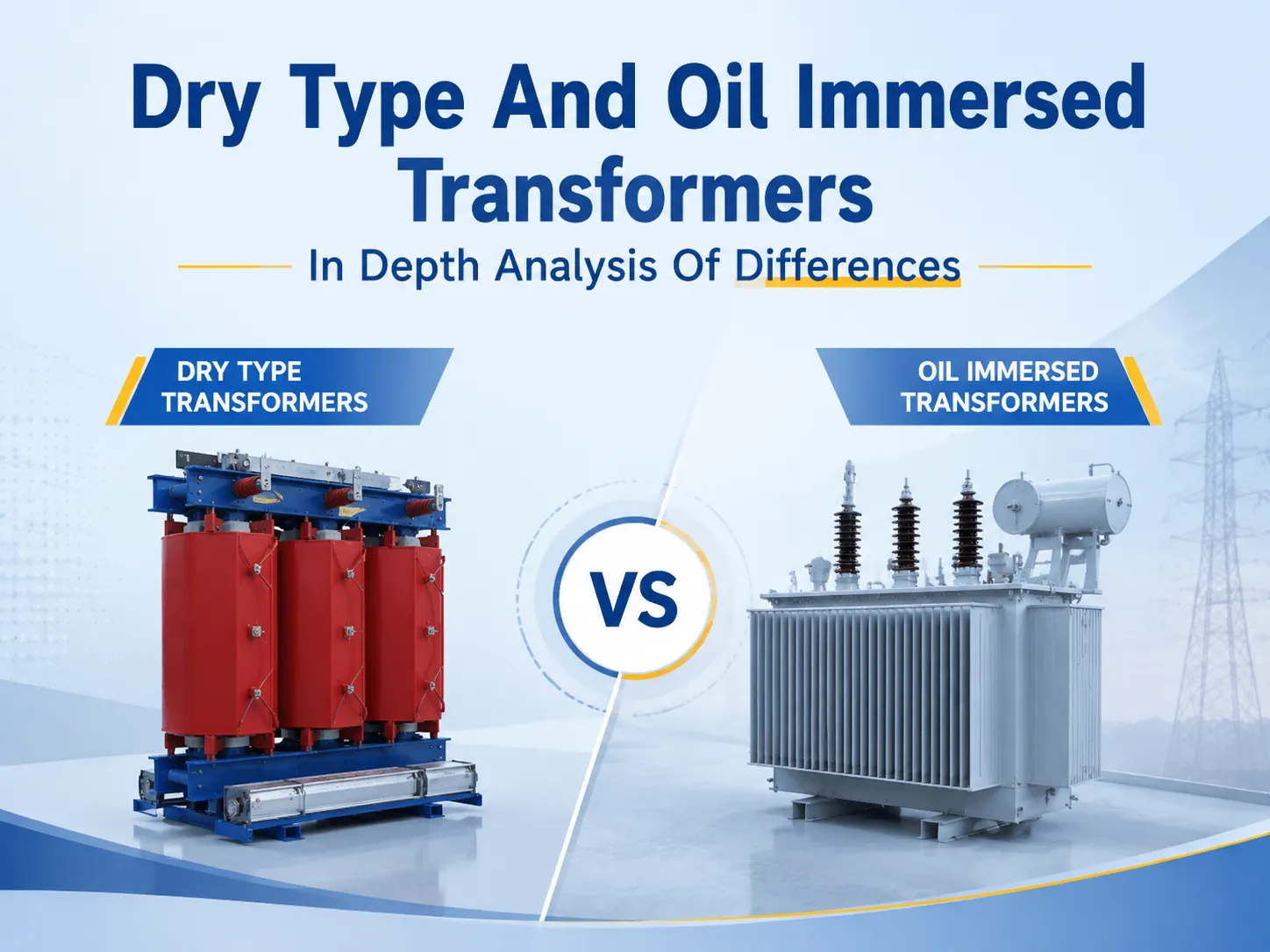
O Básico: O Que Cada Tecnologia É
Embora ambos os tipos de transformadores desempenhem a mesma função de transformação de tensão baseada em indução eletromagnética, eles empregam métodos diferentes de isolamento e resfriamento. O resfriamento de um transformador do tipo seco é alcançado no ar (classes AN/AF), e o isolamento é feito na forma de bobinas de resina epóxi sólida, onde a bobina é moldada em epóxi e preenchimento rico em sílica, ou através das bobinas VPI, nas quais a bobina é tratada com verniz sob pressão de vácuo.
Em contraste, os transformadores imersos em óleo utilizam óleo tanto no processo de isolamento quanto para condução de calor para o tanque. A diferença não é apenas superficial. O transformador do tipo seco precisa ser muito maior e feito de mais cobre porque o ar não é um bom condutor térmico como o óleo. Além disso, os tipos de resina moldada apresentam aumentos de temperatura de 100°C (classe F) ou 125°C (classe H) de acordo com a IEC 60076-11, em comparação com 65°C dos tipos imersos em óleo (IEC 60076-2).
Resfriamento e Isolamento: Ar vs Óleo
| Aspecto | Seco | Óleo Imerso |
|---|---|---|
| Meio de resfriamento | Ar (natural ou forçado) | Óleo mineral, éster ou silicone |
| Classes de resfriamento | AN, AF, ANAF | ONAN, ONAF, OFAF |
| Isolamento de bobina | Resina epóxi moldada ou verniz VPI | Papel kraft impregnado em óleo |
| Aumento de temperatura | 100 K (F), 125 K (H) típico | 65 K óleo / 78 K bobina (IEC) |
| Inflamabilidade | Autoextinguível (resina) | O óleo mineral é combustível; os ésteres são menos combustíveis |
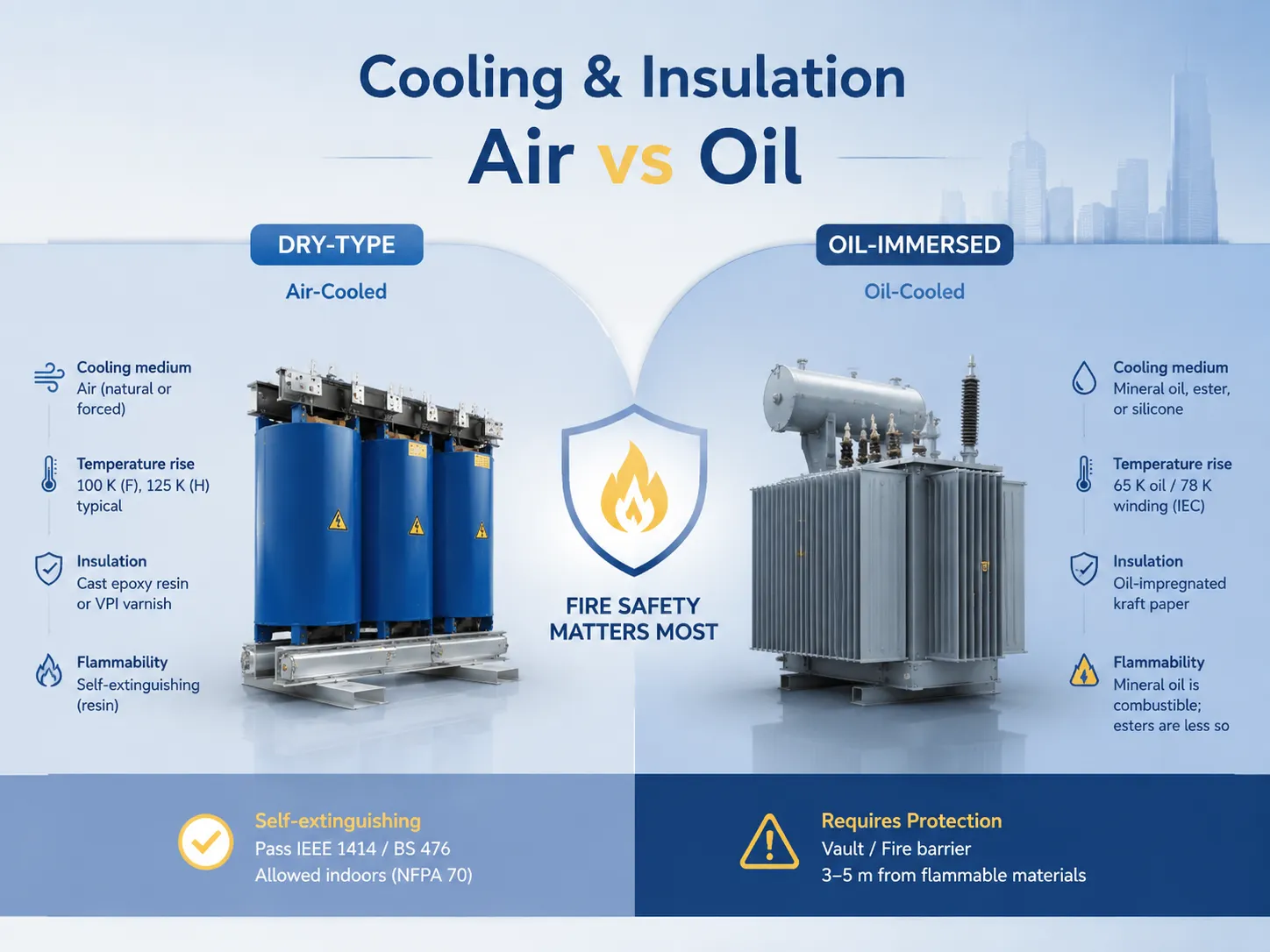
O aspecto de incêndio é mais importante do que qualquer outro aspecto. Transformadores de resina fundida são autoextinguíveis e passam nos testes de chama IEEE 1414/BS 476, que é a principal razão pela qual o NFPA 70 e a maioria dos códigos nacionais os permitem em edifícios sem um cofre com classificação de incêndio. Unidades de óleo mineral precisam de um cofre, barreira contra incêndio ou distância de 3–5 m de materiais inflamáveis. Para projetos de subsolo e arranha-céus, isso muitas vezes foi a única consideração.
Tabela de Comparação de Nove Dimensões
| Dimensão | Seco | Óleo Imerso | Vencedor |
|---|---|---|---|
| Custo inicial por kVA | Mais alto | Mais baixo (25–40% menos) | Óleo |
| Risco de incêndio/explosão | Baixo, autoextinguível | Líquido combustível | Seco |
| Aprovação interna | Nenhum cofre necessário na maioria dos códigos | Cofre/barreira frequentemente exigidos | Seco |
| Capacidade de sobrecarga | Limitada além da placa de identificação | Boa massa térmica | Óleo |
| Carga de manutenção | Verificações visuais, manutenção de ventiladores | Amostragem de óleo, DGA, verificações de vazamento | Seco |
| Sensibilidade à umidade | Mais alta; precisa de sala seca | Selado contra umidade | Óleo |
| Vida útil | 20–30 anos | 25–40 anos | Óleo |
| Ruído | Mais silencioso (sem bombas de óleo) | Pode ser mais barulhento com ventiladores | Seco (marginal) |
| Efficiency at high ratings | Larger, more copper needed | Compact for same rating | Óleo |
Total Cost of Ownership: Real Math
The cost of buying first transformer is only a starting point for the whole analysis. Now we will analyze a 1,000 kVA transformer operating at an industrial facility with a load factor of 60% producing losses of $0.12/kWh for the period of twenty years. The transformer losses will be calculated based on IEC 60076 International Standard.
| Cost Component | Dry-Type (Cast Resin) | Óleo Imerso |
|---|---|---|
| First cost (FOB, 10–35 kV) | $20,000–$45,000 | $18,000–$38,000 |
| Perda em vazio | ≈ 2,000–2,600 W | ≈ 1,500–2,000 W |
| Load loss @ 60% load | ≈ 6,000–8,500 W | ≈ 5,500–7,500 W |
| Annual loss cost (@$0.12/kWh) | ≈ $8,400–$11,600 | ≈ $7,400–$10,000 |
| 20-year loss cost | ≈ $168,000–$232,000 | ≈ $148,000–$200,000 |
| Maintenance over 20 years | ≈ $4,000–$9,000 | ≈ $12,000–$22,000 (oil tests, reconditioning) |
| Approx. 20-year total | $192,000–$286,000 | $178,000–$260,000 |
Two things immediately stand out. First of all, losses exceeds expenditures, which is why choosing based on price alone is a wrong move. Secondly, the 20-year figures show that the total costs are very similar to one another, due to the lower maintenance costs of the dry-type motor that compensate for the higher price. Although oil-immersed motors still get better lifetime costs in comparison to the dry type, the difference is not as big as the first-cost difference suggests.
Ratings and Efficiency: What the Standards Say
- Dry-type: The IEC 60076-11 standard applies to dry-type power transformers and defines insulation classes as B, F, and H with temperature rise degrees of 100 K, 125 K, and 150 K, respectively. Additionally, various efficiency categories in accordance with IEC 60076-20 were successfully introduced.
- Oil-immersed: This technology adheres to IEC 60076-1/-2 standards, which means the limits for oil and winding temperature rise of 65 K and 78 K apply correspondingly. The same theory about insulation lifetime applies and every 6 degrees temperature rise over the rated degree results in a downfall in insulation longevity by half.
Oil-immersed transformers are still achieving the same level of losses at a smaller weight. However, new technologies made modern cast resin dry-type transformers less loss-generating. Efficient cast resin transformers with copper foil winding are already able to demonstrate the same efficiency in the same power ranges.
Application-by-Application Verdicts
| Aplicação | Recommended Type | Reason |
|---|---|---|
| High-rise and commercial buildings | Dry-type | No vault, self-extinguishing, quiet |
| Hospitals and data centers | Dry-type (often cast resin) | Fire safety and uptime priorities |
| Outdoor distribution poles/padmounts | Oil-immersed | Cost per kVA, weather resistance |
| Industrial plants | Either, usually oil-immersed outdoors | Overload headroom and serviceability |
| Mining and tunnels | Dry-type preferred | No flammable liquid in confined spaces |
| Renewables (PV, wind) | Both; dry-type for indoor skids, oil for pads | Site fire rules and cost decide |
| High humidity, coastal outdoor | Oil-immersed | Selado contra umidade |
Brand Landscape and Price Ranges
| Marca | Dry-Type Offering | Oil-Immersed Offering | Price Position |
|---|---|---|---|
| ABB | Cast-resin up to 63 MVA | Distribution and power | Premium |
| Siemens | GEAFOL cast resin | Distribution and power | Premium |
| Schneider Electric | Trihal cast resin | Distribution | Premium |
| Hitachi Energy | Resibloc resin block | Power and distribution | Premium |
| Eaton | VPI and cast coil | Padmount and pole | Mid-premium |
| Chinese manufacturers (e.g., Subian) | Cast resin and VPI | Distribution and power | Valor |
The global players in the field – ABB, Siemens, Schneider Electric and Hitachi Energy – built the cast-resin transformer that shaped the industry standards, equipped with many years of type tests and worldwide service system. The premium that they charge is justified when the project specifications call for international certification or vendor-driven maintenance. Most projects with the parameters of 400 – 2,500 kVA capacity, IEC-compliance and some test reports can easily be completed by certified Chinese producers for much less money compared to Western firms. Jiangsu Subian Electric Power makes both cast resin transformers with voltages up to 35 kV and oil-filled ones with voltages from 10 kV to 110 kV, providing customers with the opportunity to buy any technology from a single certified plant and get standard documentation and direct manufacturer support.
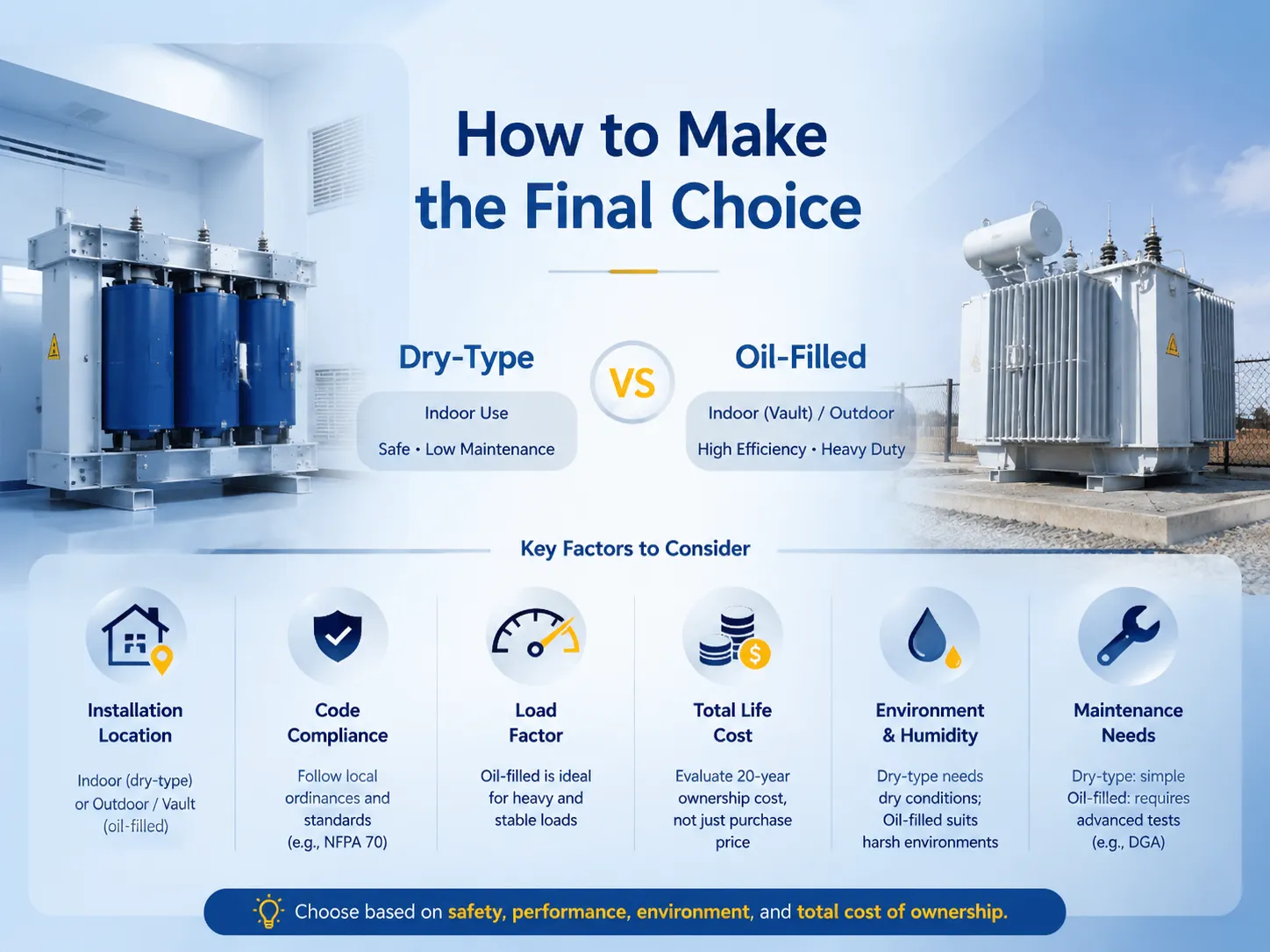
How to Make the Final Choice
- Inquire about placement of the unit. Installation indoors in an already occupied premises implies the need for dry-type but installation outdoors or in a designed transformer depot requires oil-filled units.
- Consult your local ordinances for instructions. Most national codes like NFPA 70 require that you use vaults for any oil-filled transformers used indoors with certain output ratings.
- Calculate load factor. Oil-filled units are more preferable in case of heavy and stable loads while where situation repeats itself bringing in light loads the advantage is not so considerable.
- Calculate total life costs of ownership for a period of twenty years using your local electricity prices and the method discussed above instead of just multiplying cost prices.
- Consider humidity and environment. Dry-type transformers operate only in dry cabinets, but oil-filled units can be installed even outdoors.
- Check what kind of maintenance could be done. Oil-filled transformers require some complex procedures like DGA analysis but here dry type wins easily because it would do without that.
Perguntas Frequentes
Which is cheaper: dry-type or oil-immersed transformers?
Oil-immersed is generally 25-40% less expensive at equivalent ratings. For a 1,000 kVA unit, the costs are expected to range from $18,000-$38,000 for oil to $20,000 to $45,000 for cast-resin dry-type units. However, once vault construction, oil containment, and added maintenance costs are factored in, the total for the 20-year period becomes much more comparable, underscoring the inadequacy of price as the deciding factor.
Are dry-type transformers more efficient than oil-immersed ones?
At the same efficiency class, this is not always true. This is due to the fact that oil cools better; by means of significally smaller cores and windings, oil-immersed units meet the loss requirements. When it comes to smaller power ratings (50–500 kVA), good quality cast resin products outpace oil-immersed units; when the power rating is higher than ~1,000 kVA, the latter generally performs better as far as losses per dollar is concerned.
Can dry-type transformers be installed outdoors?
Indeed, this holds true only when specific provisions are made. The open ventilated type requires a weatherproof IP23 IP54 enclosure and derating. For example, a cast resin unit used outdoors at 45 °C ambient must usually derate between 5–10% compared to indoor operation. In addition, oil-filled units are usually stronger than the others when it comes to trying climates.
What is the typical service life of each type?
Oil-filled transformers have a lifespan of 25 to 40 years, during which annual oil testing needs to be carried out. It is also seen that dry transformers have a lifespan of around 20 to 30 years, which is completely based on the accumulation of moisture over the years. Cast-resin insulated systems can have a lifetime of around 30 years provided they are used in a clean and dry location.
Why do high-rise buildings almost always use dry-type transformers?
Due to fire codes. Mineral oil being flammable prompts the creation of a fireproof vault for such an indoor oil transformer. However, since cast resin is flameproof there is no need for the dry transformer to be placed inside a vault, which leads to the elimination of substantial space and easier ventilation in electrical rooms.
Referências
- IEC 60076-1: Power Transformers — General — Core standard for ratings, losses, and testing of transformers.
- IEC 60076-11: Dry-Type Power Transformers — The international standard specific to dry-type transformers, insulation classes, and temperature rise.
- NFPA 70 (National Electrical Code) — The code that governs transformer installation, fire ratings, and clearance in buildings.
- IEEE — Publisher of IEEE C57 series and transformer thermal/life standards used with IEC.
- NEMA — North American standards body covering transformer efficiency and enclosure classifications.
- US DOE Distribution Transformer Standards — Official efficiency rules that inform loss-economics calculations.
- Jiangsu Subian Electric Power Co., Ltd. — Manufacturer of both dry-type and oil-immersed transformers, IEC 60076 compliant.
Conclusão
The dry-type transformer and oil-immersed variety should be understood not as alternatives but as two optimal answers to different inquiries. If your installation is taking place in an indoor premises, has fire-safe requirements, or is being put into operation in a venue such as an occupied building, then the dry-type transformer is your safest bet, despite its initial price which is 25 to 40 per cent higher than that of the oil-immersed model. If the transformer is located outdoors in a cable substation, then the latter version offers the best kVA price, promising better overload margins and greater service life. The choice should be made based on the overall cost of ownership (initial price, losses, service costs, construction, etc.) but not the sticker price. No matter which way you choose, buy equipment from a certified manufacturer that provides losses information together with test results.A supplier such as Jiangsu Subian Electric Power offers both technologies, so you can compare like-for-like and choose with confidence.