


Um engenheiro de compras em uma planta de cimento recebeu uma cotação para dois transformadores de 5 MVA, dos quais um custa $68.000 e o outro $95.000, e o engenheiro estava confuso sobre por que há uma diferença de preço e só descobriria isso após verificar as estatísticas de perda, classes de resfriamento e material de isolamento de ambos os transformadores. Essa epifania, quando os princípios e benefícios do uso de transformadores de potência se transformam de teoria em realidade, é o que este artigo abordará. Transformadores de potência são apenas algumas caixas feitas de aço, no entanto, suas especificidades internas determinam quão eficiente e durável o transformador seria, bem como seu custo total de propriedade.
Neste artigo, analisamos qual é o verdadeiro propósito dos transformadores de potência: transformação de tensão, isolamento, correspondência de impedância, regulação, etc. Investigamos quais benefícios um bom design desses transformadores pode trazer, entre os quais estão: eficiência acima de 99%, vida útil superior a 30 anos e capacidade de sobrecarga.
As funções de um transformador de potência incluem mudar níveis de tensão, manter isolamento elétrico entre circuitos, igualar as impedâncias e controlar a tensão. Suas vantagens quando projetadas corretamente são eficiências entre 98% e 99,7% e vidas operacionais entre 30 e 40 anos com pouca manutenção. A operação do aparelho é regulamentada pela IEC 60076-1; as perdas e eficiências são fornecidas para diferentes cargas e são usadas para a classificação de custo de propriedade que distingue propostas confiáveis das baratas.
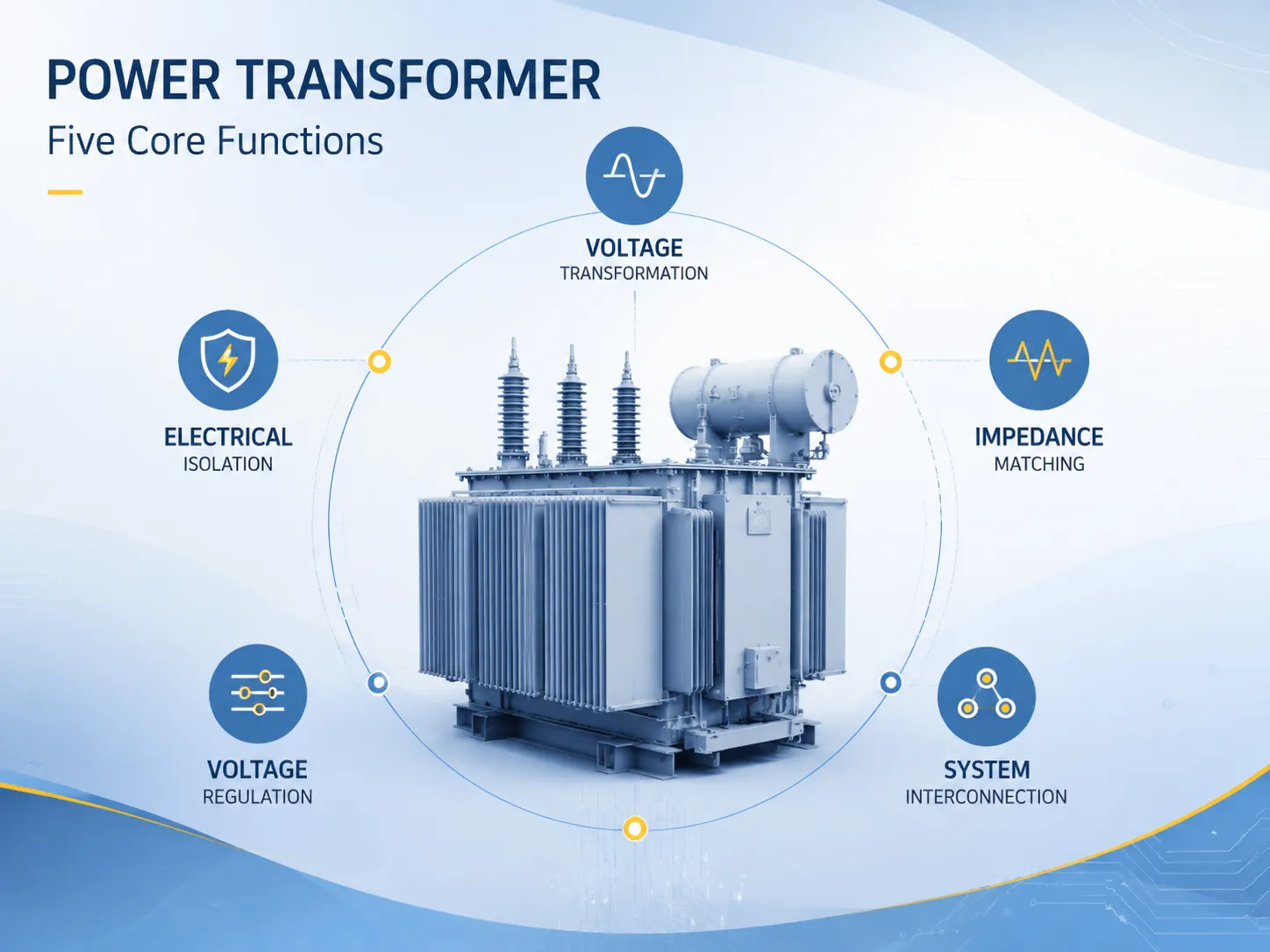
As Cinco Funções Principais de um Transformador de Potência
Um transformador de potência não é apenas um aparelho de uso único; na verdade, ele desempenha várias funções elétricas diferentes simultaneamente:
| Função | O que faz | Exemplo Prático |
|---|---|---|
| Transformação de tensão | Eleva ou reduz a tensão pela relação de espiras | 18 kV → 400 kV em um transformador GSU |
| Isolamento elétrico | Separa circuitos primários e secundários galvanicamente | Isolamento entre gerador e rede |
| Adaptação de impedância | Igualar impedâncias de fonte e carga para transferência de potência eficiente | Conectando um gerador de alta impedância a uma linha de baixa impedância |
| Regulação de tensão | Mantém a tensão de saída contra variações de carga através de comutadores de derivação | OLTC mantendo o barramento de 20 kV dentro de ±2% |
| Interconexão de sistemas | Conecta diferentes níveis de tensão, fases e arranjos de aterramento | Transformador auto-transformador de 220 kV ↔ 110 kV |
Essas funções correspondem a atributos de design específicos: a relação de espiras correlaciona-se com o número de enrolamentos, a função isolante com o sistema dielétrico, a função de correspondência com a reatância de fuga, a função de regulação com o comutador de derivação, assim como a interconexão com o grupo vetorial e o design do arranjo neutro.
Vantagens Mensuráveis de um Transformador de Potência Bem Projetado
Ao falar sobre transformadores de potência, os engenheiros se referem a números específicos:
- Eficiência – transformadores de potência têm grandes máquinas operando em torno de 99,0 – 99,7%. Por exemplo, um transformador de 100 MVA com eficiência de 99,5% tem apenas 500 kW desperdiçados em plena carga.
- Longevidade – com a manutenção adequada, os transformadores funcionam por mais de 30-40 anos. Muitos transformadores construídos na década de 1960 ainda estão em operação.
- Capacidade de sobrecarga – a margem da classe de resfriamento permite sobrecarga de 120% a 160% por um tempo específico de acordo com a instrução de carga IEC 60076-7.
- A baixa necessidade de serviço – vários dispositivos não possuem partes móveis. Os únicos trabalhos de serviço necessários são os testes de óleo e a troca de juntas.
- Alta taxa de confiabilidade – as falhas estão abaixo de 1% por ano para todos os dispositivos na frota da empresa de utilidade.
- Flexibilidade da rede – o trabalho paralelo de máquinas, a mudança de tomadas e o deslocamento de fase dos transformadores permitem gerenciar o fluxo de energia de forma dinâmica.
Essas vantagens ajudam a entender por que a mesma construção do transformador tem sido usada por 130 anos – os princípios físicos são estáveis e o benefício econômico está presente.
Como a Função é Fornecida: Enrolamentos, Núcleo & Tomadas
As funções listadas são realizadas devido a vários componentes projetados:
| Componente | Contribuição | Escolha Típica em Design Premium |
|---|---|---|
| Núcleo | Caminho de fluxo de baixa perda | Aço silício orientado a grão (classe M4/M5) ou amorfo |
| Enrolamentos | Relação de espiras, densidade de corrente | Cobre OFHC, isolamento classe F/H |
| Comutador de derivação | Regulação de tensão | Sob carga (OLTC) com interruptores a vácuo ou transição de resistor |
| Sistema de isolamento | Resistência dielétrica, classe térmica | Papel prensado de alta densidade + óleo mineral ou éster |
| Sistema de resfriamento | Capacidade de carga | Radiadores, ventiladores, bombas de óleo (ONAN → ODAF) |
A interação é importante: um núcleo de aço de baixa qualidade aumenta as perdas em vazio em 10% a 20% enquanto usa a mesma classificação; fios finos aumentam as perdas I²R; um trocador de tomadas médio é o primeiro componente a falhar. Decisões de engenharia premium é sobre o que os $95.000 oferecidos no exemplo acima se referiam.
Eficiência & Economia de Perdas: Por que 0.5% é Importante
Os transformadores dissipam energia elétrica o tempo todo. Qualquer dispositivo que esteja energizado por 24 horas por dia, 365 dias por ano, incorre em perdas em vazio mesmo que não esteja carregando. O método padrão de comparação de equipamentos é o método de perda capitalizada, que permite transformar ambos os componentes em valor presente:
| Classificação | Perda em Vazio | Perda de Carga (75°C) | Eficiência @ Carga Total |
|---|---|---|---|
| 1 MVA / 11 kV | ≈1.150 W | ≈10.500 W | ≈98,8% |
| 20 MVA / 110 kV | ≈14 kW | ≈98 kW | ≈99,4% |
| 100 MVA / 220 kV | ≈45 kW | ≈320 kW | ≈99,6% |
| 400 MVA / 400 kV | ≈130 kW | ≈1.100 kW | ≈99,7% |
Os transformadores dissipam energia elétrica o tempo todo. Qualquer dispositivo que esteja energizado por 24 horas por dia, 365 dias por ano, incorre em perdas em vazio mesmo que não esteja carregando. O método padrão de comparação de equipamentos é o método de perda capitalizada, que permite transformar ambos os componentes em valor presente:
Funções por Tipo de Transformador
Cada família de transformadores tem sua própria otimização de perfil de parâmetros.
| Tipo | Função Primária | Função Secundária | Aplicação Típica |
|---|---|---|---|
| GSU | Elevação | Isolamento, limitação de falhas | Usinas de energia, eólica/solar |
| Distribuição | Etapa final de redução | Eficiência em carga parcial | Alimentadores de utilidade, edifícios |
| Autotransformador | Interconexão | Economia de custo/tamanho | Conexões de rede HV |
| Isolamento | Separação galvânica | Ruído/bloqueio de CC | Hospitais, centros de dados, laboratórios de teste |
| Deslocamento de fase | Controle de fluxo de energia | Gestão de fluxo em loop | Redes EHV malhadas |
Um transformador de isolamento pode operar em uma relação de 1:1, ou seja, sem mudanças de tensão, pois sua única função é fornecer isolamento elétrico, bloquear CC e eliminar interferência eletromagnética. Isso significa que a definição de “transformador” é mais ampla do que apenas “um dispositivo que muda a tensão.”
Especificações Orientadas pela Função
| Especificação | Valor Típico | Função Servida |
|---|---|---|
| Potência nominal (kVA/MVA) | 200 kVA–1.200 MVA | Envelope de capacidade geral |
| Relação de tensão | por exemplo, 110/20 kV | Transformação de tensão |
| Tensão de impedância | 6%–15% | Limitação de falhas, compartilhamento de carga |
| Grupo vetorial | YNd11, Dyn11 | Alinhamento de fase & interconexão |
| Faixa de derivação | ±10%–±16% | Regulação de tensão |
| Nível de isolamento (BIL) | 550 kV @ classe 110 kV | Resistência dielétrica, integridade de isolamento |
Os parâmetros mencionados acima representam um contrato de serviço: o comprador está realmente pagando por um determinado desempenho elétrico.
Vantagens de Manutenção & Custos de Serviço Realistas
Uma característica única dos transformadores de potência é seu cronograma de manutenção prolongado que geralmente ocorre ao longo de vários anos:
- A amostragem de óleo, que consiste em uma análise de gás dissolvido (DGA) do óleo, é feita a cada 6 a 12 meses para unidades vitais. O custo de um teste completo de óleo varia entre $200 e $1.000 por amostra.
- A substituição de óleo ocorre uma vez a cada 10-20 anos no que diz respeito a sistemas de óleo mineral. Um transformador com capacidade de 20 MVA necessita de cerca de 8.000 – 12.000 litros de óleo.
- Tanto as juntas quanto os respiradores também precisam ser substituídos: a substituição do gel de sílica deve ocorrer anualmente e as juntas são trocadas a cada 5 a 8 anos.
- Os cronogramas de serviço para trocadores de tomadas são definidos pelos fabricantes e são realizados aproximadamente uma vez a cada 2-5 anos.
- Outra operação de manutenção é a inspeção anual, que consiste em inspeção visual, termografia e teste de vazamento, que geralmente custa $2.000 – $8.000 por unidade.
Isso não se compara a máquinas rotativas que precisam de constantes trocas de rolamentos e monitoramento de vibração.
Aplicações Onde a Função Importa Mais
- Redes de utilidade interconectadas — autotransformadores e transformadores de redução são utilizados para regular o fluxo de energia.
- Indústria de energia renovável — transformadores GSU e de coleta são utilizados para lidar com geração irregular.
- Indústria intensiva — transformadores de fornos e retificadores são usados para alimentar fornos de arco e eletrólise.
- Instalações sensíveis — transformadores de isolamento são usados para proteger a imagem médica.
- Marinha e offshore — equipamentos especializados usados em áreas com vibrações pesadas, sal e tamanhos exigentes.
Principais Marcas & Análise de Preços
Marcas premium em transformadores ganham projetos devido à história de engenharia, garantias de perdas e comunicações pós-venda – no entanto, as tecnologias são as mesmas, pois todos aderem aos padrões IEC 60076. A tabela abaixo ilustra as estimativas de preços de um transformador imerso em óleo de 20 MVA/110 quilovolts.
| Marca | País | Posicionamento | Preço Indicativo |
|---|---|---|---|
| Hitachi Energy | Suíça/Japão | Líder em tecnologia, EHV/HVDC | $450.000–$700.000 |
| Siemens Energy | Alemanha | EHV, subestações digitais | $430.000–$680.000 |
| Schneider Electric | França | Distribuição & liderança em MV | $280.000–$450.000 |
| GE Vernova | EUA | Projetos GSU de utilidade | $420.000–$650.000 |
| Hyosung | Coreia do Sul | Grande MVA, EHV | $380.000–$600.000 |
| TBEA | China | Escala + EPC | $180.000–$320.000 |
| Jiangsu Subian Electric Power | China | Personalizado, OEM/ODM, valor | $160.000–$300.000 |
O preço depende das especificações, perdas e regiões. Compradores que desejam adquirir transformadores que atendam aos padrões IEC 60076 sem pagar pela marca podem recorrer à Jiangsu Subian Electric Power, que fabrica transformadores de potência e distribuição na faixa de 50 kVA-220 kV, tanto imersos em óleo quanto secos, com trocadores de tomadas sob carga opcionais e relatórios de teste de fábrica completos. Os engenheiros da Jiangsu Subian Electric Power modificam relações, tipos de resfriamento e grupos vetoriais, enquanto seus preços são tipicamente 30%-50% mais baixos do que os preços de seus concorrentes europeus, e cada compra vem com uma avaliação de terceiros.
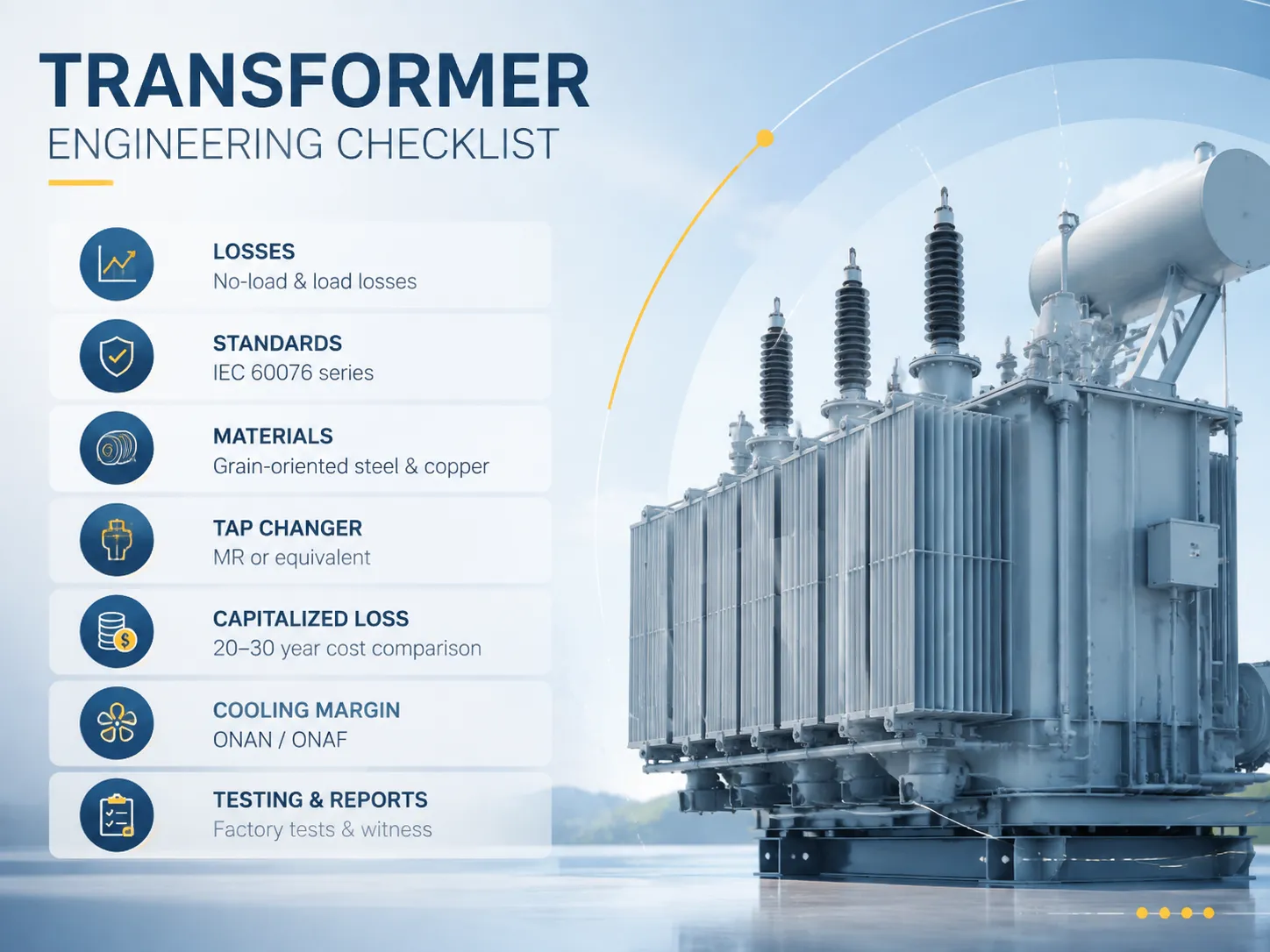
Como Avaliar a Engenharia de um Transformador
- Inicialmente, consulte a tabela de perdas para obter os números de perda em vazio e em carga, que fornecem informações sobre a qualidade do núcleo e do condutor.
- Faça perguntas sobre a conformidade dos testes de tipo com os padrões aceitos, como IEC 60076-1/2/3/5, que envolvem testes de elevação de temperatura e testes de impulso.
- Examine o condutor de enrolamento e o aço do núcleo, pois estes devem ser feitos de materiais premium, como aço silício e cobre.
- Estabeleça o fabricante do trocador de tomadas empregado, pois ter um fabricado pela MR (Maschinenfabrik Reinhausen) ajudará a mitigar qualquer mau funcionamento associado a este dispositivo em particular.
- Faça uma comparação entre perdas, ou diferença na lucratividade, que é calculada com base nas perdas esperadas ao longo de 20-30 anos.
- Verifique a temperatura para fins de resfriamento em relação à classificação dupla ONAN/ONAF.
- Peça relatórios de teste de produção e tenha certeza de testemunhar isso.
Perguntas Frequentes
Qual é a função principal de um transformador de potência?
A tarefa principal é converter a tensão – aumentar ou diminuir o nível de tensão sem alterar a frequência e a potência aparente por meio da indução eletromagnética. Outra tarefa igualmente importante é tornar os circuitos eletricamente isolados uns dos outros, o que se torna possível no processo de transmissão na forma de operações de aumento e diminuição.
Que eficiência posso esperar de um transformador de potência moderno?
Transformadores de distribuição geralmente alcançam níveis de eficiência em torno de 98%–99%, enquanto grandes transformadores de potência operam com níveis de eficiência de 99%–99.7% na carga máxima especificada. Deve-se mencionar que a eficiência de potência depende da carga; o nível mais alto de eficiência de potência é geralmente observado em cargas de 50%–75%, que é a razão pela qual os engenheiros projetam transformadores para operar nessa faixa. Nesse contexto, a comparação deve ser feita com a ajuda dos valores fornecidos das perdas, em vez de apenas a porcentagem de eficiência.
Por que um transformador de 20 MVA custa $160.000 de um fornecedor e $700.000 de outro?
As funções desempenhadas por ambas as unidades são as mesmas; a diferença está no conteúdo projetado: as garantias de perda (projeto de baixa perda usa mais metal e aço de núcleo superior), marca do comutador de derivação, tipo do sistema de resfriamento, histórico de testes das unidades, suporte de serviço e outros. Geralmente, pode-se justificar o maior gasto inicial devido ao menor custo de operação de uma perda capitalizada ao longo de 25 anos de operação.
Qual é a vantagem de um comutador de derivação sob carga (OLTC)?
O OLTC permite a mudança de derivação sob a condição de potência do transformador, permitindo a alteração do nível de tensão automaticamente de acordo com a carga. Na ausência do OLTC, a mudança de tensão varia de 5% a 10% por dia, encurtando o trabalho dos motores e causando mau funcionamento dos equipamentos vulneráveis.
Com que frequência um transformador de potência precisa de manutenção?
A amostragem de óleo de rotina é recomendada a cada 6 a 12 meses para unidades críticas. Outras atividades funcionais incluem inspeção visual anual e inspeção térmica do transformador, bem como manutenção do comutador de derivação a cada 2 a 5 anos. No decorrer das operações, a vida útil normal do transformador de potência bem mantido é de cerca de 30 a 40 anos.
Referências
- IEC 60076-1: Transformadores de Potência — Geral — Classificações, tolerâncias e requisitos gerais que definem a função e o escopo do teste.
- IEC 60076-7: Guia de Carga para Transformadores de Potência Imersos em Óleo — O guia para capacidade de sobrecarga e envelhecimento térmico.
- IEC 60076-5: Capacidade de Suportar Curto-Circuito — Requisitos e testes de resistência a curto-circuito.
- IEEE C57.12.00: Requisitos Gerais para Transformadores Imersos em Líquido — Norma acompanhante norte-americana.
- Tecnologia de Comutador de Derivação da Maschinenfabrik Reinhausen (MR) — Referência da indústria para projeto e manutenção de comutadores de derivação sob carga.
- Transformadores Siemens Energy — Exemplos de referência de engenharia moderna de transformadores.
Conclusão
Transformadores de potência têm uma aparência simples, mas desempenham inúmeras responsabilidades, como transformação de tensão, correspondência de impedância, regulação, interconexão e isolamento, que se combinam para garantir que a rede funcione. Eles são benéficos se projetados corretamente, como proporcionar de 30 a 40 anos de vida útil, eficiências iguais ou superiores a 99 por cento, baixos níveis de manutenção e capacidade de sobrecarga.
- Avalie transformadores com base nas perdas apenas, não nos custos. As perdas determinam o custo de vida útil do transformador.
- As especificações devem atender aos requisitos funcionais do transformador, como a relação, impedância, grupo vetorial, faixa de derivação, tipo de resfriamento e BIL.
- Compare pelo menos três tipos de transformadores de diferentes fabricantes sob especificações semelhantes por meio do modelo de perda capitalizada.
- O orçamento deve estar na faixa de $25.000-$90.000 para transformadores variando de 1 a 5 MVA e $160.000-$300.000 para o transformador de 20 MVA.