


Em uma siderúrgica, um transformador de forno a arco está posicionado a apenas alguns metros do aço incandescente com uma corrente secundária de 40.000 A. Em uma fábrica de semicondutores, o transformador principal reduz 110 kV para 20 kV para uma instalação que não pode tolerar um segundo de inatividade não planejada. Os transformadores principais, de fato, são a espinha dorsal do mundo industrial, transferindo o fornecimento de alta tensão da linha de utilidade e, em seguida, entregando-o em chamada baixa tensão para os quadros de distribuição das plantas, motores e fornos.
Neste artigo, você descobrirá o que é o transformador principal, como diferenciá-lo dos transformadores de distribuição e de unidade, como dimensionar e especificar um para a instalação industrial e qual é o custo em termos de eficiência, impedância, resfriamento, proteção e preço. Não importa se você é um engenheiro elétrico, engenheiro de planta ou gerente de compras, este guia fornece todos os dados técnicos e comerciais necessários para fazer a escolha certa.
O que é um Transformador Principal? (Definição)
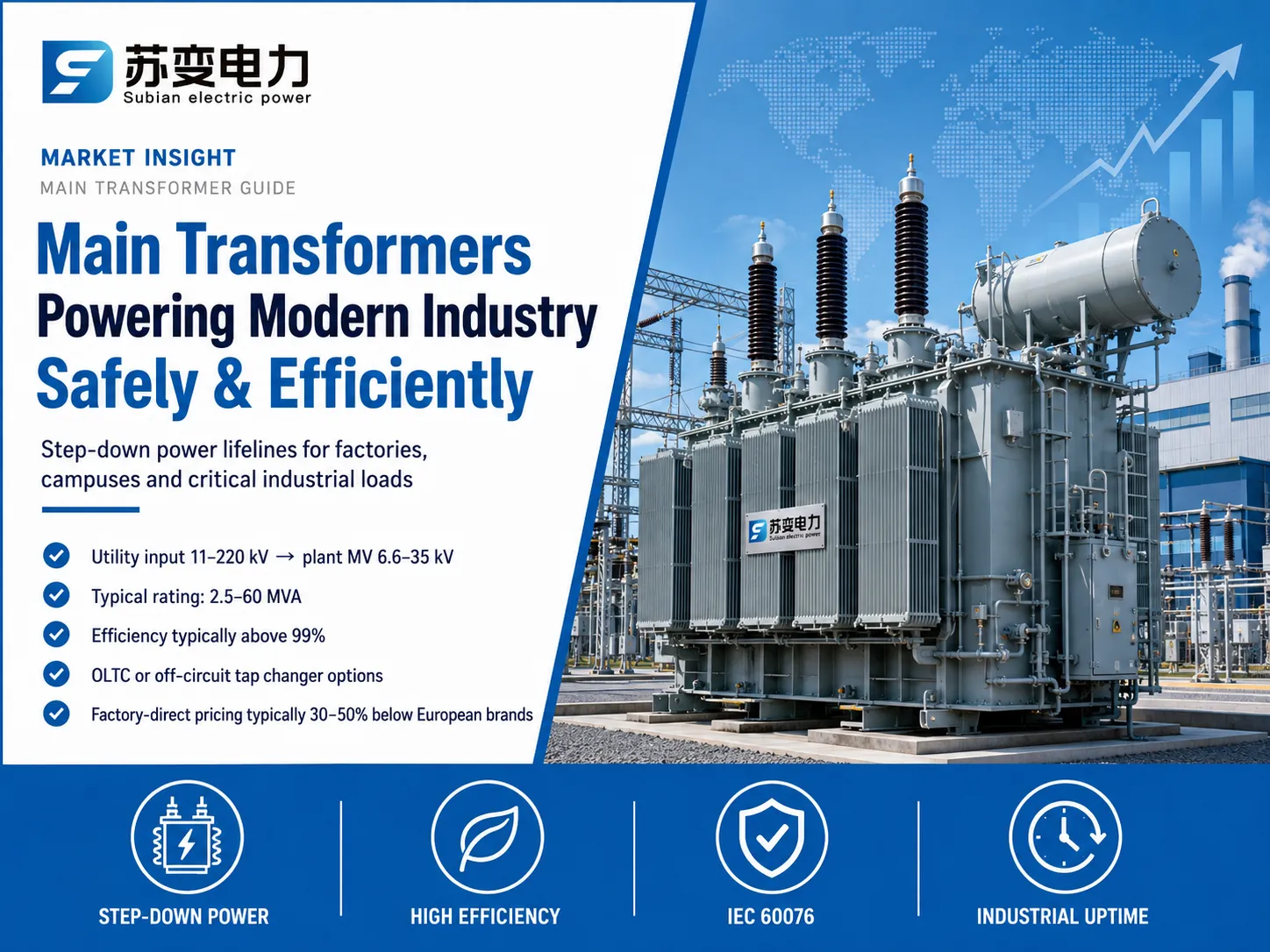
O transformador principal em uma instalação industrial, comercial ou de utilidade é o maior transformador de potência — o aparelho que conecta a instalação à rede e fornece toda a rede de distribuição interna. Em uma siderúrgica, por exemplo, pode ser uma unidade de 40MVA/110kV, enquanto uma fábrica de médio porte utiliza uma unidade de 2.5MVA/11kV, e um campus hospitalar provavelmente aplicará várias unidades de 2MVA para fornecer redundância. A razão pela qual o dispositivo é chamado de transformador principal não está nos valores de tensão, mas na posição do transformador como o componente elétrico chave da planta.
Os transformadores principais são fabricados para operar com a máxima confiabilidade porque incluem a melhor solução em relação às perdas, isolamento de alta qualidade, trocadores de tomadas funcionais e soluções de proteção adequadas. O custo da falha do transformador principal implica não apenas nas despesas de reparo; no caso da planta de processo, as perdas decorrentes da quebra podem ser medidas em milhões de dólares.
O Papel do Transformador Principal em um Sistema de Energia Industrial
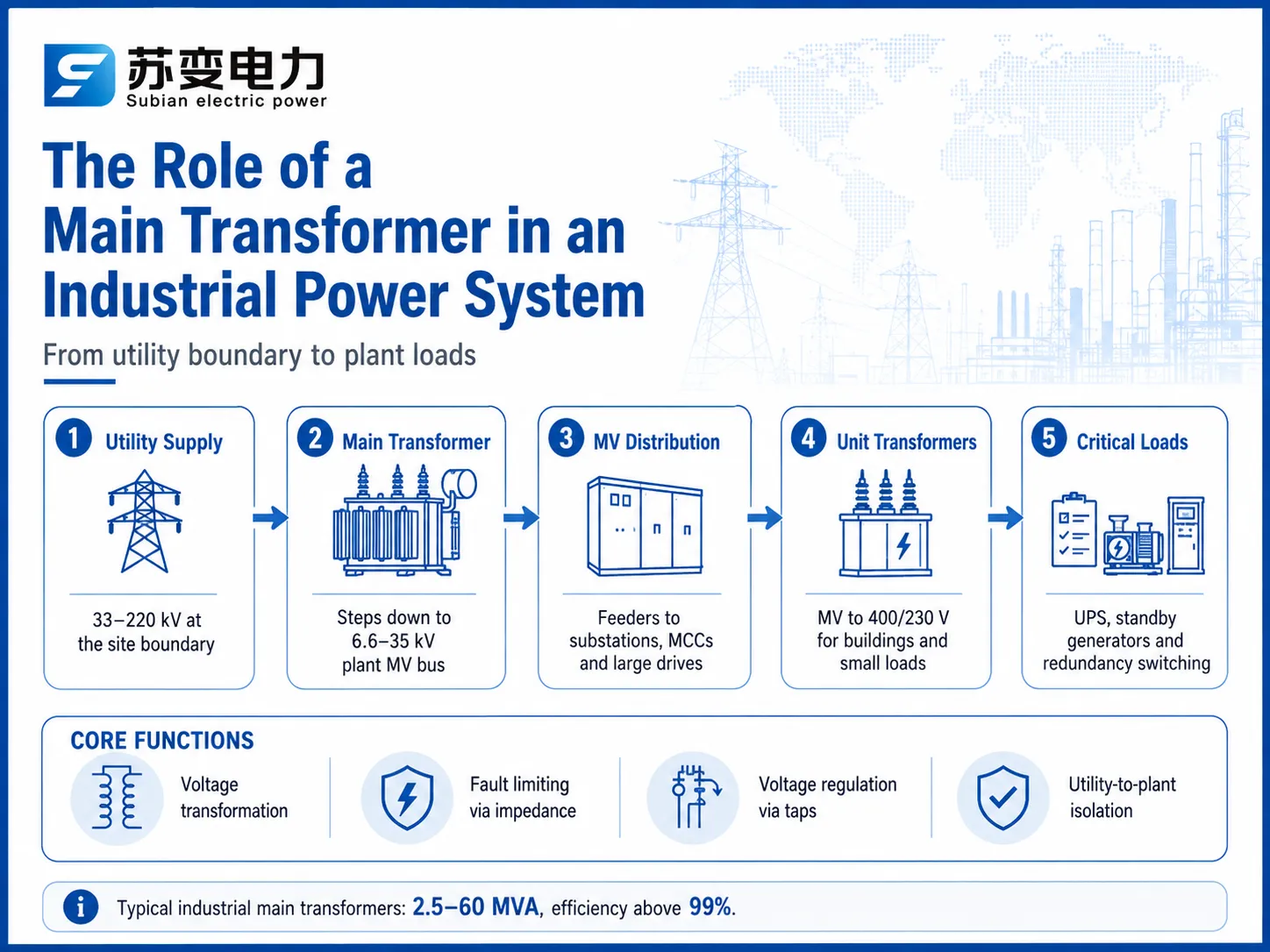
A estrutura de energia das instalações industriais modernas segue um padrão amplamente semelhante:
Conexão de utilidade — que varia de 33 kV a 220 kV, está localizada na fronteira da instalação (o ponto onde o fornecimento de energia externo é conectado ao sistema elétrico da instalação).
Transformador principal — que gera a tensão de fornecimento de 6.6 kV a 35 kV para a própria instalação.
Sistema de distribuição de média tensão — que inclui conexões de energia para subestações, centros de controle de motores e acionamentos principais.
Transformador de unidade — que reduz a tensão de fornecimento de 6.6 kV até 35 kV para produzir 400 e 230 V e fornecer eletricidade a edifícios e pequenas cargas.
Cargas críticas — que são representadas por fontes de alimentação ininterruptas (UPS), geradores de backup e interruptores redundantes instalados.
Nesse contexto, o transformador principal não apenas converte a tensão, mas também protege todo o circuito de falhas devido à sua impedância, controla a tensão devido à disponibilidade de tomadas e separa a rede de utilidade da instalação.
Como Dimensionar um Transformador Principal para uma Instalação
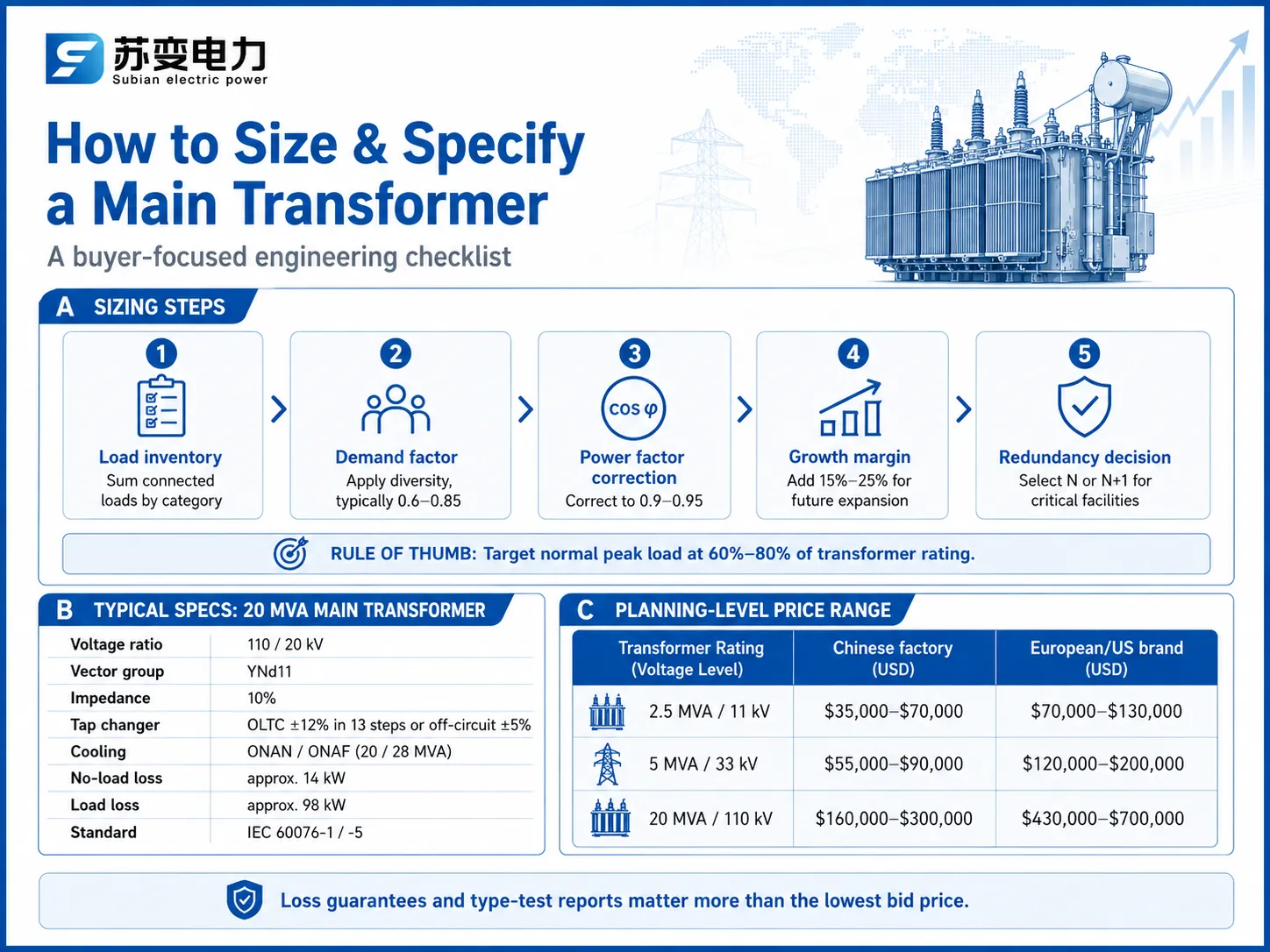
O dimensionamento é a decisão que orienta todas as outras especificações. A sequência de engenharia:
| Passo | Método | Resultado Típico |
|---|---|---|
| Inventário de carga | Some as cargas conectadas por categoria | ex. 8 MW conectados |
| Fator de demanda | Aplique diversidade (0,6–0,85 típico) | ex. 6 MW de demanda máxima |
| Correção do fator de potência | Compense para 0,9–0,95 | ≈6,5–7 MVA aparente |
| Margem de crescimento | Adicione 15%–25% para o futuro | ≈8–8,5 MVA selecionado |
| Decisão de redundância | Configuração N ou N+1 | 2×8 MVA se crítico |
Uma diretriz sólida para instalações industriais é dimensionar o transformador principal de modo que a carga máxima regular fique entre 60% e 80% de sua classificação. Isso garante que haja espaço para sobrecargas, que a eficiência seja maximizada e que haja margem suficiente para a queda de energia quando os motores são acionados. Para plantas críticas, o uso de dois transformadores em configuração N+1 (onde ambos os transformadores podem gerenciar toda a carga em caso de emergência) tornou-se bastante comum.
Tipos e Configurações de Transformadores Principais
| Configuração | Passo de Tensão | Classificação Típica | Onde Usado |
|---|---|---|---|
| Transformador de dois enrolamentos, imerso em óleo | 110/20 kV | 5–60 MVA | A maioria dos locais industriais |
| Transformador de dois enrolamentos, tipo seco | 11/0,4 kV ou 20/0,4 kV | 0,5–10 MVA | Instalações internas, sensíveis ao fogo |
| Três enrolamentos | 110/20/6,6 kV | 10–60 MVA | Plantas com múltiplos níveis de tensão |
| Banco duplo N+1 | 110/20 kV ×2 | 2×5–2×30 MVA | Data centers, hospitais, refinarias |
Transformadores principais de três enrolamentos são populares onde um local precisa tanto de um barramento de processo de média tensão quanto de um barramento auxiliar separado; o terceiro enrolamento também fornece um caminho harmônico e reduz a necessidade de um transformador unitário separado.
Transformador Principal vs. Transformador de Distribuição vs. Transformador Unitário
| Aspecto | Transformador Principal | Transformador de Distribuição | Transformador Unitário |
|---|---|---|---|
| Posição | Limite de utilidade para planta MV | Alimentador MV para usuário final | Planta MV para cargas LV |
| Classificação típica | 5–60 MVA | 50 kVA–2.500 kVA | 100 kVA–3 MVA |
| Tensão primária | 11–220 kV | 4–35 kV | 6–35 kV |
| Perfil de carga | Carga alta contínua + sobrecarga | Carga parcial variável | Cargas de edifício/processo |
| Preço típico | $35k–$300k+ | $1.5k–$45k | $5k–$70k |
A linha entre “principal” e “unitário” pode se confundir em pequenas instalações onde um único transformador desempenha ambas as funções, mas as prioridades de engenharia diferem: transformadores principais otimizam para confiabilidade e carga contínua, transformadores unitários para custo e flexibilidade.
Especificações Chave para Transformadores Principais Industriais
| Parâmetro | Valor Típico |
|---|---|
| Potência nominal | 20 MVA |
| Relação de tensão | 110 / 20 kV |
| Grupo vetorial | YNd11 |
| Tensão de impedância | 10% |
| Comutador de derivação | OLTC ±12% em 13 etapas, ou fora de circuito ±5% |
| Resfriamento | ONAN/ONAF (20/28 MVA) |
| Perda em vazio | ≈14 kW |
| Perda de carga | ≈98 kW |
| Nível de isolamento | 550 kV BIL (lado de 110 kV) |
| Padrão | IEC 60076-1/-5 |
Esses números são o contrato entre comprador e fabricante. Qualquer desvio — perdas mais altas, impedância diferente, faixa de derivação mais fraca — altera o preço e o desempenho, portanto, devem ser fixados antes da produção.
Eficiência, Perdas & Custo Total de Propriedade
A maioria dos transformadores principais industriais opera com níveis de eficiência entre 99.0% e 99.6%. Por exemplo, com uma eficiência de 99.4% para um transformador de 20 MVA, a perda de calor chega a cerca de 120 kW para operação em carga total, o que resulta em cerca de 1,000 MWh de consumo total em um ano de operação. Isso significa custos que variam de $80,000–150,000 por ano a tarifas médias de $0.08–0.15/kWh, sem contar as perdas que ocorrem durante o tempo de espera.
A avaliação de custo efetivo deve ser realizada ao longo de um período de 20–30 anos, em outras palavras. A criação de modelos de baixa perda leva cerca de 5%–10% a mais para produzir, mas economiza dinheiro em custos operacionais a longo prazo. Cortar 5 kW de perdas para a unidade de transformador de 20 MVA significa economias de aproximadamente 44 MWh anualmente, o que resulta em economias de cerca de $4,400–6,600 por ano, $90,000–130,000 em 20 anos com soluções de preços industriais normais.
Engenharia de Proteção & Segurança
A abordagem mais significativa de proteção em múltiplas camadas é voltada para um transformador que tem a maior valorização na localização.
Começando com os diferentes esquemas de proteção:
Proteção diferencial (87T) que compara correntes no lado primário do transformador com correntes no lado secundário (corrigidas para relação e grupos vetoriais) para detectar falhas internas rapidamente.
Proteção contra sobrecorrente (50/51) auxilia na proteção contra falhas de fase e terra.
Falha de terra restrita (REF, 64) auxilia na detecção de falha de enrolamento para terra.
O relé Buchholz detecta falhas em estágios iniciais devido à formação de gás; também pode produzir alarmes de surto e impulso de onda.
Alarmes de temperatura indicam que o transformador atingiu seu limite de temperatura de acordo com os padrões estabelecidos pela IEC 60076-2.
Alívio de pressão, proteção OLTC e para-raios protegem o transformador de forças mecânicas e raios.
A experiência de comissionamento e manutenção é adotada dos padrões estabelecidos pela IEEE C57.140 (guia de manutenção) e IEC 60076-7 (guia de carregamento).
Aplicações na Indústria Moderna
Aço e metalurgia — transformadores principais + de forno que lidam com cargas na faixa de 30-120 MVA ao longo de ciclos de trabalho muito árduos.
Centros de computação — transformadores principais gêmeos com redundância garantida, frequentemente na faixa de 2×10-2×30 MVA no nível de tensão de 110/20 kV.
Produtos farmacêuticos e semicondutores — conectando-se a cargas adversas e exigindo tensão de alta qualidade, além da escolha de opção de tipo seco para instalações internas.
Mineração — áreas remotas com necessidade de designs específicos que respondem a fatores ambientais difíceis, alta temperatura ambiente, condições de acessibilidade ruins.
Produtos químicos e refino — tecnologias de carga contínua geralmente funcionam em uma base N + 1 e suportam capacidade de carga excessiva significativa.
Edifícios comerciais e hospitais — 5-20 MVA que estão sujeitos a requisitos rigorosos de redundância.
Em cada situação, a lógica por trás da compra será semelhante: combinar tamanhos com as características das cargas, otimizar perdas com os investimentos, adicionar redundância onde o tempo de inatividade significa perdas e adicionar proteção com as conexões de relés.
Preços Realistas & Principais Marcas
A precificação do transformador principal segue a classificação, tensão, perdas, trocador de tomadas e marca. Faixas de nível de planejamento para unidades imersas em óleo:
| Classificação / Tensão | Fábrica Chinesa (por exemplo, Subian, TBEA) | Marca Europeia/EUA |
|---|---|---|
| 5 MVA / 11 kV | $35.000–$70.000 | $70.000–$130.000 |
| 5 MVA / 33 kV | $55.000–$90.000 | $120.000–$200.000 |
| 20 MVA / 110 kV | $160.000–$300.000 | $430.000–$700.000 |
| 40 MVA / 110 kV | $300.000–$550.000 | $800.000–$1.300.000 |
Os preços variam de acordo com a especificação, nível de perda e região. Para compradores industriais que precisam de um transformador principal projetado para seu perfil de carga sem o prêmio de marca internacional, Jiangsu Subian Electric Power é uma opção forte: um fabricante de transformadores chinês produzindo transformadores de distribuição e potência de 50 kVA a 220 kV, incluindo transformadores principais industriais de 2.5–60 MVA com impedância personalizada, faixas de tomadas e configurações de resfriamento. As unidades são enviadas com relatórios de teste tipo IEC 60076 e documentação completa de teste de fábrica, e seus engenheiros apoiam o design da interface de proteção e a comissionamento no local. A precificação direta da fábrica é tipicamente 30%–50% abaixo dos equivalentes europeus, e a personalização OEM/ODM está disponível para projetos complexos.
Perguntas Frequentes
Qual é a diferença entre um transformador principal e um transformador unitário?
Um transformador principal conecta a instalação à rede elétrica em 11–220 kV e alimenta toda a distribuição de MV da planta em 6.6–35 kV. Um transformador unitário é menor (geralmente 100 kVA–3 MVA) e reduz o barramento de MV da planta para 400/230 V para edifícios, iluminação e pequenas cargas. Um grande local tem um ou dois transformadores principais e dezenas de transformadores unitários.
Como faço para dimensionar o transformador principal para minha fábrica?
Some as cargas conectadas, aplique um fator de demanda de 0.6–0.85, corrija o fator de potência para 0.9–0.95, adicione uma margem de crescimento de 15%–25%, e então selecione a classificação padrão mais próxima para que a carga de pico normal fique em 60%–80% da classificação. Para instalações críticas, use unidades gêmeas N+1, cada uma capaz de carga total. Uma demanda máxima de 6 MW geralmente leva a um transformador de 8–10 MVA.
Qual eficiência um transformador principal industrial deve alcançar?
Espere 99.0%–99.6% em carga total, com perda em vazio em torno de 0.05%–0.1% da classificação e perda de carga 0.4%–0.7%. Uma unidade de 20 MVA pode mostrar 14 kW de perda em vazio e 98 kW de perdas de carga. Solicite valores de perda garantidos e faça uma comparação de perda capitalizada ao longo de 20–30 anos antes de escolher entre as propostas — as diferenças de perda geralmente superam as diferenças de preço.
Quanto custa um transformador principal para uma fábrica?
Orçamento de $35.000–$90.000 para uma unidade de 2,5–5 MVA / 11–33 kV, $160.000–$300.000 para 20 MVA / 110 kV de fábricas chinesas (ou $430.000–$700.000 de marcas europeias), e até $1,3 milhões para a classe de 40 MVA de marcas premium. Adicione 20%–40% para proteção, instalação, testes e obras civis.
Meu transformador principal deve ter um comutador sob carga?
Se a tensão da utilidade variar mais de ±5% ou suas cargas causarem oscilações de tensão significativas, sim — um OLTC mantém a MV da planta dentro de ±2% automaticamente em uma faixa de ±12% a ±16%. Se o fornecimento for estável e a carga for constante, um comutador fora de circuito a ±5% é mais barato e adequado. O OLTC geralmente adiciona $15.000–$60.000 dependendo da classificação.
Referências
- IEC 60076-1: Transformadores de Potência — Geral — Classificações, tolerâncias e testes para transformadores principais.
- IEC 60076-5: Capacidade de Suportar Curto-Circuito — Requisitos de resistência a curto-circuito essenciais para serviço industrial.
- IEC 60076-7: Guia de Carga para Transformadores de Potência Imersos em Óleo — Capacidade de sobrecarga e orientações sobre envelhecimento térmico.
- IEEE C57.12.00: Requisitos Gerais para Transformadores Imersos em Líquido — Norma acompanhante norte-americana.
- IEEE C57.140: Guia para Manutenção de Transformadores — A referência de manutenção e avaliação de condição para unidades industriais.
- Transformadores Hitachi Energy — Referência da indústria para tecnologia de transformadores grandes.
Conclusão
- Os transformadores principais são os componentes críticos no sistema elétrico das indústrias modernas, pois formam a base da estrutura energética da empresa. Os parâmetros de tamanho, otimização de perdas, tipo de proteção e redundância determinam o desempenho e o custo do local para os anos vindouros.
O tamanho deve ser selecionado de modo que a carga máxima normal seja de 60%–80% da capacidade nominal com uma margem de crescimento de 15%–25%.
As perdas devem ser otimizadas usando um modelo de perda capitalizada de 20–30 anos.
A proteção deve ser fornecida por meio de proteção diferencial, REF, relé Buchholz e controle de temperatura, enquanto a manutenção deve seguir o DGA.
O orçamento para esses transformadores deve variar de $35k a $90k para 2,5–5 MVA e de $160k a $300k para 20 MVA/110 kV (direto da fábrica).
Se você está planejando uma nova planta ou atualizando uma subestação existente, Jiangsu Subian Electric Power pode projetar e fornecer transformadores principais de 2,5 MVA a 60 MVA com certificação IEC 60076, configurações personalizadas de comutação e resfriamento, e preços diretos de fábrica para se adequar ao seu orçamento.