


Choosing a vendor for the padmount transformer that is used in commercial projects is critical as once you have made a decision and ordered the unit, there is no way to value-engineer the purchase after it has been manufactured. Therefore, when choosing the vendor, it is more important to focus on obtaining three specific documents prior to discussing price rather than choosing based on price alone. A buyer who requests these documents will have a much better experience than one who simply compares quotes.
Быстрый ответ: commercial real estate projects typically require three-phase padmount transformers that are built to IEEE C57.12.34. These units are normally rated at either 480Y/277 Volts or 208Y/120 Volts and the kVA rating will typically be between 500 and 2,500. All commercial padmount transformers will need to be tested to the DOE 2016 operating efficiency. Additionally, a report of a routine test for the unit you ordered should be included with your order. The vendors that you will find credible as manufacturers of these units fall into one of three categories: 1. U.S. Manufacturers that produce their own pads (for example, ERMCO, Howard Industries, Eaton, Siemens, and Prolec), 2. Utility-Oriented Original Equipment Manufacturers (OEMs) that sell through representative firms, or 3. Reconditioners and Brokers. The price for a new padmount transformer will range from approximately $15,500 for a 500 kVA unit to approximately $30,500 for a 1,500 kVA unit, and it generally takes between 16–30 weeks to manufacture the transformer. The new padmount transformer will typically carry a higher price and wait time than the reconditioned unit, but the buyer assumes a higher risk with reconditioned units because the buyer does not own the transformer until it has passed inspection.
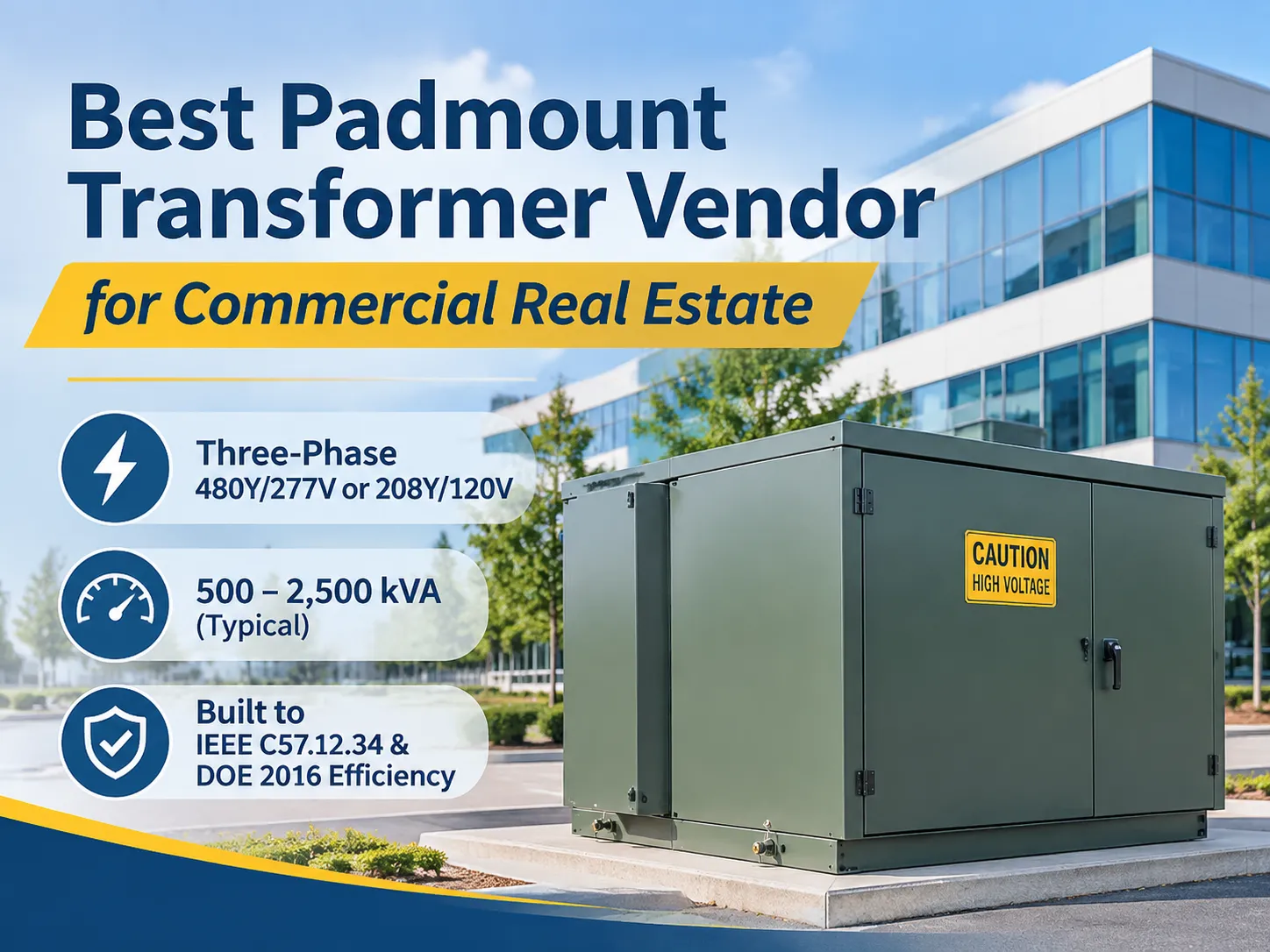
What Commercial Real Estate Actually Needs
All office buildings, retail complexes, hotel and warehousing utilize the same product, however, they use it for different reasons, and the only differences are how they load and the voltage at each secondary. That has nothing to do with the transformer itself.
An office and retail facility will normally require 480Y/277V for lighting, pumps and HVAC with a second system at 208Y/120 V for receptacle loads and small power only. In addition to this, hotels will often load their hotels with large amounts of hot water as well as provide 208Y/120V to guest rooms. The entire warehouse is virtually all motor load, mostly at 480 V and have very high load factors during working hours (24 hrs) and practically zero load during the night.
The loading profiles will define how these transformers will be applied from the manufacturer’s view. The loading profile of an item determines how much fault level will be available at 480 V, which sets the rating of every panel below the transformer, and how many hours the unit runs, which sets the energy cost: a 2,000 kVA unit running 6,000 hours a year will incur several times its purchase price over a 20 year period.
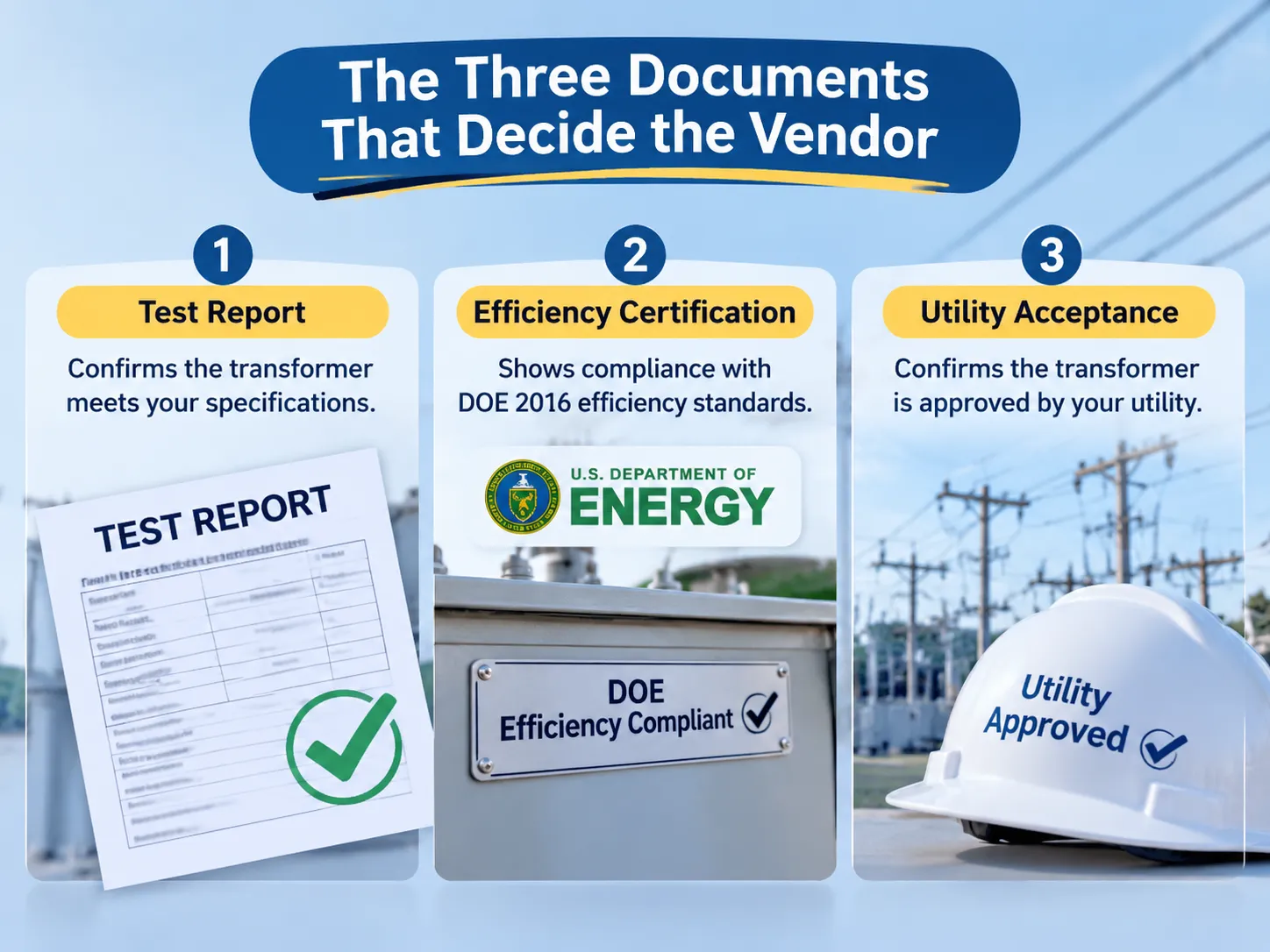
The Three Documents That Decide the Vendor
The vendor’s Test Report is the first. Each transformer is tested by itself. The Test Report contains numerical values that determine whether or not your transformer was built to your order specifications. A vendor sending the type test report is providing documented proof pertaining to a vendor’s design, not proof of performance pertaining to your particular transformer.
The efficiency certification is the second, and it is required by law for distribution transformers intended mainly for commercial applications in the United States: they have to meet the Federal (DOE) minimum efficiency levels established in 2016. That certification tells you that this specific design meets the standard, and it is placed on the rating plate and referenced in the submittal paperwork. Without these proofs of compliance (the efficiency certification), a re-manufactured or imported transformer created without these proofs, puts the owner in non-compliance status, and the owner must be the one to defend this non-compliance status, not the Vendor.
Another variable is the utility acceptance variable, and it is this particular variable that has caught out many developers. In most of the USA, utilities are the ones who either own the transformer or are the ones specifying the transformer that connects to the electrical meter at time of installation into their grid system; therefore, utilities maintain a list of approved transformers. Once an IEEE-compliant unit has been purchased, it is necessary to go through a negotiation phase prior to energising that particular unit if it is not mentioned in the current vendor list.
The Vendor Landscape, and Who Sells to Which Buyer
The Vendor Landscape offers us insight into what type of vendors are selling products to various buyers.
| Vendor group | Примеры | Range | Лучше всего для | Watch out for |
|---|---|---|---|---|
| US manufacturers | ERMCO, Howard Industries, Central Moloney | 5 to 2,500 kVA | Utility and developer projects, US lead times | Longer quote cycles, factory-direct only through reps |
| Global OEMs | Eaton, Siemens, Hitachi Energy, Prolec | Small single-phase to large three-phase | Multi-site portfolios, standardised specifications | Premium price, platform-driven configurations |
| Specialty and large power | VanTran, Niagara Transformer, Maddox | Custom and larger ratings | Non-standard voltages, high impedance requirements | Longer lead time, engineering-heavy |
| Refurbishers | Sunbelt Solomon and regional rebuilders | Whatever is in stock | Emergency replacement, temporary service | No DOE compliance, limited test records |
| Brokers and importers | Supply houses, trading companies | Broad, discontinuous | Fast availability on a standard rating | No factory relationship, unclear provenance |
Vendors in the US such as “ERMCO,” “Howard Industries,” and “Central Moloney” have units ranging from 5 kVA to 2,500 kVA and deal primarily with utility companies and developers working on projects within the US. They generally quote lead times, which are much longer than other manufacturers and will only ship factory-direct through their factory representatives.
Manufacturers who sell to developers or other large corporations include “Eaton,” “Siemens,” “Hitachi Energy,” and “Prolec” and have units ranging from small single-phase to large three-phase. These manufacturers tend to cater to multi-site portfolios, as well as have standardised specifications for the equipment they produce, often at a premium price point.
Specialty and large power vendors such as “VanTran,” “Niagara Transformer,” and “Maddox” offer large capacities as well as custom units and units that meet voltage requirements not typically used in the US. Many of these vendors take longer lead times and can also be more engineering-heavy, so they may take longer to obtain your custom-built electrical transformer or unit.
Refurbishers like “Sunbelt Solomon” and smaller regional rebuilders usually will have units that can be purchased as a temporary replacement or used as an emergency back-up source. They do not test their units to meet Department of Energy compliance standards and generally do not have adequate history regarding their units.
Brokers and importers, including supply houses and trading companies, have large inventories of units representing a variety of manufacturers. Many brokers have units on hand that can be supplied quickly, although they lack communication with the original equipment manufacturer and have no way of establishing where the equipment is from or verifying its quality. The range of equipment specified for distribution transformer and substation is organised by application. The product descriptions are intended to assist the buyer in determining what configurations are catalogue builds and which are one-off builds.
Ratings a CRE Project Actually Specifies
Most commercial work is covered by four ratings, and the numbers should be known before the first meeting.
Three-phase pad-mounted transformers are manufactured to IEEE C57.12.34. Typical primary voltages for these units are 2.4 kV to 34.5 kV and secondary voltages are 208Y/120 V, 480Y/277 V or 600 V. Single-phase pad-mounted transformers are built to IEEE C57.12.38 and typically top out at 250 kVA.
Commercially available sized transformers include 500 kVA, 750 kVA, 1,000 kVA, 1,500 kVA, 2,000 kVA and 2,500 kVA. A 1,000 kVA transformer rated 13.8 kV on the primary side and 480Y/277 V on the secondary side will have a maximum load current of 41.8 A on the primary side and 1,203 А on the secondary side. The secondary current is the figure on which the service switchboard and conductor size will be based.
Typically for these ratings, the percentage impedance rating will be 5.75 percent since that is the standard utility value, and therefore not an option. If a building has a large motor load, a 5.75 percent impedance rating will improve voltage regulation and increase the fault level which will, in turn, increase the interrupting rating for all downstream devices. Масляный распределительный трансформатор на 20 кВ is the format most non-US projects specify at that voltage class, and the plate data are the same for all transformers in that class.
The BIL rating is per voltage class as follows: The 15 kV class has BIL of either 95 kV or 110 kV. The 25 kV class has BIL of 150 kV and the 34.5 kV class has BIL of 200 kV. A project that indicates “34.5 kV class” only, with no mention of BIL, has left a cost variable open to being able to move by as much as 10 percent.
Price: What a Padmount Costs and What Moves It
| Rating, three-phase pad | New, indicative | Refurbished, indicative | Lead time, new |
|---|---|---|---|
| 300 кВА | $9,000 to $14,000 | $4,500 to $8,000 | 14 to 22 weeks |
| 500 кВА | $13,000 to $19,000 | $7,000 to $11,000 | 16 to 26 weeks |
| 750 kVA | $17,000 to $24,000 | $9,000 to $14,000 | 18 to 28 weeks |
| 1,000 кВА | $20,000 to $29,000 | $11,000 to $17,000 | 18 to 30 weeks |
| 1,500 кВА | $27,000 to $38,000 | $15,000 to $22,000 | 20 to 34 weeks |
There are five factors that impact these numbers: The kVA is obvious. The secondary voltage is the next, because a 208Y/120 V winding requires more copper per kVA than a 480Y/277 V winding. The impedance and loss specifications are the third factor. The addition of a low-loss core will increase price by 10 to 15 percent. The enclosure and finish are the fourth factor. A location on the coast will require enclosures with a corrosion class that is more expensive than standard paint. The accessory set is the fifth factor: Bayonet fuses, load-break switches, surge arrestors, fault indicators and stainless steel sills are all accessories that will increase cost on your padmount, but not necessarily appear on every project.
What is not included in the price quotations but is most important regarding a project’s development schedule is a cost associated with a delayed energisation. In general, the transformer lead time affects how much of a rent-free period an occupant receives. In most cases, this rent-free period will typically be greater than the difference between the two extremes of the price quotes received.
Lead Time: New, Refurbished and Rental
The lead times for new three-phase padmount transformers are currently between 16 weeks and 30 weeks. The delivery date is determined by the availability of core steel, winding capability and test bay space rather than the amount of assembly work to be done. Any padmount transformer rated above 1,500 kVA has a longer lead time, especially when the transformer is configured for either a non-standard voltage or for high BIL.
Refurbished transformers typically come with much shorter lead times, and if the required-rated transformer is in stock, it can usually be shipped within a few days to a week. The primary reason for the use of refurbished transformers as emergency replacements is availability, but there is a trade-off: there is no formal documentation such as a DOE compliance statement, a test record or any service history for the unit. If the refurbished transformer will be used temporarily for construction purposes, this lack of documentation may be acceptable; however, it would not be acceptable if the transformer will be used for permanent power in a facility that has been sold.
The third lead time option concerns rental transformers. This option is seldom thought of by developers. A rental transformer that is mounted on a skid can be used as temporary power until construction is completed or until a failed unit can be replaced. The cost of a rental transformer is, of course, a monthly expense rather than a capital outlay. Either option requires a rental supplier with the proper rating and a location capable of accepting a skid instead of a pad.
No matter which path is taken, the schedule must be created in reverse from the interconnection date with the utility, as opposed to being created in forward motion from the order date, since the review of the utility typically takes longer than ordering the transformer from the supplier. There is no way to expeditiously compress the utility’s review by simply increasing payment to the transformer supplier.
Utility Approval, Metering and the Ownership Question
Determining who owns the transformer needs to be done before choosing suppliers. In many state jurisdictions in the US, the utility will own the transformer associated with a single meter. If that is the case, then the developer contributes to the installation of the transformer, but the responsibility for choosing the supplier is that of the utility; therefore, it is the developer’s responsibility to submit electrical load information and building site information.
In cases when the customer owns the transformer, which is not uncommon for many larger sites and for sites located in industrial parks, the customer will buy the transformer based on specifications received from the utility and the utility will conduct an inspection prior to energising the transformer. The written specifications must be obtained during the design phase of the project, as it lists all of the manufacturers that are considered approved to build the transformer, specifies the maximum allowable impedance, BIL ratings and the components that are included in the transformer.
The metering arrangement will also depend upon who owns the transformer. When the transformer belongs to the customer, the utility will typically meter on the primary side of the transformer; as a result, there will be different switchgear and protection devices associated with this arrangement, and these additional costs will be easiest to absorb during design than at any other point in time, which is after the purchase order has been completed.
Clearances are the other regulated item. The National Electric Code (NEC) 450.27 states the minimum distance between outdoor oil-filled transformers and any combustibles, such as walls, windows or doors, must be measured from the transformer casing rather than the pad it is resting on. A pad placed against a combustible wall during value engineering will become a relocation after the plan review.
Where Cheap Vendors Fail
There are four ways cheap vendors fail and generate the most complaints about padmount purchases. All four ways will be visible before you complete your order.
The vendor did not provide a test report. If there is no serial number on the report and the values for each component within the same design are identical, this is not a routine test.
The vendor did not provide a DOE compliance statement. A rebuilt transformer or a transformer that was imported and sold as new, may not meet the 2016 efficiency standards. The owner bears the risk of noncompliance and any compliance audit will be conducted by someone else later.
The enclosure of the transformer does not match the site. For example, if you use a standard painted finish on an enclosure located in a coastal area, you will notice that the sill of the enclosure and the hinge areas on the top will fail first, and you will need to repaint the enclosure in the fourth year, instead of filing a warranty claim. Therefore, if you are using a coastal site, the corrosion class must be identified in your specifications before you receive quotes.
The vendor does not have any service relationship with the buyer. If a transformer fails after three years, there needs to be provisions for obtaining a replacement and loaner unit, as well as making a warranty decision. A broker who has moved on to another product line cannot provide any of the three.
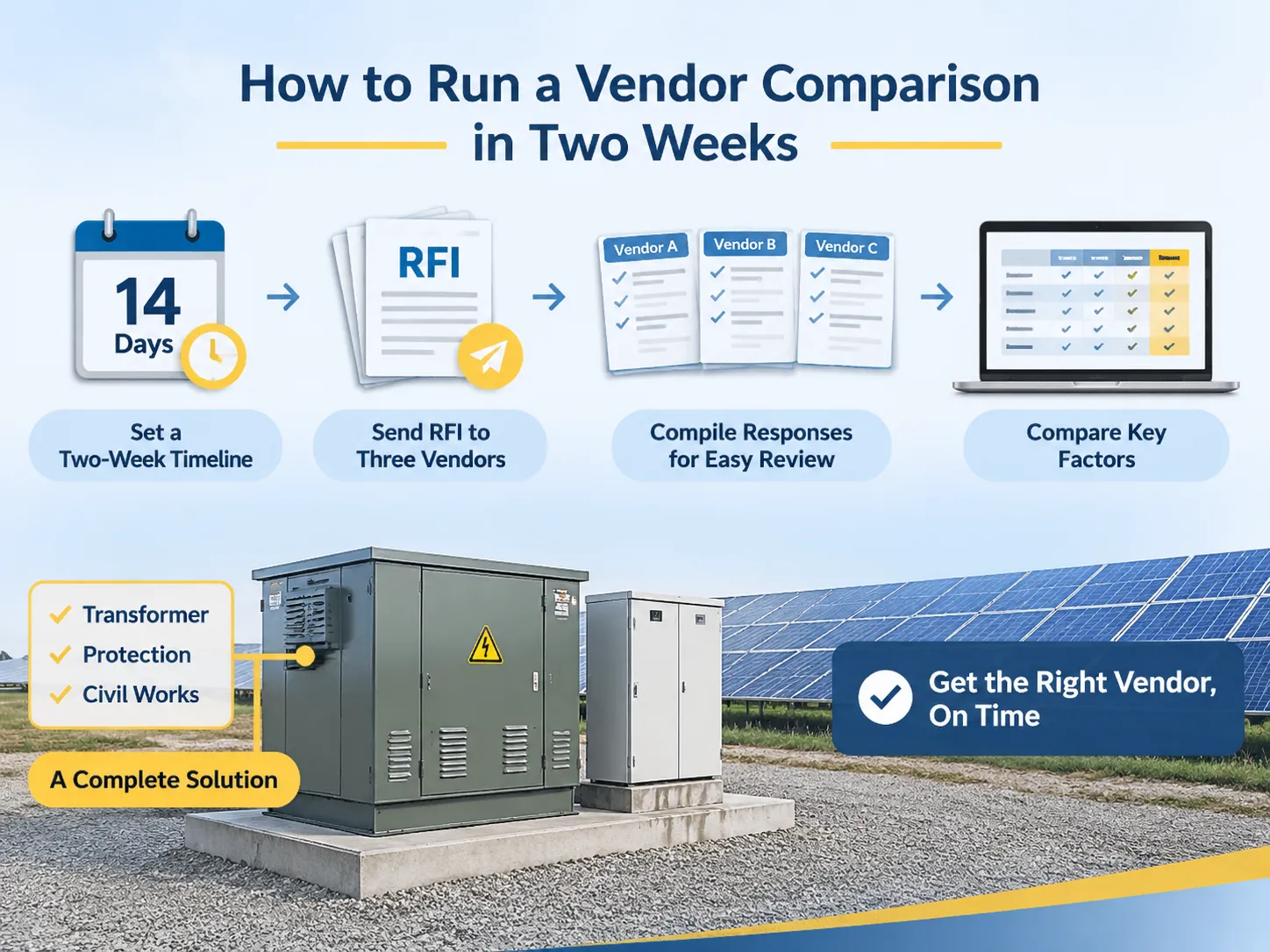
How to Run a Vendor Comparison in Two Weeks
An alternate item will be selected within two weeks of receiving written approval of the specific work to start. During that time frame, a vendor comparison can be created by reviewing the available price quotes, developing a complete list of available products and sending the electronic file with all of the information requested for the chosen item to three separate vendors.
After sending out the request for information (the RFI), compile the three vendor responses into one document for easier review of the information coming back. Once all three vendors’ responses have been compiled, contact the vendors to request clarification or additional information needed for a vendor comparison.
While you will receive the same information from all three vendors, it is important to follow a standard procedure when conducting vendor comparisons. All eight questions listed must be asked of each vendor at the same time in order to allow for comparison. The tests requested by each vendor should be conducted at the same time to provide the most accurate information.
Additional resources may need to be utilized in the vendor comparison process, including trade publications, trade shows, and internet searches, which can provide valuable information on the vendor’s company and their products. Following these guidelines, as well as other suggestions in this section, will enable the first vendor order to be processed quickly, with complete accuracy, and on-time.
A vendor comparison should be limited to the selected vendors listed above. Vendor comparisons can be created quickly, if completed correctly, and this will allow for quicker processing of vendors for comparison purposes. By completing a thorough vendor comparison within the parameters described above, the estimated timeframe for receiving vendor responses is two weeks; therefore, completing this process will allow the vendor comparison process to begin as early as two weeks and end as quickly as possible.
Using the methods described above will provide the first order that will be processed, but this does not preclude processing additional vendors as part of the vendor selection process in the future; however, the first vendor order will be completed accurately and processed in a timely manner based on your company guidelines and industry best practices. In this comparison, it becomes more about the factory and documentation than the price, which is the right order.
Whether the project is just the transformer or the transformer with the substation, the pad mounted transformer installation for the solar power station showed that the transformer, the protection and the civil works were packaged together as one, which is what the developer can take to the EPC.
What We Supply, and What We Do Not
We will describe what we provide and what we do not.
We manufacture oil-immersed distribution transformers in the range of 30 kVA to several MVA rated for 11, 22, 33 and 35 kV. Each unit is built to IEC specifications with routine testing for each unit and all units have documented loss testing records for the product. The 20 kV distribution transformer is the size range most frequently specified for commercial projects outside North America and are configured as per order product including the transformer enclosure, finish, and accessory packages.
What we do not have is a US factory, a UL listing under ANSI product standards, or a place on any approved list for any US utility. For any US commercial project connecting to a utility grid that requires IEEE C57.12.34 equipment, that will be a project of ERMCO, Howard, Central Moloney, or one of the other global OEMs, and we will provide you that information and not provide a quote for a specification that we cannot meet.
Where we are of use to you is for the adjacent markets: projects outside of North America that accept IEC, developer portfolios in countries where the utility specification follows IEC, and for the substation package around a transformer that you purchase locally. The benefit of purchasing a transformer from a factory is that you get the benefit of a full test record and you have one point of interface for your transformer, switchgear, and enclosure.
Installation Constraints That Ruin a Good Purchase
Installation constraints are the biggest factor in ruining your purchase of a transformer. If you put the right transformer in the wrong location or don’t consider site constraints, you will run into problems with your project.
There are five main site constraints that create the bulk of problems:
- Drainage and pad height. When a pad collects water, that water becomes part of the foundation of the transformer. Corrosion starts at the foundation, even with a good finish.
- Clearances from buildings, as defined by NEC 450.27, must be measured from the case.
- Access for cranes and boom lifts for 1,500 kVA units because lifting is required for this size transformers, as rolling is not possible due to weight and physical size.
- Where cables enter, because in a pad design where the cables enter from the bottom, if you do not have a duct bank to install the cables you will need to add modifications in the field.
- Security; pad mounts located in parking lots need bollards and locks that will allow utilities access.
None of these items incur a cost at the design phase, but all of them are costly after the fact. Using a compact format for substations that use a transformer and switchgear located in the same physical structure can give you more flexibility when it comes to space constraints at the installation site. The руководство по компактным подстанциям is there to provide insight as to where compact substations might work best and where they will not.
Часто задаваемые вопросы
Which company produces the best padmount transformer for commercial use?
There is no “one-size-fits-all” answer, as each type of transformer has different application requirements. The strongest manufacturers of three-phase padmount transformers from 500 kVA to 2,500 kVA with proven testing processes are ERMCO and Central Moloney. Howard Industries provides a wider range of Single-Phase Transformers. Eaton, Siemens and Hitachi Energy provide a uniform standardization across platforms and portfolios. The best vendor for a specific project is one in which their unit is on the utility service provider’s approved list and whose routine testing reports you can review before placing an order.
What is the average cost of a Padmount Transformer?
Typical prices for newly manufactured three-phase Padmount Transformers are $13,000 to $19,000 for 500 kVA, $20,000 to $29,000 for 1,000 kVA, and $27,000 to $38,000 for 1,500 kVA. Prices vary based on voltage rating, transformer impedance, losses and associated accessories. Refurbished units are priced typically at 40 to 55 percent of factory-new prices. Energy costs over two decades will typically exceed the initial purchase price by many multiples, which is why the loss specification matters more than the discount in determining the relative value of a padmount transformer.
How long do padmount transformers typically require to produce?
New three-phase padmount transformers take from 16 weeks up to 30 weeks to manufacture and lead times can be longer still for non-standard voltages (greater than 1,500 kVA). Refurbished Transformers may vary in production time depending on stock availability while a Utility’s Interconnection Review may require significantly more time to perform than the actual manufacture of the transformer(s). Thus, the project timeline should be built from the anticipated time of energisation of the transformer(s) rather than the date the unit(s) were ordered.
Are UL Listed Transformers required for commercial buildings?
If the utility is connected to the property and the authority having jurisdiction (AHJ) has jurisdiction over it, then yes, for commercial buildings, UL listed transformers would typically be required by the utility because most utility companies in the US require all their approved equipment to be from a listing agency and an inspector may also require the listing mark. Equipment constructed by the IEC under IEC standards, without a US Listing, could potentially be acceptable on the customer’s installation if accepted by the AHJ. However, any such acceptance should be clearly documented before the purchase order is placed.
Ссылки
- Hitachi Energy — Distribution Transformers and Grid Equipment
- Prolec GE — Distribution Transformers for Utility Networks
- Eaton — Distribution Transformers and Utility Equipment
- US Department of Energy — Distribution Transformer Efficiency Standards
Заключение
For the purchase of a Padmount Transformer for a commercial property, there are three documents and one question that must be answered before a padmount purchase is made. The three documents are 1) a routine test report with the serial number, 2) the DOE efficiency statement and 3) evidence from the utility that it will accept the transformer for use. The one question is “who owns the transformer” as that will dictate whether or not the developer has purchased an item or has made an investment into the utility’s transformer.
Once the three documents and the one question are settled, the Vendor Comparison is based on lead times (using the same basis), finish (to fit the site), and service relationships (at least lasting through year 3). Price is a byproduct of all of these factors, and any project that buys transformers based on price first will likely incur greater expenses due to delayed energisation subsequently causing the transformer to cost more than anticipated.