


In Nigeria hat ein Wasserversorgungsunternehmen $140.000 für den Erwerb von zehn Transformatoren mit einer Nennleistung von 500 kVA bereitgestellt. Das Beschaffungsteam wurde mit Angeboten von 17 Lieferanten überflutet, die Preise von $9.500 bis $31.000 pro Einheit anboten. Der Anbieter mit dem niedrigsten Preis hatte keine Produktionsstätte, hatte eine Postfachadresse als Kontaktadresse und hatte sein ‘Zertifikat’ aus einer PDF-Vorlage gedruckt. Der Bieter mit dem höchsten Preis war ein europäisches Unternehmen mit einem hervorragenden Ruf, aber einer langen Vorlaufzeit von neun Monaten und ohne lokale Betriebe. Das Team hatte fast die Entscheidung getroffen, den Preis zwischen den Lieferanten zu teilen und sich für ein Unternehmen mit einem moderaten Preis zu entscheiden, nur um herauszufinden, dass es seine Meinung änderte, als sie es baten, den Prüfbericht zu senden. Die Auswahl eines Transformatorenherstellers ist ein Risikomanagementprozess, da die Wahl des falschen Lieferanten Kosten verursachen könnte, die weit über den ursprünglichen Preis hinausgehen.
Der vorliegende Leitfaden zeigt die richtige Methodik für die Durchführung eines gründlichen Prüfprozesses von Transformatorenherstellern, der die Überprüfung von Zertifizierungen, die Durchführung von Werksaudits, das Einholen von Prüfberichten, das Benchmarking von Preisen und die Vereinbarung von Zahlungsbedingungen umfasst, sowie die besondere Stellung von Jiangsu Subian Electric Power auf diesem Markt der Lieferanten.
In diesem Artikel werden wir untersuchen, wie man einen Transformatorenhersteller auswählt, indem man fünf kritische Punkte überprüft: (1) Zertifizierungen – ob der elektrische Transformator IEC 60076-zertifiziert ist und der Hersteller ISO 9001 für Qualitätsmanagement erreicht hat; (2) Existenz der Produktionsstätte – ob eine Fabrik existiert; ob Produktionslinien vorhanden sind und Testanhänge nachgewiesen wurden; (3) Dokumentation – ob die Fabrik in der Lage ist, einen Prüfbericht in Dokumentation bereitzustellen; (4) Handelsbedingungen – ob die Garantiezeit zwischen 18 und 24 Monaten liegt und ob Ersatzteile für 10 Jahre verfügbar sind; und (5) Referenzen – ob der Hersteller Projekte in dieser Region abgeschlossen hat.
Warum die Wahl des Herstellers wichtiger ist als das Modell
Zwei Transformatoren mit identischer kVA, Vektorgruppen und Spannungsverhältnissen können radikal unterschiedliche Leistungen aufweisen. Sie könnten Verluste haben, die die in den Datenblättern angegebenen um 10-30% überschreiten, Isolierungen mit Hohlräumen, die innerhalb von drei Jahren reißen, und Schweißnähte, die nach fünf Jahren Betrieb Öl verlieren. Die Fabrik bestimmt den Unterschied: die Qualität des Kernstahls, den Wicklungszeitplan, die Trocknungs- und Vakuumverfahren, die Testüberwachung und das Qualitätsmanagement.
Das bedeutet, dass die Frage bei der Auswahl eines Transformators nicht “welches Modell” ist, sondern “wer es herstellt und kann dieser Hersteller seine Fähigkeiten nachweisen.” Der Entscheidungsprozess ist unabhängig davon derselbe, ob das Produkt in einer chinesischen, indischen oder europäischen Fabrik gekauft wurde: der Verifizierungsprozess bleibt derselbe und die Dokumentation liefert den Nachweis für das Produkt.
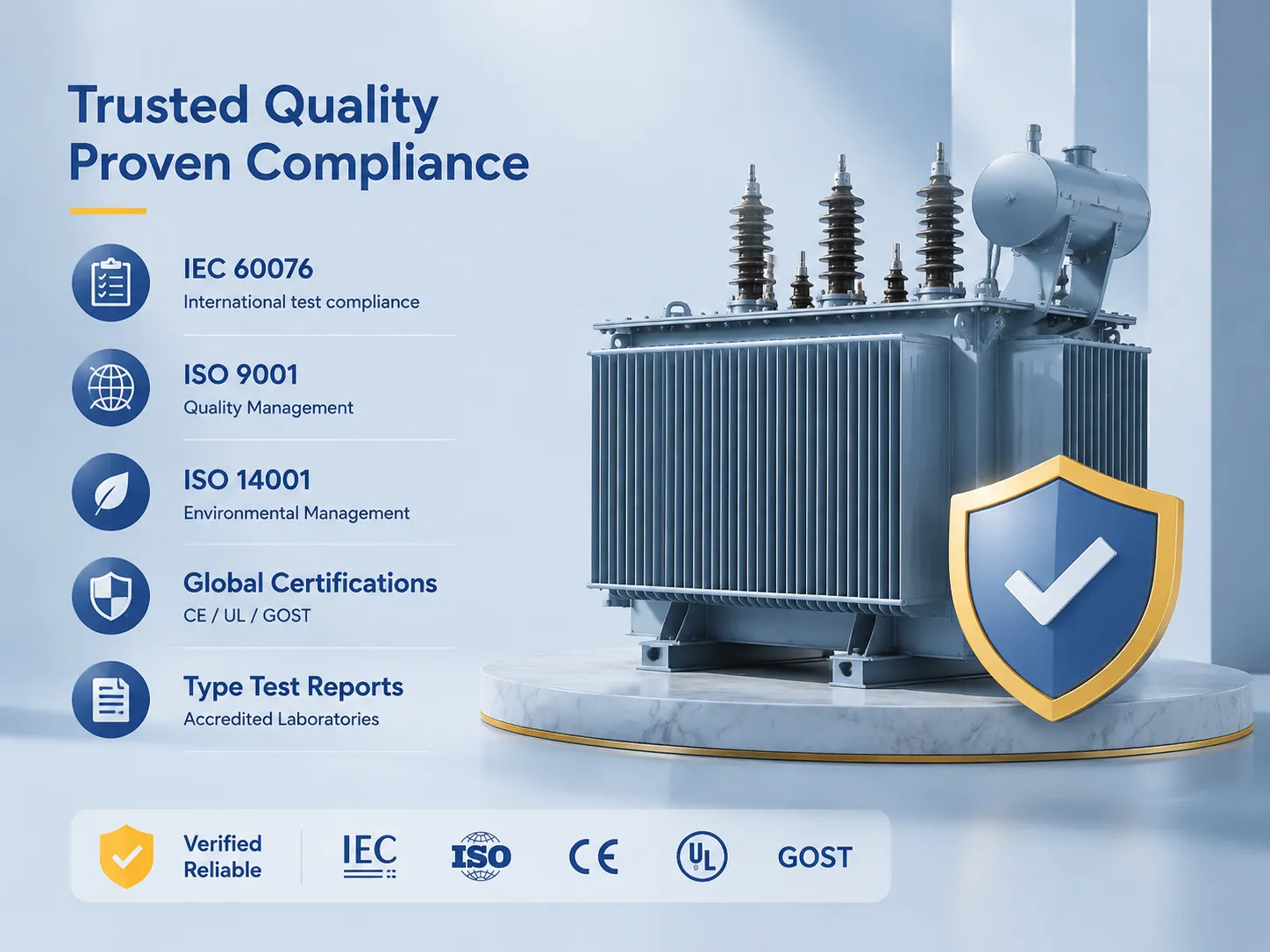
Zertifizierungen und die Einhaltung von Standards überprüfen
Beginnen Sie mit dem Sammeln von Papiernachweisen, ein zuverlässiger Transformatorenhersteller sollte Folgendes haben und bereitstellen:
- IEC 60076-Konformitätstests, internationale Standards, die mit der Bewertung und den Tests elektrischer Transformatoren verbunden sind. Stellen Sie sicher, dass Sie wissen, welche Teile in ihrem Prüfbericht abgedeckt sind (60076-1 allgemein, 60076-2 Temperaturanstieg, 60076-3 Isolierung und 60076-11 Trockenbau)
- ISO 9001-Zertifizierung, das Qualitätsmanagementsystem, das von einer zuverlässigen Mitgliedsorganisation überprüft wurde
- ISO 14001-Zertifizierung im Zusammenhang mit dem Umweltmanagement, ein zunehmend wichtiger Faktor für Exporte in die EU
- Länderspezifische Zertifizierungen, zum Beispiel CE für EU-Länder, UL/cUL für Nordamerika und GOST in einigen GUS-Ländern, also beachten Sie den Standort.
- Typprüfbericht von einem akkreditierten Labor, zum Beispiel KEMA oder CESI, der Blitzimpulsprüfungen, Temperaturanstiegsprüfungen und Kurzschlussprüfungen umfasst
Seien Sie sich zweier Fallen bei Zertifikaten bewusst: Es können gescannte Dokumente von anderen Unternehmen sein und auch “ISO”-Zertifikate von nicht akkreditierten Organisationen. Es dauert nur fünf Minuten, um den Namen der Zertifizierungsorganisation in ihrem Register zu überprüfen, und viele Bieter werden auf diese Weise ausgeschlossen.
Überprüfen Sie die Substanz der Fabrik, nicht die Broschüren
Zertifizierungen zeigen die Absicht; die Fabrik liefert Beweise. Bevor Sie eine Bestellung über einen Betrag von etwa $30.000 bis $50.000 aufgeben, sollten Sie die Herstellungssubstanz besser verstehen.
- Produktionskapazität und -linien Kernschneidemaschinen, Wickelmaschinen, Vakuumtrocknungsöfen (sehr wichtig für ölgetränkte Isolierung) und Montagebereiche. Fragen Sie, wie hoch die Produktionskapazität in kVA/Jahr ist und wie lange die Lieferzeit beträgt.
- Prüfbereich ein echtes, durchgehendes Prüfzentrum mit Geräten für Relation, Widerstand, Verluste und induzierte Spannungsprüfungen. Fragen Sie, ob Käufer die Prüfungen miterleben können.
- Kernmaterialien kaltgewalzter, warmgewalzter Siliziumstahl von einem renommierten Hersteller (z. B. Baosteel, JFE, Thyssen) oder einem unbekannten Hersteller. Die Qualität des warmgewalzten Stahls ist ein Schlüsselfaktor für die Leerlaufverluste.
- Wickelmaterialien entweder Kupfer oder Aluminium; Kupfer ist 20-40% teurer und hat eine bessere Kurzschlussfähigkeit.
- Mitarbeiterdichte und Quadratmeterzahl der Fabrik eine Fabrik mit speziellen Bereichen und Qualitätsprüfpersonal ist eine gerechtfertigte Transformatorenfabrik; wenn es sich um eine Kombination aus Büro und Lager handelt betrachten Sie dies als Warnsignal.
Der einfachste Weg, all diese Fragen zu verstehen, besteht darin, einen Video-Besuch oder noch besser eine direkte Fabrikprüfung entweder selbst oder durch ein drittes Unternehmen (SGS, Bureau Veritas Kosten der Inspektion betragen etwa $500-1500) zu bestellen.
Fordern Sie Prüfberichte und Verlustgarantien an
Der Bericht über die routinemäßigen Tests der Fabrik ist das entscheidende Dokument bezüglich des Kaufs. Laut IEC 60076-1 umfassen die Routinetests die Messung des Wicklungswiderstands, die Überprüfung des Spannungsverhältnisses und der Vektorguppe, Kurzschlusstests (Lastverlust und Impedanz), Prüfungen des Leerlaufverlusts und des Stroms sowie für bestimmte Designs die Messung von induzierten Überspannungen und Teilentladungen. Fordern Sie den tatsächlichen Fabriktestbericht der gelieferten Ausrüstung an, nicht den Referenzbericht, und vergleichen Sie die Ergebnisse mit Ihren Spezifikationen.
| Test | Was es beweist | Typische Akzeptanztoleranz |
|---|---|---|
| Wicklungswiderstand | Korrektes Material, Verbindungsqualität | ±2–5% vs. Design |
| Übersetzungsverhältnis | Korrekte Wicklungen, der Abgriffbereich funktioniert | ±0,5% |
| Leerlaufverlust | Kernqualität, Montage-Disziplin | +10% max gemäß IEC 60076-1 |
| Lastverlust | Wickelmaterial und Design | +10% max gemäß IEC 60076-1 |
| Impedanz (uk%) | Kurzschlussverhalten, Spannungsabfall | ±7.5% des Nennwerts (IEC) |
| Temperaturanstieg (Typentest) | Kapazität unter Dauerlast | Gemäß 60076-2 Grenzen |
Fügen Sie die Verlustgarantien zusammen mit den IEC-Toleranzen in den Vertrag ein: Wenn der Verlust die im Vertrag festgelegte Grenze zusammen mit den definierten Toleranzen überschreitet, muss der Lieferant entweder eine Entschädigung zahlen oder kann vom Kunden abgelehnt werden. Diese exklusive Klausel gewährleistet die Genauigkeit Ihrer Betriebskostenprognosen für 25–30 Jahre, und das unterscheidet echte Hersteller von Händlern.
Handelsbedingungen: Garantie, Ersatzteile, Zahlung
Der geschäftliche Rahmen eines effizienten Herstellervertrags umfasst:
- Garantie: Die reguläre Garantiezeit für Verteiltransformatoren liegt zwischen 18 und 24 Monaten, wobei die Ansprüche durch Reparaturen, Ersatz und Gutschriften geregelt werden.
- Ersatzteile: Die Notwendigkeit, die Hauptkomponenten wie Durchführungen, Dichtungen, Schaltgeräte und Messgeräte für einen Zeitraum von mindestens 10 Jahren bereitzustellen, sollte angegeben werden; andernfalls kostet eine Dichtung $30, was zu einem Ausfall des Transformators im Wert von $15,000 führen kann.
- Zahlungsbedingungen: Bei Lieferanten aus China betragen die Zahlungsbedingungen 30 Prozent Anzahlung und 70 Prozent zum Zeitpunkt des Versands über T/T oder unwiderrufliches L/C, und es ist besser, nicht 100 Prozent im Voraus zu zahlen für nicht verifizierte Lieferanten.
- Incoterms: EXW, FOB, CIF, DAP – spezifizieren Sie die Versand-, Versicherungs- und Zollfragen in jeder Phase.
- Lieferzeiten: 30-90 Tage für Standardliefertransformatoren ab Werk; 15 Tage “auf Lager” Lieferung vom Händler impliziert, dass es überhaupt keine Fabrik gibt.
- After-Sales: Es sollte ein technischer Spezialist vorhanden sein, der innerhalb von 24-48 Stunden auf Anfragen antwortet und Dokumentationen in Englisch bereitstellt.
| Handelsbedingung | Marktstandard | Was ein schwacher Lieferant stattdessen tut |
|---|---|---|
| Garantie | 18–24 Monate, Reparatur/Ersatz/Gutschrift | 12 Monate mit vagem Reklamationsprozess |
| Ersatzteile | 10-Jahres-Verpflichtung, Preisliste | “Wir helfen, wenn möglich” |
| Zahlung | 30% Anzahlung / 70% vor Versand, oder L/C bei Sicht | Fordert 100% im Voraus |
| Incoterms | FOB, CIF oder DAP klar definiert | Vage “wir kümmern uns um alles” Bedingungen |
| Lieferzeit | 30–90 Tage ab Werk | “Lager” Lieferung innerhalb von 15 Tagen |
| Technischer Support | Antwort innerhalb von 24–48 Stunden | Kein Ingenieur, keine englischen Dokumente |
Warnsignale, die ein Angebot töten sollten
Es gibt bestimmte Alarmzeichen, die kritisch sind. Es ist Zeit, sich von einem Anbieter zu verabschieden, der:
- Kein oder nicht bereit ist, ein Werksprüfungsdokument für ein hergestelltes Produkt bereitzustellen.
- Einen “Lager” Preis anbietet, ohne jegliche Variabilität der Vorlaufzeit, Fabrikname und einen Standort in der Postfachadresse anzugeben.
- Über negative Aufzeichnungen spricht, die “garantiert” sind und keine Abweichungen zulassen.
- Besteht darauf, 100% Geld im Voraus zu erhalten, ohne ein Akkreditiv oder Treuhandkonto bereitzustellen.
- Zertifikate bereitstellt, die nicht tatsächlich mit dem Umfang der Zertifizierungsstelle übereinstimmen.
- Sich weigert, eine Drittanbieterinspektion der Waren oder einen Fabrikbesuch durchzuführen, falls die Bestellung $30.000 übersteigt.
- Nicht in der Lage ist, echte Kunden oder Projekte bereitzustellen; angegebene Referenzen stellen sich als Familienunternehmen heraus.
Keiner der oben genannten Prüfungen ist etwas Ungewöhnliches; es ist die gleiche Sorgfalt beim Kauf, die Sie beim Erwerb eines Anlagevermögens anwenden würden. Was diesen Fall unterscheidet, ist die Tatsache, dass Transformatorenbetrug und Qualitätsversagen teuer und langwierig sein können, daher sind diese Prüfungen wirklich wichtig. Als primäre Screening-Option überprüfen Sie die folgenden fünf Dokumente, die von allen Kandidaten erforderlich sind:
| Dokument | Was zu überprüfen ist | Fehlermeldung |
|---|---|---|
| ISO 9001 Zertifikat | Zertifizierungsstelle und Gültigkeitsdatum | Kopie ist ein Scan der Akte eines anderen Unternehmens |
| IEC 60076 Prüfbericht | Werte stimmen mit dem Typenschild innerhalb der Toleranz überein | Nur “typische” Werte, kein tatsächlicher Bericht |
| Gewerbeanmeldung | Fabrikadresse stimmt mit den Produktionsansprüchen überein | Postfachadresse oder handelsrechtlich registrierte Einheit |
| Kundenreferenzliste | Rufen Sie mindestens eine Referenz an | Referenzen sind nicht überprüfbar oder Familienunternehmen |
| Gewährleistungsbedingungen | Klarer Reklamationsprozess und Dauer | Vage Versprechen, keine schriftlichen Bedingungen |
Herstellervergleichstabelle
| Kriterium | Globale Marke (ABB/Siemens) | Großes chinesisches OEM (TBEA usw.) | IEC-zertifizierter Spezialist (Subian) | Handelsunternehmen |
|---|---|---|---|---|
| IEC 60076 Prüfberichte | Ja | Ja | Ja | Oft gefälscht |
| Fabrikbesuch / Audit | Ja | Ja | Ja | Keine Fabrik |
| Kupferwicklungen Standard | Üblicherweise Option | Option | Ja | Unbekannt |
| Garantie | 24 Monate | 18–24 Monate | 18–24 Monate | Variiert, schwer durchzusetzen |
| Servicenetzwerk | Global | Regional | Exportorientiert, wachsend | Keine |
| Preis für 500 kVA | $18.000–$30.000 | $10.000–$18.000 | $8.000–$16.000 | $7.000–$12.000 (riskant) |
| Risikostufe | Niedrig | Niedrig–mittel | Niedrig | Hoch |
Die Tabelle fasst die Schlussfolgerung zusammen: Globale Marken reduzieren ihre technischen Risiken, verlangen jedoch Premiumpreise und längere Lieferzeiten; etablierte chinesische OEMs — zuverlässig zu guten Preisen; spezialisierte Exporteure wie Subian — bieten getestete Daten und niedrige Preise; Handelsunternehmen sind die günstigsten und riskantesten.
Preisbenchmarks nach Lieferantenkategorie
| Nennleistung | Globale Marke | Chinesischer OEM / Spezialist | Typische Vorlaufzeit |
|---|---|---|---|
| 100 kVA | $5.000–$10.000 | $2.500–$6.000 | 30–60 Tage |
| 250 kVA | $12.000–$20.000 | $4.500–$11.000 | 30–60 Tage |
| 500 kVA | $18.000–$30.000 | $8.000–$16.000 | 40–70 Tage |
| 000 kVA | $25.000–$42.000 | $12.000–$22.000 | 50–90 Tage |
| 500 kVA | $55.000–$90.000 | $38.000–$75.000 | 70–120 Tage |
Die Preise sind beratender Natur für Originalstücke und kommen direkt aus China. In Bezug auf Seefracht- und Logistikkosten werden die Lieferpreise berechnet, indem 5–15% zu den Standardkosten je nach Volumen und spezifischem Lieferland hinzugefügt werden. In der Praxis ermöglicht dies einen ehrlichen Vergleich basierend auf gleichen Spezifikationen und Zertifikaten.
Jiangsu Subian Electric Power auf einen Blick
Im gegebenen Rahmen hebt sich Jiangsu Subian Electric Power als wichtiger chinesischer Hersteller hervor, der in die Liste der Lieferanten für Verteilungs- und Leistungstransformatoren aufgenommen werden sollte. Das Unternehmen bietet Produkte im Kapazitätsbereich von 10 kVA bis 100 MVA gemäß IEC 60076-Zertifizierung an, einschließlich ölgetauchter Transformatoren, trockener Transformatoren, amorpher Kerntransformatoren und boxenförmiger Umspannwerke, bei denen Kupferwicklungen im normalen Produktpaket anstelle der kostenpflichtigen Alternative verwendet werden. Laut Hersteller sollte der Käufer nur an die Papierarbeit denken, da jede Lieferung von einem routinemäßigen Fabriktestbericht sowie von Dokumentationen begleitet wird, die die verwendeten Materialien und die tatsächlichen Verlustwerte für die jeweilige Einheit in Bezug auf eine spezifische Produktspezifikation, die vom Käufer ausgehandelt wurde, bestätigen.
Basierend auf den Preisen bietet Subian seine Transformatoren der Verteilungsklasse zu einem Preis an, der etwa 40-60% niedriger ist als der nächstgelegene Vertreter des globalen Marktes derselben Produktklasse, gemäß dem Prinzip, das für Hersteller gilt, die unter IEC-Zertifizierung ohne Beteiligung westlicher Servicezentren arbeiten. Standardverteilungstransformatoren werden in 30 bis 70 Tagen geliefert, während das Unternehmen zuvor ähnliche Produkte nach Südostasien, in den Nahen Osten, nach Afrika und Lateinamerika geliefert hat. Es ist jedoch auch wichtig zu beachten, dass Subian möglicherweise nicht der beste Hersteller für jeden Kunden ist, da elektrische Netze für einige Kunden wichtig sein können oder große Projekte möglicherweise nicht an lokalen Serviceorten umgesetzt werden können, sodass der Leitfaden empfiehlt, alle drei Kategorien von Herstellern in Bezug auf die Papierarbeit zu analysieren. Wenn es jedoch um Großprojekte, ländliche Elektrifizierung, Industriegebiete und Solarenergieanlagen geht, ist es wünschenswert, die Dienste eines IEC-zertifizierten Lieferanten in Anspruch zu nehmen, der die Transparenz der Anforderungen an Testberichte gewährleistet.
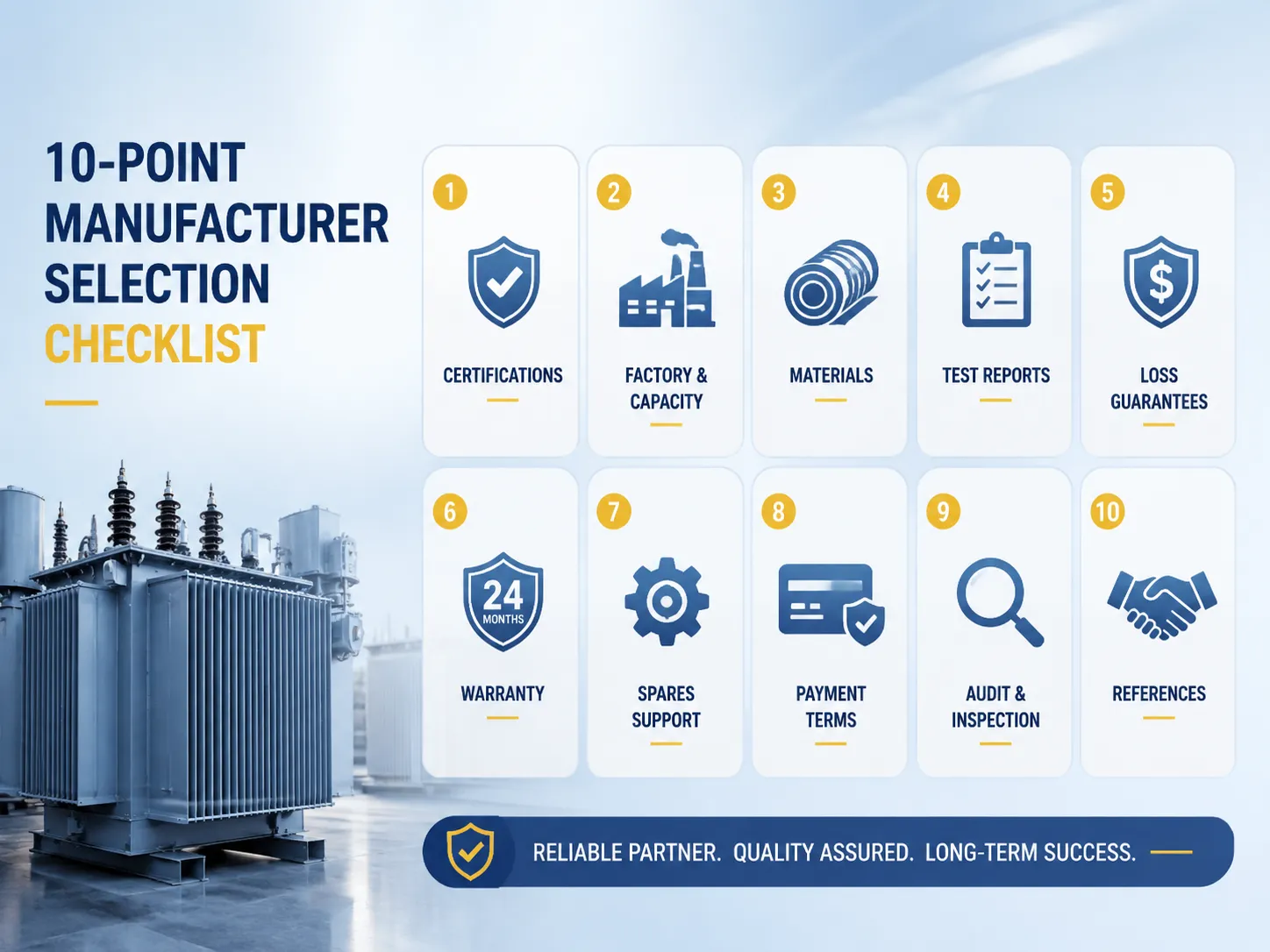
Eine 10-Punkte-Checkliste zur Herstellerauswahl
- Zertifizierungen: genannte Standards wie IEC 60076 Teile, ISO 9001, ISO 14001 usw.
- Fabrik: die Informationen zu den Produktionsprozessen wie Vakuumtrocknung, Testbereiche, Produktionskapazitätsdaten usw.
- Materialien: CRGO-Stahlquelle, Kupfer- oder Aluminiumwicklungen, Name und Grad des Kernstahls
- Berichte: ein gewöhnlicher Prüfbericht, der an einem Gerät oder einer Ausrüstung durchgeführt wird, um die Einhaltung der erforderlichen Standards und IEC-Toleranzen zu überprüfen.
- Verluste: die Garantie des Unternehmens für Verluste in elektrischen Transformatoren, ausgedrückt als vertragliche Werte mit der Möglichkeit von +10% IEC-Toleranz.
- Garantie: die Garantiezeit von 18 Monaten bis 24 Monaten und eine klare Beschreibung des Entschädigungsverfahrens für Schadensansprüche.
- Ersatzteile: 10 Jahre Berücksichtigung mit der Preisliste für Ersatzteile für Transformatoren.
- Zahlung: 30/70 T/T oder L/C bei Sicht.
- Audit: ein Unternehmen, das elektrische Transformatoren kaufen möchte, kann diese durch Inspektionen erhalten, die entweder von Unternehmen wie SGS oder BV durchgeführt werden oder während der Fabrikbesuche, wenn ihre Bestellung größer als $30.000/$50.000 ist.
- Referenzen: andere Projekte, die von dem Unternehmen entwickelt wurden.
Häufig gestellte Fragen
Welche Zertifizierungen sollte ein Transformatorenhersteller haben?
Die Anforderungen umfassen das Qualitätsmanagementsystem ISO 9001 und die Einhaltung von IEC 60076, die durch regelmäßige Prüfberichte nachgewiesen wird. Darüber hinaus sollte für den Export von Transformatoren eine ISA 14001-zertifizierte Zertifizierung sowie die entsprechenden regulatorischen Kennzeichnungen wie CE (Europäische Union) oder UL (in Nordamerika) eingeholt werden. Zudem wird dringend empfohlen, die Gültigkeit der Zertifikate im Register der relevanten Zertifizierungsorganisation zu überprüfen, da gefälschte oder unzuverlässige Zertifikate im Transformatorenhandel häufig verwendet werden.
Ist es sicher, Transformatoren von chinesischen Herstellern zu kaufen?
Absolut. Alle chinesischen Hersteller verwenden den gleichen Grad an Sorgfalt wie andere, einschließlich Jiangsu Subian Electric Power. Die renommierten chinesischen Hersteller betreiben Fabriken, die nach ISO zertifiziert sind, und führen die Prüfverfahren gemäß IEC 60076 durch. Die Gefahr geht von Handelsunternehmen aus, die gefälschte Zertifikate exportieren. Überprüfen Sie immer die Fabrik, fordern Sie die Testergebnisse an und ziehen Sie die Unterstützung unabhängiger Inspektionsprüfungen für große Lieferungen in Betracht.
Wie viel günstiger ist ein chinesischer Transformator als eine europäische Marke?
Für eine 500 kVA Verteilungseinheit verlangt ein chinesischer Hersteller mit IEC-Zertifikat normalerweise etwa $8.000-$16.000, oder 40-60% weniger als ABB, Siemens oder Schneider für ähnliche Geräte, deren Preise von $18.000 bis $30.000 reichen. Globale Hersteller gleichen diesen Unterschied durch ein umfangreiches Servicenetzwerk und jahrelange Erfahrung mit Felddaten aus. Nach Berücksichtigung der Transportkosten (5-15%) ist der Gesamtkostendifferenz nicht zu groß, aber dennoch erheblich.
Wie verifiziere ich, dass ein Prüfbericht der Fabrik echt ist?
Es gibt drei Protokolle: (1) Fordern Sie einen Bericht über eine bestimmte Einheit an, nicht über ein Muster; (2) Überprüfen Sie, ob die Zahlen den in IEC 60076-1 angegebenen Spezifikationen entsprechen (Verluste innerhalb von +10% vom Nennwert, Impedanz innerhalb von ±7,5%); (3) Bei wichtigen Aufträgen wird empfohlen, dass ein Prüfer im Werk anwesend ist, um alle Routineprüfungen zu sehen, die durchgeführt werden. Wenn der Lieferant nicht mit gesponserten Tests einverstanden ist, bedeutet dies normalerweise, dass etwas Unrechtmäßiges vor sich geht.
Welche Zahlungsbedingungen sollte ich mit einem Transformatorenhersteller verhandeln?
Typische Zahlungspraktiken chinesischer Lieferanten sind 30% Zahlung bei Auftragserteilung und 70% vor dem Versand (T/T) oder ein unwiderrufliches Akkreditiv, das erfordert, dass die Zahlung nicht im Voraus vollständig geleistet wird. Bei Aufträgen über 50.000 USD wird jedoch empfohlen, eine Zahlungsstruktur mit bestimmten Meilensteinzahlungen basierend auf erfolgreichen Tests und der Abnahme der Waren festzulegen.
Referenzen
- IEC 60076-1: Leistungstransformatoren — Allgemeines — der Standard, der Bewertungen, Toleranzen und Routineprüfungen regelt.
- ISO 9001: Qualitätsmanagementsysteme — die Qualitätsmanagement-Baseline für Hersteller.
- IEC 60529: Schutzarten von Gehäusen (IP-Code) — Definitionen zum Schutz von Gehäusen, die in Spezifikationen verwendet werden.
- IEEE C57.12.00: Allgemeine Anforderungen für flüssigkeitsgetauchte Transformatoren — Nordamerikanischer Prüf- und Bewertungsrahmen.
- SGS — Technische Bewertungs- und Inspektionsdienste — Drittanbieter-Fabrikprüfungen und Vorversandinspektionen für importierte elektrische Ausrüstungen.
- Bureau Veritas — Inspektion und Zertifizierung — Unabhängige Verifizierungsdienste für Transformatorenfabriken und -sendungen.
- Wikipedia — Transformator — Hintergrund zur Konstruktion, Prüfung und Normen von Transformatoren.
Fazit
Bei der Auswahl eines Transformatorenherstellers muss man Risikoprävention praktizieren, was die ordnungsgemäße Dokumentation zur Unterstützung bedeutet: Überprüfen Sie deren Qualifikationen und Zertifizierungen, führen Sie eine Fabrikinspektion durch, fordern Sie Prüfergebnisse an, einigen Sie sich auf kommerzielle Bedingungen und verifizieren Sie die Qualifikationen des Herstellers. Die Preisspanne von Verteilungstransformatoren ist enorm — $8.000–$16.000 für IEC-akkreditierte chinesische Hersteller im Vergleich zu $18.000–$30.000 für internationale Unternehmen — und die richtige Wahl hängt von der Bedeutung des Projekts und der Serviceanforderung ab.
- Stimmen Sie niemals zu, ohne einen IEC 60076-Fabrikprüfbericht der produzierten Einheit zu erhalten.
- Prüfen Sie die Fabrik oder beauftragen Sie einen unabhängigen Inspektor für Bestellungen über $30.000.
- Verhandeln Sie über die Garantie (für 18-24 Monate), die Lieferung von Ersatzteilen für zehn Jahre und den Zahlungsplan.
- Stellen Sie sicher, dass Sie die Kosten der gelieferten Ausrüstung vergleichen, nicht den Preis.