


Als Elektroingenieur, der beauftragt wurde, eine Industrieanlage mit einer Kapazität von 15 MW aufzurüsten, und Ihnen gesagt wurde, den Beginn der Installation von Maschinen zu stoppen, bis die Änderung der Versorgungsspannung von 33 kV auf 400 V erfolgt, verursacht eine Reihe von Unannehmlichkeiten. Mit den Transformatorspezifikationen in der Hand und im Besitz von Angeboten, die von Lieferanten für den Bereich zwischen $42.000 und $86.000 bereitgestellt wurden, haben Sie keine Zeit zu verlieren, da Ihr Chef Ergebnisse bis Freitag verlangt. Im Bereich der Energietechnik bedeutet die Bestimmung des richtigen Transformatortyps nicht, nach der günstigsten Lösung zu suchen. Es bedeutet, alle Parameter abzugleichen, einschließlich Nennwerte, Verluste, Kühlmethoden, Standards und Lastprofile.
Kurz gesagt, bei der Entscheidung für den Leistungstransformator für die Ingenieurarbeiten besteht der erste Schritt darin, die EntwurfskVA zu finden, die von der Gesamtlasteinheit in Bezug auf die Diversitäts- und Wachstumsfaktoren abhängt. Der nächste Schritt erfordert die Auswahl der Kühlklasse (ONAN oder ONAF für ölgefüllte Einheiten und AN oder AF für trockene Transformatoren) und die Identifizierung von Produkten, die der IEC 60076-Norm entsprechen.
Die Auswahlmethode in sechs Schritten
Jeder Transformatorenkauf, vom 250 kVA Verteilermodell bis zum 60 MVA Umspanntransformator, sollte diesen Verfahren folgen. Wenn Sie diese Schritte befolgen, werden Sie weder mit einer überdimensionierten und überteuerten Einheit noch mit einer unterdimensionierten Einheit enden, die im Sommer ausfällt:
- Bestimmen Sie das Lastprofil. Analysieren Sie jede Last mit ihrem Leistungsfaktor und Betriebszeitplan. Berechnen Sie die Spitzenlast in kW und wandeln Sie sie mit Hilfe des Leistungsfaktors in kVA um.
- Prognostizieren Sie das Wachstum und die Notfallreserve. Multiplizieren Sie die Spitzenlast mit 1,1-1,25, um einen gewissen Spielraum für zukünftiges Lastwachstum zu gewährleisten, und wandeln Sie sie in die standardmäßige kVA-Bewertung um, die auf dem Markt verkauft wird.
- Finden Sie die Spannungsgrenze. Stellen Sie sicher, dass Sie die Spannungen, die Vektorguppe und ob eine Spannungsregelung erforderlich ist, überprüfen.
- Wählen Sie die Art der Konstruktion. Wählen Sie zwischen ölgetaucht und trockenem Design unter Berücksichtigung der Brandsicherheit, des Standorts und des Lastfaktors.
- Untersuchen Sie die Verluste. Vergleichen Sie die Angebote für Verdrahtungsverluste mit den Angeboten für Leerlaufverluste, indem Sie die kapitalisierten Verlustformeln bewerten.
- Überprüfen Sie die Standards und Tests. Überprüfen Sie die Konformität dieses Transformators mit den IEC 60076- oder IEEE C57.12-Standards, bevor Sie ihn bestellen.
Was “richtiger Transformator” in der Energietechnik bedeutet
Der Transformator kann als effektiv angesehen werden, wenn er vier Kriterien gleichzeitig erfüllt: Er liefert die erforderliche Energiemenge, arbeitet ohne Überschreitung der maximalen Temperaturgrenzen, bietet die notwendige Spannungsregelung für das Stromnetz und seine Kunden, hat die geringsten Energieverluste und erfüllt die regionalen Anforderungen und Standards für Transformatoren.
In der Energietechnik ist der Transformator häufig die teuerste Maschine in jeder Anlage, und sein fehlerhaftes Funktionieren führt zu erheblichen Verlusten für den Eigentümer. In Bezug auf die Zuverlässigkeit deuten Daten aus verschiedenen Quellen wie CIGRÉ und IEEE-Arbeitsgruppen darauf hin, dass ein normaler Ausfall von Verteilungstransformatoren etwa 0,5 – 2 Prozent pro Jahr beträgt, wobei die häufigsten Probleme mit Isolations- und Kupplungssystemen zusammenhängen.
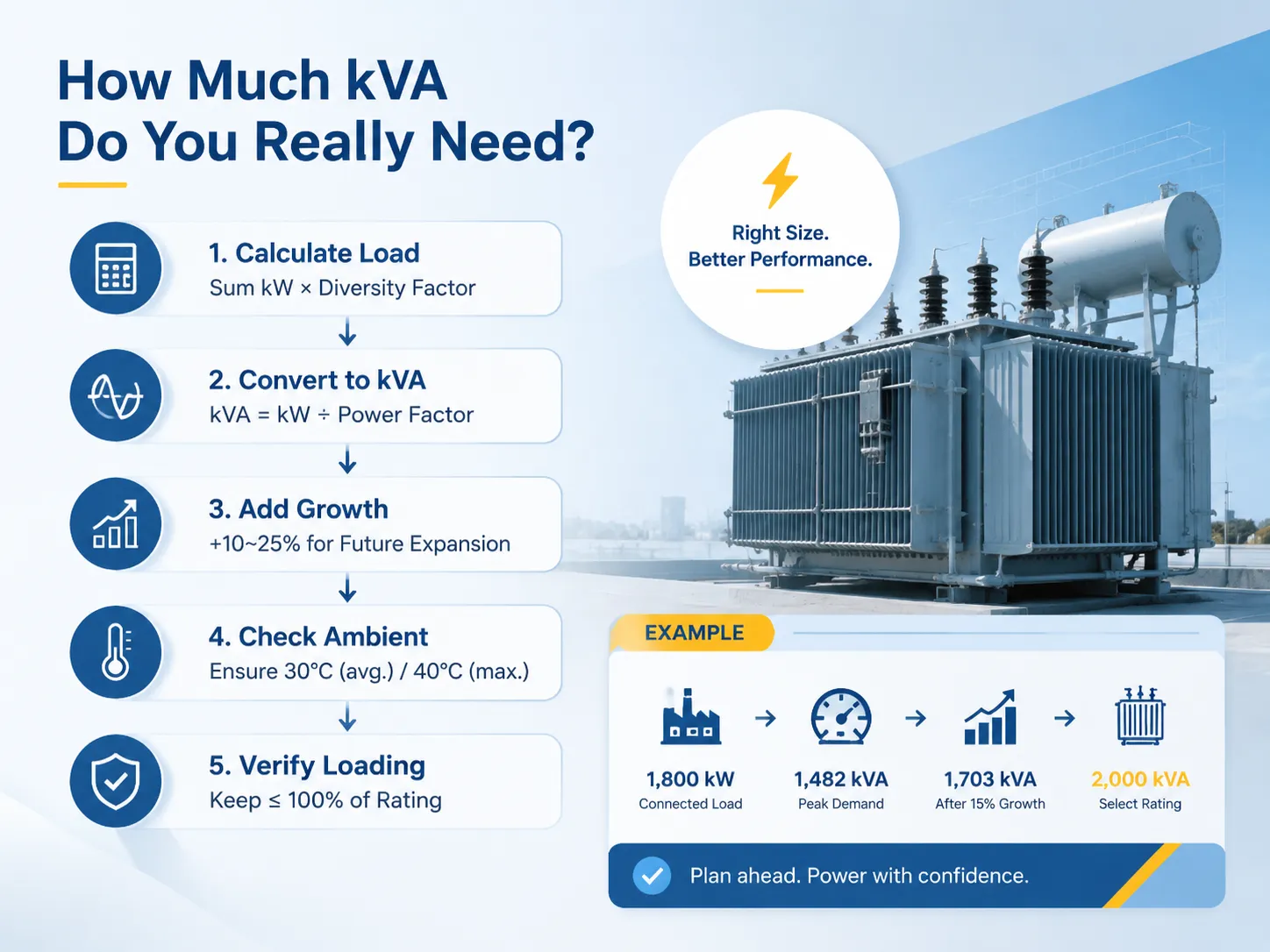
Lastberechnung: Wie viel kVA benötigen Sie wirklich?
Der am häufigsten auftretende Auswahlfehler besteht darin, die Last falsch zu schätzen. Verwenden Sie stattdessen die folgende Methode:
- Addieren Sie die Nennleistung in kW der Last(en) auf dem nachgelagerten Zuleitung, und wenden Sie dann den Diversitätsfaktor an. Industriestandorte arbeiten normalerweise mit 60 bis 85 Prozent der Summe der Nennwerte, da Motoren und Geräte normalerweise nicht gleichzeitig mit maximaler Last betrieben werden.
- Um kVA zu finden, konvertieren Sie einfach kW in kVA: kVA = kW ÷ Leistungsfaktor. Der typische Leistungsfaktor liegt zwischen 0,8 und 0,9; wenn der Leistungsfaktor unter 0,7 liegt, deutet dies darauf hin, dass der Transformator mit Blindleistung arbeitet, während er mit Wirkleistung arbeiten sollte.
- Um die Expansion zu berücksichtigen, verwenden Sie einen Wachstumsfaktor von 10-25 Prozent und runden Sie die Zahl auf die nächstgelegene Nennleistung auf (d.h. 630, 800, 1.000, 1.250 und 1.600 kVA).
- Um die Temperatur zu berücksichtigen, messen Sie die Umgebungstemperatur. Laut den IEC 60076-2-Normen wird die durchschnittliche Jahrestemperatur auf etwa 30℃ geschätzt, während die maximale Temperatur 40℃ nicht überschreiten sollte. In tropischen Regionen sollte eine Herabstufung oder eine höhere Nennleistung verwendet werden, da ein Temperaturanstieg um 10 Grad zu einem signifikanten Rückgang der Lebensdauer der Isolierung führt.
- Untersuchen Sie den Lastfaktor gemäß dem Betriebszyklus. Wenn der Transformator kontinuierlich mit 80 Prozent seiner Kapazität arbeitet, sind die Gesamverluste und die Temperaturen an den Hotspots in Ordnung. Gleichzeitig ist es notwendig, die Überlastkurven gemäß IEC 60076-7 zu überprüfen, wenn der Transformator bis zu 100 Prozent belastet wird.
Zum Beispiel hat eine Fabrik eine angeschlossene Motorlast von 1.800 kW. Ihr Diversitätsfaktor beträgt 0,7 und ihr Leistungsfaktor 0,85. Die Spitzenlast kann wie folgt berechnet werden: 1.260 kW / 0,85 = 1.482 kVA. Unter Berücksichtigung des Wachstumsfaktors von 15 Prozent beträgt die Nachfrage 1.703 kVA. Daher führt das Runden zu einer Transformator-Nennleistung von 2.000 kVA.
Verständnis von Verlusten und Effizienzbewertungen
Die Verluste in Transformatoren bestehen aus zwei Komponenten, die in IEC 60076-1 angegeben und im Werk getestet werden.
| Verlusttyp | Definition | Betriebsstunden | Typische Werte | Kapitalisierter Wert |
|---|---|---|---|---|
| Leerlauf (Eisen)verlust | Kernverlust durch Magnetisierung; ständig vorhanden | Immer, auch bei Nulllast | 1,5–4 kW pro MVA (z.B. 10 MVA: 15–40 kW) | $2.000–$6.000 pro kW |
| Last (Kupfer)verlust | Wicklungsverlust durch Laststrom | Proportional zum Quadrat der Last | 6–13 kW pro MVA bei voller Last | $400–$1.200 pro kW |
| Gesamtverlust & Effizienz | Effizienz = Ausgabe/Eingabe | — | 98,5–99,8% für Verteilungs-/Leistungseinheiten | — |
Effizienzwerte sehen beeindruckend aus, bis man die Mathematik anstellt. Ein 1.000 kVA Transformator mit 98,8 Prozent Effizienz verliert kontinuierlich 12 kW. Bei $0,12/kWh und einer durchschnittlichen Belastung von 80 Prozent sind das ungefähr 12 × 0,8² × 8.760 Stunden × $0,12 ≈ $10.700 pro Jahr an Verlusten. Über 25 Jahre können die Energieverluste 60–90 Prozent des Kaufpreises des Transformators erreichen, weshalb die Verlustbewertung von Transformatoren gängige Praxis für Versorgungsunternehmen ist. Amorphe Legierungskerne senken die Leerlaufverluste um 60–70 Prozent im Vergleich zu herkömmlichem, kornorientiertem Siliziumstahl, bei einem Aufpreis von ungefähr 10–25 Prozent.
Öl-Getaucht vs. Trocken-Typ: Eine Entscheidungstabelle
Die größte Bauentscheidung liegt zwischen flüssigkeitsgetauchten und Trocken-Typen. Die folgende Tabelle fasst die Abwägungen für typische Projekte im Bereich der Energieversorgung zusammen:
| Kriterien | Öl-Getaucht (Mineralöl) | Trocken-Typ (Gießharz / VPI) |
|---|---|---|
| Typischer Nennbereich | 25 kVA – 300+ MVA | 50 kVA – 20 MVA |
| Effizienz / Verluste | Am besten für große Einheiten | Gut; leicht höhere Verluste bei großen Größen |
| Brandrisiko | Entzündbares Öl; erfordert Auffangvorrichtung | Selbstlöschend (F1-Klasse), geringe Brandlast |
| Innen / außen | Außen typisch; innen benötigt Tresor | Innen bevorzugt; außen benötigt IP-zertifiziertes Gehäuse |
| Wartung | Öltests, Entlüfter, DGA | Minimal; saubere Wicklungen |
| Typischer Preis (1.000 kVA) | $6.000–$14.000 | $10.000–$24.000 |
| Beste Anwendung | Umspannwerke, Versorgungsunternehmen, große Industrie | Gebäude, Rechenzentren, Tunnel, Offshore |
Typischerweise beeinflussen Brandschutzstandards und Versicherungsanforderungen diese Wahl. Beispielsweise verlangen Brandschutzvorschriften und lokale Vorschriften in der Regel trockene Transformatoren oder flammhemmende Flüssigkeits-(Ester)-Transformatoren in Gebäuden, Krankenhäusern, Tunneln und Industrieanlagen. Im Gegensatz dazu verwenden Außenumspannwerke und Versorgungsanlagen typischerweise Mineralöl aufgrund der niedrigeren Kosten und höheren Effizienz. Wenn Nachhaltigkeit eine Priorität ist, können natürliche Ester (Pflanzenöl) Transformatoren eine geeignete Lösung mit einem hohen Flammpunkt sein, während ihre Kosten etwa 5–15 Prozent höher sind als die Kosten herkömmlicher Mineralöltransformatoren.
Transformator-Klassifizierungen nach Anwendung
Käufer im Bereich der Energietechnik begegnen mehreren Transformatorenfamilien. Zu wissen, welche für Ihr Projekt benötigt wird, verhindert Verwirrung bei der Spezifikation:
| Klassifizierung | Typische Nennleistung | Hauptnutzung | Anmerkungen |
|---|---|---|---|
| Verteilungstransformator | 25–2.500 kVA | Letzter Spannungsabstieg zu LV-Verbrauchern | Niedrigste Verluste pro kVA möglich; einfache Zubehörteile |
| Leistungstransformator | 2,5–300 MVA | Umspannwerke, Übertragung, Erzeugung | OLTC, komplexe Kühlung, typgeprüft |
| Einheit / Generator-Hochspannung | 100–1.200 MVA | Kraftwerksvernetzung | Höchste Zuverlässigkeitsanforderungen |
| Ofen / Gleichrichtertransformator | Maßgeschneidert | Lichtbogenöfen, Elektrolyse, HVDC | Hoher Strom, spezielle Wicklungen |
| Erdungstransformator | 100–2.000 kVA | Neutralerdung, Zickzack | Kurzzeitbetrieb |
| Trockenbau / Gießharz | 100–10.000 kVA | Gewerblich, industriell, maritim | Brandsicher, wartungsarm |
Wichtige Spezifikationen, die Käufer überprüfen müssen
Geben Sie die nächsten Parameter in Ihr Anfrage-Dokument ein und bitten Sie alle Lieferanten, diese zu quotieren. Fehlende Parameter sind der häufigste Grund, warum Lieferantenangebote nicht vergleichbar sind.
| Parameter | Anforderung | Warum es wichtig ist |
|---|---|---|
| Nennleistung | Berechnete kVA auf Standardgröße gerundet | Definiert Größe, Preis und Verluste |
| Spannungen & Vektorgroup | z.B. 33/11 kV, Dyn11, 50 Hz | Netzschnittstelle und Parallelbetrieb |
| Impedanzspannung | 4–12.5% | Fehlerpegel, Spannungsabfall, paralleler Betrieb |
| Kühlklasse | ONAN, ONAF, OFAF / AN, AF | Dauer- vs. zyklische Kapazität |
| Leerlauf- / Lastverluste | Maximalwerte angegeben | Energiekosten und Effizienzklasse |
| Isolationsniveau | BIL z.B. 170 kV für 33 kV Klasse | Blitz- und Schaltfestigkeit |
| Abgriffschalter | DETC ±2×2.5% oder OLTC ±8×1.25% | Anforderungen an die Spannungsregelung |
| Geräuschpegel | 55–85 dB(A) | Umweltgenehmigungen |
| Normen | IEC 60076 Reihe oder IEEE C57.12 | Annahme- und Gewährleistungsgrundlage |
Einhaltung von Standards: IEC, IEEE und lokale Netzvorschriften
Wählen Sie Ihre übliche Familie, bevor Sie mit der Suche nach Angeboten beginnen. IEC 60076 dominiert außerhalb Nordamerikas, während IEEE C57.12.00 und IEEE C57.12.90 in den USA und Kanada maßgeblich sind. Unter den IEC-Dokumenten sind IEC 60076-1 (allgemein), IEC 60076-2 (Temperaturanstieg), IEC 60076-3 (Isolationsstufen), IEC 60076-5 (Kurzschlussfestigkeit) und IEC 60076-11 (trocken) von Bedeutung.
Lokale Netzbetreiber legen auch ihre eigenen Standards fest, d.h. nationale Anschlussrichtlinien für die dezentrale Erzeugung, die die richtigen Spannungsbereiche und harmonischen Inhalte bestimmen, die die Wahl des Lastabgrenzers und der Impedanz beeinflussen. Fordern Sie das Dokument an, das die erforderlichen technischen Bedingungen von Ihrem Netzbetreiber beschreibt, bevor Sie über die Spezifikationen und die Typprüfberichte entscheiden, die die Einhaltung nachweisen. Ein Transformator, der die Netzanschlussprüfung nicht bestanden hat, ist zu einem sehr kostspieligen Papiergewicht geworden.
Markenoptionen und realistische Preisbenchmarks
Der Markt umfasst sowohl internationale Akteure als auch kosteneffiziente lokale Anbieter. Die unten genannten Zahlen zeigen indikative FOB-Bereiche für einen 1.000 kVA Verteilungstransformator und einen 10 MVA 33/11 kV Leistungstransformator; die Zahlen hängen von den Spezifikationen und Rohstoffkosten ab.
| Marke | Herkunft | 000 kVA Verteilung | 10 MVA 33/11 kV | Stärke |
|---|---|---|---|---|
| ABB | Schweiz | $15.000–$28.000 | $180.000–$320.000 | Globaler Service, netzgradige Referenzen |
| Siemens Energie | Deutschland | $16.000–$30.000 | $200.000–$350.000 | Digitaler Transformator, Ingenieurtiefe |
| Schneider Electric | Optimierungsmaßnahmen in der Praxis | $14.000–$26.000 | $170.000–$310.000 | Paketlösungen und MV-Portfolio |
| Hitachi Energie | Schweiz/Japan | Der dritte wichtige Vorschlag ist die Verwendung von Paralleltransformatoren im Falle einer breiten l… | $190.000–$340.000 | Expertise für große Leistungstransformatoren |
| Koreanische Großunternehmen (Hyundai, ILJIN) | Südkorea | $12.000–$22.000 | $150.000–$280.000 | Konsistente Qualität, starke Prüflabore |
| Chinesische OEMs (TBEA, usw.) | China | $7.000–$14.000 | $90.000–$180.000 | Kapazitäts- und Kostenführerschaft |
| Mittelständische chinesische Exporteure (z.B. Jiangsu Subian Electric Power) | China | $6.000–$12.000 | $80.000–$150.000 | Individuelle Ingenieurdienstleistungen, kurze Lieferzeiten |
Internationale Hersteller können höhere Preise verlangen, basierend auf ihrer Geschichte, etablierten Servicenetzwerken und Investitionen in Forschung und Entwicklung, was im Falle von wertvollen Energieanlagen äußerst wichtig ist. Auf der anderen Seite machen chinesische Hersteller fast die gesamte globale Produktion aus und arbeiten gemäß den IEC 60076 Standards unter Verwendung der Infrastruktur zur Zertifizierung von Exporten. Jiangsu Subian Electric Power ist ein chinesisches Unternehmen mit Sitz in der Provinz Jiangsu, das Lösungen anbietet, die den IEC-Vorschriften für Transformatoren mit einer Nennspannung von bis zu 110 kV in verschiedenen Regionen entsprechen. Die Hauptvorteile der Subian-Produkte sind Flexibilität in der Konstruktion, kurze Lieferzeiten und Offenheit bei Tests. China ermöglicht es, 20-40% im Vergleich zu den Preisen europäischer Hersteller zu sparen, da die Qualität chinesischer Produkte nicht geringer ist.
Häufige Auswahlfehler und wie man sie vermeidet
- Überdimensionierung, um auf der sicheren Seite zu sein. Der effektivste Betriebsbereich des Transformators liegt bei 40-80 Prozent Last. Ein zu großer Transformator bedeutet Verlust der Investition und verringerte Effizienz; daher ist es erforderlich, die Lastdaten zu messen und die Transformatorgröße zu berechnen.
- Nichteinbeziehung von Harmonischen. Frequenzumrichter erzeugen harmonische Ströme, die zu zusätzlichen Verlusten und Erwärmung (k-Faktor-Last) führen. Für verschiedene schwere Antriebsinstallationen sollte die k-Faktor-Bewertung ausgewählt oder der Transformator herabgestuft werden.
- Vergleich von Angeboten mit unterschiedlichem Umfang. Wenn ein Angebot den Lastschalter enthält, könnte ein anderes dies nicht tun. Es ist notwendig, den tatsächlichen Umfang des Angebots zu vergleichen.
- Missachtung von Höhe und Umgebung. Wenn der Transformator in einer Höhe von über 1000 m installiert wurde, sollte die ordnungsgemäße Herabstufung gemäß IEC 60076-1 erfolgen.
- Kauf vor der Bewertung der Verluste. Offensichtlich ähnliche Geräte können sich um $10000 in den Verlusten unterscheiden.
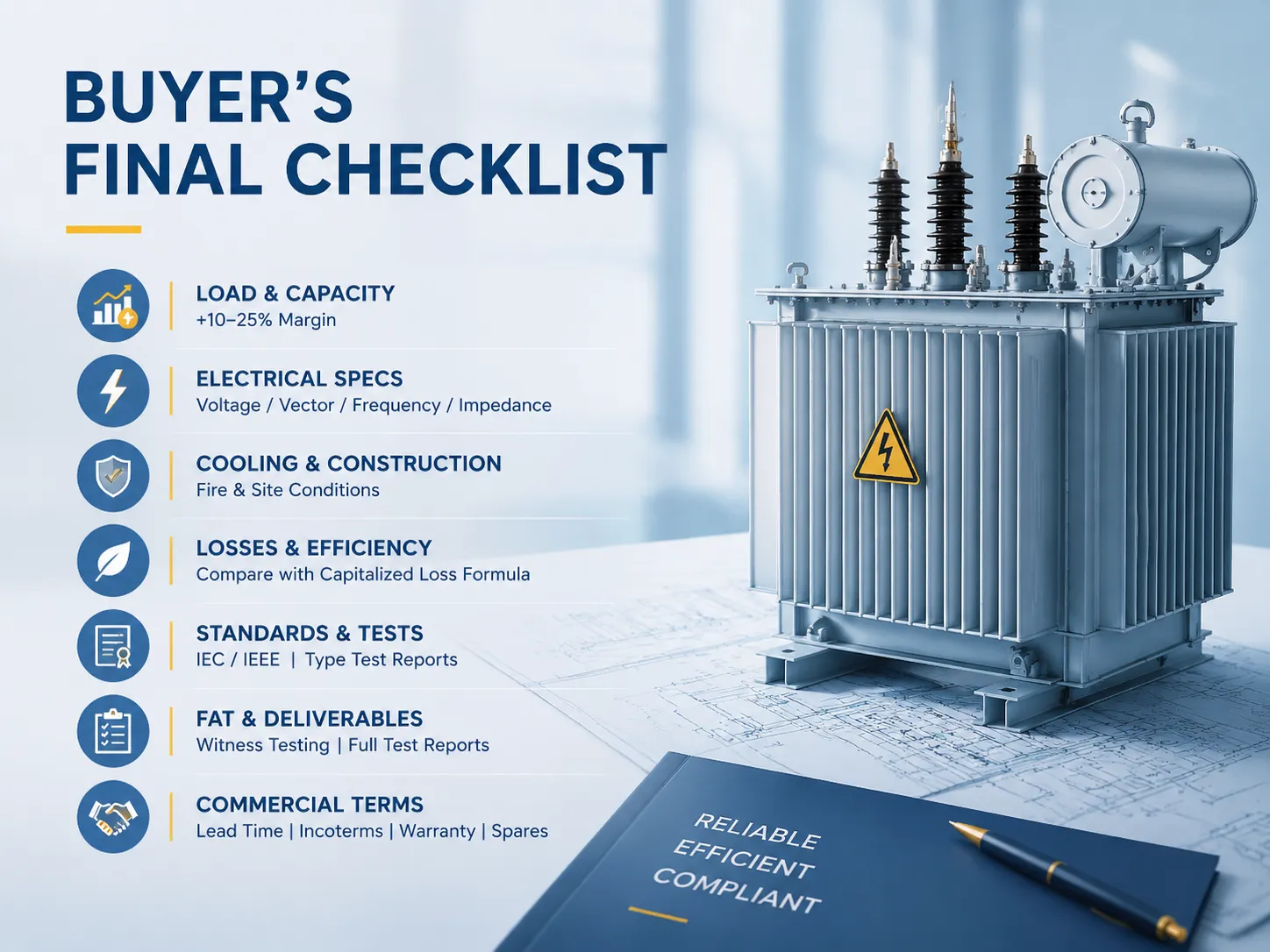
Die endgültige Checkliste des Käufers
- Die Berechnung des Lastprofils wurde durchgeführt und die kVA wurde um einen Zuschlag von 10–25 Prozent angepasst.
- Spannung, Vektorguppe, Frequenz und Impedanz wurden bestimmt.
- Der Kühltyp und die Bauart wurden basierend auf den Bedingungen von Feuer und Standortbedingungen ausgewählt.
- Die Verluste wurden gemäß der kapitalisierten Verlustformel geschätzt.
- Die Standardfamilie wurde überprüft (IEC 60076 oder IEEE C57.12), und der Typprüfbericht wurde angefordert.
- Der Umfang des FAT wurde vereinbart, der das Verfahren für Tests und die Lieferung des vollständigen Prüfberichts umfasste.
- Die Lieferzeit, Incoterms und Garantie (12 - 60 Monate) wurden bestätigt.
Häufig gestellte Fragen
Wie berechne ich die kVA-Bewertung, die mein Projekt benötigt?
Um die erforderliche Transformatorleistung zu berechnen, addieren Sie einfach die Gesamtheit der angeschlossenen Last in Kilowatt, wenden Sie den Diversitätsfaktor an (in der Regel 0,6-0,85 für industrielle Lasten), teilen Sie diese Zahl durch den Leistungsfaktor, um Kilowatt in Kilovolt-Ampere umzurechnen, und fügen Sie dann 10-25% für das Wachstum hinzu und runden Sie auf. Zum Beispiel ergeben 800 kW mit einem Leistungsfaktor von 0,85 unter Verwendung eines Diversitätsfaktors von 0,8 etwa 753 kVA, was auf 1.000 kVA mit Wachstum aufgerundet werden kann.
Was ist die typische Effizienz eines modernen Leistungstransformators?
In der Regel erreichen Verteilungstransformatoren Effizienzen von etwa 98 Prozent bis 99,5 Prozent, während große Leistungstransformatoren Effizienzen von etwa 99,5 Prozent bis 99,8 Prozent erreichen können. Es sind jedoch nicht die relativen Effizienzwerte, die signifikant sind, sondern die absoluten Werte. Zum Beispiel wird für einen 10 MVA Transformator der Verlust zwischen 30 kW (bei voller Last) und 70 kW liegen. Angesichts des Strompreises ($0,12/kWh) können die Verluste jedes Jahr eine recht erhebliche Summe Geld ausmachen.
Was kostet ein 1.000 kVA Transformator in 2025–2026?
Typischerweise würde ein Transformator mit einer Bewertung von 1.000 kVA zwischen $6.000 und $14.000 von einem Anbieter in China kosten und etwa $15.000 bis $28.000, wenn der Transformator von einem europäischen Hersteller stammt. Die Gesamtkosten des Transformators beinhalten auch Liefer-, Versicherungs- und Logistikkosten, die zusätzliche 8% bis 15% kosten werden. Sie sollten auch überprüfen, wie sich die aktuellen Preise für Kupfer und Öl auf die Preise auswirken, also vergessen Sie nicht, offizielle Preisangebote einzuholen, die 60-90 Tage gültig sind.
Sollte ich für mein Projekt ölgetauchte oder trockene Bauweise wählen?
Wählen Sie ölgetauchte Transformatoren für Installationen im Freien oder wo Versorgungs- und große Industriebelastungen vorherrschen, vorausgesetzt, dies entspricht den Brandschutzvorschriften. Wählen Sie trockene Bauweise für Installationen, die drinnen oder in Gebäuden, Tunneln, Rechenzentren oder anderen Bereichen stattfinden, in denen es Einschränkungen aufgrund von Brandgefahren oder Wartungsproblemen gibt. Die Kosten für trockene Transformatoren sind in der Regel 40-80 Prozent höher als die für ölgetauchte Transformatoren mit derselben Kapazitätsbewertung, aber sie vermeiden den gesamten Ölhandhabungsprozess.
Wie viel sollte ich zusätzlich für geringere Verluste bezahlen?
Die Bewertung der kapitalisierten Verluste ergibt ungefähr $2.000–6.000 an vermiedenen Leerlaufverlusten pro kW und $400–1.200 pro kW an vermiedenen Lastverlusten. Wenn ein Aufpreis von 5–15 Prozent des Kaufpreises gezahlt wird, ist dies in der Regel gerechtfertigt, wenn es zu einer Reduzierung der Leerlaufverluste von 15–20 Prozent oder mehr führt.
Referenzen
- IEC 60076-1: Leistungstransformatoren — Allgemeines — Der grundlegende Standard für Bewertung, Verluste und allgemeine Anforderungen.
- IEC 60076-2: Temperaturanstieg — Definiert Temperaturanstiegsgrenzen und Kühlklassenvorschriften für die Belastungsfähigkeit.
- IEC 60076-7: Lastleitfaden für ölgetauchte Transformatoren — Die Referenz für zyklische und Notfallbelastungen über die Nennleistung hinaus.
- IEC 60076-5: Fähigkeit, Kurzschluss zu widerstehen — Entwurfsverifizierung und Prüfanforderungen für Kurzschlussfestigkeit.
- IEEE — Veröffentlicht Daten der C57.12-Serie und der Arbeitsgruppe zur Zuverlässigkeit, die bei der Beschaffung von Transformatoren und der Verlustbewertung verwendet werden.
- NEMA — Nordamerikanischer Handelsverband, der Leitlinien zur Effizienz und Anwendung von Transformatoren bereitstellt.
- Jiangsu Subian Electric Power — IEC 60076-konformer Transformatorenhersteller, der Ingenieureinkäufer weltweit unterstützt.
Fazit
Der Auswahlprozess von Transformatoren in der Energietechnik basiert auf berechneten Entscheidungen und nicht auf zufälligen Vermutungen. Dazu muss die Nettolast bestimmt und dann ein angemessener Prozentsatz für mögliches Wachstum hinzugefügt werden. Durch die Berechnung der wirtschaftlichen Verluste, die aus dem Betrieb des Transformators resultieren, die Wahl eines geeigneten Entwurfs, der den Standort- und Brandschutzanforderungen entspricht, sowie die Bestätigung der Konformität der Ausrüstung mit den entsprechenden Standards können die Entwurfsberechnungen als gültig angesehen werden.
- Schätzen Sie die Größe gemäß den erhaltenen Messungen sowie dem erforderlichen Größenpuffer von zehn bis fünfundzwanzig Prozent.
- Bewerten Sie die Verluste, die von $2.000 bis $6.000/kW ohne Last und von $400 bis $1.200/kW mit Last variieren können.
- Wählen Sie den Entwurfstyp gemäß den Installationsbedingungen und den Brandschutzvorschriften aus.
- Überprüfen Sie, ob der Transformator den Standards IEC 60076 oder IEEE C57.12 entspricht, mithilfe von Typprüfberichten.
- Vergleichen Sie die erhaltenen Angebote für Transformatoren gemäß den festgelegten Regeln unter Berücksichtigung von Details und FAT.