


Ein Beschaffungsmanager, der in einem Getränkeabfüllunternehmen in Kenia arbeitete, stand vor der Herausforderung, innerhalb von nur drei Wochen zwei neue 1.000 kVA Transformatoren für eine Abfülllinie zu finden. Während die Zentrale ein strenges Budget vorgab, hatte die lokale Niederlassung keinen vor Ort tätigen Elektroingenieur. Nach einigen Recherchen fand der Beschaffungsmanager bizarre niedrigpreisige Angebote für nahegelegene Einheiten. Nachdem die Spezifikationen eingetroffen waren, stellte sie fest, dass eine Nennspannung von 11 kV am 33 kV Zuleitung, eine Vektorgruppe bei Yyn0 anstelle von Dyn11 und eine IP-Bewertung von IP21 für die feuchte und staubige Produktionsstätte festgelegt waren. Glücklicherweise wurde die Bestellung rechtzeitig gestoppt. Leider spiegelt dies die Realität der Auswahl von Transformatoren in Entwicklungsländern wider – die Anforderungen können nicht nur auf Preis und Kapazität beschränkt werden; sie könnten eine Kombination aus elektrischen, mechanischen und kommerziellen Aspekten sein, wobei ein ignorierter Teil das gesamte Projekt gefährden könnte.
Dieser professionelle Leitfaden bietet Ihnen eine Reihe von Schritten, die verwendet werden können, um den optimalen Transformator auszuwählen – von der Klärung der ursprünglichen Anfrage bis hin zu einer erstellten technischen Spezifikation und einer Liste der benötigten Einheiten. Die Checkliste kann für jede Art von Anwendung verwendet werden – Versorgungsunternehmen, Industrie oder kommerzielle Anwendung.
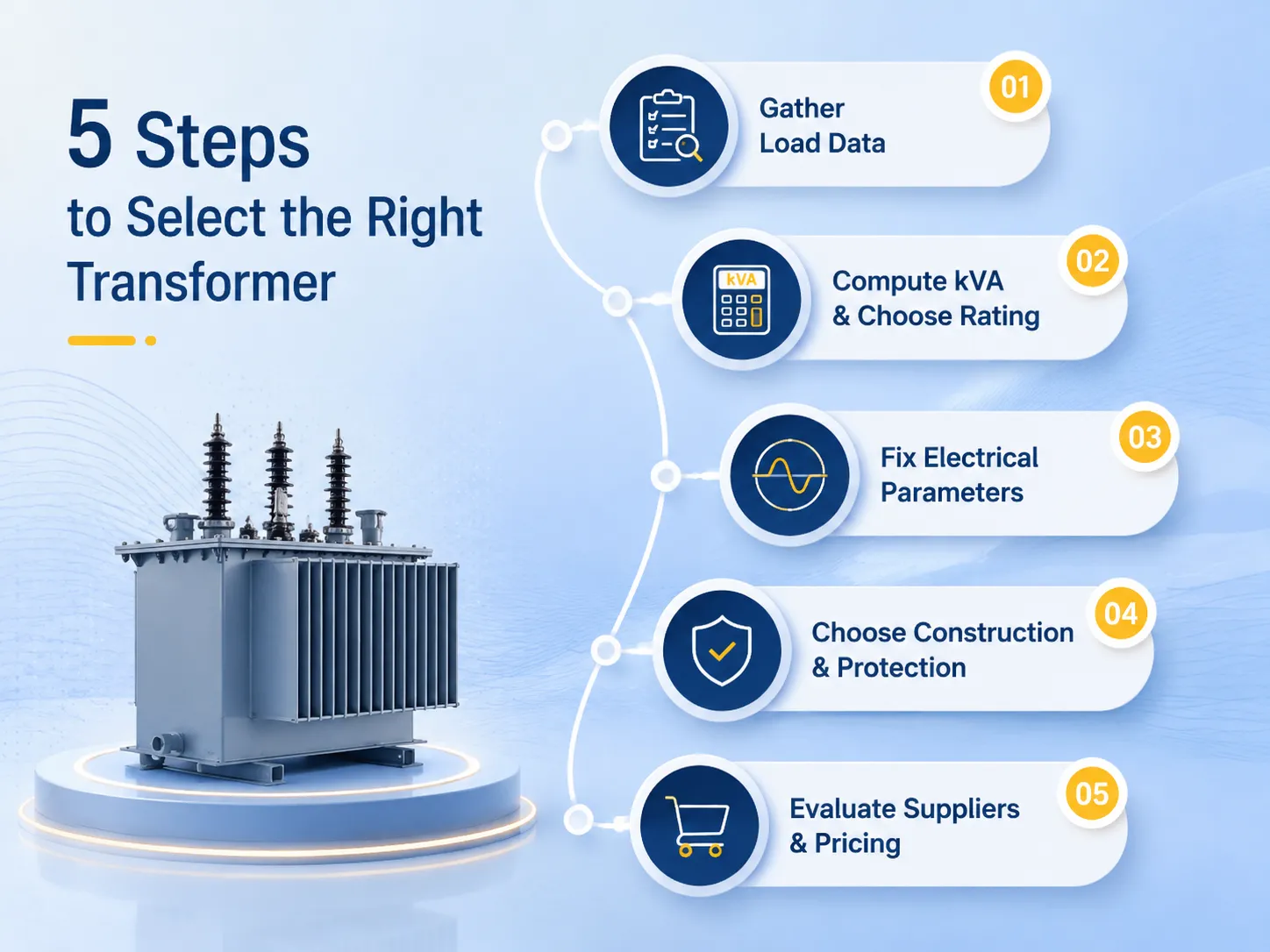
Kurz gesagt: Der Prozess zur Bestimmung des besten Transformators für Ihre Zwecke besteht aus fünf Schritten: (1) Lastdaten müssen gesammelt werden, einschließlich kW, Leistungsfaktor, Anlaufstrom und harmonischen Inhalten; (2) Die Berechnung von kVA muss mit einem Diversitätsfaktor zwischen 0,7 und 0,85 erfolgen, ganz zu schweigen von dem Wachstumsfaktor 10% bis 20%; (3) Alle elektrischen Parameter sollten festgelegt werden, d.h. Primär- und Sekundärspannung, Vektorgruppe, Impedanz und Abgriffbereich; (4) Die Art der Konstruktion muss bestimmt werden. In diesem Fall handelt es sich entweder um ölgetauchte oder trockene Bauweise, aber die IP-Bewertung muss den Bedingungen entsprechen; (5) Hauptlieferanten müssen anhand ihrer Leistungsbilanz, Garantie und Gesamtkosten verglichen werden.
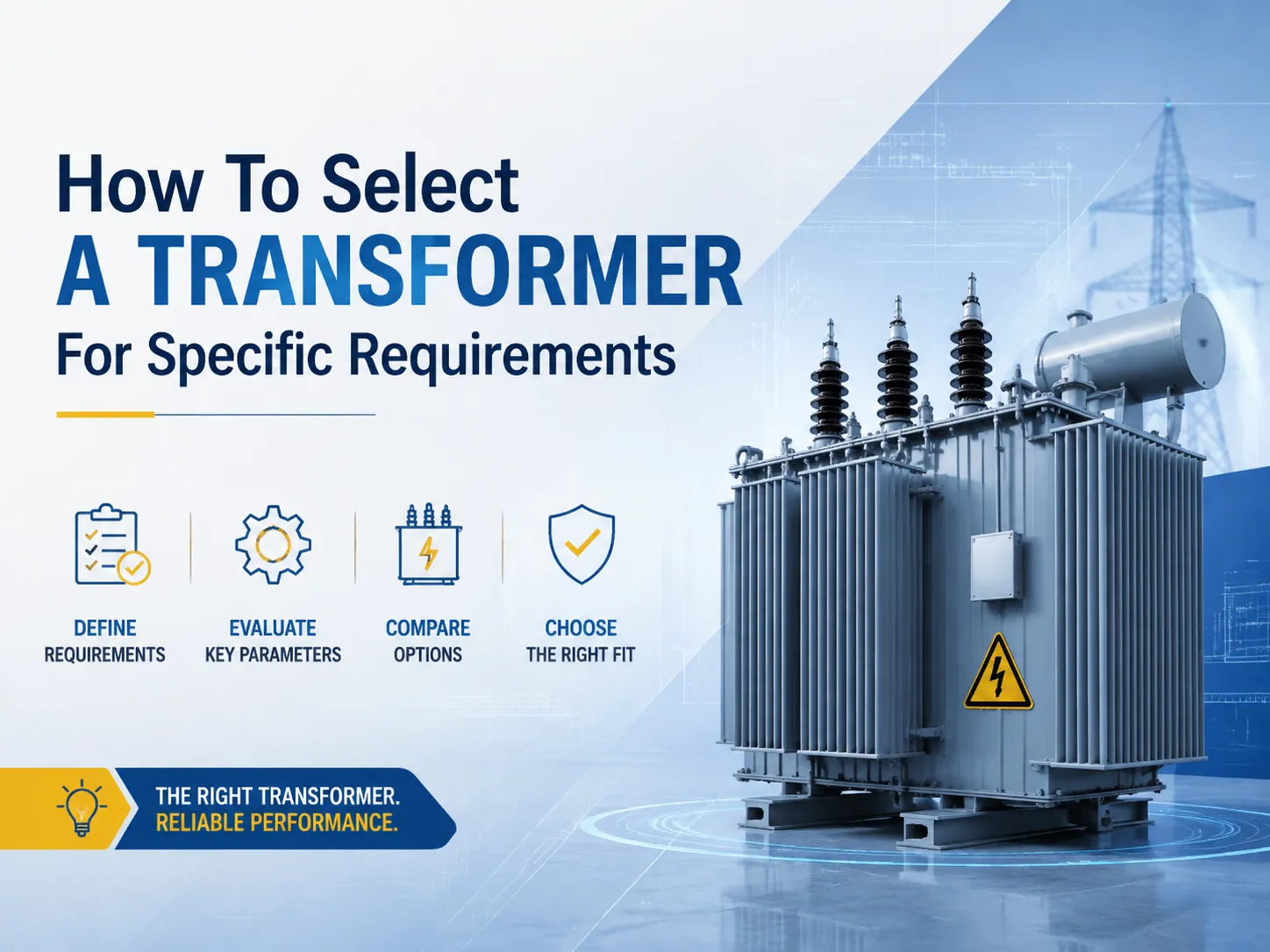
Anforderungen in eine Spezifikation umsetzen
Der Abstand zwischen “wir benötigen einen Transformator” und einer effektiven Bestellung dafür liegt in einer schriftlichen technischen Spezifikation (Spezifikation). Eine gute Spezifikation umfasst möglicherweise die folgenden Abschnitte: allgemeine Informationen (Typ, Modell, Kapazität), elektrische Daten (Spannung, Vektorgruppe, Impedanz, Verluste, Isolationsniveau), mechanische Parameter (Gewicht, Abmessungen, Prozesse) und kommerzielle Informationen (Tests, Dokumentation, Garantie, Lieferung). Jede Ihrer Anforderungen muss einem physischen Rahmen entsprechen; wenn Sie nicht sagen können, warum Sie diesen Parameter benötigen, ist es wahrscheinlich, dass Sie ihn aus einem früheren Projekt kopiert haben und er wahrscheinlich falsch ist.
Einige häufige Fehler bei der Übersetzung der Anforderungen sind die Verwendung der Nennspannung anstelle der Betriebs- spannung, das Ignorieren des Neutralerdungssystems (TN, TT, IT) sowie die Erwähnung von IP54, während tatsächlich IP23 und ein wetterfester Überzug erforderlich sind. Das Schreiben einer Spezifikation in der Realität verbessert Ihr Verständnis dafür, was die Anforderungen bedeuten, bevor das Geld für den Transformator bezahlt wird.
Schritt 1: Sammeln Sie genaue Lastdaten
Keine Transformatorenauswahl übersteht den Kontakt mit schlechten Lastdaten. Sammeln Sie für jeden Zähler und jede bedeutende Maschine:
- Scheinleistung in kVA oder MVA (nicht nur kW — der Leistungsfaktor ist wichtig).
- Spannung die an den Lastanschlüssen erforderlich ist.
- Betriebszyklus — kontinuierlich, intermittierend oder zyklisch, und erwartete Stunden pro Tag.
- Anlaufstrom für Motoren und alle Anlauflasten.
- Harmonische Inhalte von VFDs, Gleichrichtern und USV-Anlagen.
- Zukünftige Ergänzungen — der Plan, den der Betriebsleiter normalerweise vergisst zu erwähnen.
Wenn der Standort bereits läuft, verwenden Sie zwei Wochen lang einen Power Quality Analyzer, um die tatsächliche Nachfragekurve, den Leistungsfaktor und das harmonische Spektrum zu erfassen. Eine zweiwöchige Messung kostet $300–$1.000 mit einem gemieteten Logger — ein Bruchteil der $8.000–$60.000, die Sie ausgeben werden, und es beseitigt die größte Fehlerquelle bei der Auswahl: geschätzte Nachfrage.
Schritt 2: Berechnen Sie kVA und wählen Sie die Nennleistung
Mit den Lastdaten in der Hand berechnen Sie die Transformatorennennleistung:
- Addieren Sie die kVA aller Lasten, die realistisch zusammen betrieben werden können.
- Multiplizieren Sie mit dem Diversitätsfaktor für Ihre Branche — 0,6–0,7 kommerziell, 0,7–0,85 industriell, 0,9–1,0 kontinuierlicher Prozess.
- Fügen Sie eine Wachstumsreserve von 10–20% hinzu.
- Runden Sie auf die nächste Standardnennleistung gemäß IEC 60076-1 auf: 25, 50, 100, 160, 250, 400, 500, 630, 800, 1000, 1250, 1600, 2000, 2500 kVA.
- Überprüfen Sie die Spitzenbedingungen: Kann die Einheit die kurzzeitige maximale (Motorstart) ohne Auslösen des Schutzes oder Überschreiten der Spannungsabfallgrenzen halten?
Für eine dreiphasige Last beträgt die Nachfrage in kVA kVA = (√3 × V × I) ÷ 1000. Eine 480 V, 300 A Prozesslast ergibt 1.732 × 480 × 300 ÷ 1000 = 249,4 kVA, sodass eine 250 kVA Einheit bei 99,8% Last sitzt — viel zu eng. Mit einer Diversität von 0,85 und 15% Wachstum liegt das Designziel bei etwa 326 kVA, was auf eine 400 kVA Einheit hinausläuft. Das ist der Unterschied zwischen einem Transformator, der sich 25 Jahre lang selbst kühlt, und einem, der in fünf Jahren ausfällt.
| Angeschlossene Last (kVA) | Diversitätsfaktor | Wachstumsreserve | Entwurfs-kVA | Empfohlene Nennleistung |
|---|---|---|---|---|
| 150 | 0.85 | 15% | 147 | 160 |
| 300 | 0.80 | 15% | 276 | 315 |
| 500 | 0.80 | 20% | 480 | 500 |
| 900 | 0.75 | 15% | 776 | 800 |
| 1,400 | 0.75 | 15% | 1,207 | 1,250 |
| 2,200 | 0.80 | 15% | 2,024 | 2,500 |
Schritt 3: Fixieren Sie die elektrischen Parameter
Jetzt sperren Sie das elektrische Gerüst der Spezifikation. Die Primärspannung muss mit dem vorgelagerten Zähler übereinstimmen — überprüfen Sie die tatsächliche Systemspannung, nicht die Papierwerte, da viele Netze um 5–8% von der Nennspannung abweichen. Die Sekundärspannung muss die größten Lasten mit akzeptabler Regelung erfüllen. Der Abgriffbereich (typischerweise ±2×2.5% im Leerlauf oder unter Last für volatile Netze) kompensiert die Quellenvariation.
Die Auswahl der Vektorgruppe folgt dem Erdungssystem und den Anforderungen an den Neutralleiter. Dyn11 ist das Arbeitstier der Niederspannungsverteilung (HV-Dreieck, LV-geerdetes Sternsystem mit 0°–30° Verschiebung). Für Hochsetzungsanwendungen ist Yd11 oder Yd1 Standard. Die Impedanz (uk%) ist ein Kompromiss: 4% für kleine Einheiten bietet eine gute Spannungsregelung; 6–8% für größere Einheiten begrenzt den Fehlerstrom. Wenn die Einheit parallel zu bestehenden Transformatoren betrieben werden muss, muss die Impedanz innerhalb von etwa 10% übereinstimmen und die Vektorgruppe sowie das Verhältnis müssen identisch sein.
| Parameter | Typischer Wert | Entwurfsüberlegung |
|---|---|---|
| Primärspannung | 11 / 22 / 33 / 35 kV | Übereinstimmung mit dem Zuleitung, einschließlich der Abgriffsspanne |
| Sekundärspannung | 4 / 0.42 / 0.48 kV | Übereinstimmung mit der Lastnutzungs-Spannung |
| Vektorguppe | Dyn11, Yyn0, Yd11 | Erdungssystem, Neutralleiter, parallel |
| Impedanz (uk%) | 4–8% | Fehlerpegel vs. Spannungsregelung |
| Abgriffbereich | ±2×2.5% / OLTC | Volatilität der Quellenspannung |
| Isolationsniveau | LI 75/28 kV für die 33 kV-Klasse | Blitz- und Schaltüberspannungen |
| Geräuschpegel | ≤ 55–65 dB(A) bei 1 m | Wohn- und Krankenhausstandorte |
Schritt 4: Konstruktion und Schutz wählen
Der Bautyp und das Gehäuse ergeben sich aus der physischen Umgebung. Ölgetauchte Einheiten sind der Standard für Freiluft-Umspannwerke, Solarparks und Versorgungsnetze; Trockenbau- oder Gießharzeinheiten kommen in Innenräumen zum Einsatz, wo Brandschutz und Platzregeln gelten. Die IP-Bewertung des Gehäuses (gemäß IEC 60529) wird aus der Staub- und Wasserexposition gewählt: IP21–IP23 für saubere Innenräume, IP44 für staubige Innenräume, IP54 für Außenbereiche mit Spritzwasser, IP56 für Küsten- und Reinigungsbereiche.
Geben Sie auch die Kühlklasse an — ONAN für selbstgekühlte Öleinheiten, ONAN/ONAF, wenn die ventilatorunterstützte Überlastkapazität (typischerweise +20–30%) die zusätzlichen Ventilatoren und Steuerungen wert ist — und die Umgebungsbedingungen für die Herabstufung: über 40 °C Umgebungstemperatur oder 1.000 m Höhe muss die kVA-Bewertung gemäß IEC 60076-1 herabgestuft werden. Diese Entscheidungen in der Spezifikationsphase richtig zu treffen, vermeidet kostspielige Nachrüstungen — ein $300-Ventilator-Kit, das später bestellt wird, wird zu einer $2.500-Baustellenmodifikation, wenn der Tank nicht dafür gebaut wurde.
Schritt 5: Lieferanten und Preise bewerten
Mit einer vollständigen Spezifikation laden Sie mindestens drei Lieferanten ein und bewerten sie anhand einer gewichteten Matrix. Gewichtete getestete Leistung und Dokumentation stark — ein niedriges Angebot bei einer unvollständigen Spezifikation ist keine Ersparnis, es ist eine Falle. Fragen Sie jeden Kandidaten nach:
- Dem Prüfbericht über die routinemäßigen Fabriktests gemäß IEC 60076 (Verhältnis, Verluste, Impedanz, Temperaturanstieg).
- ISO 9001 / ISO 14001-Zertifikate und Akkreditierung des Prüflabors.
- Kundenreferenzen in Ihrer Branche oder Region, idealerweise besuchbar.
- Garantierte Verlustwerte mit Toleranzen, nicht “typische” Zahlen.
- Garantiebedingungen (18–24 Monate sind Marktstandard) und Ersatzteilpolitik für 10 Jahre.
- Lieferzeit und Frachtbedingungen (FOB, CIF, DAP).
Vergleichen Sie die Gesamtkosten des Eigentums, nicht den Listenpreis: Verluste über 25 Jahre bei $0.10/kWh können den Kaufpreis einer 1.000 kVA-Einheit übersteigen, daher ist ein etwas teurerer, aber verlustärmerer Transformator in der Regel die bessere Wahl. Und für jede Bestellung über $30.000–$50.000 ist eine Fabrikprüfung oder ein bezeugter Test gut investiertes Geld.
Beispielstruktur für ein Spezifikationsblatt
| Abschnitt | Inhalt | Beispielwert |
|---|---|---|
| Allgemein | Typ, Standard, Bewertung | Ölgetaucht, IEC 60076, 1.000 kVA |
| Elektrisch | Spannung, Vektorguppe, Impedanz | 33/0,4 kV, Dyn11, uk=6% |
| Leistung | Leerlauf-/Lastverlust, Temperaturanstieg | 200 W / 11.000 W, 65 K |
| Mechanisch | Gewicht, Abmessungen, Tank | 200 kg, 2,2 × 1,5 × 2,4 m, Stahl |
| Gehäuse | IP-Bewertung, Kühlklasse | IP54, ONAN |
| Zubehör | Abgriffwechsel, Ölmessgerät, Relais | ±2×2.5% DETC, Buchholz-Relais |
| Tests & Dokumente | Prüfbericht über routinemäßige Tests, Zertifikate | IEC 60076-1 routinemäßige + Typprüfungen |
| Kommerziell | Garantie, Lieferung, Zahlung | 24 Monate, 60 Tage, 30/70 L/C |
Ein Blatt wie dieses wandelt Ihre Anforderungen in etwas um, das eine Fabrik eindeutig anbieten kann. Wenn ein Angebot eines Lieferanten davon abweicht — unterschiedliche Vektorguppe “zur Bequemlichkeit” oder Verluste “um 5% verbessert” ohne Prüfbericht — kennzeichnen Sie es sofort. Abweichungen von der Spezifikation sind die Stellen, an denen Abstriche gemacht werden.
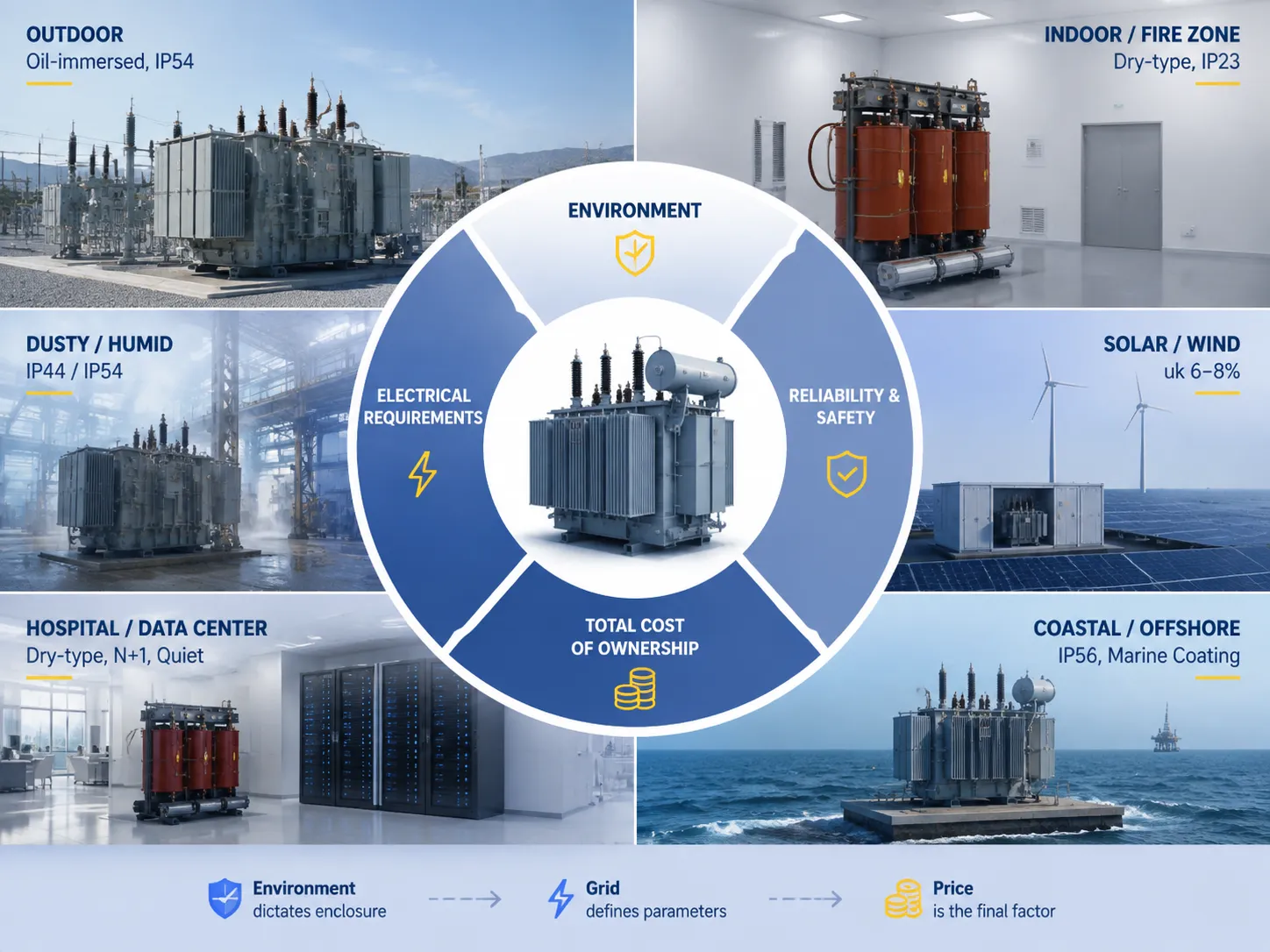
Anforderungstypen vs. Bevorzugte Lösungen
| Anforderung | Bevorzugte Lösung | Warum |
|---|---|---|
| Freiluft-Versorgungsumspannwerk | Ölgetaucht, ONAN, IP54 | Bester Preis/kVA, bewährte Lebensdauer von 30 Jahren |
| Gebäudekeller, Brandzone | Gießharz-Trockenbau, IP23 | Selbstlöschend, kein Öltank |
| Staubige / feuchte Industriehalle | Trockenbau IP44 oder ölgefüllte IP54 | Dichtungen gegen Staub und Feuchtigkeit |
| Solar-/Windkollektorenstation | Ölgefüllt, uk 6–8%, Netzcode-Gruppe | Bewältigt zyklische Belastungen und Fehlergrenzen |
| Krankenhaus, Rechenzentrum | Trockenbau, N+1 Redundanz, leise | Brandschutz, Kontinuität, niedrige Geräuschentwicklung |
| Küsten- / Offshore | Ölgefüllt IP56, maritimer Anstrich | Salzkorrosionsbeständigkeit |
Diese Zuordnungen sind Ausgangspunkte, keine Regeln. Der Punkt ist, dass Anforderungen physisch sind, bevor sie kommerziell werden: die Umgebung diktiert das Gehäuse, das Netz diktiert die elektrischen Parameter, und erst nachdem beides festgelegt ist, wird der Preis zur entscheidenden Variablen.
Top-Marken und Preisbenchmarks
Für die meisten Käufer besteht die echte Entscheidung zwischen einer internationalen Marke mit globalem Service und einem IEC-zertifizierten chinesischen Hersteller zu etwa halb so viel. Beide können einen Transformator liefern, der IEC 60076 entspricht; die Unterschiede zeigen sich in der Dokumentationsqualität, der Lieferzeit und der Tiefe des After-Sales-Service.
| Marke | Heimatregion | Position | Richtpreis (1.000 kVA) |
|---|---|---|---|
| ABB | Schweiz/Schweden | Vollständiges Portfolio, globales Servicenetzwerk | $25.000–$42.000 |
| Siemens | Deutschland | Digitale Überwachung, hocheffiziente Einheiten | $25.000–$45.000 |
| Schneider Electric | Optimierungsmaßnahmen in der Praxis | Trockenbau und LV-Integrationsstärke | $22.000–$38.000 |
| Hitachi Energie | Schweiz | Netzstärke und große Leistungseinheiten | $24.000–$42.000 |
| Eaton | USA | Nordamerikanische Konformität, Bodenmontagen | $20.000–$36.000 |
| CG Power / TBEA | Indien / China | Hohe Stückzahlen, aggressive Preisgestaltung | $14.000–$24.000 |
| Jiangsu Subian Electric Power | China | IEC 60076-zertifiziert, vollständige Prüfberichte, Kupferwicklungen | $12.000–$22.000 |
Die Preise sind indikativ FOB China oder ab Werk für eine 1.000 kVA ölgefüllte Einheit und variieren je nach Spezifikation, Marke und Region. Die globalen Marktführer verdienen ihre Prämien mit jahrzehntelangen Zuverlässigkeitsdaten und Serviceabdeckung — für mission-critical Netzassets ist das oft gerechtfertigt. Aber für Verteilungseinheiten in kommerziellen, industriellen und erneuerbaren Projekten verschiebt sich die Wertgleichung. Jiangsu Subian Electric Power liefert Transformatoren von 10 kVA bis 100 MVA unter IEC 60076-Zertifizierung, versendet standardmäßig kupfergewickelte Einheiten und stellt mit jeder Bestellung den vollständigen Fabrikprüfbericht zur Verfügung — sodass die Verlust- und Impedanzwerte Ihrer Spezifikation verifiziert und nicht angenommen werden. In einem Markt, in dem ein Unterschied von $8.000–$15.000 pro Einheit eine gesamte kleine Umspannstation finanziert, erhalten Käufer, die auf dokumentierte getestete Leistung bestehen, die gleichen Standards zu einem niedrigeren Preis. Der professionelle Schritt besteht darin, beide Optionen auf den Tisch zu legen und die gewichtete Matrix entscheiden zu lassen.
Häufig gestellte Fragen
Welche Informationen benötige ich, bevor ich einen Transformator auswähle?
Mindestens: angeschlossene Last in kVA (mit Leistungsfaktor), Primär- und Sekundärspannungen, Erdungssystem und Neutralbedarf, Installationsumgebung (innen/außen, Staub, Feuchtigkeit), Umgebungstemperatur und Höhe sowie zukünftige Wachstumspläne. Wenn eines dieser Elemente unbekannt ist, messen oder konsultieren Sie, bevor Sie spezifizieren — eine zweiwöchige Studie zur Stromqualität kostet $300–$1.000 und verhindert einen Auswahlfehler im Wert von $10.000–$60.000.
Wie wähle ich zwischen ölgefüllten und Trockenbau-Transformatoren?
Der Standort entscheidet darüber. Im Freien und auf der Versorgungsseite: ölgetränkt (günstiger pro kVA, bessere Überlasttoleranz, IP54–IP56). Innenräume, feuerempfindlich oder platzbeschränkt: Trockenbau oder Gießharz (selbstlöschend, keine Ölauffangvorrichtung, leiser). Für eine 500 kVA Einheit kostet ölgetränkt $8,000–$16,000 im Vergleich zu $12,000–$24,000 für Trockenbau, aber lokale Brandschutzvorschriften und Versicherungen können Trockenbau unabhängig vom Preis zwingend machen.
Wie viel kostet es, einen Fachmann mit der Auswahl eines Transformators zu beauftragen?
Ein Elektroberater verlangt $500–$2,000 für eine Transformatorenauswahlstudie bei einem typischen Verteilungsprojekt oder $2,000–$6,000 für ein vollständiges Unterstationsdesign einschließlich Schutzkoordination. Bei Projekten über $30,000 amortisiert sich die Studie durch die Vermeidung von Überdimensionierung (verschwendetes Kapital und Verluste) oder Unterdimensionierung (Ausfälle und Ausfallzeiten). Viele Hersteller, einschließlich Subian, überprüfen Ihre Lastdaten und empfehlen eine Nennleistung kostenlos.
Was ist der Unterschied zwischen kVA und kW bei der Dimensionierung eines Transformators?
kVA ist Scheinleistung (Volt × Ampere), kW ist Wirkleistung (tatsächliche Arbeit), und sie unterscheiden sich durch den Leistungsfaktor. Eine 100 kW Last bei 0.8 PF zieht 125 kVA. Die Wicklungen des Transformators erhitzen sich durch den Strom unabhängig vom Phasenwinkel, daher ist die Nennleistung immer in kVA. Die Dimensionierung nur nach kW führt zur Unterdimensionierung der Einheit, es sei denn, die Last ist rein resistiv, was in industriellen Anwendungen fast nie der Fall ist.
Soll ich von einer globalen Marke oder einem chinesischen Hersteller kaufen?
Passen Sie die Wahl an die Kritikalität des Projekts und Ihr Servicenetzwerk an. Globale Marken (ABB, Siemens, Schneider, Hitachi) rechtfertigen 2–3× Preise mit globaler Unterstützung und jahrzehntelangen Felddaten – richtig für netzkritische Anlagen. IEC-zertifizierte chinesische Hersteller wie Jiangsu Subian Electric Power liefern die gleichen Prüfstandards zu etwa halbierten Preisen, ideal für Verteilungs-, Industrie- und erneuerbare Projekte. Der Filter ist die Dokumentation: Wenn der Prüfbericht der Fabrik, ISO-Zertifikate und Referenzen in Ordnung sind, erfüllt die Einheit die Spezifikation unabhängig von der Herkunft.
Referenzen
- IEC 60076-1: Leistungstransformatoren — Allgemeines — der maßgebliche Standard für Nennwerte, Toleranzen und Prüfungen.
- IEC 60076-7: Lastleitfaden für ölgefüllte Transformatoren — Überlast- und zyklische Temperaturgrenzen.
- IEC 60529: Schutzarten von Gehäusen (IP-Code) — das Referenzdokument für IP-Bewertungsdefinitionen und Prüfmethoden.
- IEEE C57.12.00: Allgemeine Anforderungen für flüssigkeitsgetauchte Transformatoren — nordamerikanisches Äquivalent für Bewertung und Prüfrahmen.
- Electrical4U — Transformator — klare Erklärungen zu Transformatorprinzipien, Vektorgruppen und Verlusten.
- Eaton — Auswahlwerkzeuge für Transformatoren — Ingenieuranleitung und Größenbestimmung für industrielle Anwendungen.
- Siemens Energy — Leistungstransformatoren — Herstellerreferenz zu Transformatorspezifikationen und -technologien.
Fazit
Die Auswahl eines Transformators für spezifische Anforderungen ist ein fünfstufiger professioneller Prozess — erfassen Sie echte Lastdaten, berechnen Sie die kVA mit Diversitäts- und Wachstumsreserven, legen Sie die elektrischen Parameter für das System fest, wählen Sie Konstruktion und Schutz für die Umgebung und bewerten Sie Lieferanten anhand dokumentierter getesteter Leistung. Befolgen Sie diesen Prozess, und der Transformator wird zu einem langweiligen, zuverlässigen Asset. Überspringen Sie einen Schritt, und er wird zur teuersten Komponente in Ihrer Anlage.
- Wandeln Sie Anforderungen in eine schriftliche technische Spezifikation um, bevor Sie Lieferanten kontaktieren.
- Basieren Sie die kVA auf gemessenen Lastdaten, nicht auf Schätzungen, mit 10–20% Wachstumsreserven.
- Überprüfen Sie die Vektorguppe, Impedanz und Isolationsniveau im Vergleich zum Netz und Erdungssystem.
- Fordern Sie den IEC 60076 Werksprüfbericht an — getestete Leistung, nicht Broschürenansprüche.
Bereit zur Spezifikation? Jiangsu Subian Electric Power baut IEC 60076-zertifizierte Transformatoren von 10 kVA bis 100 MVA und liefert vollständige Werksprüfberichte, ISO-Zertifikate und Projektreferenzen — die Dokumentation, die Sie benötigen, um mit Vertrauen auszuwählen.