


Jeder Produktionsingenieur hat einen solchen Nachmittag erlebt: eine Produktionslinie, die nicht zum Stillstand kommen kann, eine Sommerhitze und ein Transformator in der Umspannstation, der mit 112 Prozent der Nennkapazität läuft, weil er keine andere Wahl hat. Die Frage bleibt die gleiche: Wer kann ihm sagen, wie viel Überlast der Transformator aushalten kann und wie lange, sowie wie viel es an Lebensdauer kosten wird. Die Überlastkapazität ist keine unveränderliche Zahl; vielmehr ist sie das Ergebnis komplexer Wechselwirkungen – vorherige Lastwerte, Umgebungstemperatur, Temperatur des heißesten Punktes, Alterung der Isolierung und Zustand des Kühlsystems. Wenn Sie das System verstehen, können Sie in Notfällen effizient mit 120-130 Prozent Überlast für Stunden arbeiten – oder einen Transformator während einer Saison beschädigen, wenn Sie die Wissenschaft vernachlässigen.
Kurz gesagt, die Überlastkapazität eines Transformators bezieht sich auf die Fähigkeit eines Transformators, über die auf seinem Typenschild angegebene Kapazität für einen bestimmten Zeitraum zu arbeiten. Die Begrenzung ergibt sich aus der Temperatur des heißesten Punktes und der Alterung der Isoliermaterialien, gemäß IEC 60076-7 und IEEE C57.91. In der Praxis kann ein Transformator, der sich in gutem Zustand befindet, mit 120% seiner Nennkapazität mehrere Stunden arbeiten. Es gibt Notfallsituationen, in denen er mit 130-150% Kapazität für kurze Zeit arbeiten kann.
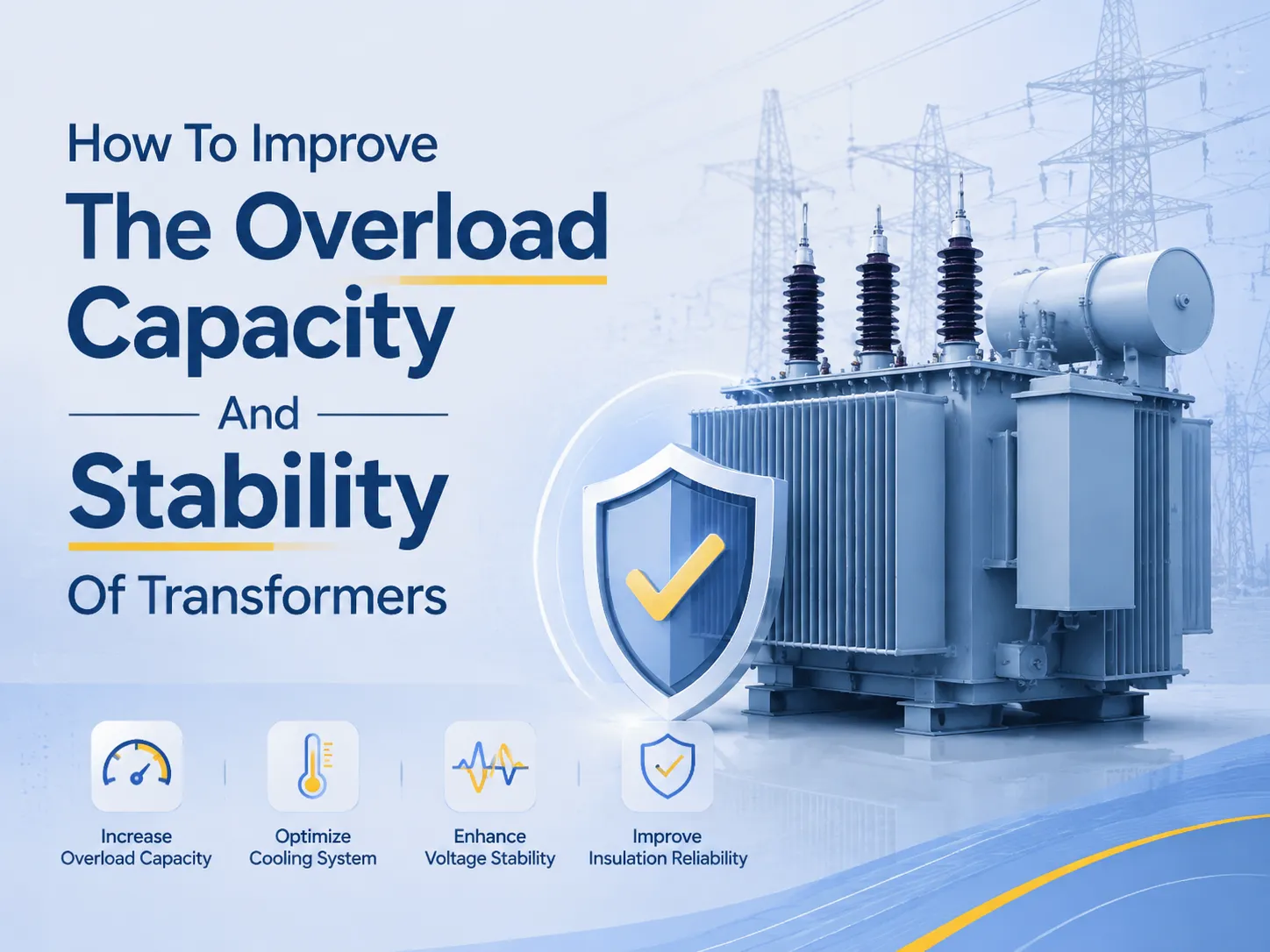
Was ist die Überlastkapazität eines Transformators?
Die Überlastkapazität des Transformators bezieht sich auf die höchste Last, die über den Nennwert in MVA hinausgeht, die der Transformator für einen festgelegten Zeitraum tragen kann, ohne die Temperaturgrenzen zu überschreiten, die zu einer schnellen Alterung der Isolierung führen würden. Die Überlastkapazität ist keine feste Zahl, sondern variiert mit der Lasthistorie des Transformators: Ein Transformator, der in einer kühlen Nacht mit 40% Last arbeitet, hat das Potenzial, eine viel größere Überlast zu ertragen als einer, der bereits bei 95% in der heißen Nachmittagssonne arbeitet. Die Nennkapazität ist lediglich der maximale Wert, den der Transformator unter Volllast bei Nenn-Temperatur (typischerweise 40 °C, gelegentlich bis zu 55 °C bei nicht konventionellen Designs) und einem Temperaturwert des heißesten Punktes von 98 °C bereitstellen kann.
Das Thema ist aus wirtschaftlicher Sicht wichtig, da die Lasten normalerweise nicht konstant bleiben. Energieversorgungsunternehmen und industrielle Nutzer erleben oft Spitzen im Bereich von 105-125% über mehrere Stunden am Tag, was das richtige Wissen über die Überlastkapazität eines Transformators für einen qualifizierten Betreiber unverzichtbar macht. Die Verwendung des oben dargestellten Wissens zur Dimensionierung jedes Transformators könnte zu schlechten finanziellen Bedingungen führen: Ein Transformator, der für seine Nennlast ausgelegt ist, kann jahrelang nur mit 40% Last arbeiten und dabei übermäßige Leerlaufverluste verbrauchen, um sich vor einer Überlast zu schützen, die ein paar Stunden im Monat auftritt.
Die Physik: Temperatur des heißesten Punktes & Lebensdauer der Isolierung
Das Problem kann als eine Zahl ausgedrückt werden: Die Hot-Spot-Temperatur, die Wicklungstemperatur kann aufgrund der I²R-Erwärmung erhöht werden, was zu einem Anstieg der Öltemperatur führt, während die Hot-Spot-Temperatur die Alterungsrate der Isolierung bestimmt. Die Branchenregel, die sowohl in IEC 60076-7 als auch in IEEE C57.91 festgelegt ist, besagt, dass sich die Alterungsrate bei thermisch verbesserten Papierisolierungen mit jedem Anstieg um 6 °C über der Temperatur von 98 °C verdoppelt, die “6 °C-Regel”. Einige Quellen sagen sogar, dass sie auf einen Temperaturbereich von 6 °C bis 10 °C je nach Materialtyp anwendbar sein könnte. Bei einer Hot-Spot-Temperatur von 110 °C ist die Alterungsrate 4–8 Mal höher als normal, während sie bei einer Hot-Spot-Temperatur von 130 °C 30–100 Mal betragen kann, was bedeutet, dass einige Stunden bei dieser Temperatur mehrere Monate der Isolationslebensdauer verbrauchen.
Die Temperatur steigt aufgrund der Last, ungefähr als das Quadrat des Stroms geteilt durch den Anstieg der Wicklungstemperatur, plus den langsameren Anstieg der Öltemperatur. Die Kühlmittel – Öl und Lüfter/Radiatorsystem – bestimmen die Zeitkonstanten, sodass thermische Modelle die Überlast als einen transienten Prozess mit Zeitkonstanten von mehreren Minuten bis Stunden behandeln. Ein weiterer wichtiger Punkt ist die Tatsache, dass die Hot-Spot-Temperatur nicht gleich der Oberöltemperatur ist. Tatsächlich gibt es einen Temperaturgradienten von Wicklung zu Öl, der normalerweise 5-15 K beträgt.
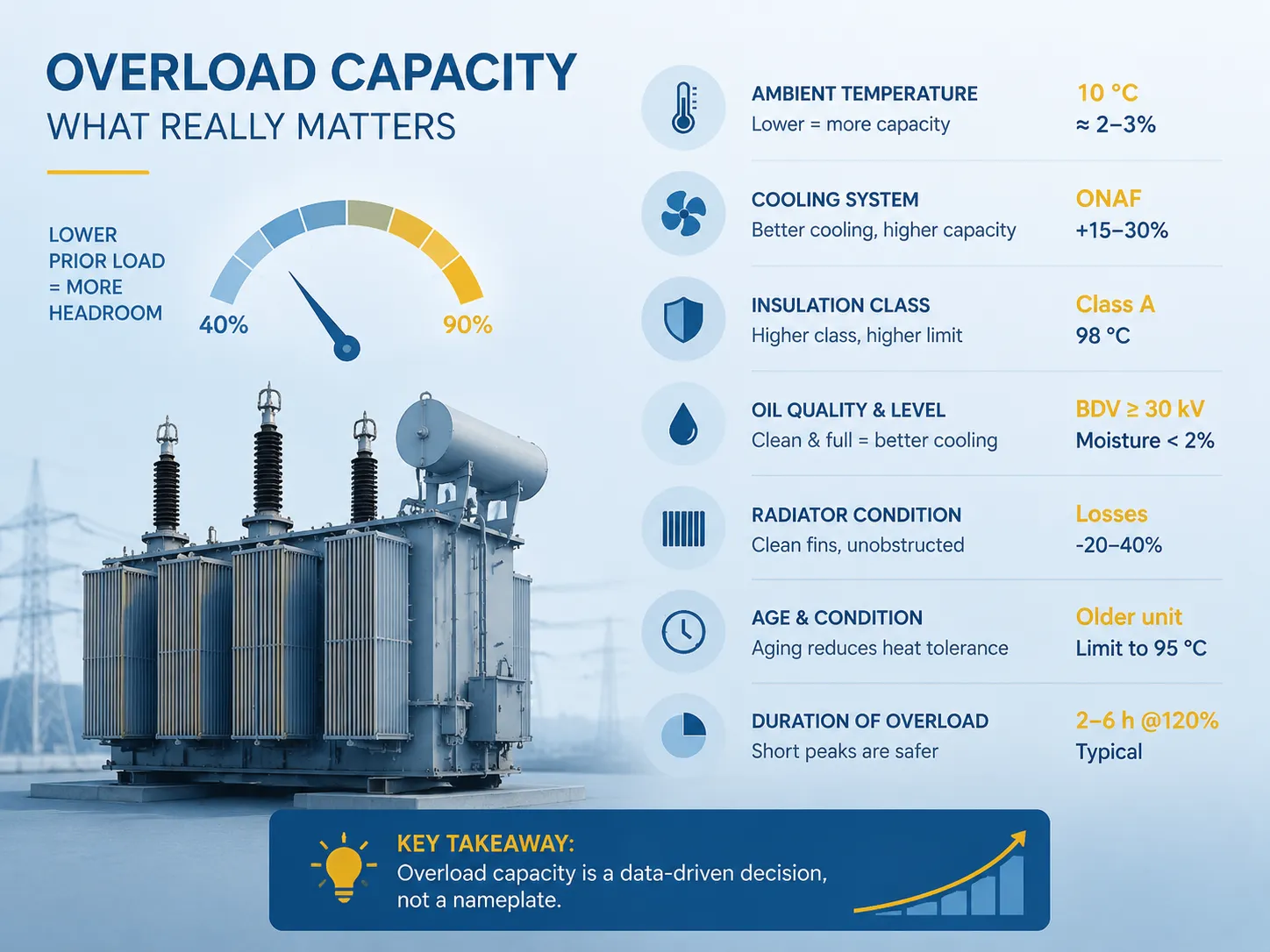
Faktoren, die die Überlastkapazität bestimmen
| Faktor | Einfluss auf die Überlastkapazität | Typische Werte |
|---|---|---|
| Vorherige Laststufe | Niedrigere vorherige Last = mehr thermische Reserve | 40% vorherige Last ermöglicht größere Spitzen als 90% |
| Umgebungstemperatur | Niedrigere Umgebungstemperatur erhöht den direkten Spielraum | Jede 10 °C Reduktion der Umgebungstemperatur fügt ungefähr 2–3% Kapazität hinzu |
| Kühlsystem (ONAN/ONAF/ONAN→ONAF) | Zwangsluft/Öl erhöht die Verlustabfuhr | ONAF fügt 15–30% Kapazität über ONAN hinzu |
| Isolierklasse | Systeme höherer Klassen tolerieren heißere Hot-Spots | Klasse A: 98 °C; Aramid: 220 °C Klasse |
| Ölqualität & -stand | Sauberes, volles Öl leitet Wärme besser ab | BDV ≥ 30 kV, Feuchtigkeit < 2% |
| Zustand des Radiators | Verstopfte Lamellen und Staub reduzieren die Kühlung um 20–40% | Jährlich inspizieren und reinigen |
| Alter & Zustand der Isolierung | Alte Isolierung toleriert weniger Hot-Spot-Exposition | Ältere Einheiten: zulässige Hot-Spot-Temperatur auf 95 °C reduzieren |
| Dauer der Überlast | Kurze Spitzen sind günstig; anhaltende Überlasten sind kostspielig | 2–6 h bei 120% typisch; anhaltende 120% verschlechtern sich schnell |
Praktische Auswirkung: Bei der Bestimmung der Überlastfähigkeit ist es besser, sich auf die Ihnen präsentierten Informationen zu verlassen als auf das Typenschild. Ein effizienter, gut gekühlter und leicht belasteter Transformator kann einige Stunden bei 130% betrieben werden. Im Gegensatz dazu sollte ein alter, staubiger Transformator, d.h. ein Transformator, der 30 Jahre alt ist und mit 90% belastet wird, als ohne Überlastfähigkeit betrachtet werden.
Die Standards: IEC 60076-7 vs. IEEE C57.91
| Aspekt | IEC 60076-7 | IEEE C57.91 |
|---|---|---|
| Umfang | Ladeleitfaden für ölgetauchte Leistungstransformatoren | Leitfaden für die Belastung von mineralölgetauchten Transformatoren |
| Grundprinzip | Relative Alterungsrate vs. Hot-Spot-Temperatur | Verbrauchte Isolierlebensdauer vs. Temperaturexposition |
| Referenz-Hot-Spot | 98 °C für thermisch verbessertes Papier | 110 °C “pro Einheit Lebensdauer” Referenz in vielen Tabellen |
| Ansatz | Vereinfachte und detaillierte thermische Modelle mit Lastfaktoren | Vollständiges thermisches Modell, Gleichungen für Ober-/Unteröl und Wicklung |
| Ausgaben | Zulässige Last- vs. Dauer-Tabellen und -Kurven | Lebensverbrauch und Lastkurven für die Planung |
| Am besten geeignet für | Europäische / internationale Projekte | Nordamerikanische Versorgungsunternehmen und Planungsingenieure |
Die beiden Normen erreichen identische ingenieurtechnische Schlussfolgerungen, formulieren sie jedoch unterschiedlich. IEC 60076-7 liefert direkte Werte für zyklische Belastung; IEEE C57.91 gibt Formeln für maßgeschneiderte thermische Modellierung. Man muss wissen, dass beide Normen existieren, diejenige verwenden, die für den Bereich und den Vertrag geeignet ist, und die gemeinsame Hauptanforderung beider Normen beachten, dass die exponierte heißeste Punkt-Temperatur mit der erforderlichen Isolationslebensdauer übereinstimmen muss.
Wie man die Überlastkapazität verbessert: 8 Methoden
| Methode | Wie es funktioniert | Kapazitätsgewinn | Typische Kosten |
|---|---|---|---|
| Kühlgebläse hinzufügen (ONAN→ONAF) | Zwangsluft erhöht die Radiatorabgabe | +15–30% | $2.000–$8.000 |
| Ölpumpen hinzufügen (ONAF→OFAF) | Zwangsölzirkulation verbessert den Wärmeübergang | +10–20% über ONAF | $5.000–$15.000 |
| Radiatoren reinigen & Kühlsystem reparieren | Stellt die Entwurfsabgabe wieder her | Stellt 20–40% verlorene Kühlung wieder her | $500–$3.000 |
| Radiatoren hinzufügen oder vergrößern | Mehr Oberfläche = mehr Wärmeabfuhr | +10–20% | $3.000–$12.000 |
| Überwachung des heißesten Punktes / Lastüberwachung installieren | Ermöglicht sichere, informierte Überlastnutzung | Ermöglicht volle Nutzung der tatsächlichen Kapazität | $15.000–$45.000 |
| Automatische lastbasierte Steuerung von Ventilatoren/Pumpen | Kühlung läuft nur bei Bedarf, schützt die Isolierung | Nutzt die verfügbare Kapazität präzise | $3.000–$8.000 |
| Hochtemperatur-Isolationssystem (Aramid/Ester) | Höhere zulässige heißeste Stelle | +20–40 °C Spielraum für heiße Stelle | +20–40% (Neubau) |
| Reduzierte Umgebung / verbesserte Belüftung | Kühler Luftstrom um die Einheit | ~2–3% pro 10 °C | Standortspezifisch |
Die kostengünstigsten Ansätze sind der erste Schritt: Einfache Prozesse wie Radiatorenreinigung, Ventilatorreparatur und regelmäßige Überprüfungen des Ölstands können bis zu 20-40% verlorene Kühlung für weniger als $3,000 wiederherstellen. Ein weiterer Schritt wäre die Verwendung zusätzlicher Ventilatoren und Pumpen, während die Investitionen bescheiden bleiben. Allerdings kann der Überwachungsprozess selbst die Kapazität nicht erhöhen, er kann sie nur ermöglichen.
Das System unter Überlast stabil halten
Die Überlastkapazität wird sich nur als effizient erweisen, wenn das System in der Lage ist, unter gefundenem Stress ordnungsgemäß zu funktionieren. Der bedeutendste Punkt ist die Spannungsregelung: Je mehr der Transformator belastet ist, desto mehr Spannung wird er verlieren, daher kann es vorkommen, dass der Transformator bei 125% der Nennleistung in der Situation ist, dass die nachgelagerte Spannung geringer ist als die zulässige, insbesondere am Ende langer Zuleitungen. Überprüfen Sie die Abgriffseinstellung und ziehen Sie in Betracht, automatische Spannungsregelung zu verwenden. In den meisten Fällen gibt es einen Spannungsabfall von 5% am Punkt des gemeinsamen Anschlusses, nach dem es zu einer Abweichung im Betrieb der Last kommen wird. Der zweite Punkt ist die Schutzkoordination: Die Relais-Einstellungen und die Eigenschaften des Überlastrelais sollten es ermöglichen, übermäßig belastet zu werden, ohne sich vom Netz zu trennen, jedoch muss es im Falle von Fehlern weiterhin funktionieren. Überprüfen Sie die Relaiskurve im Verhältnis zur thermischen Grenzwertkurve des Transformators, um zu verstehen, was unterhalb der Schadensgrenze bleibt, während es sich weiterhin unter Sicherheitsbedingungen befindet. Der dritte Punkt ist die Lastverteilung: Bei paralleler Betriebsweise von Transformatoren wird einer von ihnen aufgrund eines großen Unterschieds in den Impedanzen weniger effizient arbeiten.
Zusammenfassend ist die Zuverlässigkeit der Kühlung in Zeiten der Überlastung in Bezug auf die Sicherheit von äußerster Bedeutung. Zwangsbelüftung und Zwangsölkühlung selbst sind Lasten im Hilfsstrom des Standorts, und im Falle eines Ausfalls der Hilfsstromversorgung zu Spitzenzeiten wird der Transformator die Lüfter und Pumpen im Moment des Bedarfs abschalten.
| Stabilitätspraktiken | Was es verhindert | Typische Kosten | Priorität |
|---|---|---|---|
| Überprüfen Sie die Relaiskurven im Vergleich zur thermischen Grenzwertkurve | Fehlalarme und verpasste Fehlerbehebungen | Ingenieurzeit | Hoch |
| Spannungsabfallprüfung bei 125% Last | Unterspannung bei nachgeschalteten Lasten | Lastflussstudie | Hoch |
| Parallele Transformatorimpedanz/Tap-Korrektur | Ungleiche Lastverteilung, eine Einheit überlastet | $500–$3.000 | Mittel |
| Dual gespeiste / gesicherte Hilfsversorgung | Verlust von Lüftern/Pumpen während der Spitzenlast | $2.000–$15.000 | Mittel |
| Automatische Lastabwurf bei Kühlungsfehler | Isolationsschaden durch ungekühlte Überlast | $3.000–$8.000 | Hoch |
| Lastübertragung / Spitzenverschiebung | Anhaltende Überlast über dem Nennfenster | Betrieblich, niedrig | Hoch |
Anwendungen: Wenn Überlastkapazität wirklich wichtig ist
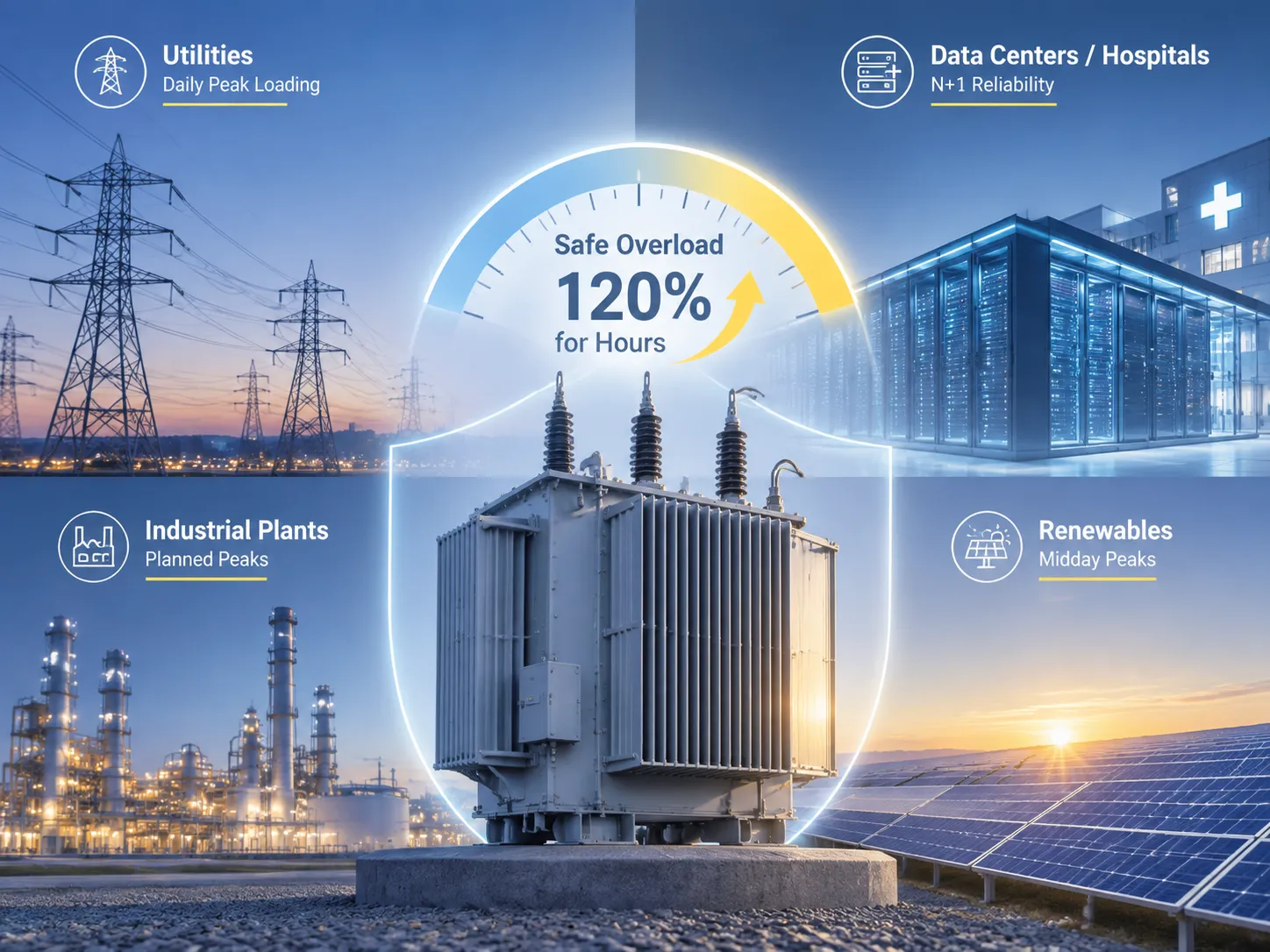
Verschiedene Branchen nutzen die Überlastkapazität unterschiedlich. Der Versorgungssektor verwendet täglich Zyklen; Verteiltransformatoren berücksichtigen typischerweise die maximale Last täglich, und die Praxis, während der Abendspitzenlast zwei bis drei Stunden bei 120% Kapazität zu arbeiten, ohne den Transformator zu gefährden, ist gut bekannt. Batch-Prozessindustrien haben regelmäßige Nachfragespitzen, wie wenn ein Ofen startet oder eine Maschine eingeschaltet wird – für diese Prozesse sind kurze Überlasten möglich, solange die thermische Kapazität der Anlage verstanden wird. Auf der anderen Seite arbeiten Krankenhäuser und Rechenzentren mit dem N+1-Konzept, was bedeutet, dass eine Überlastung des Transformators unter normalen Umständen vermieden wird, obwohl beim Umschalten zwischen verschiedenen Transformatoren der Übertragungsprozess vorübergehende Überlastbedingungen an den Transformatoren erzeugt, und diese Überlastfähigkeit wird als Sicherheitsvorteil im Prozess angesehen. Das Konzept der erneuerbaren Energiequellen bringt ebenfalls neue Herausforderungen mit sich, da Solaranlagen zur Mittagszeit Überlastungen erzeugen und nachts unterlastet sind, während thermisches Zyklen selbst mechanische Lasten auf Transformatoren beiträgt – heutzutage wird die Technik hochklassige Isolierung und Überwachung verwendet.
In allen Fällen ist der Algorithmus derselbe: Verstehen Sie die Eigenschaften der Last-Dauer-Kurve; berechnen Sie die maximale Last am heißesten Punkt; ermitteln Sie den Isolationszustand der Einheit – auf diese Weise helfen Überlasttabellen oder ein thermisches Modell zu verstehen, welches Niveau akzeptabel und sicher ist.
Ausrüstung, Lieferanten & Preisspannen
| Ausrüstung / Dienstleistung | Vertretende Lieferanten | Typischer Preisbereich | Anmerkungen |
|---|---|---|---|
| Kühlerlüfter & Steuerungen | Kelvion, Plexus, lokale OEMs | $2,000–$8,000 pro Transformator | Beinhaltet motorisierte Lüfter und Kontaktoren |
| Ölpumpen (erzwungene Ölzirkulation) | Kelvion, lokale OEMs | $5.000–$15.000 | Für OFAF/ODAF-Konversionen |
| Online Wickeltemperatur / heißester Punkt Überwachungen | Qualitrol, Doble, Maschinenfabrik Reinhausen (MR) | $15.000–$45.000 | Faseroptik oder modellbasiert |
| Lastüberwachung & Steuerrelais | Schneider Electric, ABB, GE | $1.500–$6.000 | Überlastalarm-/Steuerfunktionen |
| Ester-Öl / Aramid Hochleistungs-Transformatoren | Hitachi Energy, Siemens Energy, Jiangsu Subian Electric Power | $25,000–$60,000 (2,000 kVA Klasse) | Premium-Isolierung für Überlastbetrieb |
Die Preise hängen von den Spezifikationen und Regionen ab, daher sollten sie als Referenzwerte verwendet werden. Die weltbekannten Marken — Qualitrol und MR für Überwachung, Kelvion für Kühlung und Schneider/ABB für Steuerungen — setzen den Maßstab und diese Preise spiegeln diese Tatsache wider. Endbenutzer können Transformatoren kaufen, die für Hochüberlastanwendungen (mit verbesserter Kühlung, erstklassiger Isolierung und maximalen Entwurfsreserven) von Unternehmen wie Jiangsu Subian Electric Power produziert werden, die die IEC 60076 einhalten und hochwertige Verteilungs- und Leistungstransformatoren mit Kühl- und Isolierungssystemen entwerfen, die für Schwerlastprozesse geeignet sind — der Preis kann bekannt sein und von 20% bis 40% vom europäischen Durchschnitt abweichen. Unabhängig davon, was gekauft wird, muss die Spezifikation Informationen über das zyklische Lastprofil enthalten, damit der Hersteller diese Daten in die qualitative Berechnung der Kühl- und Isolierungsreserve einbeziehen kann.
Häufig gestellte Fragen
Wie viel Überlast kann ein Transformator sicher tragen?
Die maximale Kapazität, die ein Transformator bewältigen kann, variiert je nach vielen Faktoren, wie der Nennlast, der Erwärmung, der Kühlung und anderen Faktoren. Als Faustregel gilt jedoch, dass ein typischer Transformator mit der Nennleistung ONAN normalerweise 120-130% der Nennkapazität unter normalen Bedingungen zwei bis sechs Stunden lang betreiben kann. Im Falle von Transformatoren mit Luftkühlung (ONAF) haben sie 15-30% zusätzliche Kapazität. Im Durchschnitt liegt die Begrenzung in der Temperatur des heißesten Punktes, die nicht mehr als 110 °C betragen sollte.
Was bewirkt Überlast für die Lebensdauer der Transformatorisolierung?
Laut der “6-Grad-Regel” kann die Isolierung von Transformatoren, die aus thermisch verbesserten Papier hergestellt sind, berechnet werden, da sich die Lebensdauer der Isolierung für jede sechs Grad über der Nenn-Temperatur (von 98 °C) verdoppelt. Wenn die Temperatur auf 110 °C steigt, wird die Lebensdauer der Isolierung 4-8 Mal so hoch sein wie bei 98 °C und bei 130 °C – irgendwo zwischen 30 und 100 Mal. In diesem Fall hat eine moderate Überlast keinen Einfluss auf die Lebensdauer des Transformators, aber eine schwere Überlast wird seine Lebensdauer verkürzen.
Kann ich die Kühlung eines bestehenden Transformators hinzufügen, um die Überlastkapazität zu verbessern?
Typischerweise ja. Dies ist eine kosteneffektive Lösung, die die Kapazität des Transformators erhöhen kann, indem sein Kühlsystem von ONAN auf ONAF geändert oder die blockierten Radiatoren gereinigt und die Lüfterkühlgeräte repariert werden. Weitere Optionen sind die Installation eines Ölkühlsystems (OFAF). Es ist wichtig, die Spezifikationen des Transformators zu klären und die Modifikationen aus technischer Sicht zu bestätigen, bevor Änderungen am Kühlsystem vorgenommen werden.
Was ist der Unterschied zwischen ONAN, ONAF und OFAF Kühlung?
Der Unterschied zwischen ONAN, ONAF und OFAF besteht darin, dass sie IEC-Kühlbezeichnungen sind. ONAN erzeugt natürliche Kühlung mit Öl, das in einem Transformator zirkuliert; ONAF fügt künstliche Kühlung mit Luft hinzu und OFAF bietet erzwungene Kühlung mit Öl. Je höher die Kühlklasse, die dem Transformator zugewiesen wird, desto mehr Wattage-Kapazität erreicht er.
Soll ich einen Transformator für die Spitzenlast oder die Durchschnittslast dimensionieren?
Es ist ein Fehler, sich hauptsächlich um einen dieser Ansätze zu kümmern. Zunächst ist es wichtig zu klären, inwieweit die durchschnittliche Last im Hinblick auf die durch den Transformator erzeugten Spannungsverluste zulässig ist. Zum Beispiel sollte bei dem Versuch, die durchschnittliche Last zu identifizieren, beachtet werden, dass selbst wenn ein Transformator mit durchschnittlicher Last arbeitet, er zu bestimmten Zeiten dennoch die maximale Spannung verbrauchen kann. Für die zuverlässige Identifizierung der Betriebsstrategie ist es ratsam, fortschrittlichere Werkzeuge wie die regulatorischen IEC-Normen zu verwenden.
Referenzen
- IEC 60076-7: Leistungstransformatoren – Teil 7: Lastleitfaden für ölgetauchte Leistungstransformatoren — die internationale Norm für zulässige Lasten und die Bewertung zyklischer Überlastungen.
- IEEE C57.91: Leitfaden für die Belastung von mineralölgetauchten Transformatoren — der nordamerikanische Lastenleitfaden mit thermischen Modellen und Lebensverbrauchsmethoden.
- IEC 60076-2: Leistungstransformatoren – Teil 2: Temperaturerhöhung — definiert Temperaturerhöhungsgrenzen, die die Überlastfähigkeit begrenzen.
- IEEE C57.140: Bewertung und Wiederaufbereitung von flüssigkeitsgetauchten Leistungstransformatoren — Lebensverbrauchsmethodik für zustandsbasierte Lastentscheidungen.
- IEC 60156: Durchschlagspannung von Isolierflüssigkeiten — Ölzustandstest, der für die thermische und elektrische Integrität während der Überlast relevant ist.
- Maschinenfabrik Reinhausen (MR) — Anbieter von Lastwechseln und Überwachungsgeräten für den Betrieb von belasteten Transformatoren.
- Jiangsu Subian Electric Power — IEC 60076-konformer Transformatorenhersteller, der verbesserte Kühl- und Isolationsoptionen für schwere zyklische Belastungen anbietet.
Fazit
Reale und quantifizierbare Ressource, die Überlastkapazität von Transformatoren ist eine weitgehend ungenutzte Ressource von Betreibern, da sie die Temperatur des heißesten Punktes nicht identifizieren können. Die Wissenschaft dahinter ist einfach: Die Überlast wird durch die Lebensdauer der Isolierung begrenzt, die sich bei jeder Erhöhung um 6 °C von der Temperatur des heißesten Punktes von 98 °C halbiert. Die Technologie ist verfügbar: IEC 60076-7 und IEEE C57.91 Lastrichtlinien und Standards; Aktualisierung des Kühlsystems, hochwertigere Isolierung und Fernüberwachungssysteme. Die wirtschaftliche Seite des Problems begünstigt die informierte Nutzung: Ausgaben von $2.000–$8.000 für die Kühlventilatoren und $15.000–$45.000 für das Fernüberwachungssystem können helfen, eine Ausgabe von $50.000–$500.000 für den Kauf von Transformatoren zu vermeiden.
- Es ist die Temperatur des heißesten Punktes, die bestimmt, wie viel Kühlkapazität der Transformator unterstützen kann.
- Reinigen Sie zuerst die Radiatoren und reparieren Sie die Kühlsysteme — es ist der günstigste Weg, die Kapazität zu erhöhen.
- ONAN→ONAF-Umwandlung bietet zusätzliche 15–30% Kapazität für $2.000–$8.000.
- Verwenden Sie die Tabellen und Modelle von IEC 60076-7 / IEEE C57.91, bevor Sie über Überlast nachdenken.
- Überwachen Sie die Temperatur des heißesten Punktes von entscheidenden Transformatoren und halten Sie die Hilfskühlversorgung stabil.
- Definieren Sie das zyklische Lastprofil im Voraus — Jiangsu Subian Electric Power stellt Einheiten her, die den IEC-Standards entsprechen.