


In ihrem Versuch, den fünfjährigen Investitionsplan des südostasiatischen Versorgungsunternehmens zu aktualisieren, erhielt die Nachhaltigkeitsdirektorin eine wichtige Nachricht von ihren Analysten: Etwa 6% des von dem Versorgungsunternehmen übertragenen Stroms gingen in seinen eigenen Transformatoren verloren, wobei der Großteil von Transformatoren stammte, die vor 2005 installiert wurden. Daher war der Austausch oder die Aufrüstung von Transformatoren kein Wohltätigkeitsfall, sondern einfach der günstigste Strom, den das Versorgungsunternehmen jemals erwerben konnte. Gleichzeitig las die Nachhaltigkeitsdirektorin des chinesischen staatlichen Netzbetreibers über dieselben Entwicklungen, jedoch aus einer anderen Perspektive: Bei der Erstellung von Beschaffungsausschreibungen wurden die Umweltfaktoren berücksichtigt, und alle Fabriken, die keinen Nachweis erbringen konnten, dass ihre Produktionsprozesse “kohlenstofffrei” waren, verschwanden von der Bieter-Liste. So lebten beide Frauen durch denselben globalen Wandel, und das sind die heutigen dualen Kohlenstoffziele, die die Arbeit der gesamten Transformatorenindustrie beeinflussen.
Was die dualen Kohlenstoffziele sind
Die dualen Kohlenstoffziele sind Chinas wichtigste Klimaverpflichtungen: der Höhepunkt der Kohlendioxidemissionen bis 2030 und die Erreichung der Kohlenstoffneutralität bis 2060. Diese Ziele wurden im September 2020 angekündigt und haben die Rolle der Leitprinzipien für die Fertigungs-, Energieerzeugungs- und Exportindustrien des Landes übernommen. Der entwickelte “1+N”-Politikrahmen verbindet die nationalen Ziele mit branchenspezifischen Zielen wie Energieproduktion, grüne Fertigung, Energieeffizienz und anderen Mechanismen wie Kohlenstoffpreisen und grünen Stromzertifikaten.
Was die Transformatorenindustrie betrifft, stellen die dualen Kohlenstoffziele kein abstraktes Konzept dar. Jede Phase der Prozesskette soll die Emissionen messen und begrenzen, die sie erzeugt: Der Stahl und das Kupfer, die zur Herstellung eines Transformators verwendet werden, enthalten bereits verkörperten Kohlenstoff; die Fabrik benötigt Energie; zudem nutzt ein Transformator seinen Anteil an jedem Megawatt, das von ihm verarbeitet wird.
| Meilenstein | Datum | Konsequenz der Transformatorenindustrie |
|---|---|---|
| Ankündigung der dualen Kohlenstoffziele | September 2020 | Rahmen festgelegt; sektorale Pläne beginnen |
| GB 20052 Effizienzklassen in Kraft | 2020–2021 | Klasse 2 wird zur Basislinie für Verteiltransformatoren |
| Kohlenstoffspitzenziel | Vor 2030 | Reduzierung der Netzverluste beschleunigt; grüne Beschaffung erweitert sich |
| Ziel der Kohlenstoffneutralität | Vor 2060 | Amorphe Kerne und grüne Fabriken werden zum Standard |
Die Daten sind wichtig, da Beschaffungsentscheidungen, die jetzt getroffen werden, für 25–35 Jahre bindend sind — ein heute bestellter Transformator wird weiterhin auf den Horizont der Kohlenstoffneutralität hinarbeiten.
Warum Transformatoren im Zentrum des Problems stehen
Transformatoren spielen eine Schlüsselrolle in den meisten Prozessen innerhalb des Elektrizitätssystems — von der Erzeugung über die Übertragung und Verteilung bis hin zur Endnutzung. Nationale Stromnetze verwenden Hunderttausende von Transformatoren, wobei jeder einzelne Ineffizienzen aufweist, die zu Verlusten bei der Nutzung von Elektrizität führen.
Untersuchungen zu den Verlusten in Transformatoranlagen zeigen, dass die Verluste bei der Elektrizitätsübertragung etwa 5-8% erreichen. Das bedeutet auch, dass die Verluste der Transformatoren einen erheblichen Teil dieser Zahl ausmachen.
Solche Verluste sind aus zwei Gründen signifikant. Erstens handelt es sich um verschwendete Elektrizität im System, die von einem kohlenstoffarmen System nicht toleriert werden kann, da jeder Watt Elektrizität produziert, übertragen und bezahlt wird. Zweitens ist es eine konzentrierte und nachweisbare Verlustquelle, da es keine Probleme gibt, Transformatoren zu finden und zu reparieren, im Gegensatz zu anderen Arten von Verlusten im Elektrizitätssystem. Deshalb ist die Effizienz von Transformatoren eines der häufigsten Themen, die in verschiedenen Strategien zur Energieeffizienz und Kohlenstoffreduzierung berücksichtigt werden, wie zum Beispiel im EU-Ecodesign und im chinesischen Bewertungssystem.
Das Verlustinventar: Wo die Emissionen von Transformatoren leben
Transformatorverluste lassen sich in zwei Kategorien unterteilen, und die Kohlenstoffbilanz behandelt sie unterschiedlich:
| Verlusttyp | Ursache | Wann es auftritt | Kohlenstoffauswirkung |
|---|---|---|---|
| Leerlauf (Kern)verlust | Magnetisierung des Stahlkerns | 24 Stunden am Tag, während er unter Spannung steht | Dominant in leicht belasteten Netzen; konstante Emissionen |
| Last (Kupfer)verlust | Strom durch Wicklungen | Skaliert mit dem Quadrat der Last | Dominant bei hohem Lastfaktor |
| Verkörperter Kohlenstoff | Stahl-, Kupfer-, Ölproduktion | Bei der Herstellung | Einmalig; 5–15% der Lebenszyklusemissionen für eine langlebige Einheit |
| Lebensende | Ölentsorgung, Recycling | Bei der Stilllegung | Reduziert durch Esteröl und recycelbare Designs |
Was daraus klar wird, ist, dass in den meisten Fällen der während des Lebenszyklus von Transformatoren emittierte Kohlenstoff auf Leerlaufverluste zurückzuführen ist, da Transformatoren kontinuierlich mit Elektrizität versorgt werden, aber selten mit voller Kapazität genutzt werden. Zum Beispiel wird ein Transformator mit einer Nennleistung von 400 kVA, der mit einer durchschnittlichen Last von 30% läuft, aufgrund von Verlusten durch seinen Kern mehr Energie verbrauchen als aufgrund von Verlusten durch seine Wicklungen in den meisten Monaten. Genau aus diesem Grund konzentrierten sich die ersten Regelungen im Bereich energieeffizienter Transformatoren auf Kernverluste.
Technologische Hebel: Kerne, Öle und Design
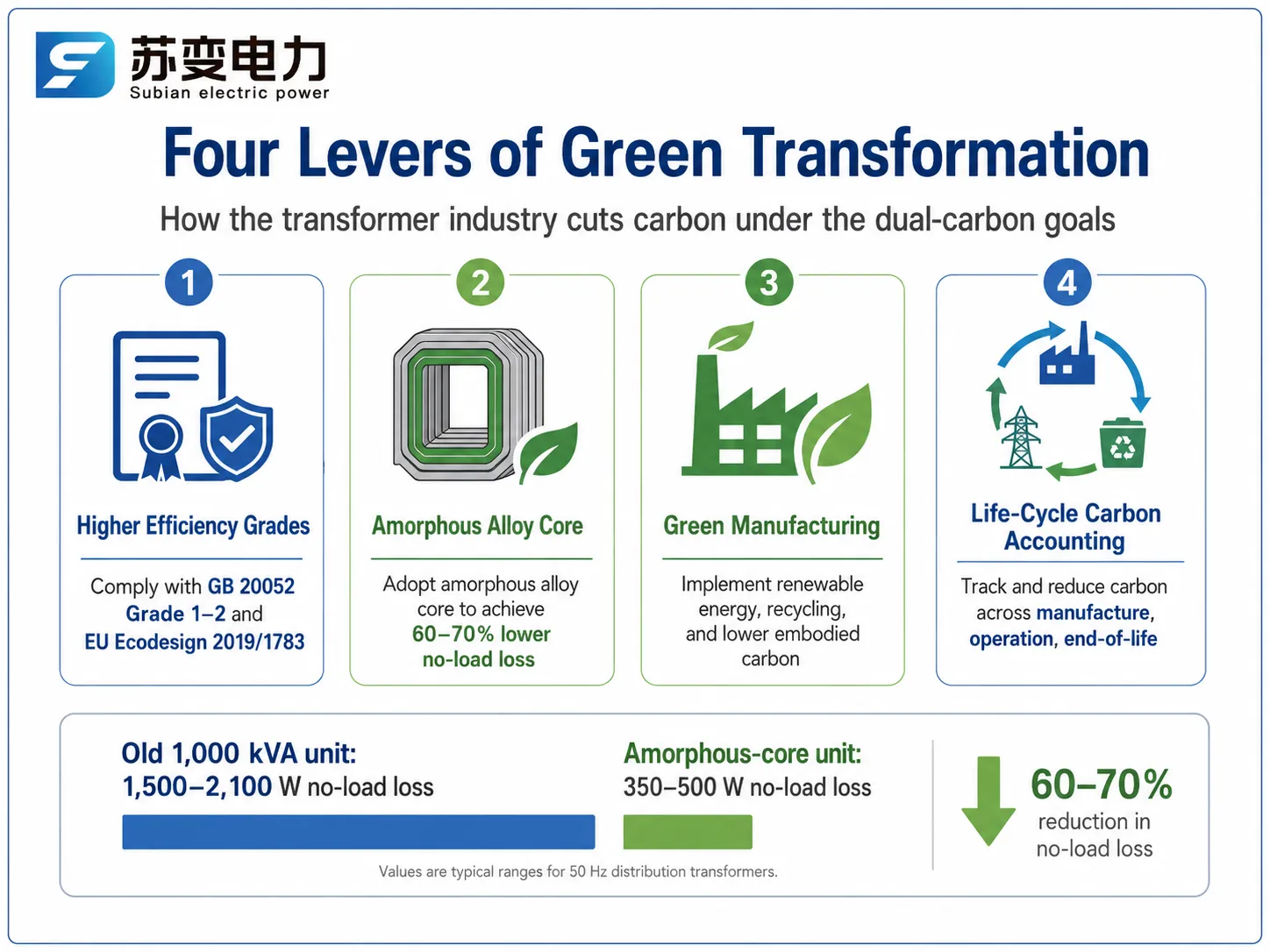
Technologie ist der Bereich, in dem die grüne Transformation der Transformatorenindustrie gewonnen wird. Vier Hebel, grob nach Einfluss auf den Leerlaufverlust geordnet:
| Technologie | Einfluss auf den Leerlaufverlust | Erstkosten-Effekt | Kohlenstoffbegründung |
|---|---|---|---|
| Hochpermeables GOES, 0,23–0,27 mm | 15–25% niedriger als Standardqualität | +3–6% | Weniger Stahlverlust pro kWh geliefert |
| Amorpher Metallkern | 60–70% niedriger als konventionell | +20–40% | Größter einzelner Hebel für den 24/7-Betrieb |
| Natürlicher Ester (pflanzliches) Öl | Neutral elektrisch | +10–15% | Biologisch abbaubar, geringeres Brandrisiko, geringerer verkörperter Kohlenstoff im Vergleich zu Mineralöl |
| Verlustarme Wicklung (größerer Leiter) | Lastverlust um 10–20% gesenkt | +2–5% | Relevant für stark belastete Transformatoren |
Amorphe Legierung ist die Flagship-Technologie der Dual-Kohlenstoff-Ära in Verteilungstransformatoren. Da der Leerlaufverlust des Bandes dramatisch niedriger ist, spart eine amorphe Kern 1.000 kVA Einheit ungefähr 500–700 W im Vergleich zu einer konventionellen hocheffizienten Einheit — etwa $440–$610/Jahr bei $0,10/kWh oder $5.000–$7.000 im Barwert über 15 Jahre. Es ist die Technologie, die in chinesischen Anreizprogrammen am häufigsten genannt wird und die am wahrscheinlichsten verpflichtend wird, wenn die Anforderungen an die Klasse 1 strenger werden.
Grüne Fertigung: Der eigene Fußabdruck der Fabrik
Das Ziel der dualen Kohlenstoffstrategie erstreckt sich auf den Produktionsprozess. Das System der grünen Fertigung bewertet Fabriken auf der Grundlage ihres Energieverbrauchs pro Output sowie auf der Menge an erneuerbarer Energie, die verwendet wird, und der effizienten Nutzung von Ressourcen wie Wasser, Recycling von Abfallprodukten und Emissionen von Schadstoffen. Hersteller streben diese Zertifizierung nicht nur wegen des Labels an, das sie erhalten, sondern auch, weil die Beschaffung durch das staatliche Netz und Versorgungsunternehmen Lieferanten bevorzugt, die über die Zertifizierung verfügen.
Die Maßnahmen, die auf Fabrikebene ergriffen werden, sind wie folgt:
Energie-trocknende Öfen und Testböden, die mit Strom aus erneuerbaren Quellen betrieben werden, was die Emissionen in Scope 1 und Scope 2 reduziert.
Recycling und Wiederverwendung von Öl, Stahlresten und Kupferschrott aus Wicklungs- und Kernoperationen.
Installation von Messmaschinen zur Messung des Energieverbrauchs während des Produktionsprozesses und zur Erfassung von Informationen über Emissionen, bevor das Unternehmen einen Jahresbericht einreicht.
Nutzung von umweltfreundlichen Esterölen sowohl in den Werkstätten als auch als Konstruktionsoption für die Produkte.
Die aufgeführten Operationen beeinflussen den Grad der Emissionen, die bei der Herstellung von Transformatoren entstehen — was 5-15% ihrer gesamten Lebenszyklus-Emissionen ausmacht, somit für ein einzelnes Stück unbedeutend, aber bemerkenswert für die jährliche Produktion von Tausenden von Transformatoren und zunehmend eine Anforderung für die Lieferanten, die sich um grüne Ausschreibungen bewerben.
Politische Hebel: Klassen, Ausschreibungen und Subventionen
Die Übersetzung von Technologie in den Marktstatus erfolgt mit Hilfe von Politik. Die Haupttreiber des Prozesses bestehen aus:
Effizienzbewertungen: GB 20052 Bewertungen, die von 1 bis 3 für Verteilungstransformatoren reichen, wobei der Mindesteffizienzstandard Klasse 2 ist, während in vielen öffentlichen Beschaffungsprogrammen die maximale Effizienzklasse, d.h. Klasse 1 (amorphe Art), entweder eine Anforderung ist oder für finanzielle Unterstützung qualifiziert.
Mindestanforderungen an die Effizienz im Handel: Der EU-Ecodesign-Standard 2019/1783 ist ein bedeutendes Gesetz, das die Mindestanforderungen an die Effizienz von Straßenlaternen regelt (der Standard tritt ab Mitte Juli 2024 in Kraft), während die Einhaltung der Anforderungen unter den DOE-Vorschriften den Marktzugang garantiert.
Bewertung der grünen Beschaffung: In Ausschreibungen gewichten Elektrizitätsverteilungsunternehmen die Effizienzbewertung, die Art des verwendeten Öls und die Werkszertifizierung, was etwa 5-10% der Gesamtbewertung ausmacht.
Kohlenstoffmärkte und Zertifikate: Die Effizienz von grünen Zertifikaten und möglichen Kohlenstoffpreisbildungsmechanismen erhöht die Wirksamkeit der vermiedenen Verluste im Laufe der Zeit.
Der Ratscheneffekt tritt mit den aktuellen Aktualisierungen des Bewertungsmusters auf, die die Basis erhöhen, während der Betrieb von Anreizen die besten Effizienztechnologien in der Massenproduktion vorantreibt, was deren Preis senkt und die nächste Verschärfung erschwinglich macht.
Ein Fahrplan für die grüne Transformation
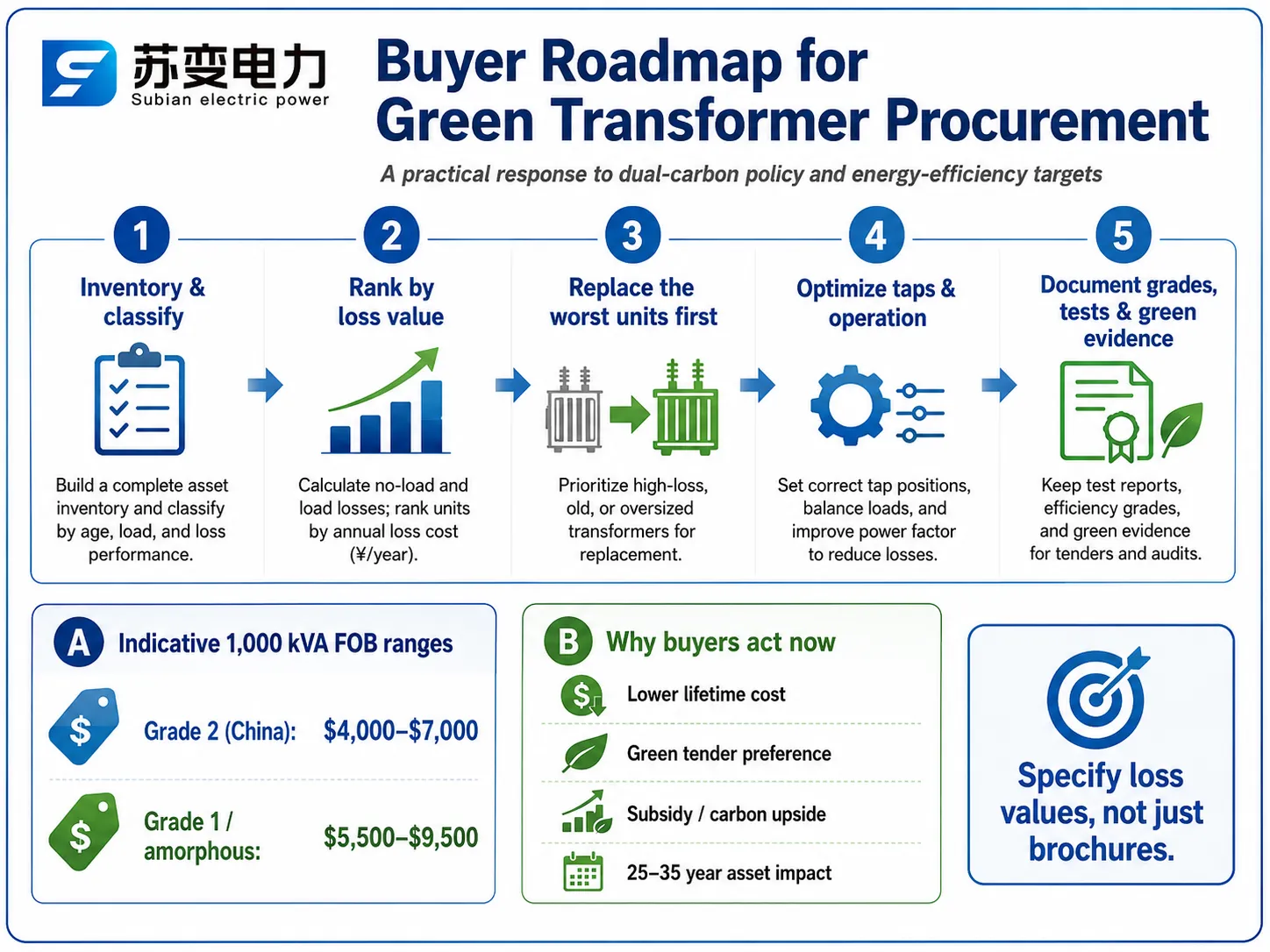
Für eine Organisation, die über einen Transformatorenpark verfügt, folgt die grüne Transformation einer praktischen Reihenfolge:
| Flottenkategorie | Typischer Zustand | Empfohlene Maßnahme |
|---|---|---|
| Einheiten vor 2000, hohe Leerlaufverluste | 500–2.100 W pro 1.000 kVA | Zuerst ersetzen — beste Verluste und Kohlenstoffrendite |
| Einheiten von 2000–2010, moderate Verluste | Innerhalb älterer Standards | Ersetzen oder umfunktionieren; nach Lastfaktor priorisieren |
| Moderne Einheiten der Klasse 2 | 700–1.100 W pro 1.000 kVA | Behalten; Taps optimieren und Parallelbetrieb sicherstellen |
| Einheiten der Klasse 1 / amorphe Einheiten | 350–500 W pro 1.000 kVA | Behalten und überwachen; als Best Practice benchmarken |
Bestandsaufnahme durchführen und alle Spezifikationen von Transformatoren aus der Transformatorendatenbank kategorisieren, einschließlich Typenschild, Alter, Verluste, Lastmerkmale und Standort.
Verlustranking zur Priorisierung anwenden: Verlustkapitalisierungsmethodik zur Bewertung von Einheiten auf jährliche Kosten von Leerlauf- plus Lastverlust anwenden; im Allgemeinen machen die wenigsten 20% der Einheiten 50% und mehr der gesamten Flottenverluste aus.
Zuerst die ineffizientesten ersetzen: Der Austausch von Transformatoren aus den 1990er und frühen 2000er Jahren konzentriert sich auf “A”-Level-Austausche unter Verwendung amorpher Kerne, wenn diese durch Last und Betriebsstunden gerechtfertigt sind.
Operative Optimierung durchführen: Nachjustierungen, Neuausbalancierung der in Schulen angeschlossenen Einheiten und sorgfältige Dimensionierung der Einheiten verursachen minimale Kosten und führen zu sehr schnellen Ergebnissen und Effekten.
Sammeln und beanspruchen: Halten Sie regelmäßige Testberichte, Nachweise der Effizienzklasse und alle berechtigten grünen Subventionen oder Beschaffungspräferenzen, die durch anwendbare Bundeszuschüsse bereitgestellt werden.
Optionen und Preise für grüne Transformatoren
Richtpreis für einen 1.000 kVA 10/0,4 kV energieeffizienten Verteilungstransformator, FOB nach Marke und Technologie:
| Marke | Herkunft | Klasse 2 (GOES) | Klasse 1 / amorpher Kern |
|---|---|---|---|
| Hitachi Energie | Japan/Weltweit | $9.000–$12.500 | $12.500–$18.000 |
| ABB | Schweiz/Weltweit | $8.500–$12.000 | $12.000–$17.000 |
| Siemens Energie | Deutschland/Weltweit | $8.000–$11.500 | $11.500–$16.500 |
| Schneider Electric | Frankreich/Weltweit | $7.500–$11.000 | $11.000–$15.500 |
| Jiangsu Subian Electric Power | China | $4.000–$7.000 | $5.500–$9.500 |
Die Preise variieren je nach Verlustklasse, Lastschalter, Esteröloption, Kupferpreisen und Lieferbedingungen; betrachten Sie diese als Planungsbereiche, nicht als feste Angebote.
Globale Marken verankern die Premium-Kategorie mit tiefen Servicenetzwerken und umfangreichen Typprüfprogrammen. Die Wettbewerbsstory der chinesischen Fertigung unter dem Dual-Carbon-Regime ist, dass die gleichen Effizienzklassen und grünen Credentials zu 40–50% niedrigeren Erstkosten führen, was jede Amortisationsberechnung verkürzt. Jiangsu Subian Electric Power ist ein chinesischer grüner Transformator Hersteller und Transformatorenhersteller zertifiziert als grüne Fabrik, die GB 20052 Klasse 1–2 flüssigkeitsgetauchte, trockene und amorphe Transformatoren von 10 kVA bis 63 MVA produziert, getestet nach IEC 60076 und mit Routinetestberichten versendet. Subian hat energieeffiziente Flotten an Versorgungsunternehmen und Industrieparks in Asien, Afrika, dem Nahen Osten und Südamerika geliefert, und sein grünes Sortiment ist dokumentiert auf subian-electric.com.
Wie Käufer reagieren sollten
Der duale Kohlenstoffpfad muss von Käufern als wesentlicher Bestandteil der Beschaffung betrachtet werden, anstatt als Marketingstrategie erwähnt zu werden:
Nennen Sie die Klasse anstelle des Marketingdokuments: Fügen Sie die GB 20052 Klasse oder die EU-Stufe in die Anfrage ein und stellen Sie sicher, dass sowohl die Leerlauf- als auch die Lastverlustwerte in der Antwort angeboten werden.
Berechnen Sie den Wertverlust jedes Mal, wenn ein Gerät erworben wird, damit eine “günstige” hochverlustige Version nicht mit “teuren” niederverlustigen konkurrieren kann, aufgrund der niedrigeren Gesamtkosten des Eigentums.
Wählen Sie amorphe Kerne und Esteröl in Fällen, in denen der Lastfaktor, das Brandrisiko oder die Nachhaltigkeitsberichterstattung deren Verwendung rechtfertigen.
Anfrage nach Umweltbeweisen: Jetzt zählen auch Produktions-, Anteil an grüner Energie und Kohlenstoffdokumente.
Planen Sie Ersatzteile gemäß den Vorschriften: Der Austausch von Geräten, die beim nächsten Aktualisierungsdatum nicht mehr konform sein werden, hilft, den Erwerb nicht konformer Vermögenswerte zu vermeiden.
Organisationen, die diesen Prozess befolgen, erhalten drei Hauptvorteile: niedrigere Betriebskosten, einfachere Compliance und eine praktische Nachhaltigkeitsgeschichte.
Häufig gestellte Fragen
Was sind Chinas duale Kohlenstoffziele genau?
China hat sich verpflichtet, seine Kohlenstoffdioxidemissionen vor 2030 zu erreichen und bis 2060 Kohlenstoffneutralität zu erreichen. Die Ziele treiben die sektorale Politik durch einen “1 + N”-Ansatz voran, der Energie, Industrie, Verkehr und grüne Fertigung umfasst, mit Maßnahmen wie Effizienzbewertungen von Transformatoren, Zertifizierung als grüne Fabrik und Ansätze für den Kohlenstoffmarkt.
Wie viel Energie verschwendet ein ineffizienter Transformator?
Ein 1.000 kVA Transformator aus den 1990er Jahren verschwendet typischerweise 1.500–2.100 W im Leerlauf – etwa 13.000–18.000 kWh pro Jahr, was $1.050–$1.800 bei $0.08–$0.10/kWh entspricht. Ein modernes Gerät der Klasse 2 halbiert diesen Wert und ein amorpher Kern reduziert ihn auf 350–500 W, etwa ein Viertel des Originals.
Ist ein Transformator mit amorphem Kern den Aufpreis wert?
In kontinuierlich belasteten Anwendungen, ja. Der 20–40% Erstkostenaufschlag wird durch 60–70% niedrigeren Leerlaufverlust in 4–8 Jahren bei typischen Industrietarifen zurückgewonnen, und die Einsparungen summieren sich über 25–35 Jahre Lebensdauer. An leicht belasteten, saisonalen Standorten ist ein Gerät der Klasse 2 GOES oft das wertoptimale.
Wie viel kosten grüne Transformatoren?
Eine 1.000 kVA Einheit der Klasse 2 kostet etwa $4.000–$7.000 FOB von chinesischen Herstellern; amorphe Kernversionen der Klasse 1 kosten $5.500–$9.500. Premium-Marken aus Europa und Japan liegen typischerweise 50–80% höher. Die Preise variieren je nach Zubehör, Esteröl-Option und Kupferpreisen.
Was ist eine grüne Fabrik in der Transformatorenindustrie?
Eine grüne Fabrik ist ein Produktionsstandort, der nach Chinas grünem Fertigungssystem für niedrigen Energieverbrauch pro Produktionseinheit, Anteil erneuerbarer Energien, Wasser- und Abfallmanagement sowie Recycling zertifiziert ist. Für Transformatorenkäufer signalisiert ein Zertifikat für grüne Fabriken einen geringeren verkörperten Kohlenstoff und wird zunehmend in Ausschreibungen von Versorgungsunternehmen und der Regierung gewichtet.
Referenzen
- Chinas Programm zur dualen Kohlenstoffarbeit (CN) — Der offizielle politische Rahmen für Spitzen- und Neutralitätsziele.
- GB 20052: Energieeffizienzklassen für Leistungstransformatoren — Der Effizienzgradstandard im Zentrum von Chinas Transformatorenpolitik.
- EU-Ecodesign-Verordnung 2019/1783 — EU-Anforderungen an die Effizienz von Transformatoren, die in die gleiche Richtung ausgerichtet sind.
- IEC 60076-1: Leistungstransformatoren – Allgemeines — Internationaler Testmaßstab für die Leistung von Transformatoren.
- IEA-Programm zur Energieeffizienz — Daten zu Netzverlusten und der Effizienzpolitik von Transformatoren.
- MIIT grünes Fertigungssystem — Chinas Bewertung und Zertifizierungsrahmen für grüne Fabriken.
- Offizielle Website von Jiangsu Subian Electric Power — Zertifizierung von grünen Fabriken und energieeffiziente Transformatorenreihe.
Fazit
Die dualer Kohlenstoff Ziele geben der Transformatorenindustrie ein klares Ziel und einen strengen Zeitplan. Der Weg der grünen Transformation ist konkret: Senken Sie die Leerlaufverluste mit besseren Kernen, senken Sie den verkörperten Kohlenstoff mit grüneren Fabriken und lassen Sie die Politik — Effizienzgrade, grüne Beschaffung, Kohlenstoffmärkte — die Wirtschaftlichkeit funktionieren. Die Technologie existiert, die Amortisation ist dokumentiert, und die Richtung ist einseitig.
Wichtige Erkenntnisse:
- Transformatorenverluste sind ein konzentrierter, adressierbarer Anteil der Netzverluste — ideale erste Ziele für die Kohlenstoffreduzierung.
- Amorphe Kerne senken die Leerlaufverluste um 60–70%; die Zertifizierung als grüne Fabrik senkt den verkörperten Kohlenstoff an der Quelle.
- Amortisationszeiten von 3–8 Jahren für Ersatzteile der Klasse 1–2, plus Zuschüsse und Vorteile bei der Beschaffung.
- Käufer sollten Effizienzgrade spezifizieren, die Kapitalisierung von Verlusten durchführen und nach grünen Nachweisen fragen.
Wenn Ihre Flotte ein Effizienz-Upgrade benötigt, Jiangsu Subian Electric Power — eine zertifizierte grüne Fabrik — liefert GB 20052 Klasse 1–2 und amorphe Kerntransformatoren, die nach IEC 60076 zu exportfreundlichen Preisen getestet wurden. Überprüfen Sie die Reihe unter subian-electric.com.