


Beide Transformatoren sind hinsichtlich der Leistung, der Spannungsbewertung und der Leistungsparameter gleich und gehören zur gleichen Effizienzklasse. Allerdings wiegt einer der Transformatoren trotz identischer technischer Parameter etwa 40% mehr als der andere Transformator und kostet fast 20% mehr, ist jedoch betriebsbereit, während der andere Transformator bereits ersetzt wurde. Dies hängt mit den Wickelleitern zusammen, die zu den Materialfaktoren in allen Transformatoren gehören, nur nach dem Kern.
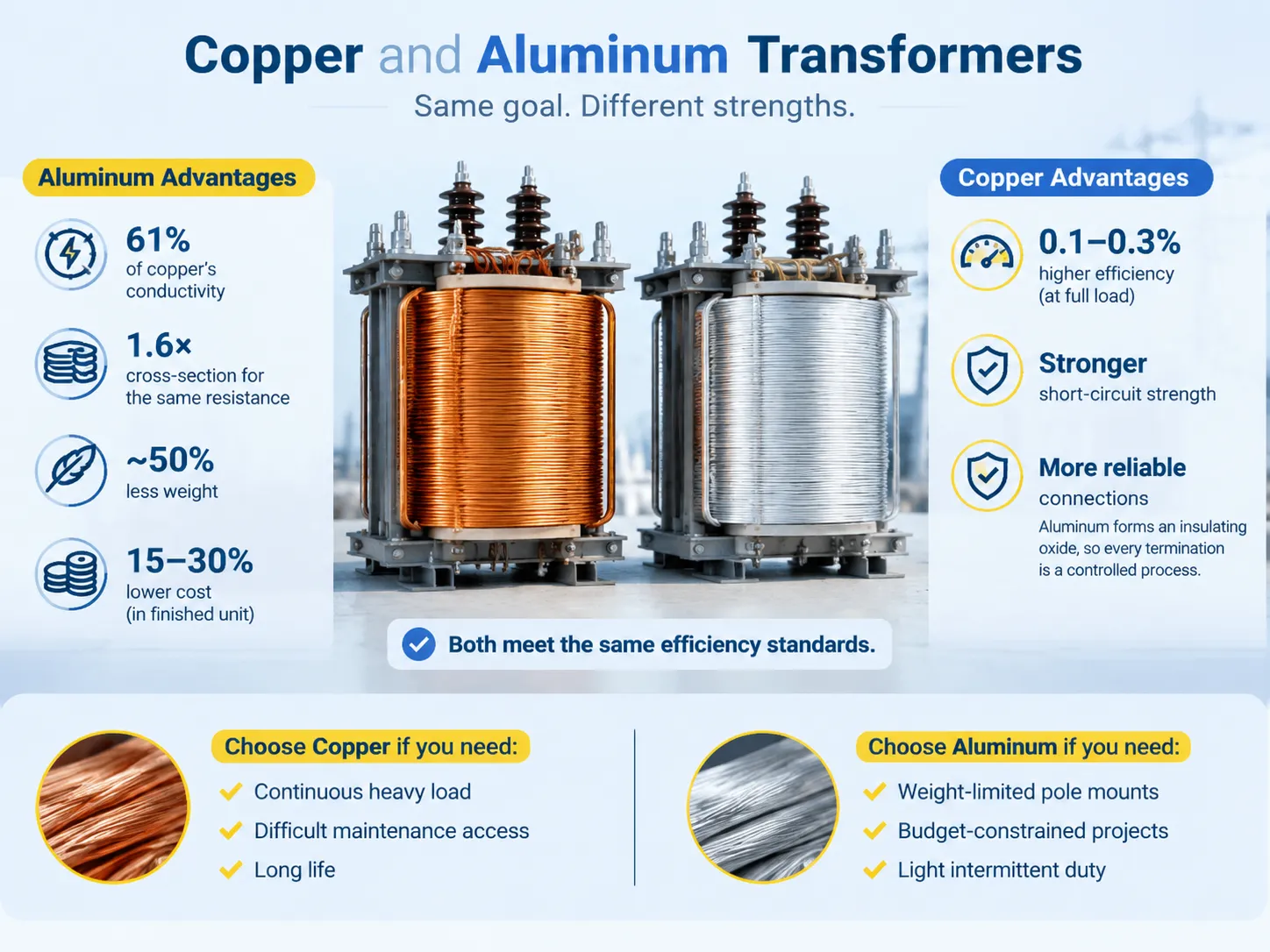
Zusammenfassend hat Aluminium eine Leitfähigkeit von 61% im Vergleich zu Kupfer und benötigt einen 1,6-mal höheren Querschnitt, um den gleichen Widerstand zu erreichen, aber sein Gewicht beträgt etwa die Hälfte und es kostet in seiner Endversion 15 bis 30% weniger. Kupfer ist besser, wenn es um die Effizienz von Maschinen von 0,1 bis 0,3% bei voller Last, Kurzschluss und Zuverlässigkeit der Verbindungen geht, da Aluminium Oxide um sich herum bildet, was jede Verbindung zu einem komplizierten Prozess macht. Unabhängig von den Effizienzniveaus wird Kupfer für Situationen mit konstanten Lasten bevorzugt, in denen Wartung schwer durchzuführen ist, während Aluminium in Fällen mit Gewichtsbeschränkungen, sei es bei Pfahlmontageinstallationen oder in Projekten mit knappen Budgets, verwendet wird.
Warum beide Materialien überhaupt existieren
Kupfer ist seit vielen Jahren das Standardmaterial in der Branche. Kupfer war auch der Branchenmaßstab für den Vergleich von Metallen miteinander. Der Internationale Normenstandard für geglühtes Kupfer besagt, dass Kupferdraht auf der Leitfähigkeit von Kupfer bei 100% IACS basiert.
Aluminium hat aus zwei Gründen in diesem Bereich Einzug gehalten, die nichts mit der Leistung zu tun haben. Erstens gibt es die Preisgestaltung. Der Preis für Aluminium auf dem Markt ist nur ein Bruchteil des Preises von Kupfer pro Kilogramm und ist ebenfalls recht stabil. Zweitens gibt es eine Gewichtsvorteil von Aluminium. Aluminium ist etwa dreimal leichter als Kupfer, und dieser Faktor ist wichtig, wenn es um pfahlmontierte Transformatoren geht.
Infolgedessen wurde die Welt geografisch in zwei Gruppen von Ländern hinsichtlich ihrer Metallwahl unterteilt, was für Käufer überraschend sein könnte. Zum Beispiel verwendet das Land Indien seit langem Aluminium gewickelte Verteilungstransformatoren, und in der Region wurden Aluminium pfahlmontierte Transformatoren produziert. Auf der anderen Seite war die Vereinigten Staaten ein Land, das Kupfer verwendete, aufgrund unglücklicher Misserfolge mit Aluminiumdrähten in den 1970er Jahren, was ein langanhaltendes Misstrauen gegenüber Aluminium schuf, und Kupfer wurde das Hauptmetall in der Region.
Beide Strategien sind nicht falsch; sie spiegeln die Prioritäten der Länder wider und ermöglichen es, je nach diesen Prioritäten die richtige Wahl zu treffen.
Sieben Zahlen, die sie trennen
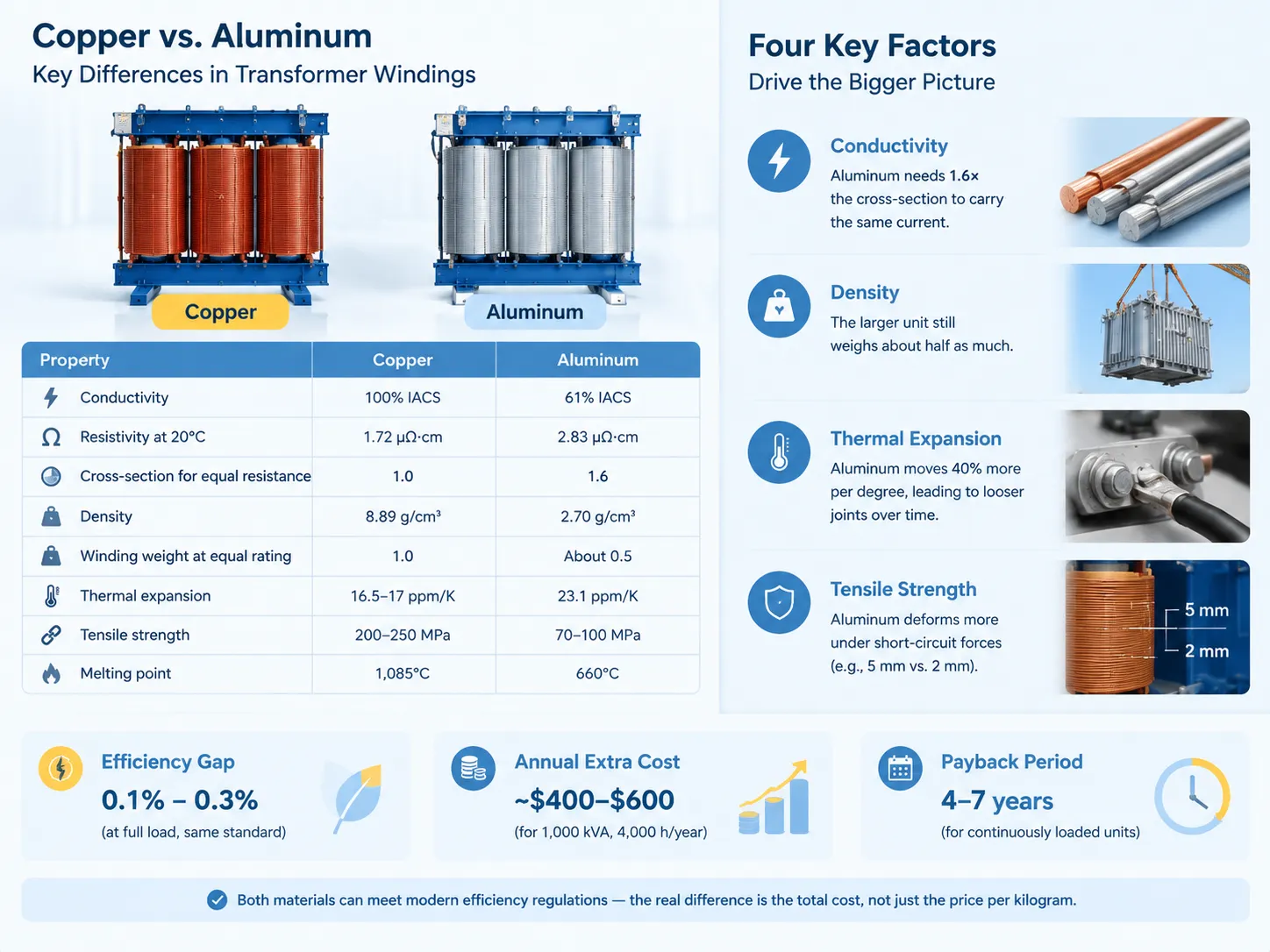
| Eigenschaft | Kupfer | Aluminium |
|---|---|---|
| Leitfähigkeit | 100% IACS | 61% IACS |
| Widerstandsfähigkeit bei 20°C | 1,72 µΩ·cm | 2,83 µΩ·cm |
| Querschnitt für gleichen Widerstand | 1.0 | 1.6 |
| Dichte | 8,89 g/cm³ | 2,70 g/cm³ |
| Wickelgewicht bei gleicher Bewertung | 1.0 | Etwa 0,5 |
| Wärmeausdehnung | 16,5–17 ppm/K | 23,1 ppm/K |
| Zugfestigkeit | 200–250 MPa | 70–100 MPa |
| Schmelzpunkt | 085°C | 660°C |
Vier Reihen sind für alles andere verantwortlich.
- Der Querschnitt des Stroms wird durch die Leitfähigkeit bestimmt. Aluminium hat eine Leitfähigkeit von 61% IACS und benötigt die 1,6-fache Fläche, um die gleiche Menge Strom zu leiten. Infolgedessen gibt es ein größeres Wickelfenster, das normalerweise einen größeren Transformator-Kern und Tank erfordert. Es wird größer, aber leichter.
- Der Grund für einen solchen Effekt ist die Dichte. Es ist wichtig zu betonen, dass es kein vernachlässigbarer Faktor ist, da er viele Aspekte beeinflusst, wie die Last des Krans, die Transportkosten und das Design des Gehäuses.
- Thermische Ausdehnung ist der Grund für Verbindungsprobleme. Die thermische Ausdehnung von Aluminium ist viel größer als die von Kupfer, was bedeutet, dass jede Verbindung des Aluminiumtransformators größeren Bewegungen ausgesetzt ist.
- Die Erklärung der Zugfestigkeit ist auch wichtig für das Verständnis des Kurzschlussmotors. Wenn ein Fehler auftritt, entstehen viele elektromagnetische Kräfte, die dem Quadrat des Stroms entsprechen, der auf die Motorwicklungen angewendet wird.
Die Konstruktionsunterschiede, die sich aus diesen Entscheidungen ergeben, einschließlich wie ein Gießharzdesign ein größeres Wickelfenster ermöglicht, sind in diesem Vergleich von SCB13 und internationalen Gießharzdesigns sichtbar..
Effizienz: Das 0,1 bis 0,3% Argument, richtig gemacht
Während die Effizienzlücke tatsächlich nicht so erheblich ist, wie die meisten Verkaufsgespräche implizieren, ist ihre wirtschaftliche Auswirkung größer, als Käufer annehmen.
Wenn beide Transformatoren nach dem gleichen Standard hergestellt werden und die Aluminiumwicklung einen größeren Querschnitt erhält, wie erforderlich, beträgt der Unterschied in der Volllast-Effizienz etwa 0,1% bis 0,3%, was tatsächlich durch die Ingenieurliteratur belegt ist. Tatsächlich vergleichen die Zahlen von etwa 1,5-2 % normalerweise Aluminiumtransformatoren mit Kupfertransformatoren, die nach einem höheren Standard gefertigt sind.
Lassen Sie uns die Mathematik durchrechnen. Nehmen wir einen 1.000 kVA Transformator, der für 4.000 Betriebsstunden und 60% Last im Durchschnitt ausgelegt ist. Bei dieser Kapazität bedeutet der Effizienzunterschied von 0,2% praktisch, dass der Transformator etwa 1,2 kW Energie verliert, was etwa 4.800 kWh entspricht, die pro Jahr verloren gehen. Die daraus resultierenden Kosten für diesen Energieverlust zu kommerziellen Preisen belaufen sich auf mehrere hundert Dollar pro Jahr, was bedeutet, dass die Effizienzvorteile erheblich höher sind als die anfängliche Investition, die für den Kauf der Ausrüstung getätigt wurde.
Daher ist dies auch der Grund, warum die meisten Lebenszyklusbewertungen, die in dieser Branche durchgeführt werden, zu dem Schluss kommen, dass Kupfer seine Kosten in 4-7 Jahren für Transformatoren, die kontinuierlich mit einer Kapazität von 1.000 kVA betrieben werden, zurückbekommt. Über diesen Kapazitäten, sei es bei Standby-Transformatoren oder Transformatoren, die intermittierend betrieben werden, erweist sich Aluminium als die bessere Wahl.
Was die Einhaltung betrifft, gilt dasselbe für beide Materialien. Die bestehenden Effizienzvorschriften, einschließlich derjenigen, die vom U.S. DOE und Tier 2 der EU-Effizienzstandards festgelegt wurden, implizieren, dass das Aluminiumdesign, wenn es die Effizienzbewertung erfüllt, den Vorschriften entspricht. Das Einzige, was man in diesem Fall normalerweise benötigt, ist die Verwendung eines größeren Kerns und größerer Leiter – Materialien, die in der Praxis einen Unterschied bei den Energieverlusten ausmachen würden.
Wie sich dieser Preisunterschied über die Bewertungen verteilt, ist in realen Angeboten leichter zu erkennen als in der Theorie, und die Unterschiede zwischen den Größen werden in diesem Blick auf die Transformatorpreise bei der 100 kVA-Marke behandelt..
Anschlüsse: Wo Aluminium seinen Ruf verdient.
Dieser Abschnitt erklärt die Mehrheit der realen Ergebnisse.
Copper also oxidizes, but copper oxide is a semiconductor and will break down under contact pressure which means when a bolt copper connection is tightened, the metal-to-metal connection is resumed. Aluminium oxide, on the other hand, consists of a tough and hard insulator with very high melting point which does not break down under pressure and which is quickly created on a newly abraded surface. A connection looking tight can have the resistance high enough to produce heat.
This single feature serves as an explanation for the aluminum branch wiring fails in North America of the 1970s and the reason why any trustworthy aluminum transformer uses many countermeasures combined.
- Plating. Copper or tin-plating of aluminum conductor prevents formation of oxide at the contact interface.
- Transition joints. A copper-to-aluminium transition part either welded by friction or bonded explosively moves from the difficult-to-control interface to a factory-controlled part.
- Ultrasonic welding. Breaks the oxide layer and bonds at molecular level creating a joint with an interface free of corrosion.
- Antioxidant compound combined with a proper connector. Field termination should include paste and hardware which is suitable for aluminum conductor. Codes are usually strict about the connection suitability to the conductor material.
- Modern aluminum transformers having plated conductors with factory transition joints are reliable devices, unlike an aluminum transformer terminated in the field by someone not familiar with the rules and thereby, earned this bad reputation.
If a winding does eventually fail, whether it can be rebuilt is a material question of its own. Copper rewinds cleanly and is easy to solder; aluminum is harder to repair and often scrapped instead, which is the practical background to transformer rewinding and repair.
Service Life and What Actually Ages
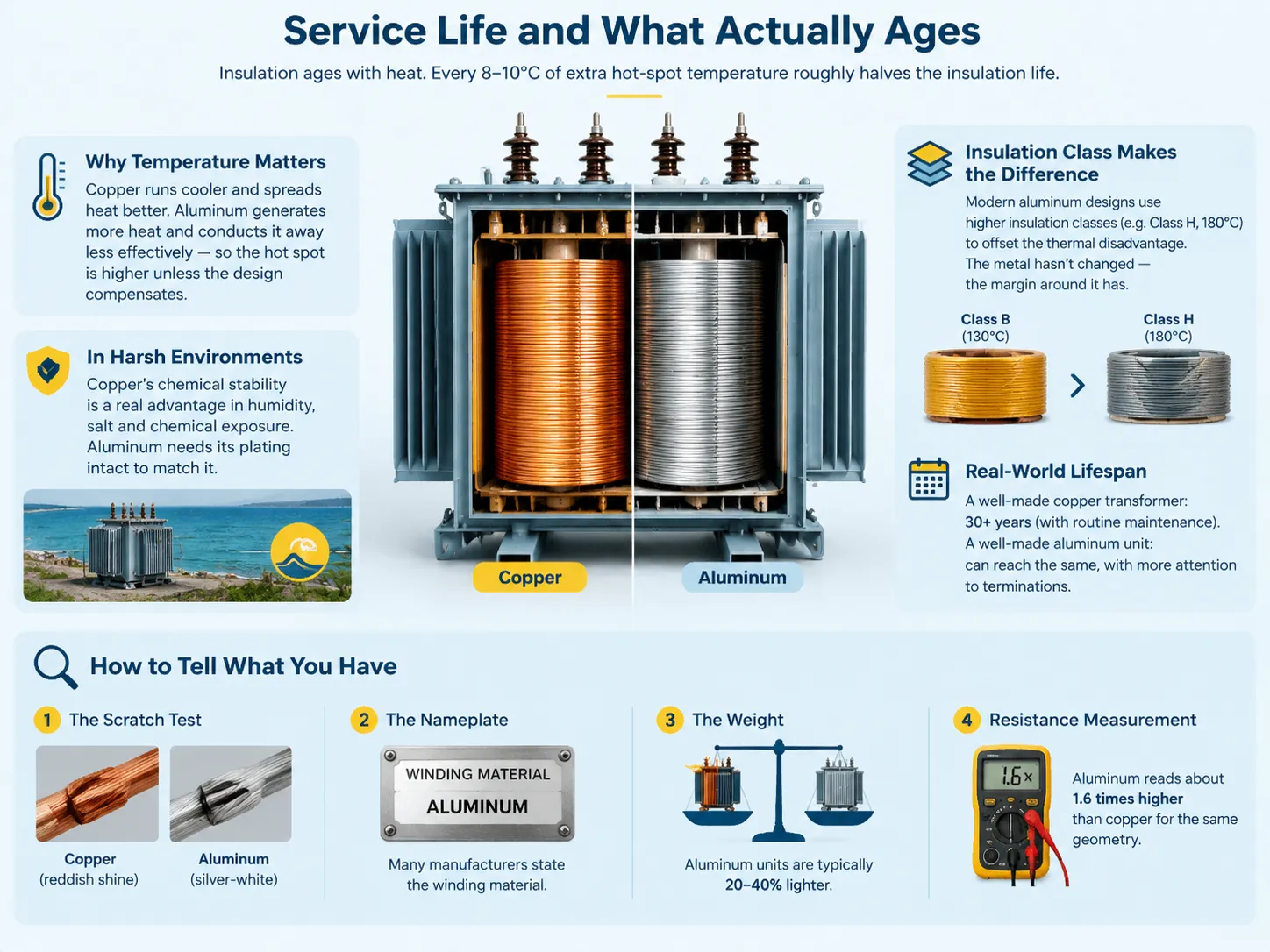
When it comes to insulation, age is a key factor as it is affected by the increased temperature. Each increment of 8-10°C of hot-spot temperatures can result in the insulation life getting shorter. The essence of heat insulation can be observed from these temperature changes rather than from metal properties.
Furthermore, copper makes the least amount of resistance compared to aluminum, that is why very little heat is formed with copper since there is less heat. Also, copper can distribute heat evenly and very well. Aluminum produces even more heat, but it can’t disperse it efficiently, which increases the hot spot for the same design unless additional cooling is provided.
Aluminum technology can address all these issues effectively, and one of the best way to do that is to improve the insulation. Moving from Class B (at 130°C) to Class H (at 180°C) means that the thermal disadvantage is worked off which is a standard approach for basically good aluminum constructions. The metal is not changed; but what changed was the surrounding conditions.
When it comes to the aggressive environment, humidity and chemicals affect copper, whereas aluminum standing alone is fine only when coated. There is a real difference between inspections on aluminum and copper, if the installation is coastal and has twenty years of salt exposure.
Now it comes to the actual lifespan: a good quality copper transformer can serve for more than 30 years under normal service and with regular maintenance; on the other hand, an aluminum transformer can reach the same life expectancy with its terminals being taken care of.
How to Tell What You Have
Four methods, classified in the order of minimum to maximum effort required.
- The scratch test. You need to scratch a winding conductor until the metal underneath becomes visible. Copper will acquire a reddish glimmer while aluminum will remain silvery white. While the colors of the insulation do not provide any reliable information about the metal being used because both copper and aluminum use similar amber enamel, it’s the test that scrap yards usually use in order to have an easy way of avoiding paying for a copper unit under an aluminum rate.
- The nameplate. Many manufacturers indicate what kind of metal is being used in winding manufacture, and therefore if there is a nameplate indicating that aluminum is being used, this statement is final. The absence of such an indication does not mean anything.
- The weight. Compare with the published weight of the design. An aluminum unit with the same kVA rating and of the same enclosure type usually weighs 20-40 percent less than a copper unit of the same configuration, because the tank and core dominate.
- The resistance. You simply need to test DC resistance for each winding and compare against the calculated resistance value of copper.
The measurement approach and the acceptance values are the same ones used in commissioning, set out in this guide to testing a transformer before it is energised.
Choosing: The Decision Rules
Five governing rules that are meant for the purposes of specification.
- Heavy continuous operation. Copper. The efficiency difference is offset and the thermal margin extends service life.
- Installation with weight limitations. Aluminum. It can be a pole installation, a rooftop, structure with limits, or any site with crane being a limiting factor.
- Difficult maintenance access. Copper. Fewer joint connections to re-torque, and less dependence on a criticism that everything has been done right.
- Harsh environment. Copper or aluminum with proper coating and record of inspections.
- A project with limited budget and low utilization. Aluminum. Lifecycle consideration is inaudible for transformers functioning less than 800 hours a year.
Two specifications surpass the five mentions above. If customer standard states copper, it’s something to use regardless of calculations. If the fault current in the bus is high, it will turn from the efficient material argument to mechanical strength into the matter of safety rather than wasting money. A standard unit such as a 150 kVA Transformator mit Spannungsabfall is available in either material, and the right choice depends on which of these rules binds.
Scrap Value and End of Life
The metal matters at the end too, and the difference is not small.
| Material | Whole-unit scrap | Stripped winding |
|---|---|---|
| Copper-wound transformer | $0.25–$0.60/lb, average about $0.35 | $3.20–$3.90/lb as #2 copper |
| Aluminum-wound transformer | $0.10–$0.20/lb | Much lower; rarely worth stripping |
The significant difference between the pricing policies of whole-unit and stripped units necessitates yards knowing what the winding is before quoting the price. This means also that the copper transformer has residual value, which aluminum does not possess, and therefore must be a part of the total cost of ownership of а big unit.
There are two warnings before hauling away anything. Oil-filled units should be drained and the oil produced prior to 1979 may contain PCBs and hence classifies the equipment as hazardous waste instead of a scrap. Confirm the age and also check the nameplate for the non-PCB mark before arranging for collection.
FAQ
What are the differences between copper and aluminum transformers?
The main difference is conductivity: an aluminum wire carries 61% of the load of a copper wire with the same cross-section. This means that an aluminum wind has to be around 1.6 times bigger with half the weight. The strength of copper is higher and the expansion is less, where copper is better at resisting short-circuit forces, and the termination is more reliable because the copper oxide can conduct. The price of aluminum is 15-30% lower, its weight is around 40% less.
How to tell if a transformer is copper or aluminum?
To get to the bare metal of a winding conductor, scratch the surface. The copper is red and aluminum is silver-white; however, it must be stressed that the colour of the enamel is not diagnostic. If scratch tests cannot be done, compare the weight of the unit with figures available in the literature or measure the DC resistance of a coil, where the ratio will be around 1.6 times for aluminum as compared to copper for the same design.
Why can’t aluminum and copper be used together?
They can, but not if contacting them directly in a moist environment. A galvanic couple is formed when these two metals are connected, which means that aluminum will be corroded first in this connection. Therefore, we have to use an approved bimetal connector for each connection, a transition plate made out of friction welding, or a coated barrier. Most jurisdictions require the connectors to be made for the particular conductor materials used, thus using a bare copper lug with the aluminum conductor is a non-compliance case and a corrosion threat.
What’s the scrap value of a copper transformer?
Copper-wound transformers go for a total of $0.25 to $0.60 per pound for a total value of about $0.35, depending on factors such as copper-to-steel ratio and yard. If the windings are removed, the copper alone will sell for #2 with a price tag of $3.20 to $3.90 per pound, explaining why high-volume scrap collectors dismantle transformers. Aluminum-wound transformers are worth $0.10-0.20 per pound and seldom justify windings being ripped off.
Referenzen
- Maddox Transformer — Aluminum vs Copper in Distribution Transformers
- Elscott Transformers — Copper vs Aluminum Dry-Type Transformer Windings
- Copper Development Association — Conductivity and Application Data
- UL Solutions — Transformer Listing and Construction Requirements
- U.S. Department of Energy — Effizienzstandards für Verteilungstransformatoren
Fazit
Transformers made from copper and aluminum are important in their own way. The correct type for a specific transformer is determined by its operation mode rather than personal choice. Copper ones are suitable for continuous loads, extreme conditions, difficult maintenance, and long service life. At the same time, aluminum is only suitable if the transformer is light and cheap, and the situation allows the use of aluminum materials.
The price of the transformer does not matter here. The only point which matters is the difference in annual costs of losses depending on the time of usage. For example, if the transformer is used only a few hundred hours a year, the annual difference will be negligible and close to zero.