


Both transformers are equal in terms of power rating, voltage rating, and performance parameters and belong to the same class of efficiency. However, despite the fact that both transformers have the same technical parameters, one of the transformers weighs around 40% more than the other transformer and costs almost 20% more, still, it is operational while another transformer has been replaced already.This is a matter of winding conductors, which is among the factors of materials used in all transformers, second only to core.
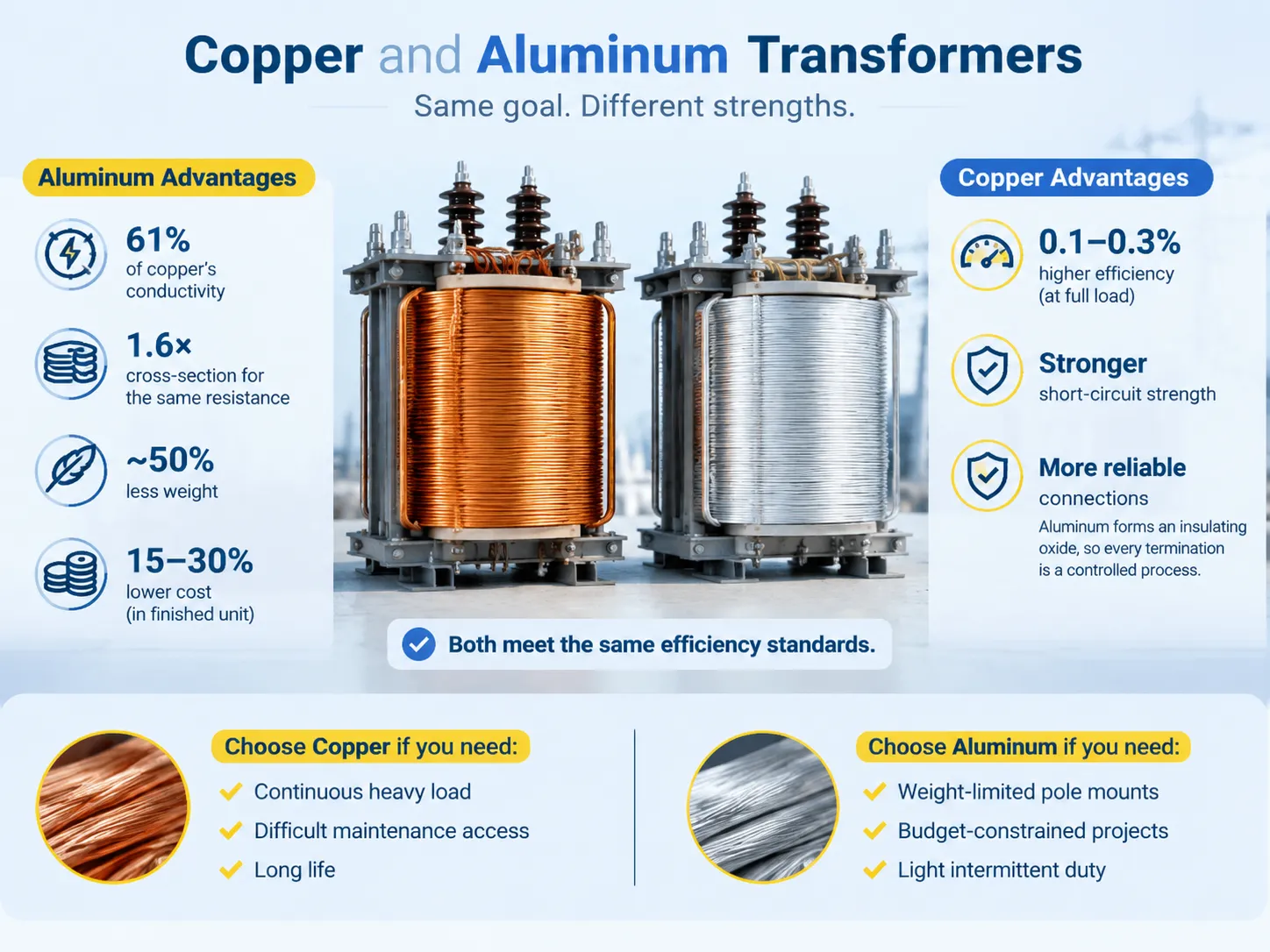
In summary, Aluminum has 61% conductivity compared to Copper and requires 1.6 times higher cross-section to get equal resistance, but its weight is about half as much and it costs 15 to 30% less in its final version. Copper is better when it comes to machines efficiency from 0.1 to 0.3% when fully loaded, short circuiting, and reliability of connections, because Aluminum forms oxides around it making every connection a complicated process. Regardless of the efficiency levels, Copper is preferred for constant load situations where maintenance will be hard to perform as well as Aluminum is used for cases with restrictions in weight either in pole mount installations or in projects with tight budgets.
Why Both Materials Exist at All
Copper has now been the standard material in the industry for many years. Copper has also been the industry benchmark for comparing metals with each other. The International Annealed Copper Standard states that copper wire is based on the conductivity of copper at 100% IACS.
Aluminum has arrived in this realm for two reasons that have nothing to do with performance. Firstly, there’s pricing. The price of aluminum on the market is only a fraction of the price of copper per kilogram and it is quite stable as well. Secondly, there is a weight superiority of aluminum. Aluminum is approximately three times lighter than copper and this factor matters when it comes to pole-mounted transformers.
As a result, the world was geographically divided into the two groups of countries in terms of their metal choice, and this might come as a surprise to buyers. For instance, the country of India has been using aluminum winded distribution transformers for a long time, and aluminum pole-mounted transformers have been produced in the region. On the other hand, the United States was a country using copper due to unfortunate failures with aluminum wires in 1970s, which created a long-standing distrust towards aluminum, and copper became the main metal in use in the area.
Both of these strategies are not wrong; they reflect the priorities of the countries and make it possible to make the right choice depending on those priorities.
Seven Numbers That Separate Them
| Proprietà | Rame | Alluminio |
|---|---|---|
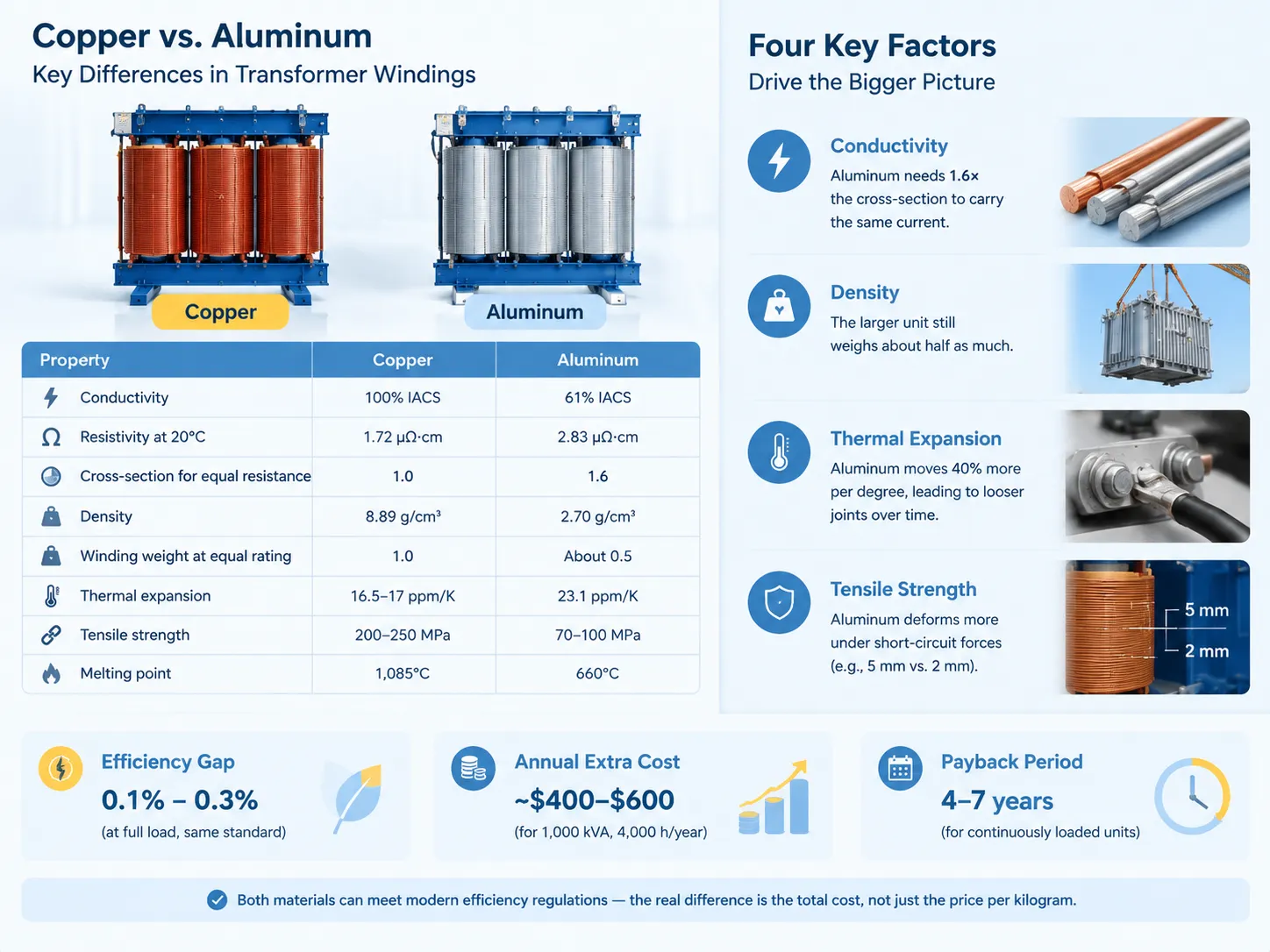
| Conduttività | 100% IACS | 61% IACS |
| Resistivity at 20°C | 1.72 µΩ·cm | 2.83 µΩ·cm |
| Cross-section for equal resistance | 1.0 | 1.6 |
| Density | 8.89 g/cm³ | 2.70 g/cm³ |
| Winding weight at equal rating | 1.0 | About 0.5 |
| Thermal expansion | 16.5–17 ppm/K | 23.1 ppm/K |
| Tensile strength | 200–250 MPa | 70–100 MPa |
| Melting point | 1,085°C | 660°C |
Four rows are responsible for everything else.
- The current’s section is determined by the conductivity. Aluminum has a conductivity of 61% IACS and requires the area of 1.6 times to conduct the same amount of current. As a result, there is a bigger winding window which usually requires a larger transformer core and tank. It gets bigger but lighter.
- The reason for such an effect is density. It is important to highlight that it is not a negligible factor since it influences many aspects such as the load of the crane, the cost of transportation, and design of the enclosure.
- Thermal expansion is the reason for connection problems. The thermal expansion of aluminum is much bigger than that of copper meaning that every connection of the aluminum transformer will be subject to bigger movement.
- Explanation of tensile strength is also important for the understanding of short-circuit motor. When a fault occurs, a lot of electromagnetic forces arise to be equal to the square of the current applied to the motor windings.
The construction differences that follow from these choices, including how a cast-resin design accommodates a larger winding window, are visible in this comparison of SCB13 and international cast-resin designs.
Efficiency: The 0.1 to 0.3% Argument, Done Properly
While the efficiency gap actually isn’t as substantial as most sales conversations imply, its economic impact is greater than buyers assume.
When both transformers are made to the same standard and aluminum winding gets a bigger cross-section as required, the full-load efficiency difference amounts to around 0.1% to 0.3%, which is indeed proven by the engineering literature. In fact, the figures of around 1.5-2 % usually compare aluminum transformers with copper transformers made to a higher standard.
Let’s work out the math. Let us take a 1,000 kVA transformer rated for 4,000 hours of operation and 60% load on average. At this capacity, the efficiency difference of 0.2% practically means that the transformer loses around 1.2 kW of energy, which equals around 4,800 kWh that is lost per year. The resulting cost of this energy loss at commercial costs comes in at several hundred dollars a year, what means that the efficiency benefits are significantly higher than the initial investment made to buy the equipment.
Therefore, this is also the reason why most lifecycle assessments carried out in this industry conclude that copper gets its costs back in 4-7 years for transformers operating continuously with a capacity of 1,000 kVA. Above these capacities, whether it be standby transformers or transformers operating intermittently, aluminum proves to be a better choice.
As for compliance, the same applies to both materials. Efficiency regulations in place, including those ones set by the U.S. DOE and Tier 2 of the EU efficiency standards, imply that if the aluminum design meets the efficiency rating, it complies with the regulations. The only thing one usually needs in this case is to use a bigger core and bigger conductors – materials that would naturally make a difference in energy losses in practice.
How that price difference lands across ratings is easier to see in real quotes than in theory, and the spread across sizes is covered in this look at transformer pricing at the 100 kVA mark.
Connections: Where Aluminum Earns Its Reputation
This section explains the majority of real-world outcomes.
Copper also oxidizes, but copper oxide is a semiconductor and will break down under contact pressure which means when a bolt copper connection is tightened, the metal-to-metal connection is resumed. Aluminium oxide, on the other hand, consists of a tough and hard insulator with very high melting point which does not break down under pressure and which is quickly created on a newly abraded surface. A connection looking tight can have the resistance high enough to produce heat.
This single feature serves as an explanation for the aluminum branch wiring fails in North America of the 1970s and the reason why any trustworthy aluminum transformer uses many countermeasures combined.
- Plating. Copper or tin-plating of aluminum conductor prevents formation of oxide at the contact interface.
- Transition joints. A copper-to-aluminium transition part either welded by friction or bonded explosively moves from the difficult-to-control interface to a factory-controlled part.
- Ultrasonic welding. Breaks the oxide layer and bonds at molecular level creating a joint with an interface free of corrosion.
- Antioxidant compound combined with a proper connector. Field termination should include paste and hardware which is suitable for aluminum conductor. Codes are usually strict about the connection suitability to the conductor material.
- Modern aluminum transformers having plated conductors with factory transition joints are reliable devices, unlike an aluminum transformer terminated in the field by someone not familiar with the rules and thereby, earned this bad reputation.
If a winding does eventually fail, whether it can be rebuilt is a material question of its own. Copper rewinds cleanly and is easy to solder; aluminum is harder to repair and often scrapped instead, which is the practical background to transformer rewinding and repair.
Service Life and What Actually Ages
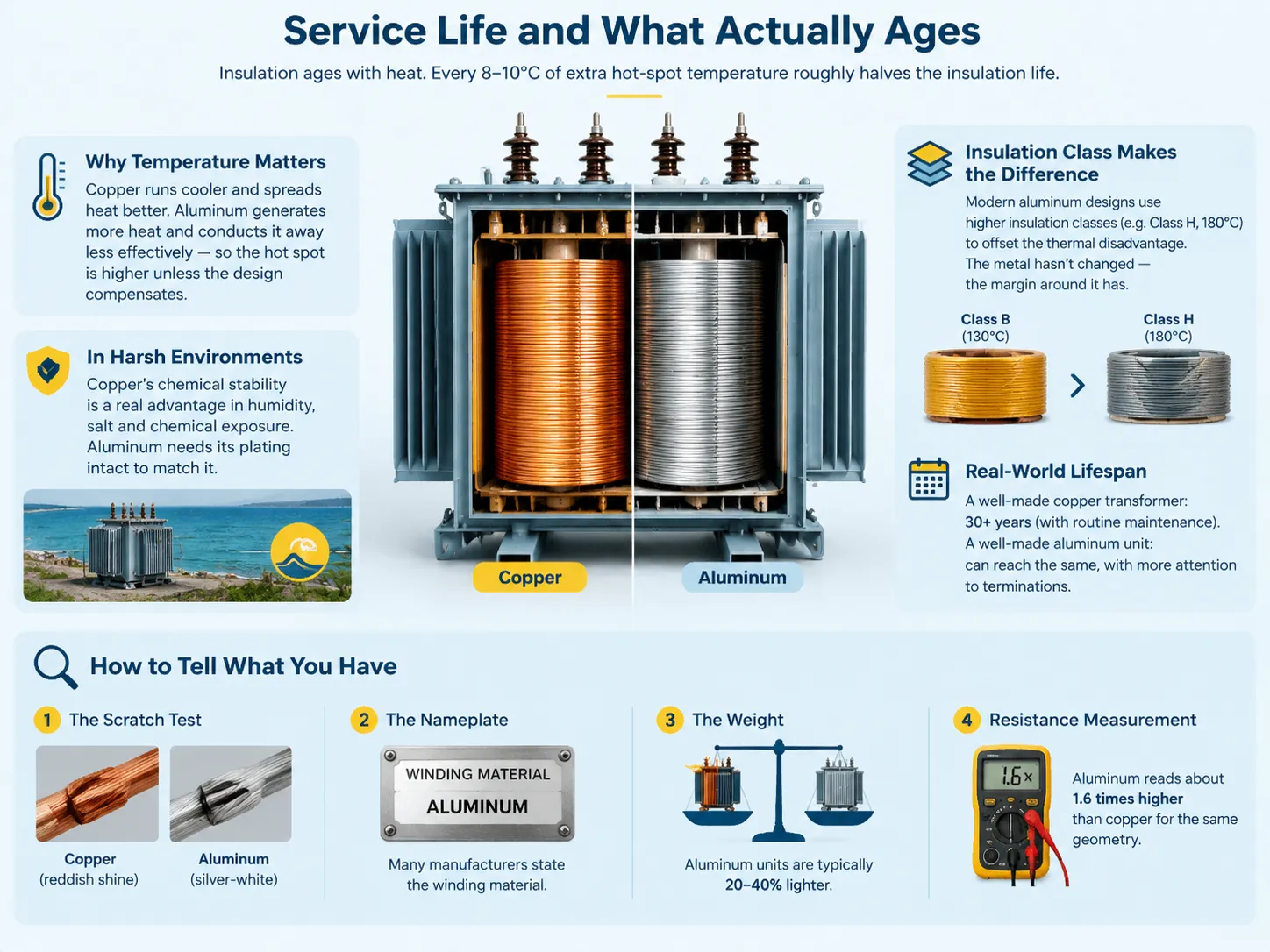
When it comes to insulation, age is a key factor as it is affected by the increased temperature. Each increment of 8-10°C of hot-spot temperatures can result in the insulation life getting shorter. The essence of heat insulation can be observed from these temperature changes rather than from metal properties.
Furthermore, copper makes the least amount of resistance compared to aluminum, that is why very little heat is formed with copper since there is less heat. Also, copper can distribute heat evenly and very well. Aluminum produces even more heat, but it can’t disperse it efficiently, which increases the hot spot for the same design unless additional cooling is provided.
Aluminum technology can address all these issues effectively, and one of the best way to do that is to improve the insulation. Moving from Class B (at 130°C) to Class H (at 180°C) means that the thermal disadvantage is worked off which is a standard approach for basically good aluminum constructions. The metal is not changed; but what changed was the surrounding conditions.
When it comes to the aggressive environment, humidity and chemicals affect copper, whereas aluminum standing alone is fine only when coated. There is a real difference between inspections on aluminum and copper, if the installation is coastal and has twenty years of salt exposure.
Now it comes to the actual lifespan: a good quality copper transformer can serve for more than 30 years under normal service and with regular maintenance; on the other hand, an aluminum transformer can reach the same life expectancy with its terminals being taken care of.
How to Tell What You Have
Four methods, classified in the order of minimum to maximum effort required.
- The scratch test. You need to scratch a winding conductor until the metal underneath becomes visible. Copper will acquire a reddish glimmer while aluminum will remain silvery white. While the colors of the insulation do not provide any reliable information about the metal being used because both copper and aluminum use similar amber enamel, it’s the test that scrap yards usually use in order to have an easy way of avoiding paying for a copper unit under an aluminum rate.
- The nameplate. Many manufacturers indicate what kind of metal is being used in winding manufacture, and therefore if there is a nameplate indicating that aluminum is being used, this statement is final. The absence of such an indication does not mean anything.
- The weight. Compare with the published weight of the design. An aluminum unit with the same kVA rating and of the same enclosure type usually weighs 20-40 percent less than a copper unit of the same configuration, because the tank and core dominate.
- The resistance. You simply need to test DC resistance for each winding and compare against the calculated resistance value of copper.
The measurement approach and the acceptance values are the same ones used in commissioning, set out in this guide to testing a transformer before it is energised.
Choosing: The Decision Rules
Five governing rules that are meant for the purposes of specification.
- Heavy continuous operation. Copper. The efficiency difference is offset and the thermal margin extends service life.
- Installation with weight limitations. Aluminum. It can be a pole installation, a rooftop, structure with limits, or any site with crane being a limiting factor.
- Difficult maintenance access. Copper. Fewer joint connections to re-torque, and less dependence on a criticism that everything has been done right.
- Harsh environment. Copper or aluminum with proper coating and record of inspections.
- A project with limited budget and low utilization. Aluminum. Lifecycle consideration is inaudible for transformers functioning less than 800 hours a year.
Two specifications surpass the five mentions above. If customer standard states copper, it’s something to use regardless of calculations. If the fault current in the bus is high, it will turn from the efficient material argument to mechanical strength into the matter of safety rather than wasting money. A standard unit such as a trasformatore riduttore da 150 kVA is available in either material, and the right choice depends on which of these rules binds.
Scrap Value and End of Life
The metal matters at the end too, and the difference is not small.
| Materiale | Whole-unit scrap | Stripped winding |
|---|---|---|
| Copper-wound transformer | $0.25–$0.60/lb, average about $0.35 | $3.20–$3.90/lb as #2 copper |
| Aluminum-wound transformer | $0.10–$0.20/lb | Much lower; rarely worth stripping |
The significant difference between the pricing policies of whole-unit and stripped units necessitates yards knowing what the winding is before quoting the price. This means also that the copper transformer has residual value, which aluminum does not possess, and therefore must be a part of the total cost of ownership of а big unit.
There are two warnings before hauling away anything. Oil-filled units should be drained and the oil produced prior to 1979 may contain PCBs and hence classifies the equipment as hazardous waste instead of a scrap. Confirm the age and also check the nameplate for the non-PCB mark before arranging for collection.
FAQ
What are the differences between copper and aluminum transformers?
The main difference is conductivity: an aluminum wire carries 61% of the load of a copper wire with the same cross-section. This means that an aluminum wind has to be around 1.6 times bigger with half the weight. The strength of copper is higher and the expansion is less, where copper is better at resisting short-circuit forces, and the termination is more reliable because the copper oxide can conduct. The price of aluminum is 15-30% lower, its weight is around 40% less.
How to tell if a transformer is copper or aluminum?
To get to the bare metal of a winding conductor, scratch the surface. The copper is red and aluminum is silver-white; however, it must be stressed that the colour of the enamel is not diagnostic. If scratch tests cannot be done, compare the weight of the unit with figures available in the literature or measure the DC resistance of a coil, where the ratio will be around 1.6 times for aluminum as compared to copper for the same design.
Why can’t aluminum and copper be used together?
They can, but not if contacting them directly in a moist environment. A galvanic couple is formed when these two metals are connected, which means that aluminum will be corroded first in this connection. Therefore, we have to use an approved bimetal connector for each connection, a transition plate made out of friction welding, or a coated barrier. Most jurisdictions require the connectors to be made for the particular conductor materials used, thus using a bare copper lug with the aluminum conductor is a non-compliance case and a corrosion threat.
What’s the scrap value of a copper transformer?
Copper-wound transformers go for a total of $0.25 to $0.60 per pound for a total value of about $0.35, depending on factors such as copper-to-steel ratio and yard. If the windings are removed, the copper alone will sell for #2 with a price tag of $3.20 to $3.90 per pound, explaining why high-volume scrap collectors dismantle transformers. Aluminum-wound transformers are worth $0.10-0.20 per pound and seldom justify windings being ripped off.
Riferimenti
- Maddox Transformer — Aluminum vs Copper in Distribution Transformers
- Elscott Transformers — Copper vs Aluminum Dry-Type Transformer Windings
- Copper Development Association — Conductivity and Application Data
- UL Solutions — Transformer Listing and Construction Requirements
- Dipartimento dell'Energia degli Stati Uniti — Standard di Efficienza dei Trasformatori di Distribuzione
Conclusione
Transformers made from copper and aluminum are important in their own way. The correct type for a specific transformer is determined by its operation mode rather than personal choice. Copper ones are suitable for continuous loads, extreme conditions, difficult maintenance, and long service life. At the same time, aluminum is only suitable if the transformer is light and cheap, and the situation allows the use of aluminum materials.
The price of the transformer does not matter here. The only point which matters is the difference in annual costs of losses depending on the time of usage. For example, if the transformer is used only a few hundred hours a year, the annual difference will be negligible and close to zero.