


両方の変圧器は、出力定格、電圧定格、および性能パラメータに関して同等であり、同じ効率クラスに属しています。しかし、両方の変圧器が同じ技術的パラメータを持っているにもかかわらず、1つの変圧器はもう1つの変圧器よりも約40%重く、コストもほぼ20%高いですが、運用は可能であり、もう1つの変圧器はすでに交換されています。これは、すべての変圧器で使用される材料の要因の1つである巻線導体の問題です。.
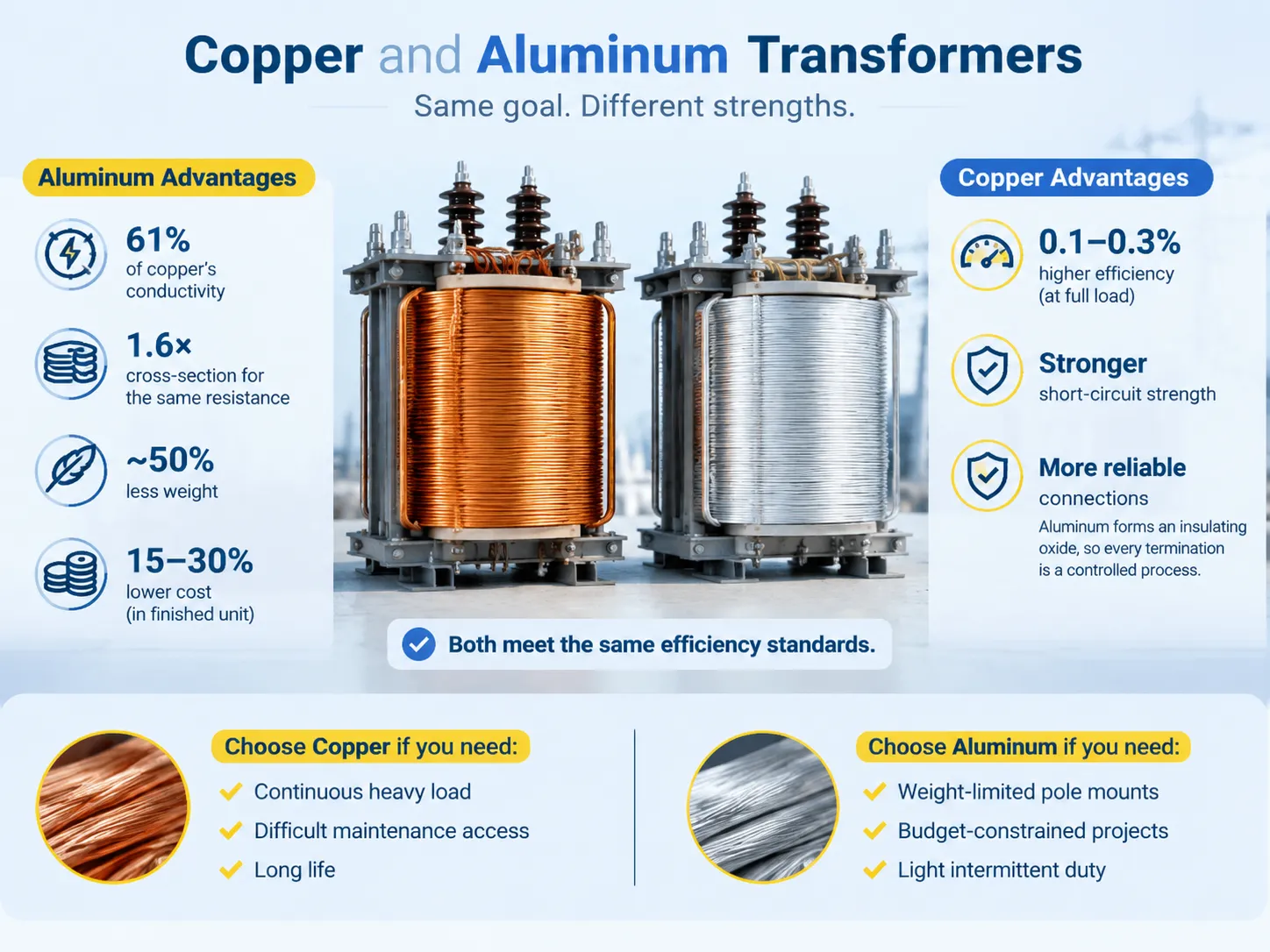
要約すると、アルミニウムは銅に比べて61%の導電率を持ち、同等の抵抗を得るためには1.6倍の断面積が必要ですが、その重量は約半分で、最終版では15から30%少なくなります。銅は、完全に負荷がかかった状態での機械効率に関して0.1から0.3%の範囲で優れていますが、アルミニウムは周囲に酸化物を形成し、接続を複雑なプロセスにするため、接続の信頼性が低下します。効率レベルに関係なく、銅はメンテナンスが難しい定常負荷の状況で好まれ、アルミニウムはポールマウント設置や予算が厳しいプロジェクトでの重量制限がある場合に使用されます。.
なぜ両方の材料が存在するのか
銅は、業界の標準材料として長年使用されてきました。銅はまた、金属同士を比較するための業界基準でもあります。国際焼鈍銅基準は、銅線が100% IACSでの銅の導電率に基づいていることを示しています。.
アルミニウムは、性能とは無関係な2つの理由でこの領域に登場しました。第一に、価格です。市場でのアルミニウムの価格は、銅の価格のほんの一部であり、非常に安定しています。第二に、アルミニウムの重量の優位性です。アルミニウムは銅の約3倍軽く、この要素はポールマウント変圧器に関して重要です。.
その結果、世界は金属の選択に関して2つの国のグループに地理的に分かれ、これは購入者にとって驚きかもしれません。例えば、インドは長い間アルミニウム巻きの配電変圧器を使用しており、地域でアルミニウム製のポールマウント変圧器が生産されています。一方、アメリカ合衆国は1970年代にアルミニウムワイヤーの不幸な失敗により銅を使用しており、アルミニウムに対する長年の不信感が生まれ、銅がその地域で主な金属となりました。.
これらの2つの戦略は間違っていません。これらは国の優先事項を反映しており、それに基づいて適切な選択を行うことを可能にします。.
彼らを分ける7つの数字
| 特性 | 銅 | アルミニウム |
|---|---|---|
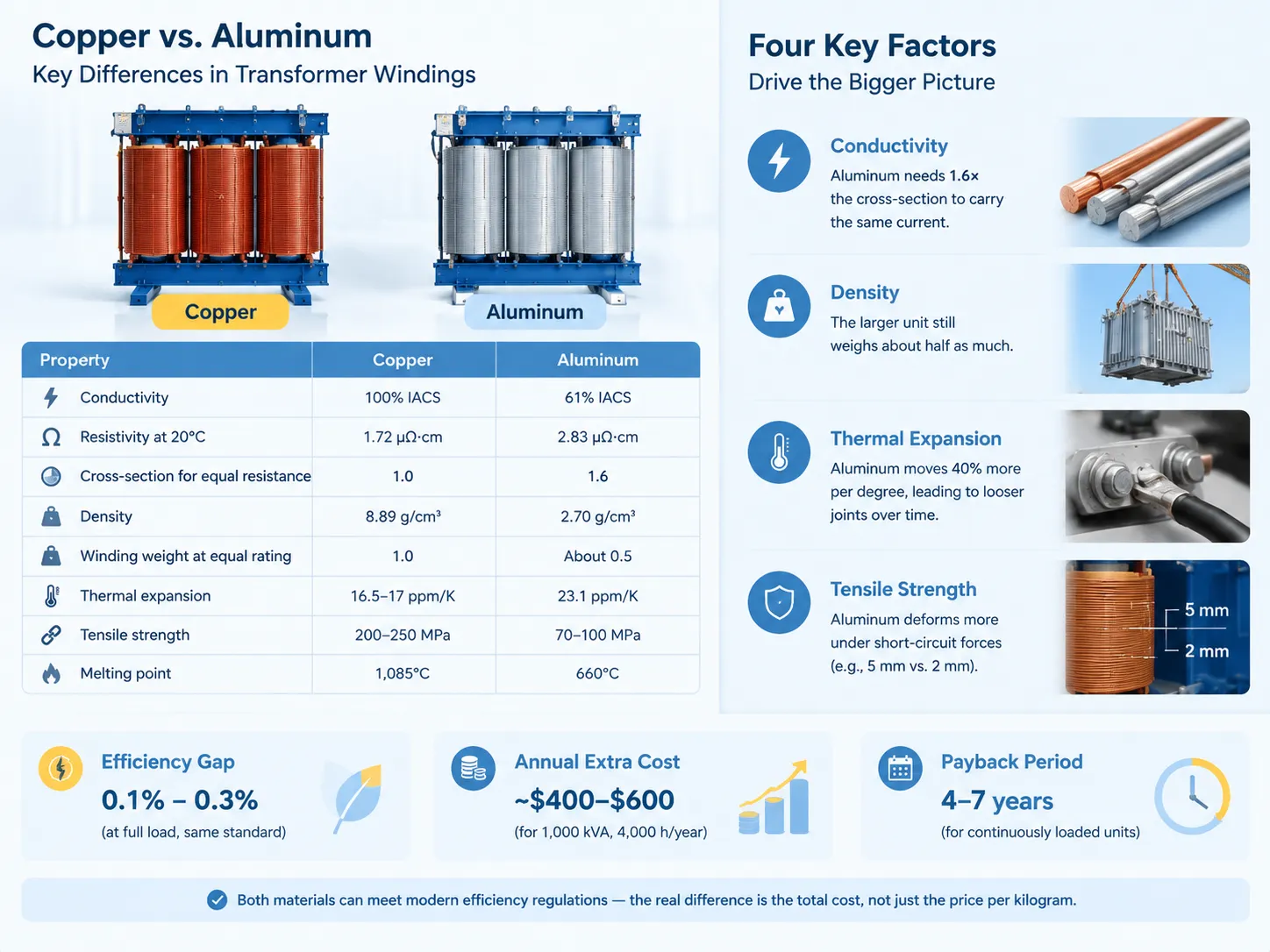
| 導電率 | 100% IACS | 61% IACS |
| 20°Cでの抵抗率 | 72 µΩ·cm | 83 µΩ·cm |
| 同等の抵抗のための断面積 | 1.0 | 1.6 |
| 密度 | 89 g/cm³ | 70 g/cm³ |
| 同等の定格での巻線重量 | 1.0 | 約0.5 |
| 熱膨張 | 5–17 ppm/K | 1 ppm/K |
| 引張強度 | 200–250 MPa | 70–100 MPa |
| 融点 | 1,085°C | 660°C |
四つの列が他のすべてを担当しています。.
- 電流の断面は導電率によって決まります。. アルミニウムの導電率は61% IACSであり、同じ量の電流を導くためには1.6倍の面積が必要です。その結果、通常はより大きな変圧器コアとタンクを必要とするより大きな巻線ウィンドウがあります。それは大きくなりますが、軽くなります。.
- このような効果の理由は密度です。. これはクレーンの荷重、輸送コスト、エンクロージャの設計など、多くの側面に影響を与えるため、無視できない要因であることを強調することが重要です。.
- 熱膨張は接続問題の原因です。. アルミニウムの熱膨張は銅のそれよりもはるかに大きいため、アルミニウム変圧器のすべての接続はより大きな動きの影響を受けます。.
- 引張強度の説明も短絡モーターの理解にとって重要です。. 障害が発生すると、多くの電磁力がモーター巻線に加えられた電流の二乗に等しくなります。.
これらの選択から生じる構造の違い、特にキャストレジン設計がどのようにより大きな巻線ウィンドウを収容するかは、この比較で見ることができます。 SCB13および国際的なキャストレジン設計.
効率:0.1から0.3%の議論、適切に行われた
効率のギャップは実際にはほとんどの販売会話が示唆するほど大きくはありませんが、その経済的影響は買い手が想定するよりも大きいです。.
両方の変圧器が同じ基準で製造され、アルミニウム巻線が必要な大きな断面を持つ場合、定格負荷効率の違いは約0.1%から0.3%に達し、これは実際に工学文献によって証明されています。実際、約1.5-2 %の数値は通常、より高い基準で製造された銅変圧器と比較されるアルミニウム変圧器を示します。.
数学を計算してみましょう。1,000 kVAの変圧器を取り、運転時間が4,000時間、平均60%の負荷とします。この容量で、0.2%の効率の違いは、変圧器が約1.2 kWのエネルギーを失うことを意味し、年間約4,800 kWhが失われます。このエネルギー損失の結果としてのコストは商業コストで年間数百ドルに達し、効率の利点は設備購入にかかる初期投資を大幅に上回ることを意味します。.
したがって、これはこの業界で実施されるほとんどのライフサイクル評価が、1,000 kVAの容量で継続的に運転される変圧器に対して銅が4-7年でコストを回収するという結論に至る理由でもあります。これらの容量を超えると、待機変圧器や断続的に運転される変圧器に関しては、アルミニウムがより良い選択であることが証明されます。.
準拠に関しては、両方の材料に同じことが当てはまります。米国DOEやEU効率基準のTier 2によって設定された効率規制は、アルミニウム設計が効率評価を満たす場合、規制に準拠していることを示唆しています。この場合、通常必要なのは、より大きなコアとより大きな導体を使用することだけです。これらの材料は、実際にエネルギー損失に違いをもたらすことになります。.
価格差が評価にどのように影響するかは、理論よりも実際の見積もりで見る方が簡単であり、サイズ間の広がりはこの調査でカバーされています。 100 kVAのトランスの価格設定.
接続:アルミニウムがその評判を得る場所
このセクションでは、実際の結果の大部分を説明します。.
Copper also oxidizes, but copper oxide is a semiconductor and will break down under contact pressure which means when a bolt copper connection is tightened, the metal-to-metal connection is resumed. Aluminium oxide, on the other hand, consists of a tough and hard insulator with very high melting point which does not break down under pressure and which is quickly created on a newly abraded surface. A connection looking tight can have the resistance high enough to produce heat.
This single feature serves as an explanation for the aluminum branch wiring fails in North America of the 1970s and the reason why any trustworthy aluminum transformer uses many countermeasures combined.
- Plating. Copper or tin-plating of aluminum conductor prevents formation of oxide at the contact interface.
- Transition joints. A copper-to-aluminium transition part either welded by friction or bonded explosively moves from the difficult-to-control interface to a factory-controlled part.
- Ultrasonic welding. Breaks the oxide layer and bonds at molecular level creating a joint with an interface free of corrosion.
- Antioxidant compound combined with a proper connector. Field termination should include paste and hardware which is suitable for aluminum conductor. Codes are usually strict about the connection suitability to the conductor material.
- Modern aluminum transformers having plated conductors with factory transition joints are reliable devices, unlike an aluminum transformer terminated in the field by someone not familiar with the rules and thereby, earned this bad reputation.
If a winding does eventually fail, whether it can be rebuilt is a material question of its own. Copper rewinds cleanly and is easy to solder; aluminum is harder to repair and often scrapped instead, which is the practical background to transformer rewinding and repair.
Service Life and What Actually Ages
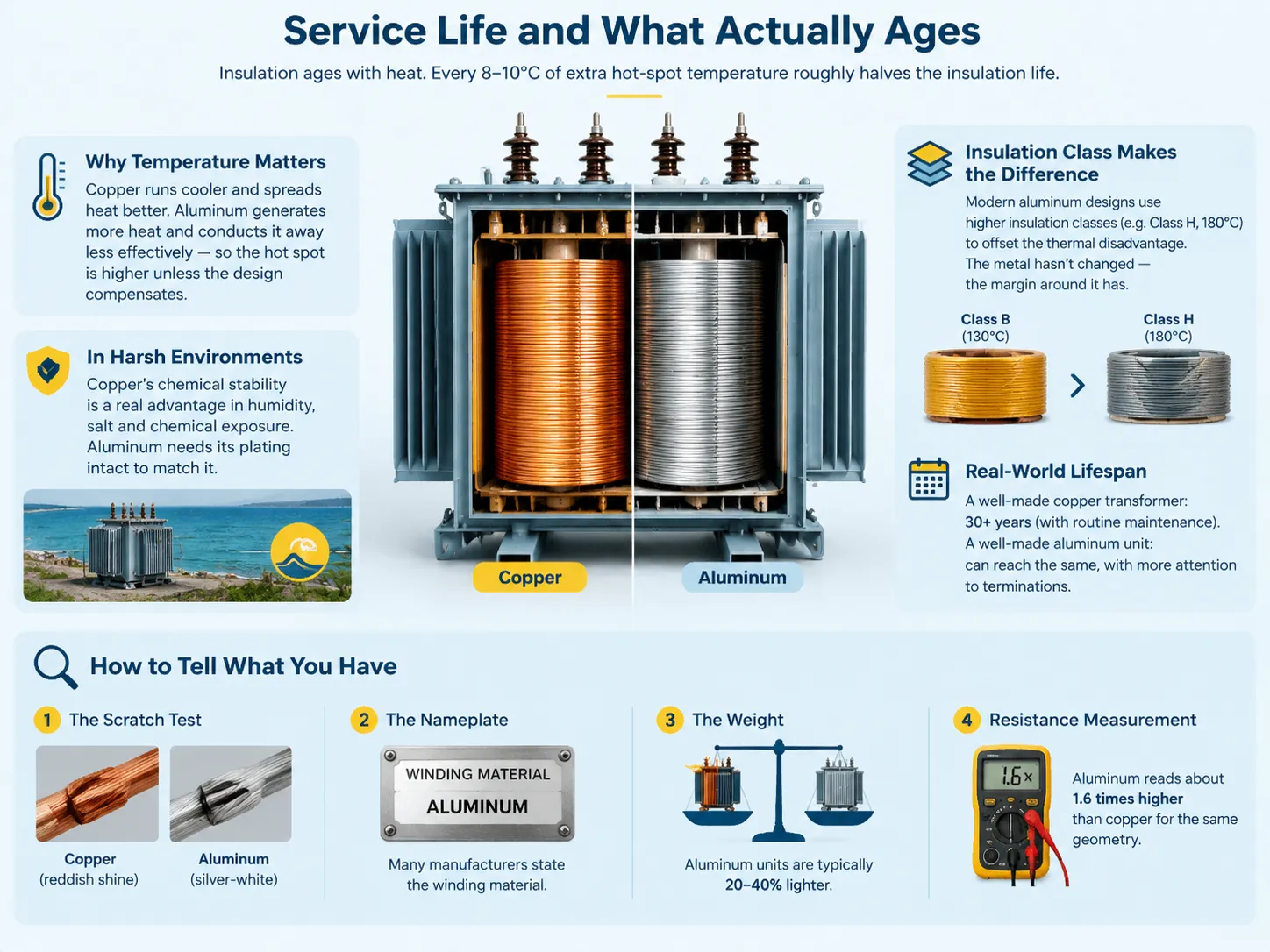
When it comes to insulation, age is a key factor as it is affected by the increased temperature. Each increment of 8-10°C of hot-spot temperatures can result in the insulation life getting shorter. The essence of heat insulation can be observed from these temperature changes rather than from metal properties.
Furthermore, copper makes the least amount of resistance compared to aluminum, that is why very little heat is formed with copper since there is less heat. Also, copper can distribute heat evenly and very well. Aluminum produces even more heat, but it can’t disperse it efficiently, which increases the hot spot for the same design unless additional cooling is provided.
Aluminum technology can address all these issues effectively, and one of the best way to do that is to improve the insulation. Moving from Class B (at 130°C) to Class H (at 180°C) means that the thermal disadvantage is worked off which is a standard approach for basically good aluminum constructions. The metal is not changed; but what changed was the surrounding conditions.
When it comes to the aggressive environment, humidity and chemicals affect copper, whereas aluminum standing alone is fine only when coated. There is a real difference between inspections on aluminum and copper, if the installation is coastal and has twenty years of salt exposure.
Now it comes to the actual lifespan: a good quality copper transformer can serve for more than 30 years under normal service and with regular maintenance; on the other hand, an aluminum transformer can reach the same life expectancy with its terminals being taken care of.
How to Tell What You Have
Four methods, classified in the order of minimum to maximum effort required.
- The scratch test. You need to scratch a winding conductor until the metal underneath becomes visible. Copper will acquire a reddish glimmer while aluminum will remain silvery white. While the colors of the insulation do not provide any reliable information about the metal being used because both copper and aluminum use similar amber enamel, it’s the test that scrap yards usually use in order to have an easy way of avoiding paying for a copper unit under an aluminum rate.
- The nameplate. Many manufacturers indicate what kind of metal is being used in winding manufacture, and therefore if there is a nameplate indicating that aluminum is being used, this statement is final. The absence of such an indication does not mean anything.
- The weight. Compare with the published weight of the design. An aluminum unit with the same kVA rating and of the same enclosure type usually weighs 20-40 percent less than a copper unit of the same configuration, because the tank and core dominate.
- The resistance. You simply need to test DC resistance for each winding and compare against the calculated resistance value of copper.
The measurement approach and the acceptance values are the same ones used in commissioning, set out in this guide to testing a transformer before it is energised.
Choosing: The Decision Rules
Five governing rules that are meant for the purposes of specification.
- Heavy continuous operation. Copper. The efficiency difference is offset and the thermal margin extends service life.
- Installation with weight limitations. Aluminum. It can be a pole installation, a rooftop, structure with limits, or any site with crane being a limiting factor.
- Difficult maintenance access. Copper. Fewer joint connections to re-torque, and less dependence on a criticism that everything has been done right.
- Harsh environment. Copper or aluminum with proper coating and record of inspections.
- A project with limited budget and low utilization. Aluminum. Lifecycle consideration is inaudible for transformers functioning less than 800 hours a year.
Two specifications surpass the five mentions above. If customer standard states copper, it’s something to use regardless of calculations. If the fault current in the bus is high, it will turn from the efficient material argument to mechanical strength into the matter of safety rather than wasting money. A standard unit such as a 150 kVA降圧トランス is available in either material, and the right choice depends on which of these rules binds.
Scrap Value and End of Life
The metal matters at the end too, and the difference is not small.
| 材料 | Whole-unit scrap | Stripped winding |
|---|---|---|
| Copper-wound transformer | $0.25–$0.60/lb, average about $0.35 | $3.20–$3.90/lb as #2 copper |
| Aluminum-wound transformer | $0.10–$0.20/lb | Much lower; rarely worth stripping |
The significant difference between the pricing policies of whole-unit and stripped units necessitates yards knowing what the winding is before quoting the price. This means also that the copper transformer has residual value, which aluminum does not possess, and therefore must be a part of the total cost of ownership of а big unit.
There are two warnings before hauling away anything. Oil-filled units should be drained and the oil produced prior to 1979 may contain PCBs and hence classifies the equipment as hazardous waste instead of a scrap. Confirm the age and also check the nameplate for the non-PCB mark before arranging for collection.
よくある質問
What are the differences between copper and aluminum transformers?
The main difference is conductivity: an aluminum wire carries 61% of the load of a copper wire with the same cross-section. This means that an aluminum wind has to be around 1.6 times bigger with half the weight. The strength of copper is higher and the expansion is less, where copper is better at resisting short-circuit forces, and the termination is more reliable because the copper oxide can conduct. The price of aluminum is 15-30% lower, its weight is around 40% less.
How to tell if a transformer is copper or aluminum?
To get to the bare metal of a winding conductor, scratch the surface. The copper is red and aluminum is silver-white; however, it must be stressed that the colour of the enamel is not diagnostic. If scratch tests cannot be done, compare the weight of the unit with figures available in the literature or measure the DC resistance of a coil, where the ratio will be around 1.6 times for aluminum as compared to copper for the same design.
Why can’t aluminum and copper be used together?
They can, but not if contacting them directly in a moist environment. A galvanic couple is formed when these two metals are connected, which means that aluminum will be corroded first in this connection. Therefore, we have to use an approved bimetal connector for each connection, a transition plate made out of friction welding, or a coated barrier. Most jurisdictions require the connectors to be made for the particular conductor materials used, thus using a bare copper lug with the aluminum conductor is a non-compliance case and a corrosion threat.
What’s the scrap value of a copper transformer?
Copper-wound transformers go for a total of $0.25 to $0.60 per pound for a total value of about $0.35, depending on factors such as copper-to-steel ratio and yard. If the windings are removed, the copper alone will sell for #2 with a price tag of $3.20 to $3.90 per pound, explaining why high-volume scrap collectors dismantle transformers. Aluminum-wound transformers are worth $0.10-0.20 per pound and seldom justify windings being ripped off.
参考文献
- Maddox Transformer — Aluminum vs Copper in Distribution Transformers
- Elscott Transformers — Copper vs Aluminum Dry-Type Transformer Windings
- Copper Development Association — Conductivity and Application Data
- UL Solutions — Transformer Listing and Construction Requirements
- 米国エネルギー省 — 配電トランス効率基準
結論
Transformers made from copper and aluminum are important in their own way. The correct type for a specific transformer is determined by its operation mode rather than personal choice. Copper ones are suitable for continuous loads, extreme conditions, difficult maintenance, and long service life. At the same time, aluminum is only suitable if the transformer is light and cheap, and the situation allows the use of aluminum materials.
The price of the transformer does not matter here. The only point which matters is the difference in annual costs of losses depending on the time of usage. For example, if the transformer is used only a few hundred hours a year, the annual difference will be negligible and close to zero.