


Stellen Sie sich die Aufgabe eines Inbetriebnahmeingenieurs vor, der an einer neuen 110-kV-Umspannstation arbeitet: Der Haupttransformator hat alle Tests bestanden, doch der Kontrollraum ist dunkel, weil der Hilfstransformator, der die Funktion von Lade-, Kühl- und Schutzsystemen sicherstellt, 20% unterdimensioniert war. Ein solches Bild kann in vielen Projekten weltweit angetroffen werden, da den Station-Service-Transformatoren im Vergleich zu den großen, die in der Nähe installiert sind, wenig Aufmerksamkeit geschenkt wird. Der Artikel präsentiert sieben wertvolle Ratschläge zur Auswahl des richtigen Hilfstransformators.
Ein Hilfstransformator, auch als Station-Service-Transformator bekannt, liefert die notwendigen Inhouse-Dienste an Umspannstationen, Kraftwerken oder Industrieanlagen. Grundsätzlich wandelt er die Leitungsspannung, die 35.000 Volt oder 10.000 Volt betragen kann, auf etwa 0,4 Volt herunter, um Beleuchtung, Steuerungsschaltungen, Schutzvorrichtungen und Kühlgebläse sowie das Laden von Batterien bereitzustellen. Sieben Dinge, die man bei einem Hilfstransformator beachten sollte, sind die Größe des Transformators, basierend auf der berechneten Last und einem zusätzlichen 15-20% Spielraum; die Entscheidung über die Spannungs- und Vektorgruppen; die Wahl der Kühlmethode; die Entscheidung über die Verwendung eines Lastabgriffs oder eines Abgriffs außerhalb des Stromkreises; der Vergleich der Verlustgarantien, da der Transformator ständig arbeitet; Punkt sechs beschreibt den Unterschied zwischen ölgetauchten und trockenen Transformatoren; und die Anforderung von IEC 60076-Testberichten.
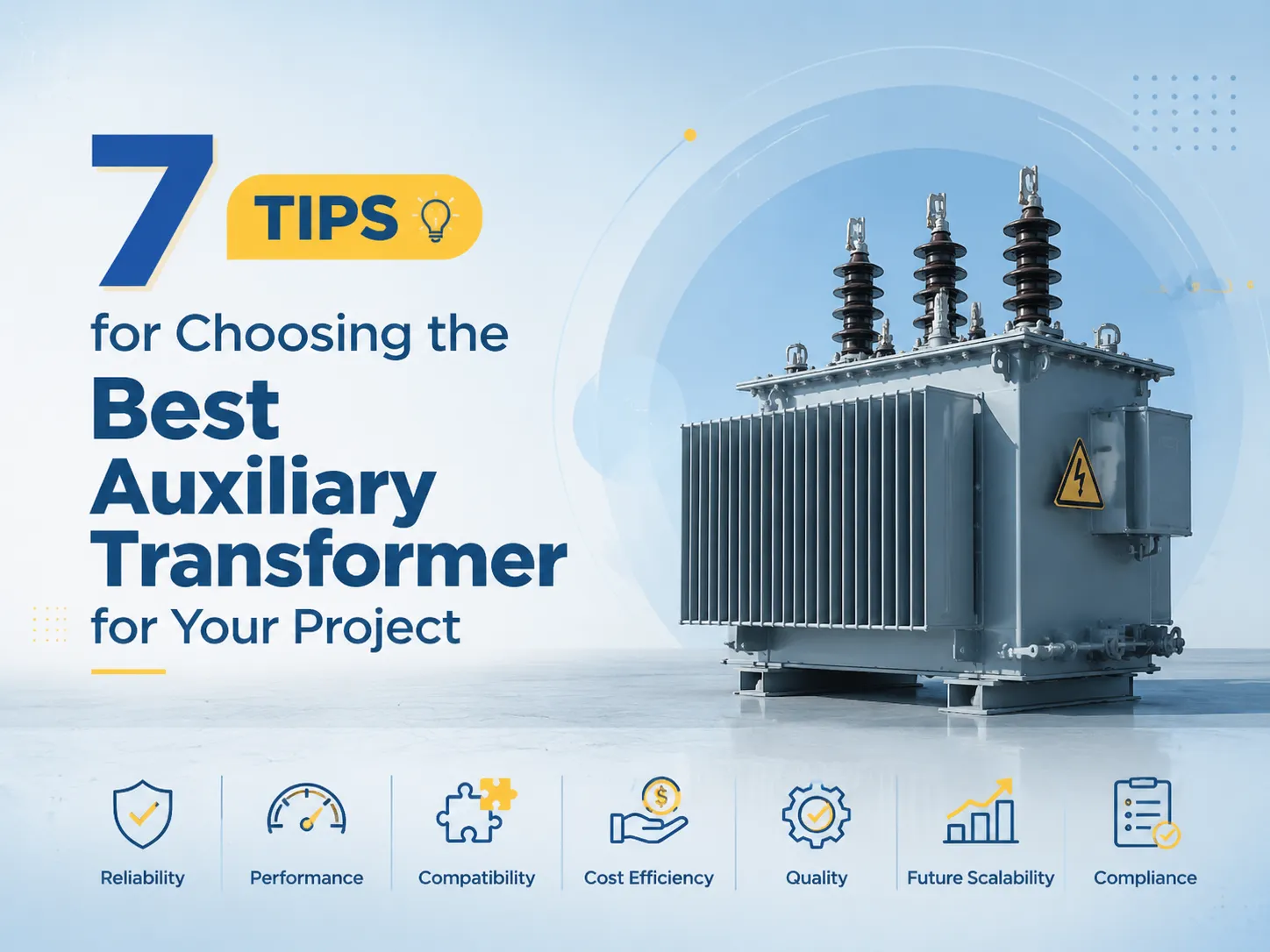
Was ist ein Hilfstransformator und welche Typen gibt es?
Ein Hilfstransformator ist auch als Einheitshilfstransformator oder Station-Service-Transformator bekannt und wurde entwickelt, um die Hilfsanlagen der Umspannstation, des Kraftwerks oder der großen Industrieanlage zu versorgen. Er reduziert die Hauptbusspannung auf Niederspannungsverteilungsniveaus (typischerweise 35/0,4 kV, 10/0,4 kV und 6,6/0,4 kV). Die bereitgestellte elektrische Energie wird zum Betrieb von Motoren, Heizung und Beleuchtung, zum Laden von Batterien und für Steuerungs-/Schutzschaltungen verwendet. Da die Last für den Betrieb der Anlage jederzeit wichtig ist, ist diese Art von Ausrüstung für den Dauerbetrieb und einen hohen Lastfaktor ausgelegt – das bedeutet, dass ein Ausfall der Einheit den Betrieb der gesunden Anlage stoppen kann. Daher ist es notwendig, die Auswahl der Parameter des Hilfstransformators ernst zu nehmen.
| Typ | Typische Nennleistung | Kühlung / Form | Am besten geeignet für |
|---|---|---|---|
| Ölgetaucht, selbstgekühlt (ONAN) | 50–2.500 kVA | Mineralöl, Außentank | Außendienst der Umspannstation |
| Ölgetaucht mit Ventilatoren (ONAF) | Über 1.000 kVA | Mineralöl, Zwangsluft | Hohe Lastfaktoren, heiße Klimazonen |
| Trockentyp Gießharz | 100–2.000 kVA | Epoxidharz, Innenbereich | Innenbereich, feuergefährdete Bereiche |
| Doppelsekundärwicklung | Maßgeschneidert | Jeder Kühlmodus | Separate Motor- und Steuerungsversorgungen |
| Mit Lastabgriff | 100–2.500 kVA | Jeder Kühlmodus | Instabile Netzspannung |
Tipp 1: Größe basierend auf gemessener Last, nicht auf Typenschild
Der häufigste Grund für das Versagen von Hilfstransformatoren ist Unterdimensionierung. Die Nennwerte der angeschlossenen Geräte übertreiben die tatsächliche Nachfrage, aber der Designer, der den Diversitätsfaktor ignoriert, indem er den Nennwert aller angeschlossenen Lasten summiert, wird eine unnötig große und ineffiziente Lösung produzieren. Eine professionelle Lösung wäre, die Betriebslast, die größte Anlauflast, die entweder der Kühlventilator oder ein Kompressor ist, der 5-8 Mal die Menge der Betriebslast benötigt, und eine Marge von 15-20 % für zukünftiges Wachstum und saisonale Variationen zu berücksichtigen. Wenn die Anlage wahrscheinlich bald automatisiert oder erweitert wird, wäre es der beste Weg, die tatsächliche Nachfrage über eine Saison zu beobachten, bevor die erforderlichen kVA bestimmt werden. Ein Hilfstransformator mit einer Nennleistung von 50 kVA würde an einer kleinen Umspannstation 2.000 bis 4.000 kosten, während ein Transformator mit 80 kVA nicht viel mehr kosten würde, aber zusätzlichen Spielraum schaffen würde.
Tipp 2: Fixieren Sie das Spannungs-Paar und die Vektorgruppe
Das Spannungsverhältnis muss dem Busspannungsniveau der Anlage und dem Niederspannungspanel entsprechen. Es muss entschieden werden, ob Ihr Unternehmen 35/0,4 kV, 10/0,4 kV oder ein anderes Spannungsverhältnis vor Ort verwenden wird. Welches dieser Verhältnisse Sie auch wählen, es sollte in den Anlagen konstant gehalten werden, um Ersatzteile und elektrische Umspannstationen mit einem einheitlichen Muster zu haben. Die Kategorie des Spannungstransformators kann ebenso wichtig sein. Bei der Anfrage nach Unterstützung für die Hilfslieferung der Umspannstation ist es vorzuziehen, Dyn11 zu wählen, da es den stabilen Neutralleiter für die einphasige Last und eine klare Phasenverschiebung bietet, dennoch kann es einige Anwendungen geben, die etwas anderes wie Dyn5 oder YNd11 gemäß der Erdungspolitik und den Anforderungen für paralleles Arbeiten erwähnen. Die Kategorie des Transformators sollte in der Bestellung angegeben und im regelmäßigen Bericht bestätigt werden, da das Gerät mit der falschen Transformator-Kategorie mit einem Schutzabschaltung konfrontiert ist oder nicht parallel arbeiten kann.
| Spannungs-Paar | Typische Vektorgruppe | Wo es verwendet wird |
|---|---|---|
| 35/0,4 kV | Dyn11 | Große Umspannstationen, Kraftwerke |
| 10/0,4 kV | Dyn11 | Verteilungsumspannstationen |
| 11/0,4 kV | Dyn11 | UK- und Commonwealth-Netzwerke |
| 6,6/0,4 kV | Dyn11 oder Dyn5 | Industrie- und ältere Anlagenbusse |
| 33/0,4 kV | Dyn5 oder maßgeschneidert | Besondere Erdungsschemata |
Tipp 3: Passen Sie den Kühlmodus an die Aufgabe an
Hilfstransformatoren werden typischerweise kontinuierlich betrieben, wodurch die Kühlklasse ein wichtiger bestimmender Faktor für die vorhandene Sicherheitsmarge bei hohen Temperaturen ist, wobei ONAN (Öl natürlich Luft natürlich) die einfachste und unkomplizierteste Option ist, die für die meisten Fälle bis zu 1.000 kVA anwendbar ist. Für größere und/oder rauere Umgebungen mit begrenztem Luftstrom werden ONAF (Öl natürlich Luft gezwungen) Transformatoren eingesetzt, die Ventilatoren einführen, die die Betriebsfähigkeit um etwa 20–33% erhöhen können. Daher ist es wichtig, die Umgebungstemperaturen und Höhen anzugeben (zum Beispiel ist eine Basislinie 40°C Umgebungstemperatur und 1.000 m Höhe, damit der Hersteller die Bewertungen entsprechend herabstuft.
| Umgebungstemperatur | Korrektur für ONAN-Bewertung | Empfohlene Maßnahme |
|---|---|---|
| 40°C | 100% des Typenschilds | Standard-Designpunkt |
| 45°C | ~93–95% | Herabstufen oder Lüfter hinzufügen (ONAF) |
| 50°C | ~85–88% | Herabstufen, ONAF oder größere kVA |
| 55°C | ~78–82% | Spezielles Design für hohe Umgebungstemperaturen |
| Über 1.000 m Höhe | Herabstufen ~1% pro 100 m über 1.000 m | Isolierung und Kühlung bestätigen |
Tipp 4: Wählen Sie die Abzapfanordnung bewusst
Der Busspannungspegel in einer Umspannstation liegt selten am Nennwert; er variiert von Zeit zu Zeit je nach Last und Netzsituation. Lastfreie Abzapfer (±2 × 2.5% ist normal) bewältigen langsam auftretende Variationen ohne zusätzliche Kosten. Wenn die Spannungspegel jedoch während eines Tages erheblich schwanken, ermöglichen Lastabzapfer (OLTCs), dass das System im Laufe des Tages innerhalb der Toleranz bleibt, ohne die Umspannstation abzuschalten, jedoch mit zusätzlichen Kosten von etwa 10-25% und erfordert regelmäßige Wartung.
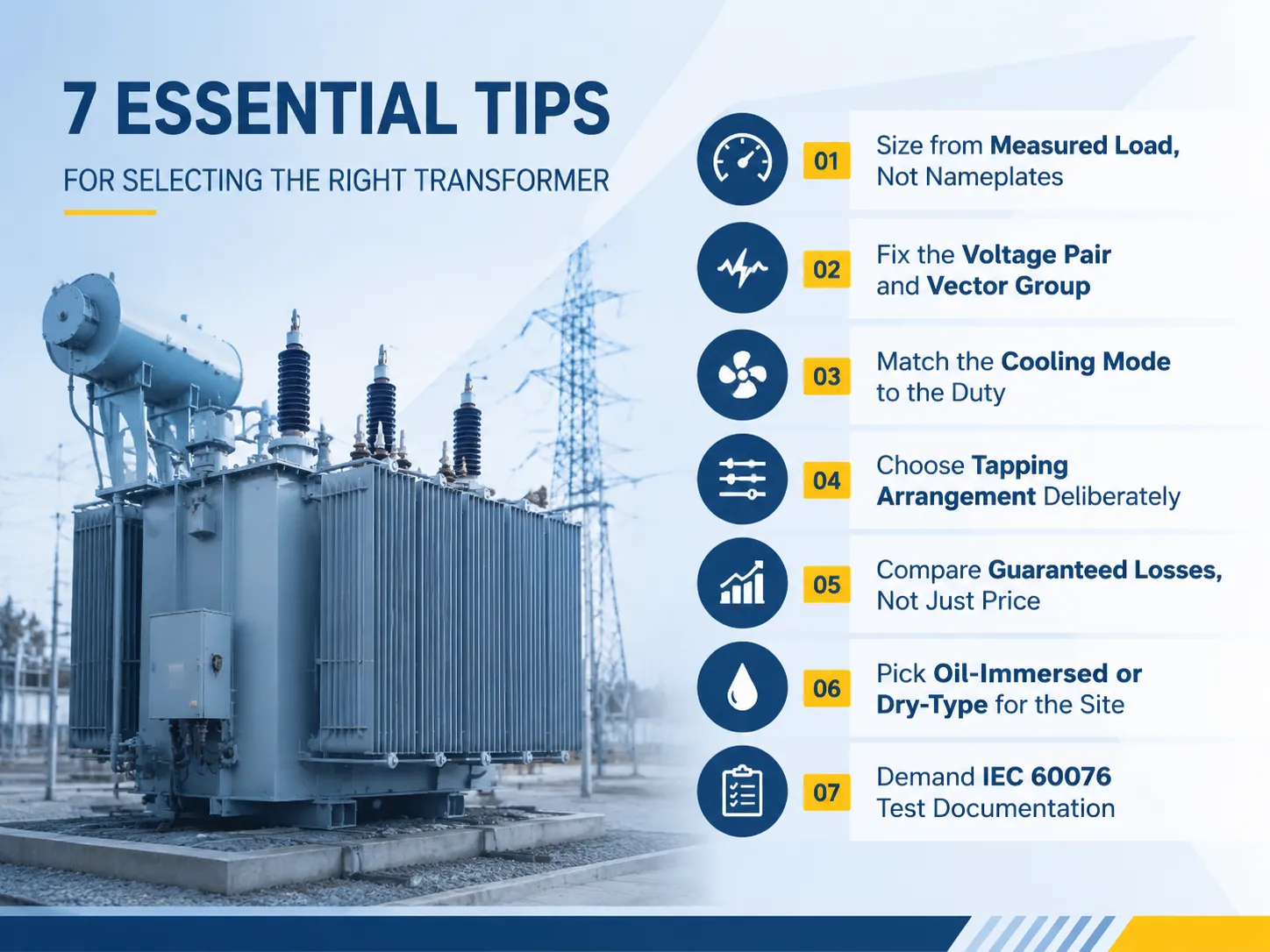
Tipp 5: Vergleichen Sie garantierte Verluste, nicht nur den Preis
Da der Hilfstransformator tagsüber einen hohen Lastfaktor hat, werden Betriebskosten zu unvermeidbaren Kosten. Lastfreie Verluste (Kernverluste) entstehen, wie während der lastfreien Verluste; Lastverluste treten je nach Nutzung auf. Bewerten Sie Angebote basierend auf den Verlusten und vergleichen Sie diese. Bei einem durchschnittlichen Strompreis von etwa $0.10-$0.15/kWh können 500 W lastfreier Verlust etwa $440-$660 pro Jahr kosten, was zu Gesamtkosten von $11.000-$16.500 über 25 Jahre Betrieb führt. Fordern Sie Daten zu lastfreien und Lastverlusten von Anbietern gemäß IEC 60076-1 an und vergleichen Sie diese.
| Unterschied der lastfreien Verluste | Jährliche Kosten @ $0.10/kWh | Jährliche Kosten @ $0.15/kWh | Kapitalisierter Wert über 25 Jahre |
|---|---|---|---|
| 100 W | $88 | $131 | $2.200–$3.300 |
| 300 W | $263 | $394 | $6.600–$9.900 |
| 500 W | $438 | $657 | $11.000–$16.400 |
| 000 W | $876 | $1,314 | $21.900–$32.900 |
Tipp 6: Wählen Sie ölgetauchte oder trockene Bauweise für den Standort
Isolationssysteme funktionieren je nach physikalischer Umgebung. Häufig verwenden Freiluft-Umspannstationen ölgefüllte Transformatoren. Diese Technologie ist robust, wetterfest und leicht zu warten, das Öl kühlt und isoliert. Inneninstallationen, unterirdische Schächte und Orte mit Brandgefahr (in der Nähe von Steuerständen und Einrichtungen für Menschen) verwenden die trockenen Typen von Gießharztransformatoren, die keine Ölauffangvorrichtungen benötigen und ein sehr geringes Brandrisiko sowie weniger Wartung aufweisen. Die Kosten für Gießharztransformatoren können 20 – 40 % höher sein als die von ölgefüllten Gegenstücken, aber die Effektivität der Beseitigung von Brandwänden, Ölgruben und dem Umgang mit Öl kann die Entscheidung zugunsten von trockenen Transformatoren verschieben, falls es notwendig ist, einen Transformator gemäß Brandschutzvorschriften im Inneren zu platzieren.
Tipp 7: Fordern Sie IEC 60076 Testdokumentation an
Der Prüfbericht dient als der einzige schlüssige Nachweis, dass der Artikel in Bezug auf seine Spezifikationen die erforderlichen Standards erfüllt. Es ist notwendig, einen Standardprüfbericht gemäß den Normen von IEC 60076 anzufordern, der das Spannungsverhältnis, die Vektorgroup, den Widerstand der Wicklungen, die Impedanz und die Verluste in Form von Lastverlust, Leerlaufverlust und Strom sowie die dielektrischen Tests detailliert beschreibt. Für kritische Projekte sollte der Typprüfbericht (Prüfung des Temperaturanstiegs, Prüfung der Kurzschlussfestigkeit gemäß IEC 60076-5, Geräuschpegel) und, falls vom Projekt gefordert, eine überwachte Prüfung oder Inspektion im Werk, die von einer dritten Partei durchgeführt wird, angefordert werden. Es ist entscheidend sicherzustellen, dass der Prüfbericht mit der Lieferung für das Zollverfahren versendet wird.
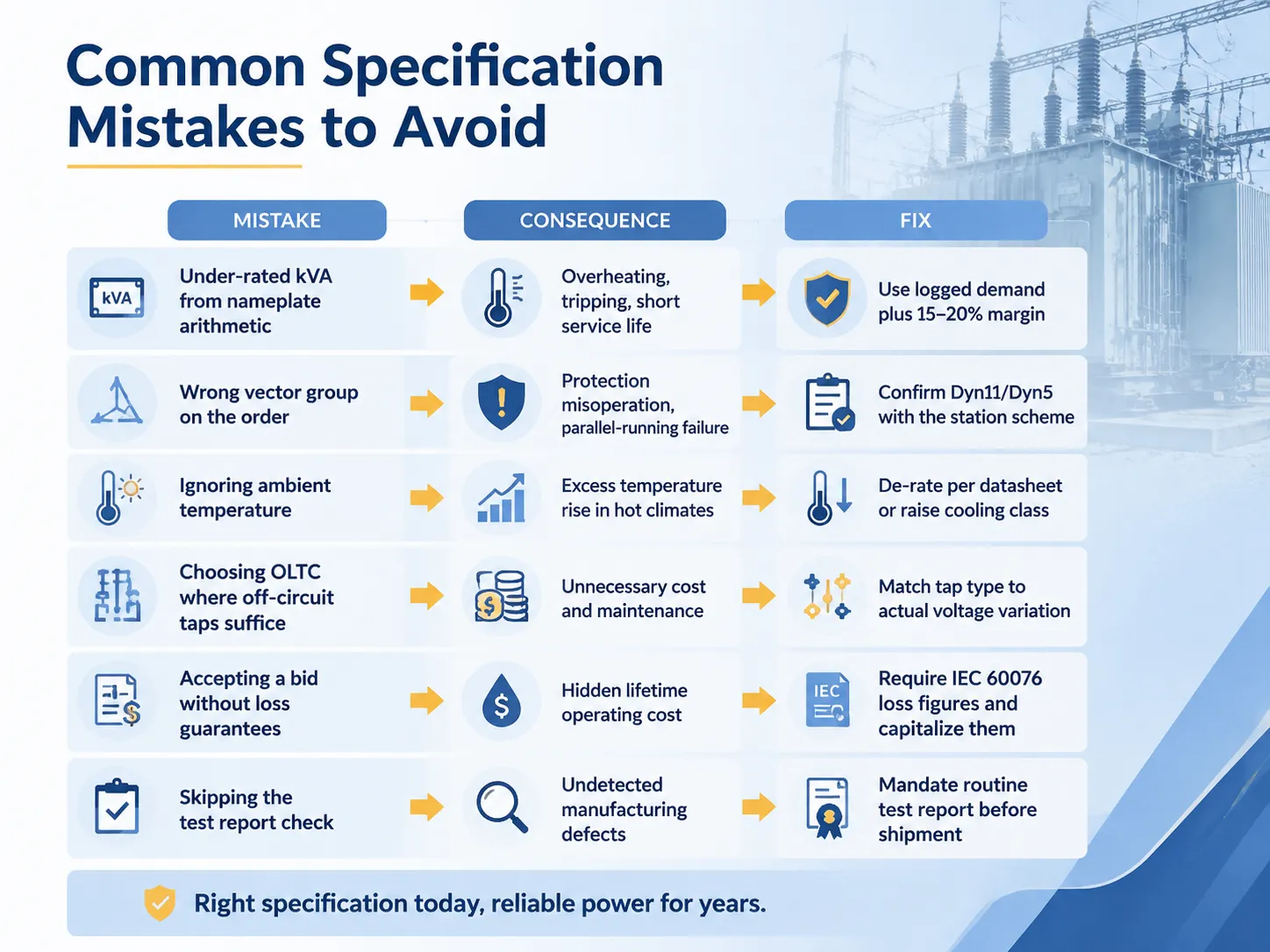
Häufige Spezifikationsfehler, die zu vermeiden sind
| Fehler | Konsequenz | Behebung |
|---|---|---|
| Unterbewertete kVA aus der Namensschildarithmetik | Überhitzung, Auslösung, kurze Lebensdauer | Verwenden Sie die protokollierte Nachfrage plus 15–20% Spielraum |
| Falsche Vektorgroup in der Bestellung | Fehlfunktion des Schutzes, Parallelbetriebsfehler | Bestätigen Sie Dyn11/Dyn5 mit dem Stationsschema |
| Ignorieren der Umgebungstemperatur | Übermäßiger Temperaturanstieg in heißen Klimazonen | Herabstufung gemäß Datenblatt oder Erhöhung der Kühlklasse |
| Auswahl von OLTC, wo Abgriffe im Leerlauf ausreichen | Unnötige Kosten und Wartung | Abstimmung des Abgriffstyps auf die tatsächliche Spannungsvariation |
| Annahme eines Angebots ohne Verlustgarantien | Versteckte Betriebskosten über die Lebensdauer | Fordern Sie die Verlustzahlen gemäß IEC 60076 an und kapitalisieren Sie diese |
| Überprüfung des Prüfberichts überspringen | Ungentdeckte Herstellungsfehler | Verpflichtung zur routinemäßigen Prüfberichterstattung vor dem Versand |
Top-Marken und Preisspannen
| Marke | Land | Produktfokus | Indikative Preisspanne (US$) |
|---|---|---|---|
| ABB | Schweiz/Schweden | Vollbereichs-Station-Service-Transformatoren | $4.000–$60.000 |
| Siemens | Deutschland | Versorgungs- und industrielle Hilfseinheiten | $3.500–$55.000 |
| Schneider Electric | Optimierungsmaßnahmen in der Praxis | Trockenbau- und Gießharzeinheiten | $2.500–$40.000 |
| Hitachi Energie | Schweiz | Versorgungsgrad-Hilfstransformatoren | $4.500–$70.000 |
| Eaton | USA | Gewerbliche und leichte industrielle Einheiten | $2.000–$35.000 |
| Jiangsu Subian Electric Power | China | Öl-untergetauchte und trockene, maßgeschneiderte Vektorgruppen | $2.000–$35.000 |
Die Preisbereiche sind indikativ für Transformatoren mit Nennleistungen zwischen 50 kVA und 2.500 kVA und hängen von einer Reihe von Faktoren ab, einschließlich der Verluste, des Vektorgruppensystems und zusätzlicher Merkmale, die möglicherweise enthalten sind. Namen wie ABB, Siemens, Schneider Electric, Hitachi Energy und Eaton haben die Ingenieurqualitätsstandards für dieses Transformatorenfeld definiert, sodass deren Dokumentation als Referenzpunkt für die Entwicklung herangezogen werden kann. Wenn man nach einem Anbieter sucht, der das gleiche Maß an Konformität mit IEC 60076, jedoch zu einem niedrigeren Preis, bieten kann, ist einer der chinesischen Hersteller, die die größte Erfahrung im Export haben, Jiangsu Subian Electric Power Co., Ltd. Das chinesische Unternehmen produziert sowohl ölgetauchte als auch trocken-transformatoren unterschiedlicher Nennleistungen von mehreren kVA bis zu Dutzenden von MVA, bietet traditionelle oder maßgeschneiderte Vektorgruppen, duale Sekundäroptionen sowie Last- und Abzweigtransformatoren an. Sie können das Produktangebot auf der Subian Electric-Website verfügbar.
Häufig gestellte Fragen
Was ist der Unterschied zwischen einem Hilfstransformator und einem Verteilungstransformator?
Die Prinzipien des Designs sind die gleichen; der Unterschied liegt im Ziel und der Position. Ein Verteilungstransformator versorgt Verbraucher — Wohnhäuser, Geschäfte, kleine Fabriken — entlang des Netzes mit Strom. Ein Hilfstransformator liefert Strom an die Systeme innerhalb eines Kraftwerks oder Umspannwerks — Steuerung, Schutz, Beleuchtung, Kühlung und Batterieladung. Da seine Last das Kraftwerk am Laufen hält, arbeitet ein Hilfstransformator oft mit einem höheren Lastfaktor als ein Verteilungstransformator und ist mit größerer Berücksichtigung von Verlusten und Zuverlässigkeit ausgelegt.
Welches kVA-Rating ist typisch für einen Station-Service-Transformator?
Bei einer Hilfslastanforderung. Ein kleines Verteilungsumspannwerk benötigt wahrscheinlich nur etwa 50–200 kVA für seine Hilfsanlagen, während ein großes EHV-Umspannwerk oder Kraftwerk mehrere Einheiten mit Nennleistungen von 1.000–2.500 kVA haben kann, die manchmal über duale Sekundäranschlüsse für Motoren und Steuerungsversorgungen verfügen. Wählen Sie eine Größe basierend auf der tatsächlichen Hilfslast zuzüglich einer Marge von 15–20 % anstelle der Faustregel.
Kann ein Hilfstransformator drinnen installiert werden?
Sicher. Bei der Installation im Innenbereich ist es ratsam, einen trocken-transformator aus Gießharz zu verwenden, da er nicht den Anforderungen an eine Ölschutzvorrichtung unterliegt, eine geringe Brandgefahr aufweist und geringere Wartungsbedürfnisse hat. Im Falle von Freiluft-Umspannwerken werden praktisch immer ölgetauchte Einheiten verwendet. Die Auswahl des Isolationssystems sollte nicht auf der Faustregel basieren; sie sollte von den Standortmerkmalen und den Anforderungen des Brandschutzcodes abhängen.
Sollte der Hilfstransformator über einen Lastabgriff verfügen?
Nur wenn sich Ihre Busspannung ausreichend ändert, um die 0,4 kV Versorgung zu beeinflussen, benötigen Sie einen OLTC. Off-Circuit-Abgriffe (±2 x 2.5%) sind effektiv im Umgang mit langsamen Spannungsänderungen ohne zusätzliche Kosten. Ein OLTC erhöht die Systempreise und Betriebskosten um 10-25%, schützt jedoch empfindliche Steuerelektronik in instabilen Netzen, wo ein Ausfall in der Regel die entstandenen Kosten rechtfertigt.
Stellt Subian Prüfberichte mit den Hilfstransformatoren zur Verfügung?
Absolut. Alle Hilfstransformatoren von Subian werden mit einem standardmäßigen Prüfbericht vor dem Versand gemäß IEC 60076 geliefert, der Tests wie das Verhältnis, die Vektorguppe, die Impedanz, Verluste und die Dielektrizitätstests umfasst. Es ist möglich, andere Arten von Prüfberichten, die für Projekte erforderlich sind, wie beobachtete Tests und Prüfungen durch Dritte, zu arrangieren, bevor die Bestellung abgeschlossen wird.
Referenzen
- IEC 60076-1 — Leistungstransformatoren: Allgemeines — der maßgebliche Standard für Bewertung, Verluste und Tests von Hilfstransformatoren.
- IEC 60076-5 — Fähigkeit zur Kurzschlussfestigkeit — der Verifizierungsstandard für Kurzschlussfestigkeit von Stationseinheiten.
- IEC 60076-3 — Isolationsniveaus und dielektrische Tests — definiert die Isolations- und Testanforderungen, die in RFQs referenziert werden.
- NEMA TP-1 — Energieeffizienz für Verteilungstransformatoren — der Effizienzbenchmark, der in der nordamerikanischen Verlustbewertung verwendet wird.
- Eaton — Transformator Produktpalette — repräsentative Herstellerdokumentation zum Vergleich.
- UL 1561 — Sicherheitsstandard für Trockenbau-Transformatoren — Sicherheitsauflistung, die für Innen- und Trockenhilfseinheiten relevant ist.
Fazit
Der Hilfstransformator ist das stille Arbeitstier jeder zuverlässigen Umspannstation, und seine ordnungsgemäße Auswahl basiert auf sieben entscheidenden Entscheidungen: die Größe unter Berücksichtigung der Lastanforderungen und unter Berücksichtigung von 15-20% Überkopfkosten zu definieren; das Spannungs-Paar und die Vektorguppe festzulegen; die Übereinstimmung des Kühlmechanismus mit den Einsatzbedingungen zu gewährleisten; bei der Auswahl der Abgriffverbindung vorsichtig zu sein; die Kosten der kapitalisierten Verluste zu vergleichen; und entweder die ölgetauchte Einheit oder die Trockenbauweise basierend auf den Anforderungen des Installationsstandorts auszuwählen; und die IEC 60076 Prüfergebnisse anzufordern. Alle Entscheidungen können praktisch überprüft werden, und es ist die Gesamtheit der Entscheidungen, die es ermöglicht, eine 25-jährige Station von einer Station zu unterscheiden, die im ersten Sommer ausfällt. Jiangsu Subian Electric Power ist ein renommierter Hersteller von sowohl ölgetauchten als auch trockenen Hilfstransformatoren, die den IEC 60076 Standards entsprechen, und bietet vollständige Prüfnachweise zu sehr fairen Preisen. Kontaktieren Sie das Unternehmen über die offizielle Website mit Ihren Stationslastdaten und dem Spannungsschema, um ein auf die Spezifikation abgestimmtes Angebot zu erhalten.