


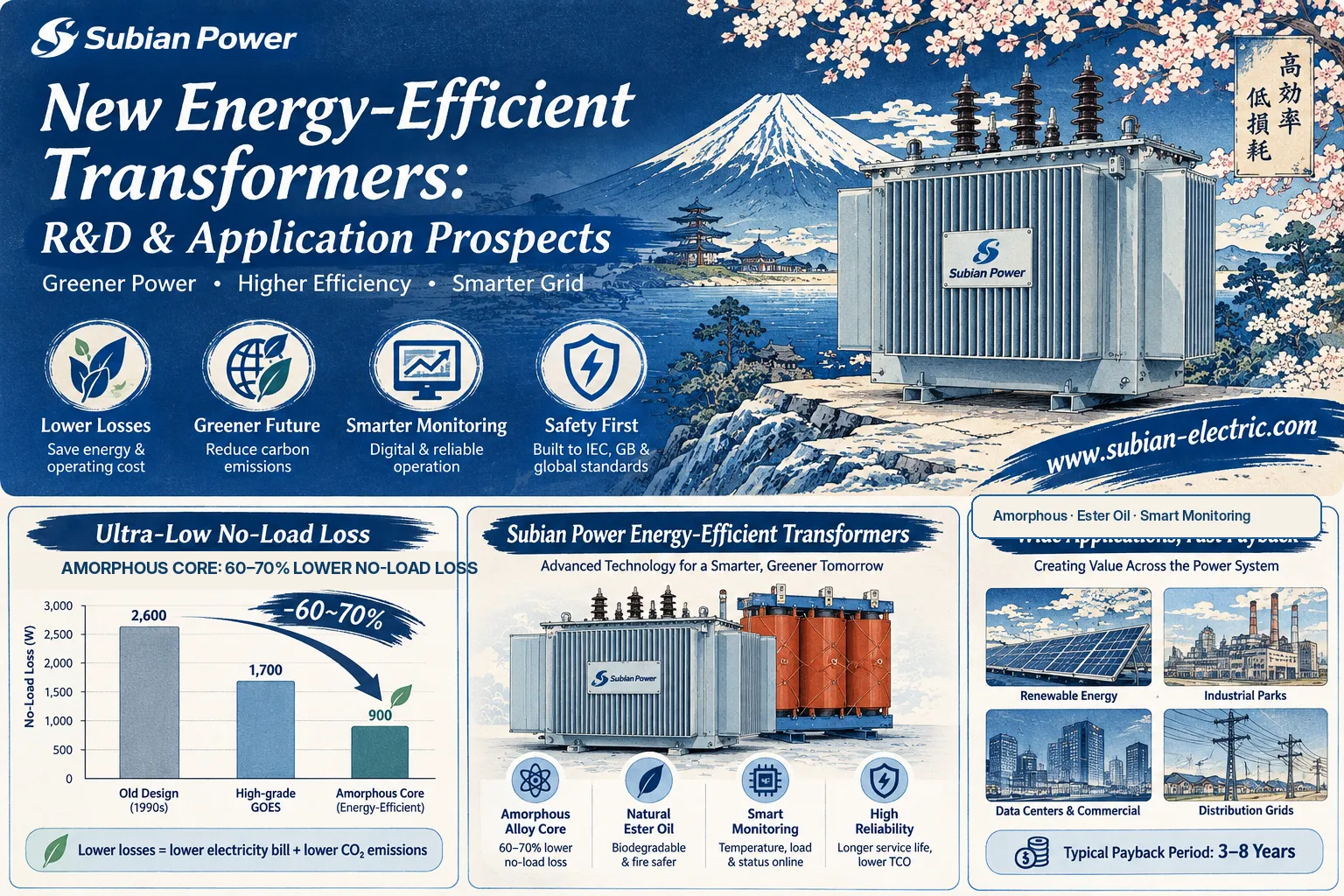
Der Cheftechniker eines Industrieparks in Vietnam beobachtete ein Paar 2.000 kVA Transformatoren, die unter einer durchschnittlichen Last von 35% summten – ein Lastprofil, das ihre Leerlaufverluste zu den größten kontrollierbaren Kosten der elektrischen Betriebsabläufe des Parks machte. Er hatte die Zahlen bereits überprüft: Ein Transformator aus den 1990er Jahren verlor 3.200–4.500 W im Leerlauf; ein moderner betrieb bei einem Verlust von 1.600–2.400 W; ein amorpher Kerntransformator verlor nur 800–1.200 W. Der Expansionsplan des Industrieparks gab ihm eine einzigartige Gelegenheit, in neue Transformatoren zu investieren, und diesmal gab es zum ersten Mal im Lieferantenverzeichnis neue Technologien, die die vorherige Generation nicht sehen würde: amorphe Kerne, natürliche Esteröle, Anschlüsse für intelligentes Monitoring von Transformatoren und Effizienzklassen, die durch neue Standards bestimmt wurden.
Was ist ein energieeffizienter Transformator?
Energieeffiziente Transformatoren werden definiert als Transformatoren mit beispiellosen Verlusten, die weit unter den branchentypischen Verlusten für ihre Nennleistung liegen. Entweder verwenden sie neue Kernmaterialien oder haben innovative Designs (oder beides).
Die quantitative Definition ist recht einfach. Sie umfasst niedrige Leerlaufverluste und niedrige Lastverluste bei derselben Nennleistung und Impedanz, wie durch die Routineprüfungen gemäß IEC 60076 bestätigt. Es gibt nur ein Merkmal, das ein Transformator haben muss, um als energieeffizient zu gelten: Er muss in der aktuellen Klasse von Hochleistungsprodukten (Stufe 1 in GB 20052, Stufe 2 in der EU-Ecodesign-Richtlinie oder die höchste DOE-Klasse) betrieben werden. Alles andere ist nur Marketing.
Wo die F&E stattfindet
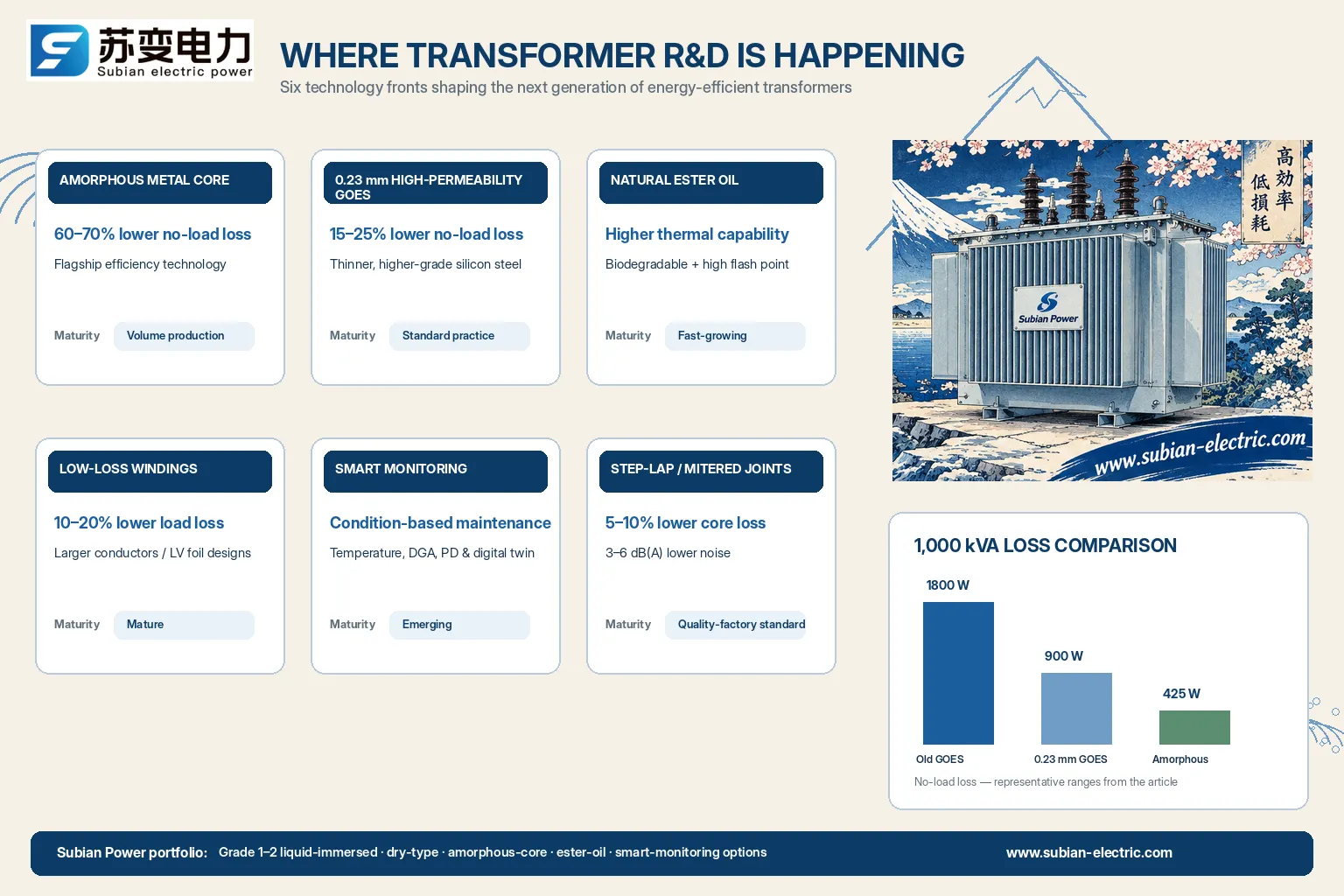
Die F&E von Transformatoren konzentriert sich heute auf eine kleine Anzahl von Fronten, und jede greift einen anderen Anteil des Verlustbudgets an:
| F&E-Front | Ziel | Typischer Gewinn | Reife |
|---|---|---|---|
| Amorphe Metallkerne | Leerlaufverlust | 60–70% Reduktion | Serienproduktion in China, weltweit wachsend |
| Hochpermeable GOES, dünnere Stärken | Leerlaufverlust | 15–25% Reduktion | Standardpraxis |
| Natürliche Esteröle | Lebenssicherheit, Nachhaltigkeit, Verlust bei hoher Temperatur | Höhere thermische Fähigkeit, biologisch abbaubar | Kommerziell, schnell wachsend |
| Niedrigverlustwicklungen (größere Leiter, Folie für LV) | Lastverlust | 10–20% Reduktion | Standardpraxis |
| Eingebettete Sensorik und digitaler Zwilling | Betriebs- und Wartungsverluste | Verlängerte Lebensdauer, vermiedene Ausfälle | Neu aufkommend, zunehmend in der 10kV+ Klasse |
| Stufenlap- und Gehrungskernverbindungen | Leerlaufverluste und Geräusch | 5–10% Verlust, 3–6 dB(A) Geräusch | Standard in Qualitätsfabriken |
Der bemerkenswerte Wandel besteht darin, dass der größte technische Hebel – der amorphe Kern – aus dem Labor in die Serienproduktion übergegangen ist, angetrieben durch Effizienzvorschriften und staatliche Anreize. Die wirtschaftliche Konsequenz ist, dass amorphe Kerntransformatoren nicht mehr exotisch sind; sie sind eine gängige Option mit vorhersehbarem Rückfluss.
Amorphe Legierungskerne: Die Flagship-Technologie
Ein amorphes Metall ist eine Eisenlegierung, die so schnell abgekühlt wurde, dass ihre Atome keine kristalline Struktur gebildet haben. Im Vergleich zu traditionellem, kornorientiertem Stahl ermöglicht die amorphe Struktur eine mühelosere Magnetisierung, weshalb die Leerlaufverluste auf etwa 30–40% der Verluste in konventionellem Stahl reduziert werden können. Die Nachteile sind bekannt: das Band ist dünner und fragiler, die Kerne sind größer und die Anfangskosten sind höher.
Repräsentativer Verlustvergleich für einen 1.000 kVA 10/0,4 kV Verteilungstransformator:
| Kerntechnologie | Leerlaufverlust | Lastverlust (indikativ) | Relativer Kernpreis |
|---|---|---|---|
| Konventionelles GOES (altes Design) | 500–2.100 W | 000–12.000 W | Basislinie |
| Hochpermeables 0,23 mm GOES | 700–1.100 W | 500–11.500 W | +5–10% |
| Amorphes Metall | 350–500 W | 500–11.500 W | +20–40% |
In Bezug auf die Kosten generiert der amorphe Kerntransformator Einsparungen, die jährlich von etwa $440 bis $610 hinsichtlich der Leerlaufverluste im Vergleich zur erwarteten Leistung des besten GOES-Transformators reichen. Wenn der 20-Jahres-Zeitraum mit einem Diskontsatz von 8% berechnet wird, stellt sich heraus, dass der Barwert dieser Einsparung etwa $4.300 bis $6.000 gegenüber dem ersten Kostenaufschlag eines neuen Transformators beträgt, der voraussichtlich zwischen $1.500 und $3.000 liegen wird.
Natürliche Esteröle und Fortschritte in der Isolierung
Natürliche Esteröle, die pflanzliches Material wie Raps oder Sojabohnen verwenden, heben sich als der zweite große Trend in der Technologie der energieeffizienten Transformatoren hervor. Während sie keine bessere elektrische Leistung als Mineralöle bieten, bieten sie zwei wesentliche Vorteile in Bezug auf Energie und Nachhaltigkeit.
Erstens haben sie eine höhere thermische Leistung, da natürliche Esteröle bei höheren Temperaturerhöhungen funktionieren können, wodurch ihre Isolationssysteme unter höheren Lasten effektiver arbeiten — kühlerer Betrieb erhöht die Lebensdauer der Papierisolierung.
Zweitens bieten sie den Vorteil der biologischen Abbaubarkeit und Brandsicherheit — Esteröle bauen sich natürlich ab und haben signifikant höhere Flammpunkte als herkömmliches Öl, was das Risiko von Bränden sowie die damit verbundenen Versicherungs- und Umweltschäden verringert.
Viele innovative grüne Transformatoren kombinieren ein amorphes Kern-Design mit natürlichen Esterölen. Diese Innovation minimiert den Energieverlust durch die Verwendung von biologisch abbaubarer Isolierung aus natürlichen Esterölen, jedoch erhöht die Kombination typischerweise die Produktionskosten zwischen 30% und 55% im Vergleich zu herkömmlichen Transformatoren.
Intelligente Transformatoren und Zustandsüberwachung
Bei “neuen” energieeffizienten Transformatoren ist der Begriff “neu” jetzt gleichbedeutend mit Intelligenz. Überwachungssysteme nutzen Informationen, die von eingebetteten Sensoren gesammelt werden, die Öl- und Wicklungstemperaturen, Gas im Öl und Teilentladungen überwachen.
Die Echtzeitüberwachung der Transformatoreneffizienz zeigt Betriebsverlustmetriken im Gegensatz zu Nennverlusten.
Darüber hinaus erkennt die prädiktive Wartung mithilfe von gelösten Gaswerten (gemäß IEC 60599) Ausfälle Jahre bevor sie auftreten können.
Dank intelligenter Funktionen kann die Echtzeit-Dynamikbelastung einen sicheren Betrieb weit über die Nennbewertung hinaus bieten, wenn sie innerhalb der akzeptablen Isolationszustandsgrenzen gemäß IEC 60076-7 liegt.
Die Auswirkungen verbesserter Technologie können indirekt, aber signifikant sein und $100.000–$500.000 an Reparatur-, Ersatz- und Ausfallkosten aufgrund nur eines mittleren Lebensdauerfehlers eines 10 MVA-Transformators einsparen.
Effizienzklassen und Standards
Neue Technologien werden erst dann zu einem Produkt, wenn ein Standard dies besagt. Der aktuelle Rahmen:
| Standard / Regel | Markt | Klassenstruktur | Status |
|---|---|---|---|
| GB 20052-2020 | China | Klassen 1–3, Verteilungstransformatoren | Klasse 2 Basislinie; Klasse 1 für Anreize |
| EU-Ecodesign 2019/1783 | EU | Verlustgrenzen der Stufen 1 und 2 | Stufe 2 in Kraft seit Juli 2024 |
| US DOE 10 CFR 431 | Vereinigte Staaten | Mindestwirkungsgradklassen | In Kraft; Überarbeitungen für 2024–2026 angenommen |
| IEC 60076 (alle Teile) | International | Bewertungs- und Testgrundlage | Immer anwendbar neben den Effizienzregeln |
Da die Standards ständig im Wandel sind, bedeutet dies, dass es immer einen Markt für Investitionen in Forschung und Entwicklung geben wird. Einfach ausgedrückt, jedes Mal, wenn die Standards strenger werden, werden die “Premium”-Technologien zu Vorschriften; das bedeutet, dass im Labor eine neue “Premium”-Technologie entwickelt wird. Es wird empfohlen, dass Verbraucher die Klasse gemäß dem Standard und nicht dem Produktprospekt lesen.
Anwendungsperspektiven nach Sektor
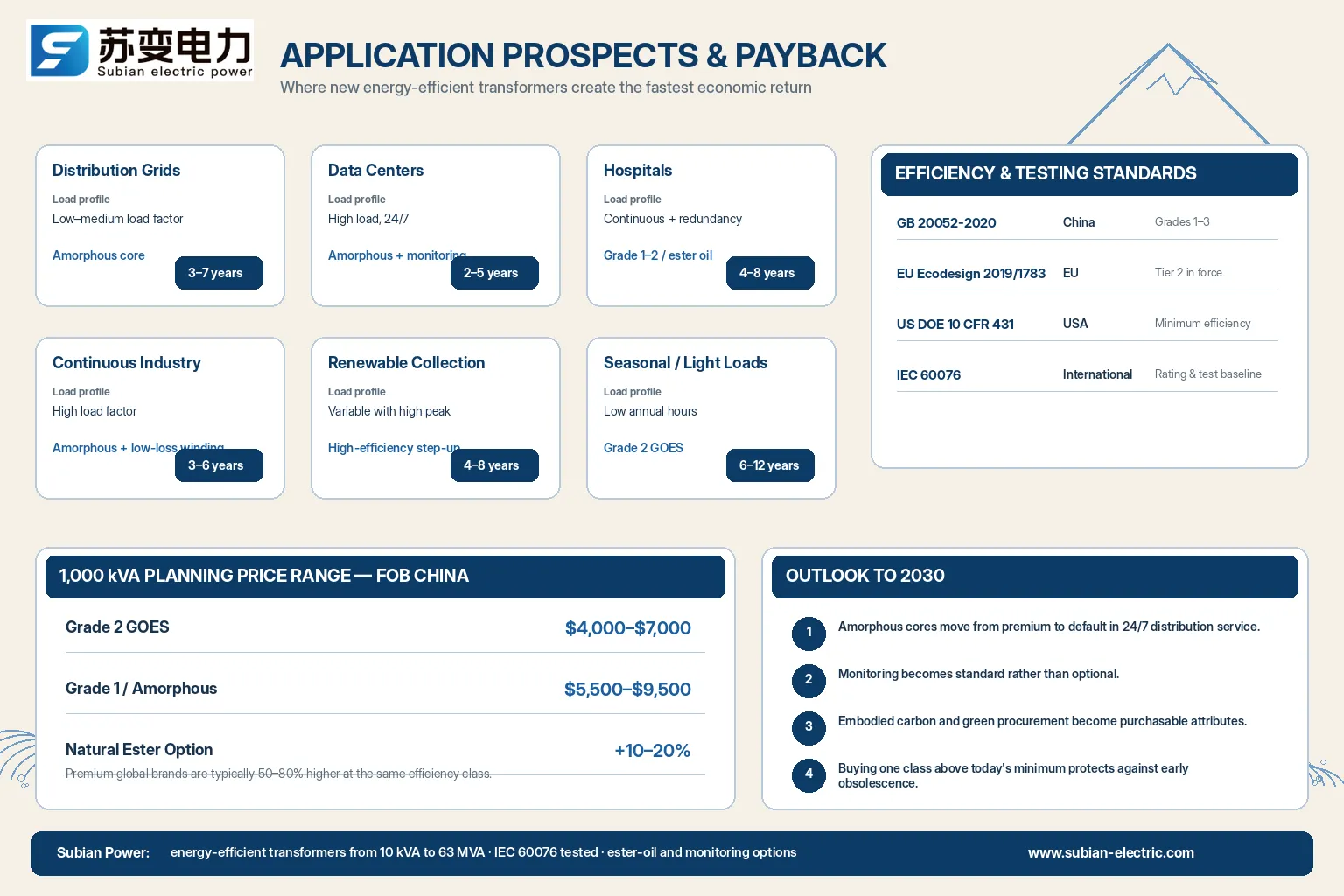
Wo neue energieeffiziente Transformatoren am schnellsten gewinnen, wird durch den Lastfaktor und die Betriebsstunden bestimmt:
| Anwendung | Typisches Lastprofil | Beste Technologie | Erwartete Amortisation |
|---|---|---|---|
| Verteilungsnetze (24/7 unter Spannung) | Niedriger bis mittlerer Lastfaktor | Amorpher Kern, Klasse 1–2 | 3–7 Jahre |
| Rechenzentren | Hoher Lastfaktor, 24/7 | Amorpher Kern + Überwachung | 2–5 Jahre |
| Krankenhäuser und kritische Einrichtungen | Kontinuierlich, redundanzintensiv | Klasse 1–2, Esteröl wo innen | 4–8 Jahre plus Resilienz-Wert |
| Industrielle kontinuierliche Prozesse | Hoher Lastfaktor | Amorpher Kern, verlustarme Wicklung | 3–6 Jahre |
| Erneuerbare Anlagenkollektion | Variabel, hohe Spitzenlast | Hochleistungs-Steigerungseinheiten | 4–8 Jahre |
| Saisonale/leichte Lasten | Niedrige Stunden, niedriger Lastfaktor | Klasse 2 GOES (Wert optimal) | 6–12 Jahre |
Die Anwendungsaussichten sind für amorphe Kernverteilungstransformatoren in Netzen, für intelligente Funktionen in der 10–110kV-Klasse und für Esteröl-Einheiten in städtischen und umweltsensiblen Standorten stark positiv. Dieselbe Liste definiert, wohin das F&E-Budget der Branche fließt.
Verfügbare Produkte und Preisspannen
Indikative FOB-Preise für einen 1.000 kVA 10/0,4 kV neuen energieeffizienten Verteilungstransformator nach Marke:
| Marke | Herkunft | Preis der Klasse 2 | Preis der Klasse 1 / amorpher Preis | Esteröl-Premium |
|---|---|---|---|---|
| Hitachi Energie | Japan/Weltweit | $9.000–$12.500 | $12.500–$18.000 | +15–25% |
| ABB | Schweiz/Weltweit | $8.500–$12.000 | $12.000–$17.000 | +15–25% |
| Siemens Energie | Deutschland/Weltweit | $8.000–$11.500 | $11.500–$16.500 | +15–25% |
| Schneider Electric | Frankreich/Weltweit | $7.500–$11.000 | $11.000–$15.500 | +15–25% |
| Jiangsu Subian Electric Power | China | $4.000–$7.000 | $5.500–$9.500 | +10–20% |
Die Preise variieren je nach Nennleistung, Verlustklasse, Abzapfvorrichtung, Zubehör, Rohstoffpreisen und Lieferbedingungen; betrachten Sie diese als Planungsbereiche, nicht als feste Angebote.
Der Preis der Premium-Kategorie ist in globalen Testprogrammen, langen Einsatzgeschichten und Servicenetzwerken verankert. Die chinesische Kategorie hat die gleichen Effizienzklassen — amorphe Kerne, Verlustklasse 1, Esteröl-Optionen — zu einem um 40–50% niedrigeren Erstkosten verfügbar gemacht, was genau das ist, was ihre Akzeptanz in kostenempfindlichen und aufstrebenden Märkten beschleunigt hat. Jiangsu Subian Electric Power ist ein chinesischer Transformatorenhersteller und energieeffizienter Transformator Hersteller von flüssigkeitsgetauchten, trockenen und amorphen Kerntransformatoren der Klassen 1–2 von 10 kVA bis 63 MVA, getestet nach IEC 60076 und mit Routinetestberichten versendet. Subians energieeffiziente Produktpalette, einschließlich Esteröl- und Smart-Monitoring-Optionen, ist dokumentiert unter subian-electric.com.
Der Ausblick bis 2030
Drei Trends werden das kommende Jahrzehnt prägen. Zunächst werden amorphe Kerntransformatoren von der Premium-Kategorie zur Standardkategorie in kontinuierlich belasteten Verteilungsanwendungen übergehen, beeinflusst durch die nächsten Stufen der Effizienzverschärfung. Der nächste Trend ist die Einführung von Monitoring als Mittel zur Sicherung von Effizienz und Zuverlässigkeit.
Was den dritten Trend betrifft, wird der Kohlenstoffgehalt Teil des Produkts werden. In diesem Fall wird der im Produkt verkörperte Kohlenstoff und die Bewertungen der Öko-Kennzeichnung Hersteller belohnen, die umweltfreundliche Herstellungsprozesse anwenden.
Was die Kunden betrifft, bedeutet die Anwendung dieser Trends, dass der Transformator, den Sie heute kaufen, 2030 höhere Standards erfüllen muss.
Häufig gestellte Fragen
Was ist der effizienteste Typ von Transformator, der heute verfügbar ist?
Bei Verteilungsnennleistungen führt der amorphe Kerntransformator: keine Lastverluste von 350–500 W für eine 1.000 kVA Einheit im Vergleich zu 700–1.100 W für eine hochpermeable GOES-Einheit und 1.500–2.100 W für ein Design aus den 1990er Jahren. Effizienzklassen sind in GB 20052 (Klasse 1–3) und EU Ökodesign 2019/1783 (Stufe 1–2) kodifiziert.
Wie viel kosten neue energieeffiziente Transformatoren?
Eine 1.000 kVA Einheit der Klasse 2 kostet etwa $4.000–$7.000 FOB von chinesischen Herstellern; eine amorphe Kern Einheit der Klasse 1 kostet $5.500–$9.500, plus 10–25% mehr für natürliches Esteröl. Premium-Europäische und Japanische Marken kosten 50–80% mehr in derselben Klasse.
Sind amorphe Kerntransformatoren die zusätzlichen Kosten wert?
In Anwendungen, die 24/7 belastet sind — Netze, Rechenzentren, Krankenhäuser, kontinuierliche Industrie — ja. Die 20–40% Premium amortisiert sich in 3–8 Jahren durch 60–70% niedrigere Leerlaufverluste, und die Einsparungen summieren sich über 25–35 Jahre. An leicht belasteten saisonalen Standorten ist eine GOES Einheit der Klasse 2 in der Regel das wertoptimale.
Wie hoch ist die Lebenserwartung eines neuen energieeffizienten Transformators?
25–35 Jahre mit routinemäßiger Wartung. Natürliches Esteröl und niedrigere Betriebstemperaturen verlängern die Lebensdauer der Isolierung; jede 6K-Reduktion der Hot-Spot-Temperatur verdoppelt ungefähr die Lebensdauer des Papiers. Smart Monitoring von Temperatur und gelöstem Gas schützt zusätzlich die Investition.
Zahlen sich neue Transformatoren selbst?
In der Regel ja, basierend auf den Gesamtkosten des Eigentums. Ein modernes Gerät der Klasse 1–2 im Vergleich zu einem Gerät aus den 1990er Jahren spart $800–$1.500/Jahr allein durch die Leerlaufverluste bei $0.08–$0.10/kWh für 1.000 kVA, was Rückflüsse von 3–8 Jahren ergibt — bevor vermiedene Ausfälle, Subventionen und Präferenzen für umweltfreundliche Beschaffung berücksichtigt werden.
Referenzen
- IEC 60076-1: Leistungstransformatoren – Allgemeines — Internationale Bewertungs- und Testgrundlage für alle neuen Transformatoren.
- GB 20052: Energieeffizienzklassen für Leistungstransformatoren — Die Klassenstruktur hinter amorphen und Klasse 1-Designs in China.
- EU-Ecodesign-Verordnung 2019/1783 — EU-Effizienzstufen, die den Marktzugang regeln.
- US DOE-Programm zur Effizienz von Transformatoren — Nordamerikanische Effizienzklassen und Verlustökonomie.
- IEA-Programm zur Energieeffizienz — Analyse des Verlustanteils von Transformatoren und Ausblick auf die Technologie.
- Hitachi Energy Transformatorenportfolio — Referenz für Angebote von energieeffizienten Transformatoren der Premium-Klasse.
- Offizielle Website von Jiangsu Subian Electric Power — Transformatoren der Klassen 1–2, mit amorphen Kernen und Esteröl.
Fazit
Kernmaterialien, energieeffiziente Transformatoren sind kein Zukunftskonzept — sie sind eine sich entwickelnde Produktlinie mit dokumentierten Verlustdaten, standardisierten Effizienzklassen und nachgewiesenen Rückflüssen. Die F&E-Agenda ist klar: amorphe Kerne, natürliche Esterisolierung und intelligente Überwachung, alles geregelt durch Effizienzstandards, die immer strenger werden. Die Anwendungsaussichten sind am stärksten dort, wo Transformatoren kontinuierlich betrieben werden, was der Ort ist, an dem die meisten Transformatorenverluste weltweit auftreten.
Wichtige Erkenntnisse:
- Amorphe Kerne reduzieren die Leerlaufverluste um 60–70% und sind jetzt Serienproduktion, keine Labortechnologie mehr.
- Effizienzklassen in GB 20052, EU-Ecodesign und US DOE bestimmen, was als “energieeffizient” gilt.”
- Amortisations von 3–8 Jahren in kontinuierlich belasteten Anwendungen, mit intelligenter Überwachung, die das Asset schützt.
- Kaufen Sie eine Klasse über dem Minimum, um Obsoleszenz bei der nächsten Normenrevision zu vermeiden.
Wenn Sie Ihre Transformatorenflotte aufrüsten oder erweitern, Jiangsu Subian Electric Power liefert GB 20052 Klasse 1–2 und amorphe energieeffiziente Transformatoren, die nach IEC 60076 getestet wurden, mit Esteröl- und Überwachungsoptionen zu exportfreundlichen Preisen. Überprüfen Sie das Sortiment unter subian-electric.com.