


L'ingénieur en chef d'un parc industriel au Vietnam a observé une paire de transformateurs de 2 000 kVA bourdonnant sous une charge moyenne de 35% – un profil de charge qui faisait de leurs pertes à vide le plus grand coût contrôlable des opérations électriques du parc. Il avait déjà vérifié les chiffres : un transformateur datant des années 1990 perdait 3 200–4 500 W lorsqu'il n'était pas en fonctionnement ; un modèle moderne fonctionnait avec une perte de 1 600–2 400 W ; un transformateur à noyau amorphe ne perdait que 800–1 200 W. Le plan d'expansion du parc industriel lui offrait une occasion unique d'investir dans de nouveaux transformateurs, et cette fois pour la première fois dans le fichier des fournisseurs, il y avait de nouvelles technologies que la génération précédente ne verrait pas : des noyaux amorphes, des huiles d'esters naturels, des ports pour la surveillance intelligente des transformateurs, et des catégories d'efficacité déterminées par de nouvelles normes.
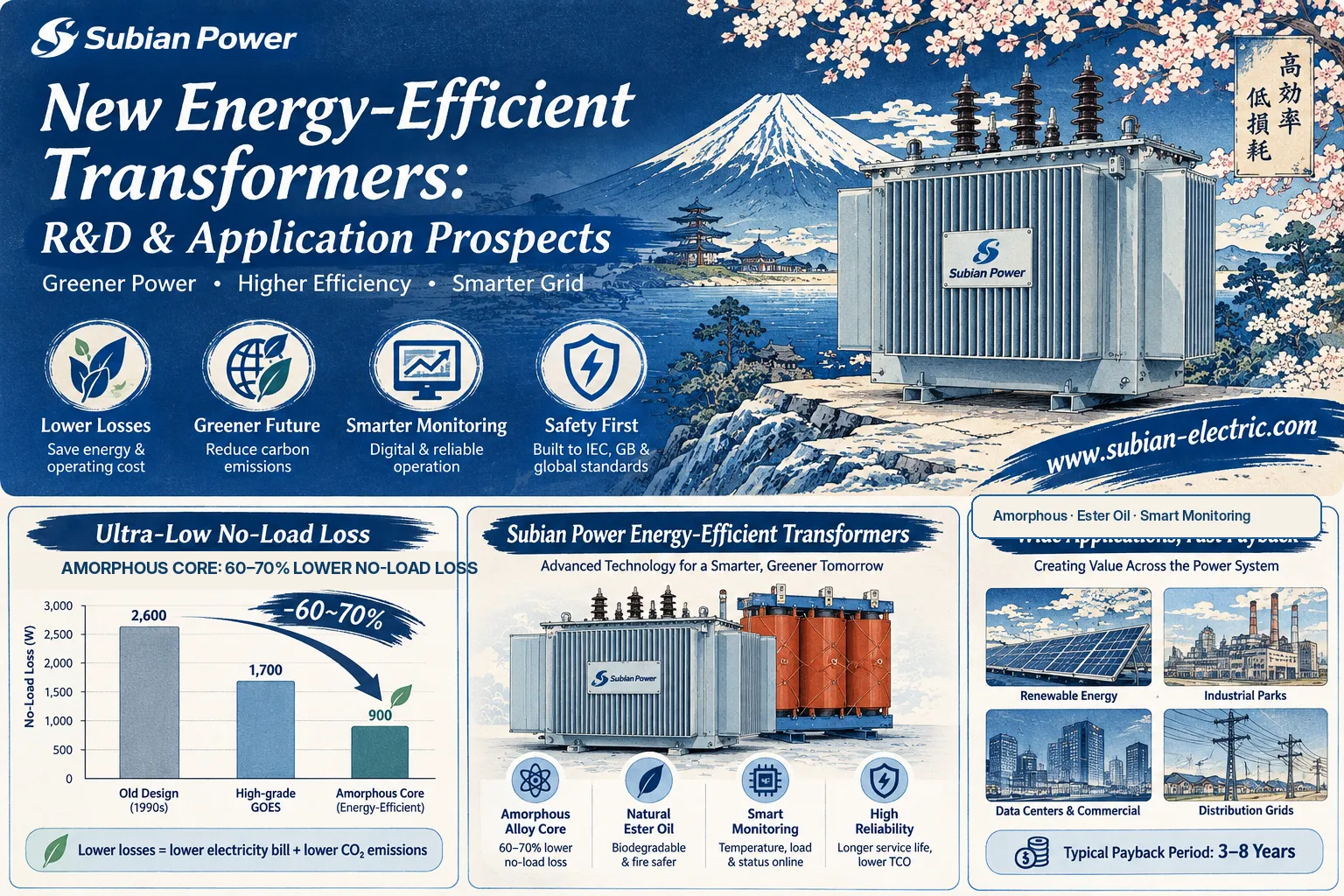
Que signifie un transformateur économe en énergie ?
Les transformateurs économes en énergie sont définis comme des transformateurs avec des pertes sans précédent qui sont bien en dessous des pertes industrielles attendues pour leur puissance. Soit ils utilisent de nouveaux matériaux de noyau, soit ils ont des conceptions innovantes (ou les deux).
La définition quantitative est plutôt simple. Elle implique d'avoir de faibles pertes à vide et de faibles pertes en charge à la même puissance et impédance, comme confirmé par les tests de routine IEC 60076. Il n'y a qu'une seule caractéristique qu'un transformateur doit avoir pour être qualifié d'économe en énergie : il doit fonctionner dans la classe actuelle des produits à haute efficacité (grade 1 dans GB 20052, niveau 2 dans la directive Ecodesign de l'UE, ou la classe DOE la plus élevée). Tout le reste n'est que marketing.
Où se déroule la R&D
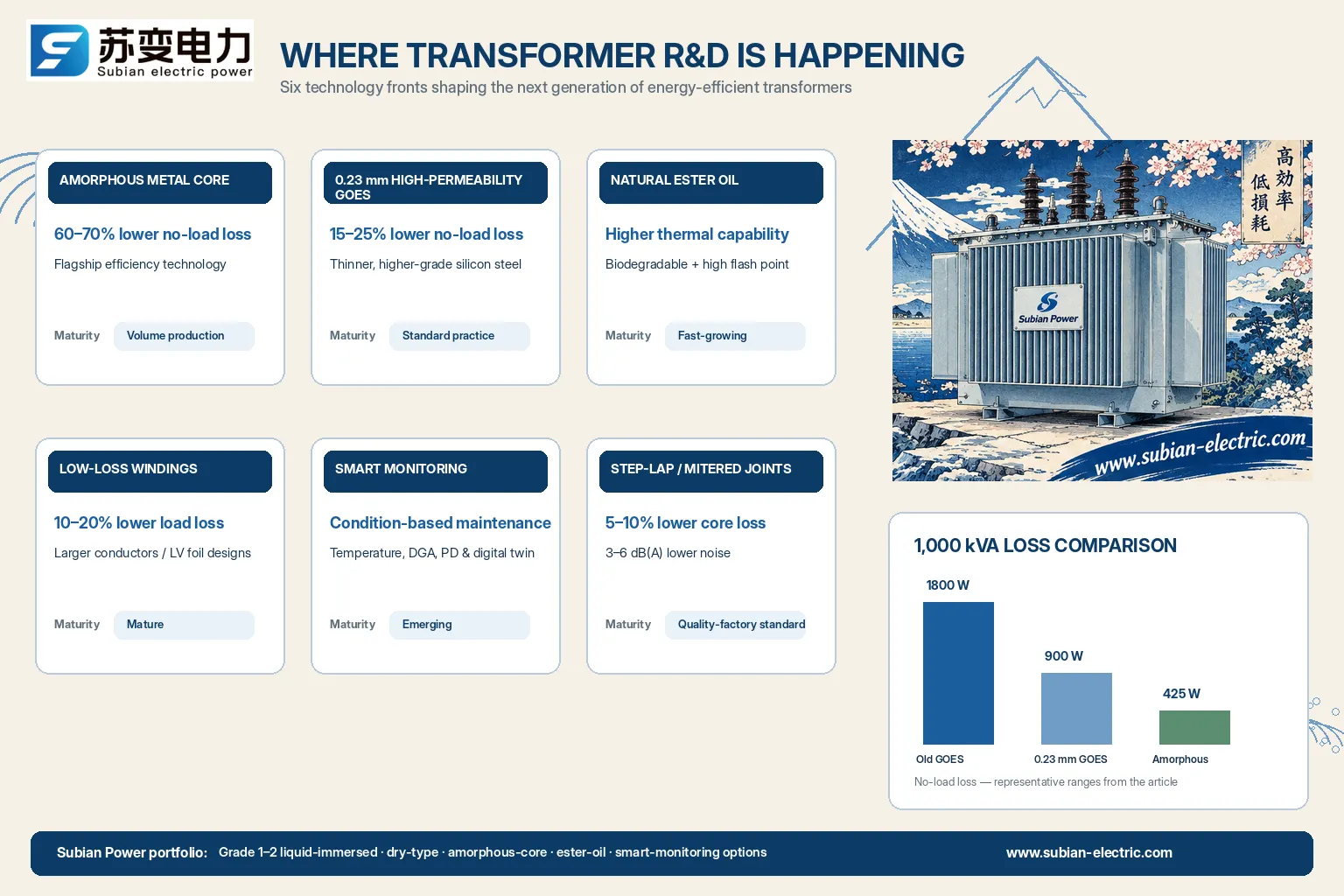
La R&D sur les transformateurs se concentre aujourd'hui sur un petit nombre de fronts, et chacun attaque une part différente du budget des pertes :
| Front de R&D | Cible | Gain typique | Maturité |
|---|---|---|---|
| Noyaux en métal amorphe | Pertes à vide | Réduction de 60–70% | Production en volume en Chine, en croissance mondiale |
| GOES à haute perméabilité, calibres plus fins | Pertes à vide | Réduction de 15–25% | Pratique standard |
| Huile à ester naturel | Sécurité de vie, durabilité, pertes à haute température | Capacité thermique supérieure, biodégradable | Commercial, en forte croissance |
| Bobinages à faibles pertes (conducteurs plus grands, feuille pour LV) | Pertes en charge | Réduction de 10–20% | Pratique standard |
| Détection intégrée et jumeau numérique | Pertes d'exploitation et de maintenance | Durée de vie prolongée, pannes évitées | Émergent, en augmentation dans la classe 10kV+ |
| Joints de noyau en pas à pas et en onglet | Pertes à vide et bruit | Pertes de 5–10%, bruit de 3–6 dB(A) | Standard dans les usines de qualité |
Le changement notable est que le plus grand levier technique — le noyau amorphe — est passé du laboratoire à la production en volume, poussé par la réglementation sur l'efficacité et les incitations gouvernementales. La conséquence économique est que les transformateurs à noyau amorphe ne sont plus exotiques ; ils sont une option courante avec un retour sur investissement prévisible.
Noyaux en alliage amorphe : La technologie phare
Un métal amorphe est un alliage de fer qui a été refroidi rapidement à tel point que ses atomes n'ont pas formé de structure cristalline. Comparé à l'acier orienté grain traditionnel, la structure amorphe permet une magnétisation plus aisée, ce qui explique pourquoi les pertes à vide peuvent être réduites à environ 30–40% des pertes dans l'acier conventionnel. Les inconvénients sont connus : le ruban est plus fin et plus fragile, les noyaux sont plus grands, et le coût initial est plus élevé.
Comparaison des pertes représentatives pour un transformateur de distribution de 1 000 kVA 10/0,4 kV :
| Technologie de noyau | Pertes à vide | Pertes en charge (indicatif) | Coût relatif du noyau |
|---|---|---|---|
| GOES conventionnel (ancien design) | 1,500–2,100 W | 10 000–12 000 W | Référence |
| GOES à haute perméabilité de 0,23 mm | 700–1,100 W | 9 500–11 500 W | +5–10% |
| Métal amorphe | 350–500 W | 9 500–11 500 W | +20–40% |
En termes de coût, le transformateur à noyau amorphe génère des économies qui varient d'environ $440 à $610 par an concernant les pertes à vide par rapport à la performance attendue du meilleur transformateur GOES. Lorsque la période de 20 ans est calculée à un taux d'actualisation de 8%, il s'avère que la valeur actuelle de cette économie devient d'environ $4 300 à $6 000 par rapport à la prime de coût initial d'un nouveau transformateur, qui devrait se situer entre $1 500 et $3 000.
Huiles d'esters naturels et avancées en isolation
Les huiles esters naturelles, qui proviennent de matières végétales telles que le colza ou le soja, se distinguent comme la deuxième grande tendance dans la technologie des transformateurs énergétiquement efficaces. Bien qu'elles n'offrent pas de meilleures performances électriques que les huiles minérales, elles présentent deux avantages clés en matière d'énergie et de durabilité.
Tout d'abord, elles ont de meilleures performances thermiques, car les huiles esters naturelles peuvent fonctionner à des augmentations de température plus élevées, permettant ainsi à leurs systèmes d'isolation de fonctionner plus efficacement sous des charges plus élevées — un fonctionnement plus frais augmente la durée de vie de l'isolation en papier.
Deuxièmement, elles offrent l'avantage de la biodégradabilité et de la sécurité incendie — les huiles esters se décomposent naturellement et ont des points d'éclair significativement plus élevés que l'huile traditionnelle, ce qui réduit le risque d'incendie ainsi que les coûts d'assurance et de fuite environnementale associés.
De nombreux transformateurs verts innovants combinent un design à noyau amorphe avec des huiles esters naturelles. Cette innovation minimise les pertes d'énergie en utilisant une isolation biodégradable fabriquée à partir d'huiles esters naturelles, cependant, la combinaison augmente généralement les coûts de production de 30% à 55% par rapport aux transformateurs conventionnels.
Transformateurs intelligents et surveillance de l'état
Dans les transformateurs énergétiquement efficaces “nouveaux”, le terme “nouveau” est désormais synonyme d'intelligence. Les systèmes de surveillance utilisent des informations collectées par des capteurs intégrés qui surveillent les températures de l'huile et des enroulements, les gaz dans l'huile et les décharges partielles.
La surveillance de l'efficacité des transformateurs en temps réel montre des métriques de perte opérationnelle par rapport aux pertes nominales.
De plus, la maintenance prédictive utilisant des lectures de gaz dissous (selon la norme IEC 60599) détecte les pannes des années avant qu'elles ne puissent se produire.
Grâce aux fonctionnalités intelligentes, le chargement dynamique en temps réel peut fournir une opération sûre bien au-delà de la capacité nominale si elle est dans les limites acceptables de l'état de l'isolation selon la norme IEC 60076-7.
L'impact de la technologie améliorée peut être indirect mais significatif, économisant $100,000–$500,000 en coûts de réparation, de remplacement et de temps d'arrêt en raison d'une seule panne à mi-vie d'un transformateur de 10 MVA.
Classes d'efficacité et normes
Une nouvelle technologie ne devient un produit que lorsqu'une norme le dit. Le cadre actuel :
| Norme / règle | Marché | Structure de classe | Statut |
|---|---|---|---|
| GB 20052-2020 | Chine | Grades 1–3, transformateurs de distribution | Ligne de base de grade 2 ; grade 1 pour les incitations |
| Ecodesign de l'UE 2019/1783 | UE | Limites de pertes de niveau 1 et niveau 2 | Niveau 2 en vigueur depuis juillet 2024 |
| US DOE 10 CFR 431 | États-Unis | Classes d'efficacité minimales | En vigueur ; révisions adoptées pour 2024–2026 |
| IEC 60076 (toutes les parties) | International | Ligne de base de classification et d'essai | Toujours applicable en parallèle avec les règles d'efficacité |
En raison du fait que les normes évoluent constamment, cela signifie qu'il y aura toujours un marché pour l'investissement en R&D. En termes simples, chaque fois que les normes deviennent plus strictes, les technologies “premium” deviennent des réglementations ; cela signifie qu'il y a une nouvelle “premium” en cours de développement dans le laboratoire. Il est recommandé aux consommateurs de lire la classe selon la norme et non la brochure du produit.
Perspectives d'application par secteur
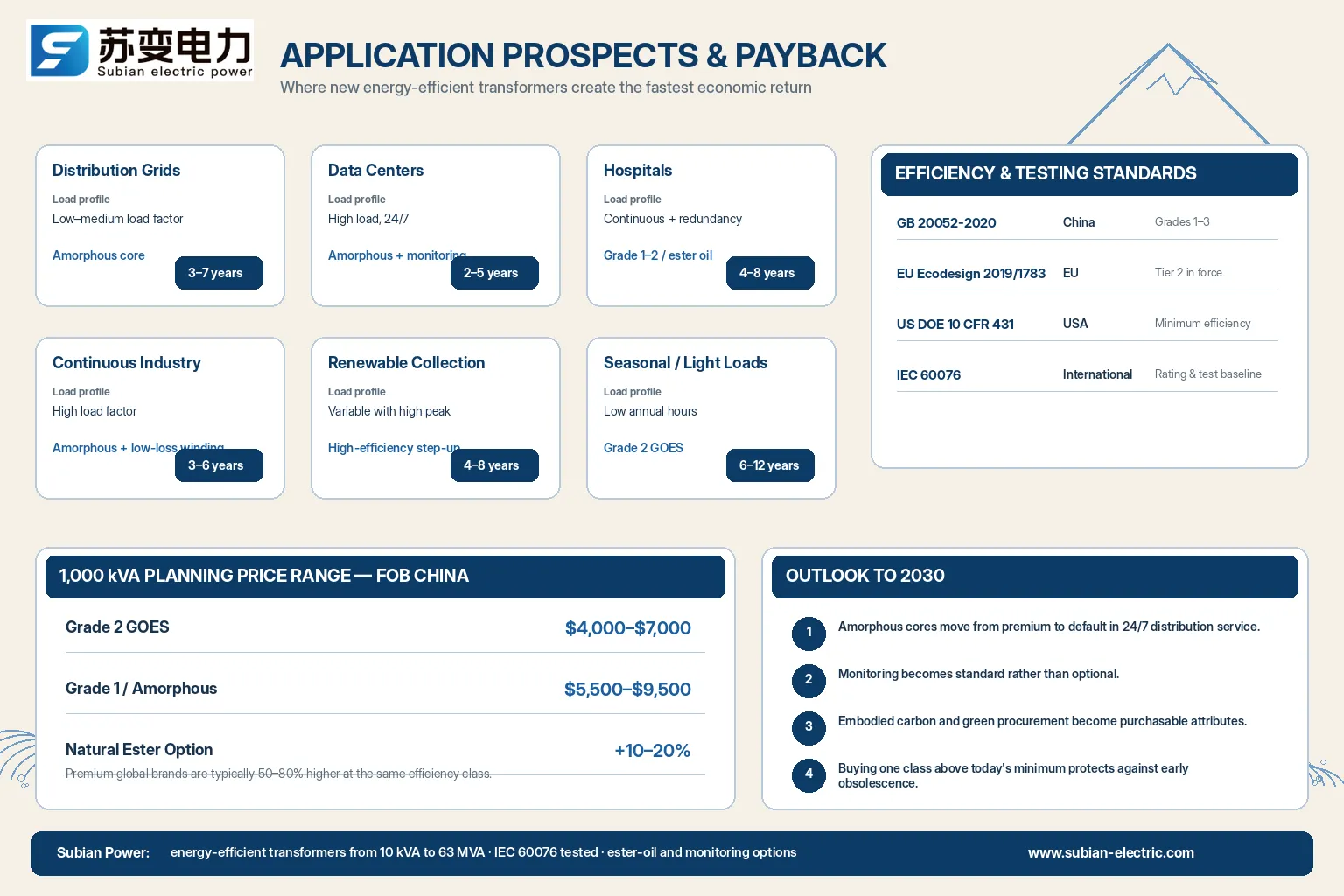
L'endroit où les nouveaux transformateurs écoénergétiques gagnent le plus rapidement est déterminé par le facteur de charge et les heures de fonctionnement :
| Application | Profil de charge typique | Meilleure technologie | Retour sur investissement attendu |
|---|---|---|---|
| Réseaux de distribution (24/7 alimentés) | Facteur de charge faible à moyen | Noyau amorphe, grade 1–2 | 3–7 ans |
| Centres de données | Facteur de charge élevé, 24/7 | Noyau amorphe + surveillance | 2–5 ans |
| Hôpitaux et installations critiques | Continu, lourd en redondance | Grade 1–2, huile d'ester où intérieur | 4–8 ans plus valeur de résilience |
| Processus industriels continus | Facteur de charge élevé | Noyau amorphe, enroulement à faibles pertes | 3–6 ans |
| Collecte de plantes renouvelables | Variable, pic élevé | Unités de montée en tension à haute efficacité | 4–8 ans |
| Charges saisonnières/légères | Faibles heures, faible facteur de charge | GOES de grade 2 (valeur optimale) | 6–12 ans |
Les perspectives d'application sont fortement positives pour les transformateurs de distribution à noyau amorphe dans les réseaux, pour les fonctionnalités intelligentes dans la classe 10–110kV, et pour les unités à huile d'esters dans les zones urbaines et écologiquement sensibles. La même liste définit où le budget R&D de l'industrie est orienté.
Produits disponibles et gammes de prix
Tarification FOB indicative pour un transformateur de distribution énergétiquement efficace de 1,000 kVA 10/0.4 kV par marque :
| Marque | Origine | Prix de la classe 2 | Prix de la classe 1 / prix amorphe | Prime d'huile ester |
|---|---|---|---|---|
| Hitachi Energy | Japon/Global | $9,000–$12,500 | $12,500–$18,000 | +15–25% |
| ABB | Suisse/Global | $8,500–$12,000 | $12,000–$17,000 | +15–25% |
| Siemens Energy | Allemagne/Global | $8,000–$11,500 | $11,500–$16,500 | +15–25% |
| Schneider Electric | France/Mondial | $7,500–$11,000 | $11,000–$15,500 | +15–25% |
| Jiangsu Subian Electric Power | Chine | $4,000–$7,000 | $5 500–$9 500 | +10–20% |
Les prix varient en fonction de la classification, de la classe de perte, du changeur de prises, des accessoires, des prix des matières premières et des conditions de livraison ; considérez ces éléments comme des plages de planification, et non comme des devis fermes.
Le prix de la catégorie premium est ancré dans des programmes de test mondiaux, de longues histoires de terrain et des réseaux de service. La catégorie chinoise a rendu les mêmes classes d'efficacité — noyaux amorphes, pertes de grade 1, options d'huile ester — disponibles à un coût initial inférieur de 40–50%, ce qui a précisément accéléré leur adoption sur les marchés sensibles aux coûts et émergents. Jiangsu Subian Electric Power est un chinois fabricant de transformateurs compétent et transformateur à économie d'énergie producteur de transformateurs immergés dans un liquide de grade 1–2, de type sec et à noyau amorphe de 10 kVA à 63 MVA, testés selon la norme IEC 60076 et expédiés avec des rapports de test de routine. La gamme économe en énergie de Subian, y compris les options d'huile ester et de surveillance intelligente, est documentée à subian-electric.com.
Les Perspectives pour 2030
Trois tendances façonneront la prochaine décennie. Pour commencer, les transformateurs à noyau amorphe passeront de la catégorie premium à celle de défaut dans les applications de distributeurs chargées en continu, influencées par les prochaines étapes de resserrement de l'efficacité. La prochaine tendance est l'introduction de la surveillance comme moyen de sauvegarder l'efficacité et la fiabilité.
En ce qui concerne la troisième tendance, la teneur en carbone fera partie du produit. Dans ce cas, le carbone incorporé dans le produit et les scores de l'écolabel récompenseront les fabricants qui appliquent des processus de fabrication respectueux de l'environnement.
En ce qui concerne les clients, l'application de ces tendances signifie que le transformateur que vous achetez aujourd'hui devra répondre à des normes plus élevées en 2030.
Questions Fréquemment Posées
Quel est le type de transformateur le plus efficace disponible aujourd'hui ?
Pour les classes de distribution, le transformateur à noyau amorphe est en tête : perte à vide de 350–500 W pour une unité de 1 000 kVA contre 700–1 100 W pour une unité GOES à haute perméabilité et 1 500–2 100 W pour un design des années 1990. Les classes d'efficacité sont codifiées dans GB 20052 (grade 1–3) et EU Ecodesign 2019/1783 (niveau 1–2).
Combien coûtent les nouveaux transformateurs écoénergétiques ?
Une unité de grade 2 de 1 000 kVA coûte environ $4 000–$7 000 FOB chez les fabricants chinois ; une unité de grade 1 à noyau amorphe coûte $5 500–$9 500, plus 10–25% de plus pour l'huile ester naturelle. Les marques européennes et japonaises premium coûtent 50–80% de plus pour la même classe.
Les transformateurs à noyau amorphe valent-ils le coût supplémentaire ?
Dans les applications chargées 24/7 — réseaux, centres de données, hôpitaux, industrie continue — oui. Le coût premium de 20–40% se rembourse en 3–8 ans grâce à une perte à vide inférieure de 60–70%, et les économies s'accumulent pendant 25–35 ans. Dans les sites saisonniers légèrement chargés, une unité GOES de grade 2 est généralement l'optimum en termes de valeur.
Quelle est l'espérance de vie d'un nouveau transformateur écoénergétique ?
25–35 ans avec un entretien de routine. L'huile ester naturelle et des températures de fonctionnement plus basses prolongent la durée de vie de l'isolation ; chaque réduction de 6K de la température des points chauds double à peu près la durée de vie du papier. La surveillance intelligente de la température et des gaz dissous protège encore davantage l'investissement.
Les nouveaux transformateurs se remboursent-ils ?
En général, oui sur la base du coût total de possession. Une unité moderne de grade 1–2 par rapport à une unité des années 1990 économise $800–$1,500/an rien qu'en pertes à vide à $0.08–$0.10/kWh pour 1,000 kVA, offrant des retours sur investissement de 3 à 8 ans — avant de compter les pannes évitées, les subventions et la préférence pour les achats écologiques.
Références
- IEC 60076-1 : Transformateurs de puissance – Général — Base de référence internationale pour l'évaluation et les tests de tous les nouveaux transformateurs.
- GB 20052 : Classes d'efficacité énergétique pour les transformateurs de puissance — La structure de grade derrière les conceptions amorphes et de grade 1 en Chine.
- Règlement européen sur l'écoconception 2019/1783 — Niveaux d'efficacité de l'UE qui régulent l'accès au marché.
- Programme d'efficacité des transformateurs du DOE américain — Classes d'efficacité nord-américaines et économie des pertes.
- Programme d'efficacité énergétique de l'IEA — Analyse de la part de perte des transformateurs et perspectives technologiques.
- Portefeuille de transformateurs Hitachi Energy — Référence pour les offres de transformateurs énergétiquement efficaces de niveau premium.
- Site officiel de Jiangsu Subian Electric Power — Gamme de transformateurs de grade 1–2, à noyau amorphe et à huile d'esters.
Conclusion
Nouveaux transformateurs énergétiquement efficaces ne sont pas un concept futur — ils sont une gamme de produits en maturation avec des données de perte documentées, des classes d'efficacité standardisées et des retours sur investissement prouvés. L'agenda de R&D est clair : noyaux amorphes, isolation en ester naturel et surveillance intelligente, tous régis par des normes d'efficacité qui se resserrent. Les perspectives d'application sont les plus fortes là où les transformateurs fonctionnent en continu, ce qui est là où se produisent la plupart des pertes de transformateurs dans le monde.
Points clés :
- Les noyaux amorphes réduisent la perte à vide de 60 à 70% et sont désormais en production de masse, pas en technologie de laboratoire.
- Les classes d'efficacité dans la norme GB 20052, l'Ecodesign de l'UE et le DOE américain déterminent ce qui compte comme “ économe en énergie ”.”
- Retours sur investissement de 3 à 8 ans dans des applications à charge continue, avec une surveillance intelligente protégeant l'actif.
- Achetez une classe au-dessus du minimum pour éviter l'obsolescence lors de la prochaine révision des normes.
Si vous mettez à niveau ou étendez votre flotte de transformateurs, Jiangsu Subian Electric Power fournit des transformateurs écoénergétiques à noyau amorphe de grade 1-2 selon la norme GB 20052, testés selon la norme IEC 60076, avec des options d'huile d'ester et de surveillance, à des prix favorables à l'exportation. Consultez la gamme à subian-electric.com.