


Lassen Sie uns annehmen, dass Ihre Fabrik in Accra gerade eine brandneue Spritzgussmaschine aus Italien erhalten hat, die mit 400 Volt Dreiphasenstrom betrieben wird, während die lokale Gemeinde nur 230 Volt Einphasenstrom bereitstellt. Alternativ könnten Sie ein IT-Manager in Manila sein, der mit dem Problem konfrontiert ist, dass Ihr Serverraum ständig von Spannungseinbrüchen geplagt wird, obwohl alle Hersteller auf ihren Garantie-Seiten einen “dedizierten Netztransformator” aufgeführt haben, von dem Sie noch nie gehört haben. In beiden Beispielen ist das Gerät, das zwischen der Netzleitung und Ihrer Ausrüstung positioniert ist – der einfache Netztransformator – das Schlüsselkomponente, die seine ordnungsgemäße Funktion ermöglicht.
In diesem Artikel erfahren Sie mehr über Netztransformatoren: wofür sie verantwortlich sind und warum verschiedene Arten von Industrien und Unternehmen sie verwenden; welche Vorteile Sie in monetären Begriffen erhalten und wie viele Betriebsstunden gewonnen werden. Darüber hinaus erhalten Sie einige Kostenschätzungen, Tabellen mit Spezifikationen und Hinweise, wie Sie die richtige Ausrüstung auswählen, um sicherzustellen, dass Ihr nächster Kauf Ihre Ausrüstung vor Stromproblemen schützt.
Was ist ein Netztransformator?
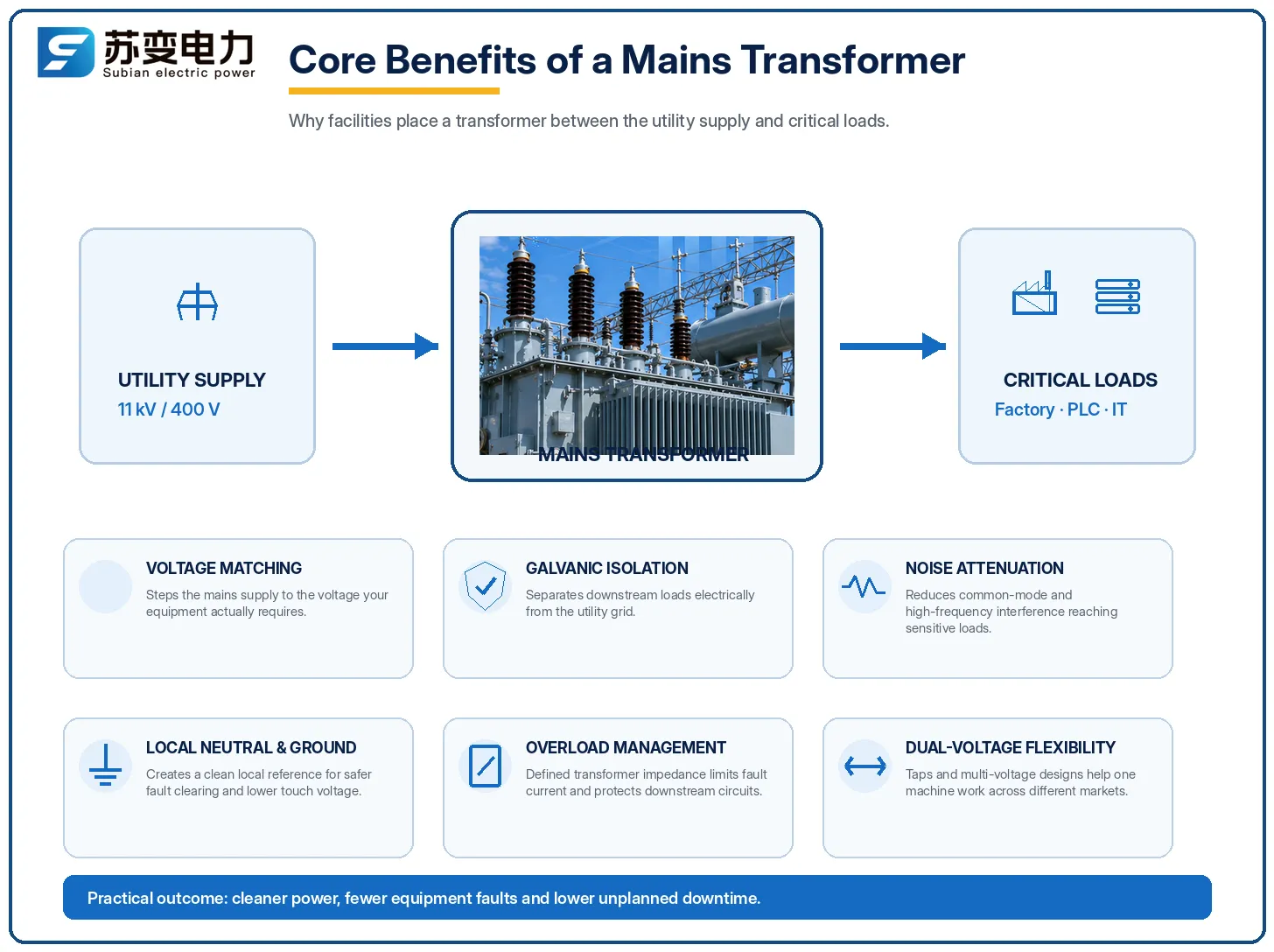
Die Netztransformator Bezieht sich auf einen Transformator, der Strom direkt aus dem Netz (dem öffentlichen Versorgungsnetz) entnimmt und ihn in eine Spannung umwandelt, die für die Nutzung in Gebäuden sowie in anderen Arten von Anwendungen geeignet ist. In einem herkömmlichen Setting beträgt die Spannung, die in den Netztransformator eingeht, 11 kV, der den Strom in eine Dreiphasenspannung von 400 V und eine Einphasen-Spannung von 230 V umwandelt. Der Netztransformator ist sogar in Desktop-Netzteilen zu finden, wo er 230 V in 12 V oder 24 V umwandelt.
Der Name Netztransformator hilft, ihn von vielen anderen Arten von Transformatoren zu unterscheiden, die verschiedene Zwecke erfüllen. Im Gegensatz zum Netztransformator haben wir Steuertransformatoren (die Relais speisen), Isolationstransformatoren, die hauptsächlich für die Sicherheit gedacht sind, sowie verschiedene Arten von Instrumententransformatoren, die lediglich Spannung und Strom messen. Der Netztransformator stellt jedoch die erste Stufe der Umwandlung von Strömen aus dem Stromnetz zu den Lasten dar.
Was die Nennleistung betrifft, variiert sie von mehreren Volt-Ampere in Wandadaptern bis zu 2.500 kVA in Gewerbegebäuden und Fabriken. Dennoch bleibt die Funktion unabhängig von den Unterschieden in der Nennleistung dieselbe, nämlich die Bereitstellung der erforderlichen Spannung mit der richtigen Frequenz und mit angemessener Stromkapazität, sodass es nicht zu Überhitzungen kommt.
Die wichtigsten Vorteile der Verwendung eines Netztransformators
Käufer installieren selten einen Netztransformator aus Spaß – sie tun dies, weil sich die Vorteile direkt in der Betriebszeit der Ausrüstung und den Wartungskosten zeigen.
| Vorteil | Was es liefert | Messbare Auswirkungen |
|---|---|---|
| Spannungsanpassung | Reduziert die Netzspannung genau auf das, was die Ausrüstung benötigt | Beseitigt Unterspannungsabschaltungen und Überspannungsschäden |
| Galvanische Isolation | Trennt Ihre Last elektrisch vom Netz | Blockiert DC-Einspeisung und Gleichtaktgeräusche |
| Geräuschdämpfung | Unterdrückt hochfrequente Störungen | Weniger Störungen in SPS, Antrieben und medizinischen Geräten |
| Neutralerdungskontrolle | Etabliert einen sauberen lokalen Neutralreferenzpunkt | Sicherere Fehlerbeseitigung, niedrigere Berührungsspannungen |
| Überlastmanagement | Definierte Kurzschlussimpedanz schützt Kabel | Kleinere, kostengünstigere nachgeschaltete Schutzschalter |
| Dualspannungsflexibilität | Eine Einheit bedient 50 Hz und 60 Hz oder mehrere Abgriffe | Eine Maschine funktioniert über Märkte hinweg |
Zahlen sprechen für sich. Ein Werk, das einen 100 kVA Haupttransformator bei 85% Lastfaktor mit ordnungsgemäßer Spannungsregelung betreibt, sieht typischerweise, dass die durch Eingangsspannung bedingten Antriebsfehler um 60–80% sinken. Für eine Einrichtung, die jährlich $50.000 für Antriebsreparaturen und Produktionsausfälle ausgibt, sind das $30.000–$40.000 vermeidbare Kosten jährlich.
Wie ein Haupttransformator funktioniert
Das Arbeitsprinzip dieser Maschine basiert im Wesentlichen auf der elektromagnetischen Induktion, die dasselbe Konzept verwendet, das in jedem Transformator angewendet wird. Der Wechselstrom in der Primärwicklung bewirkt wiederum eine Änderung des magnetischen Flusses durch den laminierten Kern und verursacht so einen Strom in der Sekundärwicklung, wobei das Spannungsverhältnis dem Wicklungsverhältnis ähnlich ist.
Ein Transformator, der bei einem Spannungsverhältnis von ungefähr 27,5:1 zwischen Primär- und Sekundärwicklung arbeitet, sieht die volle Netzspannung, was bedeutet, dass das Design der Isolierung und der Durchschlagfestigkeit herausfordernd wird, da die Spitzen von Blitzen in der Freileitung Hunderte von Kilovolt erreichen.
Es gibt zwei Verlustkomponenten, die außergewöhnlich signifikant für die Bestimmung der Betriebskosten solcher Einheiten sind: die Leerlaufverluste, die den ganzen Tag über auftreten, solange die Einheit eingeschaltet ist, aufgrund von Hysterese und Wirbelströmen im Stahl, und die Lastverluste, die mit der Erhöhung des elektrischen Stroms zunehmen.
Haupttypen von Haupttransformatoren
Nicht alle Haupttransformatoren sind gleich gebaut. Das physische Design beeinflusst, wo Sie ihn installieren können, wie viel er kostet und wie lange er hält.
| Typ | Typische Nennleistung | Typische Spannungsklasse | Am besten geeignet für |
|---|---|---|---|
| Trockenbau (gegossen / offen gewickelt) | 15 – 2.500 kVA | Bis zu 36 kV | Innenräume, Hochhäuser, feuerempfindliche Standorte |
| Ölgetaucht | 25 – 5.000 kVA | Bis zu 36 kV | Außenbereich, Umspannwerke, ländliche Netze |
| Einphasen-Gehäuse | 0,05 – 100 kVA | 230 V – 11 kV | Wohngebäude, kleine Gewerbe |
| Dreiphasen-Kern | 25 – 2.500 kVA | 400 V – 11 kV | Industrie- und Gewerbebauten |
| Hermetisch abgedichtet | 50 – 1.000 kVA | Bis zu 36 kV | Wartungsarme Außenstandorte |
Trockenbau-Einheiten dominieren in Innenanwendungen, da sie kein gefährliches Öl enthalten und weniger Brandschutz benötigen. Ölgefüllte Transformatoren werden in Außenanwendungen bevorzugt, aufgrund ihrer hohen Kapazität, niedrigen Kosten, Staub-, Regen- und Temperaturbeständigkeit.
Netztransformatoren vs. Steuertransformatoren vs. Isolationstransformatoren
Käufer verwechseln häufig diese drei Familien. Die Unterschiede sind wichtig, wenn Sie spezifizieren, daher hier die Gegenüberstellung.
| Merkmal | Netztransformator | Steuertransformator | Isolationstransformator |
|---|---|---|---|
| Primäre Rolle | Spannungsabstieg von Netz zu Last | Steuerstromkreise speisen (24 V, 110 V) | Galvanische Trennung |
| Typische Nennleistung | 25 – 2.500 kVA | 25 VA – 5 kVA | 0,25 – 75 kVA |
| Ausgangsspannung | 400 V / 230 V / 110 V | 24 V / 48 V / 110 V | Gleich wie Eingang (1:1) |
| Gehäuse | IP20 – IP54 | Schaltschrankmontage, belüftet | Eingeschlossen, oft abgeschirmt |
| Beispielpreis | $1.500 – $45.000 | $8 – $250 | $80 – $6.500 |
Bedenken Sie, dass die Aufgabe des Isolationstransformators darin besteht, die Ausgangsspannung gleich der Eingangsspannung zu halten. Er existiert ausschließlich zum Zweck der Trennung. Im Gegensatz dazu transformiert ein Netztransformator normalerweise die Spannung, indem er sie im Prozess herabsetzt, kann aber auch als Isolator fungieren. Wenn Sie sowohl Isolation als auch Spannungsumwandlung wünschen, ist es praktisch, einen Netztransformator mit isoliertem Sekundärkreis zu verwenden.
Anwendungen, in denen Netztransformatoren ihren Nutzen beweisen
Die typischen Projekte, die einen speziellen Netztransformator rechtfertigen:
- Industrieanlagen mit gemischten 400 V und 230 V Lasten, die von einer 11 kV Versorgung gespeist werden.
- Gewerbliche Hochhäuser, die Trockenbau-Einheiten auf jeder 8–10 Etage verwenden, um kurze Verteilungsstrecken und niedrige Fehlerpegel zu halten.
- Medizinische Bildgebungsräume, in denen eine abgeschirmte Isolationwicklung verhindert, dass Leckströme über 0,5 mA zu den Patienten gelangen.
- Rechenzentren mit 480 V/277 V oder 415 V/230 V Verteilung und strengen harmonischen und Erdungsanforderungen.
- Erneuerbare Installationen, die Wechselrichter über einen Transformator mit dem Netz koppeln, der die DC-Einspeisung blockiert.
- Standorte mit instabilen Netzen, bei denen ein Netztransformator mit den richtigen Abgriffen die Ausgangsspannung innerhalb von ±5% hält, trotz Schwankungen der Einspeisespannung von ±10% oder mehr.
In aufstrebenden Märkten ist eine der größten Rechtfertigungen für Unternehmen der Schutz teurer importierter Maschinen gegen schwankende Netzspannungen, die zwischen 180 V und 260 V in einem 230 V Nennsystem schwanken. Mit einem korrekt abgegriffenen Netztransformator wird die Ausrüstung so betrieben, dass sie innerhalb eines sicheren Spannungsbereichs arbeitet, wodurch die Ausfallrate von Antrieben von 40% auf unter 10% pro Jahr gesenkt wird.
Wichtige Spezifikationen und Standards
Fünf Spezifikationen tragen das meiste Entscheidungsgewicht, und zwei Standards regeln das Design.
| Spezifikation | Typische Werte | Warum es wichtig ist |
|---|---|---|
| Nennleistung (kVA) | 25 – 2.500 kVA | Bestimmt die physische Größe und die Kosten |
| Primär-/Sekundärspannung | 11 kV/400 V, 400 V/230 V, 480/277 V | Muss sowohl mit Netz als auch mit Last übereinstimmen |
| Häufigkeit | 50 Hz oder 60 Hz | Fehlanpassung verursacht Überhitzung |
| Impedanz (%Z) | 4% – 8% | Steuert Fehlerstrom und Spannungsabfall |
| Isolationsklasse / Temperaturanstieg | Klasse F/H, 75–100 K Temperaturanstieg | Definiert die thermische Überlastgrenze |
| Vektorguppe | Dyn11, Yyn0, Dyn5 | Phasenverschiebung und Verfügbarkeit des Neutralleiters |
Was die Standards betrifft, so ist IEC 60076 ein international anerkanntes Standard, das die Nennwerte, Verluste und Tests für trockene und ölgetauchte Transformatorgeräte abdeckt. IEEE C57.12 ist der Standard, der für die Regelung von Transformatoren in Nordamerika verwendet wird, während NFPA 70 (NEC) die Installationsstandards in den Vereinigten Staaten regelt, wie z.B. Belüftung, Abstand und Überstromschutz. Achten Sie beim Versand darauf, dass Sie wissen, welcher Standard in Ihrem Zielmarkt anwendbar ist, da dies die Prüfberichte sowie manchmal sogar die Anzahl der Anschlüsse beeinflussen könnte.
Preisspannen nach Nennwert
Realistische FOB-Preisspannen für Netztransformatoren von einem chinesischen Hersteller, ohne Fracht und Zoll:
| Nennleistung | Trockentyp (FOB) | Ölgetaucht (FOB) |
|---|---|---|
| 25 kVA | $1.500 – $3.200 | $2.200 – $4.000 |
| 100 kVA | $2,800 – $6,500 | $4.000 – $8.500 |
| 250 kVA | $5.500 – $12.000 | $7.500 – $15.000 |
| 630 kVA | $11.000 – $22.000 | $15.000 – $28.000 |
| 000 kVA | $16.000 – $30.000 | $22.000 – $38.000 |
| 500 kVA | $28.000 – $50.000 | $38.000 – $70.000 |
Der Preis variiert je nachdem, ob Kupfer oder Aluminium für die Wicklungen verwendet wird, die Art des Kernstahls, die Gehäusebewertung, die Art des Abgriffwechslers und die Testanforderungen – betrachten Sie diese Bereiche als Planungswerte und nicht als Angebote. Kupferwicklungen führen zu einer Erhöhung von etwa 15-35% der oben genannten Beträge.
Wie wählt man den richtigen Netztransformator aus
Folgen Sie dieser Reihenfolge, um beim ersten Versuch die richtige Bewertung und Konfiguration zu erreichen:
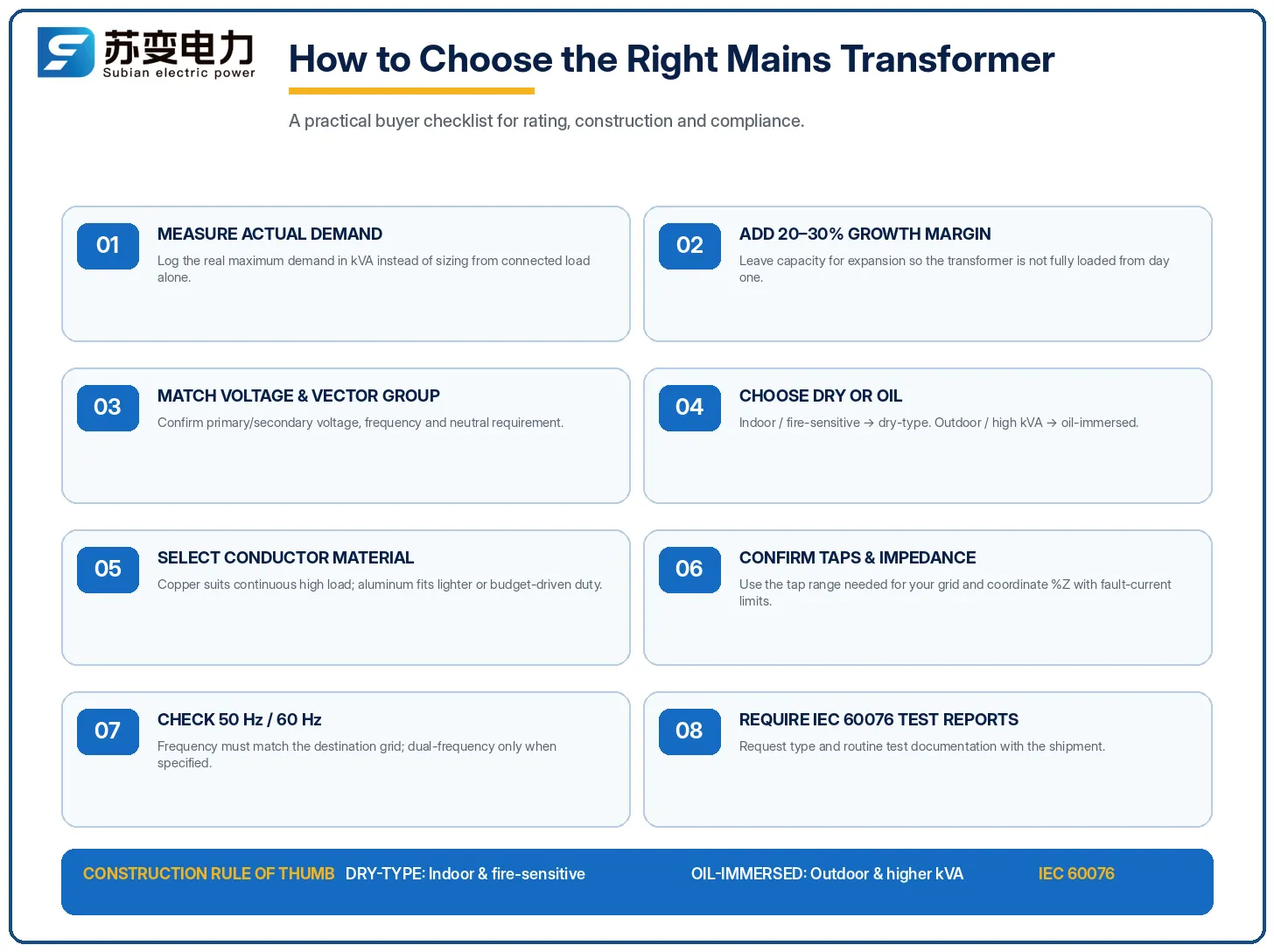
- Messen Sie die tatsächliche Nachfrage. Protokollieren Sie die Last eine volle Woche lang, nicht eine Stunde, und nehmen Sie die maximale Nachfrage in kVA.
- Wenden Sie Diversität an. Summieren Sie die angeschlossene Last und multiplizieren Sie dann mit dem realistischen Lastfaktor Ihres Standorts (typischerweise 0,6–0,8 für die allgemeine Industrie).
- Fügen Sie eine Wachstumsreserve hinzu. Dimensionieren Sie um 20–30% über der aktuellen Nachfrage, damit die Einheit nicht von Anfang an bei 100% liegt.
- Bestimmen Sie Spannung und Vektorguppe. Bestätigen Sie die Primär- und Sekundärspannungen sowie ob Sie einen Neutralleiter benötigen (Dyn11 vs. Dyn5).
- Wählen Sie Trocken- oder Öltype. Innen- und feuerempfindlich → trocken; im Freien und hohe kVA → Öl.
- Wählen Sie Kupfer oder Aluminium. Kontinuierliche hohe Last → Kupfer; Standby oder budgetorientiert → Aluminium.
- Bestätigen Sie Abgriffe und Impedanz. Standard ±2×2.5% abgekoppelte Abgriffe für die meisten Standorte; Lastabgriffe nur, wenn die Spannung tagsüber stark schwankt.
- Fordern Sie Prüfberichte an. IEC 60076 Typprüf- und Routineprüfberichte müssen der Lieferung beigefügt werden.
Installationsanleitung in Kürze: Platzieren Sie Trockenbaugeräte mit 300 mm Belüftungsabstand, schützen Sie Außenölgeräte mit einer Auffangwanne und dimensionieren Sie den vorgelagerten Schutzschalter auf 125–160% des Nennstroms des Transformators gemäß den lokalen Vorschriften.
Häufig gestellte Fragen
Welche Größe Netztransformator benötige ich für eine Last von 100 kW?
Um die erforderliche kVA-Bewertung zu ermitteln, sollte die kW-Ausgangsleistung einfach durch den Leistungsfaktor geteilt und dann die Reserve hinzugefügt werden. Daher würde bei einem Leistungsfaktor von 0,85 eine Kapazität von 100 kW ungefähr 118 kVA bedeuten, was einen 125 kVA Transformator zur Mindestanforderung macht. Da die Motoren jedoch hohe Einschaltströme verursachen, ist es vorzuziehen, einen Transformator mit mindestens 160 kVA zu wählen. Darüber hinaus führt eine Überdimensionierung des Transformators um 25 bis 30% zu einer Verbesserung der Effizienz und einer Verlängerung der Lebensdauer der Einheit.
Kann ein Netztransformator sowohl mit 50 Hz als auch mit 60 Hz betrieben werden?
Nur wenn als Dualfrequenz angegeben. Ein 50 Hz-Gerät, das bei 60 Hz bei derselben Spannung betrieben wird, läuft kühler und ist sicher; ein 60 Hz-Gerät bei 50 Hz sättigt und überhitzt schnell. Wenn Ihre Ausrüstung in Märkte auf beiden Netzen geliefert wird, bestellen Sie Dualfrequenzwicklungen und geben Sie beide Betriebsspannungen in der RFQ an.
Warum summt mein Transformator laut – ist das normal?
Der Magnetostriktion des Kernstahls führt zur Erzeugung von Brummgeräuschen mit der doppelten Netzfrequenz (100 Hz für 50 Hz Systeme). Der normale Brummpegel liegt im Bereich von etwa 40–60 dB(A), gemessen in 1 Meter Entfernung. Jedes übermäßige Geräusch über 70 dB(A) weist auf eine Lockerheit des Kernhaltesystems, einen DC-Versatz in der Versorgung oder eine lose Schraube hin — es sollten Maßnahmen ergriffen werden, damit das lose Element keine Probleme verursacht.
Welche Wartung benötigt ein ölgetauchter Netztransformator?
Die jährliche Probenahme des Öls hinsichtlich der Durchschlagfestigkeit (30 kV/mm) und die Analyse der gelösten Gase erfassen die meisten sich entwickelnden Fehler. Beobachten Sie das Verhalten des Silikagel-Atmungsventils, die Oberöltemperatur (unter 95 Grad) und ziehen Sie die Anschlüsse nach 48 Stunden bei Arbeitslast an. Erwarten Sie, $300-$800 pro Jahr für eine Nennleistung von 500 kVA auszugeben.
Wie viel kostet es, einen Netztransformator ein Jahr lang zu betreiben?
Addieren Sie die Leerlauf- und Lastverluste: Ein 250 kVA Gerät mit 1.500 W Leerlaufverlust kostet etwa $1,300 pro Jahr bei $0.10/kWh nur für die Energiebereitstellung. Fügen Sie Lastverluste hinzu, die mit dem Strom steigen. Die Wahl eines effizienteren Kerns oder eines korrekt dimensionierten Geräts kann die jährliche Energierechnung um 15–30% senken — oft die schnellste Amortisationsentscheidung in der gesamten Spezifikation.
Referenzen
- IEC 60076-1: Leistungstransformatoren — Allgemeine Anforderungen — die internationale Basislinie für die Nennwerte, Verluste und Tests von Netztransformatoren.
- IEEE C57.12.00 — nordamerikanischer Standard für die Leistung von flüssigkeitsgetauchten Verteilungstransformatoren.
- NFPA 70: Nationaler Elektrotechnischer Kodex — Installations-, Abstands- und Schutzvorschriften für Transformatoren in den USA.
- NEMA-Standards — US-Nennwerte, Tests und Effizienzklassifizierungsreferenz für Verteilungstransformatoren.
- Eaton Transformatoren Katalog — praktische Spezifikations- und Preisreferenz für Netztransformatoren.
- Schneider Electric Transformatoren — Produktfamilien- und Anwendungsreferenz für kommerzielle Verteilung.
- UL Lösungen — Zertifizierungsanforderungen für Trocken- und Regeltransformatoren in Nordamerika.
Fazit
Ein Netztransformator ist mehr als nur ein Mittel zur Spannungsversorgung; er dient als Sicherheitsverbindung zwischen der robusten Netzversorgung und kostspieligen, empfindlichen Geräten. Es gibt greifbare Vorteile wie die korrekte Spannungsabgabe, galvanische Isolation, Eliminierung von Geräuschen sowie die Definition der Fehlerstromgrenze.
Stellen Sie sicher, dass Sie für die tatsächliche Nachfrage plus 20% bis 30% Wachstum dimensionieren.
Lassen Sie den Netztransformator korrekt hinsichtlich Spannung, Frequenz und Vektorguppe bewerten.
Wählen Sie die besten Preise basierend auf den Gesamtkosten des Eigentums.
Beachten Sie, dass die Preise je nach Typ von $1500 bis $45000 reichen.
Erhalten Sie die IEC 60076 Testresultate mit jeder Lieferung.
Wenn Sie zertifizierte Netztransformatoren benötigen — Trocken- oder ölgetaucht, Kupfer oder Aluminium, 50Hz oder 60Hz — Jiangsu Subian Electric Power konstruiert seine Produkte gemäß den Anforderungen der IEC 60076 und verkauft sie weltweit. Senden Sie uns einfach Ihre Lastdaten und Spannungsanforderungen, und wir werden Ihnen ein Angebot unterbreiten. Beginnen Sie bei der Subian Electric Startseite.