


Let us suppose that your factory in Accra has just obtained a brand new injection-molding machine from Italy that operates on 400 volts three-phase and the local municipality only provides 230 volts single-phase. Alternatively, you may be an IT manager in Manila, dealing with the problem of your server room being constantly plagued with voltage sags, even though all manufacturers have got a “dedicated mains transformer” on their warranty pages, and you have never heard of it before. In both of these examples, the equipment positioned between the grid line and your equipment – the simple mains transformer – is the key component that enables its proper functioning.
In this article, you will find out more about mains transformers: what they are responsible for and why different types of industries and companies use them; what benefits you get in monetary terms, and how many operating hours are gained. In addition to that, you will get some cost estimates, tables of specifications, and hints on how to choose the right equipment to ensure that your next purchase will protect your equipment from power issues.
What Is a Mains Transformer?
The mains transformer refers to a transformer that takes electricity directly from the mains (the public utilities grid) and converts it into a voltage suitable for use in the buildings as well as in other types of application. In a conventional setting, 11 kV is the voltage that goes into the mains transformer that transforms the electricity into a three-phase voltage of 400 V and a single phase voltage of 230 V. The mains transformer can be found even in desktop power supplies where it turns 230 V into 12 V or 24 V.
The name mains transformer helps to differentiate it from many other types of transformers that serve various purposes. In contrast to the mains transformer, we have control transformers (which feed relays), isolation transformers intended mainly for safety, as well as different types of instrument transformers which merely measure voltage and current. However, the mains transformer represents the first stage of transformation of currents from the electrical grid to the loads.
As far as rating goes, it varies from several volt-amps in wall adapters to 2,500 kVA in commercial buildings and factories. Nevertheless, regardless of differences in rating, the function remains the same, which is to provide the necessary voltage with the right frequency and with appropriate current capacity, so that there will not be any overheating.
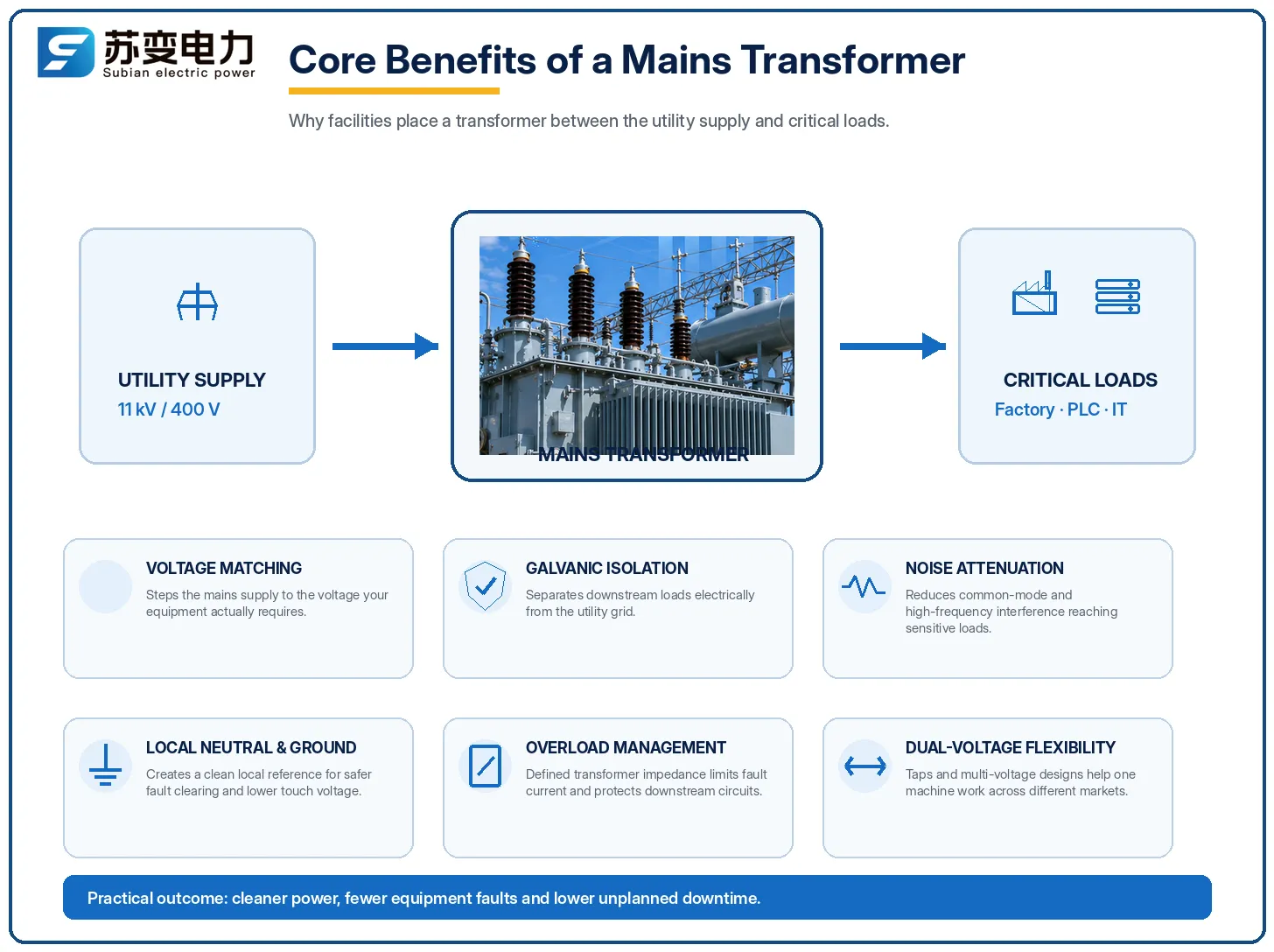
The Core Benefits of Using a Mains Transformer
Buyers rarely install a mains transformer for fun — they do it because the benefits show up directly in equipment uptime and maintenance bills.
| Benefit | What It Delivers | Measurable Impact |
|---|---|---|
| Voltage matching | Steps grid voltage to exactly what equipment needs | Eliminates undervoltage trips and overvoltage damage |
| Galvanic isolation | Separates your load from the grid electrically | Blocks DC injection and common-mode noise |
| Noise attenuation | Suppresses high-frequency interference | Fewer glitches in PLCs, drives, and medical devices |
| Neutral grounding control | Establishes a clean local neutral reference | Safer fault clearance, lower touch voltages |
| Overload management | Defined short-circuit impedance protects cables | Smaller, cheaper downstream breakers |
| Dual-voltage flexibility | One unit serves 50 Hz and 60 Hz or multiple taps | One machine works across markets |
Numbers tell the story. A plant running a 100 kVA mains transformer at 85% load factor with proper voltage regulation typically sees input-voltage-related drive faults drop by 60–80%. For a facility spending $50,000 a year on drive repairs and production stops, that is $30,000–$40,000 of avoidable cost annually.
How a Mains Transformer Works
The working principle of this machine is basically the electromagnetic induction which uses same concept applied in any transformer. The alternating current in the primary winding in turn brings change in the magnetic flux through the laminated core and in turn causing a current in the secondary winding where the voltage ratio is similar to the turns ratio.
A transformer working at a voltage ratio of approximately 27.5:1 of the primary and secondary winding so the primary winding sees the full utility voltage which means that designing the insulation and withstand voltage becomes challenging since the peaks of lightning in the overhead line reach hundreds of kilovolts.
There are two components of losses that are exceptionally significant in determining the operational costs of such units: the no-load loss losses which take place all day long as long as the unit is switched on due to hysteresis and eddy currents in the steel and the load losses that increase with the increase in the electrical current.
Main Types of Mains Transformers
Not all mains transformers are built the same. The physical design changes where you can install it, how much it costs, and how long it lasts.
| Type | Typical Rating | Typical Voltage Class | Best Suited To |
|---|---|---|---|
| Dry-type (cast / open-wound) | 15 – 2,500 kVA | Up to 36 kV | Indoor, high-rise, fire-sensitive sites |
| Oil-immersed | 25 – 5,000 kVA | Up to 36 kV | Outdoor, substations, rural networks |
| Single-phase shell | 0.05 – 100 kVA | 230 V – 11 kV | Residential, small commercial |
| Three-phase core | 25 – 2,500 kVA | 400 V – 11 kV | Industrial and commercial buildings |
| Hermetically sealed | 50 – 1,000 kVA | Up to 36 kV | Low-maintenance outdoor sites |
Dry-type units prevail in indoor applications as they do not have hazardous oil in them and else require less fire protection. Oil-filled transformers are preferred in outdoor designs because of their great capacity, low price, dust, rain, and temperature endurance.
Mains vs. Control vs. Isolation Transformers
Buyers frequently conflate these three families. The differences matter when you are specifying, so here is the side-by-side.
| Feature | Mains Transformer | Control Transformer | Isolation Transformer |
|---|---|---|---|
| Primary role | Grid-to-load voltage step-down | Feed control circuits (24 V, 110 V) | Galvanic separation |
| Typical rating | 25 – 2,500 kVA | 25 VA – 5 kVA | 0.25 – 75 kVA |
| Output voltage | 400 V / 230 V / 110 V | 24 V / 48 V / 110 V | Same as input (1:1) |
| Enclosure | IP20 – IP54 | Panel-mount, ventilated | Enclosed, often shielded |
| Example price | $1,500 – $45,000 | $8 – $250 | $80 – $6,500 |
Keep in mind that the job of the isolation transformer is to maintain output voltage equal to input voltage. It exists solely for the purpose of separation. In contrast, a mains transformer usually transforms voltage by stepping it down in the process, but may happen to act as an isolator as well. If you want both isolation and voltage conversion, it is practical to employ a mains transformer with isolated secondary circuit.
Applications Where Mains Transformers Earn Their Keep
The typical projects that justify a dedicated mains transformer:
- Industrial plants with mixed 400 V and 230 V loads fed from one 11 kV supply.
- Commercial high-rise buildings using dry-type units on every 8–10 floors to keep short distribution runs and low fault levels.
- Medical imaging suites where a shielded isolation winding prevents leakage current above 0.5 mA from reaching patients.
- Data centers with 480 V/277 V or 415 V/230 V distribution and strict harmonics and grounding requirements.
- Renewable installations coupling inverters to the grid through a transformer that blocks DC injection.
- Sites with unstable grids where a mains transformer with correct taps holds output voltage within ±5% despite feeder voltage swings of ±10% or more.
In burgeoning markets, one of the greatest justifications for business is safe-guarding costly imported machinery against fluctuating power grid voltage moving between 180V and 260V in a 230V nominal system. With a correctly tapped mains transformer, the equipment is made to work within a safe volatge range, reducing its drive failure rate from 40% to under 10% a year.
Key Specifications and Standards
Five specifications carry most of the decision weight, and two standards govern the design.
| Specification | Typical Values | Why It Matters |
|---|---|---|
| Rated power (kVA) | 25 – 2,500 kVA | Sets the physical size and cost |
| Primary/secondary voltage | 11 kV/400 V, 400 V/230 V, 480/277 V | Must match both grid and load |
| Frequency | 50 Hz or 60 Hz | Mismatch causes overheating |
| Impedance (%Z) | 4% – 8% | Controls fault current and voltage drop |
| Insulation class / rise | Class F/H, 75–100 K rise | Defines thermal overload margin |
| Vector group | Dyn11, Yyn0, Dyn5 | Phase shift and neutral availability |
As far as the standards are concerned, IEC 60076 is an internationally recognized standard used to cover the ratings, losses, and tests for dry-type and oil-immersed transformer devices. IEEE C57.12 is the standard used for regulating transformers in North America while NFPA 70 (NEC) governs the installation standards mentioned in the United States such as ventilation, clearance, and overcurrent protection. When shipping, make sure that you know which standard is applicable in your target market since it could influence test reports as well as sometimes even the number of terminals.
Price Ranges by Rating
Realistic 2026 FOB price bands for mains transformers from a Chinese manufacturer, excluding freight and duty:
| Rating | Dry-Type (FOB) | Oil-Immersed (FOB) |
|---|---|---|
| 25 kVA | $1,500 – $3,200 | $2,200 – $4,000 |
| 100 kVA | $2,800 – $6,500 | $4,000 – $8,500 |
| 250 kVA | $5,500 – $12,000 | $7,500 – $15,000 |
| 630 kVA | $11,000 – $22,000 | $15,000 – $28,000 |
| 1,000 kVA | $16,000 – $30,000 | $22,000 – $38,000 |
| 2,500 kVA | $28,000 – $50,000 | $38,000 – $70,000 |
The price will vary depending on whether copper or aluminum is used for the windings, the type of core steel, enclosure rating, type of tap changer, and testing requirement – treat these ranges as planning values rather than as quotes. Copper windings will bring an increase of about 15-35% to the above-mentioned amounts.
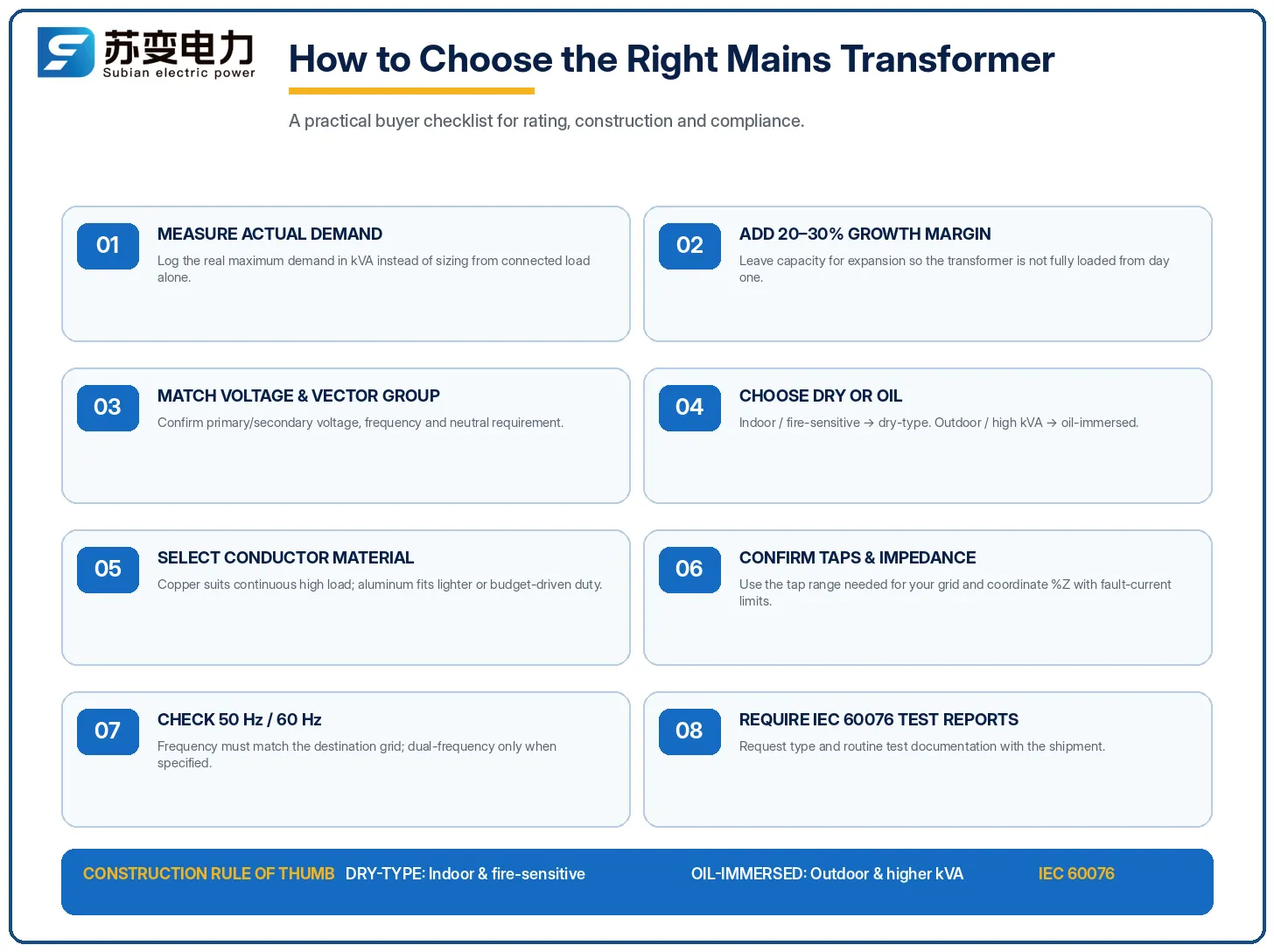
How to Choose the Right Mains Transformer
Follow this sequence to land on the correct rating and configuration on the first attempt:
- Measure the actual demand. Log load for a full week, not one hour, and take the maximum demand in kVA.
- Apply diversity. Sum connected load, then multiply by your site’s realistic load factor (typically 0.6–0.8 for general industry).
- Add growth margin. Size for 20–30% above current demand so the unit is not at 100% from day one.
- Fix voltage and vector group. Confirm primary and secondary voltages plus whether you need a neutral (Dyn11 vs. Dyn5).
- Choose dry-type or oil. Indoor and fire-sensitive → dry; outdoor and high kVA → oil.
- Select copper or aluminum. Continuous high load → copper; standby or budget-driven → aluminum.
- Confirm taps and impedance. Standard ±2×2.5% off-circuit taps for most sites; on-load tapping only if voltage varies widely during the day.
- Require test reports. IEC 60076 type test and routine test reports must accompany the shipment.
Installation guidance in brief: place dry-type units with 300 mm ventilation clearance, protect outdoor oil units with a bund and oil containment, and size the upstream breaker to 125–160% of the transformer’s rated current in line with the local code.
Frequently Asked Questions
What size mains transformer do I need for a 100 kW load?
To find out the required kVA rating, the kW output should simply be divided by the power factor followed by the margin. Therefore at power factor 0.85, generally 100 kW of capacity would mean approximately 118 kVA, making a 125 kVA transformer the minimum requirement. However, given that the motors will cause high inrush currents, it is preferable to select a transformer rated at, at least 160 kVA. Furthermore, over-sizing the transformer by 25 to 30% results in improving efficiency and prolonging the unit life.
Can a mains transformer run on both 50 Hz and 60 Hz?
Only if specified as dual-frequency. A 50 Hz unit operated at 60 Hz at the same voltage runs cooler and is safe; a 60 Hz unit at 50 Hz saturates and overheats quickly. If your equipment ships to markets on both grids, order dual-frequency windings and state both operating voltages in the RFQ.
Why is my transformer humming loudly — is that normal?
The core steel magnetostriction leads to creation of hum at double the line frequency (100 Hz for 50 Hz systems). Normal hum level is in the range of about 40–60 dB(A) measured at 1 meter away. Any excessive noise higher than 70 dB(A) indicates looseness of the core holding system, DC offset in the supply or a loose bolt — action should be taken so that loose element does not cause troubles.
What maintenance does an oil-immersed mains transformer need?
The annual sampling of oil in terms of dielectric strength (30 kV/mm) and the analysis of dissolved gases succeed in capturing most of the developing faults. Observe the behavior of silica gel breather, the top oil temperature (below 95 degrees), and tighten the terminations after 48 hours of a working load. Expect to spend $300-$800 a year for a 500 kVA rated capacity.
How much does a mains transformer cost to run for a year?
Add no-load and load losses: a 250 kVA unit with 1,500 W no-load loss costs about $1,300 a year at $0.10/kWh just for being energized. Add load losses that grow with current. Choosing a higher-efficiency core or a correctly sized unit can cut the annual energy bill by 15–30% — often the fastest payback decision in the whole specification.
References
- IEC 60076-1: Power Transformers — General Requirements — the international baseline for mains transformer ratings, losses, and testing.
- IEEE C57.12.00 — North American standard for liquid-immersed distribution transformer performance.
- NFPA 70: National Electrical Code — installation, clearance, and protection rules for transformers in the US.
- NEMA Standards — US ratings, testing, and efficiency classification reference for distribution transformers.
- Eaton Transformers Catalog — practical specification and pricing reference for mains transformers.
- Schneider Electric Transformers — product family and application reference for commercial distribution.
- UL Solutions — certification requirements for dry-type and control transformers in North America.
Conclusion
A mains transformer involves more than a means of supplying voltage; it serves as a safety connection between the tough mains supply and costly, delicate equipment. There are tangible benefits such as the correct voltage output, galvanic isolation, elimination of noise as well as defining the fault current boundary.
Be sure to size for real demand plus 20% to 30% of growth.
Get the mains transformer correctly rated with regard to voltage, frequency, and vector group.
Opt for the best pricing based on total cost of ownership.
Keep in mind the prices range from $1500 to $45000 based on type.
Get the IEC 60076 test results with every shipment.
If you need certified mains transformers — dry type or oil-immersed, copper or aluminum, 50Hz or 60Hz — Jiangsu Subian Electric Power constructs its products according to IEC 60076 requirements and sells them all over the world. Just send us your load data and voltage requirements and we will provide you with a quotation. Start at the Subian Electric homepage.