


Usted es un ingeniero eléctrico jefe en una empresa de servicios públicos de la ciudad que acaba de ser autorizado para llevar a cabo un proyecto piloto de red inteligente, que incluirá la excavación de 2,400 transformadores de distribución. Se indicó a su equipo que los planes son hacer que la red sea observable, pero lo que heredó sigue siendo una red que requiere lecturas de medidores, muestreo de aceite trimestral y llamadas ocasionales de ciudadanos sobre escuchar zumbidos inusuales antes de que se cortara la electricidad. El principal desafío aquí es específicamente el transformador de red inteligente porque el transformador de distribución es el último nodo de la red que no cuenta con un medidor y sin ningún tipo de monitoreo, sin que nadie piense en revisar el presupuesto para el reemplazo de miles de unidades de una sola vez.
Este artículo explica la actualización del transformador inteligente y las prácticas de aplicación en una red inteligente junto con los costos involucrados en la adaptación frente al reemplazo, la importancia de los sensores y los protocolos de comunicación, la información clave que debe ser recopilada primero y hasta dónde puede llegar un presupuesto modestamente organizado.
Responda con estándares: Un transformador de red inteligente es un transformador de distribución o transformador de potencia equipado con monitoreo en línea, que tiene inteligencia local y capacidades de comunicación para permitir a las empresas de servicios públicos monitorear la carga, la temperatura del aceite, los gases disueltos y la posición de derivación en tiempo real.
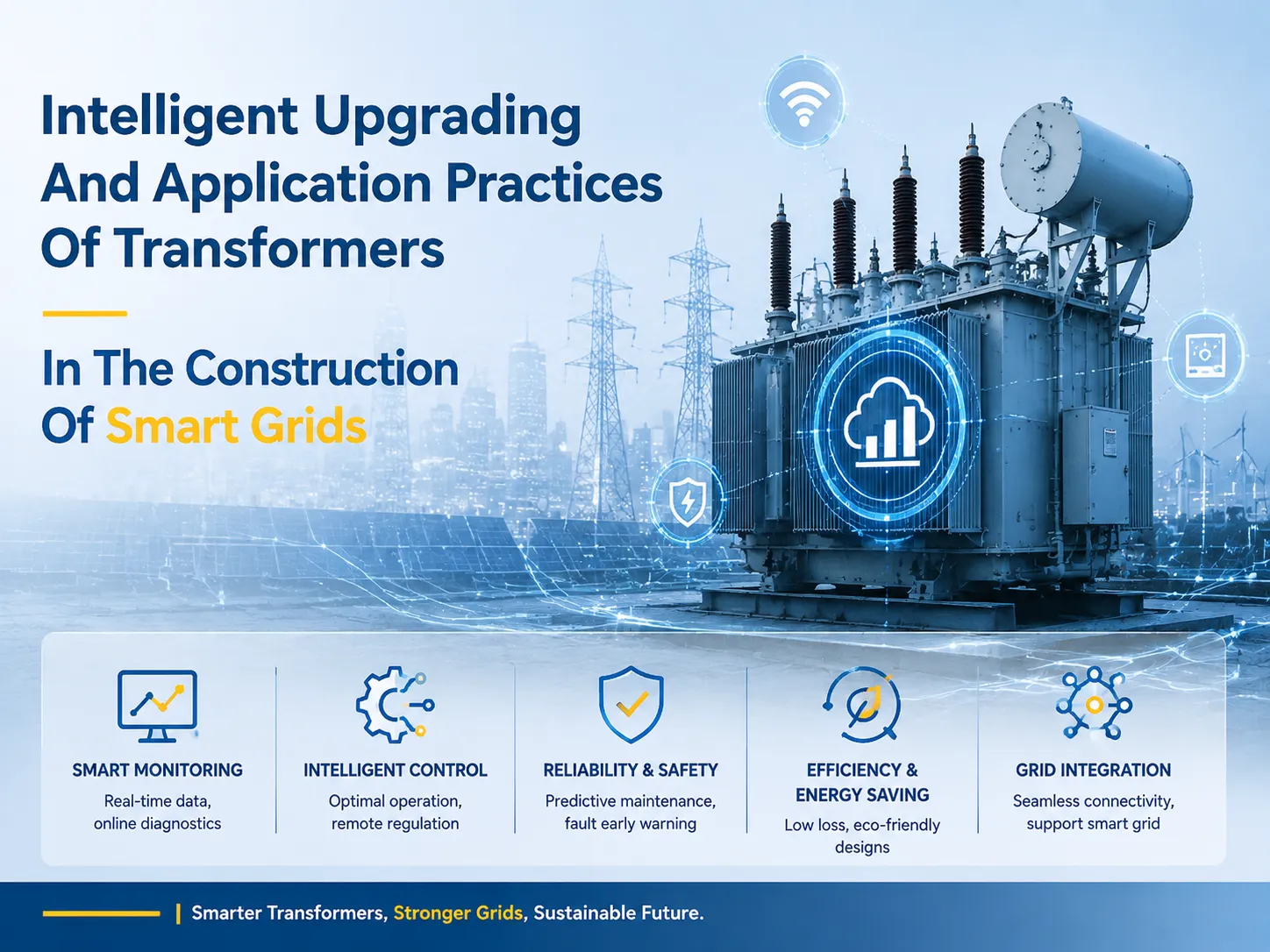
¿Qué es un transformador de red inteligente?
El transformador de red inteligente es un transformador de potencia estándar o transformador de distribución equipado con los mecanismos de detección, procesamiento y comunicación para permitir la operación remota y la gestión del rendimiento en tiempo real. La unidad se mantiene por encima de los principios electromagnéticos descritos en la IEC 60076. La diferencia se puede encontrar en la parte “inteligente” que generalmente incluye:
- Sensores de temperatura y nivel de aceite (unidades sumergidas en aceite) o monitoreo de la temperatura del devanado para unidades de tipo seco;
- Adaptador DGA para monitoreo de gases (seguimiento de hidrógeno, metano, etileno y otros gases de falla);
- Sensores de descarga parcial instalados en los bujes en la pared del tanque;
- Unidad de monitoreo y control local que es responsable del análisis, y
- Gestión de distribución a través del sistema SCADA siguiendo Modbus, DNP3 o IEC 61850.
El transformador inteligente se puede diferenciar de los “monitoreados” por el hecho de que opera utilizando datos en lugar de solo transmitirlos. Los transformadores inteligentes pueden emitir una alarma en caso de detectar una desviación del patrón de carga diaria regular, sincronizarse con el OLTC para controlar el voltaje durante la carga de vehículos eléctricos dentro de límites rastreables y evaluar la vida útil restante del aislamiento en función de los puntos de calor observados anteriormente.
Por qué los transformadores inteligentes son importantes para la construcción de redes inteligentes.
La flota de transformadores de distribución constituye aproximadamente el 70-80% de los activos totales propiedad de una empresa de servicios públicos y, irónicamente, sigue siendo la clase de activos menos monitoreada. Según estudios de CIGRE e IEEE, alrededor del 30-40% de las fallas de transformadores son “inesperadas” porque su falla no es precedida por ninguna inspección. La interrupción causada por un transformador fallido está bien establecida: 100-600 clientes pierden temporalmente su suministro de energía, la fuga de aceite puede ser de entre 400-2,000 litros, y el costo total de la falla puede ser de $25,000-150,000, dependiendo de la compensación por la interrupción y el reemplazo.
Cuando el costo de monitorear un transformador se encuentra en el rango de $1,200-5,500 pero puede salvar a una empresa de servicios públicos de incluso un incidente de este tipo durante la vida útil de diez años, es evidentemente sensato implementar el sistema de monitoreo. El segundo beneficio es un reemplazo diferido: un transformador que opera correctamente con aislamiento en buenas condiciones y que se opera a 65% puede ser utilizado durante 8-15 años más. La tercera ventaja es la operativa: los datos sobre la carga de los transformadores recibidos en tiempo real pueden ayudar a realizar ajustes respecto a las cargas de los alimentadores y prolongar las inversiones necesarias en la actualización de las estaciones por $200,000-2 millones.
Cómo Funciona la Actualización Inteligente
Actualizar un transformador de manera inteligente pasa por cinco pasos:
- Ver: Los sensores rastrean las características de la temperatura del aceite, la temperatura del devanado, la vibración del tanque, la concentración de gases y la corriente de carga en intervalos de cada segundo a un minuto.
- Analizar: La unidad de control local transforma las lecturas en bruto en indicadores utilizables — como la temperatura de los puntos calientes, el porcentaje de humedad en el aceite, la relación con la carga y el índice de salud de 0 a 100.
- Responder: Las reglas integradas (y a veces modelos de aprendizaje automático en los nuevos sistemas) señalan la aparición de tendencias anormales. Por ejemplo, si la lectura de hidrógeno supera los 150 ppm y aumenta, genera una alarma, mientras que una lectura de 80 ppm no lo hace.
- Actuar: La unidad puede cambiar la posición del tap automáticamente, iniciar los ventiladores para enfriar a un nivel de 65 °C (de acuerdo con el estándar para transformadores sumergidos en aceite), o enviar la orden para limitar la carga de alimentadores no críticos.
- Transmitir: La información se comunica utilizando la red Ethernet, fibra o 4G/LTE al centro DMS/SCADA a través del protocolo IEC 61850, transformando así el transformador en un modelo de información típico en lugar de una caja negra creada por el fabricante.
Para las empresas de servicios públicos con subestaciones basadas en el protocolo IEC 61850, los transformadores inteligentes son nodos virtuales debido a que las funciones de protección y monitoreo utilizan la misma pila de comunicación, que es muy diferente de una familia de sensores montados en el tanque.
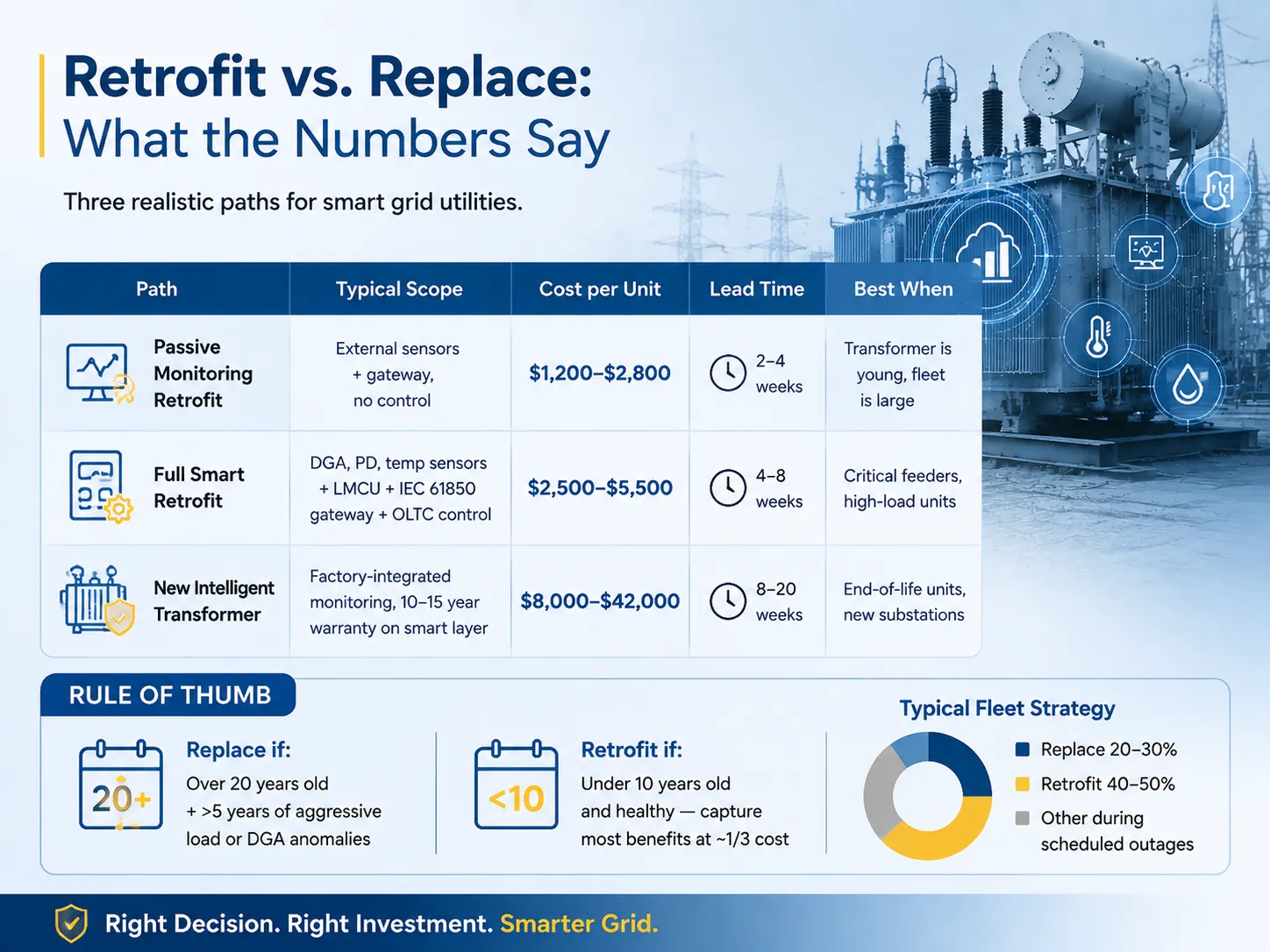
Modernizar vs. Reemplazar: Lo que Dicen los Números
Un error común durante la construcción de una red inteligente es pensar que es necesario reemplazar cada transformador. Según los datos de la tabla a continuación, la empresa de servicios públicos puede elegir entre tres escenarios prácticos.
| Ruta | Alcance Típico | Costo por Unidad | Tiempo de Entrega | Mejor Cuando |
|---|---|---|---|---|
| Modernización de monitoreo pasivo | Sensores externos + puerta de enlace, sin control | $1,200–$2,800 | 2–4 semanas | El transformador es joven, la flota es grande |
| Modernización completa inteligente | DGA, PD, sensores de temperatura + LMCU + puerta de enlace IEC 61850 + control OLTC | $2,500–$5,500 | 4–8 semanas | Alimentadores críticos, unidades de alta carga |
| Nuevo transformador inteligente | Monitoreo integrado de fábrica, garantía de 10–15 años en la capa inteligente | $8,000–$42,000 | 8–20 semanas | Unidades al final de su vida útil, nuevas subestaciones |
El consejo que los ingenieros dan con frecuencia es que un transformador de más de 20 años, y que ha sufrido de alta carga durante más de 5 años o que tiene indicios de problemas de DGA, es probable que sea un candidato para reemplazo. Sin embargo, un transformador que tiene menos de 10 años y funciona bien puede ser modernizado a aproximadamente un tercio del costo. Como resultado, la mayoría de las empresas de servicios públicos tomarán la decisión de reemplazar solo el 20–30% de transformadores, modernizar el 40–50%, e instalar sus transformadores restantes cuando estén fuera por mantenimiento.
Tipos y Clasificaciones de Transformadores Inteligentes
Hay varios tipos diferentes de transformadores de red inteligente con sus aplicaciones específicas en la red.
| Tipo | Rango de Calificación | Características Inteligentes | Aplicación Típica |
|---|---|---|---|
| Transformador de distribución inteligente (inmerso en aceite) | 50–2,500 kVA, 10–35 kV | DGA, monitoreo de carga, control de tomas | Alimentadores urbanos, electrificación rural |
| Transformador de distribución inteligente (tipo seco) | 100–4,000 kVA, hasta 35 kV | Temperatura de devanado, monitoreo de PD | Edificios, subestaciones interiores, plataformas en alta mar |
| Transformador de potencia inteligente (nivel de red) | 5–100 MVA, 35–220 kV | DGA completo, automatización de OLTC, listo para fasores | Subestaciones de transmisión, puntos de interconexión |
| Transformador de estado sólido (SST) | 100 kVA–2 MVA (etapa comercial) | Basado en electrónica de potencia, bidireccional, enlace DC | Centros de carga de vehículos eléctricos, microredes PV + almacenamiento |
| Transformador inteligente de núcleo amorfo | 50–1,000 kVA | Baja pérdida en vacío + monitoreo | Programas de reducción de alta pérdida en vacío |
Tenga en cuenta que los transformadores de estado sólido merecen ser discutidos ya que son la única tecnología que existe que conecta redes de CA y CC, permitiendo la aislamiento armónico. Sin embargo, el precio comercial (que varía de $150 a $300 por kVA o aproximadamente de 4 a 12 veces el precio de un modelo estándar) limita su uso hoy en día principalmente a estaciones de carga rápida e industrias ferroviarias, en lugar de uso de distribución de propósito general.
Normas y Protocolos de Comunicación
Todas las especificaciones de transformadores eléctricos inteligentes deben referirse a las siguientes normas para asegurar que las licitaciones puedan ser comparadas:
| Estándar | Alcance | Lo que significa para la Adquisición |
|---|---|---|
| IEC 60076 (serie) | Diseño, pruebas, pérdidas, impedancia de transformadores de potencia | Garantías de clasificación base y pérdidas |
| IEC 61850 | Arquitectura de comunicación de subestaciones y DER | El transformador debe exponer un modelo de nodo lógico estándar |
| IEEE C57.104 | guía de interpretación de DGA | Define niveles de alarma de concentración de gas y zonas de acción |
| IEC 60270 | Medición de descarga parcial | Establece niveles de PD aceptables (por ejemplo, ≤10 pC para unidades nuevas de tipo seco) |
| IEC 60529 | Protección contra la entrada | Los recintos de sensores generalmente necesitan IP54 o mejor |
| IEEE 1613 | Requisitos ambientales para dispositivos de comunicación en subestaciones | Se aplica al hardware del gateway de comunicación |
En la práctica, hay dos cláusulas que pueden influir en la decisión de la licitación; filosofía de alarma DGA (zonas de gas IEEE C57.104) y perfil de comunicaciones (un modelo de servidor IEC 61850 con archivo SCD de utilidad). Una empresa que no pueda proporcionar un archivo SCD estándar aumenta el costo de integración en $5,000–$20,000 por sitio.
Prácticas de Aplicación en la Red Inteligente
Hasta ahora, los transformadores inteligentes se encuentran en cinco tipos de usos específicos en el desarrollo de la red inteligente:
- Gestión de voltaje y potencia reactiva de alimentadores: Los transformadores OLTC inteligentes mantienen el voltaje de carga dentro de ±2% del punto de ajuste con la ayuda de bancos de capacitores e inversores DER que contribuyen a reducir las pérdidas en los alimentadores en un 3-6% en alimentadores urbanos mal cargados.
- Captación de energía renovable: El transformador aplica sus funciones de regulación automática en los puntos donde ocurre la generación de energía solar o eólica, permitiendo el flujo de energía bidireccional entre la red y los puntos de generación y logrando soporte de voltaje y anti-islanding. Una planta solar de 1 MW consume un transformador elevador de 1250 kVA.
- Estaciones de recarga de vehículos eléctricos: Debido a que las estaciones de carga rápida de CC consumen entre 150 y 350 kW cada una, hay muchos transitorios de carga que bloquean el funcionamiento del cambiador de tomas mecánico convencional. Esos transformadores implementan conmutación predictiva y funcionan con hasta 4-6 estaciones de carga sin parpadeos.
- Microredes: En tipos aislados de microredes, es necesario sincronizar su operación con inversores de batería que operan a través de herramientas de comunicación avanzadas.
- Monitoreo de la salud de los activos: El uso de transformadores inteligentes permitió a las personas recopilar datos a través de miles de unidades, obteniendo así información sobre toda la flota de transformadores. Ayudó a las empresas a utilizar esta técnica para reducir la cantidad de accidentes en un 15-25%.
Especificaciones a Especificar en una Licitación
Una vez que comience a redactar la especificación técnica, no olvide crear una cláusula separada para la capa inteligente. Los requisitos que deben tenerse en cuenta son los siguientes:
| Parámetro | Requisito Recomendado |
|---|---|
| Variables de monitoreo | Corriente de carga, temperatura del aceite superior, temperatura del devanado, nivel de aceite, DGA (H2, CH4, C2H4, C2H6, C2H2, CO, CO2), posición de la toma |
| Muestreo y registro | Medición de 1 segundo, registro promedio de 1 minuto, almacenamiento local de 30 días |
| Comunicaciones | Servidor IEC 61850 (MMS), retroceso Modbus TCP, opción de enlace ascendente 4G/LTE |
| Precisión | Temperatura ±1 °C, corriente ±0.5% de lectura, DGA ±10% de lectura o ±10 ppm, lo que sea mayor |
| Manejo de alarmas | Umbrales configurables según IEEE C57.104, notificación por correo electrónico/SMS, objetos de alarma SCADA |
| Clasificación del recinto | Cajas de conexión de gateway y sensor IP54 mínimo, rango de operación de −25 °C a +60 °C |
| Garantía | Transformador de 10 años, módulos de electrónica y comunicación de 5 años |
También se debe señalar que el sistema de monitoreo no debe cancelar la prueba IEC 60076 de transformadores, y se debe asegurar que si el equipo enfriado por aceite se adapta con los sensores, se instalaría sin violar el tanque principal.
Principales Marcas y Comparación de Precios
Mientras que el mercado de transformadores inteligentes está dominado por grandes empresas internacionales, un número creciente de empresas especializadas de China ha comenzado a participar activamente en este negocio. El precio de un transformador de distribución inteligente típico de 630 kVA, 10 kV/0.4 kV con DGA y monitoreo de tomas se muestra en la tabla a continuación; los precios dependen de las especificaciones, la región y el volumen del pedido.
| Marca | País | Oferta de Capa Inteligente | Precio indicativo (USD) |
|---|---|---|---|
| ABB | Suiza | Ecosistema TXpert, DGA completo + análisis | $18,000–$34,000 |
| Siemens | Alemania | SITRAM/EnergyIP, control de tomas integrado | $17,000–$33,000 |
| Schneider Electric | Francia | Transformador Inteligente (EcoStruxure), plug-and-play | $16,000–$31,000 |
| Hitachi Energy | Japón/Suiza | Control LTC + análisis de flota TXplore | $18,000–$36,000 |
| GE Vernova | EE. UU. | Integración de Gestión del Rendimiento de Activos | $17,000–$35,000 |
| Jiangsu Subian Electric Power | China | Unidades probadas según IEC 60076 con monitoreo inteligente opcional, OLTC, listas para DGA | $8,000–$22,000 |
Las empresas internacionales tienen sistemas de análisis extensos y programas de soporte disponibles para clientes involucrados en proyectos de flota a largo plazo. Jiangsu Subian Electric Power ha desarrollado un transformador probado en fábrica que cumple con las normas IEC 60076 y viene con monitoreo inteligente opcional. Como resultado, los precios de Subian son aproximadamente 40–55% de los precios cobrados por empresas ubicadas en Europa y América por productos con especificaciones similares. Además, ofrece posibilidades de OEM/ODM para que los clientes puedan determinar el proveedor de DGA y el tipo de gateway que desean. Estas cualidades hacen de Subian Electric Power un competidor fuerte en proyectos sensibles al precio, como la electrificación rural, alimentadores de distribución en áreas en desarrollo o iniciativas de modernización a gran escala.
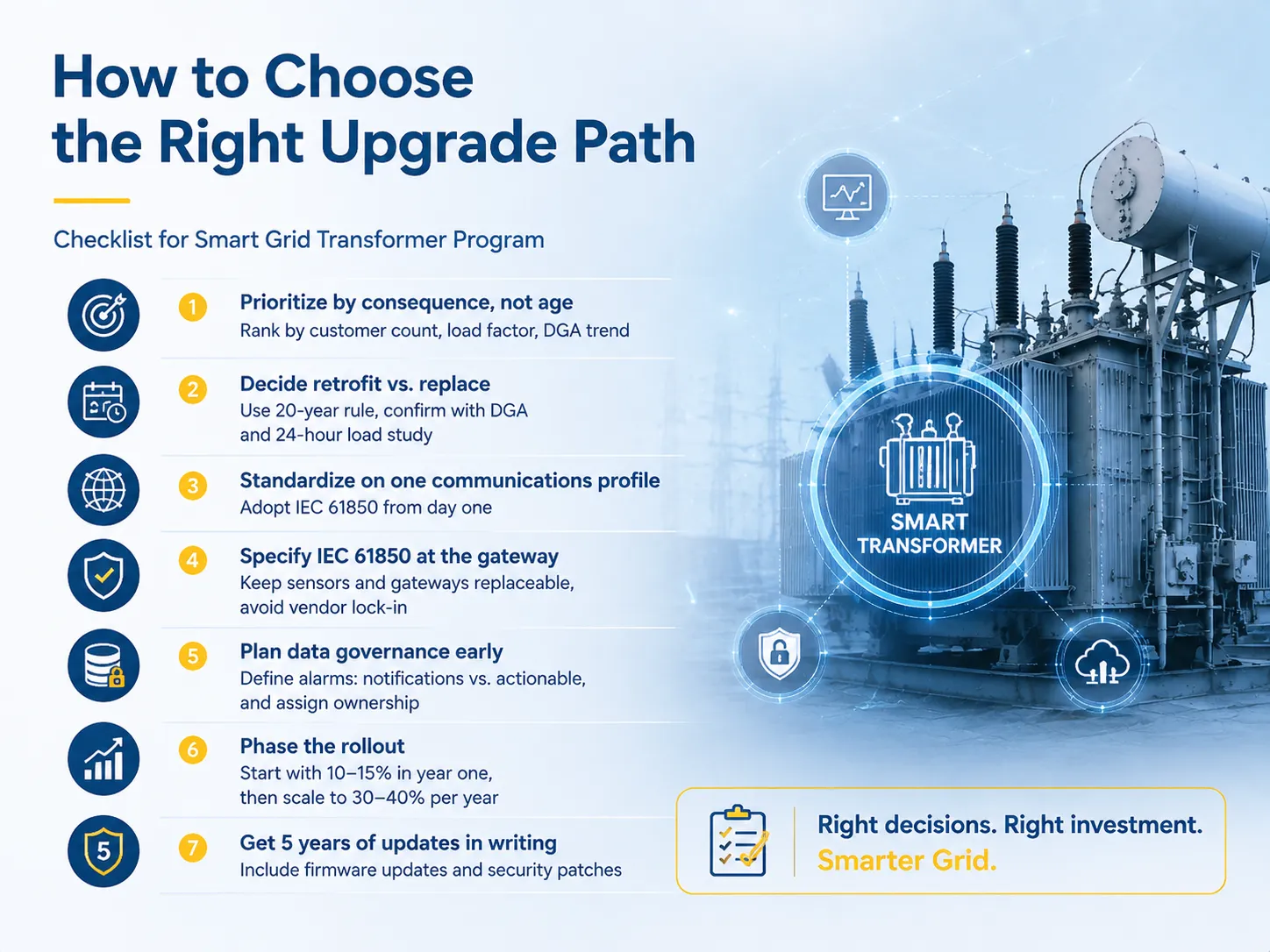
Cómo Elegir el Camino de Actualización Correcto
El siguiente conjunto de pautas debe seguirse al crear el programa de transformadores para la red inteligente:
- La prioridad en el ranking no debe darse a la antigüedad, sino a las consecuencias. Clasifique las unidades según el número de consumidores, el factor de carga junto con la tendencia de DGA. No pueden considerarse iguales cuando se trata de una unidad de 1,600 kVA que alimenta un hospital y una unidad que proporciona energía para una bomba de campo.
- Establezca la necesidad de reemplazar o modernizar según la regla de 20 años delineada y luego verifique los resultados con un curso de DGA y realizando un estudio de carga de 24 horas.
- Manténgase en un solo perfil de comunicación. La aplicación de IEC 61850 es mejor realizarla desde el primer día, ya que ayudará a ahorrar en los gastos de cambio de protocolos en el futuro.
- Explique al escribir los términos IEC 61850 que los sensores y las puertas no serán bloqueados por el proveedor y que pueden ser reemplazados fácilmente.
- Planifique la recomendación antes de poner en uso los sensores. Debe aclarar si las alarmas son mensajes o eventos que deben ser respondidos por alguien.
- Todo el proceso debe dividirse en fases. En el primer año es mejor tratar con 10-15% de las unidades que se están evaluando y luego el proceso puede avanzar a 30-40% en número anualmente.
- Sería útil obtener por escrito la respuesta sobre las actualizaciones de firmware y parches de seguridad por un período de cinco años provistos con garantía.
Preguntas Frecuentes
¿Cuál es la diferencia entre un transformador inteligente y un transformador monitoreado?
Un transformador monitoreado solo transmite mediciones a una pantalla o punto SCADA, mientras que un transformador inteligente realiza un procesamiento local de datos con la aplicación de reglas de diagnóstico como la interpretación de gases de IEEE C57.104 y puede realizar tareas de forma autónoma, como cambiar la posición del tap o iniciar los ventiladores o cooperar con inversores DER. La diferencia de precio es de aproximadamente $1,000 a $3,000 por cada unidad del dispositivo, que es la razón por la cual la modernización generalmente comienza con el monitoreo primero y solo luego se añaden tecnologías inteligentes.
¿Cuánto cuesta actualizar un transformador de distribución existente para que sea inteligente?
La modernización de monitoreo pasivo con temperatura, carga y puerta de comunicación tiene un precio de $1,200 a $2,800 por unidad, mientras que para la modernización completa que incluye DGA, detección de descarga parcial y control de tap, es de $2,500 a $5,500, con un costo adicional de mano de obra de $300 a $800. La modernización completa por fases para la flota de 1,000 unidades ascenderá a aproximadamente $3 millones a $6 millones en promedio.
¿Qué niveles de gas deberían activar una acción en un transformador sumergido en aceite?
Según la norma IEEE C57.104, el hidrógeno es el gas clave principal: su concentración normal es inferior a 100 ppm, donde el nivel de 100-150 ppm significa muestreo adicional, mientras que más de 150 ppm indica la necesidad de una investigación inmediata. La concentración de monóxido de carbono por encima de 350 ppm indica la presencia de deterioro del papel, y la presencia de más de 1 ppm de acetileno siempre indica que se necesita investigar la falla.
¿Es IEC 61850 obligatorio para proyectos de transformadores de red inteligente?
No estrictamente, sin embargo, se ha convertido en una necesidad de facto para la automatización de nuevas subestaciones de energía en la mayoría de los mercados. Modbus TCP o DNP3 son válidos para puertas de modernización. La ventaja competitiva de IEC 61850 son los nodos lógicos estándar, lo que hace posible utilizar el SCADA con diferentes proveedores junto con el uso de transformadores de otros fabricantes.
¿Cuánto tiempo tarda un sistema de monitoreo de transformadores inteligentes en pagarse por sí mismo?
Para una unidad de 630 kVA, el costo de una renovación completa es de $3,000 a $5,000 para todo el sistema instalado. Los ahorros por no tener una falla inesperada (el costo promedio de tal falla está entre $25,000 y $150,000 en total) o por posponer el reemplazo (entre $8,000 y $22,000) normalmente hacen que la inversión se recupere en 2-4 años.
Referencias
- IEC 60076 serie — Transformadores de potencia — el diseño del núcleo, las pruebas y los estándares de pérdidas para todos los transformadores de potencia y distribución mencionados a lo largo de este artículo.
- IEC 61850 — Redes y sistemas de comunicación para la automatización de servicios públicos de energía — el modelo de información estándar que hace que los transformadores inteligentes sean interoperables en la automatización de subestaciones.
- IEEE C57.104 — Guía para la interpretación de gases generados en transformadores sumergidos en aceite — la guía autorizada para las zonas de alarma DGA y la interpretación de gases de falla utilizadas en los umbrales de monitoreo.
- NEMA — Asociación Nacional de Fabricantes Eléctricos — publica estándares de eficiencia y aplicación de transformadores de distribución utilizados en programas de redes inteligentes en América del Norte.
- CIGRE — Consejo Internacional sobre Grandes Sistemas Eléctricos — publica informes de grupos de trabajo sobre la confiabilidad de transformadores, DGA y gestión de activos de flota utilizados en las estadísticas de fallas de este artículo.
- Resultados del programa de subvenciones para inversiones en redes inteligentes del Departamento de Energía de EE. UU. — informes gubernamentales sobre los costos de implementación de redes inteligentes, beneficios y resultados de proyectos de monitoreo de transformadores.
- Jiangsu Subian Electric Power — sitio oficial — fabricante de transformadores sumergidos en aceite y de tipo seco que cumplen con IEC 60076, con paquetes de monitoreo inteligente opcionales.
Conclusión
Actualizar transformadores de manera inteligente es la parte más impactante de un proyecto de red inteligente porque permite monitorear el activo más oculto de la red. La economía es bastante notable: precio de retrofitting de $1,200-5,500 por unidad, costos de falla de $25,000-150,000 y período de recuperación de 2-4 años, así como hasta 25% de disminución en el número de fallas no planificadas para empresas con prácticas analíticas amplias. La solución técnica también es obvia y consiste en estandarizar los protocolos IEC 61850, emplear límites de DGA aceptados por IEEE C57.104 y hacer uso de sensores y puertas de enlace que sean intercambiables, no dependientes del proveedor.
- Intente retrofitar todas las unidades saludables producidas hace menos de 10 años; reemplace las unidades que tienen más de 20 años y las que presentan anomalías de DGA.
- Implemente el proyecto gradualmente: comience con 10-15% en el primer año y luego cubra aproximadamente 30-40% anualmente.
- Compare marcas mundiales (ABB, Siemens, Schneider) con productores chinos certificados por IEC (como Jiangsu Subian Electric Power) para obtener el equilibrio adecuado entre control y costo.