


La ingeniera a cargo del diseño de la red estaba planeando un sitio costero que sufriría transformaciones. Una estación eólica marina de 200 megavatios se conectará a una de las diversas subestaciones de 220 kilovoltios. Una instalación fotovoltaica de 120 megavatios y una estación de almacenamiento de energía de 50 megavatios/100 megavatios hora se conectarían a través de otra subestación, mientras que los sistemas de conexión de 35 kilovoltios se expandirían. Cada nuevo megavatio requería transformadores: transformadores de 0.69 kV para turbinas, transformadores de 0.4 kV para sistemas fotovoltaicos, transformadores de 33/110 o 33/220 kilovoltios para subestaciones, y transformadores necesarios para manejar tanto la carga como la descarga en términos de las plantas de almacenamiento de energía. La máquina de la ingeniera le recordaba constantemente un hecho: aunque las plantas de energía renovable reciben toda la publicidad, son los transformadores los que aseguran que todo el sistema funcione. Si el transformador experimenta pérdidas aumentadas o no logra enfriarse, la planta eólica no podrá utilizar su capacidad adecuadamente, sin importar cuán fuerte sea el viento afuera.
Este artículo destaca la importancia de los transformadores en los sistemas de energía nueva, incluyendo su ubicación, parámetros de operación, costos y métodos de selección para la construcción de sistemas de almacenamiento.
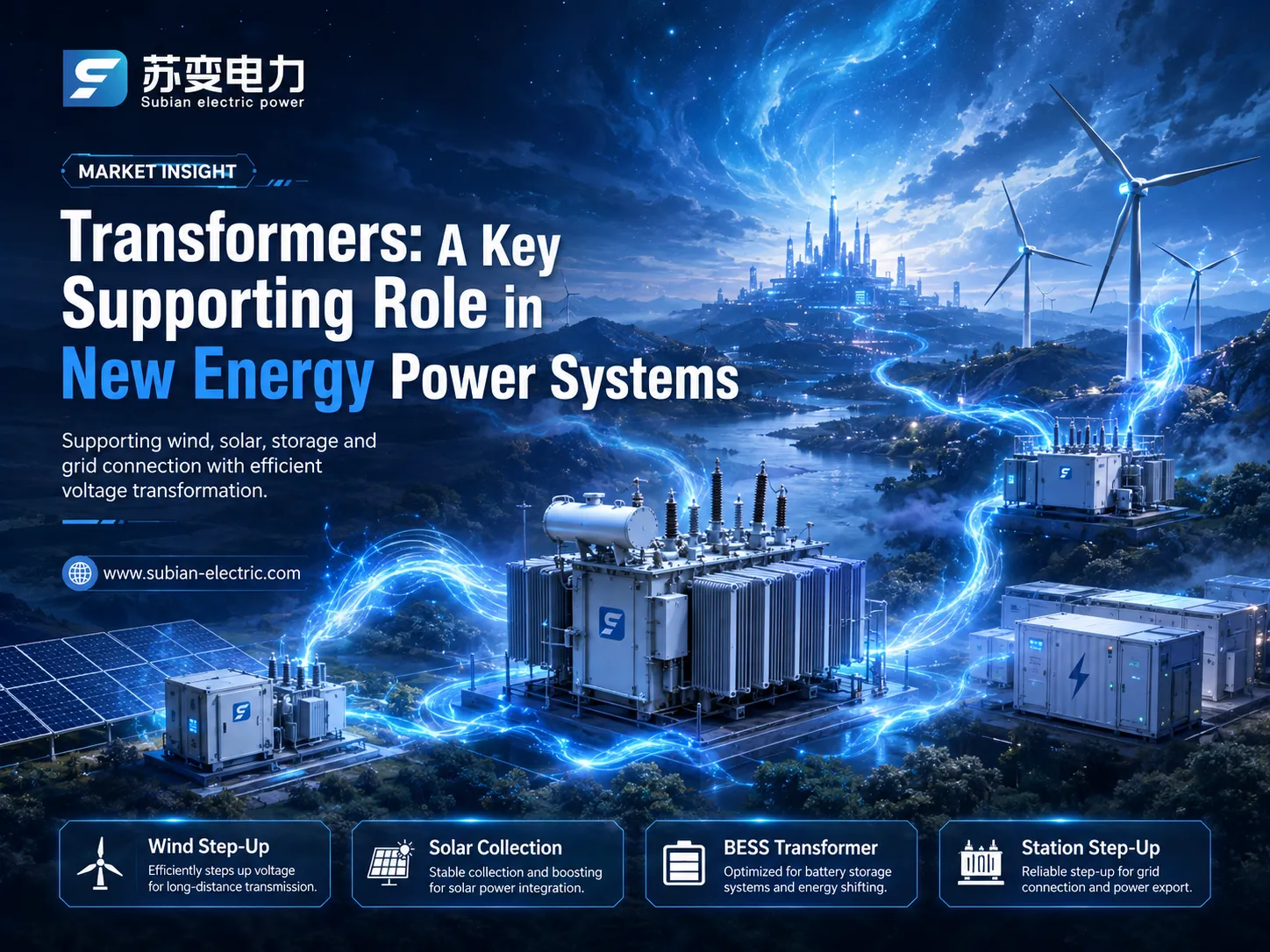
El papel de los transformadores en los sistemas de energía nueva
La operación de los sistemas de energía nueva es similar a la de los sistemas de energía tradicionales, pero solo sobre la base de fuentes distribuidas dependientes del clima. Tradicionalmente, los transformadores realizan cinco funciones clave:
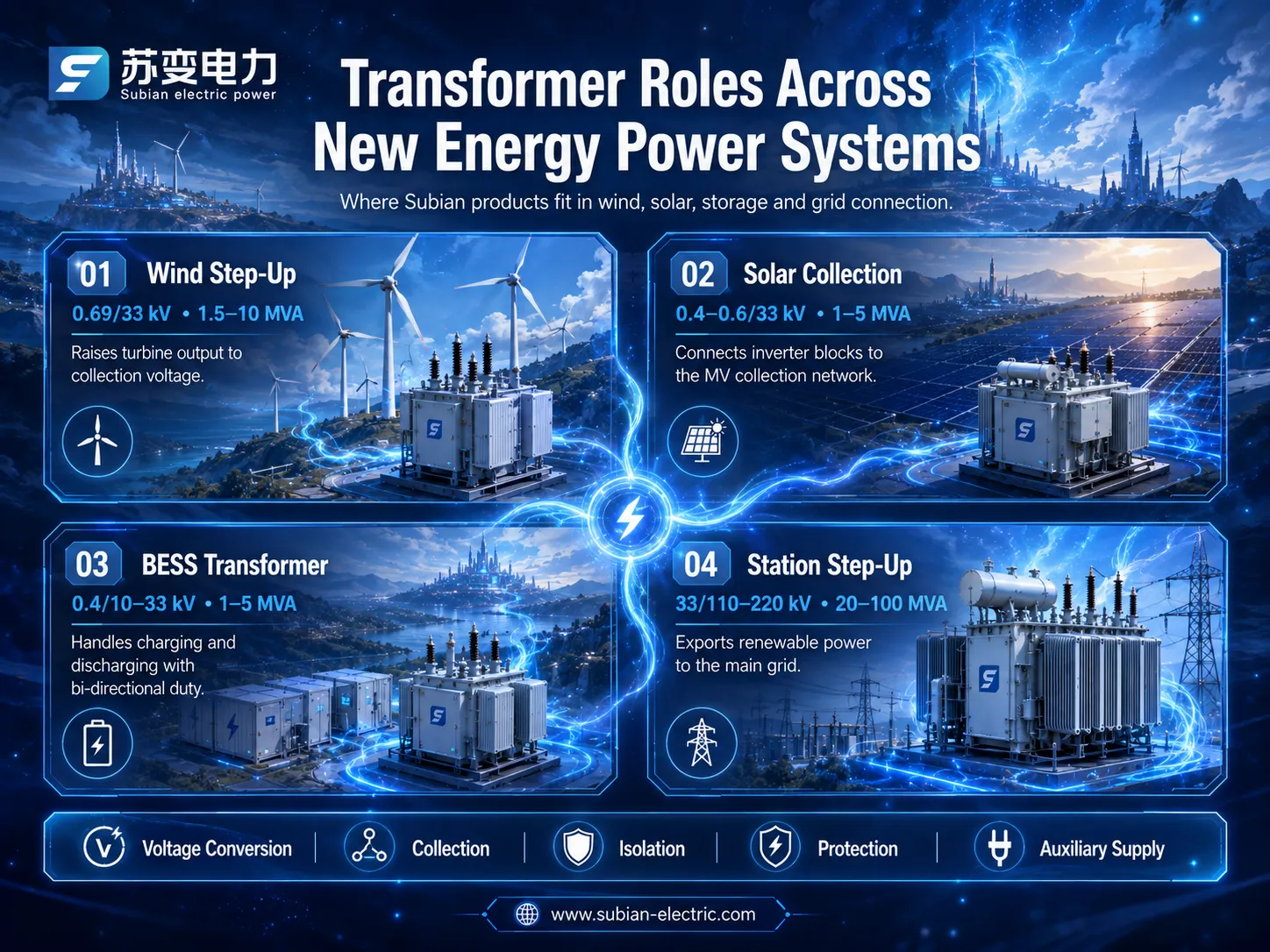
Transformador elevador para un generador: transfiere el voltaje bajo que proviene de cada turbina o cadena de inversores en el sistema de recolección a un voltaje más alto;
Transformador del sistema de recolección: transporta energía de muchos generadores a las estaciones;
Transformador elevador: aumenta el voltaje de recolección para una transmisión posterior;
Transformador de aislamiento: realiza la separación entre la generación y la red;
Transformador de suministro auxiliar: proporciona servicios auxiliares a la subestación.
Topologías del sistema: Eólica, Solar, Almacenamiento, Híbrido
La configuración del transformador depende del tipo de fuente y del tamaño de la planta:
| Sistema | Etapas típicas de transformadores | Ejemplos de clasificación |
|---|---|---|
| Eólica terrestre (20–200 MW) | Turbina 0.69/33 kV → estación 33/110–220 kV | Elevador 1.5–10 MVA; estación 20–100 MVA |
| Eólica marina | Elevador de turbina → subestación marina → estación terrestre | Elevador 5–15 MVA; estación 100–400 MVA |
| Solar de utilidad (10–200 MWp) | Inversor 0.4–0.6/33 kV → estación 33/110–220 kV | Recolección 1–5 MVA; estación 20–100 MVA |
| Almacenamiento de baterías (10–100 MW) | PCS 0.4/10–33 kV → estación elevadora | Transformador PCS 1–5 MVA |
| Híbrido (eólica+solar+almacenamiento) | Todo lo anterior en una subestación colectora | Transformadores de subestación de múltiples devanados |
Cada etapa añade pérdidas, costos y modos de falla, por lo que los diseñadores de sistemas trabajan arduamente para minimizar el número de pasos de transformación, pero los niveles de voltaje de los sistemas de transmisión modernos hacen que los pasos sean inevitables. Los transformadores son el precio de mover energía renovable de manera eficiente a través de distancias.
Deber de Nueva Energía: La Comparación con el Deber de la Red
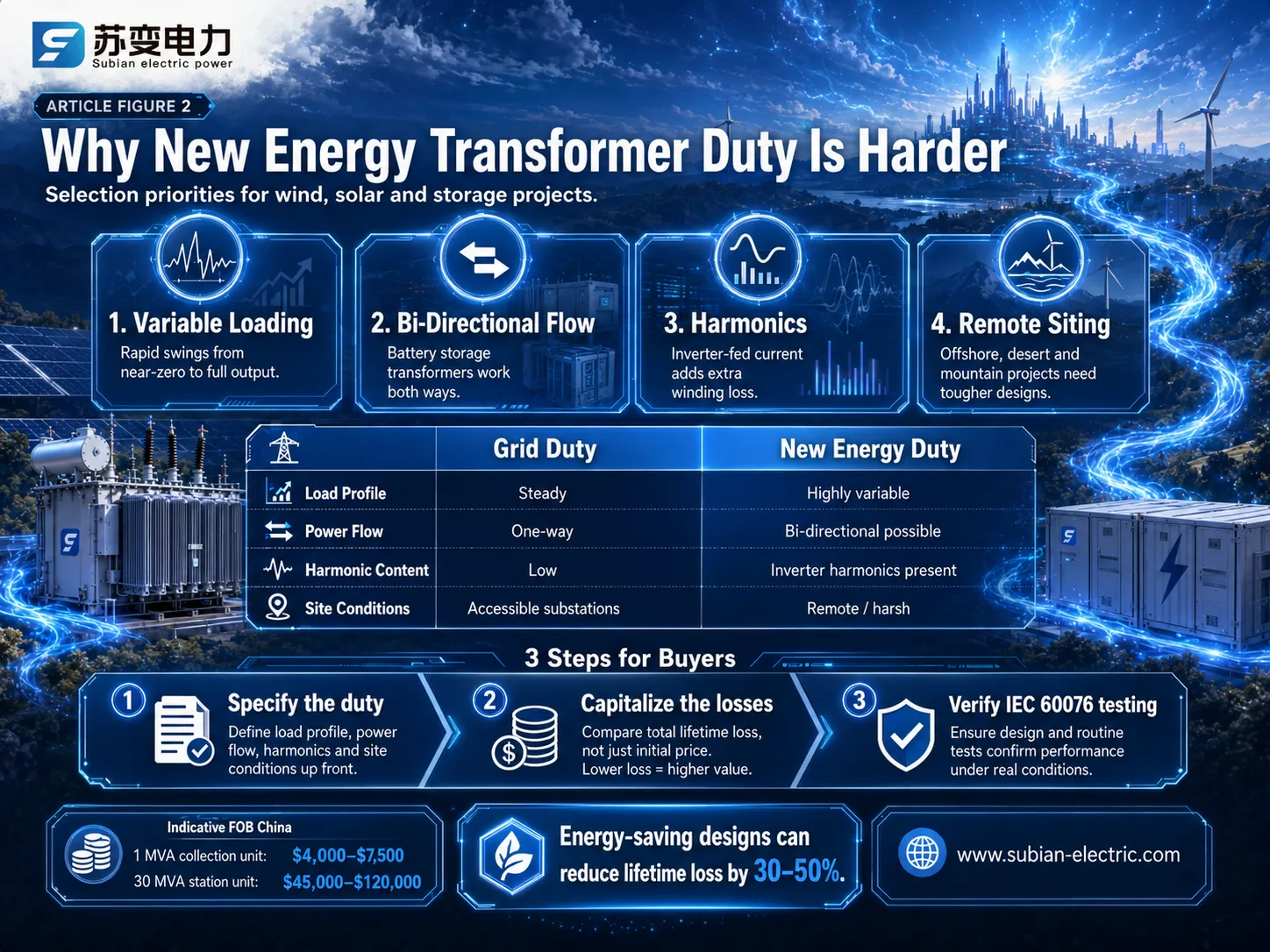
Los transformadores de nueva energía tienen que lidiar con condiciones de operación poco comunes para los transformadores de distribución de la red:
Cargas variables: la producción de energía eólica y solar fluctúa de casi cero a plena en unos pocos minutos, causando que los devanados del transformador pasen por rápidas variaciones de temperatura y estresen el aislamiento.
Flujo de energía bidireccional (energía de batería): los transformadores de batería necesitan transportar energía en ambas direcciones con la misma importancia, lo que implica un estrés térmico simétrico para el cual un transformador de red unidireccional no está diseñado.
Armónicos: los inversores y convertidores inyectan corrientes armónicas que introducen pérdidas de energía adicionales en los devanados y pueden causar resonancia con la impedancia del transformador.
Ubicación remota: los transformadores de turbinas eólicas se colocan en cumbres de montañas o en el mar en agua salada, condiciones climáticas extremas y con espacio limitado para el mantenimiento.
El resultado de esto es la reducción de potencia, mejor enfriamiento, diseño de devanados para lidiar con armónicos y uso de aislamiento fuerte. Un transformador diseñado para el servicio estable de la red, cuando se instala en un proyecto de energía renovable, puede no funcionar como se indica en la hoja de especificaciones y se sobrecalentará y fallará antes de lo planeado.
| Condición de operación | Servicio típico de la red | Servicio de nueva energía | Respuesta de diseño |
|---|---|---|---|
| Perfil de carga | Relativamente estable, predecible | Cambios rápidos de casi cero a plena | Clasificación de carga cíclica, margen térmico |
| Dirección del flujo de energía | Unidireccional (red a carga) | Bidireccional en plantas de almacenamiento | Diseño simétrico de devanados y enfriamiento |
| Contenido armónico | Bajo, mayormente 50/60 Hz | Armónicos de inversor presentes | Devanados clasificados para armónicos, margen extra |
| Ubicación | Subestaciones con acceso de servicio | Remoto, en alta mar, aire salino, extremos | Protección contra la corrosión, diseños sellados |
La lección práctica es especificar para el deber, no para el voltaje. Un transformador que se ajusta perfectamente a una subestación de distribución puede ser la elección incorrecta en la misma clasificación en una planta eólica o solar.
Tipos y configuraciones de transformadores
Las principales familias de transformadores en sistemas de nueva energía, con su énfasis de diseño:
| Tipo | Clasificación típica | Énfasis de diseño |
|---|---|---|
| Transformador elevador de turbina (WTS) | 5–15 MVA, 0.69/33 kV | Compacto, resistente a la corrosión, alta tolerancia a vibraciones |
| Transformador de inversor solar | 1–5 MVA, 0.4–0.6/33 kV | Bobinados tolerantes a armónicos, baja pérdida de carga en ciclos altos |
| Transformador de almacenamiento de baterías | 1–5 MVA, 0.4/10–33 kV | Capacidad de carga bidireccional, alto margen de sobrecarga |
| Transformador de subestación colectora | 10–40 MVA, 33/110–220 kV | Cambiador de tomas bajo carga, bajas pérdidas, alta fiabilidad |
| Transformador auxiliar | 50–500 kVA, 33/0.4 kV | Cargas de casa de estación, compacto y fiable |
Los transformadores de tipo seco y resina fundida aparecen cada vez más en la etapa de inversor y PCS para instalaciones interiores o en contenedores, donde la seguridad contra incendios y el acceso para mantenimiento favorecen el aislamiento sólido. Las unidades sumergidas en líquido dominan las etapas de recolección y estación al aire libre.
Eficiencia y consideraciones de pérdida
La eficiencia de los transformadores de nueva energía es compleja por su naturaleza. Las pérdidas constituyen la energía que la planta no puede vender, disminuyendo así sus ingresos. Además, la cantidad de pérdida depende de los cambios en la carga. Para abordar el problema, se deben seguir dos principios de diseño:
La pérdida en vacío es el factor más importante bajo baja carga. Cuando la planta solar no está generando ninguna salida por la noche, los transformadores siguen funcionando, lo que lleva a pérdidas en el núcleo de 8,760 horas al año;
La pérdida de carga es el segundo factor que puede volverse esencial cuando la carga es alta. A medida que los armónicos aumentan la pérdida de carga en 5-20%, es necesario tener en cuenta este aspecto al elaborar el diseño del bobinado del transformador.
Un transformador eficiente en energía para la estación solar puede ahorrar de 30% a 50% de las pérdidas totales del transformador de energía que tiene la misma potencia. En equivalente monetario, puede ser igual a $10,000 a $40,000 por año considerando el costo de energía de $0,08 a $0,10 por kWh.
| Tamaño de la planta | Flota típica de transformadores | Ahorro de energía por pérdidas anuales vs especificación genérica | Valor anual a $0.09/kWh |
|---|---|---|---|
| 10 MW solar | 10 × 1 MVA unidades de recolección + 1 unidad de estación | 30,000–60,000 kWh | $2,700–$5,400 |
| 50 MW solar | 25–30 unidades de recolección + estación | 110,000–440,000 kWh | $10,000–$40,000 |
| 30 MW eólico | 20 × 1.5 MVA unidades de turbina + estación | 90,000–250,000 kWh | $8,100–$22,500 |
| 50 MW / 100 MWh almacenamiento | 10–20 unidades PCS + estación | 70,000–200,000 kWh | $6,300–$18,000 |
El ahorro escala con el tamaño de la planta y empeora cuando se utilizan transformadores genéricos, que es exactamente por qué el modelo de pérdida a nivel de planta se ha convertido en parte de la ingeniería de proyectos renovables.
Protección, monitoreo y fiabilidad
Los transformadores desempeñan un papel auxiliar si están en funcionamiento. Debido a esto, las nuevas plantas de energía utilizan varios instrumentos junto con los transformadores, tales como:
– Relés de protección: transformadores de estación equipados con relés diferenciales y de sobrecorriente, así como protección por fusibles y disyuntores a nivel del sistema de recolección.
– Analizador de gases disueltos: el uso de muestreo de aceite de acuerdo con la IEC 60599 para identificar fallas tempranas que pueden ser vitales en el caso de cómo se opera el equipo remoto.
– Monitoreo de temperatura y presión: sensores de temperatura del aceite superior y del devanado.
– Cambiadores de tomas bajo carga: como parte del equipo de la estación transformadora para ayudar en el mantenimiento de los niveles de voltaje durante la operación de la planta de energía.
– Sistema de monitoreo inteligente: ahora un aspecto habitual que permite la recolección de los datos anteriores y la optimización del proceso de despacho.
La economía de la fiabilidad es sencilla: cuando los ensamblajes de potencia de 30 MVA fallan, la generación de 30-100 MW durante semanas puede retrasarse a un costo de millones de dólares. Los transformadores son solo un costo menor frente al riesgo asociado con tales inconvenientes que afectan la calidad del equipo utilizado en los proyectos.
Dimensionamiento y selección para proyectos renovables
Al elegir transformadores para un nuevo sistema energético, se deben seguir los pasos descritos a continuación.
Trazar el perfil de carga: esto implica obtener la salida horaria del modelo de generación, y se refiere al perfil de salida derivado de la serie de velocidad del viento o de irradiancia solar, y el horario de carga/descarga.
Determinar el tamaño de cada etapa del transformador utilizando métodos de desclasificación: aquí se debe aplicar la desclasificación armónica, que suele ser de 5–10%, así como métodos de desclasificación para la temperatura ambiente.
Determinar el balance de pérdidas: este paso consiste en ejecutar la capitalización de pérdidas a través de tarifas y salida.
Determinar los dispositivos de protección y monitoreo que deben incluirse en la solución, como relés y DGA.
Definir especificaciones ambientales: esto incluye regulaciones de ruido, tipo de aceite y protección contra la corrosión.
Probar los dispositivos de acuerdo con las normas.
Fabricantes y rangos de precios
Precios FOB indicativos para transformadores de nueva energía por marca y etapa:
| Marca | Origen | Unidad de recolección de 1 MVA | Unidad de estación de 30 MVA |
|---|---|---|---|
| Hitachi Energy | Japón/Global | $9,000–$14,000 | $95,000–$160,000 |
| ABB | Suiza/Global | $8,500–$13,500 | $90,000–$150,000 |
| Siemens Energy | Alemania/Global | $8,000–$13,000 | $85,000–$145,000 |
| Schneider Electric | Francia/Global | $7,500–$12,500 | $80,000–$140,000 |
| Toshiba / Hyundai | Japón/Corea | $7,000–$11,500 | $75,000–$130,000 |
| Jiangsu Subian Electric Power | China | $4,000–$7,500 | $45,000–$120,000 |
Los precios varían según la clasificación, la relación de voltaje, la clase de pérdidas, el cambiador de tomas, el tipo de aceite, los precios del cobre y los términos de entrega; trate estos como rangos de planificación, no como cotizaciones firmes.
La categoría premium ancla el mercado con programas de pruebas de tipo global y registros de seguimiento en alta mar. La categoría china ofrece la misma evidencia IEC 60076 y diseños específicos para nueva energía a un costo 40–50% más bajo, lo que la ha convertido en una fuente líder para proyectos de energía eólica en tierra, solar y de almacenamiento en Asia, África, Oriente Medio y América del Sur. Jiangsu Subian Electric Power es un fabricante chino de transformadores y transformador de ahorro de energía productor que suministra transformadores de elevación de turbinas, recolección solar, almacenamiento y estaciones desde 10 kVA hasta 63 MVA, con devanados tolerantes a armónicos, cambiadores de tomas bajo carga, opciones de núcleo amorfo y aceite de éster natural, todos probados según IEC 60076 y enviados con informes de prueba rutinarios. Subian ha suministrado proyectos renovables y de almacenamiento a nivel internacional; la gama está documentada en subian-electric.com.
Perspectivas: Transformadores en sistemas de energía futuros
Las funciones de los transformadores estarán determinadas por tres tendencias en el sistema de energía renovable nacional durante los próximos diez años. Primero, habrá una rápida expansión de las instalaciones de transformadores de energía renovable, lo cual es necesario teniendo en cuenta que las estimaciones globales predicen un aumento de la participación de la energía renovable en la producción de electricidad en los principales mercados del 30% a tan alto como el 50-70%, lo que a su vez significa que cada gigavatio de capacidad instalada requerirá docenas de transformadores. Segundo, la eficiencia se ajustará aún más a medida que las calificaciones de eficiencia y la adquisición verde continúen aumentando, haciendo transformador verde que los diseños sean la norma. Tercero, la monitorización inteligente se convertirá en estándar, porque en un sistema donde la producción es variable y remota, los datos que mantienen saludables a los transformadores son los datos que mantienen fluyendo la energía renovable.
Los transformadores permanecerán en el trasfondo de la transición energética, pero la transición simplemente no ocurre sin ellos.
Preguntas Frecuentes
¿Qué transformadores se utilizan en plantas eólicas y solares?
Típicamente tres etapas: transformadores elevadores de generador/inversor (0.69/33 kV o 0.4–0.6/33 kV, 1–15 MVA), unidades de red de recolección y un transformador elevador de estación (33/110–220 kV, 20–400 MVA). Las plantas de almacenamiento de baterías añaden transformadores PCS bidireccionales a 0.4/10–33 kV.
¿Cuánto cuestan los transformadores para plantas renovables?
Un transformador de recolección de 1 MVA cuesta alrededor de 4,000–7,500 FOB de fabricantes chinos; un transformador de estación de 30 MVA cuesta entre 45,000–120,000. Las marcas internacionales premium tienen precios un 50–80% más altos. Los precios varían según la clasificación, la clase de pérdidas, el cambiador de tomas y los precios del cobre.
¿Por qué son importantes las pérdidas de transformadores en los nuevos sistemas de energía?
Porque cada kilovatio perdido es producción renovable que nunca se puede vender. Los transformadores de estación de una planta solar permanecen energizados por la noche cuando la producción es cero, por lo que las pérdidas en vacío importan más de lo que su pequeño tamaño sugiere. En una planta de 50 MW, la especificación correcta puede ahorrar entre 10,000–40,000 al año en energía perdida.
¿Son diferentes los transformadores renovables de los transformadores de red normales?
Sí, en su función. Experimentan cargas variables y bidireccionales, armónicos de los inversores y ubicaciones remotas o difíciles. Eso requiere devanados clasificados para armónicos, desclasificación, mejor refrigeración y protección contra la corrosión. Usar un transformador de red estándar sin desclasificación acorta su vida útil.
¿Cuál es la vida útil de un transformador en una planta renovable?
20–35 años, dependiendo de la severidad de la carga, las condiciones ambientales y el mantenimiento. La carga variable y los armónicos acortan la vida a menos que la unidad esté desclasificada y monitorizada. El DGA anual según IEC 60599, la monitorización de temperatura y mantener la temperatura de puntos calientes dentro de los límites de IEC 60076-7 son los factores más importantes para la vida útil.
Referencias
- IEC 60076-1: Transformadores de potencia – General — Base de calificación y pruebas internacional para todos los transformadores de sistemas renovables.
- IEC 60076-5: Capacidad para soportar cortocircuitos — Verificación de diseño de cortocircuito para transformadores de estación.
- IEC 61936-1: Instalaciones eléctricas que superan 1 kV a.c. — Requisitos de instalación para plantas renovables de media y alta tensión.
- IEA Renovables 2023 — Datos de crecimiento global de energías renovables que respaldan la demanda de transformadores.
- Tecnología de energía renovable de IRENA — Perspectiva tecnológica para la integración de eólica, solar y almacenamiento.
- GB 20052: Grados de eficiencia energética para transformadores de potencia — Grados de eficiencia relevantes para la especificación de transformadores renovables.
- Sitio oficial de Jiangsu Subian Electric Power — Gama de transformadores renovables y de almacenamiento con informes de prueba.
Conclusión
Los transformadores son elementos importantes en los sistemas de energía contemporáneos — en el sentido estructural más que opcional. Cada turbina eólica, campo solar y instalación de baterías depende de transformadores para aumentar el voltaje, recoger energía y conectarse a la red, y cada transformador debe, por lo tanto, ser diseñado para soportar la prueba que imponen estos sistemas: cargas cambiantes, distorsión, tráfico bidireccional y ubicaciones remotas.
Puntos clave:
- Los sistemas renovables necesitan tres etapas de transformación: aumento de generación, recolección y aumento de estación.
- El deber de nueva energía es más difícil que el deber de la red — la desclasificación, la tolerancia armónica y la monitorización son innegociables.
- La especificación de eficiencia ahorra 30–50% de energía perdida anual en comparación con una unidad genérica; vale $10,000–$40,000/año en una planta de 50 MW.
- Presupuesto $4,000–$7,500 para unidades de recolección de 1 MVA y $45,000–$120,000 para unidades de estación de 30 MVA de fabricantes chinos.
Si está construyendo o expandiendo un proyecto eólico, solar, de almacenamiento o híbrido, Jiangsu Subian Electric Power suministra transformadores de grado renovable de 10 kVA a 63 MVA — tolerantes a armónicos, probados según IEC 60076, con opciones de núcleo amorfo y aceite de éster — a precios amigables para la exportación. Revise la gama en subian-electric.com.