


Una joven ingeniera a cargo de la planificación en una empresa de servicios públicos pasa su tiempo preparándose para el presupuesto del próximo año. Esto implica no solo conectar el nuevo parque solar de 40 MW de capacidad y obtener nuevas conexiones eléctricas para 3,000 hogares construidos en el perímetro de la ciudad, sino también cumplir con el nuevo requisito regulatorio de reducir la pérdida de distribución a través de las redes envejecidas existentes. El mismo equipo sigue apareciendo en cada etapa de su plan como algo que tanto habilita como limita su proyecto — el transformador de distribución. Con los transformadores siendo irrazonablemente pocos en número, los alimentadores están sobrecargados, los costosos transformadores viejos conducen a pérdidas, y usar los transformadores adecuados facilita las cosas para todo el sistema.
Este artículo discute el papel del transformador de distribución en los sistemas energéticos modernos, incluyendo las funciones que cumple el transformador y también algunas nuevas aplicaciones en generación de energía solar, almacenamiento de energía y tecnologías de redes inteligentes; así como proporciona información básica sobre las estructuras de precios y estándares necesarios para los compradores potenciales.
¿Qué es un transformador de distribución?
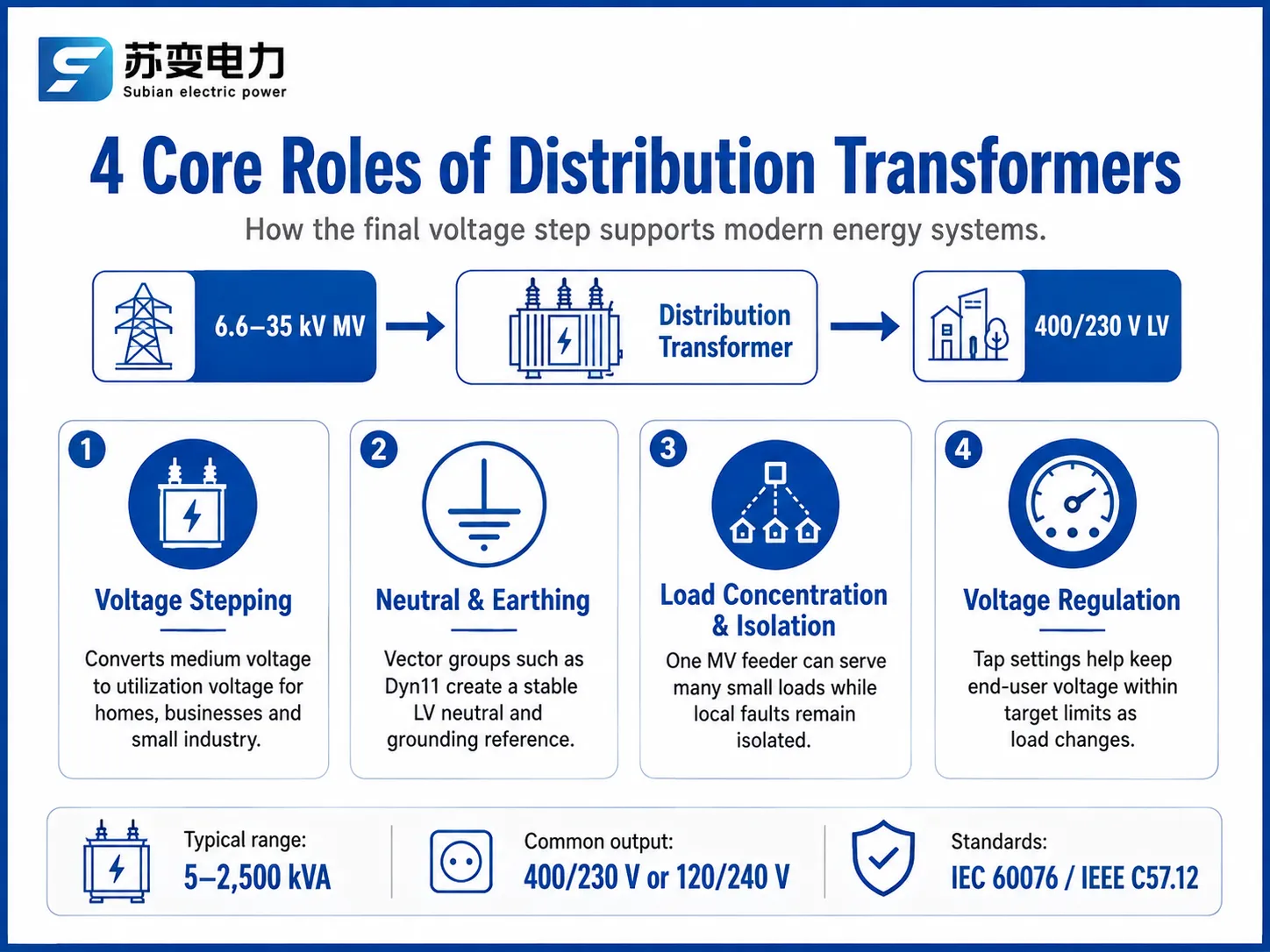
La pieza final de equipo que cambia el voltaje en la línea de transmisión de energía se conoce como transformador de distribución. La generación y transmisión ocurren a niveles de voltaje más altos – 110 kV, 220 kV, etc. – ya que el alto voltaje causa baja corriente, lo que conduce a pérdidas reducidas. Sin embargo, los clientes requieren 400/230 V (o 120/240 V), por lo que el proceso de hacer la transición del voltaje de transmisión a un nivel adecuado para el uso debe hacerse en varios pasos. El transformador de distribución realiza el paso final y más crucial en este proceso de transformación.
A diferencia del transformador de potencia utilizado en subestaciones de alta tensión, el transformador de distribución tiene dimensiones diferentes y roles diferentes. Los transformadores de potencia (generalmente más de 2,500 kVA) se pueden encontrar en subestaciones de transmisión o sub-transmisión, mientras que los transformadores de distribución (típicamente de 5 a 2,500 kVA) están situados más cerca de los consumidores (en postes, losas de concreto o dentro de pequeñas subestaciones). Una ciudad de tamaño mediano puede tener algunos transformadores de potencia y miles de transformadores de distribución.
Desde el punto de vista físico, la mayoría de los transformadores de distribución son refrigerados por aceite (ONAN) y se utilizan al aire libre, aunque los transformadores de tipo seco (resina fundida) se pueden encontrar en interiores y en lugares con mayor riesgo de incendio. Por ejemplo, un transformador de aceite sumergido trifásico de 100 kVA de capacidad pesa entre 700 kg y 900 kg con unas dimensiones de 1.3 × 0.9 × 1.4 m, mientras que el transformador de tipo seco de 100 kVA es más pequeño en tamaño y peso pero más ruidoso en operación.
El papel del transformador de distribución en la red
El transformador de distribución realiza cuatro funciones en un sistema energético moderno, y cada una merece ser entendida porque cambia lo que compras:
| Rol | Lo que hace | Ejemplo en la práctica |
|---|---|---|
| Paso de voltaje | Reduce 6.6–35 kV MV a 400/230 V o 120/240 V LV | Unidad 11/0.4 kV alimentando una calle residencial |
| Separación del sistema y puesta a tierra | Proporciona una referencia de neutro y tierra definida para la red de LV | Grupo vectorial Dyn11 que crea un neutro de LV sólidamente aterrizado |
| Concentración / aislamiento de carga | Permite que un alimentador de MV sirva a muchos pequeños consumidores mientras aísla fallas | Un transformador de calle con falla no apaga el alimentador |
| Regulación de voltaje | Los cambiadores de tomas bajo carga mantienen el voltaje de LV a medida que varía la carga | OLTC mantiene 400 V dentro de ±5% a lo largo de la curva de carga diaria |
Debe hacerse una mención especial del papel de “separación del sistema”. El grupo vectorial de un transformador de distribución (generalmente Dyn11 en mercados IEC) es lo que define cómo se aterriza el neutro. El concepto de aterrizaje influye posteriormente en la técnica de relé de protección en el lado de LV y su eficiencia, razón por la cual a menudo es la primera pregunta que un fabricante de buena reputación le hará.
Pérdidas y Eficiencia: Por qué Importan Más de lo que Piensas
En la mayoría de los sistemas de distribución eléctrica actuales, los transformadores de distribución representan la mayor fuente individual de pérdidas técnicas. Según la Agencia Internacional de Energía, las pérdidas de distribución se han evaluado en aproximadamente 4–6% de la producción global de electricidad, siendo los transformadores de distribución responsables de una parte considerable. Los transformadores de distribución operan el potencial máximo de 8,760 horas al año, y por lo tanto, incluso pequeñas diferencias en pérdidas se traducen en grandes cantidades de pérdidas a nivel nacional.
Hay dos componentes de pérdida que se comportan de manera diferente:
Pérdidas en vacío (también llamadas pérdidas de hierro) – son una pérdida constante y siempre presente. Se definen por el cuadrado del voltaje aplicado y no cambian cuando se aplica la carga eléctrica.
Pérdidas de carga (también llamadas pérdidas de cobre) – se definen por el cuadrado de la corriente consumida por la carga y, por lo tanto, crecen de acuerdo con la tasa de aumento de carga.
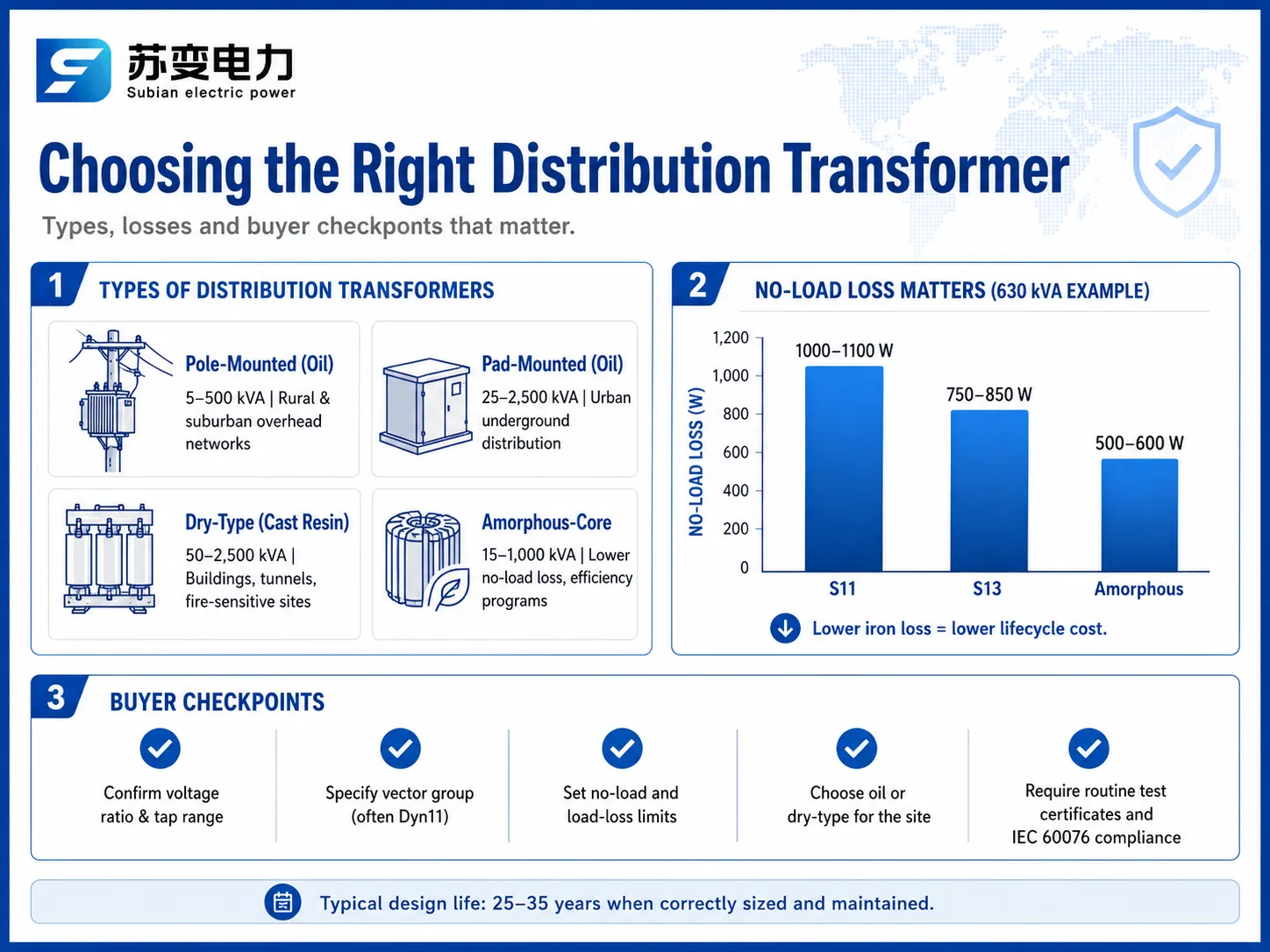
Los estándares de eficiencia modernos, como la legislación de Ecodesign de la Unión Europea, las regulaciones del Departamento de Energía de EE. UU. y el GB 20052 en China, imponen la reducción de pérdidas en vacío. Por lo tanto, un transformador de distribución que pertenece a la categoría de Grado 1, que tiene un núcleo amorfo, tiene la posibilidad de reducir las pérdidas de hierro a 70–80% en comparación con un producto diseñado en la década de 1990. Así, para un transformador de 630 kVA, la diferencia mencionada corresponde a un ahorro anual de $300–600 en costos de electricidad. La tabla a continuación demuestra las cifras anuales relacionadas con la energía consumida por una instalación de transformador de 630 kVA en operación continua.
| Antigüedad del diseño | Pérdida en vacío (630 kVA) | Energía de hierro por año | Costo anual a $0.10/kWh |
|---|---|---|---|
| Década de 1990 (clase S7) | ≈ 1,800–2,000 W | ≈ 15,800–17,500 kWh | $1,580–$1,750 |
| Clase S11 (Grado 3) | ≈ 1,000–1,100 W | ≈ 8,800–9,600 kWh | $880–$960 |
| Clase S13 (Grado 2) | ≈ 750–850 W | ≈ 6,600–7,400 kWh | $660–$740 |
| Amorfos (Grado 1) | ≈ 500–600 W | ≈ 4,400–5,300 kWh | $440–$530 |
A través de una flota de unos pocos miles de unidades, elegir núcleos amorfos de Grado 1 en lugar de acero de clase S11 ahorra silenciosamente seis cifras al año solo en pérdidas de hierro, antes de contar cualquier ahorro por pérdidas de carga.
Tipos de Transformadores de Distribución
Los compradores eligen entre varias familias, y la elección está impulsada por el montaje, el medio ambiente y la seguridad contra incendios. La tabla a continuación resume los principales tipos con rangos de precios realistas (FOB, China) para calificaciones comunes.
| Tipo | Clasificaciones | Uso típico | Rango de precios (FOB) |
|---|---|---|---|
| Montado en poste (aceite) | 5–500 kVA | Redes aéreas rurales y suburbanas | $350–$6,500 |
| Montado en base (aceite) | 25–2,500 kVA | Redes urbanas subterráneas, recinto cerrado | $900–$12,000 |
| Tipo seco (resina fundida) | 50–2,500 kVA | Edificios, túneles, hospitales, sitios sensibles al fuego | $3,500–$30,000 |
| Núcleo amorfo (aceite) | 15–1,000 kVA | Programas impulsados por la eficiencia, objetivos de Grado 1 | $900–$15,000 |
| Transformador de subestación de caja compacta | 100–2,500 kVA | Integrado en estaciones tipo caja | $2,500–$18,000 |
| Sellado herméticamente (aceite) | 50–630 kVA | Sitios costeros y húmedos propensos a la humedad | $800–$8,000 |
Hay dos tendencias principales que están transformando este catálogo. La primera tendencia es el aumento de unidades de tipo seco en aplicaciones interiores debido a la eliminación del riesgo de incendio y los costos asociados con la contención de aceite. La segunda tendencia es el uso de unidades de núcleo amorfo en programas de reembolso de eficiencia, donde un costo adicional de 15%–25% en comparación con los diseños CRGO tradicionales puede recuperarse en 3–6 años de ahorros.
Roles Modernos: Renovables, Almacenamiento y Redes Inteligentes
La representación tradicional de un transformador de distribución como un mero dispositivo pasivo ya no es aplicable. Los transformadores de distribución de hoy están cambiando rápidamente a elementos activos de los sistemas de suministro eléctrico.
Integración de energía solar y vehículos eléctricos: Las estaciones solares en techos y los cargadores de vehículos eléctricos empujan electricidad en ambas direcciones en el transformador. El flujo bidireccional de corriente crea nuevos regímenes de carga que causan sobrecalentamiento de transformadores diseñados para corrientes unidireccionales. Algunas empresas de servicios públicos ya están reduciendo la capacidad de los transformadores en áreas con alta penetración de estaciones solares en un 15-20% o han introducido cambiadores de tomas inteligentes.
Integración de almacenamiento de baterías: Las estaciones de almacenamiento de energía comunitarias cargan y descargan a través del transformador de distribución, ayudando a aplanar la carga y prolongando la vida útil de los transformadores.
Sensado de red inteligente: Los transformadores modernos tienen sensores internos de temperatura y nivel de aceite y dispositivos de comunicación inalámbrica para proporcionar datos sobre el estado de los transformadores.
Flexibilidad de demanda: Los nuevos transformadores inteligentes están equipados con cambiadores de tomas bajo carga y sistemas de monitoreo remoto que permiten al personal operativo reducir el voltaje durante las horas pico (reducción de voltaje de conservación o CVR).
Todos estos factores cambian el proceso de adquisición: las licitaciones de servicios públicos de hoy a menudo requieren el uso de dispositivos equipados con puertos de monitoreo y comunicación que cumplan con IEC 61850 incluso para transformadores con una potencia de 100 kVA.
Especificaciones y estándares clave
Cada transformador de distribución que compre debe ser especificado y probado según la serie IEC 60076 (o IEEE C57.12 en las Américas). Los campos de especificación críticos para una unidad típica de 400 kVA trifásica:
| Parámetro | Valor típico (400 kVA) | Estándar |
|---|---|---|
| Potencia nominal | 400 kVA, ONAN | IEC 60076-1 |
| Relación de voltaje | 11,000 ± 2×2.5% / 400–433 V | IEC 60076-1 |
| Grupo vectorial | Dyn11 | IEC 60076-1 |
| Impedancia de cortocircuito | 4.5–5.0% | IEC 60076-5 |
| Pérdida en vacío | ≤ 570–650 W (clase S11) | IEC 60076-1 / GB 20052 |
| Pérdida de carga a 75°C | ≤ 4,000–4,500 W | IEC 60076-1 |
| Resistencia a impulsos | 75 kVp (LI) | IEC 60076-3 |
| Aumento de temperatura del devanado | ≤ 65 K (promedio) | IEC 60076-2 |
| Nivel de sonido | ≤ 52–55 dB(A) | IEC 60076-10 |
Para proyectos destinados a EE. UU., utilice IEEE C57.12.00 para requisitos generales y C57.12.20 para unidades montadas en pad, y verifique si se aplica la eficiencia NEMA TP-1 en el estado de destino. Para todos los mercados, exija certificados de prueba de rutina por unidad y informes de prueba de tipo de diseño.
Dimensionamiento y Gestión de Carga
El dimensionamiento adecuado de transformadores de distribución requiere un estudio de carga; no imaginación desmedida. Podemos seguir el método utilizado por las empresas eléctricas en todo el mundo:
Determine la carga conectada (que es la suma de la carga total aguas abajo medida en kW).
Permita la diversidad en la carga conectada (en áreas residenciales se puede esperar que el factor de diversidad típicamente oscile entre 0.4-0.6, mientras que en un área comercial sería de 0.6-0.8).
Divida la suma obtenida por el factor de potencia (que típicamente está entre 0.85-0.95 para una carga mixta, convirtiendo así kW en kVA).
Agregue un margen adicional de crecimiento (que oscila entre 15-25% para aumentos de carga futuros que ocurran durante la vida del transformador).
Verifique la caída de voltaje (especialmente en largas distancias de distribución de baja tensión).
Como regla general, se puede decir que un transformador de 100 kVA sirve entre 60-120 hogares, un transformador de 315 kVA podría suministrar energía a un pequeño distrito comercial o hasta 200-400 hogares, y un transformador de 630 kVA suministra energía a un centro de negocios de distrito o una pequeña zona industrial. Sobredimensionar el transformador significa desperdiciar dinero en pérdidas en vacío; subdimensionarlo significa que el transformador se romperá antes. Ambos errores son mucho más costosos que los honorarios moderados de un ingeniero que previene que ocurran.
Principales marcas y rangos de precios
El mercado abarca marcas internacionales premium y fabricantes chinos e indios competitivos en costos. Los precios a continuación son indicativos para una unidad de 400 kVA sumergida en aceite, en base FOB.
| Marca | País | Rango de precios de 400 kVA | Notas |
|---|---|---|---|
| ABB | Suiza | $14,000–$22,000 | Calidad premium, servicio global |
| Siemens | Alemania | $13,500–$23,000 | Fuerte integración de redes inteligentes |
| Schneider Electric | Francia | $13,000–$21,000 | Ecosistema completo LV/MV |
| Hitachi Energy | Suiza/Japón | $15,000–$24,000 | Herencia de fiabilidad de grado utilitario |
| Eaton | Irlanda/EE. UU. | $12,000–$20,000 | Fuerte en montajes en pad en las Américas |
| TBEA / China XD | China | $5,500–$9,000 | Grandes fabricantes respaldados por el estado |
| Jiangsu Subian Electric Power | China | $5,000–$8,500 | Opciones personalizadas, probadas según IEC, enfocadas en la exportación |
Empresas globales como ABB, Siemens, Schneider Electric y Hitachi Energy ofrecen una fiabilidad efectiva, I+D establecida, sistemas de monitoreo digital y redes de servicio que les permiten cobrar un precio premium de 2-2.5x por estas garantías para las utilidades que lo prefieren.
En aplicaciones donde el umbral de eficiencia es tan importante como el nombre y donde el dinero realmente puede comprar dos unidades por el precio de una – Jiangsu Subian Electric Power es un socio listo para usar. La empresa produce transformadores de distribución sumergidos en aceite desde 5 kVA hasta 2,500 kVA, así como unidades de tipo seco con una capacidad de hasta 2,000 kVA, fabricadas de acuerdo con IEC 60076 y provistas de un registro de prueba de rutina. Subian proporciona dispositivos con núcleos amorfos, grupos vectoriales únicos y rangos de tomas, opciones de monitoreo inteligente y configuración ODM, que pueden ser enviados a nivel mundial e incluso inspeccionados por empresas de inspección de terceros antes del envío si es necesario.
Qué especificar al comprar
Cualquiera que sea la unidad que elija adquirir, ya sea una unidad o más, asegúrese de que la siguiente información se proporcione por escrito:
Refrigeración y voltaje: determine la clasificación en kVA, si se utiliza ONAN (o ONAF, si está sobrecargado).
Voltaje y tomas: cuál es el voltaje primario, caída de voltaje máxima en porcentaje (±2×2.5% o ±5%).
Grupo Vectorial: Dyn11, Yyn0, YNd11 u otro según la filosofía de puesta a tierra.
Límites superiores de pérdidas: defina, tasa de pérdida en vacío y pérdida de trabajo; además, redacte una cláusula de penalización y posibles sanciones en caso de exceder las pérdidas.
Normas y pruebas: refiérase a IEC 60076, proporcione certificados de límite de rutina.
Accesorios: si es necesario, proporcione una opción de bujes (porcelana o polímero), un conservador o tanque sellado, válvulas de drenaje y toma, dispositivo de aislamiento, etc.
Requisitos de monitoreo: especifique indicador de temperatura de devanado, nivel de aceite, descargas parciales, posible protocolo de comunicación (IEC61850/Modbus).
Logística: determine el estándar en materiales de embalaje, detalles de elevación y transporte, y verificación obligatoria por parte de la autoridad de inspección correspondiente.
Tenga cuidado con la relación de tomas y el grupo vectorial, ya que estos elementos son los más comunes en caso de costos adicionales relacionados con correcciones en el campo.
Preguntas Frecuentes
¿Cuál es la diferencia entre un transformador de distribución y un transformador de potencia?
El tamaño y el propósito. Los tamaños de los transformadores de distribución varían de 5 a 2,500 kVA y funcionan sobre los principios de reducción de voltaje del rango MV (6.6-35 kV) al voltaje operativo en el punto de uso. Los transformadores de potencia ofrecen la opción de interconectar los sistemas de transmisión con voltajes que superan el rango de 2,500 kVA o 2,500 kVA y más (por ejemplo, 110/35 kV, 220/110 kV).
¿Cuánto tiempo dura un transformador de distribución?
La vida útil de los dispositivos sumergidos en aceite puede estar entre 25 y 35 años, asumiendo que han sido diseñados, protegidos y mantenidos adecuadamente. La durabilidad del aislamiento se reduce a la mitad por aproximadamente cada 8 K sobre la temperatura por encima del umbral de aumento de bobinado de 65 K. La experiencia práctica de la flota indica que si los dispositivos operan con una carga promedio de no más de 70% y se someten a un chequeo de aceite cada 2-3 años, alcanzarán la vida útil de diseño, y las unidades sobrecargadas en las ciudades pueden fallar después de 10-15 años.
¿Por qué son tan importantes las pérdidas de los transformadores de distribución?
Dado que operan continuamente. Un generador S7 con una clasificación de 630 kVA tiene pérdidas de hierro anuales de aproximadamente 2,000 a 2,500 kWh en comparación con un generador de núcleo amorfo, que cuesta $200 a $300 al año a la tarifa de $0.10 por kilovatio-hora durante un período de 25 años o más. Para miles de generadores, el resultado de esta discrepancia es cumplir o no cumplir con el objetivo.
¿Debería comprar transformadores sumergidos en aceite o de tipo seco?
El equipo lleno de aceite cuesta alrededor de un 30 a un 50 por ciento menos en comparación con equipos similares de tipo seco, produce menos ruido y resulta más eficiente para aplicaciones al aire libre. El equipo de tipo seco o lleno de resina se utiliza en áreas donde el riesgo de incendio es una preocupación, como hospitales, túneles, para cumplir con las regulaciones, o en ubicaciones interiores. Si el sitio de instalación no tiene restricciones con respecto al fuego y está al aire libre, el equipo lleno de aceite tiende a ser la opción racional desde la perspectiva económica.
¿Cuánto cuesta un transformador de distribución en 2026?
Para unidades sumergidas en aceite FOB desde China: los tipos de postes monofásicos van $350–$1,500 (5–167 kVA); los tipos de postes/pad trifásicos van $1,500–$12,000 (15–500 kVA); las unidades más grandes montadas en pad y subestaciones van $8,000–$25,000 (630–2,500 kVA). Las unidades de tipo seco cuestan 30–50% más. Agregue 30–50% por aterrizaje, instalación y puesta en marcha.
Referencias
- IEC — Editor de IEC 60076, el estándar principal para transformadores de distribución.
- Agencia Internacional de Energía (AIE) — Datos y análisis sobre pérdidas de distribución y eficiencia de transformadores.
- IEEE — Fuente de las normas IEEE C57.12 y C57.12.20 para las Américas.
- NEMA — Norma de eficiencia TP-1 para transformadores de distribución en América del Norte.
- Departamento de Energía de EE. UU. — Regulaciones de eficiencia de transformadores de distribución y datos de mercado.
- Comisión Europea — Regulación de ecodiseño 548/2014 y 2019/1783 para transformadores.
- Jiangsu Subian Electric Power — Fabricante de transformadores de distribución sumergidos en aceite y de tipo seco.
Conclusión
- Los transformadores de distribución juegan un papel vital en el funcionamiento general del sistema eléctrico, y también realizan cambios de voltaje finales mientras realizan la puesta a tierra. Como resultado, se han convertido en una parte activa de los sistemas eléctricos inteligentes con energía solar, almacenamiento de energía y sistemas de carga de vehículos eléctricos.
La clasificación de pérdidas, el grupo vectorial y el rango de toma deben ser anotados, ya que su costo y rendimiento dependen de ellos.
Se debe comprar el transformador más rentable disponible, ya que se recuperan los costos de la energía perdida en 3-6 años después de la compra del transformador.
Presupuesto $400-$25,000, dependiendo de su tipo y clasificaciones, más el costo de instalación y aterrizaje que varía de 30-50%.
- Ya sea que elija ABB, Siemens, Schneider, o un fabricante competitivo en costos como Jiangsu Subian Electric Power, exija documentación de pruebas IEC 60076 y garantías de pérdidas por escrito.