


Lorsque le fournisseur d'électricité ou l'entrepreneur EPC vous remet une fiche de spécifications qui précise l'utilisation d'un transformateur de style américain, votre première question est de savoir si votre projet nécessite réellement un tel transformateur ou s'il pourrait utiliser un transformateur IEC moins cher. Pour illustrer, pensez aux subdivisions autour de Houston, aux camps miniers en Amérique du Sud ou aux complexes hôteliers dans les Caraïbes : tous obtiennent leur approvisionnement électrique d'un réseau de 60 Hz et utilisent donc des transformateurs conformes à l'ANSI/IEEE, qui diffèrent des transformateurs conçus pour les normes européennes ou asiatiques. Cet article traite de ce que sont les transformateurs américains, ainsi que de leurs avantages et inconvénients, ainsi que du montant que vous pouvez vous attendre à payer pour l'un de ces transformateurs en 2026 et des deux erreurs que la plupart des acheteurs commettent concernant les transformateurs américains : utiliser des transformateurs ANSI dans des opérations IEC ou obtenir des fonctionnalités inutilement coûteuses.
Réponse courte : Un transformateur de style américain fait référence à un transformateur de distribution fabriqué conformément aux normes nord-américaines, principalement aux objectifs fixés par l'IEEE C57.12.20, la série ANSI C57.12 et la NEMA, qui fonctionnent à une fréquence de 60 Hz et prennent la forme d'un transformateur monophasé ou triphasé allant de 5 kVA à environ 2 500 kVA. Les transformateurs montés sur poteau et sur socle sont plus courants avec un boîtier à façade fermée, difficile à manipuler, qui sont utilisés pour réduire les tensions de 7,2–24,9 kV à 120/240 V ou 277/480 V.
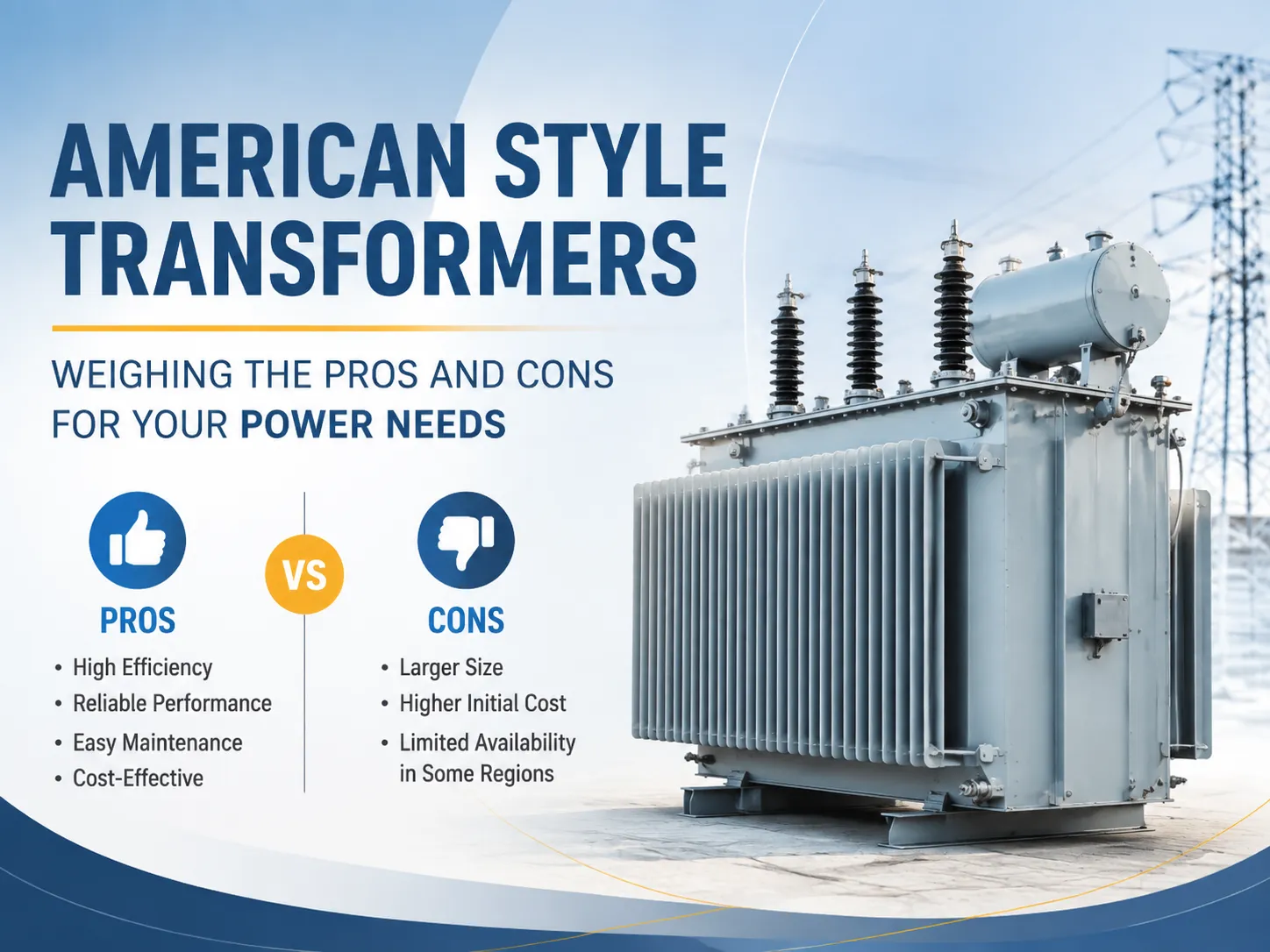
Que sont les transformateurs de style américain ?
Les transformateurs de style américain sont un type de transformateurs de distribution qui sont adaptés pour suivre les principes électriques ; fréquence de 60 Hz, spécifications ANSI/IEEE et conceptions prescrites par les entreprises d'électricité nord-américaines. Ce terme peut faire référence à des transformateurs monophasés montés sur poteau, des transformateurs monophasés et triphasés montés sur socle, des transformateurs secs utilisés dans les bâtiments et des transformateurs à huile utilisés par les services publics. Les transformateurs de style américain sont créés selon leurs propres normes contrairement aux transformateurs de style IEC ; pour cette raison, les noms des transformateurs, le type de refroidissement, l'impédance, la plage de prises, la forme du réservoir ne peuvent pas être les mêmes que ceux des équipements conformes à la norme IEC 60076.
Pour un acheteur industriel, la différence pratique avec d'autres types de transformateurs est la plus significative au point de sortie. En fait, le transformateur américain devrait être facilement adapté à une ligne électrique de 12,47 ou 24,9 kV, fournissant ainsi une sortie de 120/240 V ou 277/480 V et fonctionnant selon les exigences locales. Les producteurs et revendeurs basés aux États-Unis préfèrent utiliser des transformateurs américains, car le reste de l'équipement pour les projets fonctionnant à 60 Hz est développé selon ce schéma.
Les normes qui les définissent : IEEE C57, ANSI, NEMA
Contrairement aux équipements IEC qui sont principalement régis par la série de spécifications IEC 60076, les transformateurs américains sont régis par un ensemble de documents nord-américains. Parmi ces documents importants, on trouve :
- IEEE C57.12.20, qui spécifie les directives pour les transformateurs de distribution aérienne et montés sur socle, traitant spécifiquement de la conception des transformateurs monophasés et triphasés avec des niveaux de performance variant entre 5 kVA et 500 kVA.
- IEEE C57.12.00 décrit les spécifications pour les transformateurs remplis de liquide, tels que le transformateur de distribution, le transformateur de régulation et le transformateur de puissance.
- La publication IEEE C57.12.90 spécifie les normes d'essai des transformateurs, des tests de conception aux tests de routine.
- NEMA TP-1 fixe les normes pour mesurer le niveau d'efficacité des transformateurs de distribution secs et remplis de liquide en Amérique du Nord.
- UL 1561 / UL 1562 sont les normes de sécurité qui sont référencées dans le cas des transformateurs secs et remplis de liquide aux États-Unis et au Canada.
Ces documents ne sont pas seulement des documents, car ils mènent à des décisions d'ingénierie. Par exemple, ils stipulent que la température des enroulements ne doit pas dépasser 65 degrés, les prises hors circuit doivent être au niveau de +/-2*2.5%, le niveau d'impulsion de base doit être conçu pour chaque classe de tension, et les transformateurs remplis de liquide doivent passer des tests diélectriques et de court-circuit, conformément aux normes ANSI. Si vous achetez des transformateurs américains auprès de n'importe quelle entreprise, ils respecteront ces pratiques.
Comment fonctionnent les transformateurs de style américain
Le principe fondamental impliqué est le même que celui de tout transformateur — la loi de Faraday étant appliquée entre l'enroulement primaire et l'enroulement secondaire sur un noyau en acier au silicium laminé. Ce qui distingue les transformateurs de type américain est l'agencement du système lui-même. À 60 Hz, une certaine combinaison du noyau et de son enroulement a des pertes d'induction et des caractéristiques à vide différentes de celles à 50 Hz, ce qui signifie qu'il est optimisé pour le réseau nord-américain. Les transformateurs monophasés sont probablement les plus largement utilisés car la méthode de distribution aux États-Unis est monophasée, ce qui signifie que la tension est égale à 120/240 V dans ses prises secondaires. Les transformateurs triphasés sont utilisés dans l'industrie, réduisant les tensions de 12,47, 13,8 ou 24,9 kV en 120/208 V ou 277/480 V.
La plupart des appareils contiennent soit des changeurs de prises sous charge, généralement ±2 × 2.5%, ce qui garantit qu'une entreprise de services publics peut ajuster la tension au moment de l'installation de l'appareil. Cependant, les transformateurs montés sur socle sont équipés d'une construction à façade morte, ce qui signifie que toutes les parties sous tension de l'appareil sont cachées à l'intérieur du réservoir ou des coudes isolés afin qu'il soit facile pour le personnel de l'entreprise de services publics d'opérer les interrupteurs avec un bâton isolant, garantissant la sécurité du grand public.
Principaux types et classifications
| Taper | Plage de puissance | Primaire / secondaire typique | Où il est utilisé |
|---|---|---|---|
| Monophasé monté sur poteau | 5–167 kVA | 7,2–14,4 kV / 120-240 V | Sous-divisions résidentielles, alimentations rurales |
| Monophasé monté sur socle | 25–167 kVA | 12,47 kV / 120-240 V | Distribution résidentielle souterraine |
| Triphasé monté sur socle | 75–2 500 kVA | 12,47–24,9 kV / 208 V, 480 V | Parcs commerciaux, petites industries, solaire |
| Type sous-station triphasé | 500–5 000 kVA | 12,47–34,5 kV / 480 V-4,16 kV | Usines industrielles, sous-stations de services publics |
| Transformateur sec (ventilé / encapsulé) | 15–1 000 kVA | 480 V / 208 V, 240 V, 600 V | Bâtiments commerciaux et institutionnels intérieurs |
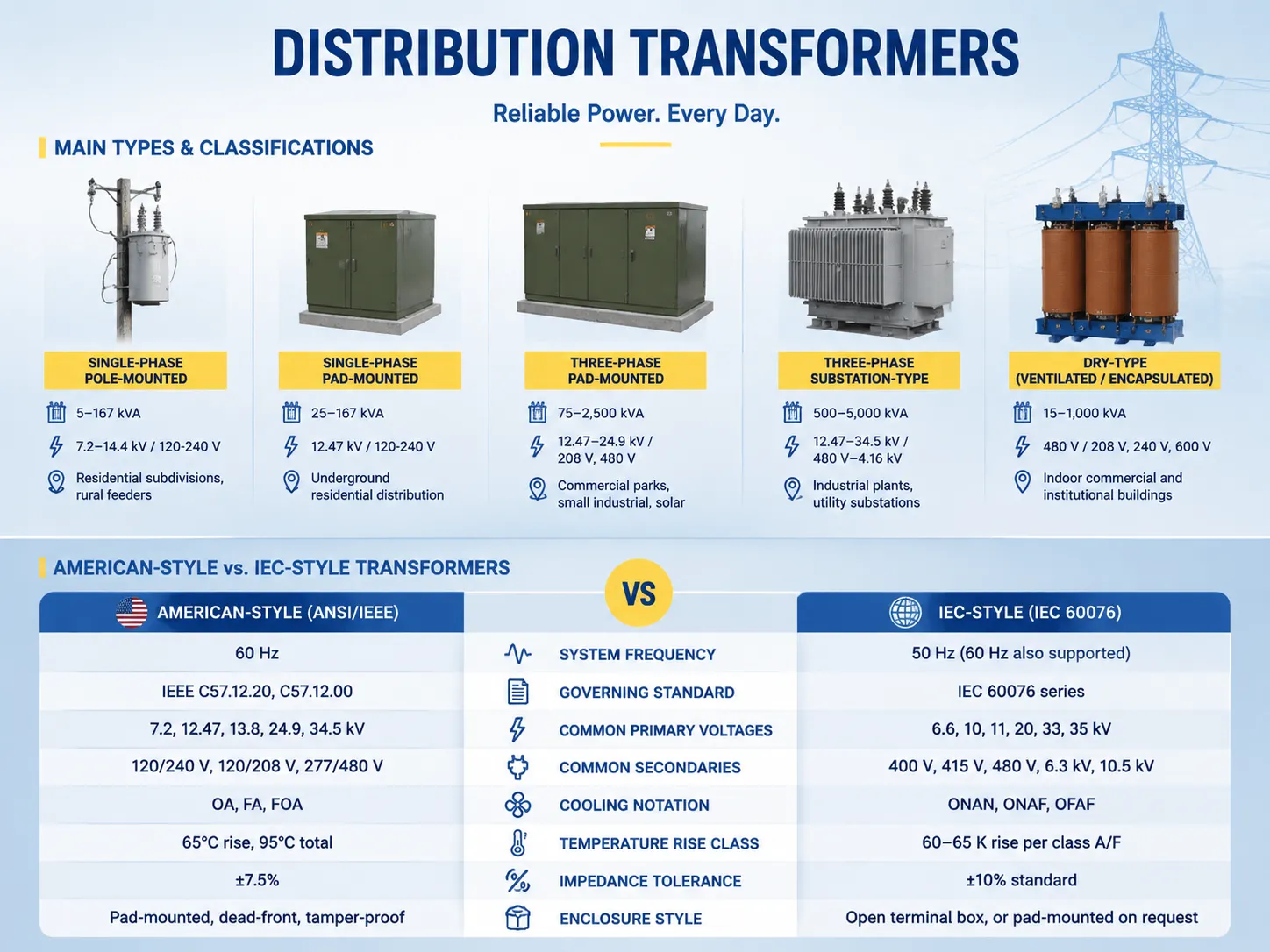
Transformateurs de style américain vs. transformateurs de style IEC
| Aspect | Style américain (ANSI/IEEE) | Style IEC (IEC 60076) |
|---|---|---|
| Fréquence du système | 60 Hz | 50 Hz (60 Hz également pris en charge) |
| Norme régissant | IEEE C57.12.20, C57.12.00 | Série IEC 60076 |
| Tensions primaires courantes | 2, 12.47, 13.8, 24.9, 34.5 kV | 6, 10, 11, 20, 33, 35 kV |
| Secondaires courants | 120/240 V, 120/208 V, 277/480 V | 400 V, 415 V, 480 V, 6,3 kV, 10,5 kV |
| Notation de refroidissement | OA, FA, FOA | ONAN, ONAF, OFAF |
| Classe de montée en température | 65°C d'élévation, 95°C total | 60–65 K d'élévation par classe A/F |
| Tolérance d'impédance | ±7,5% | standard ±10% |
| Style d'enceinte | Monté sur socle, avant fermé, résistant aux manipulations | Boîte de connexion ouverte, ou monté sur socle sur demande |
La réalité est qu'une famille ne peut pas simplement être échangée contre une autre. Un ANSI 12.47 kV ne s'adapterait pas à un système IEC 10 kV et une sortie 120/240 V ne peut pas se connecter à un tableau européen 230/400 V. Les différences de fréquence font également une différence — un transformateur 60 Hz fonctionnant sur 50 Hz va surchauffer car le noyau va se saturer. Un transformateur 50 Hz fonctionnant sur une alimentation 60 Hz fonctionne généralement avec perte mais avec un certain changement d'impédance. Assurez-vous d'acheter une famille compatible avec votre réseau.
Les avantages et les inconvénients : Ce que vous gagnez, ce que vous payez
Du côté positif, les unités de style américain sont conçues pour le réseau qu'elles desservent et pour les règles de sécurité des marchés dans lesquels elles opèrent :
| Avantage | Ce que cela signifie en pratique |
|---|---|
| Compatibilité directe avec le réseau | S'intègre dans des réseaux de classe 60 Hz, 12.47 kV sans réingénierie des alimentations, des équipements de commutation ou de protection. |
| Normes éprouvées et matures | IEEE C57.12.20 et C57.12.00 ont des décennies de données de terrain derrière elles ; les attentes en matière de conception et de test sont sans ambiguïté. |
| Sécurité publique | Les enceintes montées sur socle, à avant fermé et résistantes aux manipulations respectent les règles de sécurité des services publics dans les zones résidentielles. |
| Interchangeabilité | Les cotes et dimensions standard signifient que les remplacements et pièces de rechange de différentes marques s'adaptent au stock existant des services publics. |
| Accessoires facilement disponibles | Les bushing, terminators en coude, parafoudres, poignées de prélèvement et ensembles de surveillance sont standardisés sur le marché. |
Du côté négatif, nous voyons de nombreux inconvénients qui doivent également être pris en compte dans le processus de décision.
- Coût par kVA. La présence d'un réservoir, d'une enceinte à avant fermé, d'une configuration de bushing ANSI et la nécessité de suivre un processus de test spécifique entraînent généralement une augmentation de prix de 15–40% par rapport à un transformateur IEC du même type.
- Conception uniquement pour 60Hz. Un transformateur américain ne peut pas être utilisé dans une configuration 50Hz, ce qui est important à prendre en compte si l'usine est située dans un pays utilisant 50Hz.
- Le fardeau de la certification. De nombreux projets américains nécessiteront une certification UL ou CSA ou une inspection par un tiers de la part de la compagnie d'électricité, ce qui entraînera des dépenses supplémentaires et prendra un temps considérable.
- Biais monophasé. Le fait que l'alimentation résidentielle soit monophasée met en danger les acheteurs ayant un besoin triphasé de commander une unité triphasée au lieu du modèle en forte demande.
- Délai de livraison des fournisseurs nationaux. Au cours des dernières années, les délais de livraison pour les unités montées sur socle en Amérique du Nord ont été compris entre 20 et 50 semaines.
Spécifications typiques et tableau des cotes
| Puissance (kVA) | Classe de tension | Perte à vide typique (W) | Perte en charge typique (W) | Impédance | Poids typique (kg) |
|---|---|---|---|---|---|
| 25 (monophasé) | 47 kV / 240 V | ~80–110 | ~350–500 | 1.8–2.5% | 180–260 |
| 75 (triphasé) | 47 kV / 480 V | ~180–250 | ~900–1 200 | 1.7–3.5% | 450–600 |
| 300 (triphasé) | 9 kV / 480 V | ~450–600 | ~2 800–3 600 | 4–5% | 1,200–1,600 |
| 1 000 (triphasé) | 9 kV / 480 V | ~1 100–1 500 | ~8 000–10 500 | 5–5.75% | 3,200–4,200 |
| 2 500 (triphasé) | 34,5 kV / 480 V | ~2 300–3 000 | ~18 000–24 000 | 5.75–6.5% | 6,500–8,500 |
Les valeurs de perte servent de plages représentatives pour les équipements remplis d'huile minérale ; les conceptions conformes à l'efficacité premium NEMA TP-1 ont des pertes inférieures tandis que les conceptions personnalisées peuvent différer. Demandez toujours la garantie de perte à vide et de perte en charge comme spécifié dans un rapport d'essai avant de comparer les devis disponibles.
Applications Courantes
Les transformateurs américains sont déployés dans toute la couche du système de distribution à 60 Hz. Les entreprises de services publics ont mis en œuvre des transformateurs sur des poteaux pour fournir de l'électricité aux maisons et aux petites fermes, et la distribution résidentielle souterraine (URD) était alimentée par des transformateurs montés sur socle monophasés périodiquement le long de la rue. Dans les parcs d'affaires et les zones industrielles, l'utilisation de transformateurs montés sur socle triphasés est courante tandis que les usines choisissent des transformateurs pour convertir la tension en 480 V. Les États-Unis et le Canada ont étendu la portée des transformateurs soigneusement conçus et ont commencé à les exporter vers les pays d'Amérique latine, du Mexique, des Caraïbes, du Moyen-Orient et des îles du Pacifique. La technologie est également largement appliquée dans les centrales photovoltaïques construites selon les normes ANSI. Si votre projet suit les normes IEEE C57 ou suppose les tensions de 12,47 kV / 277-480 V, les transformateurs américains devraient être considérés dans la spécification.
Marques Principales et Gammes de Prix
| Marque | Pays | Focalisation typique sur le produit | Plage de prix indicative (FOB, US$) |
|---|---|---|---|
| ABB | Suisse/Suède | Gamme complète, unités montées sur socle et sous-stations | $3 000–$60 000 |
| Hitachi Energy | Suisse | Transformateurs de distribution de qualité utilitaire | $3 500–$70 000 |
| Siemens | Allemagne | Unités commerciales de type sec et remplies de liquide | $2 500–$50 000 |
| Schneider Electric | France | Gammes de type sec et montées sur socle | $2 000–$45 000 |
| Eaton | États-Unis | Lignes de type sec, montées sur socle, écoénergétiques | $1 500–$40 000 |
| Prolec GE | USA/Mexique | Transformateurs de distribution pour les services publics américains | $2 000–$55 000 |
| Transformateur de Virginie | États-Unis | Unités personnalisées de type sec et remplies de liquide | $2 800–$48 000 |
| Jiangsu Subian Electric Power | Chine | Transformateurs de distribution ANSI/IEEE et IEC | $1 200–$38 000 |
Les transformateurs américains sont déployés dans l'ensemble du système de distribution de 60 Hz. Les entreprises de services publics ont installé des transformateurs sur des poteaux pour fournir de l'électricité aux maisons et aux petites fermes, et la distribution résidentielle souterraine (URD) est alimentée par des transformateurs montés sur socle monophasés périodiquement le long de la rue. Dans les parcs d'affaires et les zones industrielles, l'utilisation de transformateurs montés sur socle triphasés est courante tandis que les usines cLes prix indicatifs suivants sont pour le FOB pour des configurations standard pour l'année 2026 avec quelques variations dues aux puissances, classes de tension, arrangements de prises, méthodes de refroidissement et types de certification qui leur sont attribués. Il existe de nombreux fabricants de transformateurs tels qu'ABB, Hitachi Energy, Siemens, Schneider, Eaton et Prolec GE qui produisent des transformateurs américains exceptionnels et leurs documents d'ingénierie qui établissent des normes de qualité. Pour les acheteurs qui souhaitent acheter des transformateurs similaires conformes à la norme IEEE C57.12.20 et plus avantageux en termes de prix, Jiangsu Subian Electric Power Co., Ltd est une bonne option. L'entreprise produit des transformateurs standard de 60 Hz conformes aux spécifications ANSI et IEEE, fournissant des transformateurs à façade morte et une inspection par des tiers. L'entreprise a exporté ses transformateurs vers plus de pays comme les États-Unis, le Mexique, les Caraïbes et le Moyen-Orient.
Choisissez des transformateurs pour convertir la tension en 480 V. Les États-Unis et le Canada ont étendu la portée des transformateurs soigneusement conçus et ont commencé à les exporter vers les pays d'Amérique latine, le Mexique, les Caraïbes, le Moyen-Orient et les îles du Pacifique. La technologie est également largement appliquée dans les centrales photovoltaïques construites selon les normes ANSI. Si votre projet suit les normes IEEE C57 ou suppose les tensions de 12,47 kV / 277-480 V, les transformateurs américains devraient être pris en compte dans la spécification. Vous pouvez consulter la capacité de fabrication de l'entreprise sur le site Web de Jiangsu Subian Electric Power.
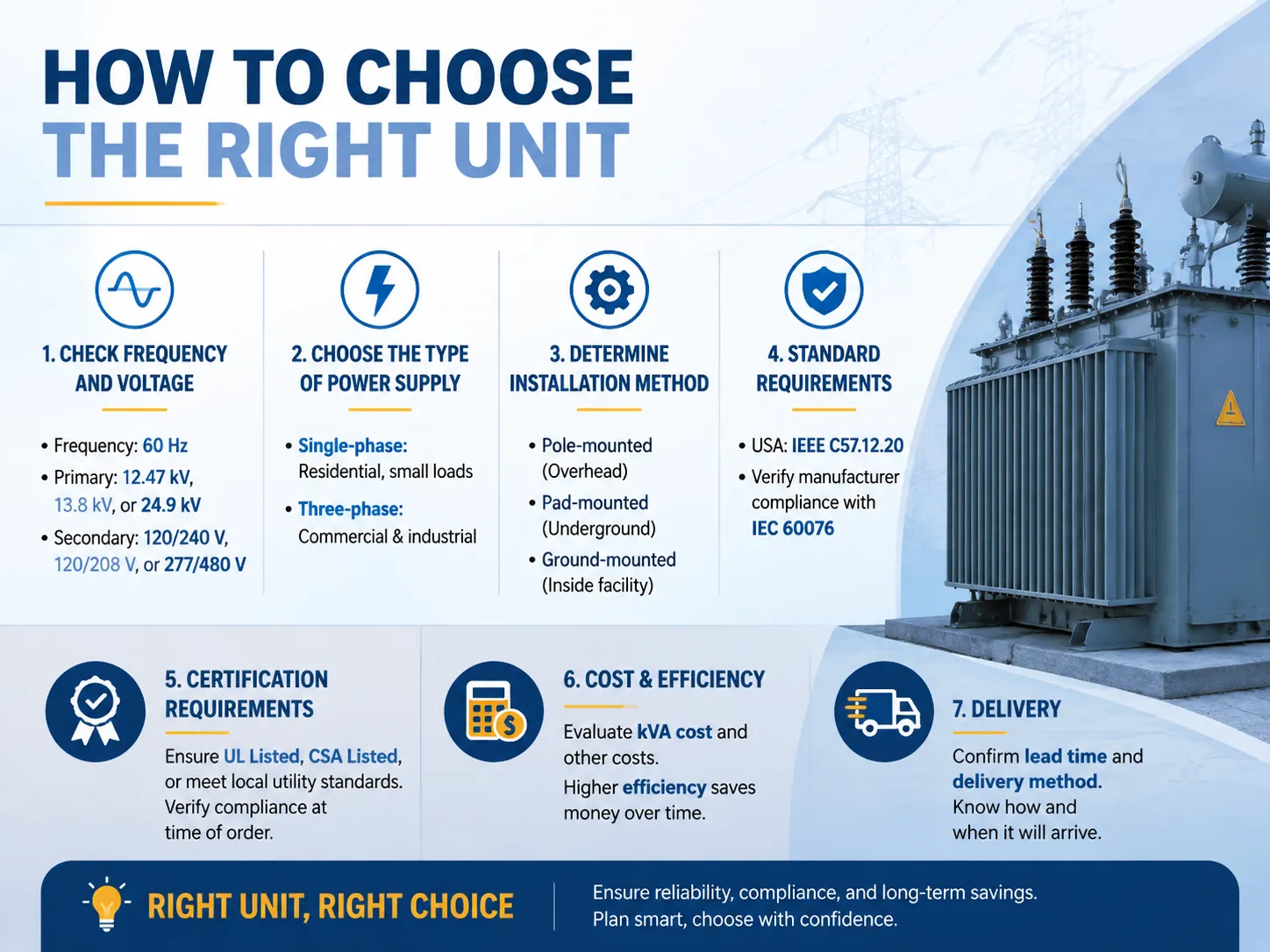
Comment Choisir la Bonne Unité
- Vérifiez la fréquence et la tension du système pour confirmer. La fréquence correcte pour un système fonctionnant en Amérique est de 60 Hz ; vérifiez à la fois la tension primaire (12,47 kV, 13,8 kV ou 24,9 kV) et la tension secondaire (120/240 V, 120/208 V ou 277/480 V).
- Choisissez le type d'alimentation électrique. Une alimentation monophasée est adéquate pour les zones résidentielles avec de faibles besoins en énergie, tandis qu'une alimentation triphasée est nécessaire pour les applications commerciales et industrielles.
- Déterminez comment le système sera installé, soit sur un poteau pour une installation aérienne, soit sur un socle pour une installation souterraine, soit au sol à l'intérieur de l'installation.
- Déterminez les options standard requises. Pour les États-Unis, la norme IEEE C57.12.20 est nécessaire ; vérifiez si le fabricant pourra se conformer à la norme IEC 60076.
- Assurez-vous de vérifier les exigences de certification. Le système peut devoir être certifié UL, certifié CSA ou répondre aux normes de l'entreprise de services publics locale ; vérifiez qu'il y aura conformité au moment de la commande.
- Déterminez le coût en kVA et les autres coûts impliqués ; considérez également l'efficacité du système, car une unité économe en énergie coûteuse permettra d'économiser de l'argent à long terme.
- Assurez-vous de savoir combien de temps la livraison prendra et comment les livres seront livrées.
Questions Fréquemment Posées
Un transformateur de style américain peut-il fonctionner sur un réseau de 50 Hz ?
Non, pas en toute sécurité. Un transformateur conçu pour 60 Hz a un noyau et des enroulements configurés pour cette fréquence ; utiliser ce transformateur à 50 Hz augmente la densité de flux du noyau d'environ 20%, nécessitant un courant de magnétisation supplémentaire qui peut provoquer une surchauffe et une défaillance prématurée de l'isolation. Si votre système électrique fonctionne à 50 Hz, procurez-vous un transformateur IEC 60076 conçu pour 50 Hz. Un transformateur de 50 Hz peut généralement fonctionner avec 60 Hz avec des résultats satisfaisants (moins de pertes et impédance légèrement différente), cependant, l'opération inverse n'est pas recommandée.
Quel est le délai typique pour un transformateur monté sur socle en 2026 ?
Selon le fabricant, les fournisseurs nationaux aux États-Unis ont signalé des délais de livraison de 20 à 50 semaines pour les unités montées sur socle. Pour les unités importées de fabricants qui viennent avec des configurations standard, comme Jiangsu Subian Electric Power, les délais de livraison varieront généralement de 4 à 10 semaines, en plus des délais de fret de 2 à 6 semaines, selon le port de livraison.
Combien coûte un transformateur de style américain ?
À titre de référence, une unité monophasée de 25 kVA montée sur poteau coûte environ $1,200, une unité triphasée de 75 kVA montée sur socle coûte environ $3,500 à $7,500, une unité de 300 kVA montée sur socle coûte environ $8,000 à $16,000, et une unité de 1,000 kVA coûte environ $15,000 à $35,000. Ces prix peuvent varier selon la marque, l'impédance, le schéma de prises et la certification, il est donc toujours conseillé de demander un devis correspondant aux spécifications.
Ai-je besoin d'une certification UL pour un transformateur de style américain importé ?
Cela dépend de l'acheteur et de la juridiction. Certains services publics et codes du bâtiment américains exigent une certification UL 1561/UL 1562 ou une certification tierce équivalente, tandis que d'autres accordent du crédit pour la conformité à l'IEEE C57.12.20 accompagnée d'un test témoin ou d'un rapport d'inspection. Avant de vous engager, vérifiez toujours avec votre ingénieur de service public et confirmez quelles options de certification le fabricant peut offrir.
Les transformateurs de style américain fabriqués en Chine sont-ils acceptés par les services publics américains ?
Lorsque les spécifications sont respectées, il est juste de dire que les services publics accepteront l'équipement importé. Les fournisseurs d'électricité acceptent l'équipement qui répond aux exigences de l'IEEE C57.12.20, qui a été soumis à un test en usine observé soit par le service public, soit par un tiers et qui possède la documentation nécessaire. Subtrans a vendu des transformateurs conformes à l'ANSI de 60 hertz à des acheteurs au Canada et aux États-Unis dans ces conditions. Ainsi, l'acceptation dépend de la documentation et des tests et non du lieu de production.
Références
- IEEE C57.12.20 — Norme pour les transformateurs de distribution aériens et montés sur socle — la spécification de base pour les transformateurs de distribution de style américain.
- IEEE C57.12.00 — Exigences générales pour les transformateurs de distribution, de puissance et de régulation immergés dans un liquide — définit les caractéristiques, les pertes et les bases d'essai pour la pratique aux États-Unis.
- NEMA TP-1 — Guide pour déterminer l'efficacité énergétique des transformateurs de distribution — le point de référence d'efficacité nord-américain mentionné dans les achats aux États-Unis.
- UL 1561 — Norme pour les transformateurs de puissance à sec à usage général — liste de sécurité généralement requise pour les installations commerciales.
- IEC 60076-1 — Transformateurs de puissance, Général — la base de référence IEC utilisée pour la comparaison et pour les projets d'exportation fonctionnant à 50 Hz.
- Eaton — Informations sur les produits de transformateurs — documentation représentative des fabricants nord-américains pour comparaison.
Conclusion
La réponse à votre besoin de transformateurs compatibles avec votre réseau électrique fonctionnant à 60 Hz et aux normes ANSI/IEEE, utilisant soit des services de 120/240 V soit de 277/480 V réside dans l'utilisation de transformateurs de style américain. Les transformateurs de style américain garantissent que vos projets respectent les précautions et normes de sécurité publique requises aux États-Unis, en Amérique latine et dans les Caraïbes. Cependant, il existe des inconvénients à ce type de transformateurs, tels que le fait qu'ils sont plus coûteux en termes de kVA et la nécessité de subir des processus de certification complexes. Afin d'éviter les inconvénients des transformateurs de style américain, ceux qui cherchent à les acheter devraient déterminer leurs exigences en matière de tension, de fréquence, de configuration de montage et de certification avant de faire des comparaisons entre les offres qu'ils reçoivent. Jiangsu Subian Electric Power fabrique des transformateurs de style américain conformes aux normes IEEE C57.12.20, ce qui garantit que les clients ne paient que des prix raisonnables directement d'usine tout en obtenant des résultats de tests entièrement documentés. Pour obtenir un devis correspondant aux spécifications pour votre prochain projet à 60 Hz, contactez l'entreprise via le site officiel.