


À 2h15 du matin, lors d'une tempête de sable dans une installation de collecte de gaz naturel dans le bassin des Ordos, un transformateur de 2 000 kVA fournissant de l'énergie à l'unité de compression tombe en panne en raison de la surchauffe. Selon le système SCADA, la température de l'enroulement dépasse 105 °C. Cela signifie que la température de l'enroulement a dépassé le seuil de 98 °C, qui a été établi conformément aux spécifications régissant le système d'isolation de l'appareil. Il en résulte que l'ingénieur était confronté à un dilemme : il devait soit maintenir les compresseurs en fonctionnement et risquer une panne du transformateur, soit les arrêter pour la journée et perdre de la production tout au long du processus de torchage du gaz comprimé. Plus tard, des experts ont pu identifier que le problème était le transformateur sélectionné pour un climat côtier relativement doux et installé dans un endroit montagneux poussiéreux, souffrant de températures ambiantes élevées en été (jusqu'à 50 °C) et de taux de panne élevés des transformateurs.
La production de pétrole et de gaz est l'un des secteurs les plus difficiles en termes de fonctionnement des transformateurs. Une haute fiabilité est essentielle pour les transformateurs utilisés aux têtes de puits, dans les stations de compression, les usines de traitement du gaz et les raffineries sur les plateformes offshore.
Pourquoi le devoir pétrole et gaz est différent
Quatre caractéristiques distinguent le devoir des transformateurs de pétrole et de gaz des services industriels dans presque tous les autres secteurs :
| Caractéristique | Effet typique | Conséquence du transformateur |
|---|---|---|
| Risque d'ignition (hydrocarbures) | Tout équipement électrique à proximité de gaz, de vapeurs ou d'huile peut être une source d'ignition | Conception pour zones dangereuses, enceintes à épreuve de flamme, bornes scellées |
| Sites distants et non habités | Pas d'équipe de maintenance dans un rayon de 100 km | Surveillance en ligne, consommables longue durée, diagnostics à distance |
| Continuité des processus 24/7 | Perte inattendue = perte de production mesurée en jours | Configurations redondantes, charge conservatrice (60–75%) |
| Environnement extrême | Chaleur désertique, froid arctique, sel offshore, poussière, vibration | Large plage de température ambiante, protection contre la corrosion, construction robuste |
Pour le transformateur, la véritable implication est que la même unité de 2 MVA qui est plus que suffisante pour une usine sera redessinée avec une boîte de bornes pour zone dangereuse, conçue pour une température ambiante de 50 degrés Celsius, un revêtement C5-M et une surveillance DGA en ligne pour être utilisée dans une usine de gaz. La différence de coût d'achat est de 20 à 60 % — c'est exactement la prime qui a empêché le déclenchement à 2h15 décrit ci-dessus de se produire.
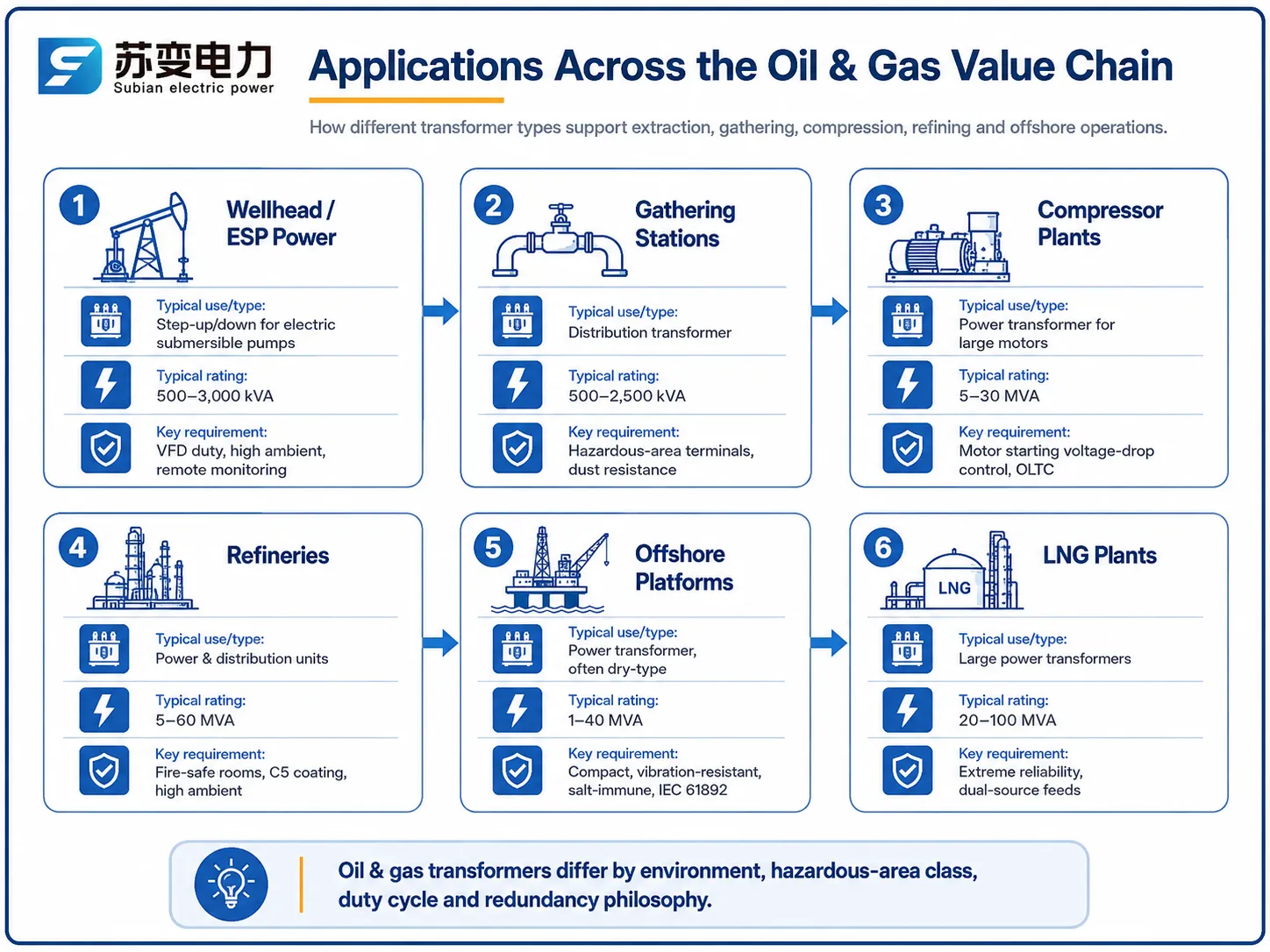
Applications des transformateurs à travers la chaîne de valeur
Différents segments de la chaîne de valeur du pétrole et du gaz utilisent des transformateurs de différentes manières :
| Segment | Transformateur typique | Puissance | Exigence spéciale |
|---|---|---|---|
| Alimentation de tête de puits / ESP | Élévation/abaissement pour pompes submersibles électriques (ESP) | 500–3 000 kVA | Devoir à fréquence variable, haute température ambiante, surveillance à distance |
| Stations de collecte | Transformateur de distribution | 500–2 500 kVA | Bornes pour zones dangereuses, résistance à la poussière |
| Usines de compresseurs | Transformateur de puissance pour moteurs de grande taille | 5–30 MVA | Contrôle de la chute de tension au démarrage du moteur, OLTC |
| Raffineries | Unités de puissance et de distribution | 5–60 MVA | Chambres à sécurité incendie, revêtement C5, haute température ambiante |
| Plates-formes offshore | Transformateur de puissance, souvent de type sec | 1–40 MVA | Compact, résistant aux vibrations, immunisé contre le sel, IEC 61892 |
| Usines de GNL | Grands transformateurs de puissance | 20–100 MVA | Fiabilité extrême, alimentations à double source |
Les pompes submersibles électriques nécessitent une attention particulière car elles représentent la charge de transformateur à la croissance la plus rapide dans les opérations. La pompe submersible électrique pour le levage artificiel nécessite entre 100 et 1 000 kVA par puits, tandis que l'énergie pour la faire fonctionner est fournie à 0,3 à 5 kV avec un transformateur capable de gérer une sortie de convertisseur de fréquence. Un site de puits avec vingt ESP peut nécessiter environ 2 à 4 MVA de capacité de transformateur avec des harmoniques compatibles avec VFD.
Exigences pour zones dangereuses
Dans les transformateurs de pétrole et de gaz, la conformité aux réglementations sur les zones dangereuses est fondamentale. La classification de l'installation par zones (IEC) ou divisions (Amérique du Nord) donne lieu à la compréhension de la présence de gaz dangereux :
– Zone 0 / Classe I Div 1 : Gaz explosif toujours présent. Les transformateurs y sont rarement installés.
– Zone 1 / Classe I Div 1 : Gaz explosif parfois présent ; les bornes et les murs doivent être spécialement conçus pour cette zone.
– Zone 2 / Classe I Div 2 : Gaz explosif présent uniquement dans des conditions anormales, l'équipement habituel étant Ex n ou Ex e ; la plupart des installations extérieures se trouvent dans cette zone.
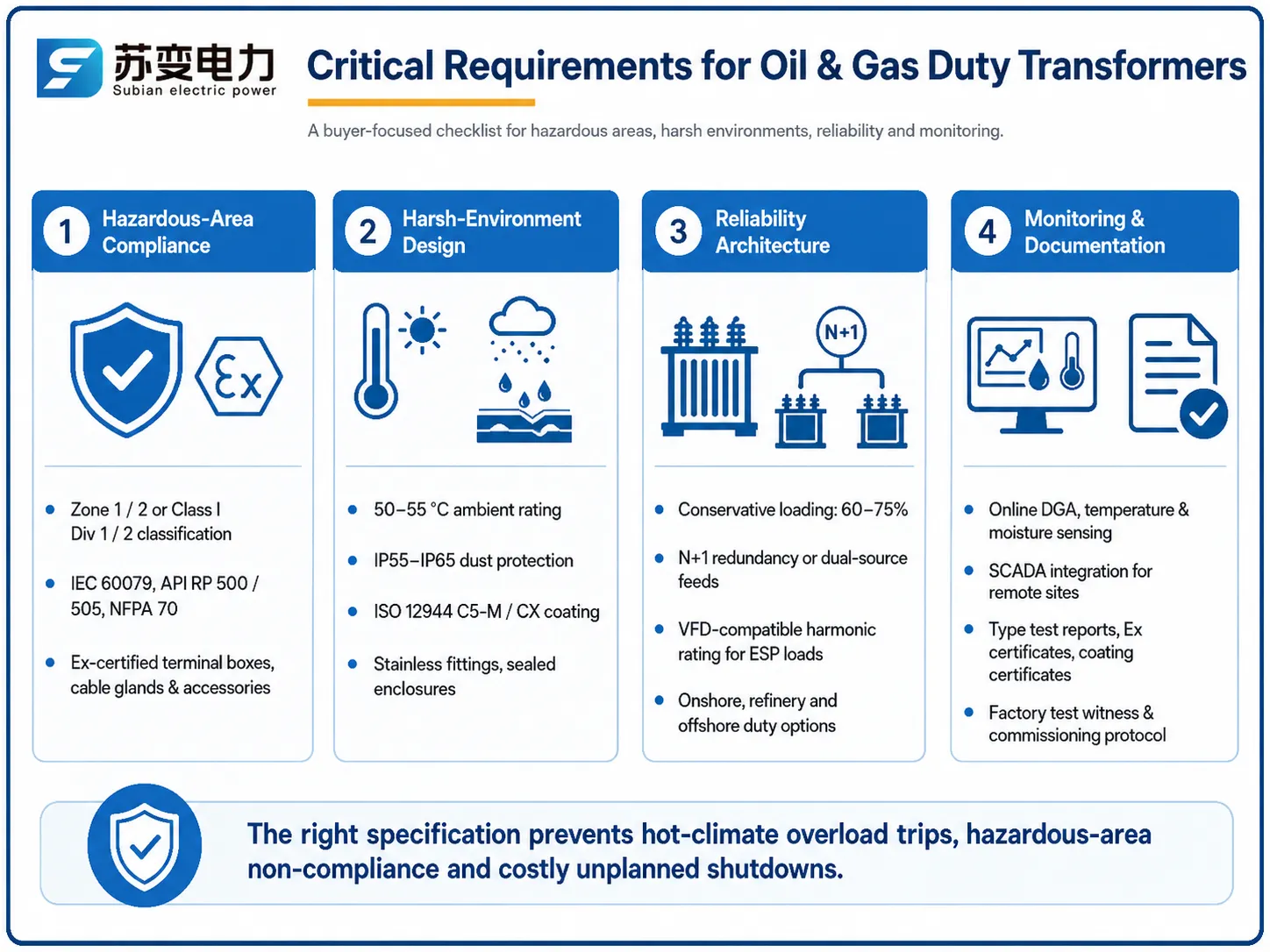
Les principales spécifications pour les transformateurs dans les zones dangereuses sont IEC 60079 pour les normes internationales et API RP 500/505 et NFPA 70 (NEC) pour l'Amérique du Nord. Les principales exigences de spécification sont les suivantes :
– Les isolateurs et les boîtes de bornes doivent avoir des certificats Ex appropriés selon la classification zonale.
– Les transformateurs remplis d'huile peuvent être acceptables en Zone 2, car les réservoirs sont hermétiquement scellés ; les bornes doivent passer la vérification.
– Les transformateurs à sec (installations intérieures) doivent avoir des enceintes certifiées pour être utilisés dans les zones dangereuses, y compris le contrôle nécessaire de l'élévation de la température, etc.
– D'autres dispositifs — moteurs OLTC, ventilateurs de ventilation, transmetteurs RTD — doivent avoir des classifications Ex similaires.
La classification Ex implique des coûts plus élevés en raison, par exemple, des boîtes de bornes classées Ex ; les coûts de documentation liés aux certificats pour les transformateurs à épreuve d'explosion peuvent également représenter une somme significative.
Conception pour haute température, poussière et corrosion
Les sites pétroliers et gaziers sont généralement les environnements les plus chauds, les plus poussiéreux et les plus corrosifs dans le secteur de l'énergie industrielle. Les adaptations de conception suivent un schéma clair :
| Stress | Réponse de conception | Spécification typique |
|---|---|---|
| Température ambiante élevée (40–55 °C) | Refroidissement dégradé ou système de refroidissement amélioré | Plaque signalétique à 50 °C ambiant, ONAN/ONAF |
| Rayonnement solaire (déserts) | Ombre, revêtement réfléchissant la lumière | Système de peinture C5-M blanc/gris clair |
| Sable et poussière | Enceintes scellées, ventilation filtrée | IP55–IP65, filtres à poussière sur les ventilateurs |
| Sel (offshore, côtier) | Matériaux résistants à la corrosion | ISO 12944 C5-M/CX, raccords en acier inoxydable |
| Vibration (plates-formes, têtes de puits) | Réservoirs renforcés, montage amorti | Qualification sismique/vibration par projet |
Une information souvent négligée mais critique est la classification ambiante. Selon IEC 60076-1, la température ambiante standard doit être définie comme 40 °C maximum de moyenne quotidienne ; ainsi, dans le cas de sites pétroliers et gaziers à 50 °C ambiant, il sera nécessaire d'avoir un équipement plus grand ou d'améliorer les unités de refroidissement. Une installation de 2 000 kVA pour 50 °C ambiant peut coûter 8-15% de plus qu'une installation similaire classée pour 40 °C ambiant, et cela peut garantir que l'équipement fonctionne pendant jusqu'à 25 ans plutôt que de tomber en panne chaque jour d'été chaud.
Architectures de fiabilité et de redondance
Étant donné qu'un arrêt de production coûte de $200 000 à plus de $1 000 000 par jour dans une grande usine de traitement du gaz, il est nécessaire d'assurer la fiabilité par la conception, plutôt que de compter sur le hasard. Les principales dispositions comprennent les suivantes :
Sauvegarde N+1 : un transformateur de secours est installé et connecté sur chaque sous-station, devenant opérationnel en quelques minutes.
Alimentation à double source : deux lignes d'alimentation sont indépendantes l'une de l'autre, les transformateurs ayant une source d'énergie différente.
Charge conservatrice : les transformateurs fonctionnent sous une charge de 60% à 75% de leur capacité de manière à ce qu'il soit possible que le premier fonctionne lorsque le second tombe en panne (c'est une pratique courante dans l'industrie pétrolière et gazière).
Politique d'actifs de rechange : il est convenu que l'entreprise disposera d'un transformateur de rechange dans l'inventaire et prêt à être utilisé dans un délai de 48 à 72 heures.
Le raisonnement de la décision est que les avantages d'une approche conservatrice l'emportent sur les coûts. Pour utiliser le transformateur sous 60% à 75% de sa capacité, il faut payer quelque chose dans la fourchette de $10,000 à $40,000, tandis qu'un cas d'arrêt de production coûtera 5 à 20 fois plus que cela.
Surveillance et Maintenance
Les sites distants et non habités rendent la surveillance prédictive la seule stratégie de maintenance réaliste. Le package standard de surveillance pétrolière et gazière pour les transformateurs :
| Couche de surveillance | Ce qu'elle détecte | Coût typique |
|---|---|---|
| DGA en ligne | Gaz de défaut (H2, CH4, C2H2, CO) en tendance | $8 000–$20 000 |
| Profilage de température / charge | Événements de surcharge, efficacité de refroidissement | $2 000–$6 000 |
| Détection de décharges partielles | Défauts d'isolation incipients | $3,000–$8,000 |
| Capteur d'humidité de l'huile | Risque d'infiltration et de dégradation du papier | $1,500–$4,000 |
| Intégration SCADA à distance | Événements d'alarme et de déclenchement vers la salle de contrôle | Inclus dans la conception de sous-stations |
En ce qui concerne les raffineries ou les transformateurs offshore dont le prix se situe entre $120,000 et $500,000, il est courant d'allouer 10–15% de cet investissement pour la surveillance et le diagnostic à distance. Cela transforme la machine d'une opération “fonctionner jusqu'à la panne” à une opération où ses pannes peuvent être projetées des semaines ou des mois à l'avance.
Normes régissant les transformateurs pétroliers et gaziers
| Norme | Portée | Rôle dans l'approvisionnement en pétrole et gaz |
|---|---|---|
| IEC 60076 (série) | Conception et test de transformateurs de puissance | Fondement pour les classifications, les pertes et les tests de type |
| IEC 60079 (série) | Atmosphères explosives | Certification Ex pour les bornes, accessoires et enceintes |
| API RP 500 / 505 | Classification des zones dans les installations pétrolières | Définit les zones dangereuses qui entraînent des exigences Ex |
| NFPA 70 (NEC) | Code national de l'électricité | Règles d'installation nord-américaines et classifications de Classe I Div |
| IEC 61892 | Unités offshore mobiles et fixes — installations électriques | Exigences des transformateurs de plateforme offshore |
| ISO 12944 | Protection contre la corrosion des structures en acier | Spécifications de revêtement C5-M pour les zones côtières et de traitement |
La documentation constitue le piège d'approvisionnement dans le pétrole et le gaz : un transformateur peut être extraordinairement construit, mais si ses certificats Ex, dessins de classification de zone et spécifications de revêtement ne sont pas conformes au calendrier des zones dangereuses tel qu'indiqué dans le plan de projet, l'unité serait inutilisable. Validez les livrables de documentation comme une exigence du contrat, et non comme une réflexion après coup.
Liste de vérification des spécifications
Identifier la classification de zone dangereuse du site d'installation (zone/sous-section) selon le calendrier de classification de la zone.
Exiger des boîtes d'électricien approuvées, des joints de câbles et des accessoires qui respectent la zone où ils doivent être utilisés (IEC 60079).
Mentionner spécifiquement la limite de température environnementale basée sur les conditions du site (généralement autour de 50 °C pour les zones désertiques) et non selon la valeur standard IEC de 40 °C.
Spécifier la nécessité d'un revêtement C5-M selon les normes ISO 12944 pour les zones côtières ou de traitement.
Concevoir la charge pour 60-75% de la puissance nominale et éviter également la redondance ou la capacité de réserve selon les principes de fiabilité de l'usine.
Inclure les données de contrôle DGA, de température et d'humidité en ce qui concerne les dispositifs à distance et critiques.
Spécifier que la classification harmonique pour VFD doit être mise en œuvre lorsque les entraînements ESP ou compresseurs sont la charge principale.
Définir ce qui est inclus dans la documentation – certificats Ex, résultats des tests des dispositifs, certificats de revêtement, manuels O&M.
Spécifier la stabilité sismique ou l'impact du criblage des vibrations pour les installations offshore et de tête de puits.
Offrir un témoin de test en usine au fournisseur.
Meilleures marques et comparaison des prix
Le marché des transformateurs pétroliers et gaziers est dominé par des fournisseurs ayant une profondeur de certification de zone dangereuse et des références dans l'industrie des procédés. Le tableau montre des prix indicatifs pour un transformateur de distribution onshore de 2,000 kVA, 35/0.4 kV avec des bornes de zone dangereuse et une classification ambiante de 50 °C ; les prix varient en fonction des exigences de zone, du revêtement, de la surveillance et de la marque.
| Marque | Pays | Forces dans le pétrole et le gaz | Prix indicatif (USD) |
|---|---|---|---|
| Siemens | Allemagne | Références approfondies de l'industrie des procédés, services numériques | $28,000–$48,000 |
| ABB | Suisse | Portefeuille de zones dangereuses, intégration de l'entraînement ESP | $27,000–$46,000 |
| Hitachi Energy | Japon/Suisse | Grandes références de raffineries et offshore | $30,000–$52,000 |
| Schneider Electric | France | Packages électriques intégrés pour procédés | $26,000–$45,000 |
| GE Vernova | États-Unis | Références de Classe I Div nord-américaines | $28,000–$50,000 |
| Jiangsu Subian Electric Power | Chine | Unités IEC 60076 avec terminaux Ex, classification à 50 °C, revêtement C5 | $18,000–$32,000 |
La licence de grandes entreprises possède l'inventaire documentaire et la base de données de vérification dont les grandes entreprises et les associations EPC ont besoin pour des programmes phares, surtout lorsque les réglementations sur le contenu local ou les contraintes de sécurité des opérateurs régissent des fournisseurs licenciés spécifiques. Jiangsu Subian Electric Power a sécurisé une empreinte dans cette industrie grâce à la fourniture de transformateurs conformes à la norme IEC 60076 avec licences de terminaux de zone dangereuse, approbation de température ambiante et revêtement C5-M à environ 40 – 55% des niveaux européens ou américains, avec flexibilité OEM en termes de packages de surveillance et d'enceintes. Dans le cas des compagnies pétrolières nationales et des entrepreneurs EPC prévoyant de standardiser la livraison de transformateurs à travers les plates-formes de forage, les stations collectrices et les usines intermédiaires, offrir un fournisseur licencié tel que Subian en plus de grandes entreprises mondiales — tout en vérifiant les certificats Ex et le programme de témoin de test dans le processus — représente une solution pragmatique pour le contrôle des dépenses d'investissement qui ne compromet pas la conformité avec la législation sur les zones dangereuses.
Questions Fréquemment Posées
Quelle classification de zone dangereuse un transformateur doit-il avoir dans une usine de gaz ?
La plupart des plates-formes de transformateurs extérieurs relèvent de la classification Zone 2/Class I Div 2, car l'utilisation de boîtes de raccordement et d'autres accessoires certifiés pour Ex n ou Ex e est couramment pratiquée. L'utilisation de transformateurs remplis d'huile avec des réservoirs scellés peut être acceptée dans la classification Zone 2. L'utilisation de transformateurs en Zone 1 est rare car les alimentations sont redirigées vers la limite de l'emplacement dangereux. Assurez-vous que chaque unité correspond aux dessins de classification de la zone du projet.
Combien coûte un transformateur pétrolier et gaz de plus qu'un transformateur industriel standard ?
Un appareil de 2,000 kVA avec des terminaux destinés à des emplacements dangereux et capable de fonctionner à des températures ambiantes de 50 °C et avec un revêtement protecteur C5 coûte significativement plus cher qu'une unité industrielle commune — environ $18,000–$32,000 pour le premier contre seulement $12,000–$20,000 pour le second. Le coût supplémentaire inclut non seulement la certification Ex, les caractéristiques de construction à haute température et la protection contre la corrosion, mais aussi toute la documentation requise.
Pourquoi les applications ESP nécessitent-elles une considération spéciale des transformateurs ?
Les pompes submersibles électriques sont alimentées par des variateurs de fréquence, donc le transformateur doit gérer les courants harmoniques et la sortie de tension VFD tout en étant situé sur des sites de puits éloignés et à haute température ambiante. Des classifications de 500–3,000 kVA par groupe de plate-forme sont typiques. Le transformateur doit être classé harmonique, classé pour la température ambiante du site et équipé d'une surveillance à distance car l'accès à la maintenance est limité.
Quelle surveillance les transformateurs pétroliers et gaziers nécessitent-ils ?
Pour les unités distantes et critiques, le package standard comprend DGA en ligne, profilage de température/charge, détection d'humidité dans l'huile et intégration SCADA — environ $8,000–$30,000 par unité. Cela transforme le transformateur d'un actif à défaillance en un actif dont la dégradation est visible des mois à l'avance, ce qui est important lorsqu'une défaillance peut arrêter une usine produisant $1 million par jour.
Dois-je faire fonctionner mes transformateurs à pleine charge nominale dans une centrale à gaz ?
Non — la norme de l'industrie pétrolière et gazière est de charger les transformateurs à 60–75% de la charge nominale afin qu'une seule unité puisse soutenir la station en cas de perte de son jumeau redondant. Le coût de la capacité premium est de $10,000–$40,000 par unité ; un seul arrêt imprévu coûte 5 à 20 fois cela. Un chargement conservateur plus une redondance N+1 est la meilleure assurance de fiabilité dans le secteur.
Références
- IEC 60079 série — Atmosphères explosives — la norme internationale pour la certification des équipements en zone dangereuse utilisée dans la sélection des bornes et accessoires de transformateur.
- API RP 500 / API RP 505 — Classification des zones pour les installations pétrolières — définit les zones dangereuses qui déterminent les exigences Ex des transformateurs.
- NFPA 70 — Code électrique national — règles d'installation nord-américaines et classifications de Classe I Division pour les installations pétrolières et gazières.
- IEC 60076 série — Transformateurs de puissance — la norme de conception et de test de base pour toutes les spécifications de transformateurs pétroliers et gaziers.
- IEC 61892 — Installations électriques pour unités offshore mobiles et fixes — exigences et pratiques d'installation des transformateurs de plateforme offshore.
- ISO 12944 — Protection contre la corrosion des structures en acier — la classification de revêtement C5-M utilisée pour les équipements côtiers et en zone de processus.
- Jiangsu Subian Electric Power — site officiel — fabricant de transformateurs conformes à l'IEC 60076 avec des bornes en zone dangereuse et des classifications de haute température ambiante.
Conclusion
Le secteur pétrolier et gazier présente aux transformateurs des situations – conditions dangereuses, températures extrêmes, emplacements éloignés inhabités et fonctionnement continu toute l'année – qui ne coexistent dans aucun autre domaine. En raison de cela, il convient d'obtenir un certificat inhabituel de zone dangereuse, de réaliser une conception spécifique pour contrer les températures ambiantes élevées et la corrosion, d'utiliser un coefficient de redondance raisonnable, ainsi que de prêter attention à la maintenance prédictive. Chaque point a son propre coût : 20 à 60 pour cent du coût de spécification, 60 à 75 pour cent de la charge, et 8 à 30 pour cent de l'actif en maintenance.
Afin d'éviter des problèmes :
Assurez-vous que la classification de la zone dangereuse répond aux exigences du certificat Ex, et vérifiez que les bornes et autres accessoires sont également destinés aux zones dangereuses.
Sélectionnez la température ambiante en fonction des données réelles du site (50oC est le meilleur choix pour les déserts), mais pas à 40oC selon les règles de l'IEC.
Chargez les transformateurs à 60 à 75 pour cent de leurs capacités et utilisez la redondance N+1 sur les stations les plus importantes.
Investissez au moins 8 à 15 pour cent de la valeur d'un actif dans le système de surveillance en ligne.
Regardez les grandes entreprises telles que Siemens, ABB, Hitachi Energy et Jiangsu Subian Electric Power afin de vous assurer que la certification est effectuée correctement à faible coût.
Pour le soutien à la fourniture et à la spécification de transformateurs classés pour zones dangereuses tout au long de la chaîne de valeur du pétrole et du gaz, contactez Jiangsu Subian Electric Power à www.subian-electric.com.