

見積もりをリクエスト
ニュース

石油およびガス抽出におけるトランスフォーマー:重要なオペレーションのための信頼性の高い電力

At 2:15 a.m., during a sandstorm at a natural gas gathering facility in the Ordos Basin, a 2,000 kVA transformer supplying power to the compression unit fails due to overheating. According to the SCADA system, the temperature of the winding exceeds 105 °C. This means that the winding temperature exceeded the threshold of 98 °C, which was established in line with the specifications governing the insulation system of the device. It follows that the engineer faced a dilemma: He either kept the compressors operating and risked transformer failure or shut them down for the day and lost production throughout the compressed gas flaring process. Later on, experts were able to identify that the problem was the transformer selected for relatively mild coastal climate and installed on the dusty mountain place, suffering from high ambient temperature of summer (up to 50 °C) and high failure rates of transformers.

Oil and gas production is one of the toughest sectors in terms of operation of the transformers. High reliability is essential for transformers employed at wellheads, in compressor stations, gas processing plants, and refineries at offshore platforms.

Why Oil and Gas Duty Is Different

Four characteristics distinguish oil and gas transformer duty from industrial service in almost every other sector:

特徴 Typical Effect Transformer Consequence
Ignition risk (hydrocarbons) Any electrical equipment near gas, vapors, or oil can be an ignition source Hazardous-area design, flameproof enclosures, sealed terminals
Remote, unmanned sites No maintenance crew within 100+ km Online monitoring, long-life consumables, remote diagnostics
24/7 process continuity Unexpected loss = production loss measured in days Redundant configurations, conservative loading (60–75%)
Extreme environment Desert heat, arctic cold, offshore salt, dust, vibration Wide ambient rating, corrosion protection, rugged construction

For the transformer, the real implication is that the same unit of 2 MVA that is more than enough for a factory will be re-designed with a hazardous area terminal box, designed for an ambient temperature of 50 degrees Celsius, a C5-M coating, and online DGA monitoring to be used at a gas plant. The difference in purchase cost is 20-60 percent — this is exactly the premium that has prevented the 2:15 a.m. trip described above from happening.

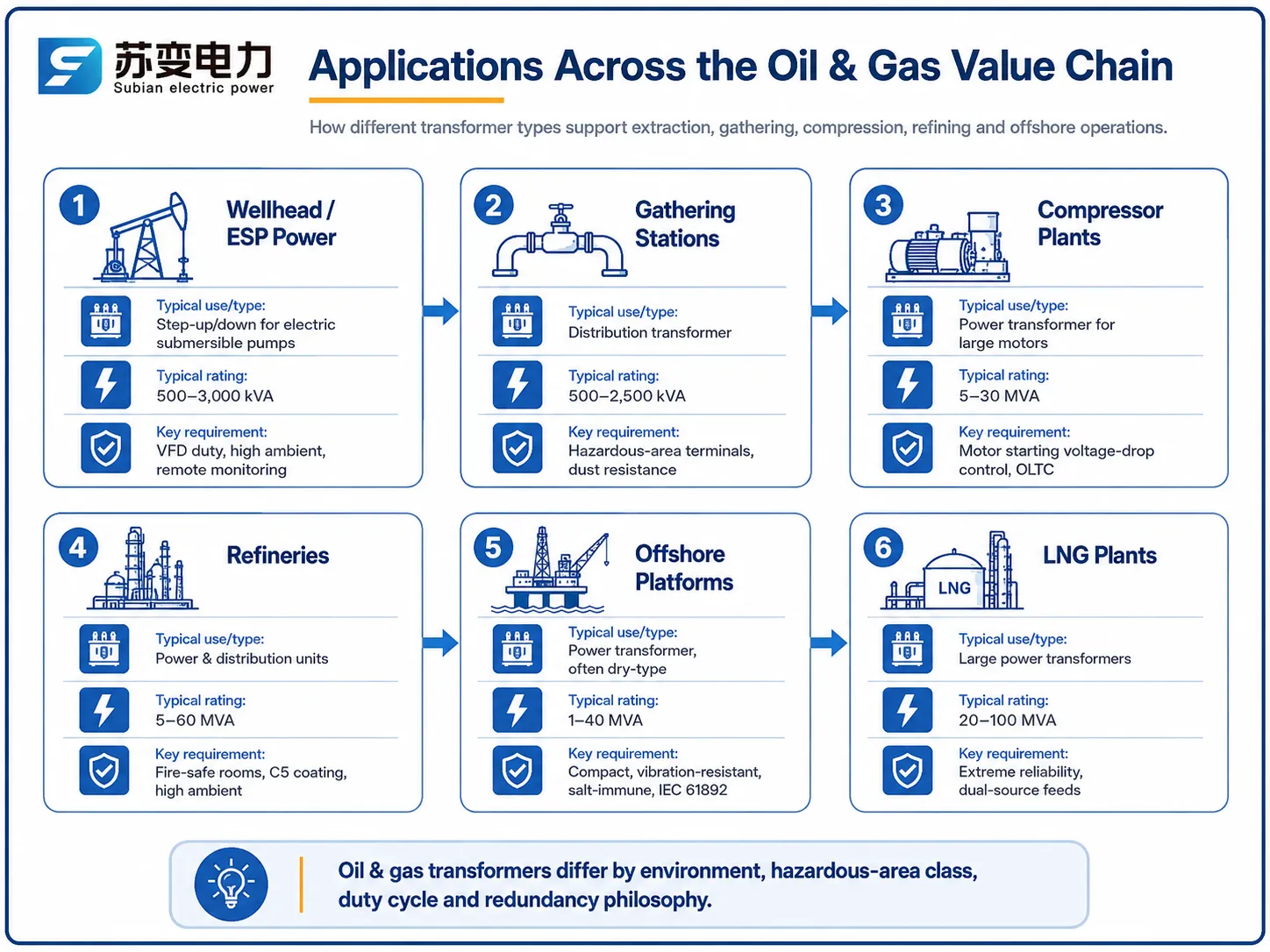
Transformer Applications Across the Value Chain

Different segments of the oil and gas value chain use transformers in different ways:

セグメント Typical Transformer 定格 Special Requirement
Wellhead / ESP power Step-up/down for electric submersible pumps (ESP) 500–3,000 kVA Variable-frequency duty, high ambient, remote monitoring
Gathering stations 配電トランス 500–2,500 kVA Hazardous-area terminals, dust resistance
Compressor plants Power transformer for large motors 5–30 MVA Motor starting voltage drop control, OLTC
Refineries Power and distribution units 5–60 MVA Fire-safe rooms, C5 coating, high ambient
Offshore platforms Power transformer, often dry-type 1–40 MVA Compact, vibration-resistant, salt-immune, IEC 61892
LNG plants Large power transformers 20–100 MVA Extreme reliability, dual-source feeds

The electric submersible pumps need special focus since they are the fastest growing transformer load in operations. The electric submersible pump for artificial lifting requires between 100 to 1,000 kVA per well, while the power to run it is supplied at 0.3 to 5 kV with a transformer that can manage a frequency converter output. A well pad with twenty ESPs may need about 2 to 4 MVA of transformer capacity with VFD compatible harmonics.

Hazardous-Area Requirements

In oil and gas transformers, compliance with hazardous area regulations is fundamental. The classification of the plant by zones (IEC) or divisions (North American) gives rise to the understanding of the presence of hazardous gas:

– Zone 0 / Class I Div 1: Explosive gas always present. Transformers are rarely installed in.
– Zone 1 / Class I Div 1: Explosive gas sometimes present; terminals and walls must be specially designed for this zone.
– Zone 2 / Class I Div 2: Explosive gas only present under abnormal conditions, the usual equipment being Ex n or Ex e; most outdoor facilities are in this zone.

The main specifications for transformers in hazardous areas are IEC 60079 for international standards and API RP 500/505 and NFPA 70 (NEC) for North America. The main specification requirements are as follows:

– Bushings and terminal boxes must have proper Ex certificates according to the zonal classification.
– Oil-filled transformers can be acceptable in Zone 2, since tanks are hermetically sealed; terminals should pass verification.
– Dry-type transformers (indoor installations) should have certified enclosures to be used in the hazardous areas, including the necessary control of temperature rise, etc.
– Other devices — OLTC motors, ventilation fans, RTD transmitters — should have similar Ex ratings.

Ex rating implies higher costs because of, for example, Ex rated terminal boxes; the costs of documentation related to certificates for explosive-proof transformers can also cost a significant sum.

High Temperature, Dust, and Corrosion Design

Oil and gas sites are routinely the hottest, dustiest, and most corrosive environments in industrial power. The design adaptations follow a clear pattern:

Stress Design Response Typical Specification
High ambient (40–55 °C) Derated cooling or upgraded cooling system Nameplate at 50 °C ambient, ONAN/ONAF
Solar radiation (deserts) Shading, light-reflective coating White/light grey C5-M paint system
Sand and dust Sealed enclosures, filter ventilation IP55–IP65, dust filters on fans
Salt (offshore, coastal) Corrosion-resistant materials ISO 12944 C5-M/CX, stainless fittings
Vibration (platforms, wellheads) Stiffened tanks, damped mounting Seismic/vibration qualification per project

One frequently overlooked yet critical piece of information is the ambient rating. According to IEC 60076-1, standard ambient should be defined as 40 °C maximum daily average; thus, in the case of 50 °C ambient oil and gas sites, it will be necessary to have a bigger equipment or to upgrade cooling working units. A 2,000 kVA installation for 50 °C ambient may cost 8-15% more than a similar one rated for 40 °C ambient, and this may ensure that the equipment works for up to 25 years rather than failing on every hot summer day.

Reliability and Redundancy Architectures

Since a halt in production costs from $200,000 to more than $1,000,000 a day in a large gas processing plant, it is necessary to ensure reliability through design, rather than relying on chance. The main provisions include the following:

1. N+1 backup: a spare transformer is installed and connected on each substation, turning into operational in a few minutes.
2. Dual-source supply: two supply lines are independent of each other, with transformers having a different source of energy supply.
3. Conservative loading: transformers operate under the load of 60% to 75% of their capacity such that it is possible for the former to work when the latter fails down (that is a common practice in oil and gas industry).
4. Spare asset policy: it is contracted that the company will have a spare transformer in the inventory and ready for utilization within 48 to 72 hours.

The rationale of the decision is that the benefits of conservative approach outweigh the costs. In order to use the transformer under 60% to 75% of its capacity, one has to pay something in the range of $10,000 to $40,000, while one case of production halt will cost 5-20 times as much as that.

Monitoring and Maintenance

Remote, unmanned sites make predictive monitoring the only realistic maintenance strategy. The oil and gas monitoring standard package for transformers:

Monitoring Layer What It Detects 典型的なコスト
Online DGA Fault gases (H2, CH4, C2H2, CO) trending $8,000–$20,000
Temperature / load profiling Overload events, cooling efficiency $2,000–$6,000
Partial discharge sensing Incipient insulation faults $3,000–$8,000
Oil moisture sensor Ingress and paper degradation risk $1,500–$4,000
Remote SCADA integration Alarm and trip events to control room Included in substation design

When it comes to refineries or offshore transformers priced between $120,000 and $500,000, it is common to allocate 10–15% of that investment for monitoring and remote diagnostics. This converts the machine from being a “run to failure” operation to one that can have its failures projected weeks or months in advance.

Standards Governing Oil and Gas Transformers

標準 範囲 Role in Oil and Gas Procurement
IEC 60076 (series) Power transformer design and testing Foundation for ratings, losses, and type tests
IEC 60079 (series) Explosive atmospheres Ex certification for terminals, accessories, and enclosures
API RP 500 / 505 Area classification in petroleum facilities Defines hazardous zones that drive Ex requirements
NFPA 70 (NEC) National Electrical Code North American installation rules and Class I Div classifications
IEC 61892 Mobile and fixed offshore units — electrical installations Offshore platform transformer requirements
ISO 12944 Corrosion protection of steel structures C5-M coating specifications for coastal and process areas

Documentation constitutes the procurement trap in oil and gas: a transformer might be extraordinarily built, but if its Ex certificates, area-classification drawings, and coating specifications do not conform to the hazardous-area schedule as indicated in the project plan, the unit would be dead. Validate documentation deliverables as a requirement of the contract, not as an afterthought.

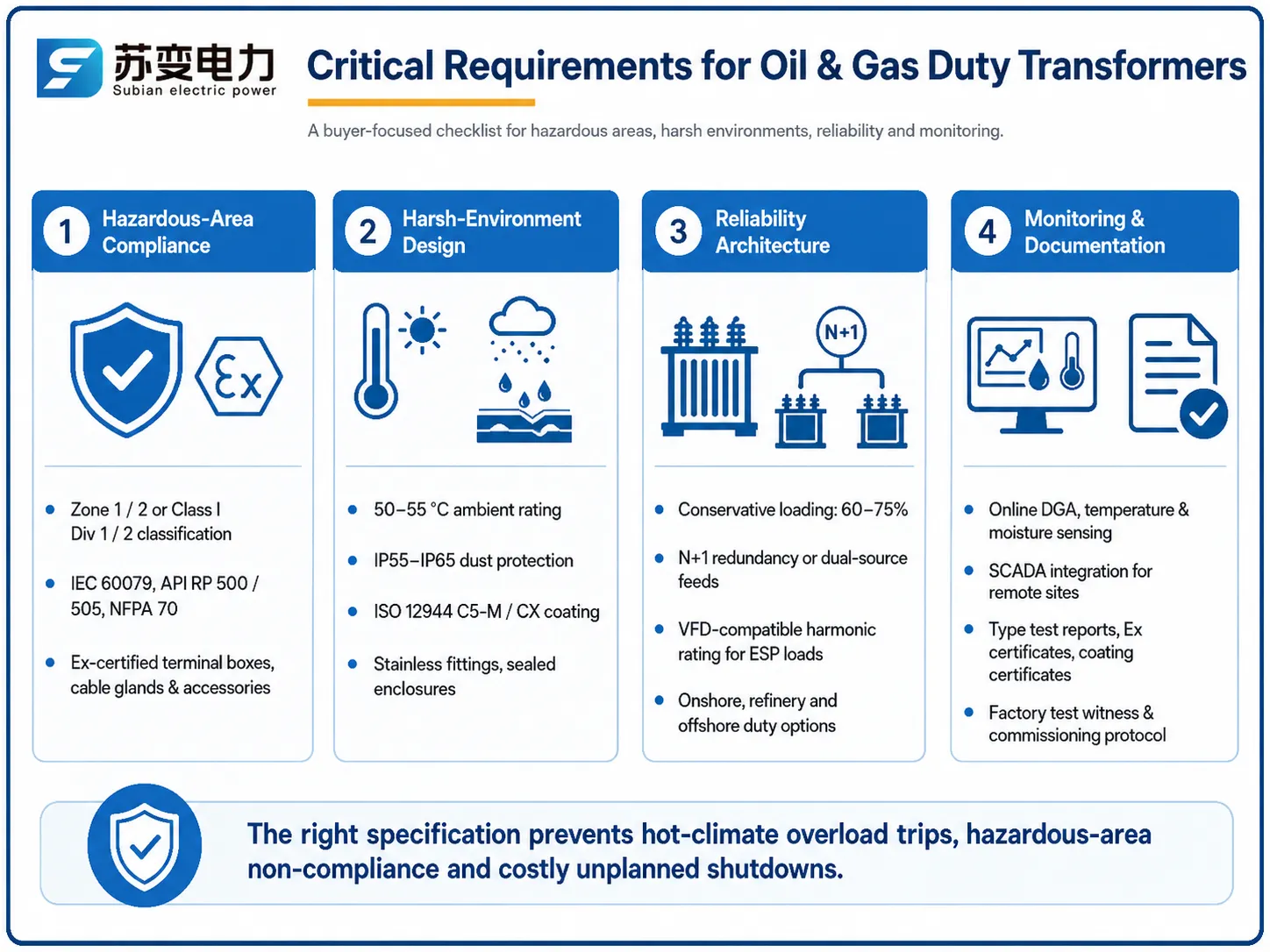
Specification Checklist

Identify the hazardous-area classification of the installation site (zone/ subsection) according to the area’s classification schedule.
Require approved electrician’s boxes, wire joints, and accessories that comply with the area where they are to be used (IEC 60079).
Specifically mention the environmental temperature limit based upon the site conditions (usually around 50 °C for desert places) and not according to the standard IEC value of 40 °C.
Specify the necessity of C5-M coating according to ISO 12944 standards for coastal or process areas.
Design the load for 60-75% of the nominal power and also avoid redundancy or spare capacity according to reliability principles of the plant.
Include the DGA, temperature, and moisture control data as far as remote and critical devices.
Specify that the harmonic rating for VFD needs to be implemented where ESP or compressor drives are the primary load.
Define what is included into documentation – Ex certificates, test results of the devices, certificates of coating, O&M manuals.
Specify seismic stability or vibration screening impact for offshore and wellhead installations.
Offer factory test witness to the supplier.

Top Brands & Price Comparison

The oil and gas transformer market is dominated by suppliers with hazardous-area certification depth and process-industry references. The table shows indicative prices for a 2,000 kVA, 35/0.4 kV onshore distribution transformer with hazardous-area terminals and 50 °C ambient rating; prices vary with zone requirements, coating, monitoring, and brand.

ブランド Country Oil and Gas Strengths Indicative Price (USD)
シーメンス Germany Deep process-industry references, digital services $28,000–$48,000
ABB Switzerland Hazardous-area portfolio, ESP drive integration $27,000–$46,000
日立エナジー Japan/Switzerland Large refinery and offshore references $30,000–$52,000
シュナイダーエレクトリック France Integrated process electrical packages $26,000–$45,000
GE ヴェルノバ USA North American Class I Div references $28,000–$50,000
江蘇省蘇辺電力 中国 IEC 60076 units with Ex terminals, 50 °C rating, C5 coating $18,000–$32,000

The licensure of significant corporations possesses the document inventory and verification database that top companies and EPC associations need for flagship programs, especially when local content regulations or operator safety constraints govern specific licensed suppliers. Jiangsu Subian Electric Power has secured a footprint in this industry through the supply of IEC 60076-compliant transformers with hazardous area terminal licenses, ambient temperature approval, and C5-M coating at around 40 – 55% of European or American levels, with OEM flexibility in terms of the monitoring packages and enclosures. In the case of national oil companies and EPC contractors planning to standardize the delivery of transformers throughout the drilling pads, collector stations, and midstream plants, offering a licensed supplier such as Subian along with global corporations — plus verifying Ex certificates and the testing witness program in the process — represents a pragmatic solution for capital expenditure control that does not jeopardize compliance with hazardous areas legislation.

よくある質問

What hazardous-area rating does a transformer need at a gas plant?

Most outdoor transformer pads fall under Zone 2/Class I Div 2 classification since the use of terminal boxes and other accessories certified for Ex n or Ex e is commonly practiced. Use of oil-filled transformers with sealed tanks can be accepted in Zone 2 classification. Use of transformers in Zone 1 is rare as feeds are rerouted to the boundary of the hazardous location. Ensure that each unit matches with the project area classification drawings.

How much more does an oil and gas transformer cost than a standard industrial one?

A 2,000 kVA device with terminals meant for precarious locations and capable of working in ambient temperatures of 50°C and with protective C5 coating costs significantly more than a common industrial unit — around $18,000–$32,000 for the former as compared to only $12,000–$20,000 for the latter. The additional cost includes not just Ex certification, high-temperature construction features and protection against corrosion but also all required documentation.

Why do ESP applications need special transformer consideration?

Electric submersible pumps are fed through variable-frequency drives, so the transformer must handle harmonic currents and VFD voltage output while sitting at remote, high-ambient well sites. Ratings of 500–3,000 kVA per pad group are typical. The transformer should be harmonic-rated, temperature-rated for the site ambient, and equipped with remote monitoring because maintenance access is limited.

What monitoring do oil and gas transformers need?

For remote and critical units, the standard package is online DGA, temperature/load profiling, oil moisture sensing, and SCADA integration — roughly $8,000–$30,000 per unit. This converts the transformer from a run-to-failure asset into one whose degradation is visible months in advance, which matters when a failure can stop a plant producing $1 million per day.

Should I run my transformers at full nameplate load in a gas plant?

No — the oil and gas industry standard is to load transformers at 60–75% of nameplate so a single unit can carry the station on loss of its redundant twin. The capacity premium costs $10,000–$40,000 per unit; a single unplanned stop costs 5–20 times that. Conservative loading plus N+1 redundancy is the cheapest reliability insurance in the business.

参考文献

結論

The oil and gas sector presents transformers with situations – dangerous conditions, extreme temperature, uninhabited remote locations, and year-round continuous operation – which do not coexist in any other domain. Because of doing this one should get an unusual certificate of hazardous area, do a specific design to counteract high ambient temperatures and corrosion, use a reasonable coefcient of redundancy, as well as pay attention to predictive maintenance. Each point has its own price: 20 to 60 percent in specification cost, 60 to 75 percent in the load, and 8 to 30 percent of the asset in maintenance.

In order to avoid problems:

Make sure that the hazardous area classification meets the Ex certificate requirements, and check that terminals and other accessories are intended for hazardous areas as well.
Select ambient temperature based on the actual data of the site (50oС is the best choice for deserts), but not at 40oС according to IEC rules.
Load transformers at 60 to 75 percent of their capacities and use the N+1 redundancy on the most important stations.
Invest at least 8 to 15 percent of an asset value in the online monitoring system.
Look at the major companies such as Siemens, ABB, Hitachi Energy, and Jiangsu Subian Electric Power in order to be sure that certification is made correctly at a low cost.

For hazardous-area-rated transformer supply and specification support across the oil and gas value chain, contact Jiangsu Subian Electric Power at www.subian-electric.com.