


Fin juin, le chef de projet d'une nouvelle usine de transformation alimentaire dans un parc industriel côtier a reçu deux propositions pour la mise à niveau de la sous-station de 1 250 kVA. L'une des offres comprend le transformateur immergé dans l'huile et l'autre, un transformateur sec ayant la même puissance. Il y a une différence d'environ 35 % entre les prix, et les dates de livraison sont presque deux semaines d'écart. Bien que le chef de projet n'ait pas de formation en ingénierie électrique, il réalise que sa décision affectera la facture d'électricité de son usine, les taux d'assurance et les plans de maintenance pour de nombreuses années à venir. Il a besoin de réponses à la question de savoir pourquoi les transformateurs à huile sont le type de transformateurs le plus largement utilisé pour les systèmes électriques et les installations industrielles, ainsi que de savoir où cette utilisation cesse d'avoir un sens.
Cet article expliquera en termes simples ce qu'est un transformateur immergé dans l'huile , fournira des données provenant des tests IEC 60076 et des prix du marché, et expliquera quand il serait préférable d'utiliser des unités à base d'huile. Des comparaisons avec des types de transformateurs secs sont également faites afin de ne pas payer trop cher pour des fonctionnalités inutiles. À la fin de ce texte, le lecteur saura quoi surveiller lors de la réception du devis et comment planifier le budget pour un transformateur efficace d'un fabricant fiable. Un transformateur immergé dans l'huile est un appareil électrique non mobile capable de transmettre un courant électrique alternatif d'un circuit à un autre par induction électromagnétique, utilisant son noyau en fer et ses enroulements en cuivre ou en aluminium complètement immergés dans l'huile. En général, il utilise de l'huile minérale de haute qualité, mais de nos jours, des substituts tels que des huiles de silicone et d'esters, sûres contre les incendies, peuvent être trouvés de plus en plus sur le marché. L'appareil est entièrement placé dans un réservoir en métal qui a été fabriqué par soudage et contient des bornes, un équipement de changement de prise et des dispositifs de protection.
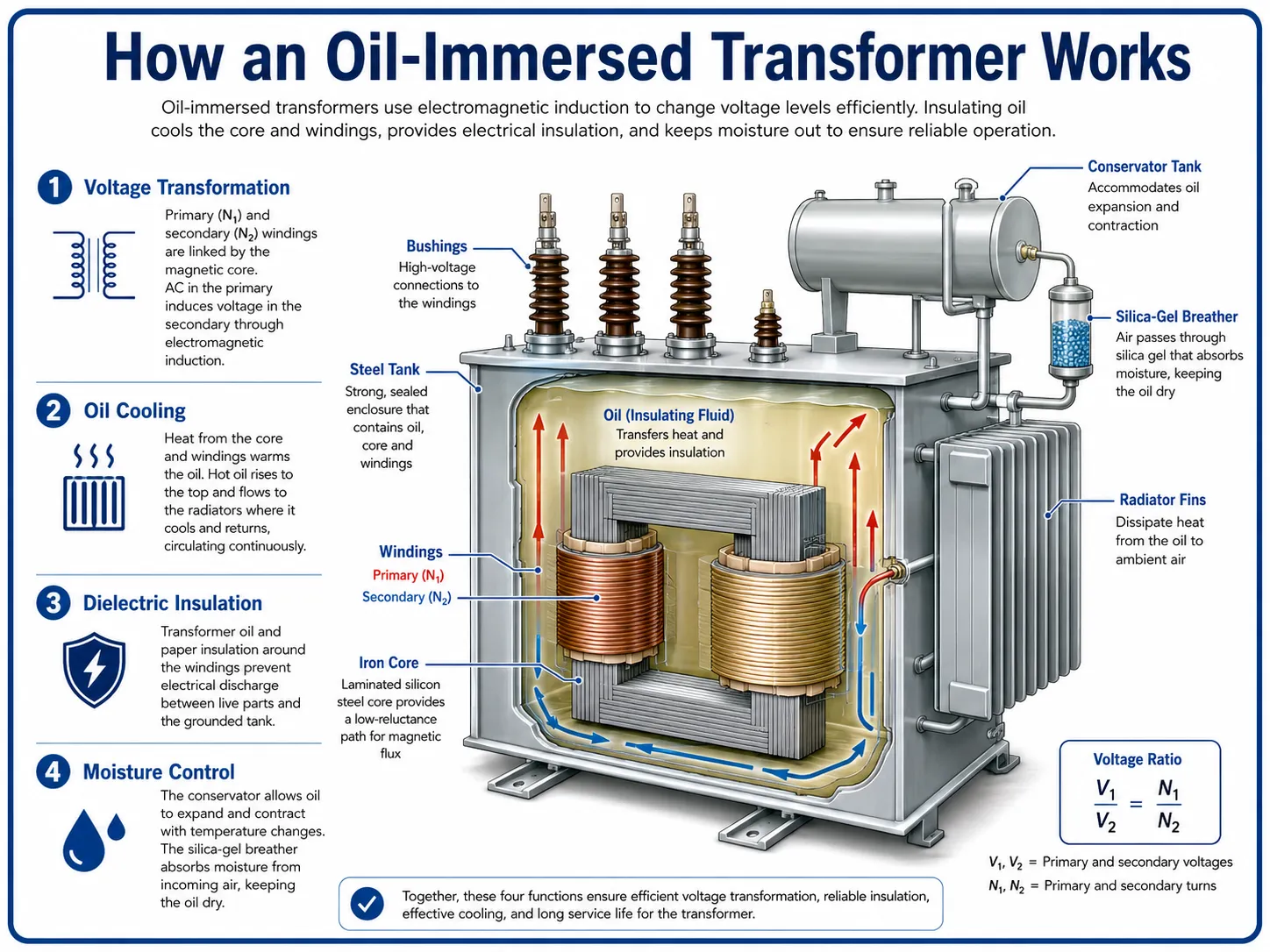
Qu'est-ce qu'un transformateur immergé dans l'huile ?
La technologie remonte à plus de 100 ans, et elle a été préservée non par hasard. En utilisant de l'huile pour refroidir les enroulements, le système est capable de transférer au moins trois fois plus de chaleur que l'air, et par conséquent, sa taille pourrait être minimisée et son coût réduit. C'est la raison pour laquelle les services publics achètent encore des transformateurs à huile : en raison du faible prix par kVA, des caractéristiques diélectriques fiables et des années de pratique.
Comment fonctionne un transformateur immergé dans l'huile
Prenons un transformateur de 400 kVA. Sur le côté du transformateur où la tension est introduite, on connecte un enroulement haute tension qui est alimenté en 10 kV ou 35 kV. Le courant alternatif crée un flux dans le noyau, qui induit une tension plus basse dans le circuit basse tension, typiquement autour de 0,4 kV dans une distribution triphasée. Tout le reste est une lutte contre deux ennemis : la chaleur et l'humidité.
Refroidissement : L'huile chaude entourant les enroulements monte grâce à la convection naturelle de l'huile vers la partie supérieure du réservoir (schéma ONAN). En ce qui concerne les transformateurs de plus grande taille, l'huile monte grâce à l'aide d'un ventilateur (schéma ONAF), ce qui permet d'augmenter la charge de 30 pour cent.
Isolation : L'isolation papier-huile répond aux exigences IEC 7600. Le papier kraft imbibé d'huile permet de supporter la charge électrique de la bobine, tandis que l'huile élimine la présence d'air.
Contrôle de l'humidité : L'huile chauffe et refroidit en fonction de la charge du transformateur. Un réservoir de conservation empêche l'huile de déborder et un évent en gel de silice s'occupe de l'humidité.
Caractéristiques clés qui comptent en pratique
| Caractéristique | Ce qu'elle fait | Avantage pratique |
|---|---|---|
| Refroidissement à l'huile (ONAN/ONAF) | Circuler la chaleur vers les radiateurs naturellement ou avec des ventilateurs/pompes | Plus grande puissance dans un réservoir plus petit ; coût matériel réduit |
| Isolation papier-huile | Papier kraft imprégné d'huile sur les enroulements HV | Haute résistance diélectrique ; durée de vie d'isolation prouvée de 30 à 40 ans |
| Réservoir de conservation et évent | Absorbe l'expansion de l'huile ; piège l'humidité dans le gel de silice | L'huile reste sèche, réduisant les alarmes DGA à long terme |
| Relais Buchholz | Détecte les gaz et les surpressions d'huile provenant de défauts internes | Alerte précoce des défauts, limite les dommages dans les réservoirs scellés |
| Changeur de prises sous charge / hors circuit | Ajuste le rapport de tension sous charge ou à l'arrêt | Maintient la tension d'alimentation dans ±5% du nominal |
| Réservoir résistant à la corrosion | Acier soudé avec peinture riche en zinc ou finition par galvanisation à chaud | Décennies de service en extérieur dans des zones humides ou côtières |
Types et configurations courants
| Taper | Refroidissement | Évaluation typique | Meilleure utilisation |
|---|---|---|---|
| Monté sur poteau (monophasé) | ONAN | 10–167 kVA | Alimentation rurale et résidentielle |
| Monté sur socle | ONAN | 75–2 500 kVA | Distribution commerciale souterraine |
| Sous-station de distribution | ONAN/ONAF | 50–5 000 kVA | Usines industrielles, réseaux urbains |
| Transformateur de puissance | ONAF/ONAN | 3–120 MVA | Sous-transmission et nœuds de réseau |
| Noyau en alliage amorphe | ONAN | 50–2 500 kVA | Faible perte à vide / projets à haute efficacité |
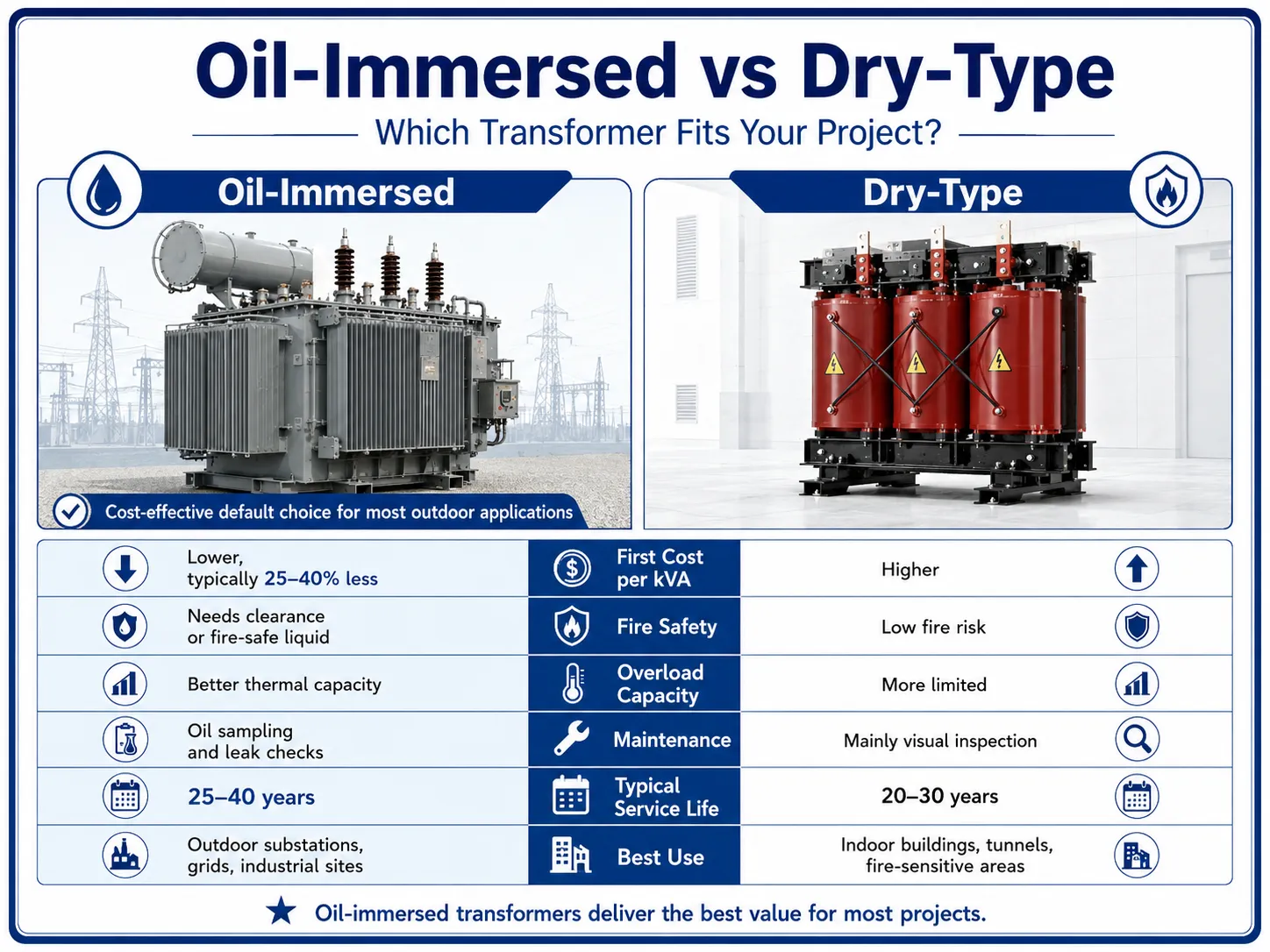
Huile immergée vs. type sec : comparaison honnête
| Paramètre | Immergé dans l'huile | Type sec (résine coulée) |
|---|---|---|
| Coût initial par kVA | Plus bas (typiquement 25–40% de moins) | Plus élevé |
| Risque d'incendie / d'explosion | L'huile minérale est combustible ; nécessite un dégagement ou des esters | Résine auto-extinguible à faible émission |
| Installation intérieure | Généralement restreint sauf utilisation de liquide ignifuge | Autorisé sans chambre forte dans la plupart des codes |
| Capacité de surcharge | Bon (masse thermique de l’huile) | Limité au-dessus de la plaque signalétique |
| Entretien | Échantillonnage d'huile, DGA, vérifications de fuites | Inspection visuelle uniquement ; ventilateurs si présents |
| Durée de vie typique | 25–40 ans | 20–30 ans |
| Tolérance à l’humidité | Scellé contre l'humidité | Sensible ; nécessite un environnement sec |
Spécifications typiques (IEC 60076)
| Paramètre | Valeur courante |
|---|---|
| Norme | IEC 60076-1 (général), IEC 60076-2 (élévation de température) |
| Classes de tension | 10 kV, 20 kV, 35 kV, 66 kV, 110 kV |
| Groupe vectoriel | Dyn11, Yyn0, Dyn5 (distribution) |
| Plage de prises | ±5% (hors circuit), ±10% avec OLTC |
| Niveau d’isolation (classe 35 kV) | LI 170 kV / AC 70 kV |
| Perte à vide (400 kVA, CRGO) | ≈ 600–700 W |
| Perte en charge (400 kVA) | ≈ 4 500–5 500 W à 75 °C |
| Élévation de température | 65 K (huile), 78 K (moyenne des enroulements) selon IEC |
Où les unités immergées dans l’huile sont le choix naturel
Transformateurs remplis d’huile sont mieux utilisés dans des endroits où trois paramètres sont réunis. Il s’agit que le transformateur puisse être installé en extérieur, que le coût par kVA soit le facteur déterminant, et que les contrôles d’huile puissent être effectués annuellement par une équipe de maintenance. Cela inclut les réseaux publics de distribution, les fabricants et les exploitants miniers, les locaux commerciaux utilisant des transformateurs sur socle, les projets d’énergies renouvelables avec des transformateurs situés à côté des onduleurs solaires ou éoliens, et les sous-stations de traction ferroviaire. Sur le même projet, l’installation agroalimentaire que nous avons commencée recevra probablement un transformateur à huile placé à l’extérieur du bâtiment et connecté à l’appareillage via un câble court. Pour les sous-sols de grands immeubles, les hôpitaux et les tunnels où la sécurité incendie est strictement appliquée, le choix se porte sur le type sec — un compromis discuté plus en détail dans notre article séparé sur transformateurs à sec vs transformateurs immergés dans l’huile.
Marques principales et fourchettes de prix réalistes
L' transformateur immergé dans l'huile Le secteur est dominé par des multinationales ainsi que par de nombreux fabricants locaux. Le tableau suivant montre le coût approximatif des modèles de transformateurs de distribution, tandis que les offres réelles peuvent dépendre du type de tension, de la fabrication du noyau du transformateur, des changements de prises, des traversées, et du type de tests effectués sur l’unité.
| Marque | Origine | Fourchette typique (400 kVA, 10–35 kV, FOB) |
|---|---|---|
| ABB | Suisse / Global | $14,000 à $26,000 |
| Siemens | Allemagne | $15 000–$28 000 |
| Schneider Electric | France | $13 000–$24 000 |
| Hitachi Energy | Japon / Suisse | $16,000 à $30,000 |
| GE (Prolec) | États-Unis | $15,000 à $27,000 |
| Toshiba | Japon | $14,000 à $26,000 |
| Marque chinoise (ex. Subian) | Chine | $8 500–$15 000 |
Des entreprises comme ABB, Siemens, Schneider Electric et Hitachi Energy fournissent un modèle de référence de l’expertise dans les transformateurs remplis d’huile. Néanmoins, les prix des fabricants chinois certifiés de transformateurs, qui examinent des industries comparables, sont beaucoup plus bas, tout en respectant le même niveau de conformité aux normes IEC 60076. Jiangsu Subian Electric Power est l’une des entreprises fabriquant également des transformateurs remplis d’huile de 10 à 110 kV et appliquant soit de l’acier au silicium orienté grain, soit un alliage amorphe dans le développement des transformateurs. Elle fournit des rapports de test détaillés pour tous les transformateurs qu’elle fabrique et teste. Lorsque les clients ont besoin de les transformateurs remplis d’huile fiabilité à un coût relativement bas, ils se tournent vers Jiangsu Subian Electric Power.
Comment Choisir la Bonne Unité
Confirmez le profil de charge, pas seulement le kVA de la plaque signalétique ; considérer une taille correspondant à 70-% de la charge de pointe prévue permettra une croissance future.
Déterminer le matériau du noyau : sélectionner de l'acier au silicium CRGO pour le coût initial le plus bas, ou choisir un alliage amorphe si la perte à vide est critique.
Sélectionner la classe de refroidissement (ONAN vs ONAF) en fonction de l'espace disponible et de la chaleur maximale.
Déterminer quel type de changeur de prises est nécessaire : hors circuit est moins cher, tandis que sous tension (OLTC) n'est conseillé que si les tensions varient tout au long de la journée.
Demander des rapports de test de routine, qui fournissent la résistance des enroulements, des tests de rapport et des tests de tension induite conformément à la norme IEC 60076-1.
Confirmer un liquide ignifuge, si l'unité est située près d'un bâtiment ou à l'intérieur.
Comparer le coût total de possession : c'est-à-dire le coût initial plus la perte à vide/perte en charge sur 20 ans, qui est souvent supérieure au prix d'achat.
Essentiels d'installation et de maintenance
| Intervalle | Tâche | Pourquoi c'est important |
|---|---|---|
| Avant la mise sous tension | Vérifier le niveau d'huile, la résistance diélectrique (> 40 kV/mm selon la CEI), la résistance d'isolation des enroulements | Détecte les dommages de transport et d'installation |
| Annuellement | Échantillon d'huile, analyse des gaz dissous (DGA), inspection visuelle du respirateur et des douilles | La tendance DGA est le premier indicateur de défaut |
| Tous les 5 ans | Test complet de l'huile (humidité, acidité, tension de claquage), vérifier les joints et le gel de silice | Maintient l'humidité en dessous des seuils dommageables |
| Tous les 10 à 15 ans | Retouche de corrosion, remplacement de joints, étalonnage de relais | Prolonge la durée de vie du réservoir et des accessoires |
Questions Fréquemment Posées
Pourquoi la plupart des réseaux électriques utilisent-ils encore des transformateurs immergés dans l'huile ?
Parce qu'ils offrent le prix le plus économique par kVA et possèdent 100 ans d'expérience dans le domaine. On estime qu'un transformateur électrique de 400 kVA refroidi à l'huile coûtera entre $8,500 et $15,000 FOB d'un fabricant chinois, tandis qu'un transformateur de type sec équivalent se situe entre $12,000 et $20,000, et le refroidissement à l'huile aide à atteindre des puissances plus élevées dans un réservoir plus petit. De plus, le personnel des services publics est formé aux tests d'huile et à la reconditionnement de l'huile, rendant ainsi cette technologie compatible avec leur modèle de maintenance.
Les transformateurs immergés dans l'huile sont-ils sûrs à installer près des bâtiments ?
Les codes de sécurité exigent une séparation ou un confinement résistant au feu en ce qui concerne les unités à huile minérale combustible. Certaines solutions incluent le maintien d'une distance de 3 à 5 mètres, l'installation d'un mur coupe-feu, ou l'utilisation d'huile d'esters synthétiques ou naturels, dont le point d'ignition est supérieur à 300 degrés Celsius. Les unités remplies d'esters sont devenues plus populaires pour les installations intérieures et sur les toits récemment.
À quelle fréquence l'huile du transformateur doit-elle être changée ?
Si elle est maintenue sèche, une bonne huile minérale peut potentiellement durer suffisamment longtemps pour dépasser la durée de vie de l'unité. Il est préférable de réaliser un test annuel plutôt que de prévoir des changements d'huile. La tension de claquage doit rester supérieure à 40 kV selon la norme CEI 60156 et les niveaux d'humidité doivent être inférieurs à 30 ppm. Il n'est nécessaire de changer ou de traiter que lorsque le niveau de gaz dissous ou les examens de qualité de l'huile indiquent une détérioration.
Quelle est la durée de vie typique d'un transformateur immergé dans l'huile ?
En général, la plupart des organisations constatent qu'une durée de fonctionnement de 25 à 40 ans est raisonnable, car de nombreux équipements en état de fonctionnement peuvent fonctionner pleinement même après 30 ans d'exploitation normale sur le terrain, à condition qu'ils soient correctement entretenus et servis au moins une fois par an. Cependant, le vieillissement de l'isolation impacté par la chaleur et l'humidité est le principal facteur limitant le fonctionnement des appareils, la limite de hausse de température de l'huile étant fixée à 65 K selon la CEI 60076-2 et le séchage de l'huile.
Un transformateur immergé dans l'huile peut-il être installé à l'intérieur ?
Oui, mais seulement avec protection. Les options incluent un coffre de transformateur dédié avec des murs résistants au feu, un système automatique de suppression d'incendie, ou le passage à un liquide résistant au feu. De nombreux codes du bâtiment limitent également la classification et exigent une rétention d'huile, donc vérifiez les réglementations locales avant de spécifier une unité à huile intérieure.
Références
- IEC 60076-1 : Transformateurs de puissance — Général — La norme internationale de référence définissant les classifications, tests et classifications.
- IEEE — Éditeur de la série IEEE C57 utilisée en parallèle avec l'IEC pour la conception et les tests de transformateurs.
- NEMA — Association professionnelle dont les normes informent l'efficacité des transformateurs et des enceintes en Amérique du Nord.
- Transformateurs Hitachi Energy — Matériel de référence sur la technologie des transformateurs de puissance et de distribution.
- Transformateurs ABB — Documentation du fabricant sur les classes de refroidissement des transformateurs et les systèmes d'isolation.
- Solutions UL — Organisme de test et de certification de sécurité pour les équipements électriques, y compris les transformateurs.
- Jiangsu Subian Electric Power Co., Ltd. — Fabricant de transformateurs certifié (10 kV–110 kV, conforme à l'IEC 60076).
Conclusion
Transformateurs immergés dans l'huile continuent d'être le composant clé dans la distribution d'énergie avec des avantages principaux tels que le refroidissement à l'huile, l'isolation papier-huile, le contrôle de l'humidité et des réservoirs robustes conduisant au prix minimum par kVA avec une fiabilité garantie. L'application la plus courante des transformateurs à huile est la distribution extérieure, les consommateurs industriels et les applications de réseau allant de 50 kVA à des MVA à deux chiffres, ce qui permet à cette option d'être la moins chère, avec des prix variant d'environ $1,800 pour une unité de 100 kVA jusqu'à $30,000+ pour une unité de 1,000 kVA en fonction de la marque et des spécifications. Cependant, une bonne exception est les intérieurs sensibles au feu, où les transformateurs de type sec ou remplis d'esters sont préférés. Néanmoins, quelle que soit l'option choisie, il est essentiel de s'assurer que l'équipement proposé est conforme à l'IEC 60076, fournit un rapport de test de routine complet et indique les pertes à vide et en charge pour obtenir une estimation correcte des coûts globaux et pas seulement du prix d'achat de l'équipement. L'un des fournisseurs certifiés, Jiangsu Subian Electric Power company, fournira la bonne combinaison de qualité et de coût.