


Quando un ingegnere sta determinando le specifiche di una distribuzione a media tensione, la decisione quasi sempre si riduce a specifiche dell'unità di anello principale nel datasheet. La tensione nominale, la corrente nominale, la corrente di tenuta a breve termine, il tipo di isolamento e la norma IEC pertinente insieme determineranno se l'unità resisterà al guasto, si adatterà all'installazione della sottostazione e funzionerà per anni. Questa guida presenta l'intero insieme di specifiche e caratteristiche dell'unità di anello principale in un unico posto, spiega cosa significa ciascun parametro e come leggerlo, le loro descrizioni, i modi per leggerli e i confronti tra i migliori design di RMU a livello mondiale. Puoi utilizzare questo documento durante la preparazione di gare o la valutazione di preventivi.
Cos'è l'Unità di Anello Principale (RMU)?
L'unità di anello principale o RMU è un'interruttore a media tensione compatto e integrato assemblato in fabbrica. Viene utilizzato nella linea di distribuzione secondaria grazie alla sua capacità di connettersi in un anello di cavi sotterranei o aerei, consentendo ai consumatori di ricevere energia da entrambi i lati della rete. Pertanto, l'affidabilità delle moderne città e industrie dipende dall'RMU, poiché quando un lato di una rete viene perso, i consumatori continuano a ricevere elettricità grazie all'altro lato del circuito ad anello che continua a funzionare.
L'unità integra solitamente diversi interruttori a carico con interruzione collegati ai cavi in entrata e in uscita e un derivato protetto (interruttore-fusibile o interruttore automatico a vuoto) che alimenta il trasformatore. L'intero design dell'interruttore è compatto e sigillato in modo che non necessiti di alcuna manutenzione durante la sua vita utile. Comprendere il specifiche dell'unità di anello principale inizia con la comprensione che ognuna di queste funzioni deve essere valutata per la stessa tensione, corrente e livello di guasto.
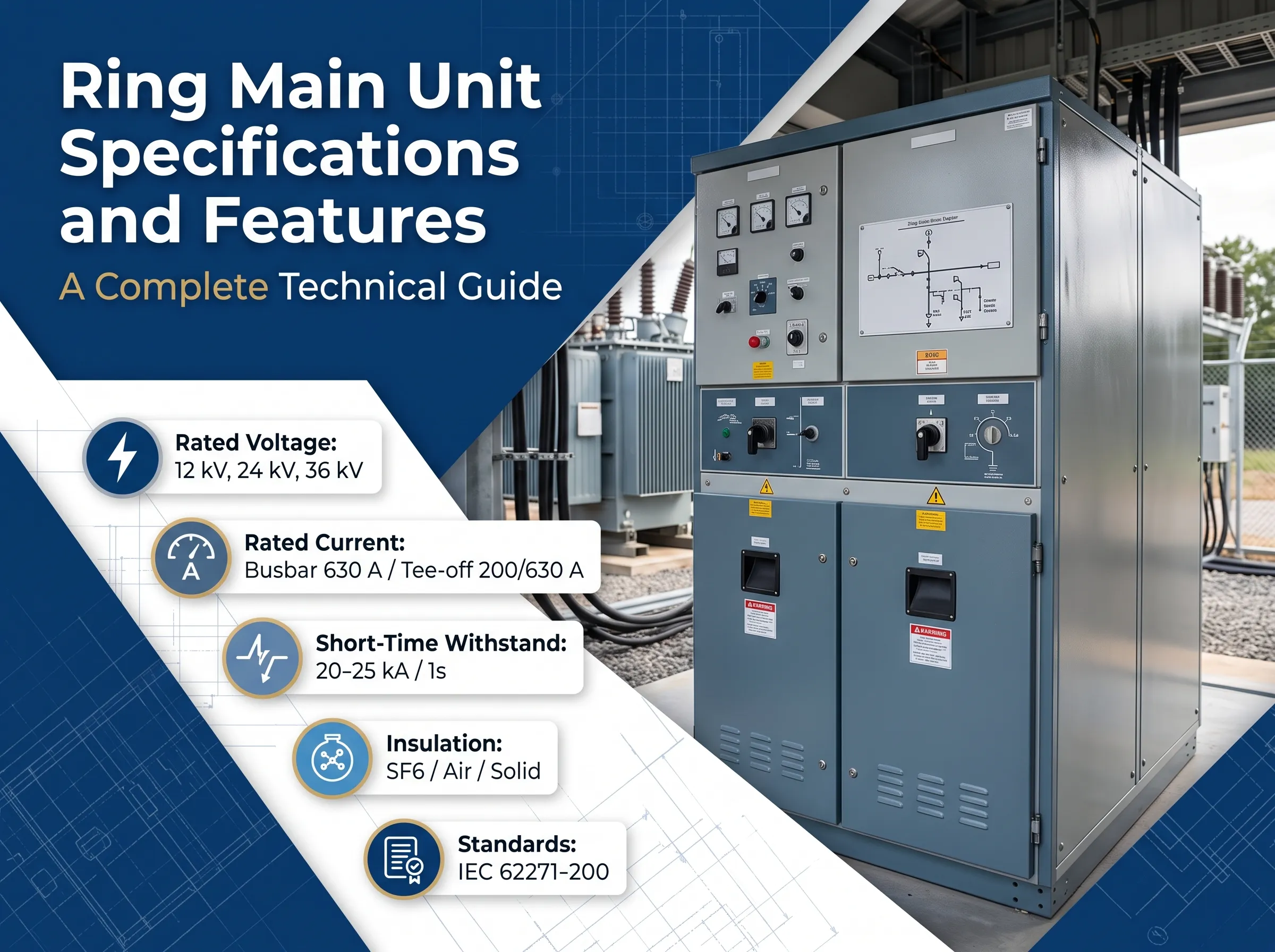
Specifiche dell'Unità di Anello Principale a Colpo d'Occhio
Prima di esaminare ciascun parametro in dettaglio, è utile vedere l'insieme completo delle specifiche che definiscono un'unità di classe 12 kV. Questi sono i core specifiche dell'unità di anello principale che appaiono praticamente su ogni datasheet e documento di gara:
- Tensione nominale: 12kV (disponibile anche a 17.5kV, 24kV, 36kV).
Frequenza nominale: 50Hz o 60Hz.
Corrente nominale del bus principale: 630A (oltre 1250A per modelli più grandi).
Corrente nominale di derivazione: 200A (interruttore-fusibile) o 630A (tipo interruttore automatico).
Corrente nominale di tenuta al cortocircuito: 20 o 21 kA per 1 secondo (fino a 25 kA).
Corrente di picco di tenuta nominale: 50 o 52.5kA (2.5 volte il valore a breve termine).
Durata nominale del cortocircuito: 1 secondo o 3 secondi su richiesta.
Tensione di tenuta all'impulso di fulmine (LIWL): 75 kV.
Tensione di tenuta a frequenza di potenza: 28 o 42 per un minuto.
Mezzo isolante: gas SF6, aria o solido.
Grado di protezione: IP65 per il serbatoio del gas e IP3X per l'involucro.
Normative applicabili: IEC 62271-200 e IEC 62271-100/105.Questa casella è la prima delle due figure tecniche suggerite per questo articolo, un'unica infografica, chiamata “Specifiche Tecniche dell'Unità di Distribuzione a Anello”, che è un buon riassunto della struttura insieme ai parametri di tensione, corrente, resistenza e IEC sopra menzionati. Di seguito sono riportate le sezioni che spiegano le figure che non dovrebbero essere fraintese da un ingegnere.
Tensione e Corrente Nominale: 12 kV, 17.5 kV, 24 kV e 36 kV
La tensione nominale definisce la massima tensione per la quale l'RMU funzionerà correttamente e sarà entro i suoi limiti. La distribuzione secondaria si basa solo su poche classi standard, e il giusto specifiche dell'unità di anello principale inizia abbinando questo valore alla rete:
- 12 kV è la classe base da impiegare per le reti con tensione nominale di 10 kV e 11 kV;
5 kV è per i sistemi con tensione nominale di 13.8 kV e 15 kV;
24 kV è utilizzato per le reti con tensione nominale di 20 kV e 22 kV, principalmente in Europa, Asia e Medio Oriente;
36 kV rappresenta l'ultimo intervallo di distribuzione secondaria applicabile per i sistemi a 33 kV.La corrente nominale indica la quantità di corrente che l'apparecchiatura sarà in grado di sopportare a causa delle condizioni di temperatura. Ci sono due letture. Il busbar principale e gli interruttori di carico a anello hanno normalmente 630 A, il che significa che questo valore consente di utilizzare la corrente del circuito di rete. Il derivato del trasformatore può avere una valutazione inferiore a causa dell'utilizzo di alcune combinazioni di fusibili interruttori, normalmente 200 A, o la stessa di 630 A quando si utilizza un interruttore automatico a vuoto per la protezione. L'errore più comune durante la lettura specifiche dell'unità di anello principale è confondere la valutazione del busbar con la valutazione del derivato.
Capacità di resistenza e interruzione del cortocircuito
La qualità appare nella corrente di cortocircuito a breve termine (Icw) classificata. La corrente di cortocircuito RMS, che l'unità è in grado di gestire durante determinati periodi, tipicamente 20 o 21 kA per un secondo senza subire danni termici o meccanici. Per le reti con livelli di cortocircuito maggiori, possono essere specificati anche 25 kA. Inoltre, alcuni bandi specificano 3 secondi.
Corrente di picco nominale (Ipk). La massima quantità di corrente istantanea che l'unità, 2.5 volte superiore alla valutazione a breve termine (secondo IEC) è in grado di sopportare, il che significa che per il dispositivo con una valutazione di 20 kA la corrente di picco di resistenza è 50 kA.
Capacità di interruzione del cortocircuito nominale. La quantità di corrente di cortocircuito che il dispositivo di protezione è in grado di interrompere. Nel derivato dell'interruttore automatico a vuoto, è la stessa della valutazione di resistenza, 20 a 25 kA; con il derivato dell'interruttore fusibile, il fusibile si occupa delle grandi correnti di cortocircuito e l'interruttore interrompe il carico di corrente.
Un dispositivo con una valutazione di resistenza inferiore alla corrente di cortocircuito della rete non è sicuro ed è questo il motivo principale per cui è la prima cosa che gli ingegneri controllano l'uno con l'altro.
Le specifiche di una buona unità di distribuzione a anello includono sempre i dati che descrivono Icw, durata e Ipk insieme.
Le unità sono classificate in base al mezzo isolante utilizzato, che è un fattore importante che determina le dimensioni dell'unità, i requisiti di manutenzione e le caratteristiche ecologiche, separando così le unità l'una dall'altra.
Tipi di isolamento in RMU: SF6, aria e solido
Concludendo che l'isolamento gioca un ruolo fondamentale nel separare i conduttori elettrici in tensione e nell'estinguere l'arco di scarica al momento dell'apertura dell'interruttore, si può affermare che le sue caratteristiche possono essere determinate. È importante tenere a mente che la scelta dell'isolamento è un fattore importante per ogni specifica dell'unità di distribuzione.
Isolato con gas SF6. I componenti in tensione sono protetti da gas SF6 all'interno del serbatoio in acciaio. L'SF6 fornisce un eccellente livello di resistenza dielettrica e rende possibile estinguere gli archi anche nell'unità sigillata che è resistente all'umidità, alla sporcizia e alla condensazione. Questo tipo di isolamento è utilizzato principalmente per RMU secondari così come in luoghi con condizioni avverse o in territori costieri.
Isolato ad aria. L'attrezzatura è composta da conduttori in tensione isolati dall'aria in un involucro metallico. Questa unità è meno compatta; tuttavia, è priva di gas serra e consente di eseguire ispezioni visive mentre è collocata all'interno.
Isolatore solido (SIS). I conduttori in tensione sono isolati con isolatori solidi simili a resina epossidica. È un nuovo tipo di tecnologia di isolamento che non prevede l'uso di gas all'interno del dispositivo.
Caratteristiche chiave delle unità di distribuzione
Insieme ai valori specifici delle specifiche delle unità di distribuzione, un buon design si distingue anche dalla prospettiva ingegneristica che garantisce un funzionamento sicuro e conveniente. Alcune caratteristiche importanti da considerare durante l'acquisto includono:
Interruttore a tre posizioni. L'attrezzatura possiede un interruttore di carico che ha tre posizioni e può essere commutato da chiuso a aperto, sia a terra che non, in un unico involucro.
Meccanismo di interblocco di cinque operazioni. Il design contiene un meccanismo meccanico ed elettrico per eliminare errori riguardanti cinque operazioni comuni con il sistema elettrico.
Hermetically-sealed tank. The service life of the tank is unlimited when it is properly sealed.
Small footprint. It occupies little space while being installed in the compact enclosure that is used mostly in prefabricated buildings. It is very important.
Ability to expand. It is important to observe that the expansion possibilities exist from the functional device and till the busbar extension.
Cable testing and fault indication systems. The equipment allows for cable testing as well as tracking faults along through the unit.
Internal arc classification. The available IAC rating gives you an idea of how the device prevents internal arc faults.
Therefore, it can be stated that the above-mentioned characteristics are those things that can separate the units of equal technical specifications.
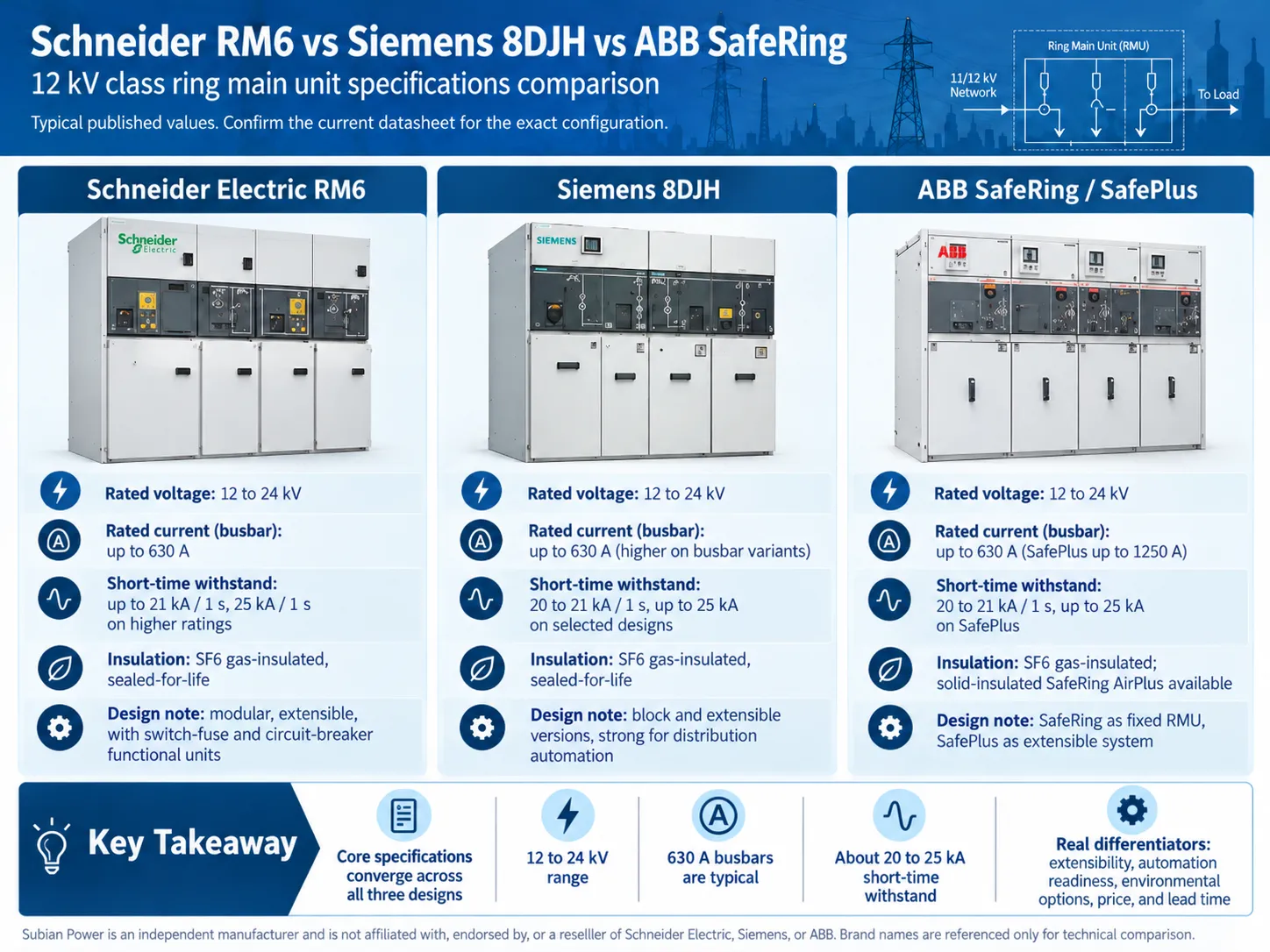
Schneider RM6 vs Siemens 8DJH vs ABB SafeRing
When it comes to ratings, buyers often carry out a side-by-side analysis of the top three internationally established designs since it’s quite common to find specifications of 12 kV class published ring main units available for comparison if their specifications are similar. The following figures represent the general figures generally found in catalogs which need to be checked against the most current configuration datasheets available. This comparison figure is the second of those recommended through this article. It should be stated that Subian Power is an independent manufacturer and has no association with, marketing authorizations from, or intentions of selling Schneider Electric, Siemens, or ABB products – these trademarks serve only for technical reference purposes.
Schneider Electric RM6
Rated voltage: from 12 kV to 24 kV.
Rated current: up to 630 A (should be more for some busbar designs).
Short-time withstand: from 20 kA to 21kA within a 1 s period; moreover, there are some designs at the limit of 25kA/1 s figures.
Insulation: with all parts insulated with SF6 gas and available for sealing life.
Note: all designs are extensible and modular and can be fitted with switch-fuse and circuit breaker units.
Siemens 8DJH
Rated voltage: from 12 kV to 24 kV.
Rated current: up to 630 A (higher for busbar variants).
Short-time withstand: from 20 to 21 kA for a 1 s withstand period with higher models rated at 25 kA.
Insulation: all materials are gas insulated – SF6; there also some elements sealed for life.
Note: all units are available in extensible and block forms.
ABB SafeRing / SafePlus
Rated voltage: from 12 to 24 kV.
Rated current: up to 630 A (for SafePlus – 1250 A).
Short-time withstand: from 20 to 21 kA and with the value of up to 25 kA for SafePlus.
Insulation: all models feature e.g. complete insulation with SF6; models with solid insulation are available.
Note: SafeRing RMUs are fixed ones while SafePlus designs are extensible ones.
The trend discussed above has been observed amongst all three brands that converge on a range of 12 to 24 kV rated voltage values, an even rated current of 630 A, short-time withstand values of 20 to 25 kA, and SF6 insulation, thus complying with IEC 62271 standards. Hence, the most important distinguishing factors are extensibility, automation readiness, eco-friendliness, and also cost and delivery terms where Subian Power, as a competitor manufacturer, is the winner.
IEC 62271 Standards for Ring Main Units
Valid ring main unit specifications cannot exist without a support of the applicable standards and approval through type tests. The main standards are:
– IEC 62271-200: AC switchgear and controlgear in metal-enclosed design which operates at voltage range starting from 1 kV and up to 52 kV, which serves as the main standard for RMU systems and defines internal arc classification rules.
– IEC 62271-100: High-voltage AC circuit-breakers which defines general rules for the tee-off of breakers.
– IEC 62271-102: Disconnectors and earthing switches.
– IEC 62271-103: Switches which is applicable to load-break switches in the ring.
– IEC 62271-105: AC fusible switch combinations which defines the rules of tee-off with fuses.
A reliable supplier always produces type-test certificates according to these standards instead of merely providing proof of conformity. If there is no information in the technical specification where each RMU characteristic has been tested, it should be treated cautiously.
How to Choose RMU for Prefabricated Substation
If specifications are properly followed, the choice will automatically flow from that. In the case of a prefabricated or compact substation, choose the RMU specifications in the following order:
– Rated voltage should correspond to the network class (12, 17.5, 24, 36 kV).
– Short-time withstand current should be greater than site prospective fault current with some safety margin.
– The type of tee-off should be chosen: use a switch-fuse for smaller transformers in terms of economy, and choose circuit breaker to ensure full safety, if bigger and more critical loads are expected.
– The insulation type should be determined by the environment: choose SF6 for compact/harsh environments, and use air or solid insulation in case the gas-free design should be used.
– The dimensions should correspond to the substations and there should be enough space for future expansion.
Subian Power Ring Main Units
Jiangsu Subian Power Equipment Co., Ltd. specializes in medium-voltage switchgear, transformers, and substations construction rated up to 110 kV. The company, which was founded in 2019 in the Chinese city of Xuzhou, supplies power plants and industries, and constructs ring main units to IEC 62271 and GB 3906 standards. There are two designs to meet most secondary distribution applications:
- Il HXGN15-12 metal-enclosed ring network switchgear is a 12 kV, 50 Hz unit with a spring-operated mechanism (manual or electric), load-break switches, and an optional VS1 fixed vacuum circuit breaker for the transformer tee-off, suited to urban distribution and ring networks.
- Il XGN15-12 inflatable (SF6) ring network switchgear is a 12 kV, 50 Hz gas-insulated unit with a three-position SF6 load switch and five-prevention interlocking, built compact and expandable for distribution automation, urban networks, and compact substations.
Both units meet the core specifiche dell'unità di anello principale described in this guide, and Subian provides type-test documentation on request. Because Subian also manufactures the transformer and the enclosure, an RMU can be supplied as part of a complete YB-series prefabricated substation, with the ring switchgear, transformer, and low-voltage equipment engineered and tested together. The engineering team can match the rated voltage, current, withstand level, insulation type, and tee-off configuration to your exact network.
Domande frequenti
How many kW can you run on a ring main?
The limits on apparent power are determined by the combination of voltage and rated current of the ring and not just by the RMU. For example, a 630 A 12 kV ring with load-break switches is capable of providing around 13 MVA of apparent power at full rated current, equating to around 11 MW at 0.85 power factor. In reality the limit is imposed by the distribution transformer that feeds from the tee-off, with ratings ranging typically from a few hundred kVA to about 1,600 kVA per RMU, which means that one transformer tee-off serves an actual load in the range of hundreds of kW to just over 1 MW.
What is RMU configuration?
The configuration of the RMU specifies the different functional parts of the unit and their arrangement. The construction of an RMU comprises the two types of module: ways of load break switch (to connect the incoming and outgoing cables of ring) and ways of protected tee-off (to connect the transformer via switch fuse or circuit breaker). The configuration is usually noted using a short symbolic term. For instance, 2 + 1 means that two load switch ways and one tee-off switch way are included in the configuration. The most common layouts include 2 + 1, 3 + 1 and others.
What is the standard size of main cable for a ring circuit?
In the case of a medium voltage distribution ring at 12 kilovolt, the ring cable is usually a three-core XLPE with either copper or aluminum conductor ranging between 95 and 300 square millimetres, depending on the load current and the fault level. The standard sizes of 185 and 240 square millimetre aluminum XLPE are often employed for this purpose. However, the exact size is determined depending on the continuous current, short-circuit withstand, RMU, voltage drop along the ring and the method of installation, thus the precise size is always verified through calculation for the specific network.
What is a 3 way RMU?
A RMU having 3 ways is known as a ring main unit having three functional units or ways. We may come across the most common variant in the form of either 2 ways or 1 way arrangement. Two ways would be load break switch ways for the incoming and outgoing ring cable and the remaining way would be the protected tee-off way. A 3-way unit is the basic component of a distribution/substation connecting to the ring supply unit and feeding one transformer although additional ways can always be added to it as the network expands.
Riferimenti
- IEC — IEC 62271-200 AC Metal-Enclosed Switchgear and Controlgear
- IEEE — Standards and Guides for Medium-Voltage Switchgear
- Electrical Engineering Portal — Ring Main Units and Secondary Distribution
- Wikipedia — Ring Main Unit
- Wikipedia — Electric Power Distribution Overview
Conclusione
Il specifiche dell'unità di anello principale that matter most, rated voltage, rated current, short-time and peak withstand current, insulation type, and IEC 62271 compliance, together decide whether a unit is safe, reliable, and the right fit for a distribution ring. Read the withstand ratings against your fault level, match the tee-off to your transformer, choose the insulation for your environment, and insist on type-test certificates. Subian Power builds HXGN15-12 and XGN15-12 ring main units to these specifiche e caratteristiche dell'unità di anello principale, and can supply them as part of a complete prefabricated substation. To request a datasheet, type-test documentation, or a quotation matched to your network, contact the team di ingegneria di Subian Power.