


Un ingegnere di progetto di un produttore di energia eolica in Europa stava analizzando le specifiche tecniche dei trasformatori per un parco eolico con una capacità di 30MW. I trasformatori che forniscono elettricità dal generatore alla rete erano situati vicino alle turbine, e alcuni di essi erano soggetti a revisioni da parte di un comitato per la sostenibilità che prendeva in considerazione le perdite nel periodo di 25 anni, l'impronta di carbonio dell'olio e le questioni di riciclaggio a fine vita. Un trasformatore a olio minerale regolare avrebbe superato il processo di approvazione tecnica. Tuttavia, la proposta vincente era quella di un imballaggio di trasformatore ecologico che includeva un trasformatore a nucleo amorfo riempito con olio estere naturale con un'impronta di carbonio dimostrabilmente inferiore, il che ha avuto senso finanziario in termini di contributi alle spese complessive del progetto.
Il presente documento fornisce una panoramica delle caratteristiche che rendono un trasformatore di potenza ecologicamente sostenibile e il meccanismo del suo funzionamento insieme ai suoi costi.
Risposta concisa: Un trasformatore di potenza che è amico dell'ambiente dovrebbe avere un impatto minimo sull'ambiente durante l'intero ciclo di vita, comprese perdite a vuoto minime (i nuclei in lega amorfa riducono le perdite a vuoto dal 60 al 70%), utilizzo di olio estere naturale biodegradabile invece di olio minerale, funzionamento più silenzioso, maggiore riciclabilità e un'impronta di carbonio incorporata più piccola grazie ai metodi di produzione ecologici. Quando si tratta di efficienza, i trasformatori verdi supportano l'energia ecologicamente sostenibile – i costi operativi si attestano nell'intervallo di $0.08 a $0.10/kWh recuperano il prezzo premium in 3-8 anni se le unità sono operate con carico continuo e le unità a olio estere minimizzano il rischio di incendio e il costo ambientale in siti eolici, solari e urbani.
Cos'è un Trasformatore di Potenza Ecologicamente Sostenibile
Un trasformatore ecologico è creato e prodotto in modo tale da avere la più piccola impronta ecologica durante l'intero ciclo di vita (perdite operative minime, ridotto rischio di incendio e perdite, prestazioni più silenziose, smaltimento più semplice, ecc.). Questa non è una singola tecnologia ma una serie di scelte fatte in diversi processi, che possono essere monitorate.
| Fase del ciclo di vita | Scelta convenzionale | Scelta ecologica |
|---|---|---|
| Produzione | Elettricità di rete standard, acciaio misto | Fabbrica verde, energia rinnovabile, materiali riciclati |
| Operazione — nucleo | 0,30 mm GOES convenzionale | 0,23 mm nucleo ad alta permeabilità o amorfo |
| Operazione — isolamento | Olio minerale | Olio estere naturale (vegetale) |
| Operazione — rumore | Design di nucleo di base | Giunti a gradino, involucri insonorizzati (3–8 dB(A) più bassi) |
| Fine vita | Smaltimento dell'olio come rifiuto pericoloso | Olio biodegradabile, acciaio e rame riciclabili |
Di conseguenza, il trasformatore genera impatti inferiori sull'ambiente e ha una minore impronta di carbonio in ogni fase del suo ciclo di vita — ed è per questo che è possibile riferirsi a questa configurazione in modo coerente come trasformatore verde.
Perché l'Energia Verde Ha Bisogno di Trasformatori Verdi
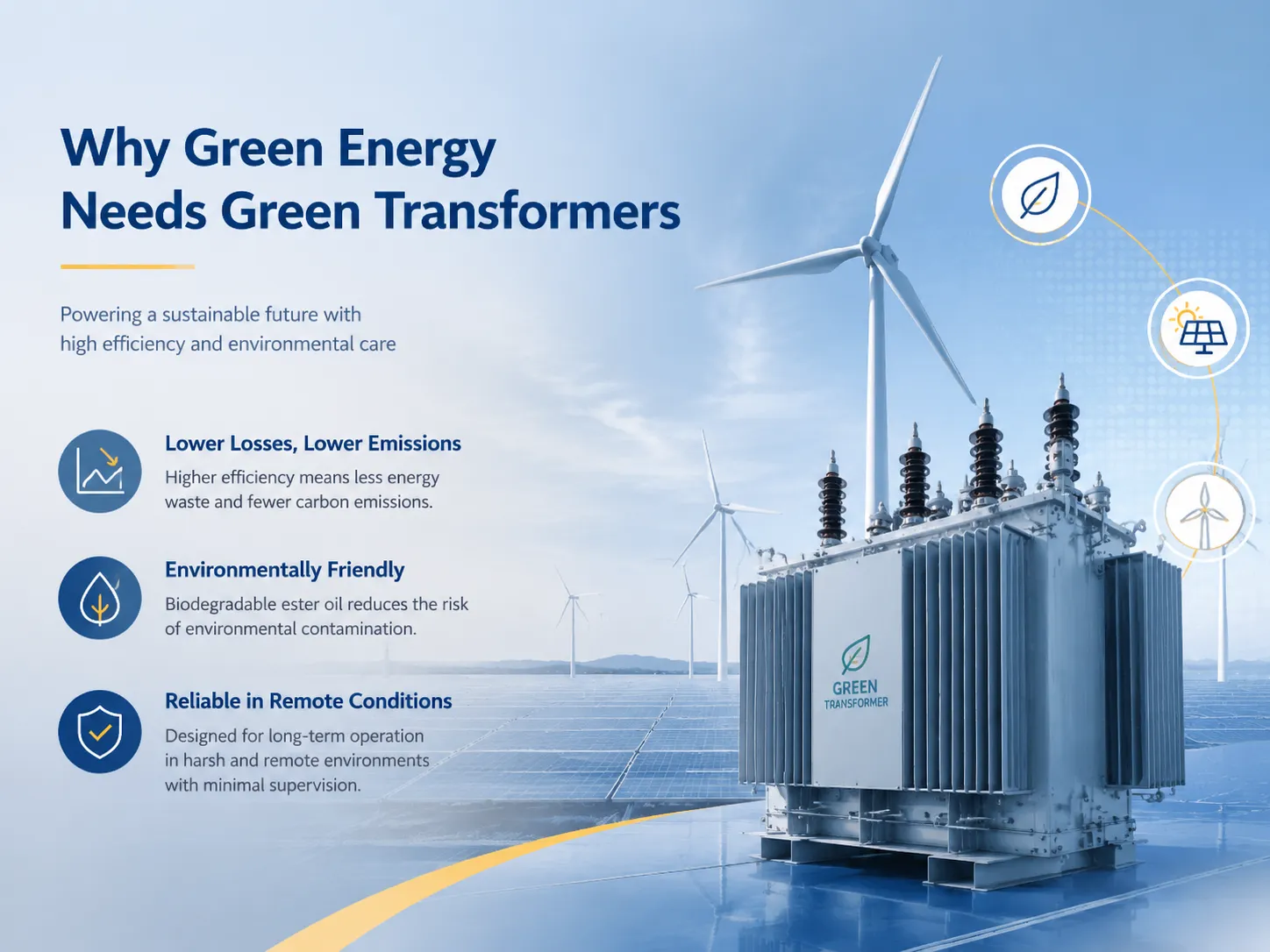
Il settore della generazione di energia verde, che comprende la generazione di energia eolica, la generazione di energia solare e la generazione di energia da stoccaggio, ha un profilo insolito in termini di trasformatori utilizzati nei progetti di generazione di energia. I generatori producono energia a diversi livelli di output e in luoghi remoti. I trasformatori utilizzati per questi prodotti sono in funzione da molti decenni e richiedono pochissima supervisione. Ecco due implicazioni di questo fatto:
- Perdite come emissioni: qualsiasi quantità di energia persa al trasformatore sarebbe già stata prodotta due volte – una volta dalla struttura di generazione rinnovabile e una volta dalla centrale di backup. Se le perdite in un trasformatore vengono ridotte, anche la quantità di emissioni prodotte dal sistema diminuirà.
- Luoghi remoti e delicati: le turbine eoliche si trovano in campi e al largo, le strutture di energia solare si trovano in deserti e aree popolate. Ciò significa che la fuoriuscita di olio minerale in tali luoghi è un grave incidente ambientale, mentre la fuoriuscita di olio estere biodegradabile ha un impatto nullo o ridotto sull'ambiente.
Di conseguenza, le banche di progetto e i dipartimenti di sostenibilità prestano particolare attenzione alle specifiche dei trasformatori. Anche se i trasformatori hanno una piccola quota nel costo della costruzione di stazioni eoliche o solari (circa 30-50 MW), rappresentano una quota significativa sia nei rischi ambientali che nelle emissioni durante l'intero ciclo di vita.
Nuclei a bassa perdita: acciaio amorfo e ad alta permeabilità
Il nucleo rappresenta il più grande influenzatore ambientale poiché la perdita a vuoto continua a verificarsi tutto il tempo. La differenza tra due esempi di trasformatore da 1.000 kVA è sorprendente.
| Tecnologia del nucleo | Perdita a vuoto | Energia annuale sprecata | Equivalente annuale di CO2* |
|---|---|---|---|
| GOES convenzionale (vecchio design) | 500–2.100 W | 100–18.400 kWh | 6,5–9,2 t |
| GOES ad alta permeabilità 0,23 mm | 700–1.100 W | 100–9.600 kWh | 3,1–4,8 t |
| Metallo amorfo | 350–500 W | 100–4.400 kWh | 1,5–2,2 t |
*Emissioni di base a un tasso di 0,5 kg CO2/kWh. Questo è fornito solo a scopo informativo. Le emissioni dipendono dalla generazione di energia della rete locale.
La tecnologia del nucleo amorfo ha rivoluzionato l'industria grazie ai miglioramenti del 60-70% osservati riguardo alle perdite a vuoto, un importante progresso ambientale.
Olio estere naturale: isolamento biodegradabile
L'olio estere naturale è considerato la seconda parte importante di un trasformatore verde. Poiché è preparato utilizzando materiali di origine vegetale, è ambientalmente diverso dall'olio minerale nei seguenti aspetti:
- Biodegradabilità: L'olio estere naturale è noto per degradarsi naturalmente nel suolo e nell'acqua, il che significa che le fuoriuscite non portano a incidenti di rifiuti pericolosi.
- Sicurezza antincendio: Dato il punto di infiammabilità di 300 °C (rispetto a 135–150 °C dell'olio minerale), l'olio estere naturale riduce il rischio di incendio, rendendo possibile utilizzare questo olio ecologico in installazioni di utilità situate in aree urbane.
- Prestazioni termiche: L'olio estere naturale consente di lavorare a temperature più elevate, portando a una maggiore durata della carta isolante o a un aumento dei carichi mantenendo una capacità equivalente.
Lo svantaggio dell'uso dell'olio estere naturale sarebbe che è costoso e ha una viscosità diversa, poiché il costo dell'olio estere naturale è 2-3 volte superiore a quello dell'olio minerale, mentre la viscosità di questi due materiali è anche diversa, costringendo i progettisti a modificare pompe e refrigeratori nei sistemi in cui viene utilizzato questo olio.
Riduzione del Rumore e Impatto Ambientale
Il rumore è un elemento ambientale, e la R&D dei trasformatori lo pone in prima linea nel monitoraggio. Il rumore del nucleo deriva principalmente dalla magnetostruzione, il che significa che il materiale viene fisicamente esteso durante la magnetizzazione, oltre ai giunti di design tra gli strati. Le misure impiegate nel design ecologico sono:
- Utilizzo di giunti a passo e giunti a miter che consentono di ridurre la distorsione del flusso nei giunti,
- Operare a bassa densità di flusso del nucleo sacrificando così poco materiale e guadagnando i decibel necessari,
- Utilizzo di involucri insonorizzati e montaggi delle unità più rumorose.
I risultati mostrano che i trasformatori di distribuzione ben realizzati operano a 48–58 dB(A) a 1 metro, mentre un design più vecchio o mal assemblato produrrebbe rumore a 55–65 dB(A). La differenza di 3–8 dB(A) è approssimativamente equivalente alla metà del suono per il vicino.
Prestazioni Ambientali del Ciclo di Vita
Per valutare correttamente le prestazioni ambientali di un trasformatore, è necessaria una valutazione da una prospettiva del ciclo di vita. Le quote per un tipico trasformatore di distribuzione su un arco di vita di 25 anni sono illustrate nel grafico sottostante:
| Fase del ciclo di vita | Quota delle emissioni del ciclo di vita (indicativa) | Principale fattore trainante |
|---|---|---|
| Produzione (incorporata) | 5–15% | Acciaio, rame ed energia della fabbrica |
| Operazione — perdite a vuoto | 30–50% | Perdite del nucleo che funzionano 8.760 h/anno |
| Operazione — perdite da carico | 20–40% | Perdite di avvolgimento dipendenti dalla corrente |
| Fine vita | 0–5% | Smaltimento dell'olio e riciclaggio dei materiali |
In tali situazioni, la perdita è il concetto dominante, rendendo il trasformatore ecologicamente sostenibile praticamente equivalente a quello efficiente. Questo spiega perché efficienza e affermazioni ecologiche coincidano nel marketing dei trasformatori verdi e perché i clienti debbano controllare le informazioni sulle perdite nel rapporto di prova piuttosto che sull'etichetta.
Applicazioni in Vento, Solare e Stoccaggio
Le principali applicazioni di energia verde e le configurazioni di trasformatore che si adattano a esse:
| Applicazione | Ruolo del trasformatore | Configurazione verde preferita |
|---|---|---|
| Parchi eolici onshore | Turbina step-up, 0.69/33kV; stazione 33/110kV | Nucleo amorfo, olio estere, controllo del rumore |
| Eolico offshore | Stazione di trasformazione offshore step-up | Unità di potenza ad alta efficienza, compatte e robuste |
| Solare su scala di utilità | Inverter step-up 0.4/33kV o 0.6/33kV | Classe 1–2, a bassa perdita, classificato per esterni |
| Stoccaggio di batterie | Trasformatore PCS, 0.4/10kV o 0.69/33kV | Design a bassa perdita da carico per cicli elevati |
| Idrogeno verde e e-fuels | Grandi trasformatori step-up e raddrizzatori | Trasformatori di potenza ad alta efficienza |
In ogni caso, il processo rimane lo stesso: il design ecologico richiede maggiori spese iniziali, ma i risparmi in termini di danni e crediti ambientali supportano il finanziamento, i permessi e gli impegni di sostenibilità dello sviluppatore.
Opzioni e Prezzi dei Trasformatori Verdi
Prezzi FOB indicativi per un trasformatore di distribuzione ecologico da 1.000 kVA 10/0.4 kV per marca:
| Marca | Origine | Classe 2 (GOES, olio minerale) | Nucleo amorfo + olio estere |
|---|---|---|---|
| Hitachi Energy | Giappone/Globale | $9.000–$12.500 | $14.000–$21.000 |
| ABB | Svizzera/Globale | $8.500–$12.000 | $13.500–$20.000 |
| Siemens Energy | Germania/Globale | $8.000–$11.500 | $13.000–$19.500 |
| Schneider Electric | Francia/Globale | $7.500–$11.000 | $12.500–$19.000 |
| Jiangsu Subian Energia Elettrica | Cina | $4.000–$7.000 | $5.500–$11.000 |
I prezzi dipendono dalla potenza, dalla classe di perdita e dal tipo di olio che hanno, se hanno un cambiavalute tra gli altri parametri e devono essere considerati come intervalli per scopi di pianificazione e non come offerte.
I produttori di tutto il mondo hanno una lunga esperienza e buoni programmi di collaudo per lo sviluppo di progetti a base di olio estere e design amorfi. Oggi i produttori cinesi offrono la stessa tecnologia e soluzioni di olio ma con un prezzo inferiore del 40-50 percento rispetto ai loro concorrenti, il che aiuta ad avere accesso a trasformatori ecologici anche nei mercati dove i costi sono importanti. Jiangsu Subian Electric Power è un produttore cinese di trasformatori verdi e trasformatori a risparmio energetico che produce trasformatori a nucleo amorfo e a olio estere naturale, che vanno da 10 kV a 63 MV, testati secondo IEC 60076 e spediti con tutti i relativi rapporti di prova. Subian ha fornito unità verdi a progetti eolici, solari e di stoccaggio in Asia, Africa, Medio Oriente e Sud America — la sua gamma è documentata su subian-electric.com.
Come scegliere un trasformatore verde
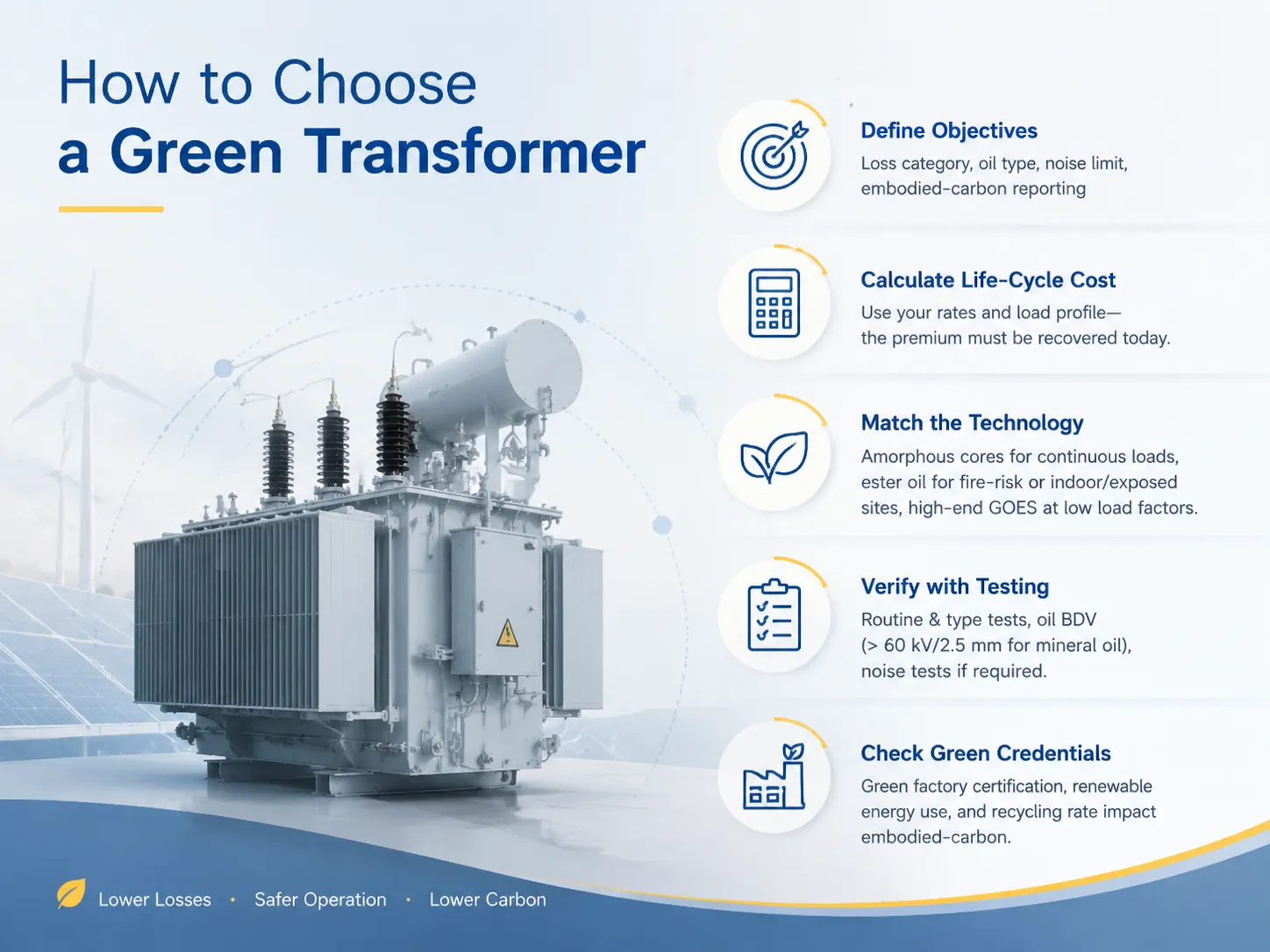
- Stabilire gli obiettivi ambientali: categoria di perdita, tipo di olio, limite di rumore e eventuali prodotti di reporting sul carbonio incorporato richiesti per il progetto.
- Calcolare la capitalizzazione delle perdite utilizzando le proprie tariffe e il profilo di carico — il premio deve essere ricevuto oggi.
- Assegnare la tecnologia in base al sito: nuclei amorfi per carichi continui, olio estere per siti resistenti al fuoco in caso di operazione interna ed esposizione ambientale, e GOES di alta qualità a bassi fattori di carico.
- Richiesta di prove di collaudo: test di perdite di routine per ogni unità, test di tipo per ogni design, tensione di rottura dell'olio (necessaria > 60 kV/2,5 mm per olio minerale fresco; controllare separatamente le specifiche dell'olio estere), e test di rumore dove richiesto.
- Controllare le credenziali ecologiche dell'impianto: la certificazione della fabbrica verde e il tasso di energia rinnovabile e riciclaggio influenzano i numeri di carbonio incorporato.
Le specifiche della disciplina assegnata sono state le stesse per i trasformatori: la differenza oggi è che le caratteristiche ambientali del prodotto sono determinate e possono essere verificate.
Domande frequenti
Cosa rende un trasformatore ecologicamente sostenibile?
Ci sono quattro qualità misurate, ovvero bassa perdita a vuoto (nuclei amorfi o ad alta permeabilità), utilizzo di olio estere naturale biodegradabile invece di olio minerale, basso livello di rumore e minore impronta di carbonio attraverso un processo di produzione ecologicamente sostenibile.
Quanto costa un trasformatore verde?
Il costo di un'unità da 1.000 kVA con nucleo amorfo e olio estere naturale è di circa $5.500 a $11.000 FOB presso i produttori cinesi. I marchi premium hanno il loro intervallo di prezzo 50% a 80% superiore a questo costo. C'è un ulteriore aumento di prezzo di circa 20% a 55% per la configurazione ecologicamente sostenibile, che dipende dal tipo di nucleo e olio scelto.
I trasformatori ecologici valgono il costo aggiuntivo?
In caso di situazioni in cui il carico è costante o in cui viene utilizzata un'applicazione sensibile, la risposta è sì. I risparmi sui perdite ripagano il premio in 3-8 anni e l'olio estere elimina il rischio di incendio/perdita oltre a ridurre le emissioni. Tuttavia, per applicazioni a basso carico e a basso rischio, un'unità standard ad alta efficienza dovrebbe rappresentare il miglior valore.
I trasformatori a olio estere funzionano altrettanto bene delle unità a olio minerale?
In termini di prestazioni elettriche, entrambi sono sviluppati secondo gli stessi standard di costruzione e test IEC 60076 e condividono un sistema di classi di efficienza simile. Tuttavia, in termini di sicurezza antincendio e sostenibilità ambientale, si raccomanda l'olio estere ma richiede un costo aggiuntivo di 10-25% per l'olio e modifiche nel sistema di raffreddamento a causa della sua maggiore viscosità.
Quanto CO2 risparmia un trasformatore in applicazioni verdi?
Utilizzando un fattore di rete di 0,5 kg CO2/kWh, sostituire un trasformatore da 1.000 kVA degli anni '90 con un trasformatore a disegno amorfo può portare a un risparmio di 5.000-7.000 kWh e di 2,5-3,5 t di CO2 all'anno, il che significa circa 60-90 t complessivamente durante l'intero periodo di 25 anni. I risparmi totali possono essere molto maggiori su unità di generazione di energia elettrica prodotta da vento o sole contenenti dozzine di trasformatori.
Riferimenti
- IEC 60076-1: Trasformatori di potenza – Generale — Baseline internazionale per la valutazione e il collaudo dei trasformatori verdi.
- IEC 62770: Estere naturali per trasformatori — Specifica per liquidi isolanti a base di estere naturale.
- GB 20052: Classi di efficienza energetica per trasformatori di potenza — Classi di efficienza alla base dei progetti a bassa perdita.
- Programma di efficienza energetica IEA — Dati sulla quota di perdita dei trasformatori e integrazione dell'energia verde.
- Sistema di produzione verde MIIT — Certificazione di fabbrica verde rilevante per il carbonio incorporato.
- Programma di efficienza dei trasformatori del DOE degli Stati Uniti — Classi di efficienza e riferimento economico delle perdite.
- Sito ufficiale di Jiangsu Subian Electric Power — Gamma di trasformatori a nucleo amorfo e a olio estere naturale.
Conclusione
I trasformatori di potenza verdi sono l'elemento chiave dell'energia verde che viene raramente menzionato negli annunci di progetto. Tuttavia, rappresentano una proporzione significativa delle emissioni e dei rischi ambientali durante l'intero ciclo di vita. Questa tecnologia è testata, standardizzata e sempre meno costosa: nuclei amorfi, olio estere naturale, basso rumore e produzione ecologica si unificano per produrre trasformatori la cui sostenibilità corrisponde all'elettricità che trasmettono.
Titoli:
- Il nucleo amorfo riduce la perdita a vuoto del 60%-70%, riducendo le emissioni nelle installazioni di energia rinnovabile.
- L'olio estere può essere rilevato in natura e non si infiamma, il che significa che il rischio di inquinamento durante i viaggi e nelle città è minimizzato.
- L'uso di attrezzature ecologiche contribuisce con un ulteriore 20%-55% al prezzo di acquisto in un colpo solo, ma si ripaga entro 3-8 anni attraverso la riduzione delle perdite e dei rischi.