


A project engineer from a wind power producer in Europe was analyzing technical specifications of transformers for a wind farm with capacity of 30MW. Transformers supplying electricity from generator to the grid were located close to turbines, and some of them were subjected to reviews by a sustainability board that took into consideration losses over the period of 25 years, oil carbon footprint and end of life recycling issues. Regular mineral oil transformer would have passed the technical approval process. However, the winning proposal was that of eco-friendly transformer packaging that included amorphous core transformer filled with natural ester oil with proven lower carbon footprint, which has made financial sense in terms of contributions to the overall project expenditures.
The present paper provides an overview of features which make a power transformer environmentally friendly and mechanism of its operation along with its costs.
Concise response: A power transformer that is friendly to the environment should have minimum harm on the environment throughout the life cycle, including minimal no-load losses (amorphous alloy cores reduce no-load losses by 60 to 70%), use of biodegradable natural ester oil instead of mineral oil, quieter operation, increased recyclability, and smaller embodied carbon footprint due to green production methods. When it comes to efficiency, green transformers are supporting the environmentally-friendly energy – the operating costs standing at the range of $0.08 to $0.10/kWh cost back premium price in 3 to 8 years if units are operated with continuous load and ester-oil units minimize the fire risk and environmental cost at wind, solar, and urban sites.
What an Environmentally Friendly Power Transformer Is
An eco-friendly transformer is created and produced in such a way that it has the smallest ecological footprint through its entire lifecycle (minimal operational losses, reduced risk of fire and leakage, quieter performance, easier disposal, etc.). This is not a single technology but a series of choices made in different processes, which can be monitored.
| Life-cycle stage | Conventional choice | Green choice |
|---|---|---|
| Manufacturing | Standard grid electricity, mixed steel | Green factory, renewable energy, recycled materials |
| Operation — core | 0.30 mm conventional GOES | 0.23 mm high-permeability or amorphous core |
| Operation — insulation | Mineral oil | Natural ester (vegetable) oil |
| Operation — noise | Basic core design | Step-lap joints, sound enclosures (3–8 dB(A) lower) |
| End of life | Oil disposal as hazardous waste | Biodegradable oil, recyclable steel and copper |
As a result, the transformer generates lower impacts on the environment and has a smaller carbon footprint at every step of its life cycle — and this is why it is possible to refer to this configuration consistently as the green transformer.
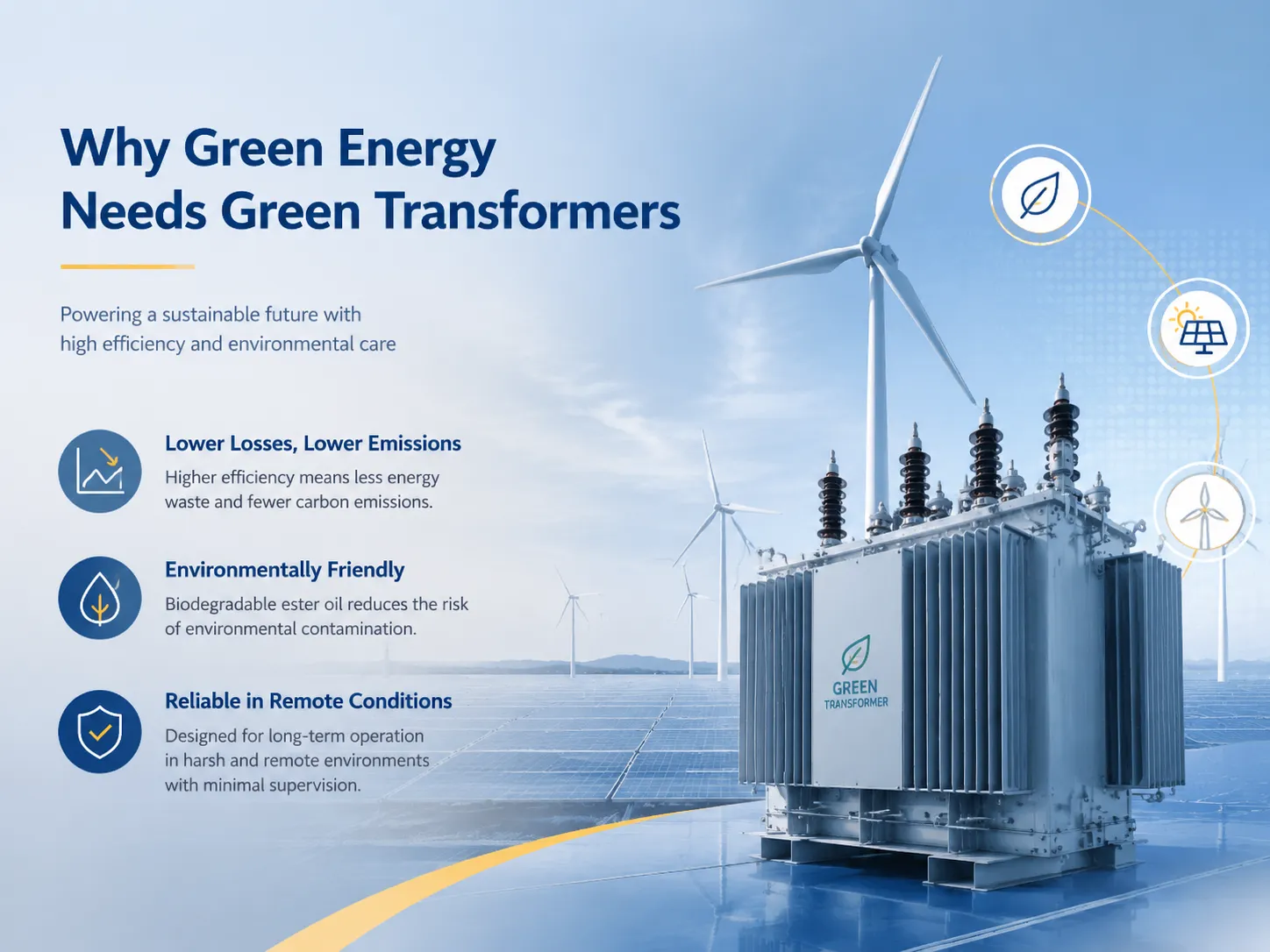
Why Green Energy Needs Green Transformers
The green energy generation sector, comprising wind energy generation, solar energy generation, and energy storage generation, has an unusual profile in terms of transformers used in energy generation projects. The generators produce energy at different levels of output and at remote places. The transformers used for these products have been in operation for many decades and require very little supervision. Here are two implications of this fact:
- Losses as emissions: any amount of energy lost at the transformer would have already been produced twice – once by the renewable generation facility and once by the backup power station. If the losses in a transformer are reduced, the amount of emissions produced by the system will also be decreased.
- Remote and delicate locations: wind turbines are located in fields and offshore, solar power facilities are located in deserts and populated areas. That means that the leak of mineral oil at such locations is a major environmental accident, whereas the leakage of the biodegradable ester oil has no or little impact on the environment.
As a result, project banks and sustainability departments pay special attention to the specifications of transformers. Though transformers have a small share in the cost of wind or solar station construction (about 30-50 MW), they represent a significant share both in the environmental risks and emissions over the entire life cycle.
Low-Loss Cores: Amorphous and High-Permeability Steel
The core represents the biggest environmental influencer as no-load loss continues to occur all the time. The difference between two examples of 1,000 kVA transformer is amazing.
| Core technology | No-load loss | Annual energy wasted | Annual CO2 equivalent* |
|---|---|---|---|
| Conventional GOES (old design) | 1,500–2,100 W | 13,100–18,400 kWh | 6.5–9.2 t |
| High-permeability 0.23 mm GOES | 700–1,100 W | 6,100–9,600 kWh | 3.1–4.8 t |
| Amorphous metal | 350–500 W | 3,100–4,400 kWh | 1.5–2.2 t |
*Base emissions at a rate of 0.5 kg CO2/kWh. This is only being provided for information purposes. The emissions are dependent on local grid power generation.
The amorphous core technology has revolutionized the industry because of the 60-70% improvements seen with regards to no-load losses, a major environmental advance.
Natural Ester Oil: Biodegradable Insulation
Natural ester oil is considered to be the second important part of a green transformer. Since it is prepared using vegetable-derived materials, it is environmentally different from mineral oil in the following facets:
- Biodegradability: Natural ester oil is known to degrade naturally in soil and water, which means that leakages do not lead to incidents of hazardous waste.
- Fire safety: Given the flash point of 300 °C (in comparison to 135–150 °C of mineral oil), natural ester oil decreases the risk of fire, making it possible to use this environmentally friendly oil in utility installations that are located in urban areas.
- Thermal performance: Natural ester oil makes it possible to work at higher temperatures, leading to a longer lifespan of the insulation paper or to getting more loads while providing an equal capacity.
The drawback of using natural ester oil would be that it is expensive and has a different viscosity since the cost of natural ester oil is 2-3 times higher than that of mineral oil, while the viscosity of these two materials is also different, prompting the designers to modify pumps and coolers in the systems where this oil is used.
Noise Reduction and Environmental Impact
Noise is an environmental element, and transformer R&D puts it on the forefront of monitoring. Core noise results primarily from magnetostriction, meaning the material is physically extended in the course of magnetization, plus the design joints in between layers. The measures employed in green design are:
- Use of step-lap and mitered core joints allowing to reduce distortion of the flux at the joints,
- Operating at low core flux density thus sacrificing little material and gaining the needed decibels,
- Use of soundproof enclosures and mountings of the loudest units.
Results show that well-made distribution transformers operate at 48–58 dB(A) at 1 meter while older or badly joined design would make noise at 55–65 dB(A). The 3–8 dB(A) difference is approximately equivalent to the half of the sound for the neighbor.
Life-Cycle Environmental Performance
In order to evaluate the environmental performance of a transformer correctly, an assessment from a life-cycle perspective is necessary. The shares for a typical distribution transformer over a life span of 25 years are illustrated in the chart below:
| Life-cycle phase | Share of life-cycle emissions (indicative) | Main driver |
|---|---|---|
| Manufacturing (embodied) | 5–15% | Steel, copper, and factory energy |
| Operation — no-load losses | 30–50% | Core losses running 8,760 h/year |
| Operation — load losses | 20–40% | Current-dependent winding losses |
| End of life | 0–5% | Oil disposal and material recycling |
In such situations, loss is the dominating concept, making environmentally sound transformer virtually equal to the efficient one. This explains why efficiency and green claims coincide in the marketing of green transformers and why clients must check loss information in the test report rather than on the label.
Applications in Wind, Solar, and Storage
The main green energy applications, and the transformer configurations that fit them:
| Application | Transformer role | Preferred green configuration |
|---|---|---|
| Onshore wind farms | Turbine step-up, 0.69/33kV; station 33/110kV | Amorphous core, ester oil, noise control |
| Offshore wind | Offshore substation step-up | High-efficiency power units, compact and robust |
| Utility-scale solar | Inverter step-up 0.4/33kV or 0.6/33kV | Grade 1–2, low-loss, outdoor-rated |
| Battery storage | PCS transformer, 0.4/10kV or 0.69/33kV | Low-load-loss designs for high cycling |
| Green hydrogen and e-fuels | Large step-up and rectifier transformers | High-efficiency power transformers |
In every instance, the process remains the same: the green design requires more up front expenditures, but the savings in the amount of damage and environmental credits support financing, permitting, and the developer’s sustainability pledges.
Green Transformer Options and Prices
Indicative FOB pricing for a 1,000 kVA 10/0.4 kV environmentally friendly distribution transformer by brand:
| Brand | Origin | Grade 2 (GOES, mineral oil) | Amorphous core + ester oil |
|---|---|---|---|
| Hitachi Energy | Japan/Global | $9,000–$12,500 | $14,000–$21,000 |
| ABB | Switzerland/Global | $8,500–$12,000 | $13,500–$20,000 |
| Siemens Energy | Germany/Global | $8,000–$11,500 | $13,000–$19,500 |
| Schneider Electric | France/Global | $7,500–$11,000 | $12,500–$19,000 |
| Jiangsu Subian Electric Power | China | $4,000–$7,000 | $5,500–$11,000 |
Prices depend on the rating, what loss class and what type of oil they have, whether they have a tap changer among other parameters and should be treated as ranges for planning purposes and not offers.
Manufacturers all over the world have long experience and good type testing programs for development of ester-oil and amorphous designs. Today the Chinese manufacturers provide the same technology and oil solutions but with 40-50 percent lower price as compared to their competitors, which helps to have access to environmentally friendly transformers even in the markets where the costs matter. Jiangsu Subian Electric Power is a Chinese manufacturer of green transformers and energy-saving transformers that produces amorphous core and natural ester oil transformers, ranging from 10 kV to 63 MV, tested in accordance with IEC 60076 and shipped with all relevant test reports.Subian has supplied green units to wind, solar, and storage projects across Asia, Africa, the Middle East, and South America — its range is documented on subian-electric.com.
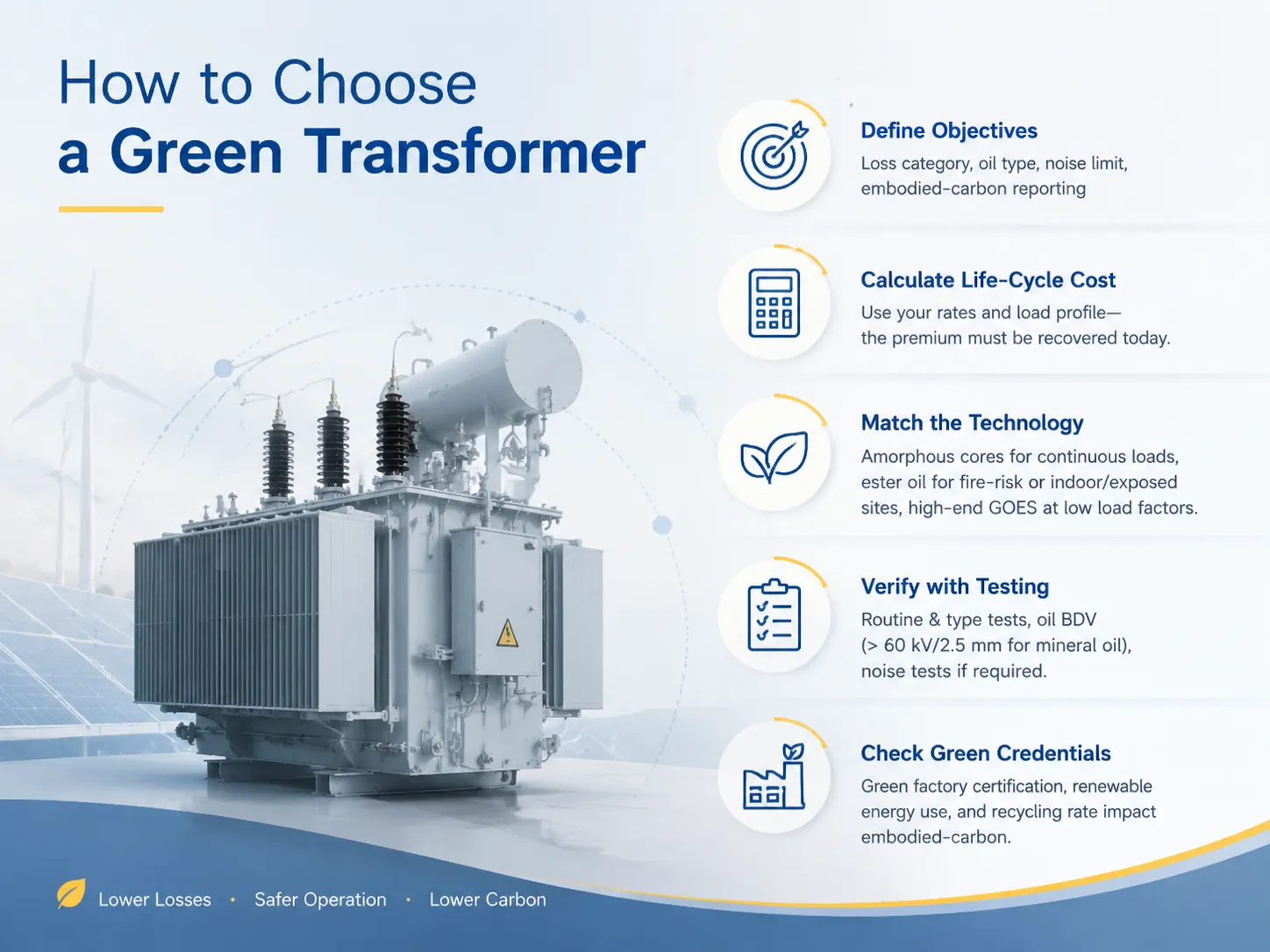
How to Choose a Green Transformer
- Establish the environmental objectives: loss category, oil type, noise limit and any embodied-carbon reporting products required for the project.
- Compute loss capitalization using your rates and load profile — the premium has to be received today.
- Assign the technology according to the site: amorphous cores for continuous loads, ester oil for fire-resistant sites in case of indoor operation and environment exposure, and high-end GOES at low load factors.
- Demand for testing evidence: routine losses tests for each unit, type tests for each design, oil breakdown voltage (needed > 60 kV/2.5 mm for fresh mineral oil; look at ester oil specification separately), and noise testing where required.
- Check the green credentials of the plant: green factory certification and renewable energy and recycling rate affect the embodied-carbon numbers.
The specifications of the assigned discipline have been the same for transformers: the difference today is that the environmental characteristics of the product are determined and can be audited.
Frequently Asked Questions
What makes a transformer environmentally friendly?
There are four measured qualities namely low-no load loss (amorphous or high permeable cores), usage of biodegradable natural ester oil instead of mineral oil, low noise level, and less carbon footprint through environmentally friendly manufacturing process.
How much does a green transformer cost?
The cost of a 1,000 kVA unit with an amorphous core and natural ester oil is approximately $5,500 to $11,000 FOB at Chinese manufacturers. The premium brands have their price range 50% to 80% higher than this cost. There is an additional price increase of approximately 20% to 55% for the environmentally-friendly configuration, which depends on the type of core and oil chosen.
Are environmentally friendly transformers worth the extra cost?
In case of situations where the load is constant or where sensitive application is used, the answer is yes. The loss savings pay back the premium in 3 to 8 years, and the ester oil eliminates the fire/leak risk in addition to lower emission. However, for low load low-risk applications, a standard high efficiency unit should be the best value.
Do ester-oil transformers perform as well as mineral-oil units?
In terms of electrical performance, they are both developed to the same IEC 60076 construction and testing standards and share a similar efficiency class system. However, in terms of fire safety and environmental friendliness, ester oil is recommended but requires an additional 10-25% in oil costs and alterations in the cooling system due to its higher viscosity.
How much CO2 does a transformer save in green applications?
Using a grid factor of 0.5 kg CO2/kWh, exchanging a 1,000 kVA transformer from the 1990s with an amorphous drawing transformer can lead to saving of 5,000-7,000 kWh and of 2.5–3.5 t of CO2 annually, which means around 60–90 t overall during the entire 25-year period. The total savings can be much larger on wind or solar generated electrical energy generation units containing dozens of transformers.
References
- IEC 60076-1: Power transformers – General — International rating and testing baseline for green transformer verification.
- IEC 62770: Natural esters for transformers — Specification for natural ester insulating liquids.
- GB 20052: Energy efficiency grades for power transformers — Efficiency grades underpinning low-loss designs.
- IEA energy efficiency programme — Data on transformer loss share and green energy integration.
- MIIT green manufacturing system — Green factory certification relevant to embodied carbon.
- US DOE transformer efficiency programme — Efficiency classes and loss economics reference.
- Jiangsu Subian Electric Power official site — Amorphous-core and natural-ester-oil transformer range.
Conclusion
Green power transformers are the key element of green energy that is rarely mentioned in project announcements. However, they account for a significant proportion of emissions and environmental risks over their entire lifecycle. This technology is tested, standardised, and increasingly less costly: amorphous cores, natural ester oil, low noise, and eco-friendly production are unified to result in transformers whose eco-friendliness corresponds to electricity they transmit.
Headlines:
- Amorphous core decreases no-load loss by 60%-70%, reducing emissions at renewable energy installations.
- Ester oil can be detected in nature and does not ignite, which means that travelling and cities pollution risk is minimised.
- The use of eco-friendly equipment contributes an additional 20%-55% to the purchase price in one go but pays back within 3 to 8 years through losses and risk decrease.