


アメリカとヨーロッパの変圧器の違いを検査すると、産業バイヤーは製造場所だけでなく、こうした電気機器に関連する仕様、試験、書類に使用されるプロセスも重要であることに気づくでしょう。例えば、ヨーロッパに拠点を置くEPC請負業者を利用しているテキサスの工場の調達マネージャーを考えてみてください。提供される機器には異なるコードと仕様があります。アメリカ版はIEEE C57.12.00、冷却タイプOA/FA、12.47 kVの一次電圧を指定しているのに対し、ヨーロッパ版はIEC 60076、冷却タイプONAN/ONAF、10 kVまたは20 kVを提供しています。両方の変圧器モデルは正常に機能するはずですが、これを可能にするためにはエンジニアリングの手配が必要です。この記事では、両タイプの変圧器の違いを示し、正確な比較が行われ、追加の再試験コストなしで適切な購入ができるようにします。.
簡潔な回答:アメリカとヨーロッパの変圧器は仕様が異なります。アメリカスタイルのギアボックスはANSI/IEEE基準(IEEE C57.12.00、C57.12.20)に従い、60 Hzで動作するネットワーク向けに設計されています。一方、一次電圧には12.47 kV、13.8 kV、または34.5 kVが含まれ、二次電圧は120/240 V、120/208 V、または277/480 Vです。ヨーロッパスタイルのトランスポンダーはIEC 60076基準に従い、50 Hzで動作し、一次電圧は6.6 kV、10 kV、11 kV、20 kV、または33 kV、二次電圧は230/400 Vです。変圧器の冷却方法、インピーダンス許容範囲、ベクトルグループのマーキング、タップ変更方法、試験用の書類はすべてスタイルによって異なります。.
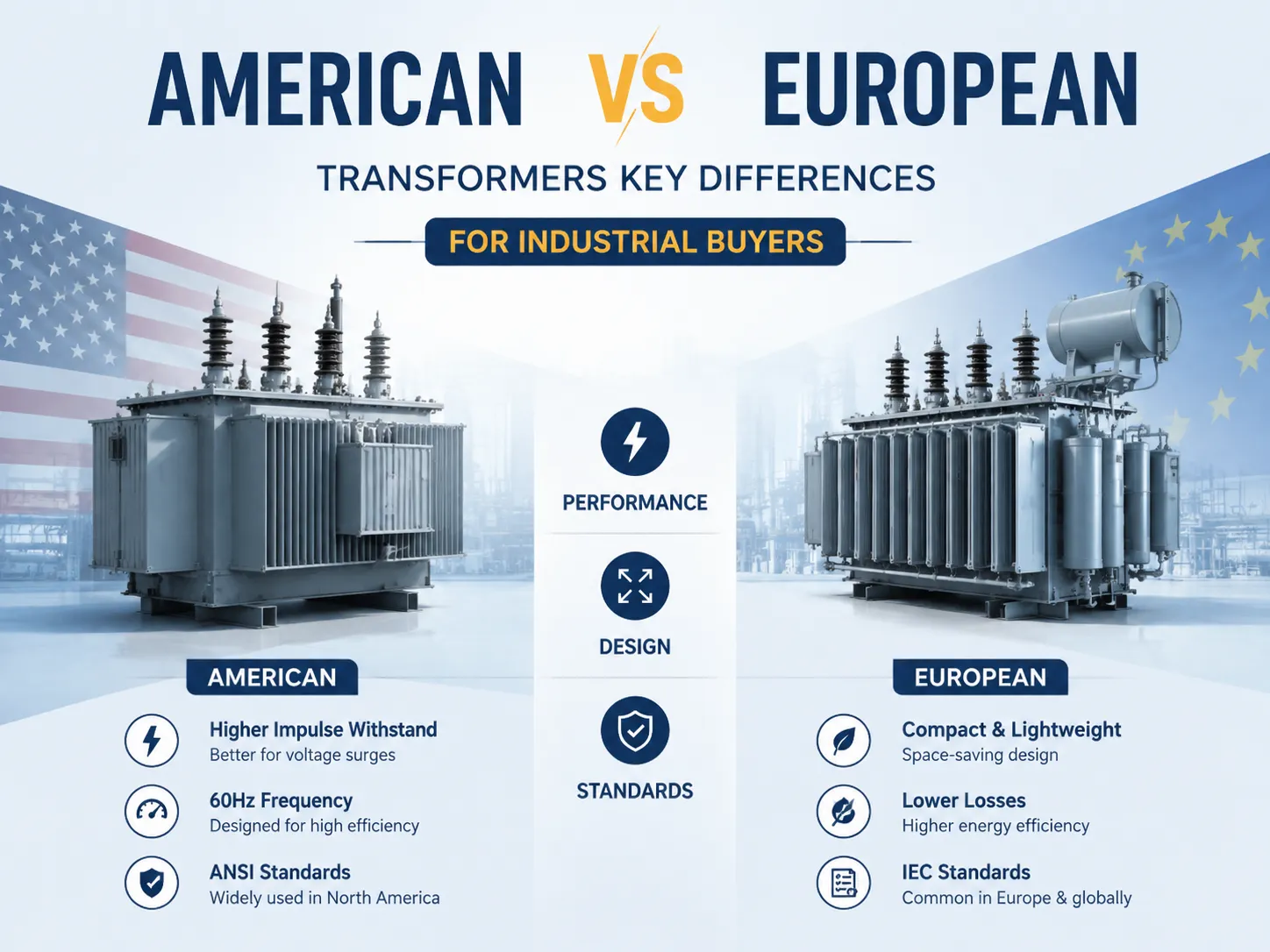
定義:二つのファミリーとは何か
アメリカの変圧器はANSI/IEEE基準に従って動作します。これらの変圧器は60 Hzの電気システムで完璧に機能します。アメリカの変圧器が使用する一次電圧レベルは7.2 kV、12.47 kV、13.8 kV、24.9 kV、34.5 kVです。さらに、これらの変圧器がエンドユーザー向けに提供する電圧には120ボルト、240ボルト、220ボルト、277ボルト、600ボルトが含まれます。アメリカの変圧器の性能仕様はIEEE C57設計基準に基づいており、インピーダンスやBILを含みますが、これに限定されません。.
一方、ヨーロッパの変圧器はIEC 60076基準に従って製造されています。これらの変圧器は50 Hzのグリッドを必要とし、6.6 kV、10 kV、11 kV、20 kV、33 kV、35 kVなどのさまざまな電圧レベルがあります。これらの変圧器で使用される低電圧システムは主に230ボルト、400ボルト、415ボルトです。IEC基準の仕様は世界のほとんどの地域で認識されています。.
適用される設計基準に違いがあるものの、二つの装置は同じ電磁物理学の原理に基づいて動作します。これは、エンドユーザーにとって、両方の種類の変圧器の適用には異なるアプローチが必要であることを意味します。.
規制基準:ANSI/IEEE対IEC 60076
- IEEE C57.12.00は、米国の実務における変圧器の一般仕様に関するもので、定格、BIL、温度上昇、インピーダンスなどのさまざまなパラメータに関するものです。.
- IEEE C57.12.20およびC57.12.90は、絶縁、誘電体、騒音などに関連する試験を説明する構造および試験文書を指します。.
- NEMA TP-1は、米国のユーティリティ損失評価計算に使用される効率の参照文書です。.
- IEC 60076-1は、電力変圧器の一般要件を指し、IEC 60076シリーズの包括的な文書です。.
- IEC 60076-2(温度上昇)、-3(絶縁レベル)、-5(短絡耐力)、-10(音レベル)は、さまざまな試験オプションを指定する特定のIECカテゴリです。.
欧州の技術マニュアルは「IEC 60076-1、-2、-3および-5に準拠した変圧器、ベクトルグループDyn11、冷却タイプONAN/ONAF」と記載しますが、米国の技術マニュアルは「IEEE C57.12.00に準拠した変圧器、冷却タイプOA、65度セ氏の上昇、12.47 kVクラスおよび95 kV BIL」と記載します。“
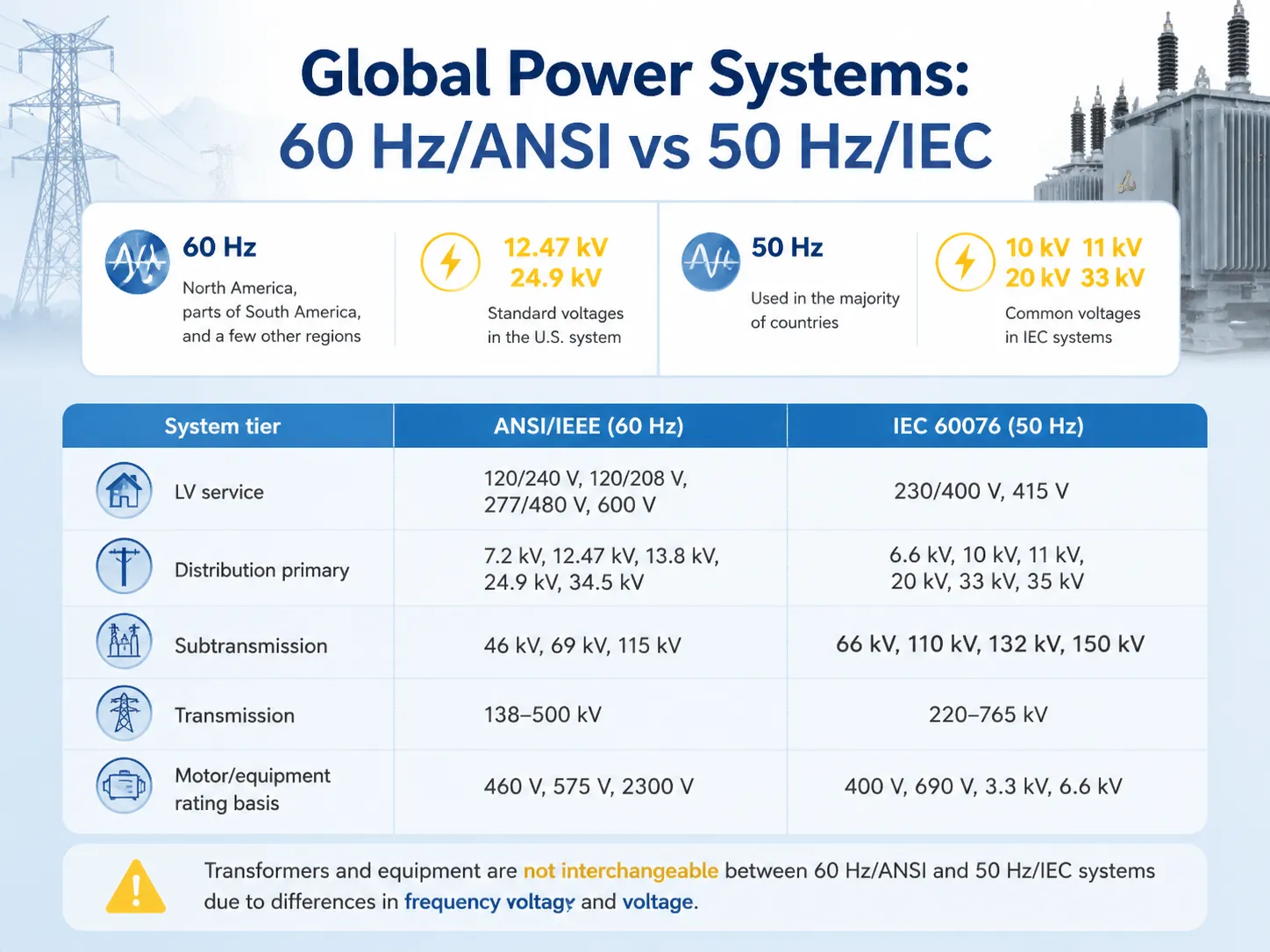
周波数と電圧クラスの比較
周波数は最初の主要な分割要因です。北米、南米の一部、およびいくつかの他の地域では60 Hzを使用していますが、大多数の国では50 Hzの周波数を持っています。変圧器の製造は特定の周波数を考慮して設計および構築されます。設計されていない周波数で動作する変圧器は、はるかに大きなフラックス密度をもたらし、飽和に近づく可能性があります。これにより、過熱、過剰な磁化電流、絶縁劣化などの重大な悪影響が生じます。.
The second parameter separating the two systems is voltage. The U.S. power grid uses voltages 12.47 kV and 24.9 kV as standard voltages, while IEC systems work with 10 kV, 11 kV, 20 kV , and 33 kV. The low-voltage side is also different in the U.S. (480 and 208 V) and IEC systems (400 and 415 V). This means that all equipment described is incompatible, as they differ in voltage.
| システム階層 | ANSI/IEEE(60 Hz) | IEC 60076(50 Hz) |
|---|---|---|
| LVサービス | 120/240 V、120/208 V、277/480 V、600 V | 230/400 V、415 V |
| 配電一次 | 2 kV、12.47 kV、13.8 kV、24.9 kV、34.5 kV | 6 kV、10 kV、11 kV、20 kV、33 kV、35 kV |
| サブトランスミッション | 46 kV、69 kV、115 kV | 66 kV、110 kV、132 kV、150 kV |
| トランスミッション | 138–500 kV | 220–765 kV |
| モーター/機器定格の基準 | 460 V、575 V、2300 V | 400 V、690 V、3.3 kV、6.6 kV |
冷却記号:OA/FA対ONAN/ONAF
冷却の表記は、RFQにおける初心者のエラーの主要な領域です。米国では、OA(油浸式および自己冷却)、FA(ファンによる強制空冷)、FOA(強制油および空気冷却)およびその組み合わせが一般的に使用される用語です。IECは4文字の表記システムを使用しています:O(鉱油)、NまたはF(自然または強制冷却)、AまたはW(空気または水)、NまたはF(自然または強制)。したがって、ONANはOAに相当し、ONAFはFAと同じです。コストを比較する前に、両方の見積もりを同じシステムに変換することを確認してください。ONANまたはONAFを使用しているサプライヤーと、OAを使用している米国の見積もりを比較すると、機械の特性が同等であっても、見積もりを確認している人々の間で多くの混乱を引き起こすことになります。.
| 意味 | ANSI/IEEE 表記 | IEC 表記 |
|---|---|---|
| 油浸式、自己冷却 | OA | ONAN |
| 油浸式、ファン冷却 | FA | ONAF |
| 強制油、強制空気 | FOA | OFAF |
| 強制油、強制水 | FOW | OFWF |
| 乾式、自然空気 | AA | AN |
ベクトルグループと位相ずれ
トランスの分類において2つのファミリーが異なるもう1つの側面は、ベクトルグループの命名法です。IECは時計番号システムを使用し、トランスが特定のベクトルグループに属することを示し、接続の種類を示す番号が続き、巻線の位相ずれを30度の倍数で示します(例えば:Dyn11は低電圧巻線が高電圧巻線に対して30度リードしていることを意味します)。アメリカで最も一般的に使用される方法はANSIによって導入されたもので、角度指定と接続バンクの概念を指します(例えば:30度の位相遅れを持つデルタ-ワイ)。アメリカで設置されているトランスの大部分(もしそうでない場合も)が単相モードで動作するため、ベクトルグループの問題はそれほど重要ではありません。それでも、ユーザーは使用されている表記に関係なく、3相機器の巻線接続と位相角を確認する必要があります。.
| 巻線接続 | IEC 表記 | ANSI/IEEEの説明 | 位相ずれ |
|---|---|---|---|
| デルタHV、ワイLV(中性点あり) | Dyn11 | デルタ-ワイ、30°遅れ(米国の慣例) | 330°(LVリード) |
| デルタHV、ワイLV、交互 | Dyn5 | デルタ-ワイ、150° | 150° |
| ワイHV、デルタLV | Yd11 | ワイ-デルタ、30° | 330° |
| ワイHV、ワイLV | Yyn0 | ワイ-ワイ、0° | 0° |
| デルタHV、デルタLV | Dd0 | デルタ-デルタ、0° | 0° |
試験、名札、および文書
試験哲学は、試験の範囲と結果の提示において異なります。IEC 60076規格は、ルーチン試験(比率、ベクトルグループ、抵抗、インピーダンスおよび負荷損失、無負荷損失および電流、絶縁試験)と型式試験(温度上昇、短絡耐性、音レベル)を定めており、許容差が明確に指定されています—例えば、インピーダンスに対して±10%および損失に対する指定された許容差。アメリカの実践は、IEEE C57.12.90によって確立された試験規則に従い、NEMA TP-1の損失評価式を使用します。ここで、公共事業は無負荷および負荷損失のワットあたりのドル価値を割り当て、製造業者に最適化を求めます。さらに、IEC諸国では、購入者は技術入札に型式試験の完全な報告書を含めることを期待しますが、アメリカの公共事業は工場での第三者検査または試験の立会いを要求します。しかし、文書は装飾ではなく、通関手続き、現場での受け入れ、保険取得の基礎として機能します。.
| 試験または要件 | ANSI/IEEEの実践 | IEC 60076の実践 |
|---|---|---|
| ルーチン試験の範囲 | IEEE C57.12.90に従って | IEC 60076-1に従って |
| インピーダンス許容差 | ±7.5% | ±10%標準 |
| 無負荷損失許容差 | 損失評価式に従って | IEC 60076-1に指定されている |
| 温度上昇試験 | 型式試験、65°Cクラス | 型式試験、IEC 60076-2 |
| 短絡耐性 | IEEE C57.12.90 | IEC 60076-5 |
| 音レベル | IEEE C57.12.90 基準 | IEC 60076-10 |
| Efficiency benchmark | NEMA TP-1 | IEC 60076-1 loss values |
Side-by-Side Comparison Table
| 視点 | American (ANSI/IEEE) | European (IEC 60076) |
|---|---|---|
| Nominal frequency | 60 Hz | 50 Hz |
| Governing standard | IEEE C57.12 series, NEMA | IEC 60076 series |
| Common distribution primaries | 12.47 kV, 13.8 kV, 24.9 kV, 34.5 kV | 6.6 kV, 10 kV, 11 kV, 20 kV, 33 kV |
| Common LV secondaries | 120/240 V、120/208 V、277/480 V、600 V | 230/400 V, 415 V, 6.3 kV, 10.5 kV |
| Cooling notation | OA / FA / FOA | ONAN / ONAF / OFAF |
| インピーダンス許容差 | ±7.5% | ±10% (tighter on request) |
| Vector-group notation | ANSI angle conventions | Dyn11, YNd11, etc. |
| Temperature-rise class | 65°C average winding | 60–65 K for class A/F |
| Typical efficiency reference | NEMA TP-1 loss evaluation | IEC 60076-1 loss values |
Regional Application Patterns
Generally speaking, American transformers fulfill the needs of the USA, Canada, Mexico, and some regions in Central and South America, as well as the Caribbean and other territories with a US-style approach. European transformers, on the other hand, cater to Europe, the Middle East, Africa, most of Asia, and a large portion of renewable energy projects globally, because IEC 60076 is the primary standard for international EPC contracts. However, there are exceptions, since some power companies in the Gulf region require ANSI units at 50 Hz frequency, while some of the countries in Latin America mix IEC and ANSI methods. So, before you make your offer, make sure you ask three questions: What’s the frequency? What are the voltages? What is the standard the local inspector will implement? The answers will give you all the required information.
Brand Landscape and Price Ranges
| ブランド | Standard family strength | Typical distribution product | Indicative price range (US$) |
|---|---|---|---|
| ABB | ANSI + IEC | Liquid-filled and dry-type distribution units | $12,000–$60,000 |
| シーメンス | IEC strong, ANSI available | Distribution and industrial transformers | $11,000–$55,000 |
| シュナイダーエレクトリック | IEC strong | Dry-type and cast-resin units | $8,000–$45,000 |
| 日立エナジー | ANSI + IEC | Utility-grade distribution transformers | $13,000–$70,000 |
| イートン | ANSI strong | Dry-type, pad-mounted US-market units | $7,000–$42,000 |
| Prolec GE | ANSI strong | US utility distribution transformers | $10,000–$55,000 |
| 江蘇省蘇辺電力 | IEC primary, ANSI on request | Oil-immersed, dry-type, box-type, special units | $9,000–$40,000 |
Prices vary for the distribution transformer with a rated power of 1,000 to 2,500 kVA, where one can expect variations depending on rating, losses, voltage class, and equipment. There are a number of manufacturers that provide excellent products in the context of transformers, such as ABB, Siemens, Schneider Electric, Hitachi Energy, or Eaton which offer exceptionally good devices verified by test documents accepted as the industry benchmark. Jiangsu Subian Electric Power Co. Ltd is a company from China that manufactures oil-immersed, dry-type, and box-type transformers according to IEC 60076 and also provides ANSI/IEEE-designs for 60 Hz projects at affordable prices for customers that require all engineering standards to be met. The materials used in manufacturing include grain-oriented silicon steel and copper for winding, while all types of tests are performed at the factory before sending transformers.More details are available on the Subian Electric website.
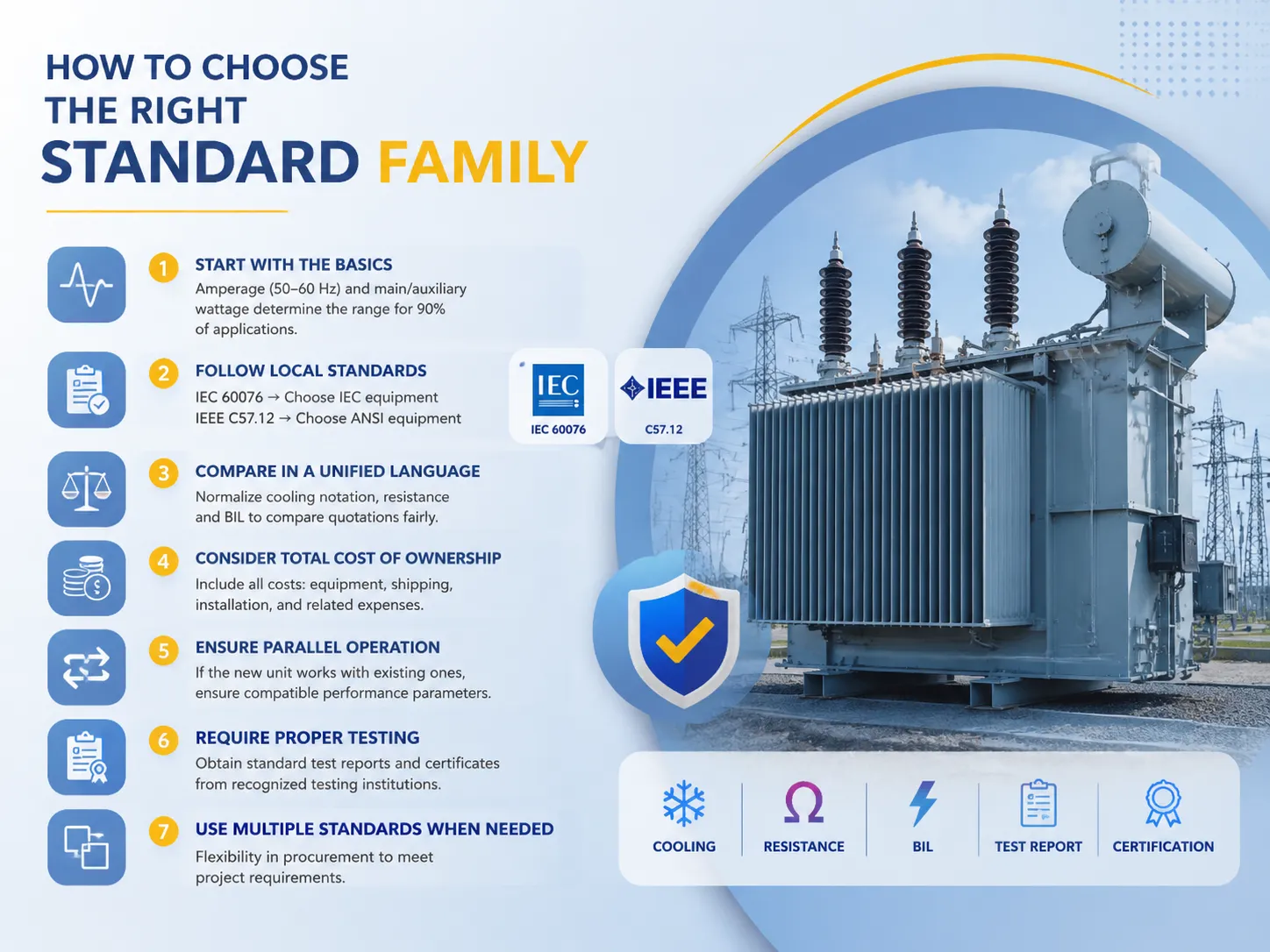
How to Choose the Right Standard Family
- Begin with the inception of the network. The amperage (50-60 Hz) and the main/auxiliary wattage at this location determines the range for 90% of subjects.
- Investigate the local principles. If the supplier or monitoring body follows the IEC 60076 standard then acquire the IEC equipment, however if they rely on the IEEE C57.12 then seek the ANSI products. Do not allow cheap options to dictate your decisions.
- Transform the details of the specifications in terms of cooling notation, resistance and BIL into a unified language in order to compare the quotations.
- Examine the total cost of purchase installation that covers all expenses: shipping and transportation of equipment, funds spent on installation.
- Make sure that parallel operation conditions are satisfied. If it’s important that a new unit works along with another one, be sure to have compatible performance parameters.
- Put forward the requirements connected with testing. You have to receive a standard test report and a certificate on testing conducted by the recognized institution if your project is especially significant.
- Use several standards for procurement if necessary.
よくある質問
Can a 50 Hz transformer be used on a 60 Hz grid?
Generally speaking, yes; however, you should verify with the manufacturer. At 60 Hz, the flux density declines by roughly 17% in comparison with the 50 Hz design point, which results in a decrease in no-load losses and magnetizing current. There is only a minor change in load-loss component and impedance; thus, the exact plate rating may not be fulfilled at 60 Hz. For a permanent installation, prefer a device manufactured for the actual grid frequency, rather than using one that is cross frequency capable.
Which standard is more common for international export projects?
IEC 60076 is the standard for most export projects in Europe, Africa, the Middle East, Southeast Asia, and Latin America, while ANSI/IEEE only applies to North America and some adjacent territories. If your buyer is an EPC contractor, you can expect to see IEC 60076-1, -2, -3, and -5 referenced in the specification.
Are American and European transformers physically interchangeable?
With some changes. The configurations of the bushing, the position of terminals, the fins of cooling units, the indications on nameplate, and the connections of the low-voltage panel differ from one way to another. In most cases, when placing the US equipment into an IEC station, the unit has to be adapted with bus bars and protection circuits should be rewired appropriately.
Does Subian manufacture transformers to both standards?
Certainly. Jiangsu Subian Electric Power uses IEC 60076 as its standard and carries out ANSI/IEEE practices (IEEE C57.12.00, C57.12.20) for all its 60 Hz project works, including ANSI voltage classes and OA/FA cooling type. The plant conducts standard tests in accordance with the appropriate test code and is in a position to offer witnessed or third-party examination of any type.
What is the typical price difference between ANSI and IEC versions of the same kVA rating?
Even for identical ratings, the price variance is typically in the range of 5-15%, which can be influenced more by the design of tanks, type of bushings, and scope of testing than by the standard itself. A transformer of the 1,000 kVA12.47 kV rating may thus price in the area of $12,000-28,000 with ANSI configuration and $11,000-26,000 with IEC configuration. Therefore, one should ask a manufacturer of both ANSI and IEC transformers to provide both quotes and compare the losses and accessories accordingly.
参考文献
- IEEE C57.12.00 — General Requirements for Liquid-Immersed Distribution, Power, and Regulating Transformers — the foundational American specification for rating and testing.
- IEC 60076-1 — Power Transformers: General — the umbrella standard of the IEC 60076 series used worldwide.
- IEC 60076-5 — Ability to Withstand Short Circuit — the IEC short-circuit verification standard referenced in export RFQs.
- NEMA TP-1 — Guide for Determining Energy Efficiency for Distribution Transformers — the US efficiency benchmark for loss evaluation.
- IEEE C57.12.20 — Standard for Overhead and Pad-Mounted Distribution Transformers — the construction standard for the most common American distribution units.
- IEC 60076-10 — Determination of Sound Levels — the IEC test standard for transformer noise, relevant for urban and industrial siting.
結論
Transformers in the United States and Europe are manufactured according to various principles, which means that there will be sizeable differences between them, such as frequency, voltage, cooling system, vector groups, and method of testing. The best way to finally make the correct purchase is to first determine the parameters of the electrical grid (for instance, frequency and input/output voltages, and standard according to which the unit is produced) and then convert offers from manufacturers into one format, comparing total costs and losses of the units instead of their prices alone.Share your system data with Subian through the official website to receive a specification-matched quotation in the standard family your project actually needs.