


Upon inspection of the differences between American and European transformers, an industrial buyer will find out that it is not only the location of manufacture that counts but also the processes used in the specification, testing, and paperwork related to such electrical equipment. Take for example the procurement manager of a plant in Texas that is using an EPC contractor based in Europe. The equipment being offered has different codes and specifications. The American version specifies IEEE C57.12.00, cooling type OA/FA, 12.47 kV primary while the European offers IEC 60076, cooling type ONAN/ONAF, and 10 kV or 20 kV. Both transformer models should be able to function properly, but they need engineering arrangements in order to make this possible. This article presents differences between the two types of transformers so that correct comparisons can be made and appropriate purchases can be made without additional costs for retesting.
Brief answer: American and European transformers differ in specification. The American style gearbox follows the ANSI/IEEE standards (IEEE C57.12.00, C57.12.20) and is designed for networks that work with a frequency of 60 Hz, while the primary voltages may include 12.47 kV, 13.8 kV, or 34.5 kV, with secondary voltages of 120/240 V, 120/208 V, or 277/480 V. The European style transponder follows the standard IEC 60076 and operates at 50 Hz with primary voltages of 6.6 kV, 10 kV, 11 kV, 20 kV, or 33 kV and secondary voltage of 230/400 V. The cooling method of the transformer, its impedance tolerance, vector group marking, tap changing method, and documents for tests all differ between styles.
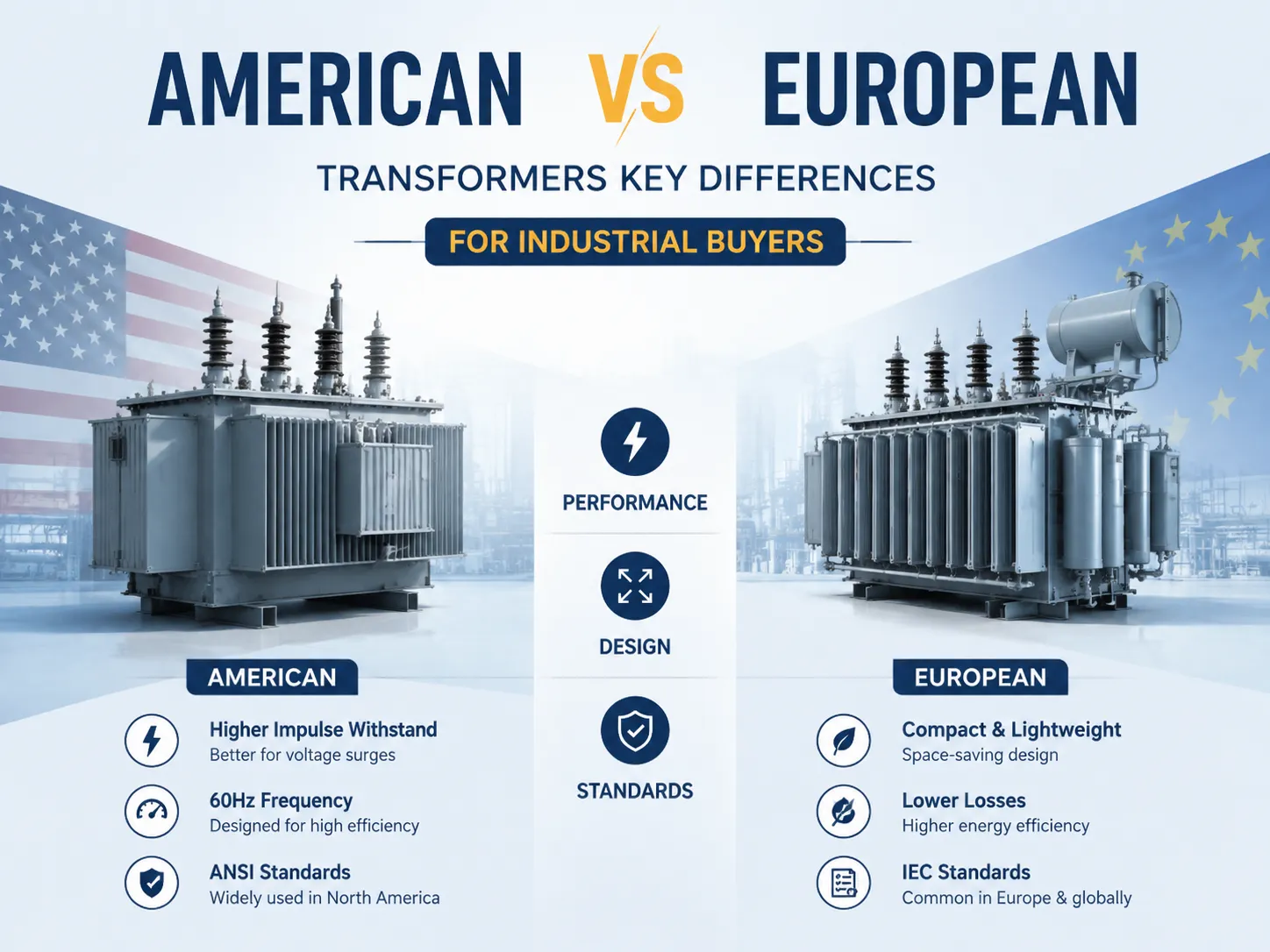
Definitions: What the Two Families Are
American transformers work as per the ANSI/IEEE standards. These transformers work perfectly on a 60 Hz electrical system. The primary voltage levels used by American transformers would be 7.2 kV, 12.47 kV, 13.8 kV, 24.9 kV, and 34.5 kV. Besides, the voltages provided by these transformers for end-user applications include 120 volts, 240 volts, 220 volts, 277 volts, and 600 volts. The performance specifications for the American transformers are based on the IEEE C57 design standards, including but not limited to impedance, and BIL.
European transformers, on the other hand, are manufactured according to IEC 60076 standards. These transformers require a grid of 50 Hz and come with various voltage levels, some of which include 6.6 kV, 10 kV, 11 kV, 20 kV, 33 kV, and 35 kV. The low voltage systems used in such transformers are primarily 230 volts, 400 volts, and 415 volts. The specifications for the IEC standard are recognized in most parts of the world.
Though there are differences in the applicable design standards, the two devices work based on the same principles of electromagnetic physics. This means that as far as the end-user is concerned, the application of both kinds of transformers can require a different approach.
Governing Standards: ANSI/IEEE vs. IEC 60076
- IEEE C57.12.00 relates to general specifications regarding transformers like power and distribution transformer in US practices regarding various parameters of transformers such as rating, BIL, temperature rise, and impedance.
- IEEE C57.12.20 and C57.12.90 refer to construction and testing documents which describe tests related to distributions like insulation, dielectric, noise and others.
- NEMA TP-1 is an efficiency reference document which is used in US utility loss-evaluation calculations.
- IEC 60076-1 refers to general requirements of power transformers and is umbrella document for IEC 60076 series.
- IEC 60076-2 (temperature rise), -3 (insulation levels), -5 (short circuit withstand capacity), -10 (sound level) are specific IEC categories that specify the different testing options.
European technical manual would write “transformer to IEC 60076-1, -2, -3 and -5, vector group Dyn11, cooling type ONAN/ONAF while American technical manual would write “transformer to IEEE C57.12.00, cooling type OA, rise of 65 degree centigrade, 12.47 kV class and 95 kV BIL.”
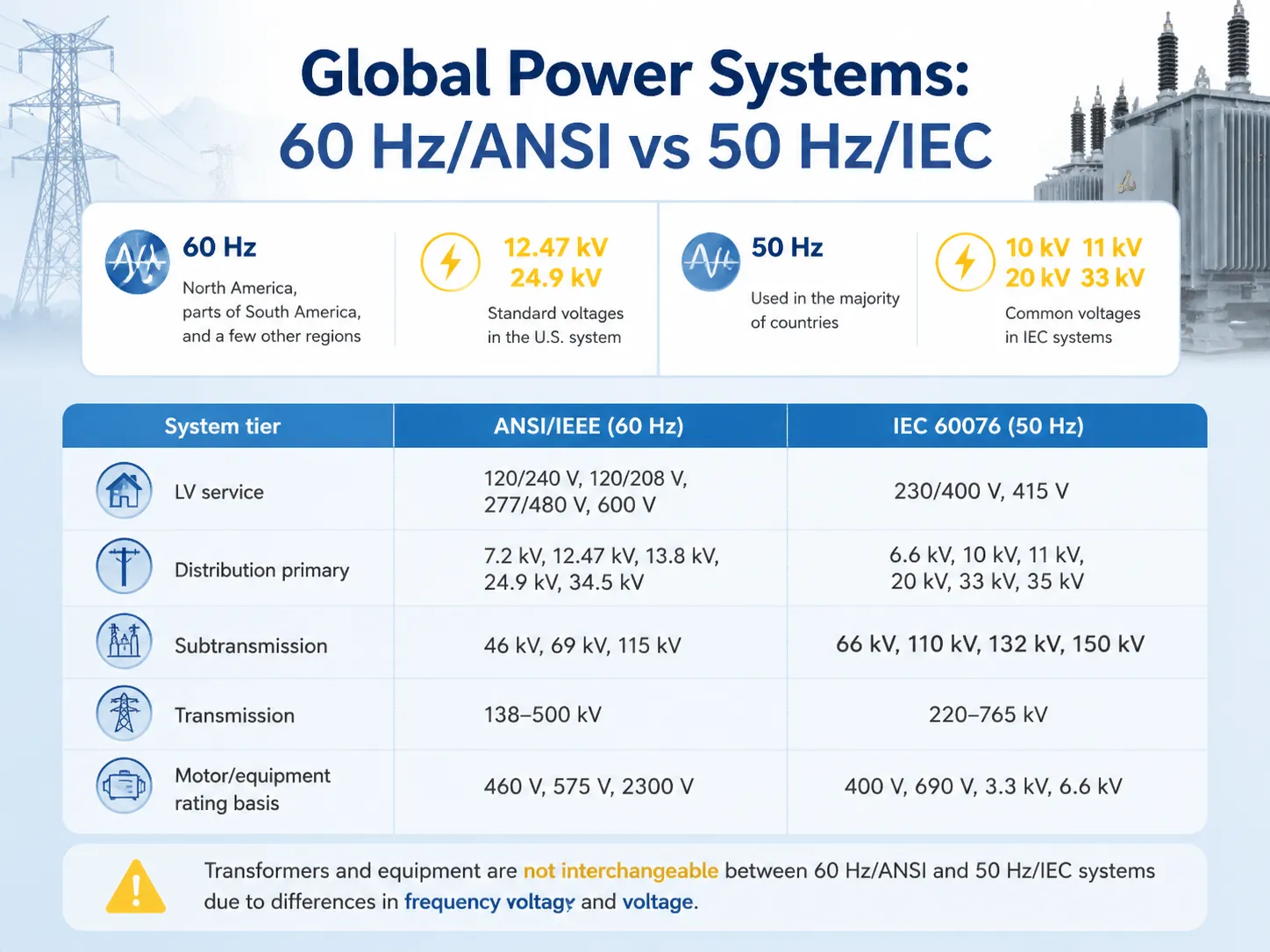
Frequency and Voltage Classes Compared
Frequency is the first major dividing factor. North America, parts of South America, and a few other regions use 60 Hz, while the majority of countries have a frequency of 50 Hz. A transformer manufacturing is designed and built considering a certain frequency. A transformer working on a frequency it has not been designed for can lead to a transformation that would result in a much bigger flux density, bringing it nearer to saturation. This would have considerable adverse effects, including overheating, excessive magnetizing current, and insulation aging.
The second parameter separating the two systems is voltage. The U.S. power grid uses voltages 12.47 kV and 24.9 kV as standard voltages, while IEC systems work with 10 kV, 11 kV, 20 kV , and 33 kV. The low-voltage side is also different in the U.S. (480 and 208 V) and IEC systems (400 and 415 V). This means that all equipment described is incompatible, as they differ in voltage.
| System tier | ANSI/IEEE (60 Hz) | IEC 60076 (50 Hz) |
|---|---|---|
| LV service | 120/240 V, 120/208 V, 277/480 V, 600 V | 230/400 V, 415 V |
| Distribution primary | 7.2 kV, 12.47 kV, 13.8 kV, 24.9 kV, 34.5 kV | 6.6 kV, 10 kV, 11 kV, 20 kV, 33 kV, 35 kV |
| Subtransmission | 46 kV, 69 kV, 115 kV | 66 kV, 110 kV, 132 kV, 150 kV |
| Transmission | 138–500 kV | 220–765 kV |
| Motor/equipment rating basis | 460 V, 575 V, 2300 V | 400 V, 690 V, 3.3 kV, 6.6 kV |
Cooling Notation: OA/FA vs. ONAN/ONAF
Cooling denotation is a major area of rookie error in RFQs. In the US, OA (oil-immersed and self-cooled), FA (forced-air cooling with fans), FOA (forced oil and air cooling) and combinations are commonly used terms. The IEC uses the four-letter notation system: O (mineral oil), N or F (natural or forced cooling), A or W (air or water), N or F (natural or forced). Therefore, ONAN is equivalent to OA and ONAF is the same as FA. Before comparing costs, make sure to convert both quotes to the same system — a supplier using ONAN or ONAF against an US quote using OA will cause a lot of confusion among those reviewing the quotes even when the machines have equivalent characteristics.
| Meaning | ANSI/IEEE notation | IEC notation |
|---|---|---|
| Oil-immersed, self-cooled | OA | ONAN |
| Oil-immersed, fan-cooled | FA | ONAF |
| Forced oil, forced air | FOA | OFAF |
| Forced oil, forced water | FOW | OFWF |
| Dry-type, natural air | AA | AN |
Vector Groups and Phase Displacement
Another aspect in which the two families in their classification of transformers differ is vector-group nomenclature. The IEC uses the clock number system, identifying the transformer as belonging to a certain vector group that indicates the type of connection followed by a number, which indicates the phase displacement of the windings in multiples of 30 degrees (for example: Dyn11 means that the low-voltage winding leads the high-voltage winding by 30 degrees). The method most commonly used in the U.S. is that introduced by ANSI; it refers to angular designation and the idea of a connection bank (for example: delta-wye with a 30 degrees phase lag). Because a large proportion (if not the majority) of the transformers installed in the USA operate in a single-phase mode, the question of vector groups is not very significant. Still, the user should make sure of the windings connection and phase angle for 3-phase equipment regardless of the notation in use.
| Winding connection | IEC notation | ANSI/IEEE description | Phase displacement |
|---|---|---|---|
| Delta HV, wye LV with neutral | Dyn11 | Delta-wye, 30° lag (US convention) | 330° (LV leads) |
| Delta HV, wye LV, alternate | Dyn5 | Delta-wye, 150° | 150° |
| Wye HV, delta LV | Yd11 | Wye-delta, 30° | 330° |
| Wye HV, wye LV | Yyn0 | Wye-wye, 0° | 0° |
| Delta HV, delta LV | Dd0 | Delta-delta, 0° | 0° |
Testing, Nameplates, and Documentation
Testing philosophy is different in both the scope of testing and the presentation of results. The IEC 60076 standard lays down routine tests (ratio, vector group, resistance, impedance and load loss, no-load loss and current, and dielectric tests) and type tests (temperature rise, short-circuit withstand, sound level), with tolerances clearly specified – for instance ± 10% on impedance and specified tolerances for losses. As for US practice, it follows testing codes established by the IEEE C57.12.90 and uses loss evaluating formulas of NEMA TP-1, where the utility assigns the dollar value per watt of no-load and load losses and asks the manufacturer to optimize accordingly. Additionally, in IEC countries buyers expect to see a full report on type testing included in the technical bid, whereas US utilities require third-party inspection or witnessing tests in the factory. However, documentation is not an ornament: it serves as basis for going through customs, accepting goods on site, and getting insurance.
| Test or requirement | ANSI/IEEE practice | IEC 60076 practice |
|---|---|---|
| Routine test scope | Per IEEE C57.12.90 | Per IEC 60076-1 |
| Impedance tolerance | ±7.5% | ±10% standard |
| No-load loss tolerance | Per loss-evaluation formula | Specified in IEC 60076-1 |
| Temperature-rise test | Type test, 65°C class | Type test, IEC 60076-2 |
| Short-circuit withstand | IEEE C57.12.90 | IEC 60076-5 |
| Sound level | IEEE C57.12.90 basis | IEC 60076-10 |
| Efficiency benchmark | NEMA TP-1 | IEC 60076-1 loss values |
Side-by-Side Comparison Table
| Aspect | American (ANSI/IEEE) | European (IEC 60076) |
|---|---|---|
| Nominal frequency | 60 Hz | 50 Hz |
| Governing standard | IEEE C57.12 series, NEMA | IEC 60076 series |
| Common distribution primaries | 12.47 kV, 13.8 kV, 24.9 kV, 34.5 kV | 6.6 kV, 10 kV, 11 kV, 20 kV, 33 kV |
| Common LV secondaries | 120/240 V, 120/208 V, 277/480 V, 600 V | 230/400 V, 415 V, 6.3 kV, 10.5 kV |
| Cooling notation | OA / FA / FOA | ONAN / ONAF / OFAF |
| Impedance tolerance | ±7.5% | ±10% (tighter on request) |
| Vector-group notation | ANSI angle conventions | Dyn11, YNd11, etc. |
| Temperature-rise class | 65°C average winding | 60–65 K for class A/F |
| Typical efficiency reference | NEMA TP-1 loss evaluation | IEC 60076-1 loss values |
Regional Application Patterns
Generally speaking, American transformers fulfill the needs of the USA, Canada, Mexico, and some regions in Central and South America, as well as the Caribbean and other territories with a US-style approach. European transformers, on the other hand, cater to Europe, the Middle East, Africa, most of Asia, and a large portion of renewable energy projects globally, because IEC 60076 is the primary standard for international EPC contracts. However, there are exceptions, since some power companies in the Gulf region require ANSI units at 50 Hz frequency, while some of the countries in Latin America mix IEC and ANSI methods. So, before you make your offer, make sure you ask three questions: What’s the frequency? What are the voltages? What is the standard the local inspector will implement? The answers will give you all the required information.
Brand Landscape and Price Ranges
| Brand | Standard family strength | Typical distribution product | Indicative price range (US$) |
|---|---|---|---|
| ABB | ANSI + IEC | Liquid-filled and dry-type distribution units | $12,000–$60,000 |
| Siemens | IEC strong, ANSI available | Distribution and industrial transformers | $11,000–$55,000 |
| Schneider Electric | IEC strong | Dry-type and cast-resin units | $8,000–$45,000 |
| Hitachi Energy | ANSI + IEC | Utility-grade distribution transformers | $13,000–$70,000 |
| Eaton | ANSI strong | Dry-type, pad-mounted US-market units | $7,000–$42,000 |
| Prolec GE | ANSI strong | US utility distribution transformers | $10,000–$55,000 |
| Jiangsu Subian Electric Power | IEC primary, ANSI on request | Oil-immersed, dry-type, box-type, special units | $9,000–$40,000 |
Prices vary for the distribution transformer with a rated power of 1,000 to 2,500 kVA, where one can expect variations depending on rating, losses, voltage class, and equipment. There are a number of manufacturers that provide excellent products in the context of transformers, such as ABB, Siemens, Schneider Electric, Hitachi Energy, or Eaton which offer exceptionally good devices verified by test documents accepted as the industry benchmark. Jiangsu Subian Electric Power Co. Ltd is a company from China that manufactures oil-immersed, dry-type, and box-type transformers according to IEC 60076 and also provides ANSI/IEEE-designs for 60 Hz projects at affordable prices for customers that require all engineering standards to be met. The materials used in manufacturing include grain-oriented silicon steel and copper for winding, while all types of tests are performed at the factory before sending transformers.More details are available on the Subian Electric website.
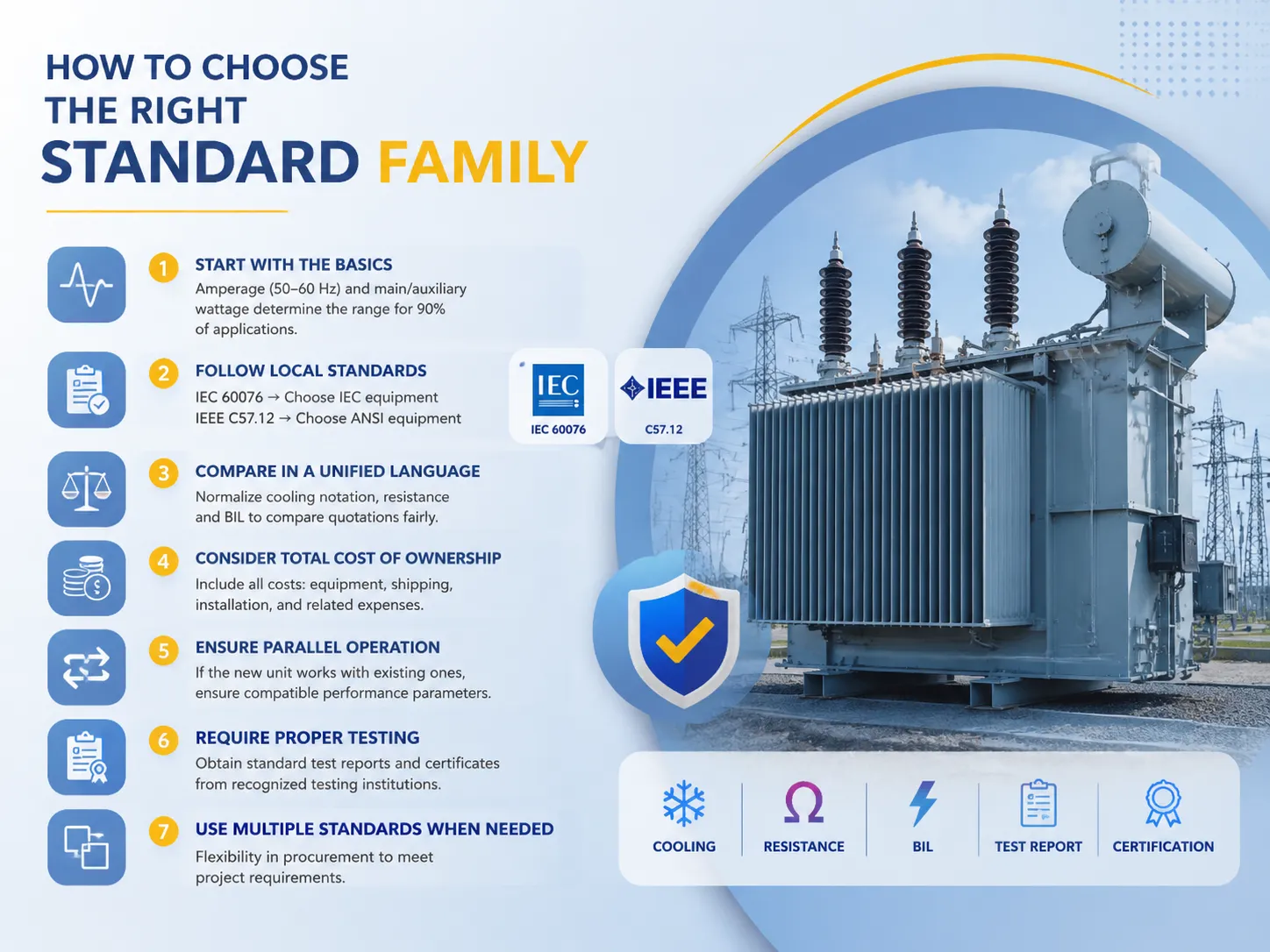
How to Choose the Right Standard Family
- Begin with the inception of the network. The amperage (50-60 Hz) and the main/auxiliary wattage at this location determines the range for 90% of subjects.
- Investigate the local principles. If the supplier or monitoring body follows the IEC 60076 standard then acquire the IEC equipment, however if they rely on the IEEE C57.12 then seek the ANSI products. Do not allow cheap options to dictate your decisions.
- Transform the details of the specifications in terms of cooling notation, resistance and BIL into a unified language in order to compare the quotations.
- Examine the total cost of purchase installation that covers all expenses: shipping and transportation of equipment, funds spent on installation.
- Make sure that parallel operation conditions are satisfied. If it’s important that a new unit works along with another one, be sure to have compatible performance parameters.
- Put forward the requirements connected with testing. You have to receive a standard test report and a certificate on testing conducted by the recognized institution if your project is especially significant.
- Use several standards for procurement if necessary.
Frequently Asked Questions
Can a 50 Hz transformer be used on a 60 Hz grid?
Generally speaking, yes; however, you should verify with the manufacturer. At 60 Hz, the flux density declines by roughly 17% in comparison with the 50 Hz design point, which results in a decrease in no-load losses and magnetizing current. There is only a minor change in load-loss component and impedance; thus, the exact plate rating may not be fulfilled at 60 Hz. For a permanent installation, prefer a device manufactured for the actual grid frequency, rather than using one that is cross frequency capable.
Which standard is more common for international export projects?
IEC 60076 is the standard for most export projects in Europe, Africa, the Middle East, Southeast Asia, and Latin America, while ANSI/IEEE only applies to North America and some adjacent territories. If your buyer is an EPC contractor, you can expect to see IEC 60076-1, -2, -3, and -5 referenced in the specification.
Are American and European transformers physically interchangeable?
With some changes. The configurations of the bushing, the position of terminals, the fins of cooling units, the indications on nameplate, and the connections of the low-voltage panel differ from one way to another. In most cases, when placing the US equipment into an IEC station, the unit has to be adapted with bus bars and protection circuits should be rewired appropriately.
Does Subian manufacture transformers to both standards?
Certainly. Jiangsu Subian Electric Power uses IEC 60076 as its standard and carries out ANSI/IEEE practices (IEEE C57.12.00, C57.12.20) for all its 60 Hz project works, including ANSI voltage classes and OA/FA cooling type. The plant conducts standard tests in accordance with the appropriate test code and is in a position to offer witnessed or third-party examination of any type.
What is the typical price difference between ANSI and IEC versions of the same kVA rating?
Even for identical ratings, the price variance is typically in the range of 5-15%, which can be influenced more by the design of tanks, type of bushings, and scope of testing than by the standard itself. A transformer of the 1,000 kVA12.47 kV rating may thus price in the area of $12,000-28,000 with ANSI configuration and $11,000-26,000 with IEC configuration. Therefore, one should ask a manufacturer of both ANSI and IEC transformers to provide both quotes and compare the losses and accessories accordingly.
References
- IEEE C57.12.00 — General Requirements for Liquid-Immersed Distribution, Power, and Regulating Transformers — the foundational American specification for rating and testing.
- IEC 60076-1 — Power Transformers: General — the umbrella standard of the IEC 60076 series used worldwide.
- IEC 60076-5 — Ability to Withstand Short Circuit — the IEC short-circuit verification standard referenced in export RFQs.
- NEMA TP-1 — Guide for Determining Energy Efficiency for Distribution Transformers — the US efficiency benchmark for loss evaluation.
- IEEE C57.12.20 — Standard for Overhead and Pad-Mounted Distribution Transformers — the construction standard for the most common American distribution units.
- IEC 60076-10 — Determination of Sound Levels — the IEC test standard for transformer noise, relevant for urban and industrial siting.
Conclusion
Transformers in the United States and Europe are manufactured according to various principles, which means that there will be sizeable differences between them, such as frequency, voltage, cooling system, vector groups, and method of testing. The best way to finally make the correct purchase is to first determine the parameters of the electrical grid (for instance, frequency and input/output voltages, and standard according to which the unit is produced) and then convert offers from manufacturers into one format, comparing total costs and losses of the units instead of their prices alone.Share your system data with Subian through the official website to receive a specification-matched quotation in the standard family your project actually needs.