


One of the utilities in the northern part of Vietnam is in the process of changing its old substation transformer, which is 25-year-old and has a capacity of 25 MVA. This is the fifth time in a year that an alarm has been raised due to dissolved gases and the grid operator is preparing complaints regarding the low voltage levels. In addition, the budget for the replacement has been revised two times already. Every engineer on the team knows the same thing: choosing the right substation transformer is not a paperwork exercise, it is the decision that decides whether their district loses power in the next typhoon season.
This publication outlines the significance of choosing the right transformer for a substation and how to make the right decision. It analyzes the issues connected with poor transformer selection from the technical and economic perspectives, the indications of appropriate transformer, the differences between types of substations and transformer prices, as well as the purchasing process that electric power and developers undergo to find the right transformer.Info on transformer theory which would help make a right decision. 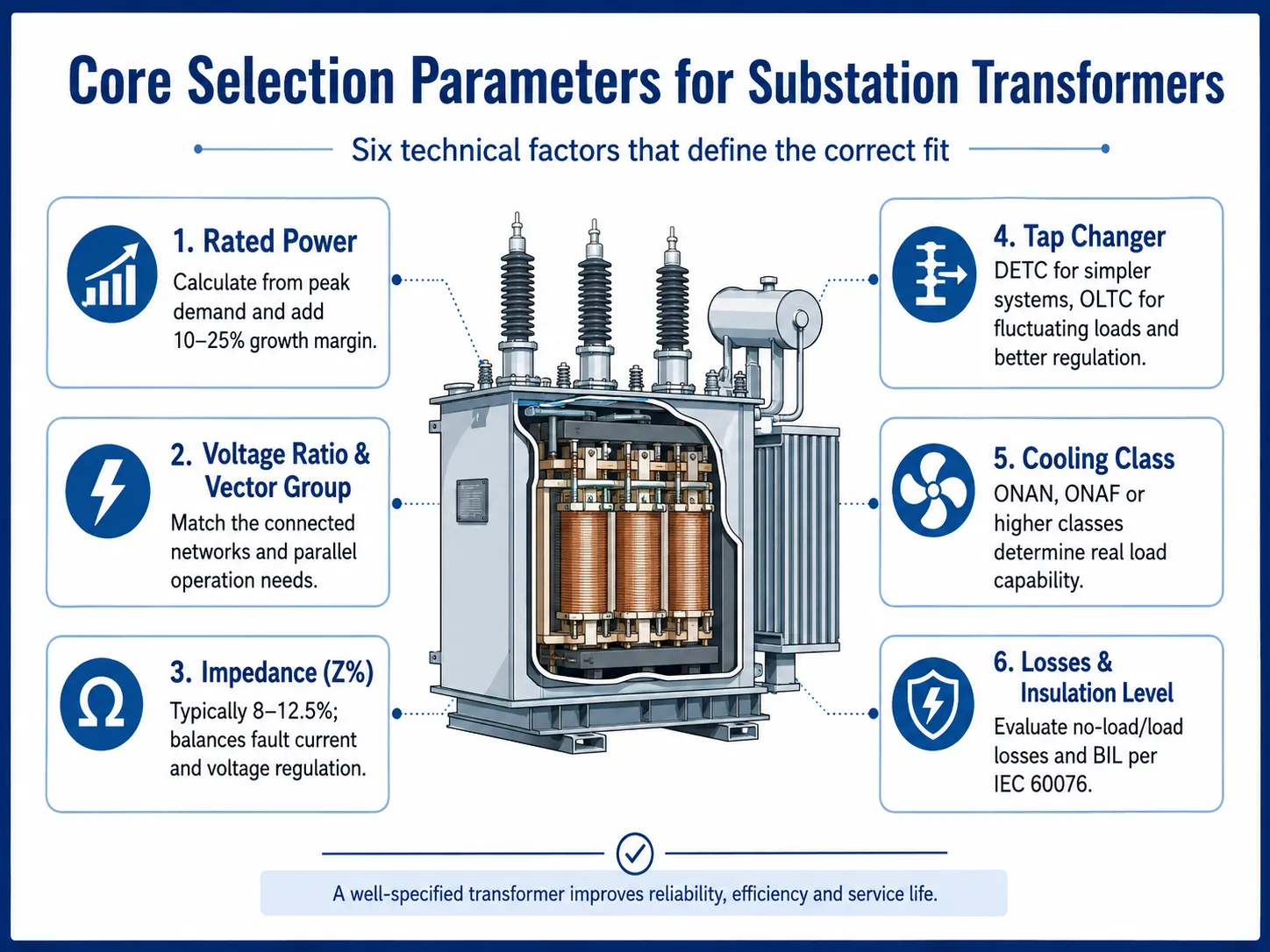
Why the Substation Transformer Is the Critical Asset
Though a typical distribution substation consists of breakers, disconnectors, protection relays, metering, and busbars, the main purpose of the substation is fulfilled by the transformer. It provides the necessary voltage transformation to interconnect two networks and is usually the most expensive component in the bill of materials, which accounts for about 20–40 percent of the total cost of the equipment. This equipment is designed and manufactured per order, so its manufacture takes about 3–9 months, which makes it the determinant of the overall construction schedule.
The operation of the transformer is equally significant. It must support the entire substation load with losses that make it possible to minimize the operating costs, ensure stable voltage within the limits set by the grid code, and withstand all the fault currents of the system. When engineers say that the quality of the substation depends on the transformer, they mean it very seriously, as every possibility of increasing the reliability of the grid due to the use of various devices, starting with reclosers and ending with smart meters, depends on the transformer only.
The Real Cost of Choosing the Wrong Transformer
When one selects a substation transformer incorrectly, it incurs costs in three stages. To start, at the time of commissioning, a transformer that is too small can overheat in summer and cause the protective device to trip, leading to immediate procurement of an emergency transformer. Over its lifetime, it incurs the cost of operating a transformer which experiences higher losses and requires additional electricity costing utility companies anywhere from $10,000 to $60,000 in the form of electricity loss. Furthermore, during a malfunction, according to the studies provided by IEEE and CIGRÉ, yearly failure rates amount to 0.5%–2% for distribution transformers and even lower for larger power ones, while cost of interruptions varies from $50,000 to $2 million depending on time when transformer fails and how much power it is rated for.
An additional cost associated with the wrong selection is a hidden capacity cost. In most cases, power companies design substations for a horizon of 20–30 years and assume an annual load increase of 2%–5% in newly developed electric grids. A transformer designed with the current load in mind becomes a bottleneck requiring further investments in order to fully use the transformer, in this case at least twice the expenses of the first shipment, as the replacement of the busbar scheme and the foundation of the substation is also required.
Core Selection Parameters for Substation Transformers
The selection of a transformer begins with the same set of parameters. You should go through the following items before you ask for quotations:
Rated power (kVA/MVA). It can be calculated based on the peak demand for the area, including a 10–25% margin. Substation of 33/11 kV for 8,000 customers usually requires a transformer of about 10–20 MVA; a transmission substation may require 100–300 MVA.
Voltage ratio and vector group. Primary and secondary voltage levels and direction shift, that is, whether it is Dyn11 or YNd1, should be suitable for the networks that are going to be connected.
Impedance. In general transformer impedances equal 8–12.5%. Impedance allows controlling short-circuit current and voltage drop; if it is too small, it may result in damage to switchgears; if it is too big, it may lead to poor voltage regulation.
Tap changer. Normally, distribution substations require the use of off-circuit taps about ±2×2.5% and transmission substations typically consume on-load tap changer (-8×1.25% or ±9×1.78% according to IEC 60214)
Cooling class. ONAN for bottom rating, ONAF for increasing capacity by 20–33% with fans, ODAF/OFAF for the biggest units.
Insulation level (BIL). The insulation level should be matched with the expected exposure to lightning as well as with the voltage of the system. For instance, the 33 kV transformer may require the insulation level (BIL) of about 170–200 kV according to IEC 60076-3.
Losses. Are usually calculated in terms of no-load and load losses.
Substation Transformer Types and Configurations
Substation transformers come in configurations matched to network function. The table below compares the main types buyers will encounter:
| Type | Typical Rating | Application | Distinct Feature |
|---|---|---|---|
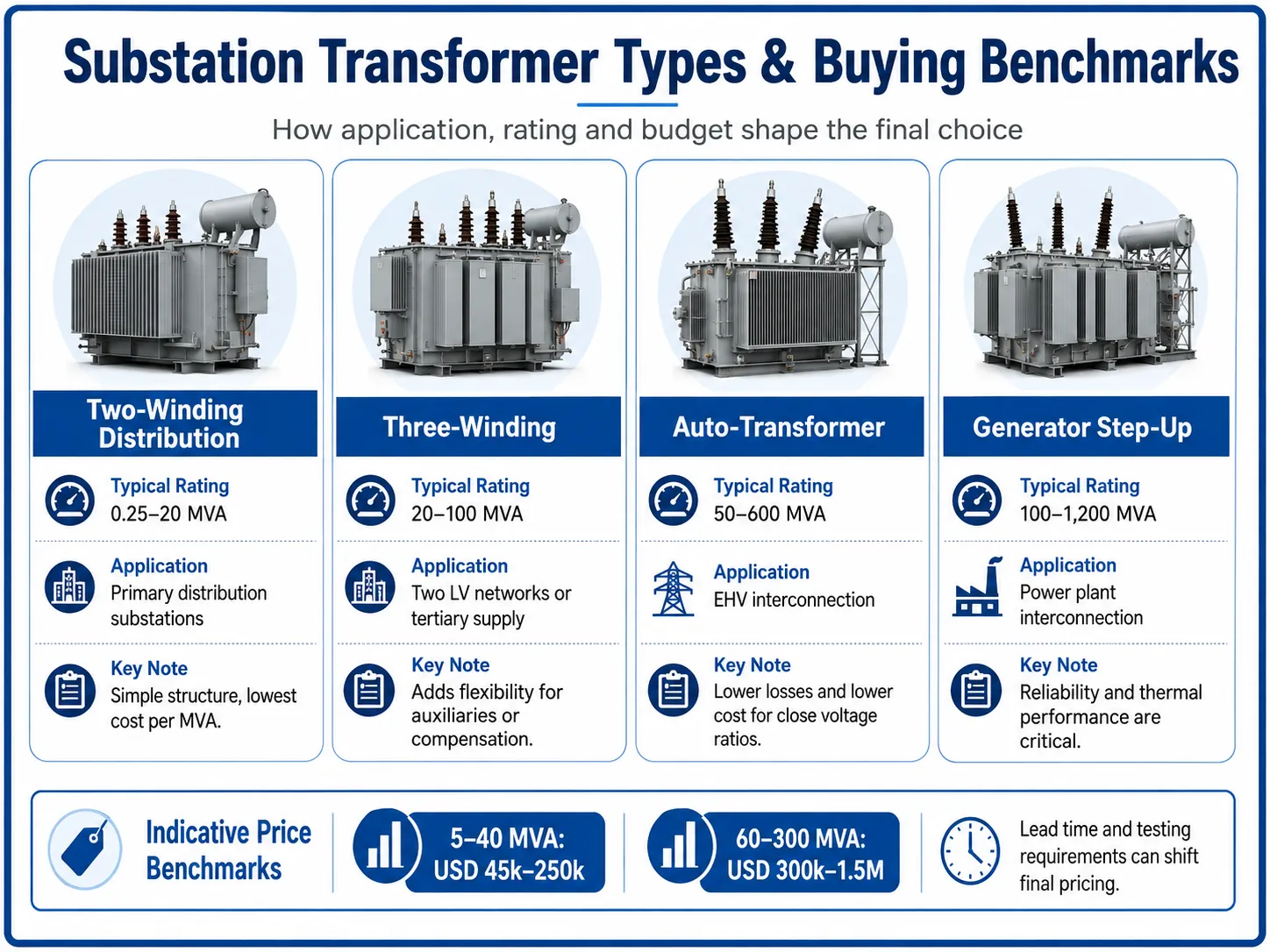
| Two-winding distribution transformer | 0.25–20 MVA | Primary distribution substations | Simple, lowest cost per MVA |
| Three-winding transformer | 20–100 MVA | Supplying two LV networks or a tertiary | Third winding for auxiliaries/compensation |
| Auto-transformer | 50–600 MVA | Interconnection of EHV networks (e.g. 220/110 kV) | Single winding, lower losses and cost |
| Phase-shifting transformer | Custom | Flow control in meshed networks | OLTC controls active power flow |
| Generator step-up transformer | 100–1,200 MVA | Power plant interconnection | Highest reliability, often delta-connected LV |
| Earthing (neutral) transformer | Up to 2 MVA | Providing a neutral for LV networks | Zig-zag winding, short-time duty |
Typically, buyers opt to buy either a two-winding transformer having an OLTC or a simple distribution transformer that has off-circuit taps. If the voltage variation in your system is equal to or exceeds ±5 percent or if you are going to face large load fluctuations between peaks and valleys, you should consider opting for an OLTC, which costs 20–40 percent more than a regular fixed-tap transformer of the same rating.
Match the configuration to your actual application:
| Application | Recommended Configuration | Typical Rating | Key Selection Driver |
|---|---|---|---|
| Rural distribution | Two-winding, ONAN, DETC | 0.5–5 MVA | Lowest first cost |
| Urban distribution | Two-winding, ONAN/ONAF, OLTC | 10–40 MVA | Voltage regulation |
| Transmission interconnection | Auto-transformer | 50–300 MVA | Low losses at EHV |
| Renewable plant step-up | Two-winding, OLTC | 10–60 MVA | Variable generation profile |
| Power plant interconnection | Generator step-up | 100–1,200 MVA | Reliability above all |
Cooling Systems and Load Capability
The loading of substation transformers is determined by the cooling system in place, and the way the cooling system is designed determines the extent to which the rated capacity can be utilized. According to the cooling classes outlined in IEC 60076-2, O stands for mineral oil, N stands for natural convection, A for air, F represents forced and W denotes water.
| Cooling Class | Mechanism | Typical Capacity Multiplier vs ONAN | When Used |
|---|---|---|---|
| ONAN | Natural oil, natural air | 1.0 (base) | Most distribution substation transformers |
| ONAF | Natural oil, forced air (fans) | 1.2–1.33 | Peak-load substations with summer demand |
| OFAF | Forced oil, forced air | 1.4–1.6 | Large power transformers with OLTC |
| ODAF / ODWF | Directed oil flow, air/water | 1.6–2.0 | Very large units, power plants |
The practical effect is that a transformer that has a capacity of 20 MVA and is rated ONAN/ONAF 20/27 MVA is capable of carrying loads of 27 MVA when fans are operational, but fan service requires additional maintenance and causes noise. Coupling the loading guidelines from IEC 60076-7 with this rating will allow for better planning of cyclic and emergency loading, so that there is no dependence on fans when it comes to base loads. Furthermore, the allowable temperature rise limits (65 K for oil and 78 K for OA class windings) must be checked against the ambient temperatures of the site to ensure that suitable margins are allowed.
Tap Changers and Voltage Regulation
The primary function of a transformer in a substation is voltage regulation. There are two types of technologies available and one must make the right choice, since tap changers have been identified as the main cause for transformer malfunctions in five years of operation.
Off-circuit tap changer (DETC): manually operated taps, typically ±2×2.5 percent or ±5×1.6 percent that can be operated only if the transformer is switched off. Low price, reliability and appropriateness where the line voltage remains stable.
On-load tap changer (OLTC): automatic taps, typically ±8×1.25 percent or ±9×1.78 percent per IEC 60214, that can be operated while the transformer is energized. Although it raises the price of the transformer by about 8 to 15 percent and requires oil maintenance, it is able to keep transformer output voltage regulated at ±2 to 3 percent under the changing load.
A good rule of thumb is to use OLTC if the line voltage changes more than 5 percent over a day or in case of variable industrial load served by the substation. OLTC maintenance involves oil filtration every 3–6 years, contacts inspection and actuator testing, so make sure to include it in your O&M plan.
Losses, Efficiency, and Life-Cycle Economics
Losses from substation transformers are a normal expense that must be paid for the entire operations of such devices. For a 20 MVA transformer with usual losses equal to 15-30 kW no-load losses and 90-150 kW load losses, the annual cost of losses at $0.10-0.14/kWh with 70-80% average loading will compose approximately $60,000 – $180,000. This sum is enough to cover the cost of the transformer in the first years after its purchase within its 30-year life span.
Therefore, utilities make their buying decisions based on total evaluated cost (TEC), applying capitalized loss factors. European and Asian utilities usually calculate their no-load loss at $2,500-$7,000/kW and load loss at $500-$1,500/kW. A 10 kW difference in no-load loss means that the associated cost for the buyer will be up to $25,000 – $70,000. Therefore, a buyer who determines price per MVA does not take losses into account gives its money away to utility for thirty years.
Specification Table for a Typical Substation Transformer
The table below is a representative specification envelope for a 10 MVA 33/11 kV distribution substation transformer. Use it as a starting point and adjust for your grid code and load.
| Parameter | Typical Specification |
|---|---|
| Rated power | 10 MVA (ONAN), 12.5 MVA (ONAF optional) |
| Voltage ratio | 33 ± 2×2.5% / 11 kV |
| Vector group | YNd11 or Dyn11, 50 Hz |
| Impedance voltage | 9–10.5% at rated current |
| Cooling class | ONAN / ONAF |
| No-load loss | ≤ 12–20 kW |
| Load loss (75°C) | ≤ 75–110 kW |
| Insulation level | HV 170 kV BIL, LV 75 kV BIL |
| Temperature rise | 65 K oil / 78 K winding (OA) |
| Noise level | ≤ 70–75 dB(A) at 1 m |
| Accessories | Conservator, Buchholz relay, silica-gel breather, OLTC or DETC |
| Standard | IEC 60076-1/-2/-3/-5 |
Brand Comparison and Price Benchmarks
The price of substation transformers is determined by rating, losses, tap changer and testing. The given ranges are typical for 10 MVA and 100 MVA units, FOB, and differ according to copper and oil markets, specification and negotiations.
| Brand / Manufacturer | Origin | 10 MVA 33/11 kV | 100 MVA 220/110 kV | Lead Time | Strength |
|---|---|---|---|---|---|
| Hitachi Energy | Switzerland/Japan | $190,000–$340,000 | $1.2M–$2.0M | 28–44 weeks | EHV and HVDC expertise |
| ABB | Switzerland | $180,000–$320,000 | $1.1M–$1.9M | 26–40 weeks | Global service footprint |
| Siemens Energy | Germany | $200,000–$350,000 | $1.2M–$2.1M | 28–42 weeks | Digital monitoring solutions |
| Schneider Electric | France | $170,000–$310,000 | — | 24–38 weeks | MV/LV package competence |
| Korean majors (Hyundai, ILJIN) | South Korea | $150,000–$280,000 | $900K–$1.6M | 24–36 weeks | Strong test labs and export record |
| Chinese OEMs (TBEA, Baoding Tianwei) | China | $90,000–$180,000 | $600K–$1.1M | 16–28 weeks | Capacity, cost, IEC certified |
| Mid-tier Chinese exporters (e.g. Jiangsu Subian Electric Power) | China | $80,000–$150,000 | — | 14–24 weeks | Custom engineering, FAT support, shorter queues |
The appropriate brand depends on the importance of the asset. In case EHV transformers are concerned, the past experience and service organization of Hitachi Energy, ABB, or Siemens Energy are understandable given the high prices of these brands. Nevertheless, in the case of distribution transformers with the capacity from 5 to 40 MVA, the market is mostly presented by mid-market manufacturers, whose products fully comply with IEC 60076 standards and are offered at a 20-40% lower price and with supply terms shorter. An example of Chinese middle-range producer is Jiangsu Subian Electric Power; this company is a manufacturer of IEC 60076 compliant transformers operating in distribution and/or power transformer segment up to 110 kV; the company invites clients to observe tests conducted at its factory; the company is making exports to power companies and developers in Asia, Africa, the Middle East and Latin America. Regarding the substation project of 10MVA class, Jiangsu Subian is capable of providing an engineer with the reliable technical background and needed speed of delivery.
Procurement, Testing, and Delivery Considerations
Because substation transformers are original, the same process has to be applied while procuring them. By applying practical rules you can ensure your project is safe:
Us an RFQ with a full technical schedule specifying the IEC 60076-1/-2/-3/-5 and your grid code; also, request compliance statement.
Request type-test report for temperature rise, lightning impulse, and short-circuit withstand from accredited or witnessed testing program.
Agree the FAT protocol and witness the first unit; $2,000–$8,000 will be spent for this trip although it is cheap compared to a failed delivery.
Identify transportation risks. For units above approximately 30 tons, conduct route survey, create transport drawings, and install vibration monitoring.
State warranty terms for 24–60 months from commissioning and provide availability of spare parts for bushings, OLTC, and gaskets.
Frequently Asked Questions
How is the size of a substation transformer determined?
The demand forecast for peak consumption governs the substation’s size. Utilities usually assess peak consumption first, then estimate how much peak consumption will grow at the rate of about 2 to 5 percent per annum over a 10- to 20-year period, allow additional peak consumption by adding a 10-25 percent allowance, and finally choose the most appropriate standard rating. For example, for a 33/11 kV primary substation, this would generally fall in the range of between 5 and 40 MVA depending on the density of the customer base.
What does a 10 MVA substation transformer cost?
The price of a 10 MVA 33/11 kV oil-immersed transformer which has an ONAN/ONAF cooling system with an on-load tap changer can cost between $90,000 and $280,000 FOB. The price of a similar transformer from Chinese suppliers is 在80,000 and $150,000, from Korean manufacturers is from$150,000 to $280,000, and from European brands is $180,000 to $350,000. Adding 5-15 percent logistic costs such as shipping and insurance, one should expect a lead time of 14 to 32 weeks.
Why is impedance voltage important in substation transformer selection?
Impedance voltage determines both the short-circuit current the substation switchgear must withstand and the voltage drop across the transformer at full load. Values of 8–12.5 percent are typical for power transformers. Matching impedance also allows transformers to share load correctly when operated in parallel.
How long does a well-maintained substation transformer last?
By properly maintaining equipment as far as oil management and DGA survey it is expected for a substation transformer to last 30-40 years, with many of them even functioning for over 50 years. Insulation aging follows the Arrhenius rule, meaning that for each 6 – 8 K in constant elevated hotspot temperature above the rated temperature the insulation life decreases by approximately half, which shows the importance of thermal design and loading regime.
Is an on-load tap changer worth the extra cost?
Typically for substations that receive uneven loads or weak grid connections. An OLTC adds 8–15 percent to the cost of a transformer but keeps the voltage within a range of ±2–3 percent automatically that helps to avoid voltage issues, motor failures, and failures of equipment downstream. For strong networks, an off-circuit tap changer with ±2×2.5 percent will work well and requires less maintenance.
References
- IEC 60076-1: Power Transformers — General — Governing standard for rating, voltages, and losses.
- IEC 60076-7: Loading Guide for Oil-Immersed Power Transformers — The authoritative reference for cyclic and emergency loading capability.
- IEC 60214: Tap-Changers — Defines on-load and off-circuit tap-changer requirements and duty.
- IEEE — Publishes C57 series standards and transformer reliability survey data used across the industry.
- CIGRÉ — Produces technical brochures on transformer failure statistics and asset management practices.
- NEMA — North American guidance on transformer application, efficiency, and safety.
- Jiangsu Subian Electric Power — IEC 60076-compliant transformer manufacturer serving substation projects worldwide.
Conclusion
The transformer used in a substation determines the system’s capacity, reliability, and operating costs. In this case, it is important to make the right choice rather than just looking for a good price. First, it is necessary to establish the capacity according to the expected demand with a margin for growth. The next step includes choosing the impedance and vector type. Then, it is necessary to choose a type of tap changer and cooling classes according to the load profile.
The specified capacity should be calculated according to the demand with 10-25 percent of growth margin, and rounded to a standard capacity.
An OLTC should be chosen if the voltage at the feeder varies more than plus/minus 5 percent.
The cooling class and temperature rise limits should correspond to the climate of the selected site.
The losses should be estimated at the level of $2,500-7,000 per kW with no load and $500-1,500 with the load.
The type tests should be checked and the factory acceptance test should be agreed, also a warranty period should be set from 24 to 60 months in written form.
When you are ready to source, Jiangsu Subian Electric Power builds IEC 60076-certified substation transformers up to 110 kV with engineering support and short lead times. Share your load forecast and network data via subian-electric.com for a specification-matched quotation.